1583: Elisabeth Plainacher, Vienna’s only witchcraft execution

The city of Vienna only has one documented execution for witchcraft to its illustrious history. It occurred on this date in 1583.

Elisabeth Plainacher (English Wikipedia entry | German) was a miller’s daughter from Mank who had lived most of her 70 or so years during the Protestant Reformation and the Catholic Counter-Reformation, that social conflict so productive of witchcraft accusations.

It would factor very specifically in Elsa’s case, since she herself was a Protestant in a very Catholic place.

Elsa’s daughter Margaret died in childbirth, and Elsa took all four of the surviving children into her own care while Margaret’s widower went his own way. Three of these children would die in her care; the fourth became an epileptic in her teens, finally leading Margaret’s (Catholic) former husband to accuse his mother-in-law of bewitching everybody.

The accusation was ill-timed for the “witch”: Jesuit zealot Georg Scherer got hold of the case and put the epileptic teenager through a gantlet of exorcisms that he claimed expunged 12,652 infernal spirits. Scherer’s accounting must have been as rigorous as his faith.

“Scholars and men of understanding know that devils have neither flesh nor limbs, but are spirits, and therefore need no place or space as do our bodies,” Scherer later wrote by way of explaining the crowded tenancy. “A hundred thousand legions of spirits could all be collected together on the point of a needle.” Scherer preached, and later published, a sermon this holy combat, titled “A Christian remembrance of the most recent deliverance of a young woman who was possessed by 12,652 devils.”

This was a relentlessness which Elsa Plainacher was not formed to resist. She was a humble miller with some family drama, and then suddenly she was under torture (German link) in the imperial capital with the day’s headline pulpit-basher at her throat. She soon admitted whatever devilries her torturers demanded of her: giving the epileptic over to the devil, desecrating the Host, all that sort of thing.

On September 27, 1583, she was drug by a horse to an open field where she was burned at the stake. Her ashes were consigned to the Danube. Plainacherin even persisted (more German) in the local vernacular for a time as a dirty word.

Posterity’s apology for this horrible fate comes in the form of a small Vienna street, Elsa-Plainacher-Gasse, named after her. (There’s also a Plainachergasse in her native Mank.)

On this day..

1803: Joseph Samuel survives three hangings

On this date in 1803, Joseph Samuel just wouldn’t hang.

Transported to Australia in 1801 for theft, Joseph Samuel was part of a cohort of Sydney Cove convicts who, on the night of August 25-26, burgled a house.

The band was surprised by constable Joseph Luker, himself a former convict. One or more of the thieves battered him to death on the spot with whatever was at hand: recovered with Luker’s broken body at morning’s light were a bloodied wheelbarrow wheel, and the hilt of Luker’s own cutlass, buried in his brains. Luker was the first policeman killed on duty in Australia, and his name can be found on the country’s National Police Memorial.

But the order of the day in 1803 was a different sort of memorial. “Avenging Heaven directs the Hand of Justice, and the Manes of the Deceased inspires us with Indignation and Resentment,” the Sydney Gazette fulminated. The need to cut a deal for crown’s evidence with one of Samuel’s compatriots eventually meant that Samuel was the only one to bear the vengeance of Luker’s Manes. (A third man, Isaac Simmonds, was acquitted at trial, but he was so heavily suspected that he was made to attend the execution.)

We’ll pick up the narration of the Sydney Gazette (Oct. 2, 1803):

James Hardwicke were brought, in pursuance of the sentence passed upon them on the preceding Friday.

Both prisoners conducted themselves with becoming decency; and when the Reverend Mr. MARSDEN had performed the duties of his function, and quitted Hardwicke, he turned to Samuels (who being a Jew, was prepared by a person of his own profession) and questioning him on the subject of the murder of Luker, he solemnly declared, that during the interval of his confinement in the cell with Isacc [sic] Simmonds, nicknamed Hikey Bull, they in the Hebrew tongue exchanged an oath, by which they bound themselves to secrecy and silence in whatever they might then disclose.

Conjured by that GOD before whom he was shortly to appear, not to advance any thing in his latter moments that would endanger his salvation, he now repeated with an air of firmness what he had before declared ; and appearing deeply imprest with a becoming sense of his approaching end, appealed to Heaven to bear him testimony that Simmonds had, under the influence of the oath by which they were reciprocally bound, acknowledged to him that Luker had accidentally surprised him … and that he, in consequence thereof, had “knocked him down, and given him a topper for luck!” … [and] that he would hang 500 Christians to save himself.

Simmonds, as we’ve noted, was right there in forced attendance at the public hanging, and as Samuel’s accusations started the audience murmuring, Simmonds tried to interject his denials. The very fact that the words were spoken by a man on the brink of death and presumably in fear for his soul made Samuel a credible accuser in the eyes of the populace, “in whose breasts a sentiment of abhorrence was universally awakened … and the feelings of the multitude burst forth into invective.” Yikes.

While the gendarmes moved to protect Simmonds from the possible wrath of his neighbors, and Hardwicke received a last-minute pardon,* Samuel commenced the inadvertently superlative finishing act of his persuasive performance.

at length the signal was given, and the cart drove from under him; but by the concussion the suspending cord was separated about the centre, and the culprit fell to the ground, on which he remained motionless with his face downwards. The cart returned, and the criminal was supported on each side until another rope was applied in lieu of the former: he was again launched off, but the line unrove, and, continued to flip until the legs of the sufferer trailed along the ground, the body being only half suspended.

All that beheld were also moved at his protracted sufferings; nor did some hesitate to declare that the invisible hand of Providence was at work in the behalf of him who had revealed the circumstances above related. To every appearance lifeless, the body was now raised, and supported on men’s shoulders, while the executioner prepared anew the work of death. The body was gently lowered, but when left alone, again fell prostrate to the earth, this rope having also snapped short, close to the neck.

Compassion could no longer bear restraint; winged with humanity, the Provost Marshal sped to His EXCELLENCY‘S presence, in which the success of his mission overcame him; A Reprieve was announced — and if Mercy be a fault, it is the dearest attribute of GOD, and surely in Heaven it may find extenuation!

Samuells when the Provost Marshal arrived with the tidings which diffused gladness throughout every heart, was incapable of participating in the general satisfaction. By what he had endured his reasonable faculties were totally impaired; and when his nerves recovered somewhat from their feebleness, he uttered many incoherences, and was alone ignorant of what had past. Surgical assistance has since restored him; And MAY THE GRATEFUL REMEMBRANCE OF THESE EVENTS DIRECT HIS FUTURE COURSES!

It didn’t.

In 1806, Samuel made an escape attempt with some other convicts by boat. It was swept away in a tempest, with all presumed lost at sea.

* A number of sources claim that Hardwicke did hang successfully while Samuel’s rope repeatedly broke. We think the eyewitness newspaper report days after the execution to the effect that Hardwicke was reprieved is by far the more credible report.

On this day..

1537: Jurgen Wullenwever, Burgermeister of Lubeck

On this date in 1537, Jürgen Wullenwever was decapitated and quartered at Wolfenbüttel.

Photo by Agnete (Own work) [GFDL (http://www.gnu.org/copyleft/fdl.html) or CC-BY-SA-3.0 (http://creativecommons.org/licenses/by-sa/3.0)], via Wikimedia Commons

Wullenwever (English Wikipedia entry | German) was a merchant from Hamburg who came to the fore of a popular Lutheran movement in the Hanseatic port of Lübeck that claimed the power of its old aristocratic council for the city’s burghers.

In this capacity, Wullenwever maneuvered — vainly as it turned out — to arrest the century-long wane of the city’s influence. Lubeck in its day had been “the Queen of the Hanseatic League”. Come 16th century, it was struggling to maintain its trading preeminence against the inroads of Dutch merchants and the fragmentation of the once-mighty Hanse.

This project was doomed in its conception — there was nothing Lubeck could really have done to hold back the historical developments happening around it — and bungled in its execution. The merchant magnates of Wullenwever’s democratic coalition grew suspicious of (too-)popular religiosity.

And Wullenwever’s political high-wire act involved arrangements of convenience with the Anabaptist commune of Münster — spurring rumors of his own radical baptist conversion* — and fomenting Catholic peasant uprisings to meddle in the succession of the Danish-Swedish crown. Whatever else one could say of him, one can’t fault him for a want of daring, a quality that stood him in good stead with romantic era writers.

But Wullenwever’s allies lost their fights, and the political coalition that supported his municipal leadership soon broke up under the pressure of events.

The aristocratic party re-took power in 1535 and didn’t immediately persecute Wullenwever. But the hostile Archbishop of Bremen eventually seized the man on his territory and turned him over to a Catholic Saxon duke for punishment.

* I’m certainly not a specialist, but I’m skeptical of the claim in some sources that Wullenwever was an Anabaptist Manchurian candidate type. Wullenwever confessed to a great Anabaptist scheme … but that was under torture of enemies determined to do him to death, and it was retracted before his execution. The claim implies that all of northern Germany might have gone over to a radically democratic Anabaptism had not the ancien regime overthrown the Burgermeister, and for that reason it’s gained Wullenwever the surprising latter-day embrace of nationalists and revolutionaries.

On this day..

1909: Les Chauffeurs de la Drome

At daybreak this date in 1909, three French rural bandits dubbed “Les Chauffeurs de la Drôme” were publicly guillotined in Valence to the hurrahs of a great crowd.

Most of the (plentiful) information online about these charmers is in French; in their day about 1905 to 1908 they enjoyed quite a lot of notoriety in southern France for their bloody crime spree, comprising at least 11 murders amid numerous home invasion burglaries. They were a throwback gang whose niche the 20th century would eradicate as surely as they themselves. In the time before ubiquitous mass communication and high-speed transport, a sufficiently bold band of robbers could have their way with a rural residence miles from any possible aid: this was one of the great terrors of Europe, and early crime broadsheets from centuries previous dwell often on the terrors of an isolated farmer or miller made prey in his own home by a band of cutthroats.*

The root of the word chauffeur is the French verb “to heat” — think stoking an engine, for the word’s familiar meaning of professional driver — and the specialty of the Chauffeurs de la Drome was torturing their hostages by scorching their feet with hot irons until the sufferers yielded up the hidey-holes of whatever treasure they had on premises. Their trial was a fin-de-siecle circus, and their executions likewise to a discomfiting degree. Though nothing specifically scandalous occurred as the chauffeurs were snuffed out on a public street, there are a number of pictures of this event, some of them made into postcards and circulated.

This was a trend not very much appreciated by the French government, but of course such images make arresting historical artifacts.

We’re here featuring select images of Octave David. When David walked the few steps through a sea of early-rising spectators to the portable guillotine erected on the streetcar tracks directly in front of the prison gates, his companion Pierre Berruyer had already been beheaded. (The chauffeurs were nos. 126 through 128 in the prolific Anatole Deibler’s career.)

He would have glimpsed Berruyer’s headless trunk already rolled into the large box that would soon receive his body as well. (The box had accommodations for four.) And while the execution team washed down the blade between uses, the grotesque bloody puddles and remains of fresh gore were a constant source of complaint. All three executions were completed in a six-minute span; it’s safe to assume that the smell and the feel of Pierre Berruyer’s violent death surrounded David as he walked to the used chopper. As the events here transpired, the third robber Urbain Liottard still awaited his own turn just inside the prison walls — in a few moments, Liottard would see two steaming neckless corpses stacked up in the rude bin gaping to receive him.


Looking alarmingly Christlike, the half-naked form of the condemned murderer emerges from the prison’s maw amid a throng of indistinct, black-clad voyeurs.


David reaches the guillotine; the assistant executioners are about to tip him onto the board that will carry him into place. The identification on these photos is from Bois de Justice, an invaluable site on the history of the guillotine; I’m unsure from my own observation whether to equate the figure in these pictures with the one in the first, above.


One of the beheadings (I’m not certain that it’s David’s) has been completed; the body and head are being transferred to their receptacles. Again, Bois de Justice has details on this scene.


Following one of the beheadings, the visibly stained blade is raised for cleaning before the third criminal is brought out.

* For some examples, see Joel Harrington’s The Faithful Executioner, a book we’ve previously profiled.

On this day..

1939: Six assassins of Armand Calinescu

On this date in 1939, Romanian Prime Minister Armand Calinescu was gunned down on a Bucharest street in an ambush by the Iron Guard. (Romanian link)

Before the day was out, six of members of the hit squad were lined up and machine-gunned on the very same spot.

Armand Calinescu

Calinescu was a conservative politician trying to fight off the rising fascist movement in his country — that aforesaid Iron Guard — and preferred to keep Romania in politic neutrality and friendly with England and France rather than hitching its fate to Nazi Germany.

This entailed an increasingly acrimonious struggle throughout the 1930s against the fascists. Calinescu once called the Guard “an association of assassins,” and the prospect of taking a bullet from them can’t have been far from his mind. Calinescu’s fingerprints were all over press closures, pre-emptive arrests, and still worse offenses to outrage the far right. After years in the cabinet working hand-in-glove with the hated-by-fascists King Carol II, Calinescu finally became Prime Minister in March of 1939. Carol hoped he could be the bulwark against a Legionary takeover.

If by his enemies ye may know a man, know that Calinescu was taken seriously enough for a multilateral meeting between representatives of the Iron Guard, fascist Italy, and Nazi Germany in order to make the arrangements for his murder. But Calinescu would probably have just as soon have preferred his life to this tribute of his foes.

Upon news of the assassination, Calinescu’s place was immediately filled by Gen. Gheorghe Argesanu, whose one week as head of government was distinguished by a ruthless crackdown on his country’s homegrown terrorists.* The very next day’s British papers, in the same stories reporting the assassination, carried news “of an exemplary punishment” delivered within hours: “Last night, under the glare of powerful arc lamps, the murderers were publicly executed by machine-gun on the spot where the crime had been committed.” (London Times, September 22, 1939)

Nor was that the last exemplar.

The Times reported on September 25th that the ensuing days had seen “more than 300 former Iron Guards were shot” all around the country, including many “in the open street as a public example, on the pattern of the machine-gun executions in public at the scene of the crime.”

The “example” did not have the intended effect: in the span of another year, a fascist-aligned government had control of Bucharest and King Carol had hightailed it to Mexico, never to return.

* The Iron Guard would pay back Argesanu a year later by killing him during the Jilava massacre of its political prisoners.

On this day..

1631: Anna Katharina Spee

On this date in 1631, Bruchhausen vintner Anna Katharina Spee was burned at the stake for witchcraft.

She’s notable for being the remarried widow (German link) of Robert Spee, who was kin to* Friedrich Spee.

Spee is an honorable figure in the sad history of 17th century witch-hunting. This very year of 1631, he published — anonymously at first — his Caution Criminalis (Precautions for Prosecutors). This seminal volume took a heretical-for-the-time stance against the widespread contemporary practice of judicial torture. Spee argued, heatedly, that it was great at extracting confessions but not so reliable when it came to extracting accurate confessions.

Torture chair-illustrated title page of Hetty Kemmerich’s study of German witchcraft prosecutions, with Anna Spee’s plaintive titular cry. Sagt, Was Ich Gestehen Soll! has not been translated from German, but is available from Amazon.de.

“Why do we search high and low for wizards?” Spee jeered his contemporaries. “I will show them to you no matter where. Torture the Capuchins and Jesuits; they will confess … Torture the prelates and canons of the Church; they will confess … If you want still more, then torture you yourselves, and then torture me.”

There’s no known connection between Spee’s work and the fate of poor Anna Katharina, but she could certainly serve as a case in point.

In vain did she deny intercourse with the devil in September 1631 until she could withstand her interrogators no longer and gave them what they demanded of her. A German book about the witch hunts takes its title from Anna Spee’s plea to her tormenters: Sagt, was ich gestehen soll! Tell me what I should say next!

* Robert Spee was either a brother or a cousin of Friedrich Spee. According to the Spee family’s German Wikipedia page, she’s also a distant ancestor of singer Wolfgang Niedecken.

On this day..

1729: Jephthah Big, ineffective extortionist

On this date in 1729, Jephthah Big was hanged at Tyburn — “so ill at the place of execution, that he could not attend the devotions proper for men in his calamitous situation,” according to the Newgate calendar.

This member of the all-name team got his from an Israelite warrior-judge noted for the human sacrifice of his daughter. The sin of Jephthah Big was much the smaller.

When Big’s brother got hired as a London gentleman’s coachman, Jephthah decided to make a quick hundred guineas of his own off the guy by sending him “such a letter as would make the gentleman tremble.”

The difficulty in this scenario is always in actually taking possession of the boodle without exposing oneself to capture.

Jephthah’s big plan was to ask for the money to be delivered to the Black Boy ale-house in Goodman’s Fields, but while his confederate Peter Salter was holding down a bench there day after day waiting for the windfall, Salter chanced to read a newspaper advert taken out by the target himself offering a reward for busting the shakedown. When a porter turned up asking for their extortionist alias, Salter sagely opted not to answer to it and instead left the tavern … but the porter had his own suspicions, and when he saw Salter by chance again a few days later, he had him arrested.

Salter got out of the scrape by turning crown’s evidence against Jephthah Big, who was hanged as the instigator of the whole mess.

On this day..

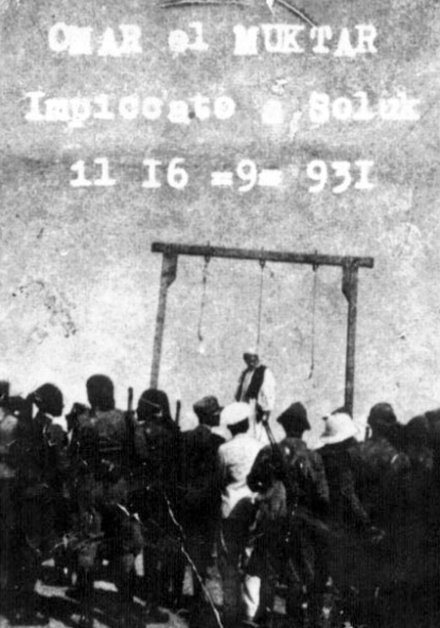
1931: Omar Mukhtar, Libyan revolutionary

On this date in 1931, Libyan independence martyr Omar [al-]Mukhtar was publicly hanged by the Italians at their concentration camp in Suluq.

Mukhtar (English Wikipedia entry | Italian) was born an Ottoman subject back in 1858 and had lived long enough to see his native Libya seized in the 1911-12 Italo-Turkish War.

Mukhtar, a religious teacher and follower of the Senussi movement, became the leader of the Libyan resistance that dogged the Italian occupation. Mukhtar proved an energetic and successful desert guerrilla fighter, and he had to be given the Italians’ mechanized military.

The Italians executed an estimated 4,000 Libyans in the 1920s, and drove hundreds of thousands into concentration camps, and gradually, only gradually, gained the upper hand on their adversaries.

Captured in battle after he abandoned a 1929 truce, Mukhtar was denied prisoner-of-war status and subjected to a snap military tribunal in one of the small coastal enclaves actually controlled by Italy — “a regular trial and consequent sentence, which will surely be death,” as the Italian general directed. It surely was.

He’s played by Anthony Quinn in the 1981 film Lion of the Desert — a better movie than you might think given that it was bankrolled by Muammar Gaddafi.

A national hero for contemporary Libyans across any social divide you’d care to name, Omar Mukhtar was valorized by the rebels who recently overthrew the aforementioned Gaddafi (here’s Mukhtar on a billboard in rebel-held Benghazi). “The whole world knows what Omar al-Mukhtar did,” Mukhtar’s 90-year-old son told media during the civil war. “That’s where they get their energy from. Ask the youth, they’ll tell you they are all the grandsons of Omar al-Mukhtar.”

His steely profile can be seen on Libya’s 10 10 dinar note.

On this day..

1459: Pietro di Campofregoso, former Doge of Genoa, stoned to death

On this date in 1459, the former Doge of Genoa Pietro di Campfregoso was stoned to death by his city’s enraged populace.

This Pietro (English Wikipedia entry | Italian) succeeded his cousin to the merchant oligarchy’s head in 1450. Genoa resided in a crab-bucket of rival peninsular and Mediterranean powers, and Pietro was distinctly out-scuttled in the 1450s.

Genoa unsuccessfully supported the Byzantine Empire when it was decisively conquered by the rising Ottomans in 1453, and the Genoans found themselves consequently rousted from a number of Aegean and Black Sea possessions. Meanwhile, fickle Italian fortune brought Neapolitan troops to the walls of Genoa and eventually forced Pietro to submit to a humiliating French protectorate under Charles VII.*

By this point, Genoa was also in the sights of Francesco Sforza, and when Pietro had to abdicate and blow town he went to the protection of the the great condottiero in Milan. There he joined a Sforza-backed plot to pull Genoa out of the French orbit and into that of the Duke of Milan, which coup utterly failed and got Pietro di Campofregoso lynched/murdered/summarily put to death near the Porta Soprana.

If only he’d been able to avoid that fate, he would have seen the plot come to fruition: when the French-supported Duke of Calabria left Genoa to attempt to re-establish his family’s foothold in Naples, Sforza’s agents got hold of the city and installed yet another Fregoso cousin, Spinetta, as the Milanese puppet.

The Campofregosos (or simply Fregosos) were far from finished with their misadventures in power. Pietro’s predecessor and kinsman Lodovico found his way back into office after Spinetta, but in 1462 the Genoan archbishop Paolo Fregoso (also kin!) arrested the sitting doge, and replaced him in office with his own self. Paolo was doge briefly in 1462, and again 1463-64, and then once again in the 1480s, being repeatedly deposed and exiled in between shifts.

* That’s the king at the end of his life whom Joan of Arc rallied to when he was a mere dauphin.

On this day..

1864: George Nelson, Indiana Jones rapist

(Thanks to Meaghan Good of the Charley Project for the guest post. -ed.)

On this day in 1864, Private George Nelson of Company F of the 13th United States Colored Troops was hanged for rape in Nashville, Tennessee.

He committed his crime on November 13, 1863. Nelson and two other men were on Nashville Pike outside of the town of Dickson when they encountered an unmarried white woman named, no lie, Indiana Jones.

They asked her where she lived and she said her house was about a mile away. The men claimed they’d been fighting with some rebels near her house and said she must go with them.

Miss Jones refused, and Nelson threatened to shoot her if she did not comply. She went with him for about 250 yards, begging him to release her. Private Nelson put a bayonet to her side and told her to come into the woods with him or he would run her through. Miss Jones started crying then, and he threatened to strangle her with a rope if she did not shut up. They went into the woods together while the other two men held the horse.

As Miss Jones later testified, “I again begged of him to let me go, when he cocked his gun and said if I did not be still he would blow my brains out. He then took hold of me, threw me down, and committed a rape on my person.”

When he was done he robbed her of $1.50, but the other soldiers made him give the money back. Then they let her go.

George Nelson’s accomplices were tried separately, and on cross-examination the victim was asked, “Did you use your utmost endeavors to prevent him from executing his desires, or did you simply cry out, thus yielding a tacit consent?”

As if she could have done anything else with a gun trained on her!

The three defendants were all court-martialed. President Lincoln approved the death sentence for Nelson in August 1864 and he hanged the following month. His partners-in-crime got twelve and ten years in prison respectively.

On this day..