1928: Floyd Hewitt, “Boy Clubber”

(Thanks to Meaghan Good of the Charley Project for the guest post. -ed.)

On this date in 1928, seventeen-year-old Floyd Hewitt was executed in Ohio’s electric chair for the horrific murder of a farmer’s wife and five-year-old son.

Floyd grew up in rural area outside Conneaut, Ohio. Although at 6’4″ he had the body of a grown man, he was mentally disabled, callously described by his defense attorneys as “a moron with a ten-year-old’s intellect.” One newspaper portrayed him thus:

He is not considered of normal intellect, his drooping mouth, dull eyes and appearances contributing to the opinion. He was not bright in his classes at school.

On the evening of February 14, 1927, he visited a local farm belonging to the Brown family. He was a frequent visitor there; he loved listening to jazz music on the radio and the Browns were the only family in the area who had a set at home. Celia Brown’s husband, Fred, was away in town and she was home alone with their son Freddie.

This news column and this article describe what happened in detail. Floyd got “stirred up inside” by the music. Feeling “an overpowering love,” he made sexual overtures towards Celia, who slapped him. He hit back, and she grabbed the fireplace poker to defend herself, but he tore it from her hands. In the ensuing fight Floyd hurled Celia down the stairs and struck her repeatedly with the poker until she was dead. Then, afraid the little boy would tell on him, Floyd chased Freddie into the basement and beat him to death with a baseball bat, too.

Then he went back upstairs, washed his hands, walked the short distance home and sat down to read the newspaper.

Fred Brown got home a little after midnight, found his wife’s body on the porch. There was blood everywhere. Fred summoned neighbors and the police. After searching the rest of the house, the neighbors found little Freddie’s body in the basement.

Floyd rapidly came under suspicion; he literally left a trail of footprints right to his front door. The next morning he was arrested, wearing the same bloodstained sweater he’d worn the night before. One of the buttons had been torn off and was left at the crime scene.

Within hours, Hewitt had made a full confession. He even went so far as to take the police on a tour of the Brown house to point out what had occurred and where. The next day, however, he retracted his statements and would maintain his innocence until his death.

The press bluntly christened him “the boy clubber.”

On the first day of his trial, as he was taken into the courtroom, Floyd remarked, “This is certainly a beautiful day, isn’t it?” One reporter described him as “like a big overgrown boy, who did not realize the seriousness of the crimes with which he is charged.”

He was indeed an overgrown boy, only sixteen years old at the time of his crime, but the prosecution demanded the death penalty.

Death penalty expert Victor Streib in this review of Ohio juvenile executions summed matters up thus:

Although indicted for two first degree murders (mother and son), he was tried only for the first degree murder of the five-year-old boy.

During the three week trial, the state relied heavily upon Hewitt’s signed confession while the defense stressed Hewitt’s mental disabilities. On April 26, the jury returned a verdict of guilty without a recommendation of mercy.

Hewitt appealed, and his execution was postponed for a time, but the appeals process wore down in less than a year and the board of clemency refused to recommend a commutation to the governor …

Hewitt’s chronological age at execution was seventeen, but his mental age remained forever fixed at ten.

Floyd Hewitt might have been the youngest person ever executed by the state of Ohio, and he was the first from Ashtabula County. A “bedraggled figure … with his long black hair hanging low over his face,” and clutching a photo of his family, he died in the electric chair at the Ohio State Penitentiary Annex at 7:43 p.m.

On this day..

1888: Leong Sing

From the San Francisco Bulletin, Dec. 28 1888:

On this day..

1919: Frank Ezell and Brown Ezell, “Atticus Finch” clients

From the Monroeville (Ala.) Monroe Journal reported on Christmas Day 1925:

For the second time within a period of forty years, Monroe County has had a legal execution for the commission of crime. Frank Ezell and Brown Ezell, father and son, on Friday, December 19, expiated on the gallows under the sentence of the court the murder of Mr. William H. Northrup.

Morbid curiosity drew a large crowd to town on the fateful day, but few were admitted within the prison walls, while those outside could catch but an occasional word that fell from the lips of the accused men and realize only in imagination the gruesome task that fell to the lot of Sheriff Russell and his assistants.

Both negroes made statements on the gallows, the older man protesting his innocence of any complicity in the crime. The younger made full confession, asserting that he alone was responsible and that his punishment was just. The Journal spares its readers the frightful details of the execution. Let us hope that there may never again be occasion for a similar sentence of law.

This story arrives to us via Kerry Madden’s Harper Lee: Up Close, a biography of the reclusive author of To Kill a Mockingbird … and it is noteworthy in that context because Frank Ezell and Brown Ezell, father and son, were defended in this case by 29-year-old lawyer A.C. Lee: Harper Lee‘s father.

The future author would not be born until 1926, but this traumatizing event still troubled her father years later: it was his first criminal case, and his last. As another biographer, Charles Shields, remarked, “[T]his was fairly typical of the time. This method of doing business in the courts was informally called ‘Negro Law,’ which means that you get a young, inexperienced white attorney to practice on some hapless black client. Some of those trials took as little as half an hour.”

The family memory of the father’s futile defense, combined with Harper Lee’s own firsthand experience of a troubling miscarriage of justice, were influences that she channeled into To Kill a Mockingbird, modeling the heroic defense attorney Atticus Finch on her own father.

“Simply because we were licked a hundred years before we started is no reason for us not to try to win.”

-Atticus Finch

On this day..

1924: A day in the death penalty around the U.S.

From the New Orleans Times-Picayune, Dec. 13, 1924:

Shreveport, La., Dec. 12 — Alfred Sharpe, about 25 years old, a negro, was hanged here today at 12:16 p.m. for the murder of Tom Askew, a white man, veteran of the World war and manager of a plantation near Keithville, which occurred last September 9.

Sharpe, in a statement just before going to the gallows blamed liquor for his trouble. He admitted since his captured two days after the killing that he was guilty.

The negro, who was unable to read or write, and did noot know his exact age, said as he mounted the scaffld: “I know I violated the law and that the law must be fulfilled.”

From the Cleveland Plain Dealer, Dec. 11, 1924:

COUMBUS, O., Dec. 11. — Alexander Kuszik, 20, of Akron, must die in the electric chair at the state penitentiary shortly after 1 a.m. tomorrow for the murder of his thirteen-year-old cousin, Elizabeth Nagy, who spurned his proffered love.

Gov. A.V. Donahey late today denied a last minute appeal by Kuszi’s counsel that the death sentence be commuted to life imprisonment. This plea, supplemented by the testimony of three alienists [psychologists — ed.] to the effect that Kuszik was not mentally responsible for his acts at the time of the crime’s commission, failed to convince the governor, however, that he should exercise his powers to extend clemency

Even Kuszik’s counsel, C.G. Roetzel, former prosecutor of Summit county, admitted the crime for which Kuszik was convicted was one of the most brutal on record, and made no claim the prisoner was insane. Roetzel based his plea for clemency on the theory, supported by alienists, that Kuszik was mentally irresponsible although he did know the difference between right and wrong.

Theory of Alienists.

The alienists advancing this theory were Dr. J.C. Hassall, superintendent of Fair aks sanitorium, Cuyahoga Falls; Dr. Arthur G. Hyde, superintendent of the Massillon State hospital, and Dr. D.H. Morgan of Akron.

Drs. Hassall and Hyde had made their observations of Kuszik within twenty-four hours after the crime had been committed. Dr. Morgan made his observations about a month later.

These specialists made their examinations at the request of Prosecutor Arthur W. Doyle, but their testimny was not used at the time of the trial, Dr. Doyle explained, because he reached his own conclusion that Kuszik was responsible for his acts.

Countering the views of this group of alienists was the testimony of three others who, after making an examination of Kuszik at the governor’s request, reported that the youth not only was not insane but that he was mentally responsible.

Mentality Subnormal.

These alienists were Dr. Charles F. Clark, superintendent of the Lima State hospital; Dr. H.H. Pritchard, superintendent of the Columbus State hospital, and Dr. Guy Williams, superintendent of the Cleveland State hospital. They all said Kuszik had no mental disorders. All the alienists had agreed that Kuszik’s mentality was sub-normal — that it represented the mentality of a child of about 11.

Prosecutor Doyle told the governor that, in his opinion, so long as the state recognizes capital punishment Kuszik’s case was one in which it should be used.

Kuszik exhibited no concern when told his appeal had been denied and that he was to die.

In complete control of his faculties, he walked even jauntily to the death cell to spend his few remaining hours.

“The youth has shown more spirit today than at any time since confined,” Warden P.E. Thomas said.

Two consecutive stories from the Portland (Ore.) Oregonian, Dec. 13, 1924:

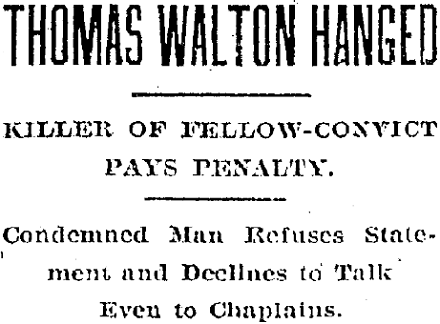
WALLA WALLA, Wash., Dec. 12. — Thomas Walton, convicted of the murder of S.P. Burt, a fellow convict, in the state penitentiary here October 7, 1923, was hanged at the penitentiary this morning. The trap was sprung at 5:06 A.M. and the prison physicians pronounced him dead 10 minutes later.

Walking to his death with the same fearlessness that he has displayed since the beginning of his prison career, Walton refused to make any final statement and even declined to talk with Rev. A.R. Liverett, prison chaplain, or Father Buckley, Catholic priest, in his cell prior to the execution.

His body will be sent to relatives in Montague, Cal.

Although Walton paid the penalty for killing Burt, he has of official record killed two other men. The first was in 1915 in California, for which he was sentenced to life imprisonment in San Quentin prison. The other was that of George McDonald, cellmate of Burt, whom he stabbed following his attack on Burt.

Walton and Burt were life termers in San Quentin and made their escape together in a prison automobile in January, 1923.

FOLSOM, Cal., Dec. 12 — Robert Matthews, negro, convicted of the murder of Coleman Stone, a grocer near Los Angeles, was hanged at the state prison here this morning. [Joe] Sinuel will be hanged next Friday.

On this day..

2014: Robert Wayne Holsey, despite a drunk lawyer

On this date in 2014, Georgia executed a contrite Robert Wayne Holsey.

Out on probation for an armed robbery conviction, this avatar of the classic middle name robbed a convenience store at gunpoint, then shot and killed a deputy who pursued him.

Georgia somehow didn’t have a state public defender system until 2003, a system presenting to the counties who were supposed to appoint indigent defense counsel on a local and ad hoc basis a fine opportunity for callous graft dovetailing the interests of the prosecutor’s office in winning its cases with court’s interest in pinching its pennies.

Accordingly, Baldwin County stuck Holsey with a man to test appellate courts’ standards for minimal representation, an alcoholic attorney named Andy Prince* who was rock-bottoming during the trial to the gobsmacking reported tune of a quart of vodka every night. Prince was disbarred shortly after Holsey’s conviction for robbing another client of $100,000.

According to a tragic Mother Jones profile, Prince, who was white, also happened to get in a dispute around this same time with a black neighbor and hurled some racist invective, which doesn’t seem ideal when your day job consists of trying to keep a black defendant off death row.

The late Prince — he died in 2011 — told an appeals court in 2006 that he “shouldn’t have been representing anyone,” but appeals courts, which must generally find that such “shoulds” clearly “would” have changed the trial outcome, have much less scope to act on the determination.

It’s a massive systemic cheat still in widespread use, albeit not always in such egregious fashion: use some underhanded means to get a death sentence on the books, then argue to every higher court that the deficiency can’t be proven certainly decisive vis-a-vis what might have happened in a fair fight. Do you know Holsey wouldn’t have received a death sentence? He did shoot a cop in the course of committing a violent felony, after all.

There are many general reasons why a robust defense might mitigate a sentence, but the specific reason of interest in Holsey’s case — a reason not litigated by Prince, an omission that likewise foreclosed appeals avenues — was that Holsey was severely mentally disabled.

With a testing IQ around 70, just at the border of the conventional definition for so-called “mental retardation,” Holsey had at the minimum a very strong card for the mitigation phase of the trial — if not an outright bar to execution.** Prince failed to play that card … and as of this date in 2014, American jurisprudence and the state of Georgia determined themselves content to leave it permanently face-down.

There’s a WNYC podcast about this case here.

* The Guardian article cited in this post calls him Andy Price. As all other media citations I find call him Prince, I’m going with that — but as it’s likely that everyone is copying from the last story instead of doing original reportage, I’m not completely confident that it isn’t Price after all.

** Georgia was actually among the first states to bar the execution of mentally disabled prisoners — although paradoxically its early standard thereafter became one of the nation’s weakest as other states implemented their own over the years. The Supreme Court theoretically bars executing the mentally disabled, but as it has enforced no coherent standard the executing states themselves generally get to decide who qualifies.

On this day..

1915: Cordella Stevenson lynched

(Thanks to Meaghan Good of the Charley Project for the guest post. -ed.)

On this date in 1915, a mob visited Cordella Stevenson’s cabin, dragged her out, and lynched her.

The good citizens of Columbus, Mississippi, found her body the next day, hanging from a tree limb. The site of her lynching was only 50 yards north of the Mobile and Ohio Railroad, and rail passengers who came in and out of the city that day saw her corpse thus displayed. She had been “maltreated” (that is, raped) and stripped naked before being strung up.

Several months before, Gabe Frank, a local white man, lost his barn to fire. Although there was no direct evidence to implicate him and he had not been seen in the area for months prior to the fire, Cordella and Arch Stevenson’s son came under suspicion of arson.

The parents were respectable people who had worked for the same white employer for over a decade, but the son had a “worthless” reputation. Frank tried tracking the young man with bloodhounds, but was unsuccessful. The local police arrested Cordella and kept her locked up for several days, hoping she might know something of her son’s whereabouts, but they eventually released her without charge.

The Stevensons thought or hoped that would be the end of the matter.

Arch and Cordella had already gone to bed that Wednesday night in December when, at about 10:00 p.m., they heard someone pounding on their door. Before they could get to the door to answer it, the vigilantes had broken it down. They seized Cordella, pointed their rifles at Arch, and threatened to shoot him if he moved. At some point he managed to flee, bullets whizzing miraculously past him in the dark, and he ran to town for help. Arch knew what was good for him; after reporting what happened to the authorities, he fled the area for parts unknown. Meanwhile, somewhere out there in the night, the mob fell on his wife.

Kerry Segrave recorded in his book Lynching of Women in the United States: Recorded Cases, 1851-1946:

Sheriff Bell telephoned to Justice of the Peace McKellar to hold an inquest. He was out of town and did not return until Thursday night. As a result, the naked body was left hanging in view of the “morbid” crowd that came to see it until Friday morning when it was cut down and the inquest was held. That inquest jury returned a verdict that Cordella Stevenson came to her death at the hands of persons unknown.

The Chicago Defender, a (still-extant) black newspaper noted for its accurate reporting of Jim Crow era violence, bitterly editorialized, “This these southern culprits did. No law below the Mason and Dixon line that would cause them to fear. No officer in the police department that would dare to do his duty. No man in the government circles in Washington that has enough backbone to enforce the Constitution of the United States. This mob knew and they went on with their ghastly work.”

A century later, Cordella Stevenson’s ghastly death has still not been forgotten. In 2013, a poem for her, titled “What the Dark Said”, was published in the collection Ain’t No Grave, by Tennessee poet TJ Jarrett.

On this day..

1884: Howard Sullivan, ravisher and murderer

From the New York Times, Dec. 3, 1884:

SALEM, N.J., Dec. 2. — The hanging of Howard Sullivan, the negro, which took place at the county jail this morning, was the closing act of a tragedy that has never been equaled in Salem and rarely in any other county in the State of New-Jersey. Ella Watson, on the night of Aug. 18, while proceeding to her home over a lonely road near Yorktown, a thrifty little village, nine miles north of this place, was waylaid, robbed, ravished, and murdered, and her body concealed in some bushes near by, where it was discovered a few days later.

For a time the murder was enveloped in mystery, but the vigilance of two or three detectives, among them a colored man, who exhibited remarkable skill in working up the case, soon unraveled it, and Sullivan was charged with the murder.

He had not been long in jail before a confession was wormed from him,* and when placed on trial before a Supreme Court and three lay Judges, in the Court of Oyer and Terminer, he pleaded guilty and was sentenced to be hanged. Sullivan stood the prison life bravely, and not once did he display the slightest emotion.

Sullivan did not go to bed until after midnight last night. A great part of the time he spent in singing and praying, and when not engaged in this he was conversing with his death-watchers.

Confined in a cell on the third floor, the one he formerly occupied, and from which he attempted to escape,** is a colored woman named Sallie Fisher, convicted of the larceny of a watch chain, and sentenced to imprisonment in the county jail for 90 days. Nearly all last night she prayed and wept aloud for Sullivan. Her voice could be heard for a long distance from the jail, and her cries were piteous in the extreme. Sullivan’s mother called to see him and remained with him for some time. The scene between them was an affecting one.

The morning opened clear and pleasant, and Sullivan arose at exactly 7:05 A.M., when he was awakened by the Warden. He left his breakfast untouched, saying he would eat “after a while.” When asked if he wished to make any statement for the public, he said: “There is nothing more that I care to say about the case. I have got no complaint at all to make about my trial or my treatment. I have had all I want to eat and Sheriff Kelty and ex-Sheriff Coles have been very kind to me. I hope to go to a better world, and I believe my sins will be forgiven.”

Sullivan added that he had slept quite as well as usual during the night. After making this statement he ate the breakfast that had been prepared for him. His manner was calm, and when talking to his companions he was almost cheerful.

At 9 o’clock the gallows was tested and found to be in good working order. A few minutes later the condemned man’s fater and mother called to see him, and while they were with him in the cell all others, except his spiritual adviser, were excluded. The father is a bright, honest looking man, 65 years of age, though his appearance does not indicate it.

The meeting between Sullivan and his father and mother, together with the Rev. Richard Miles, Pastor of the Mount Pisgah Methodist Episcopal (colored) Church, of this city, one of his spiritual advisers, was a quiet one. They all sat around a stove in an outer room and chatted pleasantly for a few minutes. Sullivan said to his parents: “If you cry I will want to cry, but if you control yourselves I will.” This was all he said regarding his feelings.

While his family were still with him the Rev. William S. Zane, Pastor of the Walnut-Street Church, and the Rev. W.V. Louderbough, Pastor of the First Presbyterian Church, called on him and uttered a few consoling words. They have been regular visitors for some time, but took no part in the execution. The Rev. Wilson Peterson, Pastor of the African Church of Bushtown, also called while Sullivan’s parents were with him, and before taking their final leave all joined in singing “Take the Name of Jesus with you.”

Finally, the prisoner’s sisters entered the jail, and his parting with them was distressing.

His sister Emeline fell in a fainting fit and had to be carried out. This sight proved too much for his mother’s nerves, and, weeping and wailing, she was led into another room. When Emeline was taken to the street, on her way to the railroad station, she again fell in a fainting fit, and was actually dragged to the train. Mrs. Sullivan kept up long enough to reach the house of a friend, where she remained until her departure for Yorktown at noon.

After Sullivan’s cell was cleared of all except his spiritual adviser a final prayer in the jail was offered by the Rev. Mr. Peterson, after which, at 10:20 A.M., Sheriff Kelty, in the presence of Prosecutor Slape, read the death warrant. Sullivan was the coolest man in the party.

At 11:18 the jury appointed by the court filed down stairs to the basement and thence to the yard.

Sullivan, preceded by the two spiritual advisers, and accompanied by his friend, ex-Sheriff Coles, followed immediately after. He was dressed in a neat-fitting black diagonal suit, and wore black cloth gloves.

At the scaffold the Rev. Mr. Miles offered a prayer. Then the prisoner’s ankles were pinioned and his hands were fastened behind him with handcuffs

Ex-Sheriff Coles asked him if he desired to say anything, and he replied: “I hope the Lord will bless you all, and I hope to meet you all in heaven. Good-bye. When I fall from here I will fall into the arms of Jesus. It is a warning for all. It is very sad for my mother, my father, for Mr. Kelty, and for every one, but it is not sad for me. It is a marriage ceremony with me, and I want to be there in time for the feast with all those good men that have gone before me. I want all you gentlemen who have sons to take heed and learn them. Good-bye all.”

As the black cap was being adjusted Sullivan bade his friend Coles good-bye. There was just the slightest tremor in his voice as he spoke.

At exactly 11:29 the drop fell. There was a twitching of the body for a minute, and then it hung withut motion. In three minutes Sullivan was pronounced dead; his neck had been broken. The body was allowed to hang for half an hour, when it was cut down and placed in the coffin. It was buried at Bushtown in the afternoon.

* By a Pinkerton detective infiltrated into his cell for the purpose. According to the Chicago Tribune report of the trial, relating that detective’s gloss on Sullivan’s alleged jailhouse confession,

Sullivan said he sneaked up behind Ella Watson unperceived and struck her three or four terrible blows with a cane had had picked up in the woods. She fell to the ground, and, grasping the prostrate form, he dragged it across the road into the bushes, where he attempted to commit a dastardly assault upon the dying girl. She resisted his attempts, but he accomplished his design. Then the girl raised her head and exclaimed, “O, I know you!” “Then,” said Sullivan, “I clutched her by the throat and choked her with all my might. That killed her. I didn’t stop choking her until a shudder ran through her and I knew she was dead.”

** One important moral of this story is that when you have the opportunity to break out of death row, don’t dawdle.


Philadelphia Inquirer, Dec. 1, 1884

On this day..

1946: Twice double executions around the U.S.

On November 22, 1946, American executioners recorded a double-double with twin killings in both North Carolina and Georgia.

North Carolina

Charles Primus, Jr., and Wilbert Johnson carjacked a couple in Raleigh, forced them to drive six miles into the country,

got out and ordered the occupants to do likewise, demanded their pocketbooks, commanded them to go down a road in the woods; the defendants then held a whispered conversation, after which Johnson, with gun in hand, directed Miss Lipscomb to “stay there,” with Primus and marched Guignard approximately 200 feet down a path and demanded to know where his money was. While the parties were thus separated, Primus had intercourse with the prosecutrix after threatening to kill her if she did not submit. She says, “I submitted to Primus on account of fear.” The defendants were over 18 years of age; and the prosecutrix was 25 years old at the time of the assault.

Soon after the rape was accomplished the defendants freed the prosecutrix and her companion and allowed them to make their way to a house in the neighborhood.

The defendants admitted in statements in the nature of confessions that they obtained $650 from Guignard and $38 from Miss Lipscomb. Each originally claimed the other committed the rape, but finally Primus admitted he was the one who actually assaulted the prosecutrix. Johnson was tried on the theory of an accessory, being present, aiding and abetting in the perpetration of the capital offense. He was referred to by Primus as “the boss” of the hold-up conspiracy.

The specification abut “submitt[ing] on account of fear” — obviously, right? — mattered because Primus and Johnson took an appeal all the way to the state Supreme Court that this submission made intercourse no longer legally “forcible.”

Georgia

Johnnie Burns and Willie Stevenson were both electrocuted at Georgia State Prison November 22, 1946 for the ax murder of a man named Lucius Thomas, a crime that netted the pair $27.14.

Stevenson was only 16 years old at the time of the murder, and 17 when he was executed.

Arkansas

There was also a fifth, singleton execution on the same day in Arkansas: Elton Chitwood was electrocuted for murdering Mena pharmacist Raymond Morris during an armed robbery.

On this day..

1933: John Fleming, not taking it too hard

(Thanks to Robert Elder of Last Words of the Executed — the blog, and the book — for the guest post. This post originally appeared on the Last Words blog. Fans of this here site are highly likely to enjoy following Elder’s own pithy, almanac-style collection of last words on the scaffold. -ed.)

I’m sorry to have caused all this trouble. You seem to be taking harder than I do.

— John Fleming, convicted of murder, hanging, California
Executed November 17, 1933

Prior resident of Folsom and San Quentin prisons for robbery and assault charges, John Fleming murdered Amos Leece at a gas-station and road house when a prostitute named Peggy O’Day (aka Leonora Smith) made derogatory remarks to Leece after he refused to buy her a drink. Leece left the station to crank his car but not before he called O’Day “a cheap, chippy whore.” Fleming then confronted Leece, demanding that he apologize and then shot him three times when he refused.

On this day..

1886: William Wilson

(Thanks to Meaghan Good of the Charley Project for the guest post. -ed.)

On this date in 1886, 45-year-old William S. Wilson was hanged for murder in Jonesboro, Illinois. He had killed his wife, Margaret.

Wilson was good at producing offspring — he was the father of at least seven children and possibly as many as nine — but not so good at providing for them. At Christmas in 1885, he left his family and went to Kentucky, leaving his destitute wife and kids only $5 in cash (the equivalent of about $130 in modern terms) and very little fuel. When supplies ran out in early January, several neighbors took pity on Margaret Wilson and her brood and banded together to cut enough firewood to get them through the winter.

When William returned home on January 7, however, he was furious when he learned Margaret had shamed him by accepting charity.

Daniel Allen Hearn, in his book Legal Executions in Illinois, Indiana, Iowa, Kentucky and Missouri: A Comprehensive Registry, 1866-1965, records,

Wilson berated his wife for allowing the neighbors to act. He chased the heavily pregnant woman out of their cabin and shot her down in the mud and slush. The sight of her near-term unborn baby vainly kicking against the interior wall of her abdomen appalled witnesses, who could do nothing to save it. Details such as these illustrate the brutality that often characterizes these all-too-common wife-killing cases.

William had shot Margaret twice: once in the chest inside the house, and once again outdoors as she was running away. As she lay dying on the frozen ground he walked away. He didn’t get far before he was arrested.

A contemporary newspaper article speculated that William might be crazy, noting that he had been “affected for a long time with some incurable disease” and “is not regarded by some as sane.” But it wasn’t enough. William paid the ultimate price for his crime eleven months after the murder.

On this day..