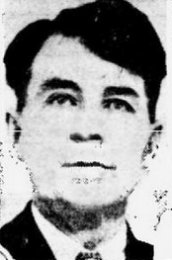
1801: Jason Fairbanks, lackadaisical escapee

On this date in 1801, Jason Fairbanks was hanged for murder in Massachusetts.

Fairbanks hailed from one of the oldest families in Anglo North America; the house where he whiled away his pre-homicide idleness is today the Dedham museum Fairbanks House.

A youth of about twenty-one, weak, sickly, with a stiff right arm,” Jason had a thing for 18-year-old “neighbor” (they lived more than a mile apart) Elizabeth Fales and she for him, but the Fales family opposed the romance.

So one day in May 1801, Fairbanks “told two of his friends, that he should meet [Fales] in the pasture on Monday, and endeavour to induce her to go off with him, and marry him; and that if she refused to do so he would attempt her chastity.”*

Evidently she just wasn’t that into him, because later that day of their rendezvous, Jason weirdly showed up at the Fales house covered in blood with a cock-and-bull story about how Eliza had committed suicide and he, Jason, had tried and failed to follow suit. Jason Fairbanks was indeed seriously injured (he convalesced in his victim’s family’s house), but Eliza’s wounds were the more interesting: her throat was slashed — she was still breathing faintly through her gashed windpipe when found — and she had stab wounds in her arms and between her shoulder blades.

It’s an atypical suicide who stabs herself in the back.

There was, of course, the matter of Fairbanks’s crippled arm (so did he really overpower Eliza?) and his own injuries (so was it a fight, or what?) — sufficient ambiguity for dueling attorneys to spin every manner of hypothetical to account for the maximum or minimum villainy of the suspect.

But when a dude says he’s off to attempt the chastity of a virtuous young woman and she emerges from the encounter with a stab in the back and a slash through the throat, he’s going to have a hard time repelling the charge. Fairbanks was easily convicted of murder on August 8.

Nine days later, or rather nights, this young-love tragedy took an even more amazing turn: Fairbanks’s friends broke him out of prison. Newspapers all over America were soon raising the hue and cry

STOP THE MURDERER
1000 Dollars Reward

The absconding of Jason Fairbanks from the jail of Dedham has excited much interest in the breasts of every one who regard the peace of society and the security of life; it will be the duty of the citizens of the United States to exert themselves in securing the condemned criminal without pecuniary reward, but as that may be the means of stimulating many who would otherwise be inactive, a large gratuity is now offered. Every newspaper printed in the U.S. it is hoped will publish the advertisement of the Sheriff … and by other means extend the hue and cry against him. (Quoted here)

Despite the bulletins, Fairbanks made it all the way to Whitehall on the southern tip of Lake Champlain, where a hired boat waited to carry him to freedom in Canada. Instead of boarding ASAP, Fairbanks and his escort paused for a parting breakfast on the very morning of the prospective embarkation — it’s the most important meal of the day, you know — and the fugitive was there apprehended addressing his table, steps away from safety.

* 1801 murder pamphlet, “A Correct and Concise Account of the Interesting Trial of Jason Fairbanks”

** We couldn’t help but enjoy this explanation for the murder published in the Philadelphia Gazette of the United States as part of an unsigned “Letter from Dedham”: “Fairbanks had been seduced previous to his becoming a murderer, by some European travellers; and joined with a society of Jacobin Deists, who held their meetings in this town. Among other of their tenets, they avowed that a rigid observance of chastity in man or woman was ridiculous; being contrary to natural impulse.” Dedham was to Federalists of 1801 sort of what San Francisco is to the present-day Tea Party, thanks in large measure to a ridiculous case recently charging a so-called “Jacobin” under the ridiculous Alien and Sedition Acts; there was an abortive attempt in the Federalist press to ascribe Fairbanks’s jailbreak to a revolutionary mob.

On this day..

1849: Elisha Reese, suitor

A number of comment threads on this site attest that many accidental visitors to Executed Today are genealogy researchers turning up information about a famous ancestor. The Internet age is a true renaissance for genealogists; while it’s not this blog’s specific objective, it’s a happy side effect if we throw the odd ray of light on the very odd bits of a family’s history.

It’s in that spirit that we present this date’s profile of Elisha Reese, hanged before a reported 5,000 spectators on September 7, 1849 just outside the city limits of Macon, Ga.

As with many crimes, it was the news on everyone’s lips in its own day, but then passed rather quickly into obscurity. Elisha Reese, age 50, was rejected in his marriage suit by 60-year-old widow Ellen Pratt. The nature of their relationship is not known, but Reese took this badly enough that Ellen’s father, 90-year-old Revolutionary War veteran David Gurganus, swore out a peace warrant against his would-be son-in-law … and then Reese took the existence of this peace warrant with a downright vengeful fury.

For what happened next, click on through to the proper genealogist — and Gurganus descendant — who has researched this story already and posted it as a three-parter on her site, A Southern Sleuth.

  1. Murder In Macon
  2. Murder In Macon Part 2
  3. Murder In Macon, the Final Chapter: Trial

On this day..

1833: Antoine LeBlanc, billfolded

On this date in 1833, Antoine le Blanc was hanged on the Morristown (N.J.) village green.

A cigar-chomping French immigrant, LeBlanc came to the New World to seek his fortune and found himself doing grueling farm work for Samuel and Sarah Sayre in exchange for a dank basement room but no pay.

After just a couple of weeks in this unsatisfactory situation, LeBlanc clobbered Samuel Sayre with a spade … and then did the same to Sarah Sayre … and then killed their infant child. Stuffing all the portable valuables he could find into pillowcase sacks, he hopped on a horse and fled for New York, hoping to pawn his booty for passage back to Europe.

Like an inept Scooby-Doo villain, LeBlanc in his haste managed to dribble a trail of the Sayres’ goods on the road, and these helped his pursuers corner him in the Meadowlands — an incriminating parcel of his ill-gotten gains right there beside him.

The trial was a mere formality. The execution on an upward-jerking gallows drew an excited crowd several times the 2,500 souls residing in Morristown itself.

And then, it really gets creepy.

LeBlanc was condemned to post-execution medical anatomization, and the good doctors of Morristown took that as license for every posthumous indignity in the 19th century book. First, the late LeBlanc got a course of electrical shocks — a popular corpse experiment of the day whose object was discovering a means of reanimation but whose consequence was merely a ghoulish danse macabre of senseless, jerking limbs as each jolt charged the putrefying flesh.

When they’d had their fill of zombie Antoine LeBlanc, they skinned the murderer and sent his hide off to be made into wallets and book covers which then got hawked to Morristown’s finest citizens. That sounds like an urban legend, but scroll down this page for the pictures: some of these objects have made it to museums, but it’s thought that others persist in private collections, handed down over the generations or just stashed away forgotten until they can emerge for a starring role on Antiques Roadshow.

Apparently the old Sayre house (significantly rebuilt after a 1957 fire) still stands in Morristown … and it’s haunted by LeBlanc and his last victim, the baby Phoebe.


Sources:

The always wonderful Murder By Gaslight blog

The New Jersey Hall of Shame (this is the link with the LeBlancskin wallet pictures)

Weird New Jersey

On this day..

1887: Josiah Terrill, “I ain’t guilty of this here charge”

From the out-of-print The palace of death, or, the Ohio Penitentiary Annex: A human-interest story of incarceration and execution of Ohio’s murderers, with a detailed review of the incidents connected with each case by H.M. Fogle (1908):


Chapter 4

Josiah Terrill
September 2, 1887

Hanged Sept. 2, 1887, for the murder of a Meigs County, Ohio, citizen. It is believed that he was innocent but lacked friends and finances to clear himself.

Died Brave, Proclaiming His Innocence


Josiah Terrill, serial number 18,872, a Meigs County murderer, was hanged September 2, 1887. He met his fate bravely and, as is said of college graduates, “acquitted himself with great honor.” Like nine-tenths of the men who die upon the gallows, Terrill denied all knowledge of the crime with which he was charged, and with a last breath declared that he suffered death as an innocent man.

A few hours before the time appointed for his execution, the condemned man awoke from a refreshing sleep and asked for something to eat. The request, of course, was granted. Someone unguardedly expressed surprise at the desire to eat, and Terrill said, “You ain’t going to choke me off that way are you, without anything to eat?”

While Terrill was eating, a Missouri Colonel conversed with him, urging him to unburden his mind if he had any guilty knowledge. The murderer reiterated his oft repeated declaration of innocence, and requested the Warden to give him a drink of whiskey. But the man’s nerve was so great that the Warden declined to give him a stimulant to raise his courage for the trying ordeal.

After the final administration of spiritual comfort, the Warden read the death warrant, and the condemned man was lead [sic] to the scaffold.

Terrill was perfectly cool and collected, and his features shone in their natural color. As he stepped to the trap, Warden Coffin asked him if he had anything to say, to which he replied, “I say I ain’t guilty of this here charge.” “You say you are guilty?” queried the Warden who, with others, misunderstood him. “I say I ain’t guilty of this here charge,” reiterated Terrill. “God in heaven knows I ain’t guilty. There are some people and lawyers in Pomeroy who think they have got satisfaction on me now. That’s all I’ve got to say.”

Warden Coffin then stepped over and shook hands with the condemned man, bidding him good-bye. The minister gravely followed his example, saying in a solemn tone: “Josiah, put your confidence and trust in the Lord.” “I have,” replied Terrill.

He was placed over the trap and, standing as if being measured for a suit of clothes, permitted Deputy Cherrington to adjust the ropes. There was some difficulty in fastening a strap, and he considerately moved his feet to facilitate operations. The black-cap–a rude bag–was placed over his head and the noose adjusted. At 12:34 A.M., before the audience realized that it had happened, Warden Coffin shot the lever from north to south. Rattle went the trap against the sides of the scaffold, and with a boom the body of the condemned man shot down seven feet, oscillated once or twice and then became quiet. There was not a twitch of the muscles or a movement of the body.

Instantly there was a plank placed across two chairs on the platform directly under the body of the hanging man, and two doctors sprang upon the plank to take note of the pulse and respiration. The heart beats were very rapid at first, but after six minutes began to lessen. In twelve minutes he was dead. The rope was lowered so the body could be placed on the plank, the knot was cut and the noose loosened, and then the black-cap removed, exposing the swollen and blackened face. His neck had been broken by the fall, but the rope had not cut the flesh. The body was placed in a coffin and shipped to Pomeroy, where it was buried by the dead man’s mother.

Strange to say, he expressed no desire to meet the aged woman before his death; on the contrary, he remarked at supper that the only person he cared to see was his child (illegitimate).

There has always existed grave doubts in the minds of some of Meigs County’s best citizens as to Terrill’s guilt. The evidence against him was purely circumstantial, but the jury evidently thought it strong enough to warrant a verdict of guilty.

He was accused of murdering an old man for whom he had previously worked. The opinion of the writer is that Josiah Terrill died an innocent man. This opinion is based upon evidence, and what could be learned from some of Meigs County’s best citizens. Certain it is that he was a poor illiterate man, without money and without influential friends.

Charles Phillips, the murdered man, was aged and decrepit. By frugality and hard toil he had accumulated quite a sum of money. Robbery was the motive of the crime, and a bludgeon and knife were the instruments of destruction.

Innocent or guilty, Terrill is in the hands of a just God, where he will remain until that great “Day of Judgment,” when all wrongs will be righted, and the innocent shown and the guilty punished according to the unerring judgement of an ETERNAL GOD.

On this day..

1876: Jesse Pomeroy’s sentence commuted

(Thanks to Meaghan Good of the Charley Project for the guest post. -ed.)

On this date in 1876, serial killer Jesse Pomeroy was reprieved by a 5-3 vote of the Governor’s Council of Massachusetts. Rather than hanging him, they elected to bury him alive instead.

With a “mere” two deaths to his name, at first glance Jesse Pomeroy may not seem like much of a serial killer. In fact, according to some definitions that require a higher body count, he wasn’t a serial killer at all. But give the kid some credit: he was only fourteen years old when he was caught. What’s more, his two murders were committed in a most brutal, sadistic manner.

Jesse was born in Massachusetts in 1860, the son of a violent and abusive father and a doting mother. He’d always been considered a “difficult” child and had tortured the family pets, but his known criminal career didn’t begin until he was twelve years old.

Over the course of nine months, he lured eight young boys between five and eight years old to remote areas and attacked them, beating them badly with a stick, a belt or his hands. In his later attacks he took to biting, and started using a knife as well. He tried to stick a needle into one child’s eyes, another boy, age six, was stabbed between the shoulders and had his penis nearly half cut off. Eventually Jesse would let his victims go, leaving them physically and mentally scarred for life.

Each attack was worse than the last, and each time the intervals between them got shorter. There were three months between the first assault and the second, and only five days between the seventh incident and the eighth (which was the last).

In his biography of Pomeroy, Fiend: The Shocking True Story of America’s Youngest Serial Killer, Harold Schechter described the assaults vividly:

The seventh attack occurred … on Wednesday, September 11. This time the “boy torturer” lured a seven-year-old named Joseph Kennedy to a vacant boathouse near the salt marshes of South Boston bay. Once inside the building, he slammed his victim’s head against the wall, stripped him naked, and administered a ferocious beating, breaking the little boy’s nose and knocking out several of his teeth. Then, pulling out his pocketknife, he forced the seven-year-old to kneel and ordered him to recite a profane travesty of the Lord’s Prayer, in which obscenities were substituted for Scripture.

When young Joseph refused to commit this blasphemy, his tormentor slashed him on his face, his back, his thighs. Then he dragged the bleeding child down to the marsh and — laughing delightedly at the little boy’s suffering — doused his wounds with salt water.

Most serial killers have a basically normal appearance, and some are downright handsome.

Jesse, however, actually did look pretty creepy. His head was too large for his body, he was blind in his right eye and the eyeball was covered by a whitish film that was deeply unsettling to look at. One of the boys he attacked said the eye looked like a “milkie,” a white marble. After that, the press often referred to the unknown assailant as “The Boy with the Marble Eye.”

On the day of his arrest on September 20, 1872, the police brought Joseph Kennedy, one of Pomeroy’s victims, around to various local schools to see if the child could find his attacker in the classrooms.

When little Joseph entered Jesse’s classroom, Jesse lifted his head when the teacher told him to but kept his gaze directed down at his desk. Joseph couldn’t see his deformed eye and didn’t recognize him. That afternoon, however, for some reason Jesse decided to pop in to the local police station on the way home from school. The boy was there and this time he recognized him.

Arrested and subjected to several hours of grilling, Jesse quickly confessed to his crimes, saying he “could not help himself” and wasn’t sure why he’d done such terrible things.

His victims identified him as the boy who had hurt them, and five of them testified against him in juvenile court. Jesse was sent off to the Lyman School for Boys, a juvenile reformatory.

The authorities were supposed to keep him locked up until he turned 18, but Pomeroy, who was no fool, read the fine print in his sentencing and discovered that if he “reformed,” he would be released early.

He immediately set about becoming an absolutely angelic inmate. He obeyed all the rules, did all the work assigned to him and didn’t talk back to the staff. When the other boys tried to bully him, he ignored them.

Before long, he was awarded the coveted position of dormitory monitor, with some responsibility over the other boys. On the outside, his devoted mom, who never believed in his guilt, kept up a letter-writing campaign, asking anyone with influence to help get her son released.

Jesse’s good behavior was rewarded and he was paroled to his mother’s custody in February 1874. He had been in custody for less than a year and a half. By then, his mother had left his father and was running a small store in South Boston.

On March 18 that year, six weeks after Jesse was released from the reformatory, ten-year-old Katie Curran disappeared. She was last seen when she went into the Pomeroy family’s store to buy a notebook for school. A neighbor boy saw her go into the store, where Jesse was manning the counter, but no one ever saw her come out.

Shockingly, in spite of his antecedents, the police at the time didn’t consider him a suspect in Katie’s disappearance, didn’t thoroughly search the store, and accepted his story that he hadn’t seen Katie at all that day.

This may have been because Jesse had never been known to attack little girls. In any case, over the ensuing six weeks the search instead concentrated on the Boston Wharf, on the theory that she’d accidentally fallen off a dock and drowned. Another theory was that she had been kidnapped.

The investigation went nowhere.

On April 22, Jesse accosted four-year-old Horace Millen while the child was on the way to the bakery with a few pennies to buy a sweet. Numerous witnesses saw them together, hand in hand, walking to the harbor; most of them assumed they were brothers out for an adventure.

What happened next is unprintable.

Suffice it to say that at 4:00 p.m., Horace’s body was found beyond a hill in a remote area near the shore. He’d been stabbed eighteen times in the chest, his throat was cut, and his face and genitals were mutilated. His fists were still clenched, the nails biting into his palms, indicating he’d been conscious during the attack and died in considerable pain.

As the police began their murder investigation, someone remarked that Horace’s injuries were remarkably similar to the attacks Jesse Pomeroy had committed before he was locked up two years ago.

As soon as the cops discovered Jesse was in fact on parole, they rushed to his house and took him into custody. His boots were caked with mud and grass was stuck to the soles, his face was scratched and his pocketknife was bloodstained.

At first, Jesse denied having done anything wrong. But when he was confronted with Horace Millen’s corpse, he cracked and started sobbing. “Please don’t tell my mother,” he pleaded. “Put me somewhere, so I can’t do such things.”

Unaccountably, more than a month passed from the time Jesse was arrested until Katie Curran’s body was found, and it was located by accident. Jesse’s mother and brother had to move out of their store in the wake of the murders. A new tenant moved in to the building and decided to refurbish the basement. Workers found Katie’s body. Her throat had been cut and her genitals mutilated.

When confronted with the news about Katie, Jesse denied any knowledge of her death and seemed indignant. “After all,” Harold Schechter noted, “aside from the fact that he was already in custody for child-murder and the little girl’s decomposed corpse had been found in the cellar of his family’s store, there was no reason in the world suspect him.”

Jesse ultimately confessed to killing the girl as well. He said he’d lured Katie down into the basement by saying there were some notebooks down there for her to look at. As soon as they reached the bottom of the steps, he took hold of her and cut her throat. He hadn’t even concealed her body very well, just tossing it in the ash heap.

The police search of the Pomeroys’ store must have been perfunctory indeed to have missed it.

(Jesse would later retract both confessions and claimed, to the end of his days, that he had never harmed a child in his life and was the victim of circumstances, coercive tactics by the police and a deliberate frame up.)

At his trial, his defense was one of insanity.

Three psychiatrists, or “alienists” as they were known in those days, examined him, one for the defense and two for the prosecution. Jesse told them he would get “a sudden feeling” that prompted his violence to small children and “I could not help doing it.”
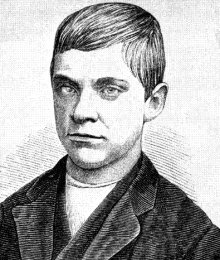

Jesse Pomeroy, young and old.

The doctors noted his lack of remorse or any sympathy for his victims. They believed Jesse would always be dangerous to society. His attorney argued that he should be found not guilty by reason of insanity and then locked away in a mental institution for good.

In the end, the jury convicted him of first-degree murder, for which the mandatory penalty was hanging. However, they issued a recommendation of mercy on account of his youth.

Although juveniles had been executed in the United States before and would be again, the state of Massachusetts had never hanged a boy of fourteen. On the other hand, Jesse had committed no ordinary crimes. By any standard he was a monster. His case was extremely controversial and the governor, William Gaston, was besieged with petitions both for and against clemency.

Gaston didn’t want to hang Jesse Pomeroy and stalled on the issue for as long as he could. It may well have cost him re-election. But his successor, Alexander Rice, didn’t want to hang Jesse either, campaign promises to the contrary.

So in August 1876, two years after Jesse’s murder conviction, by which time the furor in the press had died down, Rice commuted the now-sixteen-year-old’s sentence to life in prison. But there was a catch: the sentence had to be served in solitary confinement.

He would spend 41 years in a tiny cell, isolated from the world. His mother visited him once a month until her death. The only other people he saw were the guards. He was allowed to exercise alone in the prison yard and was allowed to read books. He wrote some bad poetry. Most of his efforts, however, were concentrated on escape. Schechter records:

Nothing — no amount of time locked in a dungeon, no beatings administered with a brass-tipped cane, no efforts at reinforcing his cell — discouraged Jesse for long. When plates of boiler-iron were bolted to his walls to keep him from digging at the stones, he set to work prying loose the bolts. When the walls were painted with a white preparation that would make even a pin-scratch conspicuous, he turned his attention to the floor, cutting loose one of the heavy boards, then digging at the ground underneath … Over the course of fifty years, virtually everything that fell into his hands became a potential implement of escape … He managed, over the decades, to fashion an amazing assortment of tools: awls, chisels, saws, drills, files, pry bars.

He never even came close to breaching the prison walls and his escape attempts mainly just made him a pain in the prison’s collective ass. Then again, a man needs a hobby.

In 1887, his ninth year in the solitary cell, he caused an explosion that blasted a hole in the ceiling and temporarily blinded him but didn’t get him anywhere. Only in 1912 was he ever able to actually make it out of the cell, something that took three years of work to accomplish — and he was caught within minutes. By then he was fifty-two.

His sentence was relaxed in 1917 and he was allowed into the general population. By then, Jesse’s health was failing, and his crimes were passing out of local memory. New inmates to the prison no longer recognized his name, something that deeply upset him. In 1929, he was transferred to the prison farm at Bridgewater. He took a car to get there, his very first automobile ride, but didn’t he didn’t seem interested in his surroundings. One reporter described him as “a deadened creature gazing with lusterless eyes upon a world that means nothing to him.”

He died at the Bridgewater Prison Farm on September 29, 1932, having spent sixty of his seventy-two years behind bars.

On this day..

2007: John Joe “Ash” Amador

On this date in 2007, John Joe “Ash” Amador died of lethal injection in Texas.

Amador, age 18, and a 16-year-old cousin, hailed a taxi in San Antonio in the dark predawn hours of January 4, 1994, directed it on a long drive to a dark street in Poteet, Texas, and abruptly shot the cabbie in the head with a .25 caliber handgun. Amador’s cousin shot the cab driver’s ride-along companion.

It’s possible to get unusually up close and personal with Amador — both the man himself, and the gears of the death penalty process at the anticlimax of 13 long years.

To begin with, journalist Dave Maass interviewed Ash Amador a month before the latter’s execution, and posted 52 minutes of audio on Archive.org.

And in a more outre vein, a team of British filmmakers crafted a surreal and digressive but frequently touching documentary of Amador’s end, most especially through the eyes of the condemned man’s wife and family. As Maass put it, they’ve “given the man one wicked afterlife.”

If that teaser intrigues, the entire documentary is freely available online here — complete with an amazing scene of a death mask being cast from the freshly-executed, just-body-bagged Ash.

On this day..

1765: Three Burglarious Johns

(Thanks to Meaghan Good of the Charley Project for the guest post. -ed.)

On this date in 1765, John Fagan, John Grimes and John Johnson alias Cochran were hanged in Burlington County, New Jersey in a rare triple execution.

The three Johns were convicted of home invasion robbery.


Wrong Three Johns.

On July 18 in Northampton Township, the three men, with their faces painted, burst into the house of Joseph Burr. By “threats of violence” they convinced Burr’s wife to give up her keys to the locked cabinets and made off with the following:

  • 1 silver sauceboat
  • 8 silver tablespoons
  • 9 silver teaspoons
  • A sum of money
  • A considerable quantity of shirts, aprons, caps and handkerchiefs
  • A great parcel of “wearing apparel made in the manner of people called Quakers”

They also took three valuable horses from Burr’s stable and rode off on them.

Burr and his wife told the authorities they knew the robbers were Irish because “they all had the brogue upon their tongues,” and it turned out three Irish laborers had gone missing from a farm near Mount Holly.

The thieves’ trail was discovered and a posse caught them red-handed, as it were, riding the stolen horses and carrying the stolen goods.

Justice acted quickly and Fagan, Grimes and Johnson were executed a mere six weeks after their crime. The Burlington County Treasury compensated the jailer his expenses in feeding the three men for 39 days.

According to Burlington County this Gallows Hill “stood not far from the Burlington-Mt. Holly Road (Rte. 541)” — perhaps the present-day Laurel Hill Cemetery.

On this day..

1897: Harvey DeBerry, raving like a madman

(Thanks to Meaghan Good of the Charley Project for the guest post. -ed.)

On this date in 1897, a 23-year-old black man named Harvey DeBerry was hanged for sexually assaulting his employer’s daughter.

His offense, this sexual assault, was a new one under the Tennessee statutes, different from the crimes of rape and attempted rape, and DeBerry was the first person in Shelby County to be convicted of it.

DeBerry was a live-in laborer on the Eigiman farm in Frayser Station, Tennessee, and his wife was the farm’s cook. Mr. and Mrs. Eigiman had three children aged seven, five and two. It was the oldest child, Elenora, that DeBerry assaulted on October 8, 1896.

At the time of the crime, Mr. Eigiman was in the hospital in Memphis recuperating from a fractured skull and a broken leg. Mrs. Eigiman went to see him that day, leaving her children in the care of the DeBerrys. She left Elenora in bed in her nightgown, because the little girl said she wasn’t feeling well.

When Mrs. Eigiman returned at the end of the day, Elenora was still in bed, crying and acting as if she was in pain. She refused to tell her mother what was wrong, and cried and moaned all night.

The next morning, her mother stripped the bed and found blood on the sheets. Mrs. Eigiman confronted her daughter, and Elenora said Harvey DeBerry had come into her room, lain on top of her and hurt her. That same day, a doctor was called to examine the victim. His findings, according to court documents, were as follows:

He found the child highly excited, nervous, and trembling; that the person of the child was swollen, and very tender to the touch; that the parts showed acute inflammation and swelling; that he found a purulent discharge, and a slight rupture of the hymen; that penetration had been partial, but not complete; that the acute inflammation, purulent discharge, and swelling indicated that the injury was recent. During the course of the examination the physician asked the child who hurt her, and she replied that ‘Harvey hurt her.’ The mother was not present when the child made this statement.

Harvey DeBerry fled when Mrs. Eigiman and Elenora confronted him with their accusations.

He turned up soon enough, though, living in Arkansas under the alias Frank Berry, and was extradited to Tennessee for trial. He was represented by a father-and-son team of black lawyers and offered two witnesses in his defense: a washerwoman who said there was no blood on Elenora’s clothing, and someone who said he and DeBerry were harvesting corn together at the time of the crime.

However, the prosecution was able to prove that DeBerry’s alibi witness was mistaken about the date, and the washerwoman had laundered Elenora’ clothing a full month before she was attacked.

Elenora testified about her experience at the trial, saying the reason she hadn’t immediately told her mother about the attack was that Harvey had threatened to kill her if she breathed a word about what he had done. The defense tried to convince the court that another man had abused the little girl, but Elenora denied this on the stand.

A jury acquitted DeBerry of two counts of rape, but convicted him of “assault and battery upon a female under ten years of age, with intent to unlawfully and carnally know her.” What exactly constituted “rape” when there was scant to no penetration was a grey area in Anglo jurisprudence, but with the sexual assault law it was six of one and a half-dozen of the other: both rape and sexual assault were capital offenses.

On the scaffold DeBerry was sobbing and appeared terrified.

A newspaper said later that his last words were “the ravings of a madman. There was no connection of coherency in what he said.”

When he stood on the trap and the sheriff pulled the lever, nothing happened. After an agonizing moment, a deputy stepped forward and pulled it a second time. This time the trap worked and DeBerry fell, cleanly breaking his neck. He was pronounced dead within twelve minutes.

As to whether he confessed before he died, the sheriff and the minister refused to say.


For a bit of period context, the same date that DeBerry hung lawfully saw the summary lynching of an unknown tramp in Manheim, Illinois, outside Chicago. That man attempted to outrage a farmer’s wife but was fought off by the “muscular German woman,” then led a desperate chase through woods and cornfields for half an hour until one of the pursuing posse finally plunked him with a gunshot.

The wounded assailant was searched for identity papers (none turned up), then instantly strung up on the nearest sturdy tree. (Source: The News and Observer (Raleigh, NC), Aug. 20, 1897)

On this day..

1929: James Horace Alderman, Prohibition rum-runner

On this date in 1929, James Horace Alderman, the “King of the Rum Runners” or the “Pirate of the Gulf Stream”, was hanged at a custom-built gallows at a Florida Coast Guard base.

Alderman grew up in Florida’s Ten Thousand Islands and therefore became at home on the sea — even taking Teddy Roosevelt out as a fishing guide at one point, according to Florida Pirates: From the Southern Gulf Coast to the Keys and Beyond.

But as he came into his own, his business on the high seas was smuggling, often Chinese immigrant workers trying to sneak into the U.S. from Cuba. It’s rumored that Alderman killed some of these people, too.

Either way, Prohibition made for a much more profitable racket hauling liquor from Caribbean manufacturers to the Everglades, where it could take a train ride and be distributed all the way up the Atlantic coast.

On August 27, 1927, a Coast Guard cutter stopped and boarded Alderman’s speedboat and seized fifty barrels of whiske. Even worse, Alderman shot two of the cutter’s boarders dead.

Alderman’s case might look pretty open and shut, but Floridians proved to be extremely resistant to hosting a federal execution. (The feds at this point generally administered executions in their own name, but at the execution sites of whatever state the malcreant happened to live with. Julius and Ethel Rosenberg, for example, simply died in New York state’s iconic electric chair.

The final judicial decision on this strange question so far from the long-ago deliberations at Liberty Hall came down like this: Florida’s facilities could be barred to the federal government, and that they should carry out the execution on nearby federal property. The U.S. Coast Guard was forced to build a temporary gallows for Alderman inside its seaplane hangar and base no. 6. (Here’s Alderman’s detah warrant, if you’re into that sort of thing.) A short drop from the platform led to an agonizing 12-minute strangulation.

Because Florida itself had only a few years prior ditched hanging in favor of the electric chair, Alderman’s execution was the last judicial hanging in (but not by!) the state of Florida.

On this day..

2001: Jeffrey Doughtie, “It started with a needle and it is ending with a needle”

(Thanks to Robert Elder of Last Words of the Executed — the blog, and the book — for the guest post. This post originally appeared on the Last Words blog. Fans of this here site are highly likely to enjoy following Elder’s own pithy, almanac-style collection of last words on the scaffold. -ed.)

“For almost nine years I have thought about the death penalty, whether it is right or wrong and I don’t have any answers. But I don’t think the world will be a better or safer place without me. If you had wanted to punish me you would have killed me the day after, instead of killing me now. You are not hurting me now. I have had time to get ready, to tell my family goodbye, to get my life where it needed to be. It started with a needle and it is ending with a needle.”

— Jeffrey Doughtie, convicted of robbery and murder, lethal injection, Texas.
Executed August 16, 2001

Doughtie had a $400-a-day drug habit, which he financed by selling stolen property. He had once worked for the antique store in Corpus Christi where he sold much of his loot. One day, after shooting a mix of heroin and cocaine, Doughtie beat the store’s proprietors to death with a piece of metal tubing. He confessed to the murders.

On this day..