1864: Martin Robinson, treacherous guide

On this date in 1864, a Union officer frustrated of a design to raid Richmond during the U.S. Civil War hanged a local African-American guide whom he thought had intentionally misled him like Susanin.

The account of an army chaplain attached to the 5th New York Cavalry explains:

The guide, a negro, had misled us during the night, and, to obviate the delay of retracing our steps. Col. Dahlgren, on the representations of the negro that an excellent ford was to be found at Dover Mills, concluded to cross at that point. After two hours’ halt we again moved on, and soon reached Dover Mills, but only to meet disappointment.


Dover Milles, Civil War era illustration

The negro had deceived us, no ford existed at this point nor any means of crossing the river. He then stated that the ford was three miles below: this was obviously false, as the river was evidently navigable to and above this place, as we saw a sloop going down the river.

… he came into our lines from Richmond … [and] was born and had always belonged in the immediate vicinity of Dover Mills, was very shrewd and intelligent, and it would seem impossible that he should not know that no ford existed in the neighborhood, where he had seen vessels daily passing. Col. Dahlgren had warned him that if detected acting in bad faith, or lying, we would surely hang him, and after we left Dover Mills, and had gone down the river so far as to render further prevarication unavailing, the colonel charged him with betraying us, destroying the whole design of the expedition, and hazarding the lives of every one engaged in it, — and told him that he should be hung in conformity with the terms of his service. The negro became greatly alarmed, stated confusedly that he was mistaken, thought we intended to cross the river in boats, and finally said that he had done wrong, was sorry, etc. The colonel ordered him to be hung, — a halter strap was used for the purpose, and we left the miserable wretch dangling by the roadside.

Our correspondent terms this the case of the “Faithless Negro”, but posterity has the luxury of a less paranoiac reading than indulged by a troupe of hotheaded commandos deep in enemy territory all a-panic as their expedition implodes. The James River was just plain swollen with winter rains. Bad luck all around.

A Goochland County marker marks the spot of the botched crossing and subsequent execution.

But we’re really just getting started. Stay tuned for some serious blowback from this bootless military debacle.

The full story of the raid is a tangled and contested affair, but it’s well worth perusing in detail. To sum up:

This expedition’s leader, Col. Ulric Dahlgren, abandoned the effort and in the attempt to fall back, rode into a Confederate ambush the next day. He died in the fusillade, while his men were captured.

The body of this late Col. Dahlgren, on whose authority our misfortunate guide was put to death, was found by the Confederates to bear some startling papers* … indicating that the intent of his ill-starred expedition was not merely to liberate starving northern prisoners, but that “once in the City it must be destroyed & Jeff. Davis and Cabinet killed.”

Within days, the story was abroad and Richmond newspapers floridly outraged at this proposed breach of chivalrous warfare.

Though Confederate General Robert E. Lee was able to quash public demands for the Dahlgren party’s summary execution, the documents may indeed have marked a turning point in the war’s conduct, a public announcement of total warfare sufficient for the South to “inaugurate a system of bloody retaliations.”** If so, it was a well-timed license: the Confederacy was in the process of being steamrolled and would soon require recourse to more desperate strategems.

After Dahlgren, argues Come Retribution: The Confederate Secret Service and the Assassination of Lincoln, “there was an increase in Confederate clandestine activity designed to encourage the antiwar faction in the North to organize and revolt” — even including a mirror-image Confederate cavalry raid on Washington D.C. with an eye towards capturing Lincoln.

There are, in fact, some historians who postulate that it was “bloody retaliation” for Dahlgren’s attempt on the Confederate president that ultimately led southern agents to initiate the late-war plots against Abraham Lincoln’s person — resulting ultimately in Lincoln’s assassination:

Ulric Dahlgren, and [his] probable patron [U.S. Secretary of War] Edwin Stanton set out to engineer the death of the Confederacy’s president; the legacy spawned out of the utter failure of their effort may have included the death of their own president.

That is some blowback.

Books exploring the alleged link between the Dahlgren Papers and the Lincoln assassination

* It must be said that the Dahlgren papers have been continually contested as frauds from the moment they were known, though many historians do indeed consider them legitimate. We are in no position to contribute to that debate, and for the purposes of this post’s narration the question is immaterial: the papers, forged or not, certainly existed, were widely publicized, and genuinely angered many southerners.

** These words are the demand of the March 8, 1864 Richmond Dispatch.

On this day..

1870: Wyatt Outlaw lynched by the Ku Klux Klan

On this date in 1870, the lynching of a mulatto freedman in Alamance County, North Carolina sounded the tocsin for ex-Confederates’ rollback of Reconstruction.

Perhaps America’s most tragic period, the aftermath of the Civil War saw a too-brief attempt to enforce ex-slaves’ civil rights, before it succumbed to violent counterattack. The prevailing historiography in the century-long era of Southern apartheid that followed remembered it as a time of impertinent Negroes ravishing Dixie’s virtue by being seated in the legislature and giving orders to their natural betters.

Winners write history, after all.

Those of the pro-Republican coalition at the time, before Northerners folded their hand, had a mind to write a different history.

Alamance County was one epicenter of this aborted alternative. The enclave was cool to secession from the beginning, and in the early years of Reconstruction had a live black-white coalition. Wyatt Outlaw, a mixed-race Alamance native who had fought for the Union, was a local leader in it. A member of the antislavery Union League, which registered freedmen as voters throughout the South, he was appointed a town commissioner for Graham, N.C. under the state’s new constitution.

This made him a prime target of Ku Kluxers. On the night of February 26, 1870, an armed party of white supremacists about 100 strong raided his home and strung him up on an elm tree facing the county courthouse. Pinned to his corpse for the edification of the morning’s churchgoers was a note:

“Beware you guilty — both white and black.”

North Carolina Governor William Holden complained to the U.S. Senate of federal unwillingness to act against such outrages.

What is being done to protect good citizens in Alamance County? We have Federal troops, but we want power to act. Is it possible the government will abandon its loyal people to be whipped and hanged? The habeas corpus should be at once suspended.

After another pro-Reconstruction politician was murdered later that year, Holden boldly took the initiative himself and called out the troops to arrest suspected Klansmen. But the right-wing Democratic party won midterm elections in 1870, and promptly impeached Holden for this atrocious tyranny; he was the first U.S. governor ever removed from office by impeachment.*


A “carpetbagger” ally of Wyatt Outlaw named Albion Tourgee — a judge who stood as one of North Carolina’s most prominent and hated advocates for African American equality — later wrote a novel about his experiences, A Fool’s Errand, by One of the Fools. Now in the public domain and available free online, this book’s portrayal of the Reconstruction South is receiving renewed scholarly appreciation** — including Tourgee’s catalogue of terrorism against emancipated blacks and the Republican government. The novel was a sensation (pdf) in its time.

One of the characters in Fool’s Errand is a nearly exact representation of Wyatt Outlaw: “Uncle Jerry Hunt”, who resists the Klan. It is “chiefly through Uncle Jerry’s persuasions, and because of his prominence and acknowledged leadership, this spirit had gone out among the colored men of the county.” He meets a graphic end that almost journalistically reports Outlaw’s real fate.

It was a chill, dreary night. A dry, harsh wind blew from the north. The moon was at the full, and shone clear and cold in the blue vault.

There was one shrill whistle, some noise of quietly moving horses; and those who looked from their windows saw a black-gowned and grimly-masked horseman sitting upon a draped horse at every corner of the streets, and before each house, –grim, silent, threatening. Those who saw dared not move, or give any alarm. Instinctively they knew that the enemy they had feared had come, had them in his clutches, and would work his will of them, whether they resisted or not. So, with the instinct of self-preservation, all were silent–all simulated sleep.

Five, ten, fifteen minutes the silent watch continued. A half-hour passed, and there had been no sound. Each masked sentry sat his horse as if horse and rider were only some magic statuary with which the bleak night cheated the affrighted eye. Then a whistle sounded on the road toward Verdenton. The masked horsemen turned their horses’ heads in that direction, and slowly and silently moved away. Gathering in twos, they fell into ranks with the regularity and ease of a practiced soldiery, and, as they filed on towards Verdenton, showed a cavalcade of several hundred strong; and upon one of the foremost horses rode one with a strange figure lashed securely to him.

When the few who were awake in the little village found courage to inquire as to what the silent enemy had done, they rushed from house to house with chattering teeth and trembling limbs, only to find that all were safe within, until they came to the house where old Uncle Jerry Hunt had been dwelling alone since the death of his wife six months before. The door was open.

The house was empty. The straw mattress had been thrown from the bed, and the hempen cord on which it rested had been removed.

The sabbath morrow was well advanced when the Fool [i.e., Tourgee himself] was first apprised of the raid. He at once rode into the town, arriving there just as the morning services closed, and met the people coming along the streets to their homes. Upon the limb of a low-branching oak not more than forty steps from the Temple of Justice, hung the lifeless body of old Jerry. The wind turned it slowly to and fro. The snowy hair and beard contrasted strangely with the dusky pallor of the peaceful face, which seemed even in death to proffer a benison to the people of God who passed to and fro from the house of prayer, unmindful both of the peace which lighted the dead face, and of the rifled temple of the Holy Ghost which appealed to them for sepulture. Over all pulsed the sacred echo of the sabbath bells. The sun shone brightly. The wind rustled the autumn leaves. A few idlers sat upon the steps of the court-house, and gazed carelessly at the ghastly burden on the oak. The brightly-dressed church-goers enlivened the streets. Not a colored man was to be seen. All except the brown cadaver on the tree spoke of peace and prayer–a holy day among a godly people, with whom rested the benison of peace.

The Fool asked of some trusty friends the story of the night before. With trembling lips one told it to him,

“I heard the noise of horses–quiet and orderly, but many. Looking from the window in the clear moonlight, I saw horsemen passing down the street, taking their stations here and there, like guards who have been told off for duty, at specific points. Two stopped before my house, two opposite Mr. Haskin’s, and two or three upon the corner below. They seemed to have been sent on before as a sort of picket-guard for the main body, which soon came in. I should say there were from a hundred to a hundred and fifty still in line. They were all masked, and wore black robes. The horses were disguised, too, by drapings. There were only a few mules in the whole company. They were good horses, though: one could tell that by their movements. Oh, it was a respectable crowd! No doubt about that, sir. Beggars don’t ride in this country. I don’t know when I have seen so many good horses together since the Yankee cavalry left here after the surrender. They were well drilled too. Plenty of old soldiers in that crowd. Why, every thing went just like clock-work. Not a word was said–just a few whistles given. They came like a dream, and went away like a mist. I thought we should have to fight for our lives; but they did not disturb any one here. They gathered down by the court-house. I could not see precisely what they were at, but, from my back upper window, saw them down about the tree. After a while a signal was given, and just at that time a match was struck, and I saw a dark body swing down under the limb. I knew then they had hung somebody, but had no idea who it was. To tell the truth, I had a notion it was you, Colonel. I saw several citizens go out and speak to these men on the horses. There were lights in some of the offices about the court-house, and in several of the houses about town. Every thing was as still as the grave,–no shouting or loud talking, and no excitement or stir about town. It was evident that a great many of the citizens expected the movement, and were prepared to co-operate with it by manifesting no curiosity, or otherwise endangering its success. I am inclined to think a good many from this town were in it. I never felt so powerless in my life. Here the town was in the hands of two or three hundred armed and disciplined men, hidden from the eye of the law, and having friends and co-workers in almost every house. I knew that resistance was useless.”

“But why,” asked the Fool, “has not the body been removed?”

“We have been thinking about it,” was the reply; “but the truth is, it don’t seem like a very safe business. And, after what we saw last night, no one feels like being the first to do what may be held an affront by those men. I tell you, Colonel, I went through the war, and saw as much danger as most men in it; but I would rather charge up the Heights of Gettysburg again than be the object of a raid by that crowd.”

After some parley, however, some colored men were found, and a little party made up, who went out and saw the body of Uncle Jerry cut down, and laid upon a box to await the coming of the coroner, who had already been notified. The inquest developed only these facts, and the sworn jurors solemnly and honestly found the cause of death unknown. One of the colored men who had watched the proceedings gave utterance to the prevailing opinion, when he said,–

“It don’t do fer niggers to know too much! Dat’s what ail Uncle Jerry!”

And indeed it did seem as if his case was one in which ignorance might have been bliss.

The multitalented, ahead-of-his-time Tourgee might well have uttered the same sentiment in 1896, when he was the lead attorney on the losing side of Plessy v. Ferguson — the Supreme Court’s landmark sanction of the color line that Uncle Jerry’s hangmen had drawn.

There are a couple of interesting journal articles touching on Alamance County during Reconstruction which are freely available as pdfs from the Journal of Backcountry Studies: “Other Souths”: The Civil War and Reconstruction in Alamance County, North Carolina and Scalawags Among Us: Alamance County Among the “Other Souths”.

* Narrowly beating Nebraska’s David Butler, who got the boot a few months later. Holden remains the only governor to suffer this indignity in North Carolina history; there has been a recent push in the Raleigh legislature to posthumously pardon him. Holden’s own memoirs are also available free online.

** Along with the book’s contention that northern Republicans were to blame for vacillating on Reconstruction. “This cowardly shirking of responsibility, this pandering to sentimental whimsicalities, this snuffling whine about peace and conciliation, is sheer weakness … [the North is] a country debauched by weak humanitarianisms, more anxious to avoid the appearance of offending its enemies than desirous of securing its own power or its own ends.”

On this day..

1906: Johann Otto Hoch, bluebeard

On this date in 1906, still implausibly claiming his innocence, “Johann Otto Hoch” was hanged for the murder of his wife.

Though Hoch died “merely” for that one homicide, he was suspected of numerous others in a prolific career of avaricious bigamy.

Born as Jacob Schmidt in Germany a half-century or so before he hanged, Hoch immigrated to the U.S. in the 1880s and started wife-hopping for fun and profit, recycling names almost as frequently. (Hoch just happens to be the alias he was using when arrested: actually, it was the name of one of his victims, “a warped keepsake stored in an evil mind.”)

It’s a classic scam, really: woo, wed, and walk out — taking the spurned spouse’s assets with. Rinse and repeat. In 1905, Charlotte Smith of the Women’s Rescue League estimated that “no less than 50,000 women who have been married, robbed and deserted by professional bigamists.” (Chicago Tribune, Sept. 5, 1905)

“Marriage was purely a business proposition to me,” Hoch eventually admitted.

Sometimes Hoch was content to vanish with the cash (with nice twists, like a hat left by a riverbank to suggest drowning). Other times, he went above and beyond the standard in the professional-bigamy industry and availed the expedient of loosing the matrimonial bonds (and the purses of life insurers) by graduating himself to widowhood.

Precisely how many women he poisoned off with arsenic isn’t known exactly, but it’s thought to range into the double digits. And when he was on his game, he was known to churn through the ladies at breakneck speed. His last murder victim, and the one he hanged for, was Marie Walcker of Chicago … but as Marie lay dying of her husband’s expert ministrations, Johann, bold as brass, proposed to Marie’s sister Amelia. Those two “lovebirds” married a week later and within hours, the groom had disappeared, pocking $1,250.

Call Amelia doltish if you will, but she went straight to the police. It turned out it was Hoch who recklessly set himself up for capture with this whirlwind double-dip courtship, and the very freshly buried evidence of his recent malignity was easily retrieved from his late ex’s stomach. When arrested in New York, Hoch had a hollow pen full of arsenic.

Naturally, the marriage proposals poured in as Hoch awaited trial early in 1905.

Hoch was actually within moments of hanging in July 1905 when his defense team finally managed to raise the last $500 necessary to lodge an appeal. That’s right: justice with a co-pay. The legislature had considered, but had not passed, a law giving every death-sentenced person the right to appeal to the Illinois Supreme Court, and in lieu of such a measure, an appellant had to pony up for the privilege.

On this day..

1934: Augusto Cesar Sandino, national hero

“The sovereignty of a people cannot be argued about, it is defended with a gun in the hand.”

-Sandino

On this date in 1934, the first name in Nicaraguan anti-colonial resistance was abducted and summarily executed by the Nicaraguan National Guard.

From 1927 until his death, Sandino led an armed peasant insurgency from the Nicaraguan mountains against the Yankee imperialists and the domestic dictatorship they backed.

Washington had had its nose (and its marines) in Managua’s business for decades, continuously occupying the Central American country since 1912. The Marine Corps saw this country’s people as

Densely ignorant … little interested in principles … naturally brave and inured to hardships, of phlegmatic temperament, tough, capable of being aroused to acts of extreme violence, they have fought for one party or the other without considering causes since time immemorial … a state of war is to them a normal condition.*

All this was the time of Sandino’s own coming-of-age. The son of a wealthy landowner and his domestic servant, Sandino grew up with the unprivileged and the working classes, eventually asorbing an eclectic mix of that period’s revolutionary ideologies.

From 1927 he took to the Segovia and began writing the playbook for the 20th century guerrilla: mobile infantry irregulars, striking from familiar-to-them forest cover, melting away among sympathetic campesinos.

The “Colossus of the North” — Sandino made no bones about his foe; his personal seal showed an American marine being killed — invariably described him as a “bandit” because he also raided towns to commandeer food, clothing, and medicine.

“Washington is called the father of his country; the same may be said of Bolivar and Hidalgo; but I am only a bandit, according to the yardstick by which the strong and the weak are measured.”

-Sandino

The strong, in this case, found little public appetite for the steady attrition of servicemen, and the U.S. employed a familiar strategy of its own: “Nicaraguanizing” the conflict by building up a National Guard to do the dirty work domestically.

That Guard’s head was headed by Anastasio Somoza — the very son of a bitch of whom FDR said, “but he’s our son of a bitch.”

While it’s hardly the only country to have been favored with an American son of a bitch, you could say that Nicaragua has been the American empire’s very own heart of darkness. Washington’s initial interest in the place after the Spanish-American War concerned preventing a canal project to compete with Panama. It invented dive-bombing to hunt Sandino. And it ranged around the world and outside the law to battle Sandino’s successors under the aegis of a modern imperial presidency.

Small wonder that an official anthem of the movement denounces “The Yankee / The enemy of all humankind.”

In the immediate aftermath of the American departure in January 1933, Sandino began coming to terms with the the country’s new president: the Sandinistas disarmed in exchange for amnesty and land. But Somoza, who at this point was “only” the head of the National Guard, was building up his own power … and he meant to have done with this inconvenient insurgent.

After Sandino left a presidential meeting on this date, at which the erstwhile rebel negotiated for his continuing demand to disband Somoza’s Guardia, Sandino was stopped at the gates by Guardsmen. They took Sandino, his brother, and two of his generals and marched them off to be shot. Then the Guard forcibly broke up the Sandinista remnants. Somoza soon seized official power for himself; his family ruled, and plundered, Nicaragua until 1979. Washington never called them bandits.

While Sandino vanished (the whereabouts of his remains are unknown), his revolutionary vision and praxis also persist down to the present day.

Sandinismo (aging much better than Somocismo) would influence Fidel Castro and Che Guevara during the Cuban Revolution.

And in 1979, the Sandinista National Liberation Front finally succeeded in overthrowing the last loathsome scion of the Somoza dictatorship.

The United States, of course, went right back to war against its long-dead “bandit” foe.

* From Julian C Smith’s officially commissioned History of the Guardia Nacional de Nicaragua (1933), as quoted in Michael J. Schroeder’s “Bandits and Blanket Thieves, Communists and Terrorists: The Politics of Naming Sandinistasin Nicaragua, 1927-36 and 1979-90,” Third World Quarterly, Vol. 26, No. 1 (2005).

Schroeder runs the definitive English-language website on Sandino and the original Sandinistas, with a truly vast collection of documents and resources.

On this day..

1912: Thomas Jennings, fingerprinted

One hundred years ago today, Thomas Jennings was ushered the scaffold … while Thomas Jennings’s fingerprints ushered in a new age of policework (pdf).

Hegemonic authority had been on a long march towards a forensic regime that could affix an oft-ephemeral identity to the profoundly corporeal body.

In the late 19th and early 20th century, investigative techniques and jurisprudence marched double time to keep pace with new techniques — from photography to the unwieldy system of Bertillonage.

A variety of American institutions — the U.S. Army, a number of prison systems — had begun systematically cataloging their respective inmates’ fingerprints in the preceding years, but it was in the Jennings case that the system really earned its whorls. It was the first U.S. murder case pinned on fingerprint evidence.

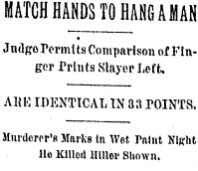
In September 1910, a Chicago homeowner in the present-day Beverly neighborhood surprised an intruder, and was shot dead. (pdf) In the course of the fight or the flight, the prowler splooshed his left hand into some wet paint on a railing.

Thomas Jennings, a paroled burglar, was arrested near the scene, and his fingerprints shown to match those left in the grieving Hiller household. A prosecution expert even gave a courtroom demonstration of dusting for prints.

This was as novel to judges as to jurymen, and given the dearth of other positive evidence against Jennings, the Illinois Supreme Court was called upon to deliberate upon the humble dactylogram. In the summer of 20111911, it stopped Jennings’ hanging just hours before it was to take place.

But its final word in December 20111911 only fitted the homebreaker’s noose.

We are disposed to hold from the evidence of the four witnesses who testified, and from the writings we have referred to on this subject, that there is a scientific basis for the system of fingerprint identification, and that the courts cannot refuse to take judicial cognizance of it …

Such evidence may or may not be of independent strength, but it is admissible, with other proof, as tending to make out a case. If inferences as to the identity of persons based on voice, the appearance or age are admissible, Why does not this record justify the admission of this fingerprint testimony under common law rules of evidence.

Courtrooms all around the world soon agreed, and within a generation the awesome investigative power of the fingerprint had fugitives going so far as to slice or burn off those incriminating little pads of flesh — the crime scene gold standard until the advent of DNA testing.

Jennings was hanged this date in a state-record five-man batch (the others, Ewald and Frank Shiblawski, Philip Sommerling, and Thomas Schultz, had all committed an unrelated murder together).

On this day..

1845: John Gordon, the last hanged in Rhode Island

Last year, the Rhode Island General Assembly approved a measure posthumously pardoning John Gordon — who on February 14, 1845 was the last man executed in that state.

Gordon’s hanging, for the murder of a prominent industrialist who had bad blood with Gordon’s brother, was long notorious in Rhode Island as one secured on highly uncertain evidence in an atmosphere of anti-Irish prejudice.

Executed Today is pleased to welcome on this occasion University of Rhode Island labor historian Scott Molloy, author of Irish Titan, Irish Toilers and a major advocate of the Gordon pardon.

ET: Can you set the scene — what’s going on in Rhode Island at this time, and what are the tensions surrounding Irish immigrants?

SM: Rhode Island was the site of the first factory in America in the 1790s, called Slater Mill. It really changed the face of Rhode Island and eventually the rest of the US.

In Rhode Island, curiously, as more and more people left the farms to work on the mills, they had an unusual requirement that really didn’t make any difference years earlier: in order to vote, you had to have so much land. (Specifically, $134 worth of land.)

By 1840, not only were the usual suspects not able to vote — women, people of color, Native Americans — 60% of native-born white male Rhode Islanders were also unable to vote. It meant that just a handful of people ruled the state, compared to the time of the American Revolution when just about every white male could vote. And immigrants in particular — and in those days, that was the Irish — were basically precluded from voting. You had a residency requirement, a property qualification. It made Rhode Island almost unique in New England, almost like a southern state.

A group of reformers came to the forefront, a guy named Thomas Wilson Dorr, a blueblood aristocrat, Harvard-educated, one of the best legal minds of the country. He threw his lot in with the reformers to try to get people the right to vote. It really polarized the state in 1842.

The Irish were sympathetic, but Irish priests tried to keep them out of it because they wanted to acclimate. But because a lot of the animosity toward people having the right to vote was directed at Irish immigrants. People blamed the Irish even though the Irish didn’t get particularly involved in the Dorr War.

Often times they got blamed for everything whether they did it or not. And of course we face the same situation with immigrants today.

What was the crime and how did the Gordons come to be the focus of the prosecution?

In 1843, a Yankee industrialist out in Cranston by the name of Amasa Sprague was found on New Year’s Eve 1843 bludgeoned to death in what today we might call a hate crime. He had a gold watch still on him, he had money in his poket, and he had been beaten to death.

Amasa Sprague was a very influential guy. His older brother who helped run the mill with him and was the US Senator from Rhode Island had the local city council lift the liquor license from the Gordon family’s business, which for all intents and purposes ended their livelihood. This was Nicholas Gordon’s shop: John Gordon had only just crossed over from Ireland.

When Sprague was found dead about six months after the license was lost, they focused on the Gordon family. The authorities formed a posse and they went after this Irish family.

Book CoverHow did anti-Irish sentiment manifest itself at trial?

The juries in all three trials had no Catholics and no Irish that I’m aware of. There was a lot of religious and socioeconomic animosity.

At the time, the Supreme Court of the state would sit in on the whole trial just because it was a capital trial, and the trial judge would say in the transcript — which is still available (pdf) — he basically says to the jury, if you find testimony that contradicts itself between a Yankee and an Irish witness, you should give the Yankee testimony more credence.

Doesn’t the fact that John Gordon’s brothers were not convicted militate against the notion of overwhelming anti-Irish prejudice?

You can’t go overboard on these things. The juries — all three of them — they found one Gordon innocent and in the other case they had a hung jury. I don’t want to say they were completely prejudiced, because they weren’t, but almost everything else in Rhode Island at that time was stacked up against them.

The earlier Irish who came in the 1820s and 1830s were a little bit better off, a little bit better-educated [compared to later Irish immigrants after the potato famine]. The animus against the Irish was still intense; the Irish were seen as criminal, unskilled, uneducated, ignorant. The Protestant majority at the time, mostly of English heritage, kind of brought that over with them even though they had been there for a long time.

So how did the legal proceedings play out?

They put two of the recently immigrated brothers up for conspiracy for murder, but not the oldest brother. So John Gordon and his brother William go on trial first.

The jury came back with a guilty verdict for John Gordon, who didn’t have much of an alibi, but a not guilty verdict for William, who did have an alibi. So you’ve got a conspiracy conviction with only one conviction.

Then they put Nicholas Gordon on trial, and the jury comes back deadlocked. His second trial is not going to be until the spring of 1845. In the interim, his brother John was to be hanged, Valentine‘s Day 1845 — rather than wait to see what happened at Nicholas Gordon’s trial and whether there even is a conspiracy.

The defense petitions the governor and the general assembly to hold off the execution until after the trial of the oldest brother. The governor washes his hands of it, and the general assembly votes very narrowly to go ahead with the execution.

So they hang him, and what’s interesting in that part of it is an itinerant, traveling Catholic priest — a guy named Father John Brady — hears John Gordon’s last confession.

Well, they invite the elite of providence inside the prison to watch the hanging. (There’s about 1,000 Irish outside the prison in support of John Gordon.) When they put the noose around his neck, the priest is with him, and the priest berates the elites and authorities, and he says, John, you are going before a just God who has seen way too many of your countrymen.

I always argue in my writings that this guy, he’s an immigrant, he’s uneducated, he’s just been in America for a few months. I just can’t believe that this guy would ever lie to the priest hearing his last confession, and the priest would never berate the elites unless he’d heard a confession of innocence.

After John Gordon’s hanging, his brother Nicholas goes on trial as planned, and they come back with another hung jury — this time, with a majority voting him as innocent. They were going to try him again except about 18 months later, Nicholas dies of natural causes.

I’ve seen a lot of people describe growing up hearing unambiguously that this was a wrongful execution. Is that how it was perceived right from the start? How universal was/is that perception?

There was such a collective feeling of guilt about this that in 1854, Rhode Island abolished the death penalty and John Gordon was the last person ever executed there.

There’s one flaw in the law. This was added late in the 20th century, that anyone convicted of killing a prison guard during an escape could still be killed. And there was an incident, I remember it as a kid maybe 30 years ago, but they still didn’t condemn even that person to death. But Rhode Island has never changed that.

None of us who ever testified ever said categorically that John Gordon was innocent, because we just can’t prove that. But we did say that he never got a fair trial, just like Sacco and Vanzetti in the 1920s.

We did in our research was come up with two or three suspects who had much better reason to assassinate Sprague. But there were no witnesses to the case. It was all circumstantial evidence. I have to say, every time I look at the case — there are some pieces of evidence that would make the Gordons look very guilty. There are other aspects of it that make them look very innocent. If it was in today’s world, the police would interrogate them as people of interest.

It’s not as cut-and-dried as some people make it. All I know is that they got an unfair trial.

Gordon was posthumously pardoned last year. How did that campaign get going, and how receptive were folks in the capitol?

The problem was a lot of people had forgotten the case. I had been writing for a number of years op-ed pieces in the Providence Journal, and mentioned John Gordon from time to time.

But it was an 80-year-old guy named Ken Dooley, and he grew up a couple miles from the murder site near Cranston, and he was a playwright. He came back home and remembered his grandmother singing some little ditty of a song 70 years ago saying something like “Poor Johnny Gordon”, and so he researched it, and he wrote a play.

And they put it on in Cranston, and over the couse of the month several thousand people saw it. A state representative, an Irish guy, saw the play four or five times and then introduced that into the general assembly trying to obtain a posthumous pardon — just to say that the evidence didn’t support the execution.

And Gov. Chaffee, who comes from an ancient Yankee family in Rhode Island, signed the damn thing. It was that play that this guy wrote and we were all amazed that this kind of came out of the blue. We held a lot of events around it — had church services, put up ceremonial headstones. I always tell people that I want this on my headstone: that I had a hand in getting John Gordon pardoned.


There are some excellent resources already available online concerning the Gordon case, including:

On this day..

1992: Johnny Frank Garrett, “kiss my ass because I’m innocent”

On this date in 1992, Johnny Frank Garrett was executed by lethal injection, with the tart last words,

“I’d like to thank my family for loving me and taking care of me. And the rest of the world can kiss my everloving ass, because I’m innocent.”

Although Garrett was only 17 at the time a nun from a neighboring Amarillo convent was raped and murdered, and he may have qualified as developmentally disabled to boot — both factors that today would exclude him from execution — that whole innocence story didn’t have much public traction.

“No, no, not at all,” New Mexico attorney Jesse Quackenbush told this site in an interview. “He was villainized from day one: he was a nun-murderer who needed to be executed. The only sympathy really came from the Pope.”

But two decades on, Garrett’s dying profession is one of the more troublesome skeletons in the Texas execution machine’s closet, thanks in no small part to Quackenbush himself.

Quackenbush directed the documentary The Last Word (viewable free on Netflix), a powerful brief not only for Garrett’s innocence* but against the comprehensive rot of the system that shunted hm off this mortal coil — from the front-line investigators all the way through the Lone Star State’s intentionally broken executive clemency farce.

“It was a system-wide failure that caused this kid to die. It wasn’t just the legal system,” Quackenbush said. “The media played a part. The governor was looking more to her own re-election hopes.* There was a dysfunctional family. The Supreme Court wasn’t morally deep enough to realize that executing 17-year-olds and ‘mentally retarded’ prisoners was wrong. There’s the system in Texas that allowed the prosecutors to hand-pick the pathologists to provide junk science.

“It’s a multifaceted failure, and no one facet is more to blame than the others.”

Garrett, a white teenager, disappeared into a Kafkaesque legal labyrinth, after the alleged supernatural vision of a local soothsayer acclaimed him the culprit in the murder of a nun named Tadea Benz. Corporeal indicia of guilt falls somewhere between circumstantial and laughable: fingerprints in a convent he had visited many times, the inevitable jailhouse snitch, and an unrecorded supposed “confession” that Garrett refused to sign.

As in a preponderance of death cases, especially in Texas (pdf), a meek and all-but-unfunded defense team offered scant resistance as prosecutors made the most of this eminently disputable evidence: once the one-sided trial was in the books and the crucial direct appeals likewise slipped past, the proceedings lay beyond the reach of judicial review.

This novel is inspired by the Garrett case.

For all that, there yet remains one un-litigated piece of evidence.

Around the time of Sister Benz’s death, there was another rape-murder of another elderly Amarillo woman, a crime that authorities publicly described as “too similar” to the Benz case not to be part of the same crime spree.

That case went unsolved … but years after Garrett’s execution, DNA databases matched an old semen sample from that second crime to a Cuban rapist (he was among the criminals and undesirables that Castro expelled to the U.S. during the Mariel boatlift) named Leoncio Perez Rueda.

Suggestive.

More dispositive evidence in the form of still-testable crime scene samples may yet reside in Amarillo’s evidence lockers — semen and blood samples that, in the era of DNA, Quackenbush thinks would exonerate Johnny Frank Garrett.

If testing this sort of thing sounds like a no-brainer, you don’t work for Amarillo.

“The [Garrett] family offered the city of Amarillo complete civic immunity and they still refused to run a DNA test, and threatened to countersue** if the family tried to pursue it,” Quackenbush says. “In the state of Texas there are still only laws protecting DNA access for living people: if you’re already executed, you have no rights.”

Which is a particular pity — since “the chances of executing innocent people are still really high.”

* Quackenbush’s case for Garrett’s innocence is outlined in this legal memo (pdf). This site maintains an extensive archive of resources about the case.

** In this, it’s not unlike the Ruben Cantu case, where post-execution evidence of innocence has also been met with legal threats by the state.

On this day..

1860: John Guthrie, antislavery horse thief

On this date in 1860 in “Bleeding Kansas” — the frontier zone of dirty war by and against the Slave Power where John Brown got his start — a man named John Guthrie was hanged under scant-to-no color of law.

The site of this execution is still known as Guthrie’s Mountain or Mound … and it’s even alleged that the spot is still ill-omened by the event, and that the dying Guthrie “assailed his executioners for lynching an innocent man,” prophesying that “each of them would meet a horrible death” which curse the imminent U.S. Civil War carried into effect.

For a fuller account, see this pdf of a 1982 Kansas History article, “Guthrie Mound and the Hanging of John Guthrie”.


I know a story I think worth preserving of a Bourbon county execution without benefit of clergy, but it was not a lynching. I have had the story from a lot of people, including two eyewitnesses — not participants, of course. Away back in the later territorial days, when Bourbon county was in the ‘region beyant the law,’ a young man named Guthrie was caught up near Mapleton riding somebody else’s horse. Everybody knows that at that time in those parts, horse stealing and nigger chasing and homicide were offenses in a class by themselves. The hardheaded and hard-fisted farmers thereabouts gathered in a hurry. But there were no courts that they respected or had reason to respect. What to do?

Just across the river south of Mapleton in the Little Osage bottom is a little round hill about three hundred feet high shaped almost exactly like an overturned soup bowl. They adjourned to the top of that hill. There they elected a judge and a sheriff and a prosecuting attorney. They selected a jury and tried their man, who admitted his guilt. After the verdict and the proper sentence, the sheriff had no place to keep the man, so he executed the sentence at once by hanging him to the limb of a jack oak tree nearby. His body was buried where it was cut dawn. It is there yet.

From what I have been told I am quite satisfied that that trial was quite as regular and formal as many cases in the regular courts of that day, though not sanctioned by the law.

By the way, that hill is the same ‘pretty little hill’ where Lieut. Zebulon M. Pike ate the fried venison steak that September morning in 1806, as he notes in his journal. It is still called Guthrie mountain, and is one of the real beauty spots of old Bourbon.

C.E. Cory, 1932

The horse-thief story has different versions, in which Guthrie is either innocent of the charge or not. For what it may be worth, the 1860 New York Times also reported a “very imperfect” version of this take.


However, there’s at least one primary document suggesting that “thieving” may have been a pretext for killing the man over his anti-slavery stance.

Mapleton, K. T., Feb. 12, 1860. “MY DEAR PARENTS: … Last Sunday night about 1 o’clock a man named John R. Guthrie was hanged about a mile and a half from here on the top. of what is known as Tigret Mound. He was left suspended until Monday eve. His corpse was in plain sight from here as he hung. The proslavery’s hung him for an alleged crime of horse stealing. They arrested him without authority or shadow of law and never gave him even a mock trial, as has generally been the case. The country is again in commotion. I know not what will be the result, the probability is that unless Montgomery takes the field again it will soon blow over and give them a chance to hang the next ones that gets in their way.

Free Stater (i.e., anti-slavery) Alpheus H. Taylor

On this day..

1951: The first four of the Martinsville seven

On this date in 1951, the first of two batches comprising the “Martinsville Seven” — black, all — went to the Virginia electric chair for gang-raping a white woman. (The remainder were executed on Feb. 5)


Newspaper scan (click for larger image) via Mr. Beaverhousen (cc).

Somewhat forgotten today, the Martinsville Seven were in their day the locus of radical activism against Jim Crow in the South — very much like Willie McGee, who was put to death in Louisiana later that same year.

In fact, this case generated a bit of a legal milestone: a month before the executions began, the U.S. Supreme Court declined an appeal seeking relief on the then-novel grounds of equal protection — rather than due process.

The argument was that the Old Dominion’s superficially race-neutral rape statute was anything but; that argument was buttressed by data showing that Virginia had executed 45 black men for raping white women from 1908 to 1950, but never once in that period executed any white man for raping a black woman. (The high court only declined to take the appeal; it wouldn’t get around to explicitly ruling equal protection claims based on racial patterns out of bounds until 1987’s McCleskey v. Kemp.)

This seems to be the debut use for this gambit, bound to become an increasingly powerful one both in and out of the courtroom during the civil rights movement.

And it was available — and necessary — here because the Martinsville Seven basically looked guilty as sin. Their confessions and the victim’s accusation and the testimony of a young eyewitness said that, drink-addled, they had opportunistically grabbed a white Jehovah’s Witness housewife when she was proselytizing on the wrong side of the tracks.

Eric Rise, author of The Martinsville Seven: Race, Rape, and Capital Punishment, noted in a scholarly article,*

certain striking characteristics distinguished the proceedings from classic “legal lynchings.” The evidence presented at trial clearly proved that nonconsensual sexual intercourse with the victim had taken place. All seven defendants admitted their presence at the scene, and although some of the men may not have actually consummated the act … The prosecution emphasized the preservation of community stability, not the protection of southern womanly virtues, as the dominant concern of Martinsville’s white citizens. Most significant, the trial judge made a concerted effort to mute the racial overtones of the trials. Although white juries decided each case, blacks appeared in every jury pool. Race-baiting by prosecutors and witnesses, notably evident at Scottsboro and other similar trials, was absent from the Martinsville proceedings. By diligently adhering to procedural requirements, the court attempted to try the case “as though both parties were members of the same race.”**

The standard playbook for fighting a “legal lynching” case was leveraging outrage over a plausibly innocent convict and an outrageous kangaroo court.†

Paradoxically, by taking these elements out of the mix (relatively speaking), the Martinsville Seven perfectly isolated the extreme harshness of the penalty and the structural discrimination under which it was imposed. The NAACP took up the case on appeal strictly for its discriminatory characteristics, steering for its part completely clear of any “actual innocence” argument.

These challenges posed discomfiting questions that jurists shrank away from. The Virginia Supreme Court, in denying an equal protection application, fretted that actual legal relief could mean that “no Negroes could be executed unless a certain number of white people” were, too. Timeless.

Though a later U.S. Supreme Court would completely overturn death-sentencing for rape, based in part on its overwhelming racial slant, justices have generally avoided meddling to redress broad statistical patterns rather than identifiable process violations specific to particular cases.

Those questions of substantive — rather than merely procedural — equality in the justice system remain potently unresolved, still part of Americans’ lived experience of the law from death row to the drug war to driving while black. As if to underscore the point in this instance, just two days prior to the first Martinsville executions, the Wall Street bankster acting as American proconsul in conquered Germany pardoned imprisoned Nazi industrialist Alfried Krupp, and restored him to the fortune he had amassed working Jewish slaves to death during the war. It was a very particular quality of mercy the U.S. showed the world in those days. (The Martinsville case was known, and protested, worldwide.)

Carol Steiker (she used to clerk for liberal Justice Thurgood Marshall, who as an NAACP lawyer worked on the Martinsville case) argues‡ that the Martinsville Seven’s legacy is linked to their later obscurity, for “[t]heir attempt to present statistical proof of discrimination in capital sentencing represents a ‘road not taken'” — neither in 1951, nor since.

The road taken instead had Joe Henry Hampton, 22, Howard Hairston, 21, Booker Millner, 22 and Frank Hairston, 19 electrocuted one by one this morning in 1951. Their three co-accused, John Clabon Taylor, 24, James Luther Hairston, 23, and Francis DeSales Grayson, 40, followed them on February 5.

* “Race, Rape, and Radicalism: The Case of the Martinsville Seven, 1949-1951” in The Journal of Southern History, Aug., 1992.

** This quote an actual trial admonishment of the judge, Kennon Whittle.

† Graded on a curve: this is still Jim Crow Virginia. Six trials were wrapped up at warp speed in 11 days, with a total of 72 jurors — each one white. The implied comparison is something along the lines of, all seven tried together in the course of an afternoon, with a good ol’ boy defense attorney mailing it in.

‡ Review of Rise’s book titled “Remembering Race, Rape, and Capital Punishment” in the Virginia Law Review, Apr., 1997

On this day..

2002: Daniel Pearl

“I decapitated with my blessed right hand the head of the American Jew, Daniel Pearl, in the city of Karachi, Pakistan. For those who would like to confirm, there are pictures of me on the Internet holding his head.”

-9/11 mastermind Khalid Sheikh Muhammad, in a claim made after torture in Guantanamo but nonetheless considered accurate according to a detailed 2011 report on Pearl’s death*

Warning: Although the filming was botched, this execution video still has plenty of gore and a severed head.

On this date in 2002, American hostage Daniel Pearl was executed by his captors in Karachi, Pakistan.

The 38-year-old Wall Street Journal reporter had been abducted January 23 by Islamic radicals while pursuing an interview with a (mistakenly) suspected handler of shoe bomber Richard Reid. Instead of being taken to the interview, Pearl was disappeared and held hostage for a variety of implausible demands targeting the United States’ relationship with Pakistan’s military government.

The reporter’s death this day was not confirmed until late February, when his killers released a video on the Internet interspersing images of American and Israeli violence with footage of Pearl speaking — and then, horrifically, of Pearl being beheaded with a knife.** It was the first of several hostagebeheading videos various militants would release in the next few years.

Pearl’s captors drew a direct line from his Jewishness to his murder in the statements they forced him to make:

My name is Daniel Pearl. I am a Jewish American from Encino, California USA … I come from, uh, on my father’s side the family is Zionist … My father’s Jewish, my mother’s Jewish, I’m Jewish … My family follows Judaism. We’ve made numerous family visits to Israel … Back in the town of B’nei Braq there is a street named after my great grandfather Chayim Pearl who is one of the founders of the town.

It was the more startling because Pearl himself was a very secular Jew. Pearl did not set out to be a martyr for his cultural or religious heritage: that identity as the identity was thrust upon him.

And it’s been suggested that it was thrust upon Pearl’s captors as well, whose object in kidnapping an American reporter might have been a much more parochial kidnapping commonplace — publicity, cash — but who became politically boxed in when their hostage was publicized by the media as a “Jewish-American reporter”. One of the emails the captors had pre-drafted actually announced Pearl’s release. It was edited after the kidnapping … to announce Pearl’s execution within 24 hours, as a Mossad agent. Al-Qaeda’s Khalid Sheikh Mohammed seems to have been summoned from outside the abductors’ circle as a ringer with the captors unsure of how to dispose of their prey.

As an investigative reporter, Pearl’s own work had in some notable instances countered the preferred narratives of American hegemony. For instance, his reporting rubbished American charges that the Khartoum pharmaceutical factory Bill Clinton ordered bombed in 1998 was actually a chemical weapons plant. His work in Kosovo led him to contradict the most bellicose “genocide” allegations from that region’s dirty ethnic war.

He was a star reporter in the prime of his life, a man who poured out words that defined a career and a public persona. From February 1, 2002, suddenly and without justice, that text was torn from his hands. In its place, during the charged months after September 11 and the American invasion of Afghanistan, came a silent Rorschach blot.

Pearl, the Jewish martyr. Pearl, the victim of blowback. Pearl, the journalistic icon. Pearl, the naive liberal in the heart of darkness. Pearl, the mandate for waterboarding and Iraq.

Pearl, the object lesson.

Pearl, the axe for others’ grinding.

Omar Sheikh, a Pakistani militant reportedly linked to Britain’s MI6 and the author of the kidnapping, was arrested within days of Pearl’s murder. He remains imprisoned under sentence of death in Pakistan for the crime.

* Mohammed also claimed that he wanted to kill Pearl personally to “make sure I got the death penalty” if he were eventually arrested.

** Among the many bone-chilling details to emerge from the subsequent investigation, it became clear that the actual murder was not shown — only some quick flashes of re-enacted throat-cutting — because the cameraman missed the shot of the kill.

On this day..