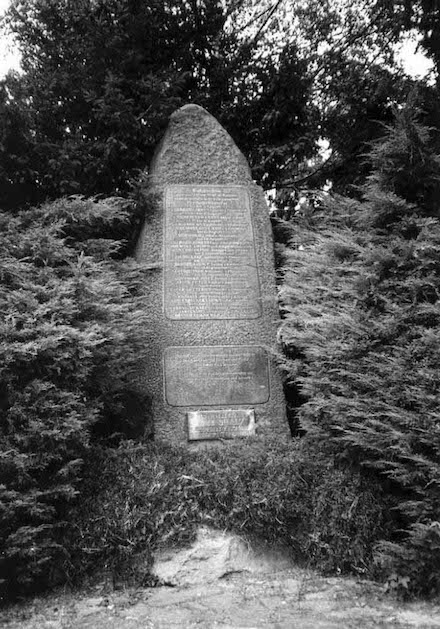
1741: John Ury, schoolmaster

Colonial New York’s summer 1741 slave rebellion panic* drew to a close on this date with the execution of the alleged Catholic priest John Ury.

The supposed plot to fire the city, whose reality and extent have been questioned ever since, had seen some 30 souls to the gallows and stakes these past four months after a suspicious series of fires hit the city in the spring.

The original supposed spider at the center of the web of was a white innkeep called John Hughson, who kept a raucous tavern frequented by blacks — and also kept a serving-girl named Mary Burton, the “eyewitness” who would become the inquisitor-judge Daniel Horsmanden‘s faithful familiar throughout the trials, conjuring every new accusation required of the next plot twist.

But even as Hughson was executed in June, the compounding accusations of people in fear of their lives had driven the story past the confines of his humble tavern, all the way to the capitals of the European powers against whom England was fighting a New World naval war. Jill LePore in New York Burning: Liberty, Slavery, and Conspiracy in Eighteenth-Century Manhattan characterizes four Venn-patterned seditions that investigators perceived over the course of these months:

  • Hughson’s Plot, centered on the publican and his establishment;
  • The Negro Plot, extending well beyond Hughson’s circle to compass perhaps the majority of black people in New York;
  • The Spanish Plot, a foreign plan — possibly coordinated with an internal slave rising — to destroy New York or seize her for Spain; and,
  • The Catholic Plot.

It was the last of these, perfectly calibrated for the Anglo id, that would gather all the other strands together. What hand could unite the threats within and without? The priest. Who moved conspiratorially among Englishmen while obeying the dictates of a foreign potentate? The priest. Who gave men the boldness to murder their masters through his promise of absolving worldly sin? The priest.

The confusing — the incoherent — unfolding of trials that summer became marvelously clarified once apprehended as a Catholic intrigue; maybe the only wonder was that this decisive reveal emerged so late. The prosecutor of the trial that concerns us in this post would say as much in his summation:

Though this work of darkness, in the contrivance of a horrible plot, to burn and destroy this city, has manifested itself in many blazing effects, to the terror and amazement of us all; yet the secret springs of this mischief lay long concealed: this destructive scene has opened by slow degrees: but now, gentlemen, we have at length great reason to conclude, that it took its rise from a foreign influence; and that it originally depended upon causes, that we ourselves little thought of, and which, perhaps, very few of the inferior and subordinate agents were intimately acquainted with.

Gentlemen, if the evidence you have heard is sufficient to produce a general conviction that the late fires in this city, and the murderous design against its inhabitants, are the effects of a Spanish and popish plot, then the mystery of this iniquity, which has so much puzzled us, is unveiled, and our admiration ceases: all the mischiefs we have suffered or been threatened with, are but a sprout from that evil root, a small stream from that overflowing fountain of destruction, that has often deluged the earth with slaughter and blood, and spread ruin and desolation far and wide.

It might have been a warning letter sent by governor of Georgia, James Oglethorpe, that prepared this popish cast to events. “Some intelligence I had of a villainous design of a very extraordinary nature, if true, very important, viz. that the Spaniards had employed emissaries to burn all the magazines and considerable towns in the English North-America,” Oglethorpe wrote in May of 1741. And who were these “emissaries”? “Many priests were employed, who pretended to be physicians, dancing-masters, and other such kinds of occupations; and under that pretence to get admittance and confidence in families.”

These few words would prove a death warrant.

Days after Oglethorpe’s letter arrived to New York, a Manhattan newcomer named John Ury was taken up as a suspected undercover priest — appearing to fit Oglethorpe’s description for he had advertised himself a schoolmaster “pretending to teach Greek and Latin.” Latin!

Mary Burton, the Hughsons’ servant turned stool pigeon for all seasons, revised her original depositions averring that she had never seen white people besides her own household at Hughson’s nefarious negro gatherings and now conveniently remembered that this guy named Ury or Jury “used to come there almost every night, and sometimes used to lie there.” And he was Catholicizing the slaves as he inducted them into a spectacular conspiracy. How could I have forgotten to mention it?!

“Corroborating” testimony to this same effect would also be wrenched from the white soldier William Kane … when Mary’s fabrications against Kane forced him to choose between joining his accuser in perjury or joining slaves at the gallows. And the case was cinched by John Hughson’s miserable daughter Sarah, who spent that entire summer suspended between life and death before she was finally pardoned on the very morning of John Ury’s trial — an expedient necessary to clear the reluctant but desperate young woman to provide evidence against the “priest.”

Ury denied being Catholic at all; he defended himself vigorously in a nine-hour trial and clowned his accuser on cross-examination:

Prisoner: You say you have seen me several times at Hughson’s, what clothes did I usually wear?

Mary Burton: I cannot tell what clothes you wore particularly.

Prisoner: That is strange, and [k]now me so well.

Furthermore, Ury noted, he had been forewarned of the suspicions against him but not attempted to flee. Plus, what about all those people who had been executed since May? “The negro who confessed as it is said that he set fire to the fort did not mention me in all his confession doubtless he would not have neglected and passed over such a person as I am said to be … neither Huson his wife nor the creature that was hanged with them and all that have been put to death since did not once name me.”

Show trials are not proper venues for defenses, of course. If anything can be said on behalf of Ury’s appalling prosecution, it is that the production of an arch-villain permitted the final closure of a terrorist-hunt that weeks before had seemed on the verge of becoming a literal hecatomb. Horsmanden’s senior colleague on the bench, James De Lancey, had shown keen to wrap things up; at the same time, as an Atlantic oligarch, he likely viewed the foreign threat of the Spanish and/or Catholic plot far more gravely. From either perspective, Ury’s death was a fit end to the scene.

Ury was hanged on August 29, 1741, a month to the day after his trial. (He was originally to have shared his gallows with the Spaniard Juan de la Silva on August 15, but had been respited.) The freelance teacher turned infernal mastermind prepared a written vindication of himself for a friend, and at the gallows he “repeated somewhat of the substance of it before he was turned of.” Here it is:

Fellow Christians —

I am now going to suffer a death attended with ignominy and pain; but it is the cup that my heavenly father has put into my hand, and I drink it with pleasure; it is the cross of my dear redeemer, I bear it with alacrity; knowing that all that live godly in Christ Jesus, must suffer persecution; and we must be made in some degree partakers of his sufferings before we can share in the glories of his resurrection: for he went not up to glory before he ascended Mount Calvary; did not wear the crown of glory before the crown of thorns.

And I am to appear before an awful and tremendous God, a being of infinite purity and unerring justice, a God who by no means will clear the guilty, that cannot be reconciled either to sin or sinners; now this is the being at whose bar I am to stand, in the presence of this God, the possessor of heaven and earth, I lift up my hands and solemnly protest I am innocent of what is laid to my charge: I appeal to the great God for my non-knowledge of Hewson [sic], his wife, or the creature that was hanged with them, I never saw them living, dying, or dead; nor never had I any knowledge or confederacy with white or black as to any plot; and upon the memorials of the body and blood of my dearest lord, in the creatures of bread and wine, in which I have commemorated the love of my dying lord, I protest that the witnesses are perjured; I never knew the perjured witnesses but at my trial.

But for the removal of all scruples that may arise after my death I shall give my thoughts on some points.

First — I firmly believe and attest, that it is not in the power of man to forgive sin; that it is the prerogative only of the great God to dispense pardon for sins; and that those who dare pretend to such a power, do in some degree commit that great and unpardonable sin, the sin against the Holy Spirit, because they pretend to that power which their own consciences proclaim to be a lie.

Again, I solemnly attest and believe, that a person having committed crimes that have or might have proved hurtful or destructive to the peace of society, and does not discover the whole scheme, and all the persons concerned with them, cannot obtain pardon from God: and it is not the taking any oath or oaths that ought to hinder him from confessing his guilt, and all that he knows about it; for such obligations are not only sinful, but unpardonable, if not broken: now a person firmly believing this, and knowing that an eternal state of happiness or misery depends upon the performance or non-performance of the above-mentioned things, cannot, will not trifle with such important affairs.

I have not more to say by way of clearing my innocence, knowing that to a true Christian unprejudiced mind, I must appear guiltless; but however, I am not very solicitous about it. I rejoice, and it is now my comfort (and that will support me and protect me from the crowd of evil spirits that I must meet with in my flight to the region of bliss assigned me) that my conscience speaks peace to me.

Indeed, it may be shocking to some serious Christians, that the holy God should suffer innocence to be slain by the hands of cruel and bloody persons; (I mean the witnesses who swore against me at my trial), indeed, there may be reasons assigned for it; but, as they may be liable to objections, I decline them; and shall only say, that this is one of the dark providences of the great God, in his wise, just and good government of this lower earth.

In fine, I depart this waste, this howling wilderness, with a mind serene, free from all malice, with a forgiving spirit, so far as the gospel of my dear and only redeemer obliges and enjoins me to, hoping and praying, that Jesus, who alone is the giver of repentance, will convince, conquer and enlighten my murderers’ souls, that they may publicly confess their horrid wickedness before God and the world, so that their souls may be saved in the day of the Lord Jesus.

And now, a word of advice to you, spectators: behold me launching into eternity; seriously, solemnly view me, and ask yourselves severally, how stands the case with me? die I must: am I prepared to meet my Lord when the midnight cry is echoed forth? shall I then have the wedding garment on? Oh, sinners! trifle no longer; consider life hangs on a thread; here to-day and gone to-morrow; forsake your sins ere ye be forsaken forever: hearken, now is God awfully calling you to repent, warning you by me, his minister and prisoner, to embrace Jesus, to take, to lay hold on him for your alone savior, in order to escape the wrath to come; no longer delay, seeing the summons may come before ye are aware, and you standing before the bar of a God who is consuming fire out of the Lord Jesus Christ, should be hurled, be doomed to that place, where their worm dies not, and their fire is never to be quenched.

* Longtime readers may recall that the series to which this post belongs ran last year. Embarrassingly I lost track of the date, and in the almanac form the calendar is unforgiving.

On this day..

388: Magnus Maximus, minimized

On this date in 388, Magnus Maximus, partially successful usurper of the western Roman Empire, was put to death by Emperor Theodosius.

The late centuries of Rome witness many a rebellious general but the smart money in a civil war rarely fancied the guy whose power base was distant Britannia. With his bombastic name and balls to back it, Magnus bigly bucked those odds, defeating and murdering the western Augustus Gratian in Gaul in 383. From there he bossed Africa, Britain, and his native Spain for several years.

The departure from Britain of this local chancer made good would prove to correspond approximately with the empire’s crumbling foothold on on the island, with the sandal-shorn Roman feet in ancient times last walking upon England’s mountains green in 410. As the last, most scintillating representative of Roman Britain, Magnus Maximus has survived into legend — extolled for example by Geoffrey of Monmouth as the title hero of “The Dream of Macsen Wledig”. In it, “Macsen”/Maximus weds a Welsh princess and sires a native dynasty, granting Brittany to the Britons in gratitude for their aid as he conquers Rome.

But forget living in legend. The real Magnus Maximus, like every aspirant to the dangerous purple, mostly just worried about living out the next campaign season.

He had a spell of tense peace with his eastern opposite number, during which time Maximus — a staunch Nicene Christian — had the distinction in 385 of decreeing the trial on trumped-up sorcery charges of the dissident bishop Priscillian. It’s widely, if loosely, accounted the very first intra-Christian heresy execution. (Saint Ambrose of Milan and St. Martin of Tours both intervened strongly to oppose this precedent which has spawned so very many imitations.)

Meanwhile Maximus and Theodosius maneuvered toward inevitable civil war and it is obvious from his presence on this here blog that Maximus on this occasion did not rise to his nomens. As Zosimus describes,

Theodosius, having passed through Pannonia [routing Maximus in the process -ed.] and the defiles of the Appennines, attacked unawares the forces of Maximus before they were prepared for him. A part of his army, having pursued them with the utmost speed, forced their way through the gates of Aquileia, the guards being too few to resist them. Maximus was torn from his imperial throne while in the act of distributing money to his soldiers, and being stripped of his imperial robes, was brought to Theodosius, who, having in reproach enumerated some of his crimes against the commonwealth, delivered him to the common executioner to receive due punishment.

Such was the end of Maximus and of his usurpation.*

The poet Pacatus thereafter paid the conquering Theodosius homage for this victory in one of antiquity’s great panegyrics. (Enjoy it in the original Latin here.) Sure he lost the war, but how many figures are both magnus and maximus in fields as disparate as Celtic mythology and classical rhetoric?

Audiophiles might enjoy history podcasters’ take on Magnus Maximus: he’s been covered by both the British History Podcast (episode 31) and the History of Rome Podcast (episodes 156 and 157).

* After the post-Maximus arrangements Theodosius made in the west also went pear-shaped, necessitating yet another conquest and execution, Theodosius established himself as the emperor of both the eastern and western halves of the Roman world in 392. He was last man ever destined to enjoy that distinction.

On this day..

1810: Santiago de Liniers

On this date in 1810, a French officer in Spanish service became an Argentine martyr.

Jacques de Liniers — or Santiago de Liniers, in the Hispanized form* — was a cavalryman turned naval officer descended of a storied noble house,** and he made his bones serving Bourbon princes on either side of the Pyrenees.

Bumping out of the French service in his early twenties, Liniers (English Wikipedia link |French | Spanish) entered his life’s destined course when he took the Spanish colors to fight the Moors in Algiers in 1774.

Progressing thence to the navy, Liniers enjoyed a variegated career at sea in the last quarter of the 18th century, participating among other engagements in the Bourbon-backed American Revolution, and in the Barbary Wars.

By the 1790s he had washed up in the Spanish possessions in the cone of South America, then organized as the Viceroyalty of the Rio de la Plata. Here he would achieve both glory and death, coming to the fore of the colony when a surprise 1806 British attack seized lightly-defended Buenos Aires during the Napoleonic Wars. Vowing to make an offering of this interloper Home Riggs Popham‘s Union Jacks to the Dominican convent where he took refuge, Liniers escaped from the occupied city to nearby Montevideo (present-day Uruguay) where he marshaled a local militia that successfully stormed Buenos Aires.

As a result, that convent still holds the captured British flags to this day … and the white-haired Liniers (he was 53 years old at this point) stands front and center in triumph in a famous painting accepting the rosbif surrender:


La Reconquista de Buenos Aires, by Charles Fouqueray (1909).

With the official leadership having fled the place, a “cabildo abierto” — an “open council” assembly of all the city’s heads of household† — anointed the re-conqueror Liniers the new viceroy.

We catch in this easy conversion of military success to populist support a foreshadowing of the caudillo political character that would so color the coming centuries of post-independence politics, writes Lyman L. Johnson in Workshop of Revolution: Plebeian Buenos Aires and the Atlantic World, 1776-1810 — “the first appearance of personalist politics in Buenos Aires … While his closest allies worked the crowd in the Plaza Mayor to demand the substitution of the viceroy, Liniers was conveniently absent in the suburbs, an absence that forced the crowd to march en masse to return him in triumph to the city.” Thereafter, “[l]eaders elevated by contested and irregular means, Liniers the prime case, would now legitimze their claims to power on the massed authority of the transformed porteno plebe.”

Buenos Aires wasn’t the only thing transforming. Across the ocean, Napoleon’s invasion had the Spanish crown on the run. King Charles IV of Spain had recognized Liniers as “Count of Buenos Aires” before Charles’s forced abdication in 1808; however, the Junta of Seville that tenuously asserted itself the Spanish rump state dispatched a different guy as viceroy and Liniers accepted that fellow’s appointment and resigned his post. It’s a surprising decision in retrospect, one that reminds of Liniers’s Old World, ancien regime roots: this very moment in time, with the Spanish crown reduced to a bauble and the Peninsular crises leaving the empire’s overseas possessions to their own devices, saw the advent of breakaway movements throughout South America. Many of Spain’s former colonies there date independence to the 1810s or 1820s as a result.

Argentina marks its independence from July 9, 1816, but that event was product of a separatist war that began with the 1810 May Revolution. This affair deposed the post-Liniers viceroy upon news of French gains in Iberia that had collapsed even the Junta of Seville. If nobody’s left in charge — why not us? (The May Revolution continued to govern in the name of the occulted Spanish king, which is why it doesn’t get the independence day laurels.)

At this, Liniers came out of retirement like an aging pugilist for one fight too many, and mounted an ill-fated royalist counterrevolution. Instead of re-creating the glories of his campaign against the British, Liniers saw his soldiers desert him to an anticlimactic capture.

He was shot together with Juan Antonio Gutierrez de la Concha and three officers of their late unreliable militia at a small town between Cordoba and Buenos Aires called Cabeza de Tigre (“Head of the Tiger”; today it’s known as Los Surgentes‡).

Despite his dying in an attempt to stand athwart Argentinian independence, his heroism against the British has secured him posthumous honor in a country he never wanted to exist. There’s a Liniers neighborhood in Buenos Aires, and a town of Santiago de Liniers; his former estate in Cordoba is preserved today as a museum and UNESCO heritage site.

* The name in either form is “James”; he got it because his birthday, July 25 of 1753, was the feast of St. James.

** The letters of U.S. Founding Father Thomas Jefferson — present in Paris as an envoy from 1784 to 1789 — preserve an invitation from another Liniers (Santiago’s older brother, the comte de Liniers?) “to a game of chess with pear and melon.”

† As distinct from the regular (“closed”) municipal council, comprising just a few handpicked grandees.

‡ Los Surgentes is unfortunately also known for an infamous 1976 massacre of disappeared leftists.

On this day..

1945: Seven German POWs

On this date in 1945, the U.S. Army hanged seven German submariners for their “traitor slaying” of a Werner Dreschler at the Arizona POW camp they all inhabited.

Their victim Werner Drechsler had been captured when his U-Boat was sunk of the Azores. Having no great love for the Nazi government which had tossed his father in a concentration camp, Drechsler willingly went to work for the Americans as a mole in the POW camps, scavenging his captive countrymen for whatever particles of actionable intelligence they might be willing to blab to a fellow prisoner.

Parked in Fort Meade, Maryland, Dreschler’s war figured to be long over. However, a careless (or worse?) March 1944 transfer to a different POW camp at Papago Park, Arizona put the turncoat into a prisoner pool that included his former U-Boat mates, and these men knew that Dreschler was “a dog who had broken his oath.”

Mere hours after his arrival to Papago Park, a drumhead court had convened to “try” Drechsler in absentia and when his fellow Kriegsmariners doomed him a traitor, he was attacked, beaten senseless, and then hanged in a prison shower.

Helmut Carl Fischer, Fritz Franke, Gunther Kulsen, Heinrich Ludwig, Bernhard Reyak, Otto Stengel, and Rolf Wizuy, were sentenced on March 15, 1944 for carrying out this murder, and all owned the deed upon their honor as Germans and soldiers.*

Still, they outlived the war — cynically dangled, Richard Whittingham argues in Martial Justice: The Last Mass Execution in the United States, as bargaining chips to protect American POWs in Berlin’s hands, and then cynically released to the executioner when the Third Reich’s disappearance dissipated their value as prisoner swap currency. (Seven different German POWs had been executed earlier that same summer.) It was the least the U.S. military could do after having more or less tossed poor Drechsler into a pit of crocodiles.

“The trap was sprung on the first man at 12:10, and the last man went to his death at 2:48 a.m.,” read the bulletin in the Fort Leavenworth News, army paper at the Kansas penitentiary where our day’s principals paid their forfeit. (Via) “A new system for mass hangings has been devised at the institution which saved more than an hour in the procedure.”

But mass hangings too were going out of fashion faster than Hitlerism, and this great leap forward in the executioner’s efficiency has never since been required again at Fort Leavenworth.

* It wasn’t necessarily a given that duty to German martial orders would cut no ice with the western Allies.

On this day..

1943: Gunnar Eilifsen, good cop

Policeman Gunnar Eilifsen on this date in 1943 achieved the undesirable distinction of becoming the first person executed under the auspices of Norway’s World War II collaborationist Quisling government.

As an officer in Oslo, Eilifsen got himself in hot water with the Reichskommissar Josef Terboven when he supported several constables’ refusal to arrest girls who shirked the national labor conscription.

Terboven’s orders-must-be-followed jag was excessive even by the standards of a fascist puppet state, and a court told him to get lost. So, Terboven “appealed” by keeping Eilifsen in custody until later that day, when he arranged a do-over proceeding with handpicked judges and no defense.

The disobedient cop was shot the next sunrise. Three days later the dubious execution was retroactively legalized by a law subjecting the police to the military code, a measure sometimes sarcastically dubbed the “”Lex Eilifsen”.

On this day..

1944: Lucien Natanson

Erwin Lucien NAUM-NATANSON, born in Bucharest (Romania), on April 5th, 1921, merchant, son of Julien and Jeanne SCHWARTZ, husband of Jeanine Hélène PROVOST, living in La Paute, killed in La Paute, on August 14th, 1944, around 21 o’clock.

The excerpt above from a report of judges and doctors of Le Bourg-d’Oisans on the executions inflicted by a German column in August 1944 comes from a family page compiled by a cousin of Lucien Natanson. Twenty-three years old and Jewish, Natanson had spent the war years laying low with his family in southeastern France until … well … read on.

On this day..

1944: Eliga Brinson and Willie Smith, American rapists abroad

Privates Eliga Brinson (of Tallahassee, Florida) and Willie Smith (of Birmingham, Alabama) were hanged on this date in 1944 at Shepton Mallet prison.

The two U.S. servicemen had ambushed and raped 16-year-old Dorothy Holmes in Gloucestershire that April. Tried and sentenced by the U.S. military, their hangings occurred over 100 years after Great Britain abolished the death penalty for rape.

On this day..

1941: Sheyna Gram and the Jews of Preili

(Thanks to Meaghan Good of the Charley Project for the guest post. -ed.)

On this date in 1941, less than two months after Germany invaded the Soviet Union, fifteen-year-old Sheyna Gram and her parents and younger brother were murdered, together with approximately 1,500 Jewish people from the town of Preili in the occupied Latvian SSR. Nearly the entire Jewish population of Preili was wiped out by the ever-diligent Einsatzgruppen.

During World War II the Nazi death squads moved from town to town in Poland and Eastern Europe. They had one job and they performed it very well, slaughtering Jews and other “undesirables” by their thousands, most notably at Babi Yar outside of Kiev in Ukraine, where 33,771 people were killed in two days.

Preili, one of the oldest Jewish settlements in Latvia, was a much smaller community than Kiev; when the German invasion began, it had a population of less than two thousand, around half of whom were Jewish.

Latvia as a whole had a prewar Jewish population of just under 100,000. Only a few thousand of them survived, mostly those who were evacuated deep into Soviet territory and beyond the reach of the Wehrmacht. Of all the Jews in Preili, only six survived the war.

Preili was no different than any of the other Soviet Jewish communities wiped out in the Holocaust, but we know details about what happened there because Sheyna Gram left a diary behind. She chronicled the day-to-day events of the German occupation from June 22, the day the Nazis invaded the USSR, until August 8, the day before she and her family were killed.

Shortly after the war, noted Soviet journalists Ilya Ehrenburg and Vasily Grossman traveled all around the USSR, interviewing people and collecting eyewitness testimonies, letters, diaries, and other documents to bear witness to the Soviet Jewish experience during the German occupation. The result, titled The Complete Black Book of Russian Jewry, was the first major documentary work on the Holocaust. However, it wasn’t actually published until 1993, and even then it was nowhere near “complete.” In 2008, Indiana University Press translated and published The Unknown Black Book: The Holocaust in the German-Occupied Soviet Territories, which consists of accounts and documents that didn’t make it into the first Black Book; the second book is nearly as long as the first.

Among the documents included in the second volume is Sheyna Gram’s diary, translated from Yiddish. It somehow survived the war even though its author had not, and even seventy-plus years later, Sheyna has not been forgotten. Several books about the Holocaust in Latvia have referenced her diary, comparing its writer to Anne Frank, and at least one play based on the diary was performed in Latvia in around 2012.

Per The Unknown Black Book, the Gram family consisted of Itzik, a 60-year-old tailor, his 52-year-old wife, and their four children: sons Gutman, 18, and Leyba, 12, and daughters Freya, 20, and Sheyna. Evidence in the diary suggests they were not a particularly observant Jewish family.

The Unknown Black Book reports that Gutman survived the war, serving in the Red Army, but Yad Vashem’s Central Database of Shoah Victims has a page of testimony for him stating he was killed in military service. Although Mrs. Gram is unnamed in The Unknown Black Book, a search of the Database of Shoah Victims turns up a Sara Gram née Zangvil who lived in Preili and was the right age. The same person, Shmuel Latvinskiy, submitted Sara and Gutman Gram’s testimonies, and Sheyna’s as well; he names himself as Sara Gram’s nephew, Gutman’s cousin, and Sheyna’s relative, making it all but certain that Sara Gram was Sheyna’s mother.

What little information is available about Sheyna indicates she was an ordinary enough teenager. She was a good student, “an intelligent girl of good spiritual development,” and had just finished the sixth grade at school when war broke out. She started her diary that very day with a few sentences, and wrote entries regularly until her death:

June 22. At twelve o’clock, the radio announced, “Germany has declared war on the USSR. At four o’clock this morning, German aircraft bombed several Russian cities.”

Toward evening, I went to Ribenishki [seven kilometers from Preili]. I sit by the radio all the time until midnight. They tell you how to protect yourself from an air raid.

The next day, Sheyna recorded that Daugavpils* had been bombed and “a state of siege has been declared.” Wanting to do her part to help with the war effort, she signed herself up for first aid lessons. “New people are coming into town all the time,” she wrote. “Each person has something new to report. The Germans are successfully advancing.” Over the following days there was an 8:00 p.m. curfew and various new rules: radios were confiscated, freedom of assembly was curtailed, and windows had to be covered.

By July 2, the Germans had arrived in Preili. The following day Sheyna wrote,

The first day went quietly. On the second day, the Germans smashed the shops and looted everything. They broke into the synagogue, hauled out the Torah scrolls, and trampled on them. In other streets, they go on various sorts of rampages. […] We are living in a state of great fear. Many Germans have stopped in our town. There are some proper gentlemen among them as well. They keep on reassuring us that they are not going to touch the workers. A decree is published that Jews and Russians do not have the right to fly their national flags. Walking on the street is permitted until 10:00 p.m., but no one dares poke their head out the door.

As per standard operating procedure, the Nazis ordered Jews to wear a six-pointed yellow star, “twelve centimeters wide and long. Men are to wear it on their backs, their chests, and their legs, just above the knee. Women will wear them on their chests and on their backs.” For the rest of the month, Jews were regularly rounded up for forced labor. Sheyna was assigned to a work party cutting peat; roll call was at five in the morning and work didn’t stop until 7:00 p.m.

Except when she was working, she didn’t leave home. She whiled away the empty hours sleeping, studying Russian, reading back issues of the Jewish magazine Yidishe bilder, and writing in her diary.

On July 27, she wrote:

This is a bloody Sunday for the Latvian Jewish people.

Morning. All the Jews in Dvinskaya Street are ordered to put on their best clothes, take some provisions with them, and go out into the street. Searches of the homes are carried out. At twelve o’clock, all the Jews are herded into the synagogue. One group of young Jews is sent to dig graves behind the cemetery. Then the Jews of two more streets are driven into the synagogue.

It is 3:30 in the afternoon. All the Jews are chased out beyond the cemetery and shot there. All 250 Jews: men, women, and children.

This is terrible. We did not expect things to end this way. The handful of survivors expects death at any moment.

Iossif Rotchko’s untranslated book about the Holocaust in Latvia describes in detail what happened that terrible day. According to his account, the killers were not German but Latvian, local collaborators, and he names names:

The unfortunate [Jews] were ordered to stop at a stone quarry. They were ordered to take off their clothes and remain in underclothes, then they were led to the edge of the pit by groups of 8-10 persons. The executioners killed them by firing at their backs, as if they were afraid to look in their eyes a final time. After all, they were neighbors. The killers were conducted to the killing ground by carts driven by the farmers I. Prikulis, J. Litaunieks, as well as others…

Whomever the perpetrators were, this was the first such massacre Sheyna was personally affected by, although she’d probably heard rumors of others. One of her friends had been among the victims, and she was understandably terrified. “We look at each other,” she wrote, “and are amazed that we are still alive.”

On July 30, she reported that the Germans had said “they are not going to touch the Jews again. They are satisfied with the 250.” She was skeptical, however, writing the next day:

Every day there are new persecutions, and there is no end in sight. We have lived this long, but we do not know whether or not we will manage to survive. They send Jewish girls to clean freed-up Jewish apartments for those who have been killing them. They do not take me. But when they clean out the apartment of my murdered friend Mery Plagova, which they are preparing for a police officer, I go. I gather up her photos and keep them with me. I cannot believe that my friends the Plagovas are dead.

The Jewish holiday of Tisha B’av on August 3 found the young diarist still contemplative.

I have never fasted on this day or ever fasted at all. Today, however, a week after the great catastrophe, after that bloody Sunday, when so many innocent victims fell, I have decided, keeping it a secret from the authorities, of course, to fast the entire day. At 1:30, they come to see me and register me for the peat work. Mama orders me to eat something, otherwise I will not be able to work. I obey her. Then they change the list and send my little brother instead of me.

Three days later the Gram family was ordered out of their apartment, but “there are no apartments to move to. It is as though we are living up in the air … Yet another commission comes and decides that we can stay where we are.”

August 8 was her last entry:

The peasants say that lots of airplanes flew over during the night. At seven o’clock we go to wash the floors of the police station. The boss is in a bad mood today. It rains the entire time. At twelve o’clock they arrest three Jewish representatives. They demand that they send thirty people out to work. Twenty-one turn up, leaving nine short. The commandant demands the nine; otherwise things will go badly. The nine have hidden themselves. We are all dreadfully worried.

Rain the entire day. They want to select nine other Jews, but he insists only on the ones from before. From the moment, the representatives are under arrest. No one knows when our sufferings will end. I feel as though the next awful thing is getting closer and closer to me.

Her intuition was right: the next day, the 1,500 Jews from Preili and the surrounding area were murdered in the Jewish cemetery, among them Sheyna, Itzik, Sara and Leyba Gram. The Unknown Black Book notes that Freya Gram survived for another week: she was “kept back after work that day by the commandant, who, when he had had his fill of her, had her killed on August 16.”

A memorial with Latvian, Hebrew and English text, marks the spot where the Preili Jews died. It was funded by David Silberman, a Holocaust survivor from Preili, and dedicated on August 8, 2004, sixty years almost to the day after the massacre. The central obelisk has a quote from Sheyna Gram’s diary, and buried beneath it is an urn with a list of the names of the victims, pieced together by the aforementioned Shmuel Latvinskiy, who wrote pages of testimony for the Gram family. Additional photos of the memorial can be seen at the bottom of this page.

* Sheyna calls this city by its Yiddish name, Dvinsk. An 832-page list of Jewish people from Daugavpils who died in the Holocaust can be found here.

On this day..

1942: Six German saboteurs

Seventy-five years ago today, six German saboteurs were electrocuted in a Washington, D.C. jail … a failed World War II operation that bequeathed its target nation a controversial legal landmark.

On June 13 of 1942 — just eight weeks before they faced the electric chair — Herbert Hans Haupt, Heinrich Heinck, Edward Kerling, Herman Neubauer, Richard Quirin and Werner Thiel, all of them German nationals who had returned to the Fatherland after previous emigration to the U.S., were dropped by U-Boats along with two other men, Ernest Peter Burger and George John Dasch, in two quartets on the eastern fringe of Long Island and the Florida coast.

“Operation Pastorius” to sabotage war industries on the U.S. mainland would never even have time to get its land legs; spied in Long Island by a Coast Guard watchman whom they clumsily attempted to bribe, the agents scattered themselves to New York and Chicago. Burger and Dasch — who for this reason were not in the end electrocuted* — had their reservations about the Third Reich to begin with and guessed after the Coast Guard encounter where this fiasco was heading. They rang up the gobsmacked FBI to shop themselves and their comrades, enabling the feds to pick up the other six men in short order.

The eventual fate of the Nazi saboteurs is no surprise, but the means to obtain it was controversial then and remains so to this day.

On a substantive level, the Germans had landed in uniform for the explicit purpose of asserting POW status were they to be apprehended immediately; this didn’t cut much ice since all had then discarded their uniforms and attempted to melt away in the U.S. Attorney General Francis Biddle successfully cited the American Revolution precedent of John Andre, whom patriots hanged as a spy after detaining him out of uniform behind their lines. That they hadn’t yet done anything yet was a bit beside the point.**

Much thornier was U.S. President Franklin Delano Roosevelt’s order to try the Germans using a seven-member military tribunal that he conjured for this purpose, and seemingly with the objective of assuring the harshest possible sentence. (Bear in mind that these events transpired only months after Pearl Harbor.) Such a commission is explicitly anticipated by the U.S. Articles of War† whose 81st and 82nd provisions the saboteurs were charged with violating:

ART. 81. RELIEVING, CORRESPONDENCE WITH, OR AIDING THE ENEMY. — Whosoever relieves or attempts to relieve the enemy with arms, ammunition, supplies, money, or other thing, or knowingly harbors or protects or holds correspondence with or gives intelligence to the enemy, either directly or indirectly, shall suffer death or such other punishment as a court-martial or military commission may direct.

ART. 82. SPIES. — Any person who in time of war shall be found lurking or acting as a spy in or about any of the fortifications, posts, quarters, or encampments of any of the armies of the United States, or elsewhere, shall be tried by a general court-martial or by a military commission, and shall, on conviction thereof, suffer death.

However, the military commission did not seem very well in keeping with the American preference for regular jurisdictions as expressed by Ex parte Milligan, the post-Civil War decision forbidding the use of military courts anywhere that civilian courts are functioning.‡ The signal Milligan precedent formed the basis of a furious objection by Army defense lawyer (and future Secretary of War) Kenneth Royall, who fought his clients’ hopeless corner so vigorously that the doomed men signed a letter praising his efforts. (“unbiased, better than we could expect and probably risking the indignation of public opinion.”)

Already recessed for the summer, the Supreme Court hastily reconvened to cut this Gordian knot: the only forum of judicial review the case would ever receive. Its decision, Ex parte Quirin — titled after one of the defendants — spurned Royall’s Milligan claim and upheld Roosevelt’s statutory authority to determine this case for a military tribunal by a unanimous vote.

The court’s common front concealed a variety of stances on the reach of executive authority. While the whole court agreed that “Congress has explicitly provided … that military tribunals shall have jurisdiction to try offenses against the law of war in appropriate cases,” a concurring memorandum by Justice Robert H. Jackson — later famous for his role prosecuting the Nuremberg trials — proposed to carry the argument well beyond this point. Jackson claimed in a concurrence that he would eventually withdraw that “the Court’s decision of the question whether it complied with the Articles of War is uncalled for … it is well within the war powers of the President to create a non-statutory military tribunal of the sort here in question.” This was by no means the consensus of his colleagues.

The later publication of a “Soliloquy” memorandum by one such colleague, Felix Frankfurter, throws a less than dispassionate light on deliberations. Writing to smooth over internal disputes between the blackrobes, Justice Frankfurter shows himself personally hostile to the Germans — “You’ve done enough mischief already without leaving the seeds of a bitter conflict involving the President, the courts and Congress after your bodies will be rotting in lime,” he chides them in his own voice. “That disposes of you scoundrels.” In the end, the court took his advice to sidestep the potentially deep jurisdictional question.

But that question has not been left rotting in footnotes (they never are). Quirin in general and Jackson’s expansive claims of executive power in particular have been relied upon by 21st century Presidents to justify muscular and controversial innovations like the Guantanamo Bay prison and the drone war.

A few books about Operation Pastorius and Ex parte Quirin

Pierce O’Donnell, author of In Time of War: Hitler’s Terrorist Attack on America, discussed his book on C-SPAN here.

Jurisprudence is not the only artifact of the Nazi saboteurs’ failed infiltration.

Bizarrely, a tributary slab “in memory of agents of the German Abwehr” was discovered in 2006 illicitly placed on National Park Service land in southeast Washington DC, the same vicinity where the saboteurs had been secretly buried after their electrocution. There it had seemingly reposed some twenty-odd years, unknown but to its devotees … who if the stone’s carvings are to be credited must consist of the heirs of the (defunct since 1983) National Socialist White People’s Party, also known as the American Nazi Party.

* They would be condemned to death along with the rest, but Roosevelt commuted their sentences: a fine boon but far short of the outright pardons they had been promised for their cooperation. In 1948, President Truman had Burger and Dasch deported to Germany, where many saw them as traitors.

** After unsuccessfully attempting to trade Andre for Benedict Arnold, whose defection Andre had facilitated, and whom the American revolutionaries would have much preferred to Andre for a hanging.

† Enacted by Congress in 1920, these Articles of War are no longer operative in the U.S.: they were replaced by the Uniform Code of Military Justice in 1951.

‡ Haupt and Burger were also U.S. citizens, further complicating the commission’s suspension of their constitutional habeas corpus rights.

On this day..

1849: Ernst Elsenhans, Rastatt revolutionary

Swabian revolutionary Ernst Elsenhans was shot at fortress Rastatt on this date in 1849 for his role in the revolutions of 1848-49.

Elsenhans — that’s a German link, which is the case for almost everything readily available about this gentleman — was a democratic journalist who was already serving a prison sentence for inciting treason in the Baden installation of Germany’s 1848 revolutions when he was liberated by the May 1849 republican recrudescence. He of course went right back to inciting treason, as secretary to the revolutionary government’s War Ministry for its short interim before Prussian boots stamped out the rebellion.

Elsenhans and other revolutionaries shot in the course of this suppression are honored at a memorial slab unveiled for the sesquicentennial of their martyrdoms.

German speakers can peruse editions of the Fortress Messenger published by Elsenhans in July 1849 here.

On this day..