1944: The Wola Massacre begins, during the Warsaw Uprising

On this date in 1944, a weeklong German slaughter of Polish civilians and resistance fighters began in the Wola district of the capital city Warsaw.
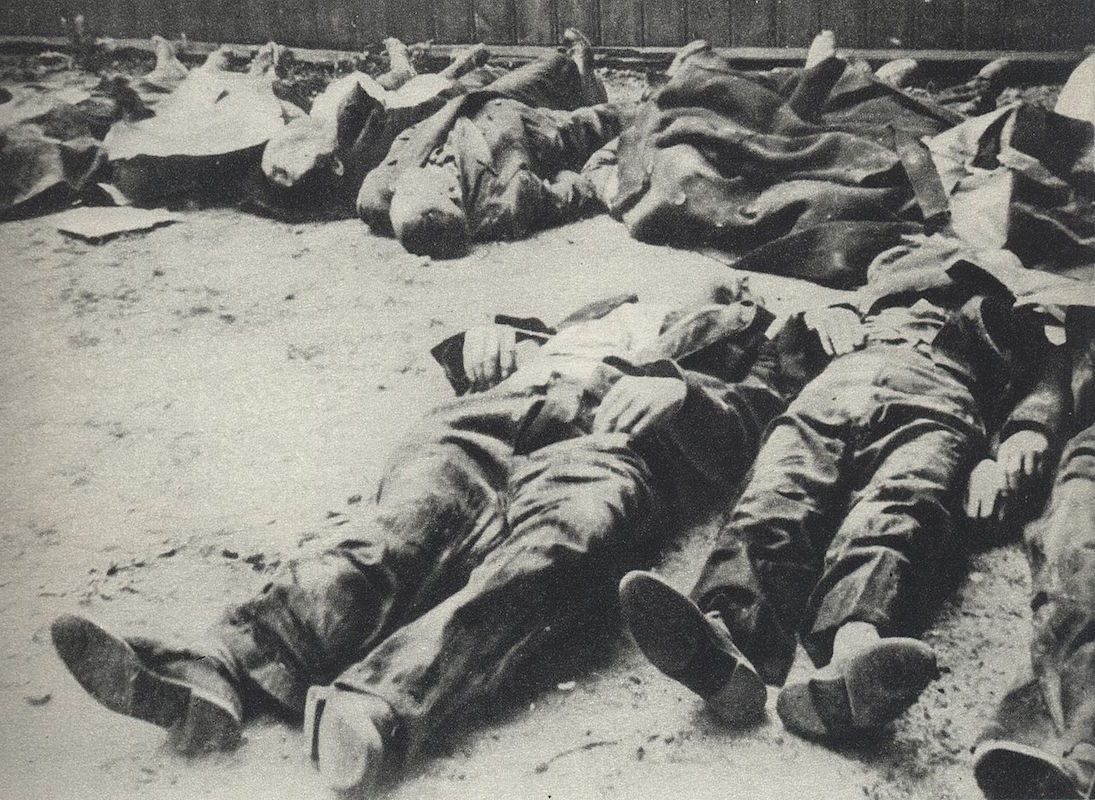
The Wola Massacre marked the start of the Reich’s counterattack against the Warsaw Uprising, the heroic and suicidal rising mounted by the Polish Home Army as the Red Army’s summer offensive brought it to the banks of the Vistula.

Aiming to claim some foothold upon which to influence events in the soon-to-be Soviet-occupied Poland, the Home Army enjoyed initial success in the first days of August. But German reserves from the Replacement Army — the vehicle by which the Valkyrie plotters had attempted their coup against Hitler just days before, and now as a consequence answering directly to Heinrich Himmler — were quick to the scene and would turn back the rising in weeks of bloody urban warfare. Himmler’s authority in crushing the Warsaw Uprising would also allow him to give rein to his SS for a campaign of atrocities intended to cow the populace into speedy submission.

Himmler wasn’t a battlefield commander, of course. Chief on the scene would be Erich von dem Bach-Zelewski; for this purpose he would enlist some of the more notorious units on the eastern front, such as the lawless Sonderbataillon Dirlewanger and the “Russian National Liberation Army” of Bronislav Kaminski. They were just the types to implement Himmler’s brutal orders* for a city they were soon to lose anyway:

  1. Captured insurrectionists shall be killed whether or not they fight in accordance with the Hague Convention.
  2. The non-fighting part of the population, women, children, shall also be killed.
  3. The whole city shall be razed to the ground, i.e. its buildings, streets, facilities, and everything within its borders.

The outcome rates as perhaps the largest battlefield massacre of World War II.

On August 5, Bach-Zelewski’s forces began a coordinated push into the western suburb of Wola. Himmler’s orders were implemented immediately, as attested by numerous civilian witnesses and lucky survivors:

I lived in the Wola district at No. 8, Elekcyjna Street. At 10 a.m. on Aug. 5, 1944 a detachment of SS-men and Vlassov’s men entered. They drove us from the cellars and brought us near the Sowinski Park at Ulrychow. They shot at us when we passed. My wife was killed on the spot: our child was wounded and cried for his mother. Soon a Ukrainian approached and killed my two-year-old child like a dog; then he approached me together with some Germans and stood on my chest to see whether I was alive or not – I shammed dead, lest I should be killed too. One of the murderers took my watch; I heard him reloading his gun. I thought he would finish me off, but he went on further, thinking I was dead. I lay thus from 10 a.m. until 9 p.m. pretending to be dead, and witnessing further atrocities. During that time I saw further groups being driven out and shot near the place where I lay. The huge heap of corpses grew still bigger. Those who gave any sign of life were shot. I was buried under other corpses and nea rly suffocated. The executions lasted until 5 p.m. At 9 p.m. a group of Poles came to take the corpses away. I gave them a sign that I was alive. They helped me to get up and I regained sufficient strength to carry with them the body of my wife and child to the Sowinski Park, where they took all the dead. After this sad duty had been performed they took me to St. Laurence’s Church at Wola, where I remained till next day. I cannot state the exact number of the victims, but I estimate that those among whom I lay amounted to some 3,000 (three thousand). I met a friend in the church who had gone through the same experience as I, having lost a boy of 8, who had been wounded and died calling for his father. I am still in hospital and the image of death is constantly before my eyes.

And another:

On August 5, 1944, between 12 and 2 p.m., I saw from a window on the first floor of Wola Hospital Germans dragging women out of the cellars of No. 28, Plocka Street. They shot them in the courtyard with machine-guns. Almost at the same time, I saw in the courtyard of No. 30, Plocka Street the hands of more then 20 people raised and visible over the fence (the people themselves could not be seen). After a volley of shots these hands fell down: this was another of the executions in Wola.

And the agonizing testimony of Wanda Lurie:

I stayed in the cellar of No. 18 until August 5, when, between 11 and 12 noon, the Germans ordered all of us to get out, and marched us to Wolska Street. This march was carried out in dreadful haste and panic. My husband was absent, taking an active part in the Rising, and I was alone with my three children, aged 4, 6 and 12, and in the last month of pregnancy. I delayed my departure, hoping they would allow me to remain, and left the cellar at the very last moment. All the inhabitants of our house had already been escorted to the “Ursus” works in Wolska Street at the corner of Skierniewicka Street, and I too was ordered to go there. I went alone, accompanied only by my three children. It was difficult to pass, the road being full of wire, cable, remains of barricades, corpses, and rubble. Houses were burning on both sides of the street; I reached the “Ursus” work’s with great difficulty. Shots, cries, supplications and groans could be heard from the factory yard. We had no doubt that this was a place for mass executions.

The people who stood at the entrance were led, no, pushed in, not all at once but in groups of 20. A boy of twelve, seeing the bodies of his parents and of his little brother through the half-open entrance door, fell in a fit and began to shriek. The Germans and Vlassov‘s men beat him and pushed him back, while he was endeavouring to get inside. He called for his father and his mother. We all knew what awaited us here; there was no possibility of escape or of buying one’s life; there was a crowd of Germans, Ukrainians (Vlassov’s men), and cars. I came last and kept in the background, continuing to let the others pass, in the hope that they would not kill a pregnant woman, but I was driven in with the last lot. In the yard I saw heaps of corpses 3 feet high, in several places. The whole right and left side of the big yard (the first yard) was strewn with bodies. We were led through the second. There were about 20 people in our group, mostly children of 10 to 12. There were children without parents, and also a paralysed old woman whose son-in-law had been carrying her all the time on his back. At her side was her daughter with two children of 4 and 7. They were all killed. The old woman was literally killed on her son-in-law’s back, and he along with her. We were called out in groups of four and led to the end of the second yard to a pile of bodies. When the four reached this point, the Germans shot them through the backs of their heads with revolvers. The victims fell on the heap, and others came. Seeing what was to be their fate, some attempted to escape; they cried, begged, and prayed for mercy. I was in the last group of four. I begged the Vlassov’s men around me to save me and the children, and they asked if I had anything with which to buy my life. I had a large amount of gold with me and gave it them. They took it all and wanted to lead me away, but the German supervising the execution would not allow them to do so, and when I begged him to let me go he pushed me off, shouting “Quicker!” I fell when he pushed me. He also hit and pushed my elder boy, shouting “hurry up, you Polish bandit”. Thus I came to the place of execution, in the last group of four, with my three children. I held my two younger children by one hand, and my elder boy by the other. The children were crying and praying. The elder boy, seeing the mass of bodies, cried out: “they are going to kill us” and called for his father. The first shot hit him, the second me; the next two killed the two younger children. I fell on my right side. The shot was not fatal. The bullet penetrated the back of my head from the right side and went out through my cheek. I spat out several teeth; I felt the left side of my body growing numb, but I was still conscious and saw everything that was going on around me.

I witnessed other executions, lying there among the dead. More groups of men were led in. I heard cries, supplications, moaning, and shots. The bodies of these men fell on me. I was covered by four bodies. Then I again saw a group of women and children; thus it went on with group after group until late in the evening. It was already quite, quite dark when the executions stopped. In the intervals between the shootings the murderers walked on the corpses, kicked them, and turned them over, finishing off those who still gave any sign of life, and stealing valuables.

German soldiers too recorded wholesale executions in their diaries and correspondence; while the accounts above are all specifically attributable to the 5th of August, those that follow are undated snapshots of environment:

Policemen with rifles under their arms trudged along. All of the police from occupied Poland came together there to show off their bravery and also to enrich themselves on the side. I did not see this activity, but others did. They saw how these policemen executed those from the procession who could not keep up, those who were sick and lagging behind, and right in front of their compatriots. What was particularly troubling about this misery is that unlike in Russia what was occurring was not a matter of a completely poor, and in any event already moaning, mass of people; rather these were people of our own social class, women in fur coats, cute children who up until two days before had been fully cared for. This memory has always caused me anguish during my short stopovers in Warsaw: the look from so many hostile eyes, people of our culture, who knew exactly what I knew. For that reason I was always glad never to have been deployed in the West. And now I stood beside these people in bitter agony, and I was shocked.

Now we arrived at the command post of the SS-commander. There were two buses parked on the right side of the street. We reported to the SS-commander, a medium-built stringent man with a sharply chiseled face. With a cold glance at the procession of women and children that was passing no farther than 10 meters from us, he said, “You see, this is our biggest problem. These refugees! I don’t have enough ammunition to kill them all!” He said this quietly and with a remorseful shrug of the shoulders, this elegant officer with the Iron Cross and pleasant manners. Meanwhile tears fell down my cheeks. What kind of human being was he?

Hans Thieme

And another:

Before each daily operation I reported to the SS commander. During one visit I witnessed an event, which sickened me to my very core. The SS officer’s office was on the upper floor of a building and had a balcony that overlooked a large courtyard. The SS had lined up near a wall about 40 or so Polish men, women, and children of all ages. I distinctly recall a young woman holding hands with two small children. It was clear to me what was about to happen. I confronted the SS commander as to why these people were about to be shot. His reply was that they were being executed as a reprisal for the Germans that had been killed in the Uprising. He informed me that it was also none of my concern. Shortly, thereafter the hostages were shot before my eyes. I was disgusted by what I had witnessed and after 60 years later it still haunts me.

Eberhard Schmalz

And another:

I was setting explosives under big doors, somewhere in Old Town. From inside we heard Nicht schiessen! Nicht schiessen! (Don’t shoot! Don’t shoot!). The doors opened and a nurse appeared with a tiny white flag. We went inside with fixed bayonets. A huge hall with beds and mattresses on the floor. Wounded were everywhere. Besides Poles there were also wounded Germans. They begged the SS-men not to kill the Poles. A Polish officer, a doctor and 15 Polish Red Cross nurses surrendered the military hospital to us. The Dirlewangerers were following us. I hid one of the nurses behind the doors and managed to lock them. I heard after the war that she has survived. The SS-men killed all the wounded. They were breaking their heads with rifle butts. The wounded Germans were screaming and crying in despair. After that, the Dirlewangerers ran after the nurses; they were ripping clothes off them. We were driven out for guard duty. We heard women screaming. In the evening, on Adolph Hitler’s Square [now Pilsudzki Square] there was a roar as loud as during boxing fights. So I and my friend climbed the wall to see what was happening there. Soldiers of all units: Wehrmacht, SS, Kaminski’s Cossacks, boys from Hitlerjugend; whistles, exhortations. Dirlewanger stood with his men and laughed. The nurses from the hospital were rushed through the square, naked with hands on their heads. Blood ran down their legs. The doctor was dragged behind them with a noose on his neck. He wore a rag, red maybe from blood and a thorn crown on top of the head. All were lead to the gallows where a few bodies were hanging already. When they were hanging one of the nurses, Dirlewanger kicked the bricks she was standing on.

Mathias Schenk

A much larger catalogue of atrocity accounts awaits at warsawuprising.org.

The massacre at Wola would run on to about the 13th at which point Bach-Zelewski abated the civilian massacre order as counterproductive: too many soldier-hours needed for focused bloodbaths were being squandered orchestrating gratuitous ones. Nevertheless, weeks of hard urban warfare lay ahead, and policy continued to embrace the summary execution of captured fighters and of all fighting-age men, resistance or no. Some 200,000 civilians are thought to have died during the Warsaw Uprising.

One legacy was eerily and unknowingly captured by a LIFE magazine photographer in 1948, of a young girl in a school for disturbed children in Poland. Her face a scramble of innocence and madness as it peers into the lens, she illustrates her “home” as an incoherent chalk vortex. It wasn’t known until many years after this photo became emblematic of a generation wracked by horror, but “Tereska” — Teresa Adwentowska — was an orphaned survivor of Wola.

* Per Bach-Zelewski’s evidence to the Nuremberg tribunal. By dint of cooperation, he saved his own life from the Nuremberg gallows.

On this day..

1598: Lucas, waterboarded Guale

On this date in 1598, the indigenous Guale youth called Lucas was hanged by the Spaniards in St. Augustine, Florida, for his supposed part in the prior year’s massacre of five Franciscan missionary friars during a 1597 Guale revolt.

This entire tragic affair, documented poorly and with partiality in Spanish sources, remains an interpretive palimpsest to the few who are familiar with it. Historian J. Michael Francis grapples with it in Murder and Martyrdom in Spanish Florida: Don Juan and the Guale Uprising of 1597; a recent talk by the latter at the U.S. Library of Congress delves into the “400-year-old murder mystery”:

The key primary source for this event is Luis Jerónimo de Oré’s text The Martyrs of Florida, from approximately 1619. (Here’s a public domain English translation) The titular “Florida” as claimed by Spain in the New World colonization scramble was a much larger territory than the present-day U.S. state, peninsula, and running Internet gag; hence, the Guale territory relevant to this post lies on what is today the Georgia coast.

Ore informs us that “an Indian youth, who was a Christian and heir to the caciquedom,” was incensed when the Franciscan resident at the settlement of Tolomato presumed to disallow him a second wife.

This cacique and two other Indians, like him, given to the same immoral practice, went into the interior among the pagans, without saying anything or without obtaining permission as they were wont to do on other occasions. After a few days they returned at night with many other pagan Indians, painted and smeared with red paste, and with feathers on their heads. This among them is a sign of cruelty and slaughter.

Thus fearsomely attired, they burst upon the hut of the prudish Fray Pedro de Corpa and butchered him, setting up his head on a spear. Having done this, the angry cacique — who is known only as Juanillo, which is sometimes the name given to this rebellion — ordered other Guale to treat their nosy proselytizers likewise. As a result, four other Franciscans — Fray Miguel de Aunon and a lay brother on St. Catherine’s Island, Fray Bias Rodriguez at the mission village of Santa Clara de Tupiqui, and Fray Francisco de Verascola on Asao — were all murdered within days. A couple of other missionaries had very close escapes.


Map of the relevant part of the Georgia coast.

Besides these, a Fray Francisco de Avila was kidnapped and held hostage for ten months. Although cruelly tortured, Avila would survive captivity and produce a narrative of his own, one that Ore includes wholesale in his volume as a standalone chapter.

In the course of the ensuing Spanish raids on the Guale, the Spanish captured seven boys or young men and interrogation zeroed in on one of them: the son of the cacique of Tupiqui, who appeared as a possible participant in murdering Fray Bias Rodriguez.

Lucas was reticent on the point but after being subjected to the water torture he allowed that “he arrived in time to see Fray Bias die,” and this confession of his presence sufficed to condemn him. He was the only person judicially executed in the course of the entire revolt.

In view of said declarations of these proceedings, the crime falls upon Lucas the Indian, son of the Cacique de Tupiqui, for having been present and participated in the killing of Fray Bias, who was sent to convert the people of Tupiqui. I must condemn him by this my decree, sentenced according to his declaration, with the penalty of death. The justice which I order shall be done him is: That when he leaves the jail where he now is, it shall be with a rope around his neck, his hands tied behind him, and with a loud voice it must be proclaimed to the public his crime; that he be taken to the gallows, already prepared for this purpose, and that there he shall be hung by the neck and strangled until dead. Because, thus is it well to punish with real justice those who dare to commit such crimes, and as an example to the other Indian natives of these provinces that they may not commit similar crimes. So do I pronounce sentence and command.

And if the said Lucas is not mindful of receiving baptism and should not die repenting, and in the Catholic faith, I order that he be hung and after his death his body be burned to powder.

Gonzalo Menendez de Canco, Governor of Florida (Source)

Interpretations of the whole affair have always been driven by Ore’s narrative: either the surface reading of it, that Juanillo and company found monogamy irksome and preferred, in Ore’s words, “to give rein to their sensuality and unlawful pleasures”; or, a converse take for the era of decolonization, that the cultural interference of the Spanish empire triggered a native backlash for whom the friars were the ready-to-hand targets. In either version, the rebellion flourishes briefly but ultimately fails.

Francis in his book and the video above offers a very different reading: as a successful revolt authored by a different cacique, Don Domingo of Asao, who violently renegotiated the local balance of power** and thereby displaced the caciques of Tolomato as the paramount chiefs of the Guale. As a particularly gruesome coda, Domingo made successful obeisance to the Spanish and obtained the crown’s blessing for an expedition to destroy Juanillo, whom he blamed for the disturbance. After capturing the rebels’ last redoubt (beheading Juanillo in the process), Domingo ordered the surviving women to scalp their own men. Now that is paramount chiefdom.

Domingo appears to have maintained his preeminence among the Guale for the balance of his years — backed by and partnering with the Spanish, to the happiness of evangelizing clerics who were never more disturbed. A few years later, the Spanish even plopped down a new mission in his very own native soil … Santo Domingo de Asao.

* The Guale people are thought to have been subsumed into the Yamasee.

** View the Spanish arrivistes, who had a handful of small settlements rather than the dominating presence that their globe-straddling empire might suggest, as just “another powerful Mississippi chiefdom” to local eyes. (Source of this characterization)

On this day..

1795: Charles de Virot, after the Quiberon debacle

On this date in 1795, general Charles de Virot, marquis de Sombreuil was shot for leading the royalist invasion of Quiberon in the west of France.

It was not even a year since the end of the Paris Terror — indeed, Sombreuil would have the honor of dying on the anniversary of Robespierre’s beheading — when 5,000 emigres backed by British ships crowded like sardines onto a peninsula famous for canning them, intending to join and lead the domestic Chouan resistance.

Amid the uncertain interim of the Directory a yet-Republican France wracked by war, economic crisis, and political uncertainty looked ripe for the overthrow. And true enough, the Directory in time would give way to a king of sorts.

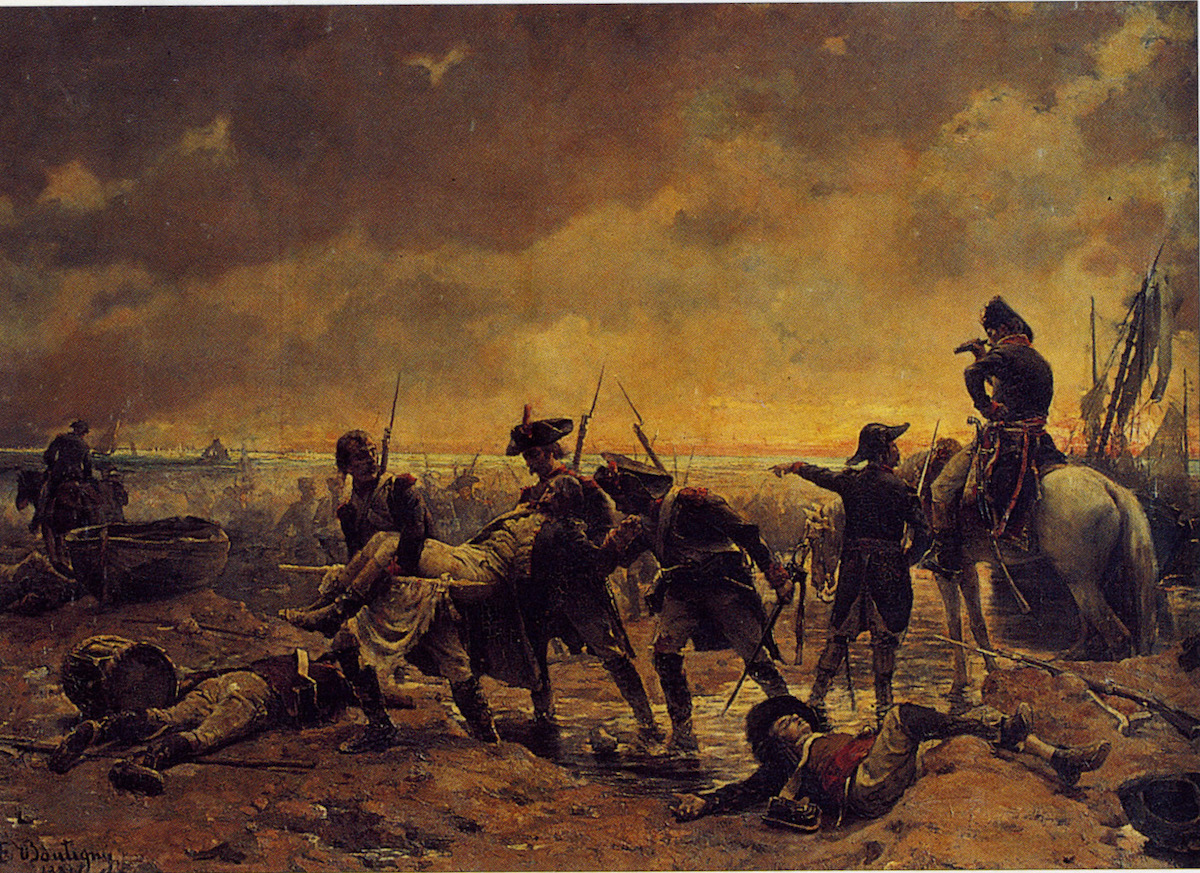
The west of France, in Brittany adjacent the Vendee which had long troubled Jacobin rule, ought to have been the place to raise the fleur-de-lis but the expedition as cogitated from London was plagued from the start by disorganization and came to a speedy grief in June and July of 1795, remembered only in the dourest of palettes.


An episode in the affair of Quiberon, by Paul-Camile Boutigny.


An episode in the rout of Quiberon, by Pierre Outin.

A mere pup of 25, Gen. Sombreuil had already lived long enough to quaff the Revolution’s horrors: his father and brother had fallen under the sans-culotte blade in Paris in 1794, while his sister is famous for literally quaffing the blood of the guillotined to prove her loyalty and thereby save her family from the September Massacres.

Our man Charles shared the ill fruit of Quiberon with 747 other captured prisoners as the Republicans made policy of showing no mercy to invading emigrants. They were shot over a period of weeks at Quiberon and nearby Vannes and Auray; a nearby grounds would become hallowed of the Bourbon restoration as the Champ des martyrs with the burial of these martyrs’ remains. A expiatory chapel to their memory still stands there to this day.

On this day..

1587: George Gaspar, an English heretic in the Inquisition

We have noted previously the progress of the Spanish Inquisition on the Canary Islands in the early 16th century. We turn here to another auto de fe it authored there in 1587 from the same source, The Inquisition in Spanish Dependencies, available free from Google books here.

By this time, the Canaries boasted a population of some 35,000* — half or so on Tenerife, where this auto took place — and had become an important entrepot in the growing traffic to the New World. For the same reason these isles became a theater in the running (albeit undeclared) Anglo-Spanish War, the conflict of which the Spanish Armada forms the most scintillating chapter. English privateer Sir Francis Drake raided the Canary Islands repeatedly in the 1580s. Between commerce and war, English, Irish, and Flemish sailors began to turn up in Spanish prisons on the Canary Islands where holy inquisitors could begin to take an interest in them.

There was another auto, celebrated July 22, 1587, in which there were burnt three effigies of a remnant of the Lanzarote fugitives.** There was also the more impressive relaxation of a living man — the first since that of the Judaizers in 1526. This was an Englishman named George Gaspar who, in the royal prison of Tenerife, had been seen praying with his back to a crucifix and, on being questioned, had said that prayer was to be addressed to God and not to images.

He was transferred to the tribunal, where he freely confessed to having been brought up as a Protestant.

Torture did not shake his faith and he was condemned, a confessor as usual being sent to his cell the night before the auto to effect his conversion. He asked to be alone for awhile and the confessor, on his return, found him lying on the floor, having thrust into his stomach a knife which he had picked up in prison and concealed for the purpose.

The official account piously tells us that it pleased God that the wound was not immediately mortal and that he survived until evening, so that the sentence could be executed; the dying man was carted to the quemadero and ended his misery in the flames.

It bears noting here that the beheading in February of that same 1587 of Mary, Queen of Scots might have inflamed continental Catholic sentiment against an Englishman at this moment; and, the aforementioned Drake had famously harried Spanish shipping during that spring. Nevertheless, the steely Gaspar presents an atypical case. More usually, an ounce of discretion could buy the life even of a heretic of a hostile power, and most preferred to pay the torturer in that coin.

Another Englishman was Edward Francis, who had been found wounded and abandoned on the shore of Tenerife. He saved his life, while under torture, by professing himself a fervent Catholic, who had been obliged to dissemble his religion, a fault which he expiated with two hundred lashes and six years of galley service.

Still another Englishman was John Reman (Raymond?) a sailor of the ship Falcon; he had asked for penance and, as there was nothing on which to support him in the prison, he was transferred to the public gaol. The governor released him and, in wandering around he fell into conversation with some women, in which he expressed Protestant opinions. A second trial ensued in which, under torture, he professed contrition and begged for mercy, which he obtained in the disguise of two hundred lashes and ten years of galleys.

In addition there were the crew of the bark Prima Rosa, twelve in number, all English but one Fleming. One of them, John Smith, had died in prison, and was reconciled in effigy; the rest, with or without torture, had professed conversion and were sent to the galleys, some of them with a hundred lashes in addition.

* Source

** In 1569, a Morisco merchant named Juan Felipe, catching wind that the Inquisition meant to arrest him, took to the seas with about thirty fellow Muslim converts and escaped to Morocco. These refugees were punished in auto de fe effigies in 1569, 1581, and the present case.

On this day..

2008: Two alleged prostitutes, by the Taliban

On this date in 2008, the Taliban executed two women whom it claimed were running a prostitution ring for U.S. soldiers based in the city of Ghazni.

The Taliban invited a journalist who gives us a disarmingly placid picture of the two burka-clad women seemingly conversing even as armed men surrounding them in the nighttime gloom prepare to take their lives.

On this day..

1408: Konrad Vorlauf, Vienna Burgermeister

Konrad Vorlauf, late the mayor of Vienna, was beheaded on this date in 1408 with two other councillors.

The patrician Burgermeister was a casualty of the dynastic civil war between brothers Leopold IV and Ernest the Iron, which manifested in Vienna — a rising city on the brink of becoming (in 1440) the Habsburgs’ permanent residence — as a conflict between the city’s merchant oligarchs (allied to Ernest) and her artisan craftsmen (allied to Leopold).

It was a violent conflict even within city walls: in January of 1408, Vorlauf had seized five Leopold-friendly guild leaders and had them beheaded on the Hohenmarkt. (See this public-domain history of Vienna, in German)

During a subsequent truce, Vorlauf along with fellow Vienna grandees Hans Rock, Rudolf Angerfelder, Stephan Poll, Friedrich von Dorffen, Wolfhardt Schebnitzer, Niklas Untermhimmel and Niklas Flusthart went to a confabulation called by Leopold under his safe conduct, only to be seized on their return by knights allied to his cause and held to ransom.

Vienna duly paid it up but perhaps might have done better to keep the cash. Somewhere around this time Leopold imposed himself in Vienna itself, and when the artisan class caused a ruckus over new taxes, the prince was pressured to seize Vorlauf along with the aforementioned Hans Rock and another councillor named Konrad Rampersdorfer. Their beheading — in the city’s Pig Market, for added disgrace — proceeded under no color of law. The aged Rampersdorfer asserted his seniority for the privilege of dying first, saying

I have hitherto been a precursor to all others, and I have not earned the death penalty, but I have stood always for the natural rights of my prince. Therefore I offer to my fellows my own example, not to fear a righteous death, but to submit to it voluntarily.

With the childless death of Leopold a few years later Ernest became the uncontested chief of the Leopoldian line, and his martyred Viennese compatriots celebrated as municipal patriots — eventually exhumed from their graves and reburied with honor in St. Stephen’s Cathedral. They were fortuitously allied, as events would transpire, to the imperial glory conquered by Ernest’s descendants in what became the chief Habsburg dynastic line (the mighty Maximilian I was Ernest’s grandson).

Today, the place of the mayor’s execution is called Lobkowitzplatz; it’s marked by a plaque paying tribute to the men who bled there in 1408.


Commemorative plaque honoring Vorlauf and the others beheaded with him.

On this day..

1941: Francisco Escribano, for supplying the Spanish Maquis

My name is Francisco Escribano. They accused me of stealing for the men in the mountains two sacks of chickpeas, a blanket, a pair of scissors, six socks, six handkerchiefs and 10 pesetas. For this crime they executed me on 1 July 1941. For that same crime, my father, two uncles and my cousin died with me.

-Actor Javier Bardem voicing a victim of Franco’s Spain, for Pedro Almodovar‘s documentary short. We’ve previously encountered this film in our entry on the very first execution of the Spanish Civil War.

On this day..

1917: Dragutin “Apis” Dimitrijevic, of the Black Hand

A century ago today* Dragutin Dimitrijevic — better known by his code name “Apis” — was shot on the outskirts of Salonika (Thessaloniki) along with two lieutenants in his legendary Serbian terrorist organization, the Black Hand.

Not to be confused with mafia extortionists of the same name, the Black Hand was the cooler brand name of Ujedinjenje Ili Smrt — “Union or Death” in the Serbo-Croatian tongue, referring to the network’s objective of aggrandizing the small Kingdom of Serbia with their ethnic brethren who, circa the fin de siècle, still answered to the Austro-Hungarian Empire.

This national aspiration would midwife the First World War.

Though it wasn’t formed as an institution until 1911** — it had its own constitution and everything — some of the Black Hand principals had entered the chessboard dramatically by conspiring in the 1903 assassination of the unpopular King Alexander Obrenovic and his consort Queen Draga. This operation is remembered as the May Coup and numbered among its leaders our very man, Apis. (English Wikipedia link| Serbian) Apis caught three bullets in the chest during the murderous palace invasion, but the hand wasn’t the only thing tough about him.

In victory, these conspirators grew into a powerful faction of a more bellicose state, the most militant exponents of Pan-Serbism — a spirit perforce directed against the Austrian polity, which called South Slavs subjects from Trieste to Montenegro. Belgrade, then as now the capital of Serbia, was at this point a border city, with the bulk of the future Yugoslavia lying to its north and west, in Austria-Hungary.

“We do not say that this war is declared yet, but we believe that it is inevitable. If Serbia wants to live in honour, she can do so only by this war,” Apis predicted to a newsman in 1912. “This war must bring about the eternal freedom of Serbia, of the South Slavs, of the Balkan peoples. Our whole race must stand together to halt the onslaught of these aliens from the north.”

I, (name), by entering into the society, do hereby swear by the Sun which shineth upon me, by the Earth which feedeth me, by God, by the blood of my forefathers, by my honour and by my life, that from this moment onward and until my death, I shall faithfully serve the task of this organisation and that I shall at all times be prepared to bear for it any sacrifice. I further swear by God, by my honour and by my life, that I shall unconditionally carry into effect all its orders and commands. I further swear by my God, by my honour and by my life, that I shall keep within myself all the secrets of this organisation and carry them with me into my grave. May God and my brothers in this organisation be my judges if at any time I should wittingly fail or break this oath.

-Black Hand induction oath

On the pregnant date of June 28, 1914, the Black Hand grasped at its historical destiny to redraw that noxious border when a cell of Bosnian Serbs whom Apis — a mere captain at the time of the 1903 coup, he by now commanded Serbian military intelligence — had dispatched for the purpose assassinated the Austrian heir presumptive Archduke Franz Ferdinand during his visit to the Bosnian capital, Sarajevo.

Their objective was the same as it had ever been, to avenge themselves upon their occupier. Moreover, Serbia had allied herself with Russia, and Vienna’s inevitable declaration of war over the provocation could be expected to draw Russia into a Great Power war, perhaps with the effect of shaking loose Austria’s Balkan provinces.

It did that, and it drew in the whole of Europe besides.

Apis’s assassins shattered the Habsburg empire and made possible a postwar Yugoslavian kingdom. That the Black Hand itself was one of the Great War’s casualties in the process was the littlest of ironies.

Its aggression had long placed it in a delicate relationship with the state which could never really be expected to acclimate to a permanent network of enragees looking to author wars and political murders.

By 1917 the Prime Minister Nikola Pasic saw an opening to move against Apis. Perhaps he feared resumed Black Hand subversion if Serbia negotiated a peace with Austria, or wanted to get rid of the guy who could tell exactly how much he, Pasic, knew about the Archduke’s assassination before it happened.

It was an effective ploy, no matter the reason. Alleging a bogus Black Hand plot to kill Serbia’s prince regent, a Serbian military investigation rolled up Dimitrijevic along with one of his original May Coup cronies, Ljobomir Vulovic and the alleged would-be assassin Rado Malobabic, a man who really had been involved in planning the Archduke Franz Ferdinand hit. Dimitrijevic was known to remark privately that whatever the charge sheet said, he was really being executed for that fateful day in Sarajevo.

The three condemned men stepped down into the ditches that had been dug for the purpose, and placed themselves in front of the stakes. Dimitrijevic on the right, Vulovic in the middle, and Malobabic on the left. After being blindfolded, Dimitrijevic and Vulovic cried: “Long live Greater Serbia!”

Malobabic succumbed after the first five shots, while the two others suffered longer, twenty shots having to be fired at each of them. No one was hit in the head. The execution was over at 4.47 in the morning.

Witness’s account of the execution

* Different sources proposing numerous different dates in June and even July can be searched up on these here interwebs. We’re basing June 26 on primary reportage in the English-language press (e.g., the London Times of June 28, 1917, under a June 26 dateline: “The Serbian Prince Regent having confirmed the death sentences passed on Colonel Dragutin Dimitriovitch, Major Liubomir Vulovitch, and the volunteer Malobabitch for complicity in a plot to upset the existing regime, these were executed this morning in the outskirts of Salonika”). The sentences were confirmed on June 24, and both that date and its local Julian equivalent June 11 are among the notional death dates running around in the wild.

** The Black Hand from 1911 was the successor to Narodna Odbrana (“National Defense”) which formed in 1908 in response to Austria-Hungary’s annexation of Bosnia.

On this day..

1943: Maria Kislyak, honeytrapper

Soviet resistance operatives Maria Kislyak, Fedor Roudenko and Vasily Bougrimenko hanged on this date in 1943 by Nazi occupation.

Kislyak, an 18-year-old from Kharkov, Ukraine who is esteemed a Hero of the Soviet Union,* is the best-known of them and made herself the poisoned honey in a trap for German officers.

As ferocious Eastern Front fighting raged near her city, Kislyak feigned affection for a German lieutenant and thereby lured him to a woodland rendezvous where her friend Roudenko ambushed him and bludgeoned him to death.

Kislyak endured German torture without admitting anything and was even released since the man’s comrades couldn’t be sure that the local flirt had anything to do with the murder. But when she and her friends pulled the trick a second time, the Germans forced the assassins to reveal themselves by threatening to shoot random hostages en masse.

* One of three women so honored for their service during World War II, all of whom have been featured in these grim annals; the others are Klava Nazarova and Zoya Kosmodemyanskaya.

On this day..

1863: Not Nathaniel Pruitt, reprieved deserter

On this date 150 years ago, according to Larry Daniel’s Soldiering in the Army of Tennessee, a middle-aged man was all set to be shot for deserting the Army of Tennessee, and the much-resented command of Gen. Braxton Bragg.

In a well-documented incident, a soldier received a reprieve as a result of a dramatic incident. Forty-seven-year-old Nathaniel Pruitt of the Nineteenth Tennessee was found guilty of desertion and on June 10, 1863, was taken to a field beside his regimental camp, his coffin placed beside an open grave. A minister cut a lock of hair to give to Pruitt’s wife. The firing squad was positioned and ordered to take aim, but just then an officer came galloping up with a special order to suspend the sentence. The prisoner began crying. “I was truly glad [of the reprieve], but must say some of the boys were disappointed,” a Mississippi diarist noted. Incredibly, the very next day, Pruitt again deserted and was never heard from again.

One takes the author’s point here about Pruitt’s risk-seeking second flight, but even so it might not really be all that “incredible” that one would desert the company of armed men who had recently shown open disappointment about being prevented from shooting one dead.

On this day..