1835: Joshua Cotton and William Saunders, steam doctors

In the Mississippi slave insurrection panic of 1835, slavers’ fears attached themselves right from the start to the prospect of white leadership affiliating with the prospective black rising.

Israel Campbell, a slave who would eventually reach freedom in the North and publish a fascinating autobiography on the eve of the Civil War, was present in the vicinity. He knew nothing of any rebellion until

two white men came to my house one night after I had gone to bed, and ordered me to get up immediately. I could not think, for my life, what was the matter. Before I got my clothes on, they became impatient, and called for me to open the door. As I done this, one of them seized me by the collar, having a bowie-knife in one hand. Uttering a horrible oath, he asked —

“What do you know about Doctor Cotton’s scrape?”

“Nothing at all, sir,” I replied.

“Don’t you tell me a lie. Do you know Dr. Cotton? When did you see him last?”

I replied, that I would not tell them a lie; that I did know Mr. Cotton, but that I had not seen him for some time. They went on asking a number of questions, wanting to know if I knew Harris’ old Dave, the negro preacher, and when I heard him preach last, and where at? I answered them satisfactorily these queries. They then wanted to know if I staid at the meeting until the people had all dispersed? If they talked any thing about getting free and killing the white people?

I replied to them about knowing the different parties; but about the rising of the slaves I had heard nothing.

After convincing themselves that I was ignorant, they left, warning me, however, not to be caught outside our own plantation, nor talk with any strange negroes or white men. They told me that Dr. Cotton and some other mean white men and a great many of the negroes were laying plans to rise and kill off the white people and free the negroes. After giving me some brandy, and again warning me, that if I did not heed their advice, I would be shot, they left my house.

They, with other parties, went around among all the slave quarters. Many they scared so badly, that they told lies of every description, and suffered for it. When they thought they had succeeded in quelling the insurrection, they commenced punishing those they had caught. Some they hung, others they burned, and some of those they thought not so guilty they pulled cats back-wards on their bare backs. Two of the party hung themselves in the prison.

The man these rude guests hunted with that menacing Bowie knife was Joshua Cotton, an itinerant homeopath expounding the fad launched by Samuel Thomson‘s hit publication New Guide to Health. Thomson had by means of some natural palliatives healed his family of several ailments that confounded legitimate medical practitioners; his emphasis on having patients sweat out toxins by immersion in steam led his followers to be derided as “steam doctors.”

Cotton wasn’t the only steam doctor beating the bushes in Madison County: an intimate named William Saunders was also about. Their wandering practice, interacting with free men and slaves alike, profiled as precisely the types who would be orchestrating a coordinated rebellion — and they had been implicated under the lash by the Beatties Bluff slaves, where the insurrection panic had begun days earlier.

Though not yet aware that they would be caught up in the panic, the steam doctors were making their own moves in these days. Saunders attended a June 30 meeting of Livingston whites to organize suppression of the supposed rebellion and advised them that the other steam doctor, Cotton, “was in the habit of trading with negroes; would buy any thing they would steal and bring to him.” This put the vigilantes onto Cotton; Saunders left town in peace and made, so he said, for Texas — which would have been a wise choice, as events would show.

On the road to Vicksburg and a river crossing to the safety of Louisiana, Saunders repeated the story to another traveler who just so happened to have a more suspicious frame of mind than the Livingstonians. This Good Samaritan promptly brought Saunders in as a suspected conspirator himself. Both steam doctors were under lock and key as the Beatties Bluff allegations of their complicity reached Livingston.

Saunders elaborated his charges against Cotton, plainly hoping to trade his opposite number’s life for his own: that Cotton was forever going about pretending to lose his horses in the countryside “as a pretext for hunting them, that he might have opportunities to converse with the negroes, and, by that means, to seduce them from their allegiance to their owners, by instilling rebellious notions among them; and to form plans, and to make converts to his propositions, which he could not do by being a steam-doctor.” Since a slave brought from Beatties Bluff also identified Cotton on sight as the man keen on seducing him to rebellion, Cotton could perceive that his fate was surely sealed, and while the vigilantes deliberated on July 4 he sent them a desperate offer to confess in exchange for leniency. The committee refused the offer … but confession was still the only card Cotton had to play, and he submitted the confession on spec. In it, he leaned for his narrative on Virgil Stewart’s recently published claims about a slave plot led by the bandit John Murrell.

I am one of the Murrell clan, a member of what we called the grand council … Our object in undertaking to excite the negroes to rebellion, was not for the purpose of liberating them, but for plunder. I was trying to carry into effect the plan of Murrell as laid down in Stewart’s pamphlet … from the exposure of our plans in said pamphlet, we expected the citizens would be on their guard at the time mentioned, being the 25th of December next; and we determined to take them by surprise, and try it on the night of the 4th of July, and it would have been tried to-night (and perhaps may yet), but for the detection of our plans.

Cotton also repaid tit for tat by naming Saunders as one of the plotters, confirming some slaves’ accusations and leaving the backstabbing chum to twist on his own useless protestations of innocence.

The upshot of Cotton’s statement was an offer to buy his own life by continuing to reveal more information about the conspiracy going forward — essentially, to become a standing informant against anyone whom the slavers might next suspect. “But the committee, deeming it of infinitely more importance to check the impending storm, by immediately destroying two of the ringleaders, and thereby creating dismay and panic among them, ordered their execution” — which was effected immediately, both steam doctors being marched directly from their hearing to the jail where, “fastening a rope to the grating of a window, in the upper story of the jail, and leaning a couple of rails against the wall, assisted the culprits upon the rails; then, adjusting the other end of the rope around their necks, removed the rails. They were left hanging until the next morning.”

The final extent of the executions/lynchings meted out during the course the insurrection panic is uncertain. Israel Campbell, however, would remember that Cotton and Saunders were certainly not the end of it when it came to rootless itinerants in the vicinity — and not only the steam doctor set. “[T]he party who were making arrests endeavored to get hold of every steam doctor and colored preacher they could,” he wrote in his autobiography.

[O]nce in their grasp, there was very little mercy shown them. The heads of the preachers they cut off and put on poles, and placed them along the road, where they remained until they were bleached. I saw several of their skulls in an apothecary store at Mount Vernon the latter part of that fall. Dr. Cotton was a noble-looking man and a friend to the slave, and he died a martyr to the cause he had so much at heart, — the emancipation of the slave.

On this day..

1835: A white man at Vicksburg and two black men at Livingston, and five slaves at Beatties Bluff

The first casualties of the Murrell Excitement, a purported slave rising in Madison County, Mississippi, were strung up by vigilance committees on this date in 1835.

Having been alerted to rebellious talk by slaves on a Beatties Bluff plantation, a vigilance committee organized itself and interrogated every slave there.

Events were moving fast, and those in the middle of them had all they could do to keep up with developments — as can be seen by this staccato letter from Canton, Mississippi in the center of Madison County. It was reprinted widely in the U.S. in late July; we’re quoting here from the July 25, 1835 Baltimore Gazette And Daily Advertiser.

Canton, Mississippi
July 3, 1835.

I have to inform you the disagreeable news that the negroes are about to rise upon the whites. It come out about two weeks ago; the whole country is in alarm — There have been meetings throughout the state, to adopt measures to find out the ringleaders and to appoint patrols. We are out patroling every night. — Last night I was in company to ride about the country to the plantations to see if every negro was at his home. There was a white man taken up at Vicksburg concerned with the negroes; they called a court together, and brought him in guilty and HUNG him right off. There have been three more white men taken up, but they have not had their trials yet.

In Livingston a town twelve miles from here, they gave a negro six hundred lashes, before he would discover any thing; then he informed them that the blacks were to rise on the Fourth of July. The jail here is full and they are bringing more and more in every day. We have a meeting here to day to form a volunteer company, to be ready at a minute’s notices and we are prepared with guns and ammunition.

Whilst I am writing this, there is a large meeting here to adopt resolutions to protect the citizens; also to send on to the Secretary of War to send a company of soldiers to protect the citizens of the County. — They hanged two negroes yesterday at Livingston, and they have about fifteen more that they are going to hang. We had four brought in here this morning to examine, and expect they will hang one of them.

The Court has just adjourned. They tried three blacks and flogged them all. To one of them they gave two hundred lashes! There were three white men at the head of the insurrection, that have run away. They have one in jail. They took him out yesterday, and gave him Lynch’s law, and that is thirty-nine lashes in this country. They expect to hang him.


Meanwhile, at Beatties Bluff, interrogators on July 1-2 harrowed the slaves with scourges. A letter from one of their number described the transaction with the first man to crack, a blacksmith named Joe. We do not know for a fact whether there was any slave plot, but if one reads it from the perspective of Joe’s likely innocence it presents as an archetypical feeling-out dialogue between torturer and prey, each party half-guessing at the other’s direction so as to steer a story to its acceptable destination.

We then called for a rope, and tied his hands, and told him that we were in possession of some of their conversation, and that he should tell the whole of it; after some time he agreed that, if we would not punish him, he would tell all that he could recollect. He said he knew what we wanted, and would tell the whole, but that he himself had nothing to do with the business. He said that Sam had told him that the negroes were going to rise and kill all the whites on the 4th, and that they had a number of white men at their head: some of them he knew by name others he only knew when he saw them. He mentioned the following white men as actively engaged in the business: Ruel Blake, Drs. Cotton and Saunders, and many more, but could not call their names; and that he had seen several others. He aso gave the names of several slaves as ringleaders in the business, who were understood to be captains under those white men.

Joe appears to have managed this frightful situation with aplomb and “was set at liberty”; however, on his evidence, other slaves were brought in: an aged preacher named Weaver (“no offers of lenity could shake his courage, and he remained steadfast under the torture of the lash, when even his executioner was nigh to fainting with his task”); a man named Russell (“all was mystery with him” until, prompted, he made a statement “in all particulars, precisely like the one made by Joe”); a handsome youth called Jim who offered more white man’s names and claimed that the slaves intended “to slay all the whites, except some of the most beautiful women, whom they intended to keep as wives”; and “a boy” — presumably a child — called Bachus who confirmed same.

“After getting through with these examinations, Jim, Bachus, Weaver, Russell, and Sam, were all put to death by hanging.”

A tense albeit perhaps dramatized narration of the violent interrogations and summary executions can be found in chapter 29 of The Life and Adventures of J. A. Murrell, the Great Western Land Pirate, which is also the source of the illustration above, and of the parenthetical quote about the preacher Weaver.

On this day..

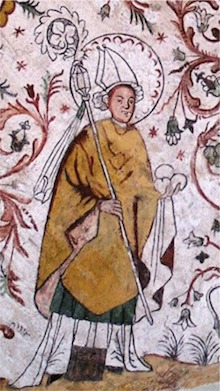
Feast Day of St. Cetteus

June 13 is the feast of St. Cetteus, patron of the Adriatic port city of Pescara.

This saint’s legends smudges the line between just-so story and real historical events, illustrating the Church martyrology’s great strength as a ready-made memorial of Christians’ trials down the years. In this case the suffering was less a religious persecution per se than the shame of being trod over by conquerors who installed themselves almost without opposition in the hollowed husk of Roman greatness and did as they pleased.

The Lombard incursion beginning in 568 in some ways signals the permanent sundering of east from west in the Roman world, for the Germanic invaders — a mixture of pagans and Arian heretics, no less — in time ousted Byzantium from the latter’s Italian holdings and meanwhile underscored the Roman Empire’s near-impotence in its ancestral homelands. “From Italy the emperors were incessantly tormented by tales of misery and demands of succor, which extorted the humiliating confession of their own weakness,” writes Gibbon. “The expiring dignity of Rome was only marked by the freedom and energy of her complaints: ‘If you are incapable,’ she said, ‘of delivering us from the sword of the Lombards, save us at least from the calamity of famine.'”

For the near term, it was a violent and unstable period; Lombard rulers assassinated and warred with one another as their hegemony devolved into a patchwork of feuding duchies, helping set the scene for the fractured medieval peninsula.

The perils of internal strife manifest in our martyr’s story; despite his eventual association with Pescara, his bishopric was inland at Amiternum and it was there, the story goes, that he was ordered drowned in 597 by a tyrannous Lombard warlord who mistakenly thought him a crony of his rival.

Tossed into the drink, the bish floated downstream to Pescara where a fisherman, recognizing the corpse’s ecclesiastical raiments without knowing exactly who wore them, buried him under the whimsical name “Peregrino”.

On this day..

Feast Day of Saint Eskil

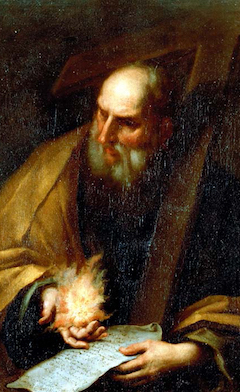
June 12 is the feast date* of Saint Eskil, a martyr to the slow Christianization of Scandinavia.

Ol’ “God-kettle” was one of several missionaries known to have been dispatched in the 11th and 12th century from England to Sweden, a traffic in religious conversion across the North Sea crossroads to invert the centuries-past course of Vikingers who put so many British sanctuaries to the sack.

The Northmen realms were ripe to join Christendom but sagas touching the time describe an uneven transitional period where the new and old faiths jostled for primacy.

“Ingi was king for a long time, well-liked and a good Christian; he put down [pagan] sacrificing in Sweden and ordered all the people of the land to become Christian,” runs The Saga of King Heidrek the Wise** (available in pdf translation here), about King Inge the Elder.

But the Swedes had too strong a belief in the heathen gods and held to their ancient ways … the Swedes thought that King Ingi had infringed their rights under the ancient law of the land, when he found fault with many things that Steinkel his [Christian] father had let be; and at a certain assembly which the Swedes held with King Ingi they gave him the choice of two things, either to observe the ancient laws or else to give up his throne. Then King Ingi spoke, and said that he would not leave the true faith; whereat the Swedes cried out, and pelted him with stones, and drove him from the law-assembly.

Svein, the king’s kinsman, remained behind at that assembly, and he offered to make sacrifice for the Swedes if they would grant him the kingdom; all agreed to Svein’s offer, and he was accepted as king over all the Swedish realm. Then a horse was led forth to the assembly, hewn in pieces, and divided up for eating, and the sacrificial tree was reddened with its blood. Thereafter all the Swedes cast off the Christian faith, and sacrifices were instituted, and they drove King Ingi away; he departed into western Gautland. For three years Svein the Sacrificer was king over the Swedes.

King Ingi went with his own bodyguard and some followers, though it was only a small force … into Sweden; he rode by day and night and came upon Svein unawares in the early morning. They seized the house over their heads and set it on fire, and burnt all the company who were inside … Svein came out and was cut down. And so Ingi took the kingship of the Swedes anew, and restored the Christian faith; he ruled the realm till the day of his death.

The “Svein” referred to here is a gentleman whom the historians recall as Blot-Sweyn — “Sweyn the Sacrificer” — and this Norse answer to Julian the Apostate apparently enjoyed his interregnum authority in about the 1080s thanks to Inge’s disrespect of the old rites still honored at the ancient Temple at Uppsala.

The timeline of high statecraft is extremely sketchy, and Saint Eskil’s relationship to events doubly so. Commonly recalled as a victim of the Blot-Sweyn period, Eskil is first marked in the 1120s annals of another Anglo-Saxon monk abroad in Scandinavia, Aelnoth from Canterbury — “Eschillus of sacred memory” who succumbed evangelizing to the “barbarorum feritate.” That’s the whole of it, with nothing like a year or a regnal era to hang one’s hat upon. In the 13th century, with Christianity truly triumphant, a hagiography of Eskil greatly embroidered the martyrdom story and tied it to the land’s most notorious rearguard ruling unbeliever, featuring a cast of heathens so nonplussed at the monk’s interruption of their feast that, notwithstanding his show of divine miracles, Blood-Sweyn has him sentenced to immediate stoning.

The town of Eskilstuna bears his name (it used to just be “Tuna”).

* Though it’s been bumped to June 12 everywhere else, the feast is still marked on its original June 11 date in the diocese Strängnäs, where the saint was supposed to have attained his martyr’s crown. (Strängnäs Cathedral is supposed to mark the very spot of his fatal confrontation with the Aesir followers.)

** This saga’s narrative stretches from an outright legendary prehistory to the Middle Ages. The Ingi-Svein affair is its last episode, but its first locates a more Wagnerian milieu: “Sigrlami was the name of a king who ruled over Gardariki; his daughter was Eyfura, most beautiful of all women. This king had obtained from dwarves the sword called Tyrfing, the keenest of all blades; every time it was drawn a light shone from it like a ray of the sun. It could never be held unsheathed without being the death of a man, and it had always to be sheathed with blood still warm upon it. There was no living thing, neither man nor beast, that could live to see another day if it were wounded by Tyrfing, whether the wound were big or little …”

On this day..

Feast Day of St. Barnabas

June 11 is the feast date of St. Barnabas, St. Paul‘s New Testament wingman.

A Cypriot Jew named Joseph, “Barnabas” (“Son of Encouragement”) was so christened in the fourth chapter of the New Testament’s Acts of the Apostles because upon his conversion he sold his land for a donative to the Galileans.
After that, Barnabas reappears throughout Acts as one of the most important of the early Christian missionaries, usually joining St. Paul — whom Barnabas himself introduced to the Christians after Paul got religion — as emissary to the non-Jews, for which purpose the Holy Spirit itself demanded him by name. (Acts 13:2: “Set apart for me Barnabas and Saul for the work to which I have called them.”)

They’re frequently paired thereafter in the narrative although it’s invariably Saint Paul’s honeyed tongue that does the confounding before the companions flee this city or that ahead of a furious mob.* Evidently the Holy Spirit’s labor policies could have used some updating: Barnabas also features in a whinge by Paul in 1 Corinthians 9 against the excess sacrifices the Jesus sect is exacting from its most successful envoys, who get no wages and no sex and (so it seems) have to hustle side jobs to keep up their proselytizing.

Don’t we have the right to food and drink? Don’t we have the right to take a believing wife along with us, as do the other apostles and the Lord’s brothers and Cephas [St. Peter]? Or is it only I and Barnabas who lack the right to not work for a living?

Who serves as a soldier at his own expense? Who plants a vineyard and does not eat its grapes? Who tends a flock and does not drink the milk? … whoever plows and threshes should be able to do so in the hope of sharing in the harvest. If we have sown spiritual seed among you, is it too much if we reap a material harvest from you? If others have this right of support from you, shouldn’t we have it all the more?

But we did not use this right. On the contrary, we put up with anything rather than hinder the gospel of Christ.

Barnabas eventually parted ways with Paul, proceeding to Cyprus with the mysterious John Mark (possibly Mark the evangelist, author of the Gospel, or possibly a different guy) where hagiography holds that Jews angered by his preaching fell on Barnabas and stoned him to death, perhaps around the year 61.

Although obviously a consequential figure in early Christianity, Barnabas’s many Biblical appearances do not capture his voice. The apocrypha preserves at least two tracts** further animating this important character: the Epistle of Barnabas dating to the late first century or early second century; and, the Acts of Barnabas, a 5th century creation which purports to arise from the hand of John Mark and describes a martyrdom by fire, not stone:

And Barjesus, having arrived after two days, after not a few Jews had been instructed, was enraged, and brought together all the multitude of the Jews; and they having laid hold of Barnabas, wished to hand him over to Hypatius, the governor of Salamis. And having bound him to take him away to the governor, and a pious Jebusite, a kinsman of Nero, having count to Cyprus, the Jews, learning this, took Barnabas by night, and bound him with a rope by the neck; and having dragged him to the hippodrome from the synagogue, and having gone out of the city, standing round him, they burned him with fire, so that even his bones became dust. And straightway that night, having taken his dust, they cast it into a cloth; and having se cured it with lead. they intended to throw it into the sea. But I, finding an opportunity in the night, and being able along with Timon and Rhodon to carry it, we came to a certain place, and having found a cave, put it down there, where the nation of the Jebusites formerly dwelt. And having found a secret place in it, we put it away, with the documents which he had received from Matthew. And it was the fourth hour of the night of the second of the week.

Because June 11 formerly fell on/near Midsummer, ere the Gregorian reforms skipped the calendar 10-11 days forward, St. Barnabas’s Day has a festive agrarian history commemorated by the proverb, “Barnaby bright, Barnaby bright, the longest day and the shortest night.” The saint is also the patron of Cyprus, and may be invoked to protect against hailstorms or in service of peacemaking. Numerous schools, churches, and monasteries around the world bear his name.

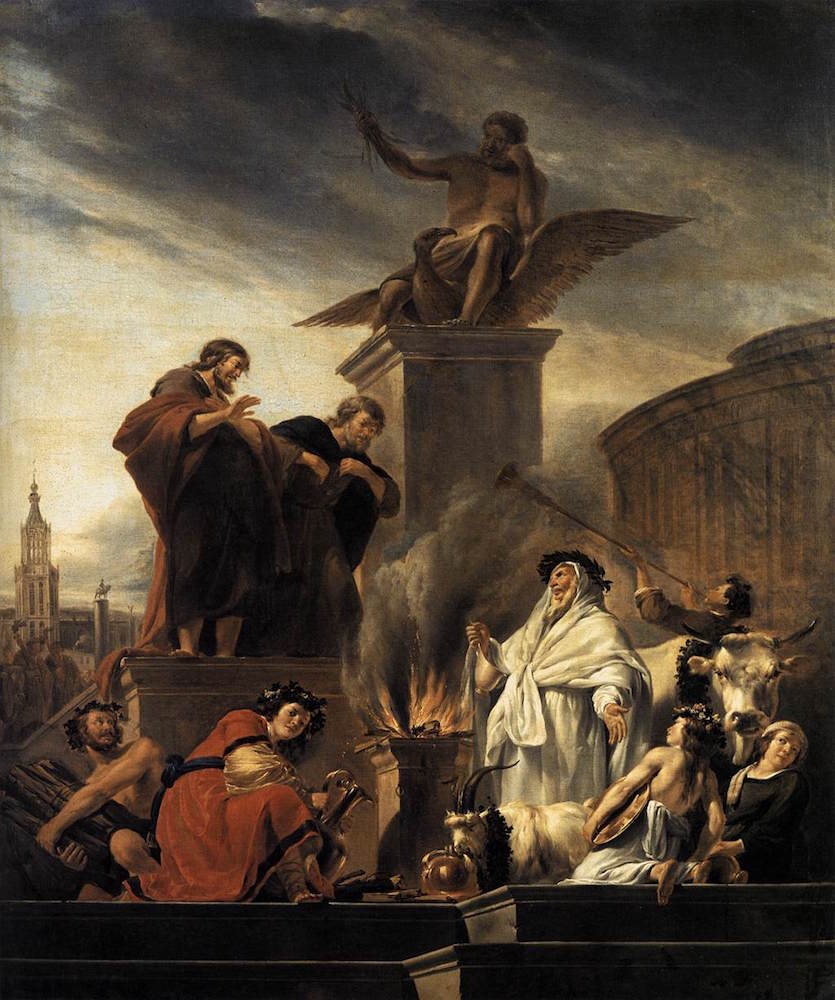
* There’s a comic touch to their preaching travails, too: in one exciting episode (Acts 14), Paul (of course) heals a cripple while the dynamic duo preaches in Lystra, leading excited witnesses to take them for Hermes and Zeus and start sacrificing to them.


No tips, please: Paul and Barnabas refusing the sacrifices of Lystrans in this detail (click for the full image) of a 1650 painting by Nicolaes Berchem.

** Beyond the Epistle and the Acts, there is also a very much later Gospel of Barnabas.

On this day..

1940: Julien Vervaecke, Tour de France cyclist

On or around this date — exactly when is forever obscure* — the former Tour de France cyclist Julien Vervaecke was summarily executed by Polish and British soldiers in German-occupied Belgium.

The Belgian velocipeddler raced professionally from 1924 to 1936 and reached the top ten of cycling’s signature event four times — capped by a third-place ride in 1927.

He’s most famous in the annals of his sport for his controversial victory in the 1930 Paris-Roubaix race, when he crossed the finish line second after getting the worst of a late collision with French cyclist Jean Marechal, but was awarded the win by judges who faulted Marechal for the incident. (Vervaecke got the medal but not the branding: it’s known as l’affaire Marechal.)

By the time war clouds had gathered anew, Vervaecke (English Wikipedia entry | German | French) had retired to proprietorship of a restaurant in Menen, on the French border.

As the Wehrmacht blitz overran Belgium, Vervaecke’s home chanced to fall within the British pocket pinned to Dunkirk, 70 kilometers away away. The famous evacuation would commence on May 26.

On May 24, scrambling soldiers of the British Expeditionary Force, apparently including some officers of the exiled Polish army,* tried to ransack Vervaecke’s place for supplies, and the ex-cyclist resisted. As with Marechal all those years ago, Vervaecke had the worst of this collision, and the tetchy troopers led him away.

Nobody witnessed what happened to him; his body only turned up weeks later, over the border in France. It’s guessed that he might have been detained and then shot out of hand hours later — more prey to the fog of war.


At least he didn’t die of lung cancer: In a different era for athletics, Vervaecke and Maurice Geldhof take a trip to flavor country during the Tour de France.

* Poland had already been occupied by Germany and the USSR, in September 1939.

On this day..

1996: Yevgeny Rodionov, Chechen War martyr and folk saint

On this date in 1996 — his 19th birthday — Russian hostage Yevgeny Rodionov was beheaded by his captors outside a village in Chechnya.

The young conscript was seized by guerrillas/terrorists/rebels along with three other comrades* during the horrible Chechen War.

Whatever ransom was demanded, the young man’s family could not pay it and in the end the the kidnappers sawed off his head. Searching for his remains at great personal peril his mother met a Chechen who claimed to be Yevgeny’s executioner, and was told by him that “your son had a choice to stay alive. He could have converted to Islam, but he did not agree to take his cross off.”

If it was meant as a taunt it backfired, for the story was later picked up by Russian media and, championed by his mother, the young Rodionov has become elevated into a contemporary folk saint — icons and all.

From the standpoint of the Orthodox hierarchy, Rodionov’s cult is thoroughly unofficial, but when it comes to popular devotion people often vote with their feet. Rodionov’s martyrdom expresses themes of great importance to some Russians: the growing cultural currency of Orthodoxy after the fall of the irreligious Soviet Union; a muscular resistance to Islamic terrorism;** an intercessor for common people ground up in the tectonic shifts that have reshaped Russia.

Thy martyr, Yevgeny, O Lord, in his sufferings has received an incorruptible crown from thee, our God, for having thy strength he has brought down his torturers, has defeated the powerless insolence of demons. Through his prayers save our souls.

* The other three — Andrey Trusov, Igor Yakovlev and Alexander Zheleznov — were all likewise murdered by their kidnappers.

** Although the war that he died in ended for Moscow in humiliating futility, Rodionov only became widely visible in the early 2000s amid an upswing of Russian patriotism following the outrages of the Moscow apartment bombings. (And, a more successful re-run of Chechen hostilities.)

On this day..

1622: Sultan Osman II

On this date in 1622, the deposed Ottoman Sultan Osman II was strangled in Yedikule Fortress.

A boy-emperor still in his 18th year at death, Osman had been the subject of a strange succession dispute: his father died in 1617, but with multiple underaged princes available to succeed him, the throne had been placed in the hands of a mentally disturbed uncle instead.

Osman was able to depose this man, but at his age — and without the steadying maternal hand* so necessary in the “Sultanate of Women” era — he was always an underdog to the Porte’s political snakepit.

Osman would be an early casualty of an intractable administrative problem for the Ottomans: curbing the Praetorian-like power of that clique of European-born warrior elites, the Janissaries.

Irritated by a battlefield reversal in Europe, Osman showed his young backside to the Janissaries by having their officers discipline them and exploring the feasibility a replacement force of Muslim-born Anatolians.

Thus while Osman prepared for an expedition to the southern reaches of his realm, the disaffected infantrymen answered their sultan’s ire with a rising of its own, one which Osman imperiously refused to pay in the customary coin of executed courtiers and policy concessions. He was accordingly deposed for that same disturbed uncle he had supplanted, and the unhappy Osman

was thrust into a cart by the wrestler Bunyan and strangled within the walls of the Seven Towers. The Jebbehji-bashi cut off one of his ears and carried it with the news of his murder to [new regime Grand Vizier] Davud Pasha. His body was buried in the At-maidân in the mausoleum of Sultan Ahmed Khan [Osman’s father]. He was cut off by fate before he could leave any monument of his reign. (Source)

Allegedly (via this detailed pdf breakdown of his fall), Osman cried to the mob as the cart hauled him to his dungeon, “Yesterday morning I was a sultan, now I am naked. Pity me, learn a lesson from my misfortune! This world shall not stay yours forever!”

* His European mother was either dead or in exile; she does not factor in Osman’s story; it was most typical during this period for a harem mother to sustain a prince in power by mastering Topkapi Palace’s labyrinthine internal politics.

On this day..

1643: The Book of Sports

On this date in 1643, all copies of the Book of Sports were publicly burned by the common hangman.

Product of the queer eddies of a century’s religious reformation, the 1617 edict commonly going under this winsome title was no athletes’ According to Hoyle; rather, it authorized for Sundays “any lawful recreation, such as dancing, either men or women; archery for men, leaping, vaulting, or any other such harmless recreation, nor from having of May-games, Whitsun-ales, and Morris-dances; and the setting up of May-poles and other sports therewith used.”

The day of the week was the decisive thing here. These traditional pastimes had long multiplied upon the numerous feast-days speckling the Catholic medieval calendar, but with the English Reformation this clutch of Papist holidays had been collapsed into just … Sundays. And so sportive Englishmen took their May-poles and Morris-dances to the Sabbath.


The Sabbath Breakers, by J.C. Dollman (1895)

By the late 16th and early 17th century the burgeoning Puritan movement was burnishing its sourpuss bona fides by — among other things — espousing a strict Sabbatarianism requiring that on their one day of rest from holiday-less labor people be “taken up the whole time in the public and private exercises of His [God’s] worship, and in the duties of necessity and mercy.” No vaulting or any other such harmless recreation for you!

I allowe not of such excesse of ryot & superfluitie as is there used. I thinke, it convenient for one Friend to visite another (at sometimes) as oportunitie & occasion shall offer it selfe, but wherfore shuld the whole towne, parish, village and cuntrey, keepe one and the same day, and make such gluttonous feasts as they doo? And therfore, to conclude, they are to no end, except it be to draw a great frequencie of whores, drabbes, theives and verlets together, to maintai[n] […] whordome, bawdrie, gluttony, drunkennesse, thiefte, murther, swearing and all kind of mischief and abhomination. For, these be the ends wherto these feastes, and wakesses doo tende.

Philip Stubbes, 1583

As one might well suppose from the eventual alliances in the English Civil War, the sports stuff was one of the fault lines between high church and low, and between crown and Parliament. Like any proper inbred royal, King James I loved himself a good hunt, and not only of witches — so he was nonplussed when passing through Lancashire to discover citizen grievances over killjoy blackrobes shutting down their Maypoles. He issued the Book of Sports explicitly in response, “to see that no man do trouble or molest any of our loyal and dutiful people, in or for their lawful recreations.”* This gave leisure-seeking commoners something to throw in the faces of their neighborhood nabobs, and Puritans another abomination to grow incensed about.

The Book of Sports remained law of the realm into the reign of James’s Puritan-allergic son Charles I but Puritan muscle grew stronger all the while,** eventually becoming irresistible when Parliament was recalled in 1640 and the high church bishop William Laud was ousted.

The outcome in 1643 was the rough impeachment of the sports book and I don’t mean Vegas.

It is this day ordered by the Lords and Commons in Parliament, that the Booke concerning the enjoyning and tollerating of Sports upon the Lord’s Day be forthwith burned by the hand of the common Hangman in Cheape-side, and other usuall places: and to this purpose, the Sheriffs of London and Middlesex respectively are hereby required to be assistant to the effectuall execution of this order, and see the said Books burnt accordingly. And all persons who have any of the said Books in their hands, are hereby required forthwith to deliver them to one of the Sheriffes of London, to be burnt according to this Order.

John Browne, Cler. Parl.
Henry Elsynge, Cler. P.D. Com.

The Sheriffes of London and Middlesex have assigned Wednesday next the 10th of this instant May, at twelve of the clock, for the putting in execution of the foresaid Ordinance; and therefore doe require all persons that have any of the Bookes therein mentioned, to bring them in by that time, that they may be burned accordingly.

John Langham,
Thomas Andrewes

London

Printed for Thomas Underhill in Great Wood strete, May 9, 1643

Obviously this is not an “execution” even in the metaphorical sense of executions by effigy but part of the wider remit of the hangman, whose duties ran to all sorts of public law enforcement as well as to cajoling society’s untouchables.

Still, “purging by fire” of the printed word was extraordinary treatment reserved for blasphemous or seditious books, not uncommonly accompanied by corporal punishment or even death for their authors. It would not far stretch matters to see in the Puritan Parliament’s disdainful lese-majeste against the hand of the past king its imminent regicidal stroke upon the neck of the current one.

* The Book of Sports wasn’t all license; for the amusements it authorized, it prohibited them to those who “are not present in the church at the service of God, before their going to the said recreations.” Even for the godly it evinced explicit preference for “such exercises as may make [subjects’] bodies more able for war,” therefore excluding “all unlawful games to be used upon Sundays only, as bear and bull-baitings, interludes and at all times in the meaner sort of people by law prohibited, bowling.”

This was a man with a philosophy on exercise as rigorous as any personal fitness coach. James, who was a prolific scribbler, elsewhere “debarre[d] all rough and violent exercises, as the footeball; meeter for laming, than making able the users thereof.” In four centuries since James so pronounced, England have only ever won the football World Cup once.

** Numerous Puritans fled oppressively pleasurable off-days and took their dour Sabbaths to New England where their descendants could one day propound several of the world’s most obnoxious sporting concerns.

On this day..

1919: Rudolf Egelhofer, Bavarian Soviet commandante

On this date in 1919, the commandante of the “Red Army” of the short-lived Bavarian Soviet Republic was shot by the German soldiers and Freikorps that had just overrun the revolutionary republic.

The son of a pauper basketweaver, Rudolf Egelhofer enlisted in the navy in World War I and was involved in a naval revolt in the war’s closing days. Transplanting to Munich in the chaotic postwar environment, Egelhofer joined the Communist Party and became a fixture of the revolutionary movement; the socialist writer Oskar Maria Graf would record of Egelhofer’s stature at a parade that he stood “determined and sincere, in a sailor’s uniform, sometimes raising his fist. Those who heard him, had to believe in him.”

After a left-wing coup claimed Bavaria in early April, Egelhofer’s steel and magnetism received the impossible mandate of organizing a Red Army before Munich went the way of the Paris Commune. But the Bavarian Soviet was overwhelmed in less than a month.

In the first days of May, Egelhofer’s fate was shared by something like 700 supporters of the defeated Soviet.


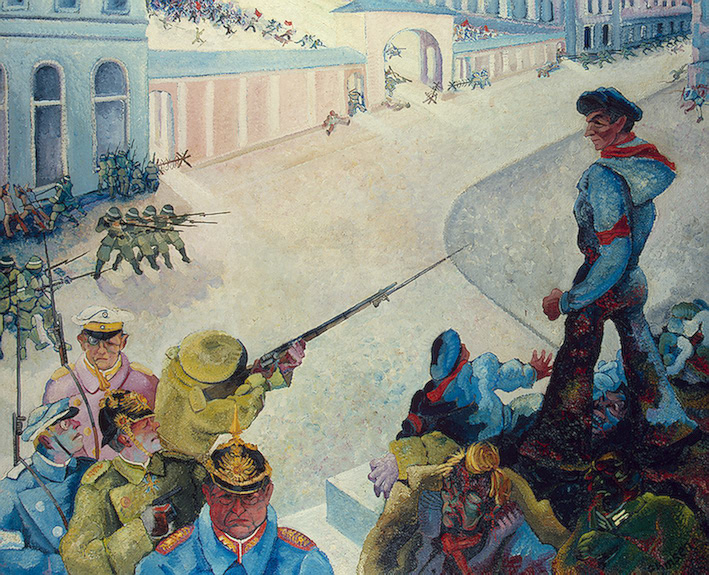
The fierce “victim” dominates his executioner in Execution by Firing Squad of the Sailor Egelhofer, by Heinrich Ehmsen (1931). This is only the central panel of a triptych depicting the White storming of Red Munich; the piece is described in this post.

Ehmsen has a similar idea about relative stature at work in Execution by Firing Squad (Red Jacket) (1919).

Though little memorialized at the place of his glory and martyrdom — which fell on the western side of the Iron Curtain — numerous East Germany streets, public buildings, and naval vessels bore Egelhofer’s name in tribute during the Cold War.

On this day..