1944: The Wola Massacre begins, during the Warsaw Uprising

On this date in 1944, a weeklong German slaughter of Polish civilians and resistance fighters began in the Wola district of the capital city Warsaw.
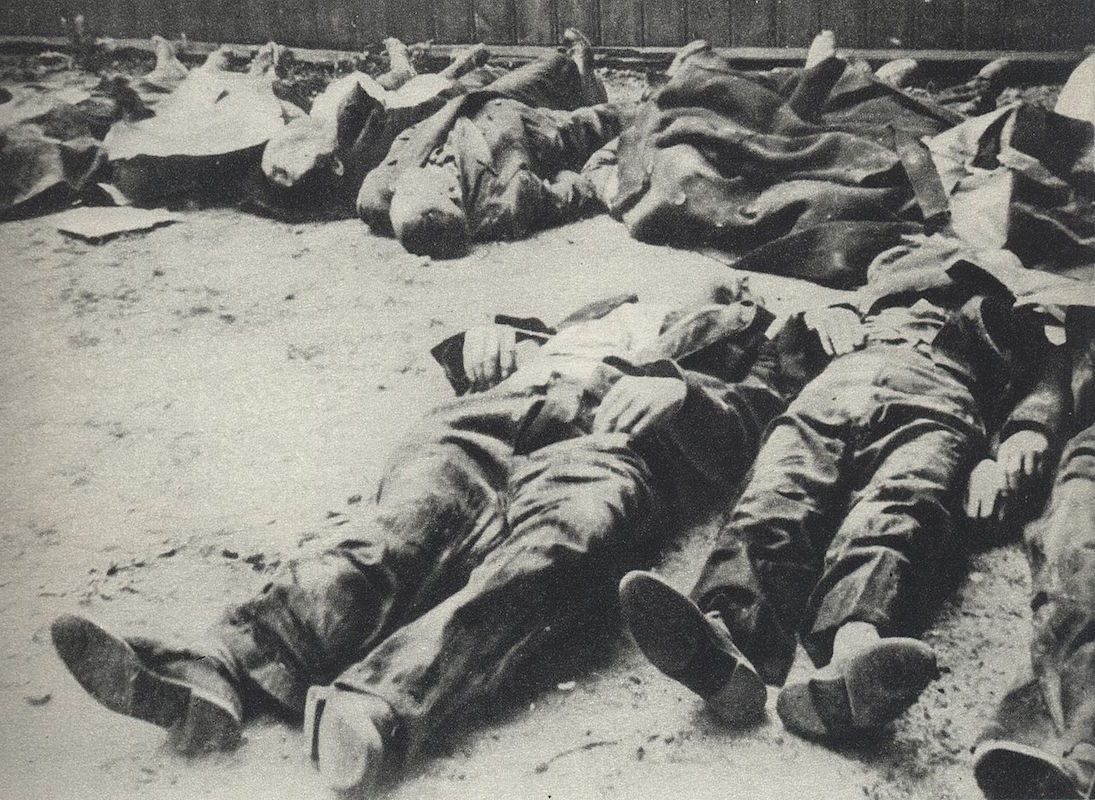
The Wola Massacre marked the start of the Reich’s counterattack against the Warsaw Uprising, the heroic and suicidal rising mounted by the Polish Home Army as the Red Army’s summer offensive brought it to the banks of the Vistula.

Aiming to claim some foothold upon which to influence events in the soon-to-be Soviet-occupied Poland, the Home Army enjoyed initial success in the first days of August. But German reserves from the Replacement Army — the vehicle by which the Valkyrie plotters had attempted their coup against Hitler just days before, and now as a consequence answering directly to Heinrich Himmler — were quick to the scene and would turn back the rising in weeks of bloody urban warfare. Himmler’s authority in crushing the Warsaw Uprising would also allow him to give rein to his SS for a campaign of atrocities intended to cow the populace into speedy submission.

Himmler wasn’t a battlefield commander, of course. Chief on the scene would be Erich von dem Bach-Zelewski; for this purpose he would enlist some of the more notorious units on the eastern front, such as the lawless Sonderbataillon Dirlewanger and the “Russian National Liberation Army” of Bronislav Kaminski. They were just the types to implement Himmler’s brutal orders* for a city they were soon to lose anyway:

  1. Captured insurrectionists shall be killed whether or not they fight in accordance with the Hague Convention.
  2. The non-fighting part of the population, women, children, shall also be killed.
  3. The whole city shall be razed to the ground, i.e. its buildings, streets, facilities, and everything within its borders.

The outcome rates as perhaps the largest battlefield massacre of World War II.

On August 5, Bach-Zelewski’s forces began a coordinated push into the western suburb of Wola. Himmler’s orders were implemented immediately, as attested by numerous civilian witnesses and lucky survivors:

I lived in the Wola district at No. 8, Elekcyjna Street. At 10 a.m. on Aug. 5, 1944 a detachment of SS-men and Vlassov’s men entered. They drove us from the cellars and brought us near the Sowinski Park at Ulrychow. They shot at us when we passed. My wife was killed on the spot: our child was wounded and cried for his mother. Soon a Ukrainian approached and killed my two-year-old child like a dog; then he approached me together with some Germans and stood on my chest to see whether I was alive or not – I shammed dead, lest I should be killed too. One of the murderers took my watch; I heard him reloading his gun. I thought he would finish me off, but he went on further, thinking I was dead. I lay thus from 10 a.m. until 9 p.m. pretending to be dead, and witnessing further atrocities. During that time I saw further groups being driven out and shot near the place where I lay. The huge heap of corpses grew still bigger. Those who gave any sign of life were shot. I was buried under other corpses and nea rly suffocated. The executions lasted until 5 p.m. At 9 p.m. a group of Poles came to take the corpses away. I gave them a sign that I was alive. They helped me to get up and I regained sufficient strength to carry with them the body of my wife and child to the Sowinski Park, where they took all the dead. After this sad duty had been performed they took me to St. Laurence’s Church at Wola, where I remained till next day. I cannot state the exact number of the victims, but I estimate that those among whom I lay amounted to some 3,000 (three thousand). I met a friend in the church who had gone through the same experience as I, having lost a boy of 8, who had been wounded and died calling for his father. I am still in hospital and the image of death is constantly before my eyes.

And another:

On August 5, 1944, between 12 and 2 p.m., I saw from a window on the first floor of Wola Hospital Germans dragging women out of the cellars of No. 28, Plocka Street. They shot them in the courtyard with machine-guns. Almost at the same time, I saw in the courtyard of No. 30, Plocka Street the hands of more then 20 people raised and visible over the fence (the people themselves could not be seen). After a volley of shots these hands fell down: this was another of the executions in Wola.

And the agonizing testimony of Wanda Lurie:

I stayed in the cellar of No. 18 until August 5, when, between 11 and 12 noon, the Germans ordered all of us to get out, and marched us to Wolska Street. This march was carried out in dreadful haste and panic. My husband was absent, taking an active part in the Rising, and I was alone with my three children, aged 4, 6 and 12, and in the last month of pregnancy. I delayed my departure, hoping they would allow me to remain, and left the cellar at the very last moment. All the inhabitants of our house had already been escorted to the “Ursus” works in Wolska Street at the corner of Skierniewicka Street, and I too was ordered to go there. I went alone, accompanied only by my three children. It was difficult to pass, the road being full of wire, cable, remains of barricades, corpses, and rubble. Houses were burning on both sides of the street; I reached the “Ursus” work’s with great difficulty. Shots, cries, supplications and groans could be heard from the factory yard. We had no doubt that this was a place for mass executions.

The people who stood at the entrance were led, no, pushed in, not all at once but in groups of 20. A boy of twelve, seeing the bodies of his parents and of his little brother through the half-open entrance door, fell in a fit and began to shriek. The Germans and Vlassov‘s men beat him and pushed him back, while he was endeavouring to get inside. He called for his father and his mother. We all knew what awaited us here; there was no possibility of escape or of buying one’s life; there was a crowd of Germans, Ukrainians (Vlassov’s men), and cars. I came last and kept in the background, continuing to let the others pass, in the hope that they would not kill a pregnant woman, but I was driven in with the last lot. In the yard I saw heaps of corpses 3 feet high, in several places. The whole right and left side of the big yard (the first yard) was strewn with bodies. We were led through the second. There were about 20 people in our group, mostly children of 10 to 12. There were children without parents, and also a paralysed old woman whose son-in-law had been carrying her all the time on his back. At her side was her daughter with two children of 4 and 7. They were all killed. The old woman was literally killed on her son-in-law’s back, and he along with her. We were called out in groups of four and led to the end of the second yard to a pile of bodies. When the four reached this point, the Germans shot them through the backs of their heads with revolvers. The victims fell on the heap, and others came. Seeing what was to be their fate, some attempted to escape; they cried, begged, and prayed for mercy. I was in the last group of four. I begged the Vlassov’s men around me to save me and the children, and they asked if I had anything with which to buy my life. I had a large amount of gold with me and gave it them. They took it all and wanted to lead me away, but the German supervising the execution would not allow them to do so, and when I begged him to let me go he pushed me off, shouting “Quicker!” I fell when he pushed me. He also hit and pushed my elder boy, shouting “hurry up, you Polish bandit”. Thus I came to the place of execution, in the last group of four, with my three children. I held my two younger children by one hand, and my elder boy by the other. The children were crying and praying. The elder boy, seeing the mass of bodies, cried out: “they are going to kill us” and called for his father. The first shot hit him, the second me; the next two killed the two younger children. I fell on my right side. The shot was not fatal. The bullet penetrated the back of my head from the right side and went out through my cheek. I spat out several teeth; I felt the left side of my body growing numb, but I was still conscious and saw everything that was going on around me.

I witnessed other executions, lying there among the dead. More groups of men were led in. I heard cries, supplications, moaning, and shots. The bodies of these men fell on me. I was covered by four bodies. Then I again saw a group of women and children; thus it went on with group after group until late in the evening. It was already quite, quite dark when the executions stopped. In the intervals between the shootings the murderers walked on the corpses, kicked them, and turned them over, finishing off those who still gave any sign of life, and stealing valuables.

German soldiers too recorded wholesale executions in their diaries and correspondence; while the accounts above are all specifically attributable to the 5th of August, those that follow are undated snapshots of environment:

Policemen with rifles under their arms trudged along. All of the police from occupied Poland came together there to show off their bravery and also to enrich themselves on the side. I did not see this activity, but others did. They saw how these policemen executed those from the procession who could not keep up, those who were sick and lagging behind, and right in front of their compatriots. What was particularly troubling about this misery is that unlike in Russia what was occurring was not a matter of a completely poor, and in any event already moaning, mass of people; rather these were people of our own social class, women in fur coats, cute children who up until two days before had been fully cared for. This memory has always caused me anguish during my short stopovers in Warsaw: the look from so many hostile eyes, people of our culture, who knew exactly what I knew. For that reason I was always glad never to have been deployed in the West. And now I stood beside these people in bitter agony, and I was shocked.

Now we arrived at the command post of the SS-commander. There were two buses parked on the right side of the street. We reported to the SS-commander, a medium-built stringent man with a sharply chiseled face. With a cold glance at the procession of women and children that was passing no farther than 10 meters from us, he said, “You see, this is our biggest problem. These refugees! I don’t have enough ammunition to kill them all!” He said this quietly and with a remorseful shrug of the shoulders, this elegant officer with the Iron Cross and pleasant manners. Meanwhile tears fell down my cheeks. What kind of human being was he?

Hans Thieme

And another:

Before each daily operation I reported to the SS commander. During one visit I witnessed an event, which sickened me to my very core. The SS officer’s office was on the upper floor of a building and had a balcony that overlooked a large courtyard. The SS had lined up near a wall about 40 or so Polish men, women, and children of all ages. I distinctly recall a young woman holding hands with two small children. It was clear to me what was about to happen. I confronted the SS commander as to why these people were about to be shot. His reply was that they were being executed as a reprisal for the Germans that had been killed in the Uprising. He informed me that it was also none of my concern. Shortly, thereafter the hostages were shot before my eyes. I was disgusted by what I had witnessed and after 60 years later it still haunts me.

Eberhard Schmalz

And another:

I was setting explosives under big doors, somewhere in Old Town. From inside we heard Nicht schiessen! Nicht schiessen! (Don’t shoot! Don’t shoot!). The doors opened and a nurse appeared with a tiny white flag. We went inside with fixed bayonets. A huge hall with beds and mattresses on the floor. Wounded were everywhere. Besides Poles there were also wounded Germans. They begged the SS-men not to kill the Poles. A Polish officer, a doctor and 15 Polish Red Cross nurses surrendered the military hospital to us. The Dirlewangerers were following us. I hid one of the nurses behind the doors and managed to lock them. I heard after the war that she has survived. The SS-men killed all the wounded. They were breaking their heads with rifle butts. The wounded Germans were screaming and crying in despair. After that, the Dirlewangerers ran after the nurses; they were ripping clothes off them. We were driven out for guard duty. We heard women screaming. In the evening, on Adolph Hitler’s Square [now Pilsudzki Square] there was a roar as loud as during boxing fights. So I and my friend climbed the wall to see what was happening there. Soldiers of all units: Wehrmacht, SS, Kaminski’s Cossacks, boys from Hitlerjugend; whistles, exhortations. Dirlewanger stood with his men and laughed. The nurses from the hospital were rushed through the square, naked with hands on their heads. Blood ran down their legs. The doctor was dragged behind them with a noose on his neck. He wore a rag, red maybe from blood and a thorn crown on top of the head. All were lead to the gallows where a few bodies were hanging already. When they were hanging one of the nurses, Dirlewanger kicked the bricks she was standing on.

Mathias Schenk

A much larger catalogue of atrocity accounts awaits at warsawuprising.org.

The massacre at Wola would run on to about the 13th at which point Bach-Zelewski abated the civilian massacre order as counterproductive: too many soldier-hours needed for focused bloodbaths were being squandered orchestrating gratuitous ones. Nevertheless, weeks of hard urban warfare lay ahead, and policy continued to embrace the summary execution of captured fighters and of all fighting-age men, resistance or no. Some 200,000 civilians are thought to have died during the Warsaw Uprising.

One legacy was eerily and unknowingly captured by a LIFE magazine photographer in 1948, of a young girl in a school for disturbed children in Poland. Her face a scramble of innocence and madness as it peers into the lens, she illustrates her “home” as an incoherent chalk vortex. It wasn’t known until many years after this photo became emblematic of a generation wracked by horror, but “Tereska” — Teresa Adwentowska — was an orphaned survivor of Wola.

* Per Bach-Zelewski’s evidence to the Nuremberg tribunal. By dint of cooperation, he saved his own life from the Nuremberg gallows.

On this day..

2010: Michel Germaneau, AQIM hostage

Al-Qaeda in the Islamic Maghreb (AQIM) executed its hostage French national Michel Germaneau on this date in 2010, in the Saharan state of Mauritania.

An engineer who turned 69 years old in captivity, Germaneau was abducted that April while in Niger doing humanitarian aid. AQIM attempted to exchange him for French-held terrorists, including Rachid Ramda, but the militants shot him out of hand when a joint French-Mauritanian raid attempted to free him but stormed the wrong al Qaeda camp.

Germaneau’s body has never been found.

On this day..

Feast Day of Rasyphus and Ravennus

July 23 is the feast date of fifth century Christian martyrs Rasyphus and Ravennus.

Supposed by Middle Ages legends to be British natives who fled to Gaul as Rome abandoned the island to onrushing Anglo-Saxons, they found martyrdom on the continent via some different horde — possibly the Goths.

Today, these historically unreliable characters have been deprecated to the Vatican’s minor league “local cult” circuit, but in their day they were the pride of Bayeux, whose cathedral held the honor of the saintly relics

Despite the repose of their bones, Rasyphus and Ravennus were not associated with Bayeux in life; they are said to have been decapitated at instead at the town of Mace.

This reliquary relocalization was consequence of a widespread shuffling of religious treasures during the Viking age — like the century-plus posthumous journey of St. Cuthbert as Danes put his various resting places to the sack. Bayeux’s native saint, the 4th-5th century bishop Exuperius (Exuperius of Bayeux is not to be confused with his contemporary and fellow-bishop, Exuperius of Toulouse), had had his bones moved for safekeeping from the Northmen to Corbeil, near Paris. Relics, especially very old ones, bestowed reverential prestige on their surroundings during the Middle Ages and having lucked into this bounty Corbeil afterwards refused to return Exuperius — which was a very common (mis)behavior. At one point Corbeil even humiliatingly shammed Bayeux by sending it the skeleton of some peasant after accepting a bribe for Exuperius.

So much for Bayeux’s homegrown holyman, but no problem: the Vikinger threat had also driven Rasyphus and Ravennus on from Mace to Bayeux, and two late antiquity corpses being even better than one, these British refugees now became patrons of a home they had never known.

(In later years the Rasyphus and Ravennus relics would be uprooted yet again, by the Wars of Religion; today, they’re not to be found in Mace or in Bayeux, but in Grancey.)

And thanks to their domicile, R+R perhaps make a cameo appearance on medieval Europe’s most famous narrative textile, the Bayeux Tapestry.

The tapestry pictures events leading up to the Norman conquest of England, culminating with the epochal 1066 Battle of Hastings. The Anglo-Saxon king who lost that battle, Harold, is a key character on the tapestry, and in the 23rd scene Harold swears an oath to his eventual foe at Hastings, William the Conqueror.

Although it’s not explicitly labeled as such in the threads, according to Trevor Rowley in An Archaeological Study of the Bayeux Tapestry: The Landscapes, Buildings and Places, we can plausibly identify the setting for that oath as the altar consecrated to Rasyphus and Ravennus in the Bayeux Cathedral. (The artifact was commissioned by William the Conqueror’s powerful half-brother Odo, who was also Bishop of Bayeux — hence both the tapestry’s name and its prospective interest in broadcasting the Bayeux cults. The 22nd scene preceding it appears to overtly situate the action at Bayeux (“Bagia”).)

Rasyphus and Ravennus provided a high-status devotional focus. Their feast day was celebrated in the cathedral and their altar was second only to the high altar, dedicated to the Virgin Mary. Bishop Odo’s centrepiece for the shrine was a new reliquary, which is described in an inventory of 1476 as a large architectural shrine, richly decorated with gilding and enamel work.

The back side [of the shrine] is of gilded silver or worked in beaten metal; and all the rest of it, that is to say the front side, the two ends, and the top is made of fine gold, with raised golden images, and decorated with large and expensive enamels and precious stones of various kinds.

The reliquary was installed on an especially dedicated altar in the apse of Bayeux Cathedral just behind the primary altar and was described by a sixteenth-century antiquarian as ‘a miniature version of Bayeux Cathedral that was taller than a ten-year-old girl’.

Although the cult of the brothers did not spread outside Bayeux, at the time Harold swore his oath their perceived sanctity would have been at its height and their fine new reliquary would have provided an appropriately holy shrine for the purpose. It is also clear from what we know of Odo in other contexts that he would not have hesitated to use the opportunity of the Tapestry to advertise the Bayeux cult to an audience outside his own diocese.

On this day..

1450: Jack Cade posthumously quartered

On or around this date in 1450 the body of the rebel Jack Cade was posthumously beheaded and quartered.

He’s one of England’s first names in rebellion, and Cade’s Kentish rising indexed England’s catastrophic breakdown under the weak king Henry VI, a milepost between the waning Hundred Years’ War and the onrushing Wars of the Roses.


Panel of a 1964-1965 ceramic mural in Peckham, by Polish artist Adam Kossowski. (cc) image from Peter Gasston.

And for all of these, Cade included, Henry was the chaos-making variable.

He had just about finished squandering the entire French patrimony so gloriously won for him by the sword-arm of his doughty father Henry V, and defeated troops fleeing French advances in Normandy compounded, as they tramped up the southeast beaten and looting, the general fury at the king’s unpopular marriage to the French princess Margaret of Anjou. With shambolic governance allied to a slumping economy, corrupt taxation, and mounting public debt, things were coming unglued.

Like many kings, Henry benefited from the instinct to target overt blame away from the sovereign himself and towards the aides and counselors who surround him. One of the very most hated of those counselors was the man who had negotiated that French marriage — giving away to the French crown the hard-won provinces of Anjou and Maine as its price. William de la Pole, Duke of Suffolk, was so near to being attainted or lynched around London that King Henry exiled him for his own safety to France. But Suffolk didn’t make there: instead, he was captured at sea and murdered.

When his body washed up in Kent, rumors seem to have anticipated a royal reprisal against that region and in favor of the late hated favorite, perhaps the trigger for the events in this post.

Nevertheless, the “rebels” did not conceive themselves engaged in a seditious enterprise; this is apparent from the manifesto of grievances it issued, with moderating tones and language echoing complaints that the Commons was raising to no avail in Parliament.

Item. The law serves of nought else in these days but for to do wrong, for nothing is spread almost but false matters by colour of the law for reward, dread and favour and so no remedy is had in the Court of Equity in any way.

Item. We say our sovereign lord may understand that his false council has lost his law, his merchandise is lost, his common people is destroyed, the sea is lost, France is lost, the king himself is so set that he may not pay for his meat nor drink, and he owes more than ever any King of England ought, for daily his traitors about him where anything should come to him by his laws, anon they take it from him.

Item. We will that all men know we blame not all the lords, nor all those that are about the king’s person, nor all gentlemen nor yeomen, nor all men of law, nor all bishops, nor all priests, but all such as may be found guilty by just and true inquiry and by the law.

Item. We will that it be known we will not rob, nor plunder, nor steal, but that these defaults be amended, and then we will go home …

The man at the forefront is a cipher: he went by the potent alias of “John Mortimer”, the surname unmistakably linking his cause to the rival royal claimants over at the the House of York, but neither the name of “Jack Cade” by which history recalls his movement nor the antecedent experiences that thrust him into leadership can be attested with any confidence.

He appears by the half-glimpses we catch of him in the period’s chronicles to be a vigorous and intelligent character. He shied away from battle with a royal army, wisely avoiding the taint of treason that would come with entering the field against the king’s own person; but, it was an organized withdrawal that left his forces capable of ambushing and destroying the detachment from that army that the king had sent to pursue them, a testament to Cade/Mortimer’s adroit command.

Panicked when the news of this reversal resulted in his own forces taking up the rebels’ call to punish traitorous lords, King Henry beat feet for the safety of Kenilworth Castle and abandoned the stage of London to this mysterious new character.

The rebel militia seized it on the third of July that year, visiting its promised popular justice in the process upon several of those “false counsellors” detested among the populace — including the Bishop of Salisbury, the Baron Saye and Sele, and the former sheriff of Kent, William Cromer; Shakespeare gives us a bloody-minded* Cade bantering with his prey Saye and Sele in Henry VI, Part 2 — “Ye shall have a hempen caudle, then, and the help of hatchet … Go, take him away, I say, and strike off his head presently; and then break into his son-in-law’s house, Sir James [sic] Cromer, and strike off his head, and bring them both upon two poles hither.”


Charles Lucy, “Lord Saye and Sele brought before Jack Cade 4th July 1450”

Peasant risings like these are made for eventual failure, but it the unusually high water mark achieved by Cade’s rebellion before receding makes another measure of the crown’s weakness. After ceding the Kentishmen the run of London for several days, it took a desperate nighttime battle on London Bridge to finally push them out.

A general amnesty went abroad to induce the rebels to disperse, but it was not for Cade — who fled to Sussex where he was taken, and mortally wounded in the process, by the new sheriff of Kent, Alexander Iden. (A road called Cade Street now runs in the vicinity; there is a monument to his capture in Heathfield.) It was Cade’s good fortune to succumb to his injuries on the journey back to London but the pains of justice were inflicted upon his remains just the same.

Cade died on Sunday, July 12. The precise date for his posthumous disgrace is not certain from the sources available to us. Many writers report July 15, seemingly based on John Benet’s chronicle, which is a strong source and asserts the 15th unambiguously. I’m here guardedly preferring the 16th based on Gregory’s Chronicle, whose authors were clearly Londoners, and who narrated the progress of the week following Cade’s death with specificity.

And that day was that fals traytoure the Captayne of Kentte i-take and slayne in the Welde in the countre of Sowsex, and uppon the morowe he was brought in a carre alle nakyd, and at the Herte in Sowetheworke there the carre was made stonde stylle, the wyffe of the howse myght se hym yf hyt were the same man or no that was namyd the Captayne of Kente, for he was loggyd whythe yn hyr howse in hys pevys tyme of hys mys rewylle and rysynge. And thenne he was hadde in to the Kyngys Bynche, and there he lay from Monday at evyn [i.e., Monday, July 13] unto the Thursseday nexte folowynge at evyn [Thursday, July 16]; and whythe yn the Kynges Benche the sayde captayne was be-heddyde and quarteryde; and the same day i-d[r]awe a-pon a hyrdylle in pecys whythe the hedde by-twyne hys breste from the Kyngys Benche thoroughe owte Sowthewerke, and thenne ovyr Londyn Brygge, and thenne thoroughe London unto Newegate, and thenne hys hedde was takyn and sette uppon London Brygge.

Cade’s is the rebellion that gets the ink, but several other uprisings in the South of England followed in the months ahead … ill omen for the king who would soon experience the ruin of his reign and family.

The History of England podcast covers Jack Cade’s rebellion in Episode 161.

* It is one of Cade’s subalterns in this play who supplies posterity with the immortal quip, “The first thing we do, let’s kill all the lawyers.”

On this day..

2008: Two alleged prostitutes, by the Taliban

On this date in 2008, the Taliban executed two women whom it claimed were running a prostitution ring for U.S. soldiers based in the city of Ghazni.

The Taliban invited a journalist who gives us a disarmingly placid picture of the two burka-clad women seemingly conversing even as armed men surrounding them in the nighttime gloom prepare to take their lives.

On this day..

1835: Ruel Blake, “often seen among negroes”

On this date in 1835, Ruel Blake hanged in Livingston as one of the white instigators of a supposed slave uprising.

Blake was an foreigner to Madison County, a Connecticut carpetbagger who (according to the vigilance committee’s proceedings) “could claim but few or none as friends” as he was “of a cold, phlegmatic temperament, with a forbidding countenance; kept himself almost aloof from white society, but was often seen among negroes” and “was noted for cold-blooded revenge, insatiable avarice, and unnatural cruelty.” He worked as a wheelwright and carpenter, and had only a single slave, Peter.

But not everyone in Livingston had it in for the guy. As the excitement first began to bubble up as June turned to July, Captain Thomas Hudnall, a wealthy plantation owner gave Ruel Blake money and a horse and sagely suggested he lay low somewhere else while the storm passed. Blake had not yet been accused by anyone, but he’d aroused the ire and seemingly the suspicion of his neighbors when his own slave was accused and Blake administered an unconvincing and pro forma flogging — “he did not wish to hurt [the slave], occasionally striking a hard lick to keep up appearances.” Eventually other white citizens forcibly relieved him of the job, and Blake had the effrontery as he saw his man being thrashed to “[rush] through the crowd to where his negro was, and swore, if he was touched another lick, they would have to whip him first,” a threat that brought him to blows with the man wielding the whip.

Hudnall rightly anticipated that his neighbors’ presumption of “mere” excess sympathy for the slave would soon take a much darker turn: Blake blew town on July 1, and with the arrival into Livingston the very next day of the fantastical slave revolt claims from nearby Beatties Bluff, a $500 reward for his capture soon went nipping at Blake’s heels. In the ensuing panicked days, Blake along with the “steam doctors” Cotton and Saunders — all strangers come to Mississippi, all of them socially marginal and noted for fraternizing with black people — came to be acclaimed as the chief white conspirators, accusations that became self-affirming as men under the lash or in fear of the gallows repeated the names, knowing from their torturers’ leading questions who was already condemned by acclamation.

Blake was captured after just a few days, in Vicksburg, where he posed as a boatman from upriver. Now Hudnall’s favor cut against him, for the flight from Livingston appeared to prove his guilt:

He arrived in Livingston on the 8th of July, under a strong escort, intimations being obtained that an attempt would be made by the clan [John Murrell’s bandits, the alleged nexus of the slave rising plot -ed.] to rescue him.

His appearance in Livingston created a most alarming excitement; and, but for the committee’s being in session, in all probability he would have been forcibly taken from the guard, and immediately executed. After arriving, he was immediately put on his trial before the committee … Every disclosure which was made [by previous interrogations] was replete with testimony against him.

After hearing all the evidence, every opportunity was given him to produce counteracting testimony, which he failed to do. There being no doubt on the minds of the committee, he was, by a unanimous vote, condemned to be hanged; and, just before leaving the committee-room, he requested the committee to give him time to settle his affairs.

On the 10th of July, in the presence of an immense concourse of people, he was executed. He privately commended the verdict of the committee, and said they could not have done otherwise than condemn him from the evidence before them, and publicly, under the gallows, made the same declaration. He protested in his innocence to the last, and said that his life was sworn away.

On this day..

1835: Vincent, by popular demand

This story is transcribed from the July 27, 1835 National Banner and Nashville Whig:

From the Clinton (Miss.) Gazette.

PUBLIC EXECUTION. — On Thursday morning last,* between the hours of 10 and 11 o’clock, VINCENT, a mulatto fellow belonging to the estate of the late Robert Bell, was hung in this place, by the citizens.

Abundant evidence of his participation in the late insurrectionary movements having been furnished the Committee of Vigilance appointed by the people of Clinton, he was sentenced to receive three hundred lashes, and to perpetual banishment from the United States, after the expiration of forty days.

On Wednesday evening, Vincent was carried out to receive his stripes; but the assembled multitude were in favor of hanging him — regarding the sentence pronounced against him as insufficient for the punishment of so enormous a crime. A vote was accordingly fairly taken, and the hanging party had it by an “overwhelming majority,” as politicians say. He was remanded to prison.

On the day of execution, a still larger crowd was assembled, and fearing that public sentiment might have changed in regard to his fate, after every thing favorable to the culprit was alleged, which could be said, the vote was taken — and his death again demanded by the people.

In pursuance of this sentiment, so unequivocally expressed, he was led to a “black-jack,” and suspended to one of its branches.

We approve entirely of the proceeding. The people have acted properly. Any man, whether he be white, yellow, or black, who lends his countenance and aid to a scheme, having for its object the burning of villages and towns, and the indiscriminate butchery of men, women and children, surely deserves an ignominious death. He who robs a solitary traveller on the high-way of a few dollars, is doomed to suffer death. How much more then, is he deserving of that punishment, who concocts and matures a deep laid conspiracy against the lives of an unoffending community?

Vincent could have made important discoveries at the gallows, but obstinately refused doing so, alleging that his own death being certain, it would profit him nothing to bring others to the same fate, and that he should inform on no one.


The Clinton lawyer named Henry Foote — who in future would become Governor of Mississippi — claimed in his memoir Casket of Reminisces that the ad hoc public votes on Vincent’s life were the product of his, Foote’s, desperate attempts to prevent the lynching at the behest of the former slave’s aged mistress.

When I rode into the town of Clinton I saw a large multitude assembled on one of the most popular streets, in front of a store in which Mr. Archibald Kenney, now in Staunton, Virginia, had some years before sold merchandize. I dismounted and went to the spot. I soon learned that the vigilance committee of that vicinage, composed of some of the best citizens of the county, had been trying a mulatto man, whom I knew very well, upon a charge of being a participant in the scheme of alleged insurrection.

A considerable quantity of powder and shot had been found in his possession, which circumstance had awakened some suspicions against him. The committee had tried him, and had sentenced him to be whipped only, and they would, indeed, have discharged him altogether, as I learned from themselves, had they not dreaded the indignant rage of the population of the town, then in a very excited condition. The committee had been unfortunate enough to sit with closed doors, which gave to the imagination of those not taking part in their proceedings a wide field for unfavorable conjecture. When the sentence was announced the outsiders determined to hang their longed-for victim at any rate; and at the time I reached the place where they were assembled the preparations for the execution of the boy were going forward. The boy had been in the ownership of a venerable gentle man of the neighborhood, Captain Bell, a Virginia friend of mine of great respectability and intelligence. He had been a great favorite with his master, who had left him free. The captain had been dead about a year, and this boy, who by-the-by was nearly white, and singularly polite and civil in his manners, had been since his master’s decease a faithful protector of his family, which consisted of his widow and a single female child. This widowed lady had reached the fearful scene some minutes before my own arrival, and had been allowed, in connection with a learned and pious minister of the Gospel, Dr. Comfort, to hold a last interview with this unfortunate boy. She came forth from this interview, attended by her pious and humane protector, and advancing within the portico where most of the multitude were located, she spoke, with a voice much agitated and almost stilled with emotion, while the tears were rapidly coursing down her venerable cheeks, as follows:

“GENTLEMEN, you all knew my husband during his life, and respected him. This poor boy was his favorite servant. I know his disposition and character well. I have just catechised him most searchingly. Had he been guilty as charged I should have been able to detect his guilt. I assure you that he is innocent. Oh! gentlemen, (she wildly exclaimed,) is there not one among you who will stand up here as the representative and champion of a poor, widowed, friendless female?” I immediately rose to my feet. I looked circumspectly upon the crowd for a moment. I saw standing just before me the grim-looking face of a man notorious for his violent and blood-thirsty character, whose name was Hardwick, and whom I soon after prosecuted for a diabolical murder, for which he would certainly have been hanged if the victim of his atrocity had been a white man. I saw a new rope in this ruffian’s hands, the texture of which he was feeling with his accursed fingers, evidently for the purpose of ascertaining whether it was strong enough to do the dread office effectually for which he had purchased it. I was conscious of all the perils which surrounded my position, and I therefore proceeded with extreme caution. I spoke thus: “Gentlemen, you have heard the touching appeal of this venerable lady. I have nothing to add to her decorous and impressive address, but I have a word to say to you of a prudential character in regard to yourselves and your own future responsibilities. The excitement now raging in this community may after awhile subside. Then it may be that some officious person shall wish to institute a prosecution for murder on account of the hanging of this boy. In my judgment it will be most safe that whatever is done in this affair shall be the act, as it were, of the whole community. I am not willing that a few generous-minded young men shall be made the scape-goats of this vicinage. Let us all join in whatever act may be resolved on. Now I will take the vote of the whole assemblage upon the question of banging, if no one sball object to it.” No objection being made, I said: “All in favor of hanging this unfortunate boy will signify the same by saying aye.” Nine-tenths answered aye. I said: “Those opposed to hanging will answer no.” About eight or ten persons said no.

I determined to make one more experiment before I gave up all hope of saving a human being from a fate so dreadful as that I saw impending. The day was intensely hot. The street on which we were located was very wide and intersected with deep gullies. I said: “Gentlemen, let us settle this question more satisfactorily: All in favor of hanging will range themselves on the opposite side of the street; those in favor of mercy will remain under the shade of this portico.” Nearly all rushed across the street! I left the spot with feelings of sorrow and disgust which no words can express. The boy was swung into eternity in less than fifteen minutes from that moment.

On my way home to dinner I met that distressed widow. She was on horseback, and stopped for a moment to speak to me. She said: “Mr. Foote, you know what has taken place to-day. You were, during the life of my venerated husband, his friend and his legal adviser. Tell me what I had best do. I wish to prosecute the murderers of my servant. Will you undertake to bring them to justice? I will reward you liberally.”

“My dear madam,” I said, “We are in the midst of most unhappy circumstances and of most appalling dangers. The community in which we live is in a frenzied condition. Were you to commence such a prosecution as you mention your own life would not be safe. Let me recommend to you earnestly to bow to the imperious necessity of the hour. “She looked at me for a moment with a mingled expression of sorrow and resentment upon her countenance, and then responded to me with a grave and touching solemnity of look I can never forget: “I will take your advice. Farewell!”

* This story was republished around the country featuring only the Gazette‘s original “Thursday morning last” locution, without any contextualizing dateline, which is another compelling reason for newsfolk to abandon the chatty day-of-week convention in favor of stating an actual date. Neither does Foote trouble to date the affair.

However, in view of the infuriatingly cavalier dating of events that this calendar-interested author is forever wrestling, Joshua Rothman‘s gumshoe act on Vincent’s hanging date in Flush Times and Fever Dreams: A Story of Capitalism and Slavery in the Age of Jackson is nothing short of a godsend. Here’s endnote 50 to chapter 7 in its gloriously diligent entirety:

Figuring the date of Vincent’s trial requires a bit of detective work and a bit of guesswork. On July 24 the Jackson Mississippian reprinted Vincent’s story as it appeared in the Clinton Gazette. July 24 was a Friday, and while no copies of the Gazette from July 1835 survive, the paper was published on Saturdays, meaning that its article about Vincent appeared in either the July 11 or July 18 edition. The original story indicates that Vincent’s execution took place on “Thursday morning last” and suggests that his trial took place the day before that. The language here is ambiguous. If the story originally appeared in the July 11 issue of the Gazette, “last” means July 9, the Thursday immediately preceding, as there was no vigilance committee in existence in Clinton on any Thursdays prior to that one. If the story originally appeared in the July 18 issue of the Gazette, “last” could mean that Vincent’s trial occurred on July 15 or on July 8, but July 8 seems more likely for several reasons. The activities of the vigilance committees all over the state, including the one in Livingston, had slowed significantly by the fifteenth. Moreover, Henry Foote claimed to have seen what happened to Vincent when he got back to Clinton the day after seeing the beating of Lee Smith. He may have been mistaken, but an entirely plausible and consistent timeline exists in which Foote saw a mob assault Lee Smith on the afternoon of July 7, arrived in Jackson that evening, accompanied William Sharkey to Clinton on the morning of July 8, and witnessed what became of Vincent in town that afternoon and early the next day. [citing] Clinton Gazette in Jackson Mississippian, July 24, 1835; Foote, Casket of Reminiscences, 256.

On this day..

1835: Dean and Donovan, white abolitionists

The planters comprising Livingston’s extralegal public safety committee had Albe Dean and Angus L. Donovan lynched on this date in 1835, during the ongoing panic at the prospect of slave rebellion.

Dean was a New England itinerant doctor, denounced by the “steam doctors” executed in Livingston on the 6th, in a desperate attempt to preserve their own lives; Donovan was a poor man from Kentucky whose name had been served up by similarly desperate slaves under torture at Beatties Bluff. Both were white, and in both cases the evidence marshaled against them largely resolved to a failure on the part of the accused to honor the color line.

The Livingston lynch committee was good enough to publish its own Proceedings by way of self-vindication, and we draw this post from its perspective on these marginal characters.

Trial of Albe Dean.

This man was a native of Ashford, Connecticut, whence he emigrated to Mississippi two years since. His general character before the disclosure of the conspiracy was not good; he was considered a lazy, indolent man, having very few pretensions to honesty. He had previously resided in the neighbourhood of Livingston, where he pretended to make a living by constructing washing-machines, until he became acquainted with Cotton, when he abandoned his business and turned steam-doctor, and went into partnership with Cotton, Saunders, & Co., and settled in Hinds county.

He was known to associate with negroes, and would often come to the owners of runaways and intercede with their masters to save them from a whipping. It was in evidence before the committee that he was seen prowling about the plantations in the neighbourhoods of Vernon, Beatie’s Bluff, and Livingston, ostensibly for the purpose of inquiring for runaway horses, which he did with great particularity — sometimes inquiring for a black, bay, gray, or other colour that suggested itself at the time. It was evident that horse-hunting was not his business, but that he was reconnoitring [sic] the country, and seeking opportunities to converse with the negroes …

Dean was arrested at the instigation of Saunders, who said he was a great rascal, and one of the conspirators. He was brought to Livingston with Saunders, on the 2d of July. On Monday, the 6th of July, he was placed on trial before the committee; but was in presence of the committee during the trial of Saunders and Cotton, and heard the whole of the testimony which went to implicate him.

It was in evidence before the committee, that, when on his way to Livingston, he had asked a witness, among other things, if some of Mr. W.P. Perkin’s negroes were not engaged in the conspiracy; and particularly if Hudnold’s Ned (a noted villain, whom he, Dean, had often endeavoured to screen from a whipping) was not concerned. He also inquired if Mr. Wm. Johnson’s Ruel Blake’s, and some other gentlemen’s negroes were not accused. He was not aware, at the time, that the very negroes about whom his inquiries were made had not only been suspected, but some of them actually hung; and, when informed Blake’s negro had been hung, he asked if he had made any disclosures about him. He was identified as one of their white accomplices by negroes accused.

And, lastly, he was accused by Dr. Cotton, who said, “Dean was one of his accomplices, and deeply engaged in the conspiracy, as a member of the Murrell clan.” After a cool and deliberate investigation of his case, he was, by a unanimous vote of the committee, found guilty of aiding and exciting the negroes to insurrection, and sentenced to be hanged.

In pursuance of the sentence, he was executed on the 8th of July, with Donovan, and died in dogged silence, neither acknowledging his guilt nor asserting his innocence.

This man requested that his name should not be given to the public, as his father was a public man, and it might lacerate the feelings of a venerated mother, who still survived. This request the committee and the writer would have scrupulously regarded, but that the name of the unfortunate man had already been made public by the officious and gratuitous information of some of the letter-writers [letters from Madison County to newspapers that were published widely in July and August -ed.], who have already given his name to the public.

Trial of A.L. Donovan, of Maysville, Ken.

After the trial of Dean, this young man was brought before the committee for examination, having been arrested on the evening of the 2d July, at Beatie’s Bluff.

His deportment, some weeks previous to his arrest, was very suspicious, from his intimacy with the negroes in the neighbourhood, being suspected at the time of trading with them, &c. His behaviour was so reprehensible as to compel the gentleman with whom he boarded to tell him, if he did not change his course he must leave his house, which he did a few days after, and went to the house of a man by the name of Moss, reputed a great scoundrel, whose name is mentioned in the report of the proceedings at Beatie’s Bluff: there Donovan remained until his arrest.

Donovan’s conduct was so very extraordinary and suspicious after he commenced boarding with Moss, as to induce the citizens of the neighbourhood to watch his movements. He was repeatedly found in the negro cabins, enjoying himself in negro society. Some persons requested him to leave the place, but he refused, alleging as a reason that he had to take care of some old keel-boats (which were entirely useless), half sunk, in Big Black river.

After the plot of the conspirators was discovered, instead of using his exertions to ferret out the ringleaders, and to assist the citizens in their efforts of detection, he would be found sneaking about the negro quarters, seeking opportunities to converse with them; and was caught at the house where the discovery of the conspiracy was made, engaged in earnest conversation with the girls who divulged the plot.

After arrests were made and examinations were going on, his conduct was such as no honest man would pursue; he would introduce himself into any company of gentlemen he would see conversing; this in itself at the time, was not noticed, as every one was desirous of finding out something to direct him in his investigations; but he would then go off and engage in conversations with Moss and his sons-in-law, who he knew, from their character, were suspected of being engaged in promoting the insurrection.

Even after several negroes were taken on suspicion, he still persisted in his attempts to converse with them, and at one time actually undertook (while the citizens were examining one) to release a negro who was tied, which negro afterward implicated him.

He was requested by the gentlemen who were examining the negroes not to come about them; they were compelled to take this step, from the fact that, when he was present, the negroes would say nothing, for the experiment was frequently tried; but when they were apprized that Donovan was not present, their disclosures were full, complete, and corresponding; the experiment was tried several times with the same success.

When he found he could not be permitted to be present at the examination of the negroes, he evinced considerable uneasiness, and kept walking to and fro, in view of the negroes under examination. The cause of his anxiety and alarm was soon explained; after his removal the negroes commenced a full detail and expose of the whole conspiracy (being at the time one or two hundred yards apart, and examined one at a time).

Among other white associates implicated by them, Donovan was said to be one of their leaders, and deeply concerned with them in the conspiracy.

After being implicated by a number of negroes at Beatie’s Bluff, the citizens thought proper to arrest him and bring him to Livingston, where the committee then organized was in session.

He was put on trial before the committee on the 7th July, and, in addition to the testimony before adduced, the following evidence was brought forward, which proved his participation in the conspiracy: —

A negro man from Beatie’s Bluff stated that Donovan was one of the white men engaged in persuading him to rebel with the rest, on the 4th of July, and that he had often solicited him to join them; Donovan said nothing was easier than for them to get their freedom; that the negroes could kill all the white people; and, if they should be pushed, that he would take them to a free state.

The confession of another negro man was in evidence before the committee, who pointed Donovan out at the time of the negro’s examination, and said, “He was to be one of their captains at Beatie’s Bluff.” It was also in evidence before the committee, that another boy, just before his execution, pointed Donovan out, when in a crowd, and said he was one of the men who persuaded him to enter into the conspiracy, and had encouraged him to go on, and get as many negroes to join as possible: other negroes implicated him.

A young man of unimpeachable character testified to the committee, in the presence of Donovan, that he and Donovan were walking through the field of his employer about the 25th or 26th May, when Donovan remarked to him that he should hate to be an overseer very much. Witness asked him why? He answered, it was such cruel work to be whipping the poor negroes, as he was obliged to do. Witness told him he never whipped only when they deserved it, and that was not often. Donovan exclaimed — “My friend, you will not have use for this long,” at the same time putting his hand on witness’s whip. Witness was a little astonished, and asked him to explain himself. Donovan, by way of explanation, remarked, the reason why he would not have use for it long was, that the negroes would soon be all free in this state. Witness replied, he knew the owners were not going to set them free, and that he (Donovan) ought to know that they could not effect their liberty by force, as they had tried it two or three times, and always failed; and that he thought they were now contented to remain in slavery.

Donovan replied warmly, in answer to his remarks, “that they could obtain their liberty by force, and that they would do it, not by themselves, but with the aid of thousands of rich, smart white men, who were ready to head them, with money, arms, and ammunition for their use.” And, before leaving the plantation, requested permission of witness to converse with the negroes, and to inform them of their rights, &c.

Of course, after the expression of such sentiments as above set forth, his request was denied, and at the same time he received a little good advice, and a threat from witness that, if he was seen on the plantation again, he might expect a “benefit” from his negro whip; and, using witness’s remark, Donovan cut out, and he had not seen him since until before the committee on his trial.

The committee were satisfied, from the evidence before them, that Donovan was an emissary of those deluded fanatics at the north — the ABOLITIONISTS. And, that while disseminating his incendiary doctrines among the negroes to create rebellion, he had found out that he was anticipated by a band of cut-throats and robbers, who were engaged in the same work, not wishing to liberate negroes, but to use them as instruments to assist them in plunder.

Being of a dissolute and abandoned character … and ripe for every rash enterprise, he joined the conspirators with the hope of receiving part of the spoils. If there had been any doubt on the minds of the committee as to his connexion with the conspirators, he would at least have been sentenced to be hanged for his attempts at diffusing among the negroes rebellious notions. On the 7th he was condemned to be hanged.

Accordingly, at twelve o’clock on the 8th of July he offered up his life on the gallows, as an expiation for his crimes. He said, from the gallows, that the committee did their duty in condemning him; that from the evidence they were compelled to do so.

Thus died an ABOLITIONIST, and let his blood be on the heads of those who sent him here.

On this day..

1835: The unknown lynched of the Murrell Excitement

We’ve done several posts in these pages devoted to Mississippi’s July 1835 slave insurrection panic and there are several more yet to come.

But today’s post is dedicated to the dead that we can’t date, and mostly can’t even name: the unknown slaves killed beyond the reach of law and documentation in forgotten lynchings or private murders around Madison County and environs. There’s no way to know how many these were; it’s guessed that they ranged into the dozens.

Well might one outrage to the well-documented extralegal lynch committee stretching necks in the county seat of Livingston — but as this was a committee of local oligarchs it had an orientation towards order, even if not law, and it brooked cross-examination and extenuating evidence, issued sub-lethal sentences and even acquittals. According to Joshua Rothman in Flush Times and Fever Dreams: A Story of Capitalism and Slavery in the Age of Jackson, many claimed — right or wrong — that Livingston was an island of relative calm in a panic compassing “a territorial belt along the Mississippi River stretching northward from Mississippi’s boundary with Louisiana nearly 250 miles toward Tennessee and inland roughly 75 miels toward the center of the state.”

Numerous public reports in Mississippi tried to suggest that a very different atmosphere prevailed in and around Madison County during the insurrection scare that continued on past the hangings of the gamblers in Vicksburg, and that the Livingston Committee of Safety had successfully introduced order to a situation that might otherwise have escalated into an uncontrolled orgy of violence.

Yet even in Livingston, the narrative is absorbed with the white purported masterminds; slaves’ executions appear as a part of the scenery, never exhaustively categorized. The white artisan Ruel Blake would be impeached on evidence given by a slave whose capture and hanging by a mob dignifying itself an ad hoc lynching subcommittee is entirely recounted — sans date — in a single footnote to the Livingston proceedings.

He was run by track-dogs some two hours without being taken, making his escape by taking to water. He remained in the woods until the excitement had partially subsided. By the laudable exertions of his master, he was decoyed into Livingston, where he was taken … the committee of safety had adjourned when he was taken. The citizens seemed determined he should be hanged, and consequently organized a committee, composed of some of the members of the first committee and other freeholders, who condemned him to be hanged; and, in pursuance of the sentence, he was executed in Livingston. Under the gallows he acknowledged his guilt, and said that R. Blake told him of the insurrection … Blake told him he must kill his master first, which he promised to do. Blake told him he was to be one of the captains of the negroes, &c.

And this is a wealth of information compared to some. Elsewhere we are left with passing allusions, shocking and frustratingly sparse, fragments deposited by a whirlwind.

In Warren County, the slave Israel Campbell remembered in his autobiography how he “saw the place where the slaughter took place. Two large wooden forks, with a pole laid from one to the other, served for the gallows, and they told me men hung there two days and nights.” But he never quite tells us how many or just when.

A July 8 letter from a white man in Clinton, Mississippi,* remarks that “a general excitement prevails, and every one is vigilant in the detecting and hanging of all villains, and it requires but little proof. I cannot say how many have been hung and shot among the white and blacks.”

From Mississippi Springs* on the same date: “Many white persons have been suspected of giving encouragement to it — some taken up, others pursued — those taken up have invariably been hung after a hasty examination by those who apprehended them; no more ceremony than is usually used upon hanging a dog for killing sheep is extended to them … A great number of negroes have been hung, and they are hanging them daily.”

Rothman again:

From near Natchez, about forty miles south of Claiborne, a plantation governess wrote in her diary about “insurrections, hangings, patrolling, and all sorts of frights” in the area, and one man wrote from Natchez itself that everyone in the city was “under arms all the time” and “hourly expect[ed] an insurrection, as the celebrated negro stealers Murrel and his band, are at the head of all the negroes.” All the towns upriver from Natchez, the man reported, were similarly guarded, and people in those places were “catching from 5 to 20 every day … and they hang them without judge or jury …

Future U.S. Senator and Mississippi Governor Henry Stuart Foote lived then in Clinton and his memoir heaped scorn on the ur-text of this statewide paroxysm, Virgil Stewart’s pamphlet claiming that small-time outlaw John Murrell was really a master criminal orchestrating a slave revolution. Foote remembered how in a timeless phenomenon “those who dared even to question the actual existence of the dangers which he depictured [sic] were suspected by their more excited fellow-citizens of a criminal insensibility to the supposed perils of the hour.”

[In Clinton] after the first organization of the vigilance committee, which sat afterward every day, the excitement, as was natural, increased perceptibly every hour. Suspected persons, both white and black, were apprehended everywhere; some of whom were brought before the committee for examination, while others, whose guilt seemed to be fully established, were hung without ceremony along the roadsides or in front of their own dwellings by those who had apprehended them …

Madison county was still the main focus of excitement, and every day we heard in the peaceful village where I dwelt of some new case of supposed guilt which had been there developed, and some new application of punishment not known to the law of the land, but which was supposed to be justified by the terrible necessity then dominating over all things beside.

Circumstances being what they are, we cannot but assume that such episodes each stand in for added multiples of lives taken by fire or noose or musketry, on plantation fastnesses or remote byways or hamlets too small for their own scrivener … nameless lives whose loss never spilled a drop of ink.

* Published in the Ohio State Journal, July 24, 1835.

* Published in the Baltimore Gazette and Daily Advertiser, July 30, 1835.

On this day..

1835: Five professional gamblers lynched at Vicksburg

On this date in 1835, five professional gamblers were strung up in Vicksburg.

It was an event more adjacent to than constituent of the slave rebellion panic shaking Mississippi, for the men were neither slaves nor their confederates and they were not struck down for threatening the Slave Power; at best, the uneasiness of possible insurrectionary stirrings abroad informed the tense background, or offered the post hoc justification — but these lynchings were a different thing that inhabited by chance the same time and place.

A Mississippi River boomtown “created by the easy credit of the Jacksonian ‘flush times’ and the scramble for wealth coincidental to Indian removal,” wrote Joshua Rothman,* Vicksburg had become a haven for faro players and other imps. The reports of this date’s events run thick with moralizing but as Rothman observes,

The merchants, doctors, lawyers, and planters who constituted Vicksburg’s budding elite may have believed professional gamblers threatened their moral integrity, but most people in Vicksburg were essentially speculators who had risked migration to the Southwest for the allure of fast profits almost unimaginable everywhere else in the country. In a very real sense, nearly everyone in Vicksburg was a gambler.

Then as now the high rollers at the tables of casino capitalism make free to snort at their louche progenitors and their marked cards and cathouse molls; gambling was a top-shelf moral hazard throughout 19th century America.

Whatever uneasy accommodation Vicksburg’s respectable had made with their cardsharps came to an abrupt end at an Independence Day barbecue that Fourth of July, when a player got into an altercation with a civilian and, ejected from the festivities, boldly returned to the scene armed, looking for trouble. Incensed townspeople overpowered him and drug him out of town to tar and feather him and order him out of town.

The summary executions that will follow two days hence would be widely condemned as news of the event echoed to the corners of the Republic, but that condemnation would always be attenuated by the nigh-universal public disapproval attached to gambling. A dispatch from Vicksburg that reached many other newspapers — we’re quoting it from the July 31, 1835 Richmond (Va.) Whig; one may find the piece in its entirety here — trowels on thick paragraphs of sermonizing before we come to the narrative: “shameless vices and daring outrages … destitute of all sense of moral obligations … intent only on the gratification of their avarice … vile and lawless machinations … every species of transgression … drunken and obscene mirth …” Et cetera, et cetera.

Now that we’ve forded this mighty river of invective, we find the townspeople of Vicksburg post-tar-and-feathering, “having thus aggravated the whole band of these desperadoes,

and feeling no security against their vengeance — the citizens met at night in the Court house, in a large number, and there passed the following resolutions:

Resolved, That a notice be given to all Professional Gamblers, that the citizens of Vicksburg are resolved, to exclude them from this place and its vicinity; and that twenty-four hours notice be given them to leave the place.

Resolved, That all persons permitting faro-dealing in their houses, be also notified that they will be prosecuted therefor.

Resolved, That one hundred copies of the foregoing resolutions be printed and stuck up at the corners of the streets — and that this publication be deemed notice.

Most of Vicksburg’s wagering fanciers took the ultimatum seriously and blew town. They were wise to do so.

On the 6th, as promised, Vicksburg’s soldiery marched door to door through a roster of homes suspected of hosting illicit gambling and there “dragged out every faro table, and other gambling apparatus that could be found” … until,

At length they approached a house which was occupied by one of the most profligate of the gang, whose name was North, and in which, it was understood that a garrison of armed men had been stationed. All hoped that these wretches would be intimidated by the superior numbers of their assailants, and surrender themselves at discretion, rather than attempt a desperate defence.

The House being surrounded, the back door was burst open, when four or five shots were fired from the interior, one of which instantly killed Doctor Hugh S. Bodley, a citizen universally beloved and respected.

The interior was so dark that the villains could not be seen, but several of the citizens, guided by the flash of their guns, returned their fire. A yell from one of the party announced that one of the shots had been effectual, and by this time a crowd of citizens, their indignation overcoming all other feelings — burst open every door of the building and dragged into the light, those who had not been wounded.

North, the ringleader, who had contrived this desperate plot, could not be found in the building, but was apprehended by a citizen, while attempting in company with another, to make his escape at a place not far distant. Himself, with the rest of the prisoners, were then conducted in silence to the scaffold.

One of them not having been in the building before it was attacked, nor appearing to be concerned with the rest, except that he was the brother of one of them, was liberated. The remaining number of five, among whom was the individual who had been shot, but who still lived, were immediately executed in presence of the assembled multitude. All sympathy for the wretches was completely merged in detestation and horror of their crime.

The whole procession then returned to the city, collected all the Faro Tables into a pile and burnt them.

The names of the individuals who perished, were as follows: North, Hullams, Dutch Bill, Smith and McCall.

Their bodies were cut down on the morning after their execution and buried in a ditch.

It is not expected that this act will pass without censure from those who had not an opportunity of knowing and feeling the dire necessity out of which it originated. The laws, however severe in their provision, have never been sufficient to correct a vice which must be established by positive proof, and cannot, like others, be shown from circumstantial testimony.

It is practised too, by individuals whose whole study is to violate the law in such a manner as to evade its punishment, and who never are in want of secret confederates to swear them out of their difficulties, whose oaths cannot be impeached for any specific cause.

We have borne with these enormities, until to have suffered them any longer would not only have proved us to be destitute of every manly sentiment, but would also have implicated us in the guilt of accessories to their crimes. Society may be compared to the elements which although “order is their first law,” can sometimes be purified only by a storm. Whatever therefore sickly sensibility or mawkish philanthropy may say against the course pursued by us, we hope that our citizens will not relax the code of punishment which they have enacted against this infamous and baleful class of society — and we invite Natchez, Jackson, Columbus, Warrenton, and all our sister towns throughout the State, in the name of our insulted laws — of offended virtue and of slaughtered innocence, to aid us in exterminating this deep-rooted vice from our land.

* “The Hazards of the Flush Times: Gambling, Mob Violence, and the Anxieties of America’s Market Revolution,” The Journal of American History, Dec. 2008. Also recommended: Rothman’s book Flush Times and Fever Dreams: A Story of Capitalism and Slavery in the Age of Jackson.

On this day..