1863: Mangas Coloradas, Apache leader

One hundred and fifty years ago, day to day,* the Apache chief Dasoda-hae — better known as Mangas Coloradas, “red sleeves” — was extrajudicially executed by U.S. Army soldiers at Fort McLane, New Mexico.

This legendary Apache statesman’s nickname was Spanish, because he’d spent the 1830s and 1840s fighting Mexicans seeking bounties on Apache scalps. Indeed, when the U.S. in 1846 attacked Mexico, Mangas Coloradas gave U.S. soldiers safe passage through Apache territory, and subsequently signed a treaty with the victorious Americans. (There’s a handy map of the scene in this pdf.)

He did his utmost to keep relations with the gigantic industrial society on his borders safely diplomatic, but over the 1850s Apaches spiraled into conflict with aggressive Anglo settlers drawn by the call of gold. In 1861 Mangas Coloradas married his daughter to another Apache chief, Cochise. These two were able to keep whites at bay with raids for a short time (and given a big assist from the resource diversion of the Civil War). But there was only one way this was going to end.

In January 1863, Mangas Coloradas — about 70 years old and still alive to the impossibility of long-term success by force of arms — arrived under a flag of truce to negotiate a ceasefire with Brigadier General Joseph Rodman West. West had him clapped in irons instead, and let his soldiers know exactly how to handle their prisoner.

Men, that old murderer has got away from every soldier command and has left a trail of blood for 500 miles on the old stage line. I want him dead or alive tomorrow morning, do you understand? I want him dead.

That night, Mangas Coloradas was tortured with red-hot bayonets and shot “trying to escape.” The Apache Wars would expand calamitously in the years to come.

The army medical officer David Sturgeon took the Apache’s scalped head (they scalped him, too), eventually bringing it to Ohio after he left the service. Sturgeon finally presented his prize to Prof. Orson Squire Fowler; Fowler examined it and published a description in his 1873 work Human Science: Or, Phrenology: Its Principles, Proofs, Faculties, Organs, Temperaments, Combinations, Conditions, Teachings, Philosophies, Etc., Etc..**

The fate of this horrid trophy after it passed through Fowler’s hands is a mystery. It’s rumored that the Smithsonian received it, and perhaps surreptitiously got rid of it; while the institution has always denied ever having the skull of Mangas Coloradas, it is a fact that the Smithsonian collected and still possesses an alarmingly enormous trove of Native American remains.

* It appears to me that Mangas Coloradas entered into army custody on January 17, and was shot just about midnight that night: the exact moment of the incident could be either the 17th or the 18th. An eyewitness account from one of the soldiers on night watch describes giving over the watch to George Lount until midnight. When the first watchman returned at that time, he noticed that “Mangas arose upon his left elbow, angrily protesting that he was no child to be played with. Thereupon the two soldiers [who had been torturing Mangas], without removing their bayonets from their Minie muskets, each quickly fired upon the chief, following with two shots each from their navy six-shooters.”

** What did the skull-measurer make of his prize? “It bulges out at its side in the region of Secretion, Caution, and Destruction, beyond anything I ever saw. Cunning is his largest organ, and far exceeds any other development of it I have ever seen, even in any and all Indian heads. It is simply monstrous. Yet Destruction also far exceeds any other development of it I ever saw …

“Conscience and Worship are unusually large, both absolutely and relatively, which coincides with the scrupulous fidelity with which he kept his promises. He doubtless thought he was but doing his duty in avenging the injuries white men had done to his tribe, by torturing and killing them. He must also have been a devout worshipper of the Great Spirit and extremely superstitious. Benevolence is very poorly developed indeed.”

(Mangas Coloradas actually was a very tall man with a very large head: a number of accounts attest to this.)

On this day..

69: Galba, in the Year of the Four Emperors

On this date in the year 69, the blink-and-you’ll-miss-him emperor of Rome Galba was slain — the first casualty in ancient Rome’s Year of the Four Emperors.

From the standpoint of this blog’s portfolio, Galba’s death admittedly makes for an edge case; in their time, the Romans experimented with every shade and interval for the span from extrajudicial execution to assassination to simple murder. Certainly the sudden homicide which forms our subject today proceeded under no purported legal color.

But dead is dead, and in Rome at that moment, dead was the essential fact. You had to get the incumbent into the ground to don the blood-drenched purple.

That’s exactly how Galba managed it himself: his predecessor was the infamous Nero, dead the previous June in a revolt that had set Galba up as the rival emperor.

Galba was a classic Peter Principle guy, a respected wealthy patrician who had been a prominent public figure for decades. At the end of Nero’s run, Galba was governor of a Spanish province and everyone thought would make a swell emperor … until he actually got the job.

As Suetonius observed, Galba’s “popularity and prestige were greater when he won, than while he ruled the empire.” Tightfisted (or fiscally responsible) and inflexible (or upright), the new emperor proved to have a gift for alienating his subjects.

The skinflint sovereign bullied enemies real and perceived, took an obnoxiously lordly attitude towards inferiors, and even decimated a legion (a practice long since out of date at this point). He set about restoring the ruined state finances by seizing even from parties at second and third hand goods which allegedly traced to Nero’s graft, then re-auctioning them … many of those auctions suspiciously won at a discount by Galba’s hated advisors-slash-controllers, the “Three Pedagogues.” And he “condemned to death divers distinguished men of both orders on trivial suspicions without a trial.” (Suetonius, again)

Very dangerously, Galba also refused to pay the customary donative to those arbiters of imperial succession, the Praetorian Guard.

All this mess brought the distant German legions into rebellion.

However, Galba triggered his downfall directly when he passed over for official heir an early Galba supporter, Otho — who had been dispensing liberal largesse on the understanding that he had the inside track to the throne — in favor of a youth named Piso.

Personally affronted and also in danger of having his now-unpayable debts called in, Otho brought the disaffected Praetorians over to his side and revolted.

The capital was thrown into a tumult. On January 15, Galba’s litter was being borne in the Roman Forum when Otho’s militia appeared,

loudly ordering all private citizens out of their way. The multitude, accordingly, took to their heels, not scattering in flight, but seeking the porticoes and eminences of the forum, as if to get a view of the spectacle. Hostilities began with the overthrow of a statue of Galba by Attilius Vergilio, and then the soldiers hurled javelins at the litter; and since they failed to strike it, they advanced upon it with their swords drawn. No one opposed them or tried to defend the emperor, except one man, and he was the only one, among all the thousands there on whom the sun looked down, who was worthy of the Roman empire. This was Sempronius Densus, a centurion, and though he had received no special favours from Galba, yet in defence of honour and the law he took his stand in front of the litter. And first, lifting up the switch with which centurions punish soldiers deserving of stripes, he cried out to the assailants and ordered them to spare the emperor. Then, as they came to close quarters with him, he drew his sword, and fought them off a long time, until he fell with a wound in the groin.

The litter was upset at the place called Lacus Curtius, and there Galba tumbled out and lay in his corselet, while the soldiers ran up and struck at him. But he merely presented his neck to their swords, saying: “Do your work, if this is better for the Roman people.” (Plutarch)

Piso tried to take refuge with the sacred Vestal Virgins, but was hauled out most impiously and abruptly put to death on the temple’s steps. Otho was said to greet this severed head of his rival heir with particular satisfaction. (Galba’s head was paraded through town on a spear, then given over to the servants of a guy Galba had executed so that they could dishonor it on the execution grounds.)

As for the victorious Otho, you’ll recall those restive German legions … and the fact that this is the Year of the Four Emperors. Galba was the first of those four; Otho, the second. As Cassius Dio tells it, “as he [Otho] was offering his first sacrifice, the omens were seen to be unfavourable, so that he repented of what had been done and exclaimed: ‘What need was there of my playing on the long flutes?’ (This is a colloquial and proverbial expression applying to those who do something for which they are not fitted.)”

Three months later, it was time to pay the flautist. Those German legions arrived, bumped off Otho, and made their own commander into emperor number three. (Otho, not theretofore viewed as particularly noble soul, redeemed himself for posterity by committing suicide for the good of Rome rather than press a ruinous civil war — uttering the Spock-like sentiment, “It is far more just to perish one for all, than many for one.”)

The History of Rome podcast series covers Galba’s abortive reign here.

On this day..

1864: Five Virginia City road agents

The frontier town of Virginia City, Montana, saw a quintuple hanging on this date in 1864, authored by the local vigilance committee.


(cc) image from Rich Luhr of the hanged men’s gravestones at Virginia City’s Boot Hill. (It’s one of several American West cemeteries known as “Boot Hill”)

A miners’ boom town since prospectors struck gold nearby the previous year, Virginia City was even, briefly, the capital of the Montana Territory.

For order, it depended upon a Vigilance Committee of local grandees … and that committee had just days before carried out the hanging of Henry Plummer, the sheriff of the nearby mining town of Bannack and a reputed outlaw gang boss.

Plummer’s supposed “road agents” did the wilderness-trail robbery act familiar of the western milieu, but on a nearly industrial scale: it was suspected that “horses, men and coaches” traveling around Bannack and Virginia City were systematically “marked in some understood manner, to designate them as fit objects for plunder.”

The next act in the Vigilance Committee’s confrontation with these highwaymen and bywaymen was to bust up the Plummer network by seizing and hanging five supposed road agents on this date.

The evidentiary basis for these conclusions was varied, and in most cases less than what you’d call ironclad; the club-footed cobbler George Lane was thought to be marking stages for outlaws to hit, but the crippled rancher Frank Parish? Or Jack Gallagher, who wasn’t even on the list of wanted road agents the vigilantes were working from?

(The Vigilance Committee’s Parish Pfouts would record in his diary “that every man executed by the Vigilance Committee at that time was proved to be a murderer or highway robber.” The unsavory whiff of lynch law notwithstanding, those vigilantes have not wanted for latter-day defenders.)

This text summarizes all the accused men’s backgrounds, including the colorful Boone Helm.

Upon the Vigilance men’s summary and predetermined judgment, the quintet was marched down the street to a then-unfinished log structure and strung up on an inside beam.

That log store can still be seen in Virginia City, where it’s kitschily advertised as the Hangman’s Building.

On this day..

1889: Alfred Schaeffer, diabolical dynamiter, lynched near Seattle

From the Chicago Daily Inter Ocean, January 8, 1889 (paragraph breaks added for readability: the original had none at all):

A DIABOLICAL DYNAMITER.


After Killing Three Persons and Wounding Others He Is Barbarously Lynched

SEATTLE, Wash. T., Jan. 7. — Alfred Shaffer [sic], a Bohemian, fired a heavy charge of giant powder under the house of George Bodala, at Gilman,* thirty miles east of Seattle, at 4:30 o’clock this morning, instantly killing John and Michael Scherrick, and Anna, the 9-year-old child of Bodala, and badly wounding Bodala, his wife, and little son and daughter.

Last spring Bodala caused the arrest of Schaeffer on the charge of criminal assault upon his wife. Schaeffer was sentenced to a short term of imprisonment, and when he was released he made such serious threats against the life of Bodala that he was again arrested, and incarcerated in jail nine days.

When he was released he returned to Gilman, and since then he lost no opportunity attempting to injury Bodala, and this morning put his threats into execution. The two Scherricks and the little girl were instantly killed.

Bodala was brought to the Providence Hospital to-day, and is in a very bad condition. The other three will probably recover. Schaeffer was found by the people of Gilman at his own house. He was placed under arrest, and later in the afternoon, upon the arrival of the sheriff, turned over to that officer.

This afternoon while the Sheriff was at dinner a crowd of 100 broke open the door of the house where Schaeffer was confined, took him to a tree opposite the railroad depot, and strung him up, first trying to make him confess.

He refused, and was hanged.

After thirty seconds he was cut down again and given another chance to confess, still declining he was again elevated and cut down for a second time after forty-five seconds.

He was then very weak, and, efforts to make him confess failing, he was again pulled up, and left hanging until death ensued.

* Present-day Issaquah.

On this day..

1987: Seven Suriname Maroons

This New Year’s Eve, we pay a visit to a notorious atrocity* 25 years ago today during Suriname’s Guerrilla War (Binnenlandse Oorlog).

The full judgment of the Inter-American Court of Human Rights on this matter is available in pdf form here. (There’s more analysis of the reparations awarded by the court in the August 1995 Human Rights Quarterly.)

Inter-American Court of Human Rights
Case of Aloeboetoe et al. v. Suriname
Judgment of September 10, 1993

1. The instant case was brought to the Inter-American Court of Human Rights (hereinafter “the Court”) by the Commission on August 27, 1990 … the Commission asserted that “the Government of Suriname violated Articles 1, 2, 4(1), 5(1), 5(2), 7(1), 7(2), 7(3), 25(1) and 25(2) of the American Convention on Human Rights” …

2. … The events that gave rise to the petition apparently occurred on December 31, 1987, in Atjoni (village of Pokigron, District of Sipaliwini) and in Tjongalangapassi, District of Brokopondo. In Atjoni, more than 20 male, unarmed Bushnegroes (Maroons) had been attacked, abused and beaten with riflebutts by a group of soldiers. A number of them had been wounded with bayonets and knives and were detained on suspicion of belonging to the Jungle Commando, a subversive group. Some 50 persons witnessed these occurrences.

3. According to the petition, the Maroons all denied that they were members of the Jungle Commando. The Captain of the village of Gujaba made a point of informing the commander in charge of the soldiers that the persons in question were civilians from various different villages. The commander disregarded this information.

4. The petition asserts that the soldiers allowed some of the Maroons to continue on their way, but that seven of them, including a 15-year old boy, were dragged, blindfolded, into a military vehicle and taken through Tjongalangapassi in the direction of Paramaribo. The names of the persons taken by the soldiers, their place and date of birth, insofar as is known, are as follows: Daison Aloeboetoe, of Gujaba, born June 7, 1960; Dedemanu Aloeboetoe, of Gujaba; Mikuwendje Aloeboetoe, of Gujaba, born February 4, 1973; John Amoida, of Asindonhopo (resident of Gujaba); Richenel Voola, alias Aside or Ameikanbuka, of Grantatai (found alive); Martin Indisie Banai, of Gujaba, born June 3, 1955; and, Beri Tiopo, of Gujaba (cf. infra, paras. 65 and 66).

5. The petition goes on to state that the vehicle stopped when it came to Kilometer 30. The soldiers ordered the victims to get out or forcibly dragged them out of the vehicle. They were given a spade and ordered to start digging. Aside [Richenel Voola] was injured while trying to escape, but was not followed. The other six Maroons were killed.

6. The petition states that on Saturday, January 2, 1988, a number of men from Gujaba and Grantatai set out for Paramaribo to seek information on the seven victims from the authorities. They called on the Coordinator of the Interior at Volksmobilisatie and on the Military Police at Fort Zeeland, where they tried to see the Head of S-2. Without obtaining any information regarding the whereabouts of the victims, they returned to Tjongalangapassi on Monday, January 4. At Kilometer 30 they came across Aside, who was seriously wounded and in critical condition, and the bodies of the other victims. Aside, who had a bullet in his right thigh, pointed out that he was the sole survivor of the massacre, the victims of which had already been partially devoured by vultures. Aside’s wound was infested with maggots and his right shoulder blade bore an X-shaped cut. The group returned to Paramaribo with the information. After 24 hours of negotiations with the authorities, the representative of the International Red Cross obtained permission to evacuate Mr. Aside. He was admitted to the Academic Hospital of Paramaribo on January 6, 1988, but died despite the care provided. The Military Police prevented his relatives from visiting him in the hospital. It was not until January 6, that the next of kin of the other victims were granted permission to bury them.

* But scarcely the only atrocity among Maroons during those years.

On this day..

1017: Eadric Streona, traitorous

On Christmas 1017, England’s King Cnut had the ealdorman Eadric Streona summarily axed.

While legend has it that Eadric Streona (“Grasping Eadric” or “Eadric the Acquisitor”) irritated the monarch by beating him in a game of chess, Middle Ages chroniclers attributed his fate to the just deserts of inveterate treachery.

A couple centuries of Viking raids and conquests had just culminated with the Northmen’s outright capture of the English throne, fifty years before the better-remembered Norman invasion.

Notwithstanding his best efforts at resistance, the Anglo-Saxon king Aethelred the Unready had been briefly driven into exile by Cnut’s father, Sweyn Forkbeard, and his house then decisively dispossessed by Cnut at the Battle of Assandun. (All kings had cooler names in the Anglo-Saxon period.)

Eadric figured into this period in the timeworn role of duplicitous nobleman. The BBC named him the worst Briton of the 11th century.

Though not of the highest pedigree himself, “his smooth tongue gained him wealth and high rank, and gifted with a subtle genius and persuasive eloquence he surpassed all his contemporaries in malice and perfidy, as well as in pride and cruelty.” (Florence of Worcester, whose chronicle dates to a century later.) Eadric maneuvered himself into a union with Aethelred’s daughter, but he didn’t exactly follow Corleone rules where the family was concerned.*

Plenty of lords were playing both sides of the Anglo-Saxon/Danish conflict, but Eadric did it as well as anyone. He was an exponent of the policy of appeasing the Northmen with the Danegeld tribute, rather than resisting by arms. (Eadric might have been helping himself to a rake of the Danegeld that passed through his own hands.) He’s slated with, on one occasion, dissuading Aethelred from falling upon a crippled Danish force that might have been destroyed.

His nemesis on the policy front was Aethelred’s combative son and heir Edmund Ironside. (Seriously: cooler names.)

Anyway, in 1015, when Aethelred and Cnut were pressing rival claims at arms, Eadric “seduced forty ships from the king, and they went over to Cnut.” Early the next year, he defected back.

By this time, Aethelred had died and Eadric’s old rival Edmund Ironside inherited leadership. What terms these two old foes came to when Eadric returned are a matter of speculation, but it can be no surprise that Eadric switched sides back to Cnut yet again at Assandun. Some chronicles like to attribute the whole fall of England to this backstab, but it’s more than likely the guy just recognized the balance of forces (the English got routed) and tacked to the wind.

And Eadric sure could tack. He even helpfully cleared out his and Cnut’s mutual rival Edmund Ironside, allowing Cnut to claim all the lands he’d just recently agreed to leave to Edmund. The most flinch-inducingly scabrous version of the assassination story goes that Eadric’s guys shot Edmund up the backside from a privy-hole. Guess that side wasn’t so iron.

But Eadric’s belief that he’d ingratiated himself with Cnut was as sorely mistaken as Edmund Ironside’s confidence in the loo. Kings tend to look askance upon traitors, and not a few usurpers have been known to extend that opprobrium to the very people who betrayed their predecessors. Cnut valued loyalty, and it was pretty clear he couldn’t rely upon Eadric in that department.

After tolerating this underhanded underling for a decent year or so,

[a]t the Lord’s Nativity, when [Cnut] was in London, he gave orders for the perfidious ealdorman Eadric to be killed in the palace, because he feared to be at some time deceived by his treachery, as his former lords Ethelred and Edmund had frequently been deceived; and he ordered his body to be thrown over the wall of the city and left unburied.

-Florence of Worcester (via)

The rich English-history podcast environment has various offerings touching this period, including …

* It needs to be said that Eadric is known through the testimony of hostile chronicles; given the dearth of primary documentation, his reputation lies at their mercy. One 20th century historian remarked that he takes on a bogeyman character in the texts, an all-purpose villain “to whom unknown crimes may be safely attributed.”

On this day..

1868: Sam Dugan lynched in Denver

Like San Francisco and other western cities dissatisfied with the half-lawless frontier atmosphere, the city of Denver formed a “Vigilance Committee” — ominously known as “The Stranglers” — to maintain rough quasi-justice, “meted out innocent and guilty alike.”

This date in 1868 marks the end of one of the guilty.

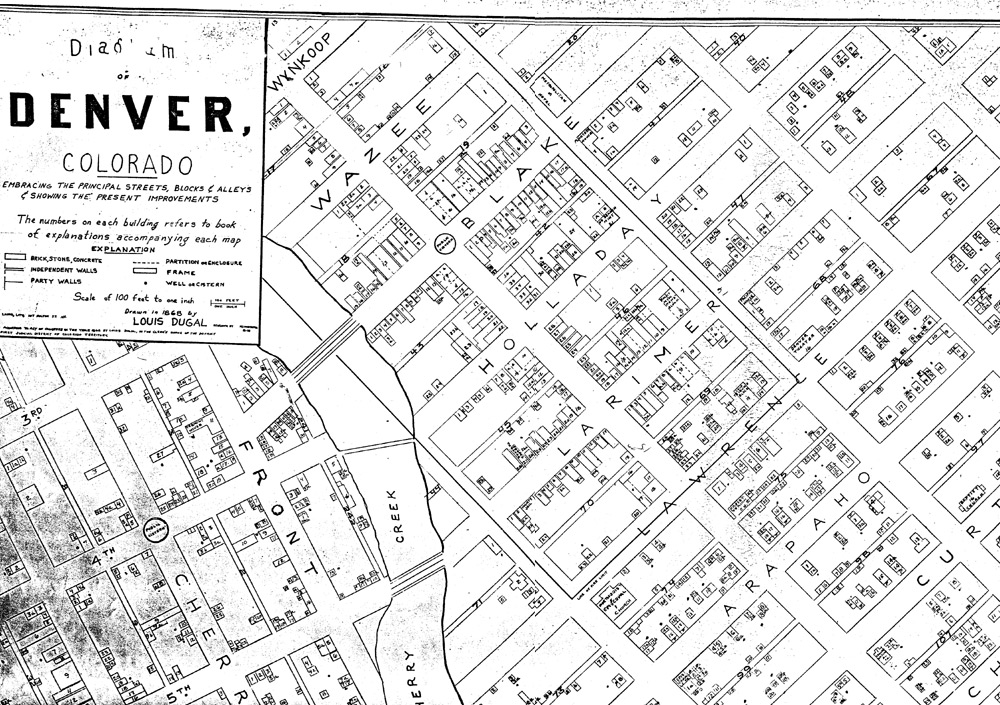
Sam Dugan, aka Sanfourd Dougan, is seen here lynched to a cottonwood tree at Cherry Street, midway between 4th and 5th streets, in Denver.

(Denver’s city plan has changed quite a bit since those days, but I believe the present-day location of this lynching would be approximately Speer Blvd. in a knot of paving the edge of the downtown University of Colorado campus.)

The photo, snapped by the morning light of Dec. 2, 1868, showed the previous night’s work of the Vigilance Committee.

Dug(g)an was a young (23 years old) knockabout in the territories with a blackhearted reputation, having been thought to have killed a man at a camp the year before.

In 1868, he and buddy Ed Franklin robbed a justice of the peace, one Orson Brooks, at gunpoint. As one can imagine, Brooks was one of the little town’s more prominent citizens and the crime outraged residents.

Denver lawmen chased Brooks’s assailants to nearby Golden, Colo., where Dugan’s accomplice Franklin — blind drunk — was shot dead resisting arrest. An innocent Golden citizen named Miles Hill also died when he was caught up in the the shootout to take Dugan … but Dugan himself escaped.

Public fury over this bloodshed (on Nov. 22) precipiated the Nov. 23 lynching of already-jailed outlaw L.H. Musgrove from a Cherry Creek bridge, not far from where Dugan would soon stretch hemp. (Musgrove had ridden in a murderous gang with the late unlamented Ed Franklin.)

Our surviving fugitive Dugan, meanwhile, made a run for Wyoming but was picked up within a few more days at Fort Russell after he stole a mail carrier’s horse. Marshal David Cook, whose public-domain Hands Up! or Twenty Years of Detective Work in the Mountains and on the Plains is a major source for this post, went to retrieve him.

Given the Musgrove lynching, Cook must have had an idea of the danger Dugan would face in Denver. Denver papers anticipating the party’s arrival said that Cook’s team “will bring the prisoners dead or alive. The former condition would be preferred by many.”

About 90 to 100 vigilantes made that preference into fact after dark on Tuesday, Dec. 1, stopping a police wagon moving Dugan between lockups, just as it was crossing a bridge over Cherry Creek.

The hijackers redirected the wagon around the corner to a copse of trees and “in a moment a rope was thrown over the limb, and in another moment, Dugan was standing in the wagon immediately under the fatal noose.”

That’s from a newspaper report that appeared in several publications; our cite is from the Milwaukee Daily Sentinel on December 21, 1868.

Dugan, “completely unmanned, crying and sobbing like a baby,” wheedled and stalled, begging for a Catholic priest and making various professions of innocence or mitigation that would cut no ice with his judges.

After he had said all that he had to say, the order was heard, “Drive on,” and the wagon which had served as his frail bulwark between life and eternity moved from under, and the spirit of Sanford S.C. Dugan took its flight into the presence of Him who shall judge us all according to the deeds done in the body. The fall, about eighteen inches, broke his neck. He was a man six feet two inches in height, and weighed 205 pounds.

Cook, in Hands Up!, says he “would gladly have prevented” the lynchings, “but it was useless for [lawmen] to fly in the face of an entire community, which had been outraged and which was aroused, not so much to vengeance as to the necessity of protecting itself against the rough element of the plains.”

On this day..

1930: Yang Kaihui, Mao Zedong’s wife

(Thanks to Meaghan Good of the Charley Project for the guest post. -ed.)

On this date in 1930, Yang Kaihui was executed in Changsha, China.

The 29-year-old mother of three was beheaded for her refusal to renounce the Chinese Communist Party and Mao Zedong. She was technically Mao’s second wife; a previous marriage had been arranged for Mao by his parents, but he and the woman never lived together and the marriage was never consummated.

Yang and Mao grew up together in Changhsa — she was the daughter of one of his teachers — and fell in love as young adults. Yang, like Mao, was an enthusiastic Communist. She joined the CCP in 1921, becoming one of its earliest members. She never held any official position in the CCP, however, and wasn’t terribly active in the movement, since she had to raise the children.

Mao and Yang truly loved one another. Phillip Short, in his biography of Mao, writes of this period: “Perhaps for the only time in Mao’s life, he had a truly happy family to come home to … It was a surprisingly traditional Chinese household.”

But Mao became more and more absorbed in dangerous revolutionary work, and he and Yang were often separated when he traveled. The last time she saw her husband was in 1927, the year the Chinese Civil War started and Mao became a guerrilla leader, hiding in the mountains, far from his family. They maintained sporadic contact after that, but often what little she knew about his activities came from the papers.

During the final years of her life, Yang missed her husband desperately and had thoughts of suicide. “No matter how hard I try,” she wrote once, “I cannot stop loving him.”

Yang predicted she might meet with a violent death. She was right: on October 24, 1930, a warlord loyal to the nationalists captured her and one of her sons.

She did not break under threats and torture, and refused to give in and publicly repudiate her husband and Communism, even though her captors offered to spare her life if she did so. She became one of the CCP’s earliest martyrs.

Yang was executed more for being Mao’s wife than she was for anything she’d done herself. She wasn’t the only woman who would be killed for being married to a prominent member of the CCP; the wife of Zhu De had met with the same fate in 1929.

Mao, who had always called Yang his true love, was reportedly devastated by her death and wrote, “the death of Kaihui cannot be redeemed by a hundred deaths of mine!” He wrote a poem about her in 1957 that suggests he still grieved for her even then. But it must be noted that he never tried to rescue her or his sons when he knew their home had turned into a battleground and their lives were in danger.


Propaganda poster of Yang and Mao.

Tragedy followed the lives of Yang and Mao’s three sons.

The youngest boy, Anlong, died of dysentery in Shanghai at the age of four, soon after his mother’s execution. The oldest, Anying, was killed in the Korean War. Middle child Anqing lived to be 83, but perhaps as a consequence of watching his mother being put to death as a youth, he suffered bouts of mental illness throughout his life. He died quietly in China in 2007.

On this day..

2000: Yopougon Massacre

This date in 2000 saw the most notorious incident in a dreadful wave of election violence in the West African nation of Ivory Coast.

The context was the aftermath of a contentious 2000 presidential election summoned by a coup government that had overthrown the previous regime the year before.

Ivorian politics pitted the more prosperous coastal Christian south against the more rural Muslim inlands, but the 2000 election did not: Alassane Ouattara, the northern/Muslim standard-bearer was eliminated from the election by a conveniently-introduced summer 2000 law disqualifying candidates with a foreign parent. Ouattara was a former Ivorian Prime Minister, but for this election, he wasn’t Ivorian enough to stand.

Political bad blood became political bloodsport with the Oct. 22 election.

On Thursday, Oct. 26, 2000 — which was also the day that election’s winner Laurent Gbagbo was officially sworn in, despite thousands protesting — pro-Gbagbo militias went to town on Ouattara supporters, Muslims, immigrants.

In pro-Gbagbo sections of Abidjan like the suburbs of Abobo and Yopougon, ethnic Dyula or Dioula were rounded up en masse, mosques attacked by mobs, and people menaced, beaten, or worse.

The Human Rights Watch report “The New Racism: The Political Manipulation of Ethnicity in Côte d’Ivoire” gathers a number of these eyewitness accounts, including the summary execution/mass murder of 57 that would make global headlines (French link):

In the late afternoon of October 27, the bullet-ridden bodies of fifty-seven young men were found dumped in two piles in a forest clearing on the outskirts of Yopougon. After speaking with two survivors of and several witnesses to events surrounding the massacre, Human Rights Watch researchers established that paramilitary gendarmes based at the Gendarme Camp of Abobo were directly responsible for the killings. This incident was the single worst atrocity of the election period.

The massacre took place on October 26, 2000 in two stages. The first involved the shooting of detainees at the Gendarme Camp of Abobo, where young men rounded up from Abobo neighborhood were taken during the morning and early afternoon of October 26, 2000. Prior to the shooting detainees were subject to … brutality and torture … At approximately 3:00 p.m…. at least two gendarmes opened fire on the detainees held there, killing some thirty to forty.

The second stage showed the signs of being a well-planned operation. Well-armed gendarmes deployed intoa neighborhood bordering the Gendarme Camp of Abobo and rounded up between eight and thirteen young men who were used as porters to load the dead onto a truck and later dispose of the bodies in the forest. The porters and all other survivors were then gunned down, though some were not killed. These survivors described the presence of one truck, two jeeps, and the involvement of some thirty gendarmes in this operation.

Two men (they’re both directly quoted in the Human Rights Watch report) survived the second stage of the massacre by playing dead.

This unpunished incident — eight gendarmes were tried, but all acquitted — has blended into the rich tapestry of grievances stoking Ivory Coast tensions down to the present day.

Laurent Gbagbo … under arrest. (Not for this massacre.)

When outright civil war erupted in 2002, anti-Gbagbo rebels reportedly yelled “This is for Yopougon!” when gunning down policemen.

In 2010 Ouattara beat Gbagbo in yet another presidential election. That led to a fresh round of nasty civil war.

That war’s upshot was to seat Ouattara — he’s President of the Ivory Coast as of this writing — and to extradite Gbagbo for war crimes proceedings at the Hague. But in the course of that more recent bloodletting, Yopougon once again became a massacre site, and its football pitch “an open-air cemetery”.

On this day..

1942: Ten for Meir Berliner’s murder of a Treblinka officer

(Thanks to Meaghan Good of the Charley Project for the guest post. -ed.)

On September 11, 1942, Meir Berliner, an inmate of the Treblinka Extermination Camp, stabbed Unterscharführer Max Bialas to death with a penknife during evening roll-call. The Nizkor Project summarizes:

Max Bialas

At the evening roll-call of the prisoners, Max Bialas instructed those who had arrived that same day to line up on the side. It was not clear who was to be liquidated — the new arrivals or those who had arrived earlier. At that moment Berliner jumped out from the ranks of the prisoners, lurched toward Bialas and stabbed him with a knife. A great commotion followed. The Ukranian guards opened fire. Berliner was killed on the spot. and in the course of the shooting more than ten other prisoners were killed and others were wounded. When the tumult subsided the prisoners were lined up again for roll-call. Christian Wirth, who was in Treblinka at the time, arrived on the scene accompanied by Kurt Franz, the second in command of the camp. Ten men were removed from the ranks and shot on the spot in full view of all the others. On the following day, during the morning roll-call, another 150 men were taken out, brought to the Lazarett [the so-called “hospital” which was in fact an execution site] and shot there.

Little is known about Berliner.

According to the testimony of fellow-inmate Abraham Krzepicki, he was a middle-aged Jewish citizen of Argentina who had lived in that country for many years.

He and his wife and young daughter traveled to Poland on vacation in the summer of 1939. They could have picked a better time: when Germany invaded on September 1, 1939, the Berliners were unable to return home. Their Argentine passports should have protected them, but they ended up in the Warsaw Ghetto and were transported to Treblinka. Berliner’s wife and child were gassed immediately, but he was spared to work.

This reprieve would be expected to last days, or a few weeks at the most before he too would go to the gas chamber. Berliner became consumed with rage and the thirst for revenge, supposedly saying, “When the oppressors give me two choices, I always take the third.”

And so he took the first opportunity he could to kill one of his tormentors. As Yitzhak Arad said in his book Belzec, Sobibor, Treblinka: The Operation Reinhard Death Camps*: “His was an individual act of heroism and despair.”

As he must have known he would, Berliner died a horrible death — according to Krzepicki, he was beaten to death with a shovel.

Ironically, following Bialas’s murder, conditions for prisoners at Treblinka actually improved.

This was strictly for pragmatic reasons, as Arad noted: “The Jews selected for temporary work were a danger to the Germans, and the Berliner incident had proved it … When people knew they had nothing to lose, an act of despair like that of Meir Berliner could happen again and again.”

Rather than constantly killing and replacing their workers, the Nazis in charge of the camp decided to create a permanent staff of prisoner-workers and treat them with relative humanity. In this way, they hoped to prevent further acts of suicidal violence on the part of the Jews.

The existence of a permanent cadre of workers made it possible to plan and organize a revolt and mass escape from the camp. In August 1943, after months of conspiring and gathering the necessary weapons, the inmates killed most of the guards and made a run for it. About 300 or so actually made it outside of camp; of those, approximately 60 would survive the war.

* Operation Reinhard is presumably named for Reinhard Heydrich.

On this day..