104 B.C.E.: Jugurtha

(Thanks to Daily Kos diarist “emperorhadrian” for licensing this guest post, originally published on that site June 24, 2007. -ed.)

The Jugurthine War was a key war in the final century of the Roman Republic.

Like the Americans in Iraq, Rome assumed that their war against Jugurtha, King of Numidia (a nation in north Africa), would be a cakewalk. They believed that Numidia was a nation of savages with a bizarre religion. They assumed that their own “shock and awe” attacks by the superior legions would decapitate and destroy the “evil doer” Jugurtha. They believed that in order to liberate the Numidians of their primitive ways, they had to impose the civilized will of the Roman state on this backward nation. Rome never expected that the Numidians would wage an insurgent war against their Roman occupiers. This war ended up dragging on for almost a decade. And in the end, it showed the depravity of the ruling party (the ultra-conservative republican Optimate party), which was sending the Roman Republic on its way to tyranny, empire and ruin.

In 148 BC, the King of Numidia, Masinissa, died. The Roman proconsul, Publius Cornelius Scipio Aemilianus, had been given authority by Masinissa to divide Masinissa’s estate. He divided it between Masinissa’s three sons, Micipsa, Gulussa, and Mastarnable. Soon after, Gulussa and Mastarnable died, leaving Micipsa as the sole King of Numidia. Around the year 134 BC, Micipsa sent Jugurtha (who was Masinissa’s grandson, but the son of another Numidian) to Spain with Scipio Aemilianius. Scipio was fighting the Celtiberians, who lived in a part of what is now Spain. Jugurtha was able to raise an army to help Scipio. Because of the valor of Jugurtha and his army at the Siege of Numantia, Scipio was able to win his war against the Celtiberians.

While fighting for Rome, Jugurtha worked alongside his future enemy, Gaius Marius. Jugurtha not only learned the superior Roman style of fighting, but he also learned of Rome’s weakness for money and thus bribery. Jugurtha described Rome as “urbem venalem et mature perituram, si emptorem invenerit” (“a city for sale and doomed to quick destruction, if it should ever find a buyer”). When Jugurtha returned to Numidia, Micipsa adopted Jugurtha, and decided to include Jugurtha in his will.

After the fall of Numantia, Jugurtha returned home with a letter from Scipio addressed to his uncle; in it, the commander praised Jugurtha’s exploits and congratulated Micipsa for having “a kinsman worthy of yourself, and of his grandfather Masinissa” (Sallust Iug. 9). On this recommendation the king formally adopted Jugurtha and made him co-heir with his own children

In 118, Micipsa died. He left his kingdom to Jugurtha and his two natural sons, Hiempsal and Adherbal. Shortly after Micipsa’s death, Jugurtha had Hiempsal killed. Adherbal fled to Rome. The Roman Senate sent a commission to Numidia to make peace. Jugurtha bribed the Romans on the commission, and thus the commission gave the better regions of the kingdom to Jugurtha.

In 113 BC, Jugurtha took his army and cornered Adherbal in his capital city of Citra. According to Sallust, Adherbal had the support of the people, but Jugurtha had the support of the best soldiers. A Roman Commission was sent to Numidia to forge a new peace. Jugurtha then bribed the Romans on this commission. The Romans thus allowed Jugurtha to storm Citra, and slaughter Adherbal and his supporters. Because Jugurtha slaughtered a number of Italian business people (including Roman Equites, or “Knights“), the Roman senate declared war on Jugurtha.

The Roman Senate sent an army under the command of the consul Lucius Calpurnius Bestia to fight Jugurtha. Bestia decisively defeated Jugurtha. But Jugurtha bribed Bestia, and thus was given unusually favorable terms. The Roman Senate viewed the favorable terms with suspicion, so it summoned Jugurtha to Rome. When Jugurtha arrived in Rome, he bribed two Tribunes, who thus prevented him from testifying. While in Rome, Jugurtha attempted to have his cousin and rival Massiva assassinated. Because of this, he was expelled from the city and returned to Numidia.

In 110 BC, the Roman Senate sent the praetor Aulus Postumus Albinus (who was the cousin of a consul for that year) to defeat Jugurtha. Because Jugurtha bribed key Romans involved in Albinus’ army (who then betrayed Albinus), Albinus was defeated.

The Roman Senate then sent the consul Quintus Caecilius Metellus to fight Jugurtha. At the Battle of the Muthul, a young Roman officer named Gaius Marius helped to reorganize Metellus’ legions, which then defeated Jugurtha. But Jugurtha was defeated because he forced his army to retreat before it could suffer heavy losses. The Romans did suffer their own heavy losses. Jugurtha disbanded his army, and had his soliders mount an insurgency to fight the Roman occupiers.

Marius returned to Rome. Dissatisfied with the slow pace of the war under Metellus, the Roman Military Assembly (one of the two Roman legislative assemblies, similar to the US Senate) appointed Marius consul (the Military Assembly, not the senate, appointed consuls). The Roman consuls had similar powers as the US President. The consulship was the highest constitutional office, and the consuls had imperium powers, which allowed them to command armies and conduct wars. The senate didn’t want Marius to be consul, because at this time it was dominated by an ultra-conservative republican party of aristocratic elites known as the Optimates. Marius belonged to the party that opposed the Optimates, the Populares. Partly because the senate didn’t like Marius, and partly because of the increasing difficulty Rome was having in recruiting armies, Marius was forced to raise his own army.

The capture of Jugurtha, from this French history of the Jugurthine War.

Marius took his army to Numidia to fight Jugurtha. But while Marius had been raising his army, Jugurtha allied with his father-in-law, Bocchus, the King of Mauretania. Marius defeated Jugurtha and Bocchus in several key battles. But much like with the American occupation in Iraq, Jugurtha’s strategy of insurgency warfare against the occupiers rendered all conventional victories irrelevant. Marius was playing a game of whack-a-mole. No matter how many times the Numidians were defeated, Jugurtha’s insurgents would regroup and keep fighting. It became clear that because of this, Rome could not defeat Jugurtha.

Marius sent his young Quaestor, Lucius Cornelius Sulla, to Bocchus. Sulla bribed Bocchus, and told him that Bocchus would be given a part of Numidia if he would betray Jugurtha. Bocchus then decided to give Jugurtha to Sulla. Sulla took Jugurtha to Rome, where Jugurtha was strangled in the Tullianum in Rome after marching in Marius’ January 1, 104 B.C. Triumph.
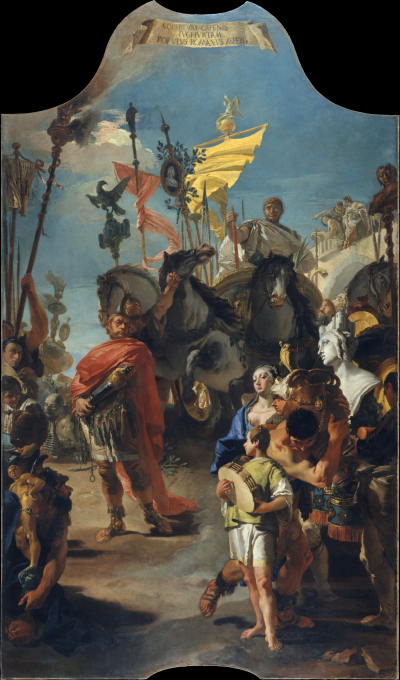

The Triumph of Marius (1729) by Giovanni Battista Tiepolo. The inscription in Latin reads “The Roman people behold Jugurtha laden with chains”.

The Jugurthine War was over. But in the process, several problems were exposed that would cause Rome serious pain in the future. Republicans in this country love to tell us that money in politics is harmless free speech. But as we saw in the Roman Republic during the Jugurthine War, money can be very corrupting. Rome almost lost the war because of money in politics, and the susceptibility of public officials to bribery.

In addition, this war saw the rise of two Romans who would play a key role in the events that directly preceded the fall of the Roman Republic. The first Roman made famous through this war was Gaius Marius. Gaius Marius would later hold the Roman Consulship an unconstitutional 7 times in 21 years (constitutionally, a Roman had to wait 10 years before being reelected consul).

The second Roman made famous through this war was Lucius Cornelius Sulla. Sulla and Marius would fight an unconstitutional civil war with each other several years after this war had ended. Sulla would illegally march his troops on Rome, and unconstitutionally legalize the mass killing of Marius’ supporters. Marius’ supporters in the senate would unconstitutionally prevent Sulla from fighting a war during one of Sulla’s consulships. Sulla would eventually seize absolute power for himself. Sulla would be the first Roman to be Dictator in almost 150 years. He would also be the first Roman in history to hold the dictatorship without the traditional six month term limit.

As dictator, Sulla would illegally change the Roman constitution to make himself and his party (the ultra-conservative republican Optimates) even more powerful. And most importantly, Sulla would set the example (of civil war on Romans, and then the seizing of absolute power) that the future tyrant Gaius Julius Caesar would follow.

In the end, the actions taken by key players in the war against Jugurtha would be repeated in the final destruction of the Roman Republic. The future triumvir Pompey would unconstitutionally hold multiple consulships in a short period of time. Crassus, another future triumvir, would illegally bribe politicians to get his way. And the future tyrant Julius Caesar would bribe, unconstitutionally hold the consulship, and become dictator for life (as Sulla had done). It was Caesar’s actions in this regard, as well as the similar actions of his adopted son and heir, Gaius Octavius (later Gaius Julius Caesar Octavianus, the Emperor Augustus) that would once and for all destroy the Roman Republic, and create the Roman Empire.

1. When when, and whenever death closes our eyelids,
2. Moving naked over Acheron
3. Upon the one raft, victor and conquered together,
4. Marius and Jugurtha together,
5. one tangle of shadows.

6. Caesar plots against India,
7. Tigris and Euphrates shall, from now on, flow at his bidding,
8. Tibet shall be full of Roman policemen,
9. And the Parthians shall get used to our statuary
10. and acquire a Roman religion;

11. One raft on the veiled flood of Acheron,
12. Marius and Jagurtha together.
13. Nor at my funeral either will there be any long trail,
14. bearing ancestral lares and images;
15. No trumpets filled with my emptiness,
16. Nor shall it be on an Atalic bed;
17. The perfumed cloths shall be absent.
18. A small plebeian procession.
19. Enough, enough and in plenty
20. There will be three books at my obsequies
21. Which I take, my not unworthy gift, to Persephone.

From Homage to Sextus Propertius, Canto VI by Ezra Pound

On this day..

1609: Vicente Turixi, King of the Moriscos

La Expulsión de los Moriscos, by Vincenzo Carducci (Vicente Carducho).

Having taken the trouble over the preceding century to eliminate (or force underground) its substantial Muslim population by forcibly converting it to Christianity, Spain in the early 1600s bethought itself to complete the operation upon its recently minted fellow-Christians by ejecting these Moriscos from Spain altogether.

When the edict for this radical act of expulsion first came down in the heavily Morisco area of Valencia, some of its victims reportedly embraced the prospect of deportation to a land where their dress, language, and religion were no longer forbidden.

Others were less sanguine.

Armed resistance broke out in two wilderness fastnesses, the mountainous Vall de Laguar (Spanish link) and — as narrated by Henry Charles Lea in his freely available The Moriscos of Spain; their conversion and expulsion

the Muela de Cortes (Spanish link), an almost inexpugnable spot, being a deep valley surrounded by precipitous heights, of which the passes were easily defensible. The Moriscoes of that region … were in a state of excitement and were readily persuaded to rise by an outlaw named Pablillo Ubcar. They elected as king Vicente Turixi, who sent a proclamation through the sierra for all to join him under pain of treason. From their strongholds they made raids on the surrounding country, gathering cattle and provisions, burning villages, and desecrating churches.

[Ethnic cleansing coordinator Don Agustin] Mexia, absorbed in the work of embarkation and fearing to interrupt it, for awhile paid no attention to these movements … who could readily be reduced when the time came.

His provisions were justified … those of the Muela de Cortes … lost heart when they heard of the defeat of those of Aguar, and were disappointed as to the appearance of the Moor Alfatami on his green horse, whom tradition reported to be concealed under the mountain since the days of King Jayme … It was agreed that they [the rebels, surrendering] should be safe in person and property, provided they would go to embark within three days.

The rapacious soldiery, who had promised themselves abundant plunder, in their disappointment threw off all discipline; they sacked the village of Royaya, outraged the women and seized numbers of children as slaves. Only three thousand Moriscoes were brought to the port of embarkation, the rest having scattered and taken to the mountains to escape the fury of the soldiers.

These, estimated at two thousand in number, for several years gave infinite trouble, killing all the Christians they met and committing constant depredations. At one time the Governor of Jativa induced many of them to come down, but finding that they were to be enslaved they fled back to the mountains.

A reward was offered for King Turixi, dead or alive; he was tracked to a cave, captured, and brought to the city, when he was sentenced to have hands and ears cut off, to be drawn, torn with pincers, hanged and quartered; but at the execution, December 18th, the cutting of hands and ears was omitted. He had been confessed twice and reconciled twice, and died as a good Christian, making a most edifying end, for we are told that he had been a liberal almsgiver and devoted to the Virgin and the religious Orders.

The miserable remnants were hunted down gradually, the viceroy paying twenty ducats a head for them as galley-slaves.

The armed resistance in Valencia — where Moriscos were most numerous, and the expulsion was first decreed — was actually much less than had been feared, which gave the Spanish authorities all the encouragement they would need to enforce it elsewhere, too.

“Seeing that the whole body of our nation is tainted and corrupt, he applies to it the cautery that burns rather than the salve that soothes; and thus, by prudence, sagacity, care and the fear he inspires, he has borne on his mighty shoulders the weight of this great policy and carried it into effect, all our schemes and plots, importunities and wiles, being ineffectual to blind his Argus eyes, ever on the watch lest one of us should remain behind in concealment, and like a hidden root come in course of time to sprout and bear poisonous fruit in Spain, now cleansed, and relieved of the fear in which our vast numbers kept it.”

-Cervantes, Don Quixote

On this day..

2007: Seven Tuareg and Arab civilians

On this date two years ago, seven civilians were apparently summarily executed by Niger security forces in that country’s long-running internal conflict with its Tuareg population.

Extrajudicial executions have been a recurring event (among the other usual charms of warfare) in Niger’s fight against the Mouvement des Nigériens pour la Justice (MNJ).

Amnesty International charged that these were among 13 civilians executed in a four-week span, possibly in retaliation for MNJ armed attacks.

A close relative of one of the dead told Amnesty International: “We were waiting for our relatives in Agadez when we saw their vehicles arrive driven by soldiers. We asked them where our relatives were. They refused to answer and then, as we insisted, they agreed to drive us to the place where the seven were buried.”

The people who identified the bodies said that they saw numerous signs on the victims of cigarette burns and whipping as well as many bullet wounds to the face and chest.

The nomadic Tuareg people of Niger’s (and neighboring Mali’s) northern Sahara territories have a long-running history of rebellion against the southerly federal government stretching back into the colonial period. (There’s a very detailed pdf paper on the subject here.)

These executions, which also swept up Arab businessmen, were part of the most recent (as of this writing) incarnation, a 2007-2009 campaign that seems ostensibly to have simmered down for now.

But the lucrative, contentious, and damaging (to the Tuareg) uranium mining industry that fuels the conflict (and that put Niger in the American news for the Bush administration’s duplicitous attempt to impute nuclear ambitions to Iraq in order to justify invading) still remains … and that fact seems to promise more bloodshed yet to come.

On this day..

1326: Hugh Despenser the Younger, King Edward II’s lover?

On this date in 1326, the power behind Edward II’s throne — and the presumed lover in his bed — was hanged, drawn and quartered and pointedly emasculated in a grisly public execution as the Queen and her lover took control of England.

(Wince.)

The younger Despenser, being carved up in an illustration from Froissart.

Poor King Edward — that’s the swishy princeling gay-baited in Braveheart — would suffer a horrid demise of his own a few weeks later. He’s the one most conveniently read as a gay martyr.

Hugh Despenser the Younger (or Hugh le Despenser) has his fans, but he’s much more likely to be taken for a villain.

An upstart knight who unexpectedly lucked into a jackpot inheritance when his wife’s brother died at Bannockburn — that’s the rumble Robert the Bruce starts at the end of Braveheart — Hugh the younger parlayed his newfound position of feudal magnate into the still better gig of royal favorite.

That job was open because its occupants had a distressing tendency to get dead, a fate obviously ordained for Hugh Despenser as well.

But whereas Edward’s childhood pal Piers Gaveston, the murdered former fave, aroused mostly personal pique among rival nobles, Hugh Despenser meant to use his favor to rule.

Despenser exploited his position to build up his wealth and control the king; with his father (you’ll never guess that he went by “the elder”), he became the de facto if never the de jure ruler of the realm.

At one point, his rivals in the nobility turned the tables and got him exiled. Hugh became a pirate in the English Channel while he maneuvered his way back onto dry land in his customary most-favored-consigliere position.

So although the British barons who wanted Despenser’s head were undoubtedly a distasteful lot themselves, and certainly capable of all manner of depravity in pursuit of their own crass self-interest, it doesn’t take a backwards view of human sexuality to get why Hugh Despenser would raise an early 14th century Briton’s hackles.

But you have to give England this: its politics back then were a damn sight more interesting than you get today. Anyone who uses the term “bloodsport” for the modern electoral charade ought to cross cutlasses with the likes of the dread pirate Despenser.

And it gets better. Meaning, for Hugh Despenser the Younger, worse. Much.

Queen Isabella — that’s Sophie Marceau’s hot-for-barbarian imported princess in Braveheart — became estranged from her Hugh-lovin’ husband,* and established herself back in France with her lover Roger Mortimer.

Then, the lovebirds invaded England.

Edward and Hugh were so unpopular at this point that “their” nobles who should have repelled the incursion went in a landslide for the invading adulterers.

Hugh Despenser’s father had already been hanged for his trouble by the time The Younger was taken; the latter tried to cheat the executioner by refusing all food and drink for days, truly a spartan image of desperate self-mortification in a rough day and age.

When you get a load of the death his royal captors had worked out for him — and which they were obliged to deliver to their starving captive hurriedly in Hereford rather than more ceremoniously back in London — you can understand why. After a perfunctory trial that same morning, they tore the former favorite apart.

Froissart’s rendering:

When the feast was over sir Hugh, who was not beloved in those parts, was brought before the queen and knights assembled; the charges were read to him – to which he made no reply; the barons and knights then passed the following sentence on him: first, that he should be drawn on a hurdle, attended by trumpets and clarions, through all the streets in the city of Hereford, and then conducted to the market-place, where all the people were assembled; at that place he was to be bound on a high scaffold, in order that he might be more easily seen by the people. First, his privates were cut off, because he was deemed a heretic, and guilty of unnatural practices, even with the king, whose affections he had alienated from the queen by his wicked suggestions. His private parts were cast into a large fire kindled close to him; Afterwards, his heart was thrown into the same fire, because it had been false and traitorous, since he had by his treasonable counsels so advised the king, as to bring shame and mischief on the land, and had caused some of the greatest lords to be beheaded, by whom the kingdom ought to have been supported and defended; and had so seduced the king, that he could not or would not see the queen, or his eldest son, who was to be their future sovereign, both of whom had, to preserve their lives, been forced to quit the kingdom. The other parts of sir Hugh thus disposed of, his head was cut off and sent to London.**

It’s reported that Isabella and Mortimer feasted and made merry as they beheld this hideous spectacle. Now that’s bloodsport politics.

Hugh the younger Despenser and his life and times are covered in amazing detail by a couple of active-posting enthusiasts of this particular period who have already been linked elsewhere in this post: the aptly-named Edward II blog (dig his biography of Hugh Despenser, among many other such dramatis personae; also his account of the execution, already cited); and, Lady Despenser’s Scribery (whose entire sidebar is pretty much all about our day’s principal; for the quick tour, see her biography and posts on the “trial” and execution).

* The reason for said estrangement can be situated anywhere one likes along the personal-political spectrum; one recent historical novel speculates (upon no authority but dramatic license) that Hugh raped the queen.

** Remains reportedly discovered last year were speculatively identified as Hugh Despenser’s; the litany of injuries to the body testify to the ghastly death-ritual its owner underwent.

On this day..

1676: Johan Johansson Griis, the Gävle Boy

On an uncertain date in November 1676, the Gävle Boy paid the penalty for his elders’ credulity.

Only 13 years old at his death, he’d spent the foregoing months as the star witness in Stockholm’s witch trials. Like the hysteria itself, he’d migrated to the capital from the provinces; it’s said that in his native town of Gävle, he’d orphaned himself with a witchcraft accusation against his own mother.

Sent off by relatives to live in Stockholm, young Johann Johansson Griis (or Grijs) found his previous evidence made him an expert courtroom authority on the infernal arts; driven by some blend of blandishments and cajolery sufficient to stimulate the youthful imagination’s potent capacity for blending fancy insensibly with fact, Griis was in no time at all sending fresh victims to the scaffold with his freaky stories about Blåkulla.

Dracula‘s soul brother, deadlier even than he …”

No, Blåkulla, a sort brunch buffet for Swedish sorcerors.

Hard to imagine this kid and a few others like him were given carte blanche to destroy people’s lives with increasingly ludicrous Satanic abuse stories.

When authorities reined in the witch hysteria, it wasn’t the authorities who were going to end up with a hemp necktie for structuring and managing a legal system that allowed a gaggle of impressionable adolescents to railroad innocent people. No, it was the adolescents themselves who would pay the penalty for the perjury that they had so recently been solicited to provide. And of course, when pressured by the Man to cop to lying about everything, Gävle Boy did exactly that.

“A vicious and mendacious rascal,” is how our short-lived character was being described by the time he got his comeuppance. (Quote from this detailed Swedish paper about the witch hunts.)

Well, maybe. He wouldn’t exactly be the first callow, naughty adolescent. But give the Swedes this much: after they hanged the Gävle Boy (and some fellow youths with tall tales to tell), they stopped executing witches. Only one more person would ever again die for the “crime” in the country’s history.

Johan’s namesake town would prefer you remember a different Yuletime tradition, the Gävle Goat.

On this day..

1864: Hong Tianguifu, in the Taiping Rebellion

On this date in 1864, the sins of the father were visited upon the son when the Qing Dynasty dealt a coup de grace in what is perhaps history’s bloodiest civil war, executing the luckless teenager to whom leadership of the Taiping Rebellion had fallen.

Strangely little-known, the Taiping Rebellion shook the weakened Chinese state through the middle of the 19th century, nearly to its very foundations.

From 1851 until the 1864 death of its queer leader figure, prophetic Christian convert Hong Xiuquan, it maintained its own state in southern China, the Taiping Heavenly Kingdom.

China’s defeat in the First Opium War in the 1840’s set the stage for Hong Xiuquan’s movement, and not only geopolitically: western powers had pried open the Orient to proselytizers as well as poppies, and though Christianity would find a rough go of it in China, it did win over Hong.

Fired by his supposed divine vision, Hong’s Heavenly Kingdom conquered the Yangtze Valley and much of the south, with an outlook radically progressive as against the hidebound Qing: egalitarian land distribution and gender equity (the Kingdom’s administrative acumen is less generously accounted). Naturally, the “real” Christian missionaries abhorred it, which sincere theology happily comported with the policy of their national statesmen who abhorred the Taiping’s encumbrance upon the opium trade.

This illustrated podcast does creditable coverage of the Qing’s twilight century; from about 14:17, it covers Hong Xiuquan and the Taiping Rebellion specifically.

The rebellion waxed while the Qing lost a second Opium War to the west, but a Taiping bid to capture Shanghai fell short in 1860. By this time, westerners had the Qing by the short-and-curlies and were not eager to see the client dynasty they had so painstakingly browbeaten supplanted by a bunch of millenarian Levellers without the common courtesy to promulgate smack; accordingly, China’s recent Opium War antagonists now helped China field the forces necessary to suppress the rebellion.

Charles George Gordon, a British evangelical Christian himself destined for eventual beheading, even led the pacification force swaggeringly branded the “Ever Victorious Army“.

We’ve reached the end here and only just met our day’s principal, the son and heir who at 15 was handed the helm of the collapsing state by his visionary father. (Hong Xiuquan conveniently proceeded to kick the bucket just before the Qing finished off the rebellion.)

Officially the second (and obviously the last) ruler of the Heavenly Kingdom, Hong Tianguifu had no juice with his military or administration, and no time to enjoy the more prosaic perquisites of regal authority, but was available as the object of official vengeance. (Thanks, dad.)


Less exalted Taiping Rebellion prisoners, from here (click through the pages for a detailed history of the rebellion).

The Taiping Rebellion features in the 2007 Chinese flick Tau ming chong (The Warlods), which represents a Qing-Taiping battle in the fine cinematic bloodbath below. Some 20 to 30 million people are thought to have perished in this civil war, which was also one of the last significant conflicts fought primarily with blades rather than bullets.

On this day..

1909: Leonard Groce and Lee Roy Cannon, American mercenaries in Nicaragua

In few countries is it possible to trace the development of anti-American sentiment as clearly as in Nicaragua. A century of trouble between the two nations, which led to the death of thousands and great suffering for generations of Nicaraguans, began when the United States deposed President Zelaya in 1909. Benjamin Zeledon [Spanish link -ed.] took up arms to avenge him. Zeledon’s death inspired the young Sandino, who, in turn, inspired the modern Sandinista Front.

For all his faults, Zelaya was the greatest statesman Nicaragua ever produced. If the United States had found a way to deal with him, it might have avoided the disasters that followed. Instead, it crushed a leader who embraced capitalist principles more fully than any other Central American of his era.

-Steven Kinzer, Overthrow: America’s Century of Regime Change from Hawaii to Iraq

It was a century ago today* that the execution of two American soldiers of fortune set all that strife in motion.

Leonard Groce, a mining supervisor, and Lee Roy Cannon, a rubber planter, were among those hired out by the U.S.-backed rebellion of Juan Jose Estrada. Dictatorial Nicaraguan President Jose Santos Zelaya — no known relationship to his namesake bookend at the other end of that century, the recently deposed leftist Honduran President Manuel Zelaya — had earned Washington’s ire by attempting to carve out an excessively independent sphere of action for his country. Most notably, he courted European investment, and mooted funding a possible Nicaraguan competitor to the U.S.-controlled Panama Canal.

Though the Estrada insurrection was spinning its wheels militarily, Groce and Cannon would give it legs diplomatically, and afford the Yankees sufficient pretext to overthrow Zelaya directly.

These two U.S. nationals were caught mining the San Juan River in an admitted attempt to sink a Nicaraguan troop transport, and shot in El Castillo a few days later. (Here‘s Groce’s final letter to his mum — a Spanish translation; I have not been able to find the English original.)

When word reached U.S. Secretary of State Philander Knox about the shootings, he “saw an opportunity to intervene directly.”**

Knox dashed off a bellicose note to the Nicaraguan charge d’affaires calling his

regime … a blot upon the history of Nicaragua …

From every point of view it has evidently become difficult for the United States further to delay more active response to the appeals so long made, to its duty to its citizens, to its dignity, to Central America, and to civilization.

The Government of the United States is convinced that the revolution represents the ideals and the will of a majority of the Nicaraguan people more faithfully than does the Government of President Zelaya.

“Then,” says Steven Kinzer, “he issued an official legal opinion holding that because Estrada’s rebellion had given his men the ‘stature’ of belligerents, Cannon and Groce had been entitled to prisoner-of-war status. That made Zelaya a war criminal.”

Maybe Zelaya mistook the foreign bombers for “unlawful combatants.”


Groce and Cannon temporarily became a media cause celebre in the U.S. This article is from the Nov. 21, 1909 edition of the Salt Lake Herald-Republican.

By late December, with marines† landing, Zelaya bowed to the inevitable and resigned, and Nicaragua began a generation under more-or-less overt U.S. control.

That terrible miscalculation drew the United States into a century of interventions in Nicaragua. They took a heavy toll in blood and treasure, profoundly damaged America’s image in the world, and helped keep generations of Nicaraguans in misery. Nicaragua still competes with Haiti to lead the Western Hemisphere in much that is undesirable, including rates of poverty, unemployment, infant mortality, and deaths from curable diseases.

Kinzer

There’s more coverage of this episode and America’s early 20th century Nicaraguan policy in The Banana Men: American Mercenaries and Entrepreneurs in Central America, 1880-1930 and Beneath the United States: A History of U.S. Policy toward Latin America.

* A few sources give the date as the 16th, and the situation was confused and uncertain enough on the ground that early press reports elide the execution date altogether. The 17th tracks with The Banana Men, Overthrow, and the U.S. diplomatic correspondence.

** Knox, a plutocrats’ attorney from Pennsylvania and certifiable bastard, was also personally connected with Pittsburgh-based mining interests Zelaya was threatening to expropriate. Groce worked for the firm.

† Marine Corps Major (later General) Smedley Butler mounted three different expeditions to Nicaragua during the civil war following Zelaya’s departure. He would later remember of his service in America’s southerly “Banana Wars” interventions, “I spent most of my time being a high class muscle-man for Big Business, for Wall Street and for the Bankers. In short, I was a racketeer, a gangster for capitalism.”

On this day..

1885: Louis Riel, Metis leader

On this date in 1885, Louis Riel, “the puzzling Messianic figure of Canadian history,” was hanged in Regina for treason.

We have already met in these pages the magnetic, controversial figure of Louis Riel when his Red River Rebellion caused the 1870 execution of Thomas Scott, one of the soldiers sent to suppress it.

Now, after a decade and a half in the political and sometimes literal wilderness, the champion of the Métis had been recalled from the United States to press the rights of his mixed-race French-indigenous people against the Anglo Canadians’ westward march.

It was North America’s familiar clash of civilizations between expanding industrial economies and the traditional ways of life they displaced. (Here’s a good background documentary video, with a Part 2 that gets into the weeds on battlefield events.) Because the Metis were “half-breeds” whose European stock was French, the story’s familiar cocktail of racism had a twist of Canada’s Anglo-French rivalry, too.

Riel declared an independent Provisional Government of Saskatchewan, and the North-West Rebellion was on.

The rebels had some initial successes. But hampered by an inability to make a firm alliance with the more politically realistic Cree, by the non-support of the Catholic Church in view of Riel’s increasingly out-there millenarianism, and by the extension of technological superiority another 15 years’ railroad-building had given the Ottawa government, Riel’s forces soon gave way.

The lightning-rod leader was arrested and repaired to the provincial capital for trial, where he spurned his lawyers’ desperation attempt to plead insanity and cogently vindicated his position.

“Life, without the dignity of an intelligent being, is not worth having.”
Riel

For a man twice a rebel, the hanging sentence was no surprise. Later, juror Edwin Brooks would tell a newspaper “We [the jury] tried Louis Riel for treason but he was hanged for the murder of Thomas Scott.” (Source, via this pdf handbook all about the Metis.)

His hanging was met with outrage in Francophone Quebec, and Louis Riel remains a polarizing figure down to the present day — an emblem of multiple overlapping cultural conflicts never fully resolved. The upcoming year’s 125th anniversary of events profiled here promise a renewed examination of Louis Riel (or at least of his tourism potential).

Below are a few more-or-less obtainable recent books about Riel and the North-West Rebellion, culled from this pdf reading list. Also note the public-domain volume The history of the North-west rebellion of 1885.

Recent considerations of Louis Riel and the North-West Rebellion

On this day..

1726: The Gypsy outlaws of Hesse-Darmstadt

On November 14 and 15, 1726, more than 20 Gypsy outlaws of Hesse-Darmstadt were executed en masse.

Detail view (click for full image) of the execution of the Gypsies at Giessen.

Gypsies in Europe still suffer ample discrimination today, so it’s little surprise to find early modern Europe thick with anti-Gypsy legislation.

No surprise, Angus Fraser writes in The Gypsies, this sort of thing

did in the end produce enormous changes in the life of the Gypsies in Europe. To survive, they had to adapt; they also had to make the most of the loopholes in a system which expressly sought, by denying them food and shelter, to make honest living impossible. Some found a degree of security in inaccessible waste-lands and forests. Some exploited differences in jurisdiction and the spasmodic nature of the authorities’ activity, by making a home in frontier regions … Many broke up into small groups when it was necessary to avoid attention; conversely, others gathered into larger bands to facilitate self-protection … sometimes resorting to violence. Certain Gypsy brigands gained notoriety in eighteenth-century Germany, large tracts of which were overrun with robber companies of mixed and varying origins. Some of these had a strong Gypsy element: numbering perhaps 50 or 100, armed and defiant, they stole for their sustenance and skirmished with the soldier-police sent to confine them.

“The poor Gypsies,” one poor Gypsy lamented to a contemporary German author,* “also want to have the right to live.”

Like the Gypsies’ other necessities, that right went as far as they themselves could secure it … and when secured by brigandage, it eventually brought down an overwhelming response.

The German author in question, J.B. Weissenbruch, relates the tale of a particularly notorious pack of Gypsy outlaws under the leadership of rough characters names of Antoine la Grave, aka “der Grosse Galantho” or “the Great Gallant”, and Johannes la Fortun, aka “Hemperla”.

These were no romantic Johnny Depp-esque Gypsies, at least according to Weissenbruch. Besides “their disposition to wandering, to idleness, to theft, to polygamy, or rather promiscuous license” — well, okay, sort of romantic — these went toe to toe with soldiery dispatched to corral them and had the chops to “take military possession” of a village for the purpose of exacting some corporal revenge.

We know where this ends up.

Though the Great Gallant escaped punishment,† Hemperla and 20-plus of his band (different sources quote slightly different figures) enjoyed the pleasures of the thumbscrew and the Spanish boot to secure confessions necessary to license their sentences. Some were hanged, others (including women) beheaded, and Hemperla and a few comrades were broken on the wheel.

* Cited here; regrettably, I have not been able to locate a browsable original of the Weissenbruch text.

** Same story in yet another Google books freebie.

This German book says his rank got him off the hook, but he lost his head just the same in 1733.

On this day..

1780: Corregidor Antonio de Arriaga, by his slave

On this date in 1780, Incan-Peruvian indigenous leader Tupac Amaru launched his insurrection against the Spanish with the public execution of a Spanish corregidor.

Antonio de Arriaga, as Spain’s man in Tungasuca, had as part of his job description forcing curacas to extract the crown’s tribute from the natives. This put some tension between him and the likes of the strong-willed Tupac Amaru, who advocated fiercely enough for his people’s rights that Arriaga threatened him with death.

It also made Arriaga’s death an invitingly emblematic scene to open the indigenous revolt.

On Nov. 4, 1780, Tupac Amaru kidnapped Arriaga returning from a dinner party, then forced him to sign letters summoning Spaniards and curacas alike to Tungasuca.

There, he mustered his own force of armed natives and performed for them a “carefully staged public ceremony.”

According to a primary source excerpted in The Tupac Amaru and Catarista Rebellions

Account of the Most Horrible Crime Committed by Jose Gabriel Tupac Amaru, Cacique of Pampamarca

On the morning of Friday, November 10th, Tupac Amaru ordered that three columns … be organized from all the people from his Province that were already there. Two were composed of Spaniards and Mestizos armed with muskets, sabers, and sticks; and one of Indians with slings. In the middle of this, he brought out the Corregidor, dressed in his military uniform, and publicly started taking his uniform off, stripping him of his rank following the rituals he had understood and seen in other occasions, until he was left in his shirt. He then put a shroud on him … that had the title of La Caridad on it. He then gave the order to take him to the gallows, accompanied by the Priest and two other clergymen, where he went with a resignation and patience worthy of somebody who was already touching the portals of eternity.

Once on the gallows the Corregidor was forced by the tyrant to publicly declare that he deserved to die in that way. A black slave of the Corregidor [named Antonio Oblitas -ed.] served as his executioner, but the ropes snapped and both fell to the ground. But they suspended them again with a lariat around their necks, and thus they completed the execution in clear sight and tolerance of all his Province. [“they” is as rendered in the book; I have no indication that more than one person was executed. -ed.] Not one voice was raised that would disturb the operation. And most surprising of all was that those same Collectors and those close to the Corregidor were the ones who (oh, what an awful spectacle of perfidy!) sped his way to the ignominious place of execution, and who pulled on his feet so he could die even more violently.

The rebellion, needless to say, was on.

On this day..