1944: Galeazzo Ciano and four other Italian Fascists

On this date in 1944, Benito Mussolini had his son-in-law, the politician Galeazzo Ciano, shot for treason outside the gates of Verona along with four other fascists who had abandoned Mussolini.

A glamorous playboy in public life, Ciano was the scion of a wealthy fascist founder. The youth wed Mussolini’s eldest daughter in 1930 and quickly ascended the party’s ranks, becoming Foreign Minister at the tender age of 33.

Ciano’s treachery, and that of the others seated in chairs and shot from behind on this day, was to have voted with the majority of the Fascist Grand Council for deposing Mussolini as Allied attacks thrust Italy into a desperate position. This confused affair lacked the character of a coup d’etat, but Mussolini was indeed placed under arrest the next day and a separate peace concluded with the Allies in early September.

Soon after, an audacious German glider raid freed Mussolini, who was quickly re-installed as head of a Nazi puppet state in northern Italy.

Ciano’s capture by this body set in motion a final personal drama with implications for later students of the Second World War. Edda Ciano escaped to Switzerland with her husband’s diaries — potentially damaging notes on the machinations of the Axis.

These scribblings she took hostage for the life of her husband. The blackmail was not accepted — to the grief of Edda, who never spoke to her father again.

One final quixotic rescue attempt cooked up by a female SS administrator on Ciano’s guard detail — the last of many women drawn to this charismatic man — foundered; the preordained death sentence came down on January 10th, and the men were shot the next morning.* Mussolini reportedly fretted in the small hours of the night over whether his standing in Hitler’s eyes would suffer should he intervene.

Edda had the diaries published as she threatened, and if they exposed scant novel evidence against his German and Italian compatriots, they offer a window upon diplomatic intrigue and personal relationships within the Pact of Steel.

The last entries were written from prison just three weeks before his execution, and (allowing that by that time the author had reason to lay blame for policy missteps explicitly at Mussolini’s door) the protracted effort they describe to steer the impulsive Duce towards some sane foreign policy — something that might have spared Italy the devastation of war and maintained a fascist government, as Spain managed to do — reads almost farcically in retrospect. Italy could make little material contribution to the war, and probably had as much to fear from Hitler in victory as from the Allies in defeat … but at every turn, Hitler’s inspiring star pulled the Italian dictator away from realpolitik and towards romantic catastrophe.

As the invasion of Poland approached, for instance, Ciano watched Mussolini vacillate on whether to cast his lot irrevocably with Hitler.

The Duce’s reactions are varied. At first he agrees with me [not to commit to war]. Then he says that honor compels him to march with Germany. Finally, he states that he wants his part of the booty in Croatia and Dalmatia.

Like World War II’s every nook and cranny, the Italian experience bestrode by Ciano has received eager literary coverage.

Edda and Galeazzo Ciano’s son Fabrizio also wrote a personal memoir entitled Quando il nonno fece fucilare papa (“When Grandpa had Daddy Shot”).

* Four of the five were only wounded by the initial volley, and the fifth was missed altogether; all were dispatched with a coup de grace.

On this day..

1463: Not François Villon

Je suis François, dont ce me poise,
Né de Paris emprès Ponthoise.
Or d’une corde d’une toise
Saura mon col que mon cul poise.*

-F. Villon, LE QUATRAIN
“Que feit Villon quand il fut jugé à mourir.”

On this day in 1463 François Villon vanished into thin air — along with his mastery for words and for mischief.

Posterity is left to write blog entries about his miraculous deliverance from the gallows; to credit him with influence on Fin de siècle poets, contemporary cinema and god knows what else; to speculate about his destiny; to explain the motives for his disreputable lifestyle (oh, why, my dear reader, are we so presumptuous?); and, well, to read his verse.

[audio:Villon_ballade_du_concours_de_Blois.mp3]

The epithets “thief” and “rogue” are de rigueur when a discourse demands an allusion to his name. The man was a villain, all right. Villon’s official criminal career started with a drunken brawl murder. He got entangled with a gang. He stole, imbibed and rollicked. He was banished, imprisoned and tortured.

One prim Scotsman, a trained lawyer and a beloved writer, wields rather harsh albeit stunningly eloquent prose to depict our pauvre Villon. To Stevenson, Villon was “the first wicked sansculotte”, a “sinister dog”, “the sorriest figure on the rolls of fame”, whose “pathos is that of a professional mendicant who should happen to be a man of genius”.

Incidentally (I hope the reader will forgive this digression given the general topicality of the issue), Stevenson, a harsh judge of Villon’s ignoble nature, says this about waterboarding:

[Villon] was put to the question by water. He who had tossed off so many cups of white Baigneux or red Beaune, now drank water through linen folds, until his bowels were flooded and his heart stood still. After so much raising of the elbow, so much outcry of fictitious thirst, here at last was enough drinking for a lifetime. Truly, of our pleasant vices, the gods make whips to scourge us …

A different take on Villon’s despicable life is voiced by another poet, Osip Mandelstam:

Villon’s sympathy to the society’s scumbags, to everything that is vile and criminal is not demonism. The nefarious company, to which he was so quickly and intimately drawn, captivated his feminine nature with great temperament and powerful rhythm of life, which he could not find elsewhere in the society.

… With odd brutality and rhythmic ardor, he depicts in his ballad [The Ballad of the Hanged], how wind swings the bodies of the wretched, to and fro, as it will … Even death he endows with dynamic qualities, and here manages to manifest his love to rhythm and movement … I think that Villon was allured not by demonism, but by the dynamics of crime …

(Mandelstam’s original is in Russian; this translation is mine)

In the autumn of 1462 François Villon was arrested. He expected to be hanged. Instead, on this date, parliament granted him a pardon and banished him from Paris (for the third time, no less).

What happened to the poor vagabond, medieval Parisian desperado, that troubadour of the rascals?

The trail goes cold — the yellowed parchments fall silent. He vanished into thin air …

* Below is a rather unsatisfactory and uncredited translation found here, which nevertheless conveys the idea:

Surname? Villon, just my luck.
Born? In Paris, near Pontoise.
You wonder what my backside weighs?
Ask my neck when they string me up.

On this day..

2006: Saddam Hussein

One year ago today, Saddam Hussein was hanged in “the hell that is Iraq” — his riposte to the mob scene at his gallows, transmitted worldwide by way of illicit footage shot with a cell phone.

Caution: This video contains graphic footage. You knew that already.

How it was then:

Who could follow in his footsteps?

On this day..

1874: John Murphy

On this date in 1874, John Murphy was publicly hanged at the foot of Carson City’s Lone Mountain for murder.

The New York Times (.pdf) story, reprinted here in its entirety, suggests the tenor of the affair in the young western state:

John Murphy, who was executed at Carson, Nevada, yesterday, for the murder of J.R. McCallum, was a native of Scotland, and at one time traveled with John C. Heenan, giving sparring exhibitions. On the scaffold he made some remarks professing his belief in spiritualism, and at the same time uttering horrible blasphemy.

He had been temporarily reprieved December 18 to determine his sanity.

This appears to be the only historically identifiable execution in Carson City from the Nevada Territory’s creation in 1861 until the legislature in 1903 removed all Nevada executions to that city’s state prison — where they still take place to this day.

On this day..

1559: Anne du Bourg

On this date in 1559, Protestant parliamentarian Anne du Bourg was publicly strung up and burned for his uncompromising defense of Calvinism.

All France burned, figuratively, with the Protestant Reformation — and literally, with Henri II‘s ruthless reaction against it. But that flame tempered and honed the Huguenots’ steel.

With the dissolute crowned head before him to attend a seating of Parlement considering the matter of the heretics’ suppression, Anne du Bourg delivered himself of a rebuke of “more courage than prudence” (Batiffol and Bodley):

While men are conducted to the stake for the sole crime of praying for their prince, a shameful license encourages and multiplies blasphemies, perjuries, debaucheries, and adulteries. (Martyn)

Incensed, the king had du Bourg and others of the “moderate” party arrested in Parlement and drug to the dungeon. And though his compatriots were satisfied to recant what imperiled them, du Bourg remained obdurate and even provocative, smuggling a pamphlet against the monarch out of prison.

Henri would not make good his vow to see du Bourg burnt, having been slain by a freak jousting accident. But it little availed du Bourg inasmuch as Henri’s untimely demise put the Catholic faction even more firmly in the saddle. The agitation of Protestants for du Bourg’s release went for naught, and the sharp-tongued minister of state had occasion to speak to posterity from the scaffold. “My friends, I am not here as a thief or a martyr, but for the evangelium.”

“His one speech did more harm to the Catholic Church than a hundred ministers could have done.”
-Eyewitness Florimond de Roemond, quoted in The Cambridge Modern History

The religious conflict that made an end of du Bourg soon exploded into civil war. Many more, like du Bourg, would find their triumph in death — until, after three bloody decades, a Protestant prince accepted triumph in apostasy by deciding that “Paris is worth a Mass.”

On this day..

1594: Alison Balfour

On this date in 1594, Alison Balfour was burned as a witch on the strength of a confession extracted under the hideous torture of her family.

Balfour had been implicated in a plot — probably entirely fictitious — to poison the tyrannical young Earl of Orkney, with some misshapen blob of wax appearing as evidence of her communion with the infernal.

She was tortured, but she denied the charges.

Her 81-year-old husband was tortured in front of her, but she denied the charges.

Her son’s feet were crushed in front of her, but she denied the charges.

When at last her seven-year-old daughter was put to thumbscrews in front of her, she broke down and “confessed.”

Before her execution, she renounced her confession in heartbreaking words to be read in the original records:

sche … declarit and tuik upoun hir saull and conscience, as sche wald ansuer att the day of judgement … that sche wes als innocent and wald die als innocent on ony point of Wichcraft as ane barne new borne … the tyme of hir first Depositioun sche wes tortourit diverse and severall tymes in the Caschielawis, and sindrie tymis takin out of thame deid,* … as lykewyis hir guidman being in the stokis, hir sone tortourit in the Buitis, and hir dochtir put in the Pilliewinkis, quhairwith sche and thay wer swa vexit and tormentit, that pairtlie to eschew ane gretar torment and pwneischement, and upoun promeis of hir lyffe, and guid deid be the said Personne, falslie, aganis hir saull and conscience, sche maid that Confessioun, and na uthirwyis.

Just two years later, another supposed perpetrator of this same plot was acquitted in Edinburgh — the evidence of Balfour’s case thrown out as unreliably obtained under torture.

* “taken out of them dead” — i.e., unconscious

On this day..

1793: Sydney Carton posing as Charles Darnay

On an unspecified date in December 1793 is set one of literature’s immortal execution scenes, when ne’er-do-well Sydney Carton heroically goes to the guillotine in the place of his aristocratic doppleganger Charles Darnay at the climax of A Tale of Two Cities.

In Charles Dickens‘ classic 1859 novel of the French Revolution, Darnay, the good-hearted scion of the cruel Evremonde line, falls prey to the Revolutionary Terror.

The dissolute, tormented Carton is the respectable Darnay’s literary dark twin, whose appearance he also happens to strikingly resemble. Driven by an unrequited love for Darnay’s wife, who stands in danger not only of losing her husband but of following him to the scaffold, Carton contrives to switch places with the doomed noble.

While those saved by his sacrifice flee for England, Carton goes to the guillotine in a batch of 52 condemned prisoners,* one of them a sweet and frightened girl he comforts tenderly.

His prophetic thoughts as he awaits the blade form the conclusion of the novel, and the last sentence ranks among literature’s most recognizable lines.

“I see that I hold a sanctuary in their hearts, and in the hearts of their descendants, generations hence. I see her, an old woman, weeping for me on the anniversary of this day. I see her and her husband, their course done, lying side by side in their last earthly bed, and I know that each was not more honoured and held sacred in the other’s soul, than I was in the souls of both.

“I see that child who lay upon her bosom and who bore my name, a man winning his way up in that path of life which once was mine. I see him winning it so well, that my name is made illustrious there by the light of his. I see the blots I threw upon it, faded away. I see him, fore-most of just judges and honoured men, bringing a boy of my name, with a forehead that I know and golden hair, to this place — then fair to look upon, with not a trace of this day’s disfigurement — and I hear him tell the child my story, with a tender and a faltering voice.

“It is a far, far better thing that I do, than I have ever done; it is a far, far better rest that I go to than I have ever known.”

A Tale of Two Cities is one of thousands of public-domain books available for free at Project Gutenberg. Stanford’s “Discovering Dickens” community reading project guide annotates the novel here.

* Never one for understatement, Dickens crowds his mass execution tableau with far too many extras. “The Terror” is usually dated from September 1793 through July 1794, but only during its bloodiest last two months would so many as 52 have been guillotined together; at the time of Carton’s execution, half as many would have constituted a large group.

On this day..

1941: Zoya Kosmodemyanskaya

On this date in 1941, Soviet partisan Zoya Kosmodemyanskaya was hanged by the Wehrmacht for sabotaging buildings behind German lines near Moscow.

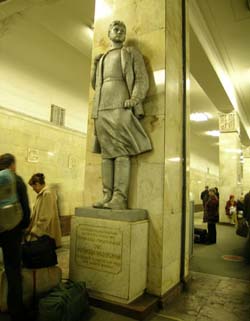
A statue of Zoya Kosmodemyanskaya stands vigil over Moscow’s World War II-era Partizanskaya metro station. Image used with permission.

One of the most famous Soviet war heroines and the first woman decorated as Hero of the Soviet Union during World War II, the 18-year-old had quit school to volunteer for a partisan unit only a few weeks before her hanging as Russia mobilized against Hitler’s race towards Moscow.

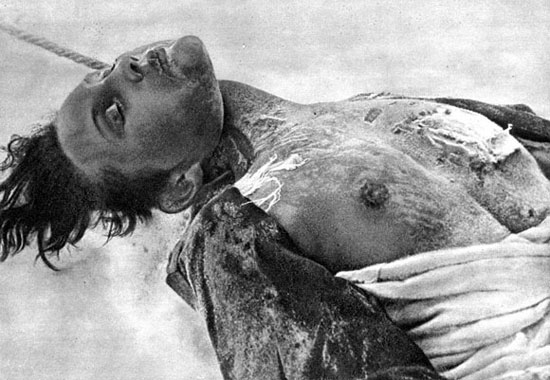
Known simply as “Tanya”, the nom de guerre which was the only information she volunteered during two days of torture, the power of the press offered her apotheosis into a propaganda coup for the Kremlin, and a symbol of courage that would long outlive Stalin. Before the public execution, the Nazis paused to photograph the scene; Kosmodemyanskaya availed the lull to harangue the Germans — “you can’t hang all 190 million of us!” — and call on the Russian villagers present to resist occupation.

Her bayoneted, mutilated body hung on the gibbet until the Red Army recaptured the village; witnesses related the tale of her dying heroism to a newsman.

It was only after the story of “Tanya” hit the press in January 1942 that her identity was established … and then promulgated widely. Anonymous and obscure in death, Zoya Kosmodemyanskaya would inspire millions and become the heroic emblem of other women partisans.


Soviet propaganda poster unabashedly modeled on the already-iconic image of Zoya Kosmodemyanskaya’s abused corpse.

Zoya, a 1944 Soviet film, was scored by Dmitri Shostakovich.

Part of the Themed Set: Women Against Fascism.

On this day..

1915: Joe Hill

On this date in 1915, songwriter, poet and labor activist Joe Hill was shot in Utah for the murder of a local butcher.

Even before his execution, the Swedish immigrant was widely thought to have been railroaded for his IWW affiliation.

Though state authorities had little use for the worldwide clemency bid whose backers included U.S. President Woodrow Wilson — powerless to intervene officially, since the execution was a state matter — Hill walked spryly into his martyrdom. The strange post-mortem career of his totemic ashes is the least of the ways Hill lives on.

His dauntless last message to fellow Wobbly Bill Haywood — “Don’t waste any time mourning. Organize.” — is a permanent fixture on pins and placards among every stripe of left activist. The songs he wrote remain in print — and in performance.

And the Depression-era tribute ballad “I Dreamed I Saw Joe Hill Last Night” can seamlessly serenade ripped-from-the-headlines footage, as a Paul Robeson rendition does in these clips of 1998 protests against then-New York City Mayor Rudy Giuliani.

On this day..