1925: Sheikh Said Piran, Kurdish rebel

Early this morning this date in 1925, just hours after his condemnation for an eponymous rebellion against the newborn Turkish Republic, Sheikh Said Piran was publicly hanged.

This founding member of the Kurdish anti-Ankara martyrology had sparked a momentarily-successful rising against Turkey, fired by grievances that have not ceased to resonate since.

The secular nationalist Kemal Ataturk‘s intent to “Turkify” its peoples. The Kurdish populace’s frustrated national ambitions, indifferently bartered away by distant great powers dismembering the Ottoman Empire.* Ataturk’s abolition of the Caliphate.

“Oppressive and vile towards the Kurds,” Sheikh Said declared. (pdf)

For several years we have been able to read in the newspapers and official documents about the oppression, insults, hatred, and enmity that the Turk Republic [sic] accords to the Kurdish notables and dynasties. There is a lot of evidence available from authentic sources that they want to subject the Kurdish elite to the same treatment to which they subjected the Armenians

The February revolt quickly made him master of the majority-Kurdish eastern province of Diyarbakir, but a massive Turkish counterattack drove him east, encircled him, and had the Sheikh in irons by mid-April.

The government arrogated martial law powers to itself and appointed Orwellian courts called Independence Tribunals to prosecute Kurdish elites, rebels or no. (Some Kurdish intelligentsia were hailed to Diyarbakir from Istanbul.) Hundreds hanged, without even counting wholesale extrajudicial retribution against Kurdish civilians.

the repression of the 1925 rising was accomplished with a brutality which was not exceeded in any Armenian massacres. Whole villages were burnt or razed to the ground, and men, women and children killed.


Mass hanging of Kurds at Diyarbakir, May or June 1925 (Source)

Despite prosecutors’ avowed intention to extirpate the separatist sentiment “root and branch,” it hasn’t exactly put the whole Kurdish issue to bed.

Just ask Kurdish guerrilla Abdullah Ocalan, who received on this very same date 74 years later his own Turkish death sentence (since commuted).

* A past-is-prologue artifact from the time: the “Issue of Mosul“, a prickly international relations dispute over control of the historic city, accurately suspected to be sitting on a lot of oil.

Turkey claimed it as part of its historic heartland, but Great Britain had seized it just before World War I ended and wound up hanging onto it for the embryonic Iraqi state. Kurds who also considered it part of their homeland got short shrift altogether. It’s still disputed today among Iraqis, situated as it is just on the edge of Kurdish Iraq.

On this day..

1826: Janissaries during the Auspicious Incident

We have received from Constantinople the following further particulars of the revolt of the Janissaries: —

“June 16, 3 o’clock p.m.

“The Sultan was at his summer palace of Bschektash. The Aga Pacha, and the Pacha commanding on the Asiatic bank of the Bosphorus, repaired to Constantinople with their troops: 8,000 topschis, or artillery, also went thither. At length, his Sublimity being resolved to quell the rebellion, caused the standard of the Prophet to be displayed, and proclamations to be made in all the quarters of the city, that all men of honour — that is to say, true believers — had immediately to rally round this standard. The Ulemas met in the Seraglio. The appearance of the Snadgiak Sherif caused some hesitation among the rebels; their numbers were reduced by desertion, while, on the other hand, all the people hastened to assemble round the sacred standard. The energy of the Aga Pacha did the rest; he has crushed the rebles with grape-shot, burnt their barracks in the Ahnudan, and pursued them without mercy.

“The Grand Vizier is in the Court of the Mosque of Sultan Achmet, in the Hippodrome, with the Sandgiak Sherif still displayed; the chiefs of the corps of the Ulemas are met there in council; the Sultan is at the Seraglio, with the great men of the empire. Every moment persons are brought into the Hippodrome, and executed on the spot. Above 100 Oustas have already suffered this fate. This morning all the gates of Constantinople, except one, are shut or guarded by topschis and citizens. The remainder of the rebels have taken refuge in some khans built of stone, where they are invested, and where, to all appearance, famine will soon deliver them to the mercy of the Aga Pacha.

London Times, July 15, 1826 (translating July 11 reports published in the French papers)

This date in 1826 finds Constantinople in the midst of what history will remember as the Auspicious Incident — an attempted revolt by the Ottoman Empire’s elite Janissary corps that was not at all auspicious for the Janissaries.

This centuries-old slave infantry,* a sort of Ottoman Praetorian Guard as well as the sultan’s elite military presence in the empire’s hinterlands, had evolved by this stage of decadence into a vampire squid on the face of the Porte.**

Jealous of their material privileges and political prerogatives even as the dawn of industry and conscript armies undermined their combat utility, the Janissaries had become much more trouble than they were worth.†

They had “begun to present a serious threat to the Empire,” wrote Lord Kinross in Ottoman Centuries. “On the battlefield they were gaining a reputation among the modern foreign armies for ineptitude and even cowardice under arms … In the capital … they came to be a dominant power and a focus of sedition.”

Kinross wrote that about the Janissaries of the early 17th century, in the reign of Osman II. (Osman tried to curtail the troop’s power, and was executed by his bodyguards for his trouble.)

A couple of centuries on from that moment, and the Janissaries are still skulking about the Seraglio, still keeping their supposed masters in mortal terror, still arbitrating the succession.

The current ruler, Mahmud II, had been fortunate in his own youth to survive the Janissaries’ political intrusion and reach the throne.

For a generation, Mahmud had waited and readied himself for the opportunity to sweep this piece off the chessboard. This would be a most Auspicious Incident indeed.

Kinross and many other historians suspect that Mahmud intentionally baited the Janissaries to revolt in 1826, but whether or not that is so, they did revolt — in response to a decree reorganizing the corps.

Mahmud was ready for them. He repelled the Janissary mutiny on June 15, and as described by our third-hand correspondent above, proceeded to slaughter them without mercy: under artillery barrage in the barracks they retreated to, or by the summary execution of all who surrendered — not just on this date, but throughout the Incident and extending to the further reaches of the empire where Mahmud’s agents carried his decree abolishing the Janissaries forever.

* Culled from children taken from non-Muslim families and raised as Islamic converts.

** Not unlike the actual Praetorian Guard.

† There’s a competing historiography contending (pdf) that, contrary to the corrupt-backwards-military-caste story, it was the Janissaries’ economic and social links that brought on their destruction: they became the entity representing the autonomous Ottoman classes, such as artisans and guilds, who had the most to lose from the elites’ state modernization project.

On this day..

1857: Twelve blown from cannons in British Punjab

An account from the February 15, 1862 Harper’s Weekly of a very messy spectacle orchestrated to maintain British control of Punjab.

Another execution of a similar nature took place on the 13th of June, at Ferozepore. All the available troops and public establishments were convened to witness the scene. Some of the mutineers were to be hung, and around the gallows, erected during the night previous, the soldiers were drawn up. The mutineers were then brought into the centre, and the proceedings of the general Court-Martial was read. Upon being informed that if they would become Queen’s evidence they would be reprieved, twelve of the criminals accepted the offer and were marched to the rear. Two were taken to the gallows. They ascended the ladder with firm steps, and to the last moment betrayed no emotion of fear.

The remaining ten were now led away to the artillery guns, and while their irons were being struck off some cried, “Do not sacrifice the innocent for the guilty!” Two others rejoined, “Hold your sniveling: die men and not cowards — you defended your religion, why then do you crave your lives? Sahibs! they are not Sahibs, they are dogs!” Others then began to upbraid their commanding officer. The wretched beings were quickly fastened to the muzzles of ten guns, charged with blank cartridge.

The commanding officer directed port-fires to be lit. “Ready!” “Fire!” and the drama was played out. An eye-witness says: “The scene and stench were overpowering. I felt myself terribly convulsed, and could observe that the numerous native spectators were awe-stricken — that they not only trembled like aspen-leaves, but also changed into unnatural hues. Precaution was not taken to remove the sponge-and-load men from the muzzles of the guns; the consequence was that they were greatly bespattered with blood, and one man in particular received a stunning blow from a shivered arm!


A lengthier account, no less riveting and we suppose more accurate on account of its primary sourcing, is to be found in this memoir or the British campaign against the Sepoy rebellion.

June 13 The morning of June 13 was fixed upon for the execution. A gallows was erected on the plain to the north side of the fort, facing the native bazaars, and at a distance of some 300 yards. On this two sepoys were to be hanged, and at the same time their comrades in mutiny were to be blown away from guns.

We paraded at daylight every man off duty, and, with the band playing, marched to the place of execution, and drew up in line near the gallows and opposite the native quarter.

Shortly after our arrival the European Light Field Battery, of six guns, appeared on the scene, forming up on our left flank, and about twenty yards in front of the Light Company.

The morning was close and sultry, not a cloud in the sky, and not a breath of wind stirring; and I confess I felt sick with a suffocating sense of horror when I reflected on the terrible sight I was about to witness.

Soon the fourteen mutineers, under a strong escort of our men with fixed bayonets, were seen moving from the fort. They advanced over the plain at our rear, and drew up to the left front of, and at right angles to, the battery of artillery.

I was standing at the extreme right of the line with the Grenadier Company, and some distance from the guns; but I had provided myself with a pair of strong glasses, and therefore saw all that followed clearly and distinctly.

There was no unnecessary delay in the accomplishment of the tragedy. Two of the wretched creatures were marched off to the gallows, and placed with ropes round their necks on a raised platform under the beam.

The order was given for the guns to be loaded, and quick as thought the European artillerymen placed a quarter charge of powder in each piece. The guns were 9-pounders, the muzzles standing about 3 feet from the ground.

During these awful preparations, I watched at intervals the faces of the condemned men, but could detect no traces of fear or agitation in their demeanour. The twelve stood two deep, six in front and six in the rear, calm and undismayed, without uttering a word.

An officer came forward, and, by the Brigadier’s order, read the sentence of the court-martial, and at its conclusion the six men in front, under escort, walked towards the battery.

There was a death-like silence over the scene at this time, and, overcome with horror, my heart seemed almost to cease beating.

Arrived at the guns, the culprits were handed over to the artillerymen, who, ready prepared with strong ropes in their hands, seized their victims. Each of these, standing erect, was bound to a cannon and tightly secured, with the small of the back covering the muzzle. And then all at once the silence which reigned around was broken by the oaths and yells of those about to die. These sounds were not uttered by men afraid of death, for they showed the most stoical indifference, but were the long-suppressed utterances of dying souls, who, in the bitterness of their hearts, cursed those who had been instrumental in condemning them to this shameful end. They one and all poured out maledictions on our heads; and in their language, one most rich in expletives, they exhausted the whole vocabulary.

Meanwhile the gunners stood with lighted port-fires, waiting for the
word of command to fire the guns and launch the sepoys into eternity.

These were still yelling and raining abuse, some even looking over their shoulders and watching without emotion the port-fires, about to be applied to the touch-holes, when the word “Fire!” sounded from the officer in command, and part of the tragedy was at an end.

A thick cloud of smoke issued from the muzzles of the cannons, through which were distinctly seen by several of us the black heads of the victims, thrown many feet into the air.

While this tragic drama was enacting, the two sepoys to be hanged were turned off the platform.

The artillerymen again loaded the guns, the six remaining prisoners, cursing like their comrades, were bound to them, another discharge, and then an execution, the like of which I hope never to see again, was completed.

All this time a sickening, offensive smell pervaded the air, a stench which only those who have been present at scenes such as these can realize — the pungent odour of burnt human flesh.

The artillerymen had neglected putting up back-boards to their guns, so that, horrible to relate, at each discharge the recoil threw back pieces of burning flesh, bespattering the men and covering them with blood and calcined remains.

A large concourse of natives from the bazaars and city had assembled in front of the houses, facing the guns at a distance, as I said before, of some 300 yards, to watch the execution. At the second discharge of the cannon, and on looking before me, I noticed the ground torn up and earth thrown a slight distance into the air more than 200 paces away. Almost at the same time there was a commotion among the throng in front, some running to and fro, while others ran off in the direction of the houses. I called the attention of an officer who was standing by my side to this strange and unaccountable phenomenon, and said, half joking: “Surely the scattered limbs of the sepoys have not been carried so far?”

He agreed with me that such was impossible; but how to account for the sight we had seen was quite beyond our comprehension.

The drama came to an end about six o’clock, and as is usual, even after a funeral or a military execution, the band struck up an air, and we marched back to barracks, hoping soon to drive from our minds the recollection of the awful scenes we had witnessed.

Two or three hours after our return news arrived that one native had been killed and two wounded among the crowd which had stood in our front, spectators of the recent execution. How this happened has never been explained. At this time a “cantonment guard” was mounted, consisting of a company of European infantry, half a troop of the 10th Light Cavalry, and four guns, and two of these guns loaded with grape were kept ready during the night, the horses being harnessed, etc. Half the cavalry also was held in readiness, saddled; in fact, every precaution was taken to meet an attack.

As far as I can recollect, there were but two executions by blowing away from guns on any large scale by us during the Mutiny; one of them that at Ferozepore.

On this day..

2010: 18 in Libya

Last year on this date, Libya — having just days prior been controversially elected to the United Nations Human Rights Council* — celebrated by conducting 18 firing squad executions.

State media reported that 14 were shot in Tripoli, and four more in Benghazi, in unspecified cases that Amnesty International “fear[ed] … fail to satisfy international standards for fair trial.”

Among them were nationals of Nigeria, Chad, and Egypt who, particularly in the first case, might have been condemned at a tribunal entirely conducted in a language they could not understand.

Qaddafi’s Libya has always been opaque about its practice of capital punishment; if it met the international outcry for more information about these 18, this site is not aware of it.

But as with Libya’s neighbor in the so-called Arab Spring, it’s one small reminder that what goes around occasionally (maybe) comes around too.

* In view of the current unpleasantness, Tripoli has recently been suspended from the body.

On this day..

1894: Six anarchists in Barcelona

On this date in 1894, on the very day that anarchist terrorist par excellence Emile Henry was guillotined in Paris, six more anarchists were executed by firing squad outside Barcelona’s Montjuich Fortress.

Mariano Cerezuela, Bernat Siveval, Jaime Sogas, Jose Codina, Villarubbia, and Manuel Archs were condemned just weeks prior by a military court for complicity in the attempted assassination earlier that year of Spanish Marshal Arsenio Martinez Campos. Some had originally been rounded up in the general anti-anarchist crackdown after the bombing of the Liceu theater … although another man would be put to death for authoring that crime later in 1894.

Only one of their number, Sogas, died penitent.

In the report of the London Times (May 22, 1894),

[t]he condemned men were conveyed from the chapel, where they had spent the night, to the place of execution by an underground passage, the first two to appear being Sogas and Cerezuela. The former, who confessed last night, joined in the prayers offered by the priest, and he and Cerezuela walked quietly to their doom. The other prisoners, however, shouted all kinds of revolutionary cries. The convicts were placed in line, and at the first shot they all fell to the ground. It was found, however, that in the case of Sogas and Codina the bullets had not taken effect, and a second shot was necessary.

On this day..

1976: Lt. Col. Bukar Dimka and six coup confederates

On this date in 1976, Nigeria executed the leading spirit of an abortive Nigerian coup was shot for the “abortive” part of that coup.

That February 13, Bukar Dimka had taken to the airwaves to announce the assassination of Nigeria’s incumbent military strongman, Murtala Mohammed.*

Good morning fellow Nigerians.

This is Lt. Colonel B. Dimka of the Nigerian Army calling. I bring you good tidings. Murtala Muhammed’s deficiency has been detected. His government is now overthrown by the young revolutionaries. All the 19 military governors have no powers over the states they now govern. The states affairs will be run by military brigade commanders until further notice.

Any acts of looting or raids will be death. Everyone should be calm. Please stay by your radio for further announcements. All borders, air and sea ports are closed until futher notice. Curfew is imposed from 6am to 6pm. Thank you. We are all together.

-From Romancing the Gun: The Press as Promoter of Military Rule

They were not all together.

Mohammed’s second-in-command, Olusegun Obasanjo, instantly quashed the putsch and served notice that assassinating the head of state would not be welcome on his watch.**

A large body of coup conspirators were publicly executed within a month; the Nigerian Defense Minister was among them.

Dimka himself managed to remain at large for most of that month, so he wasn’t among that crop. Instead, Obasanjo had the pleasure of announcing Dimka’s execution separately, along with that of

a former state governor, Joseph Gomwalk … “two of the principal actors” in the coup.

New York Times, May 16, 1976

The coup was thought to have aimed at restoring the guy Mohammed deposed, Yakubu Gowon, who was luckily in exile in England and therefore escaped a similarly grim fate.

Years later, he received an official pardon; Gowon is still alive, one of Nigeria’s elder political statesmen.

* When next in Lagos to transfer several million in oil wealth from a secret bank account, be sure to visit Mohammed’s bullet-ridden Mercedes.

** Obasanjo handed power to a democratic government in 1979; that government was itself later toppled by the military, but Obasanjo eventually served as Nigeria’s elected president from 1999 to 2007.

On this day..

1655: Massacre of Waldensians

On this date in 1655, Catholic forces under the Duke of Savoy carried out a notorious massacre of Waldensians* in the Piedmont.

This interesting, excommunicate sect had persisted for centuries in those hard-to-reach places in Alpine foothills, intermittently ignored and hunted. After Martin Luther, many Protestants inclined to see them as a proto-Reformation movement, or even a counter-papal apostolic succession reaching back to ancient Christianity.

At any rate, they sure weren’t Catholic.

And our friend the Duke decided — perhaps piqued by the murder of a missionary Catholic priest, or for whatever other reason — to mount one of those heresy-extirpating sorties and make them Catholic in 1655.

On April 17, the Marquis of Pianezza appeared with an overwhelming force of mixed Piedmontese, French, and Irish** troops. They conducted a few skirmishes, then made nice with the Waldensian civic leaders and induced them to quartering their troops temporarily further to some expedient pretext.

Alas! alas! these poor people were undone. They had received under their roof the executioners of themselves and their families. The first two days, the 22d and 23d of April, passed in peace, the soldiers sitting at the same table, sleeping under the same roof, and conversing freely with their destined victims …

At last the blow fell like a thunderbolt. At four of the clock on the morning of the 24th April the signal was given from the Castle of La Torre. But who shall describe the scenes that followed? On the instant a thousand assassins began the work of death …

Little children were torn from the arms of their mothers, and dashed against the rocks; or, more horrible still, they were held betwixt two soldiers, who, unmoved by their piteous cries and the sight of their quivering limbs, tore them up into two halves. Their bodies were then thrown on the highways and the fields. Sick persons and old people, men and women, were burned alive in their own houses; some were hacked in pieces; some were bound up in the form of a ball, and precipitated over the rocks or rolled down the mountains … Some were slowly dismembered, and fire applied to the wounds to staunch the bleeding and prolong their sufferings; some were flayed alive; some roasted alive; others were disembowelled; some were horribly and shamefully mutilated, and of others the flesh and brains were boiled and actually eaten by these cannibals.

Source, whose atrocity accounts channel those in this French tome

Without doubting the capacity of man’s inhumanity to man, the cannibalism charge reminds that we’re dealing with propaganda alongside historiography. And what great propaganda — like, babies-torn-from-incubators great.

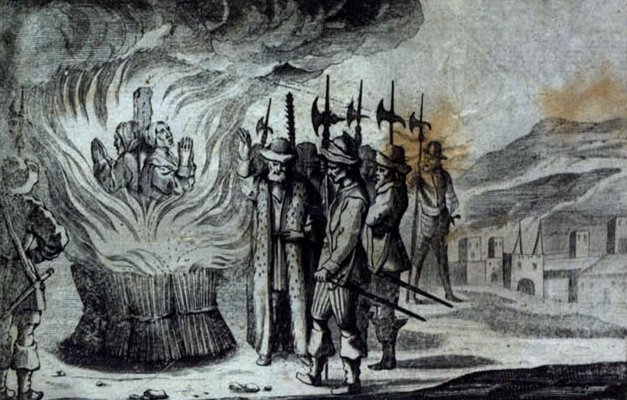
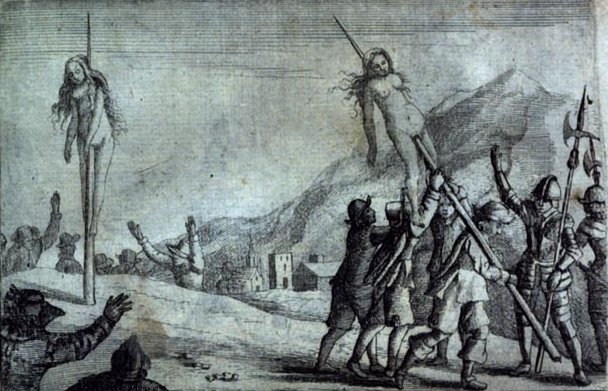
Thumbnails (click for a larger, disturbing view) of selected images of this date’s atrocities from Samuel Morland’s The History of the Evangelical Churches of the Valleys of Piedmont

And there’s little doubt as to the overall savagery of the affair, which could well have become the opening salvo in a full-scale sectarian cleansing campaign. (A later addendum to Foxe’s Book of Martyrs narrates the ensuing Piedmontese armed struggle, petering out before any definitive resolution in the field.)

Outrage at this hecatomb spread in Protestant Europe — which would also refer to the day’s doings as the “Bloody Easter,” since it corresponded with the eve of that celebration as reckoned by the Julian Calendar (source).

It was felt especially in Protectorate England, which intervened diplomatically.

A “day of solemn fasting and humiliation” was promulgated in Albion, along with collections for the relief of the survivors. Oliver Cromwell personally put £2,000 into the kitty.

More importantly, he dispatched diplomat Samuel Morland† to force the House of Savoy to lay off the persecution; in fact, he threatened to disrupt high statecraft between England and France unless the French twisted arms on behalf of the Waldensians.

Written correspondence for Morland’s diplomatic tour addressed to Louis XIV of France and various other continental potentates, as well as a fiery bit of oratory that Morland delivered to Savoy, all seem to have originated from the pen of Republican scribbler John Milton — the future author of Paradise Lost.‡

Milton, for whom the whole thing was more than just a day job, was further moved to put his umbrage at the slaughter into sonnet form:

Avenge O Lord thy slaughter’d Saints, whose bones
Lie scatter’d on the Alpine mountains cold,
Ev’n them who kept thy truth so pure of old
When all our Fathers worship’t Stocks and Stones,

Forget not: in thy book record their groanes
Who were thy Sheep and in their antient Fold
Slayn by the bloody Piemontese that roll’d
Mother with Infant down the Rocks. Their moans

The Vales redoubl’d to the Hills, and they
To Heav’n. Their martyr’d blood and ashes sow
O’re all th’ Italian fields where still doth sway

The triple Tyrant: that from these may grow
A hunder’d-fold, who having learnt thy way
Early may fly the Babylonian wo.

* The Waldensians in question here are interchangeably known as the Vaudois for their geographic region, actually above the Piedmont and abutting the Swiss region also known as Vaud. (These pages have visited the latter.)

** Fresh from being on the receiving end of another infamous massacre.

† Morland is more regarded for his post-Restoration labors as an inventor; he created an early calculator and internal combustion engine.

‡ The speech in particular is not definitively attributed; see Robert Fallon, “Milton in Government: Denmark and Savoy,” Milton Quarterly, May 1989.

On this day..

1534: Elizabeth Barton, the Holy Maid of Kent

On this date in 1534, Elizabeth Barton was hanged at Tyburn with her “conspirators” for having prophesied the death of Henry VIII and (in the words of the parliamentary attainder against them) “traterously attempted many notable actes intendyng therbye the disturbaunce of the pease and tranquyllytie of this Realm.”

A country servant-girl, this Elizabeth Barton had begun having divine visions around Easter 1525, and developed a popular following for her gift of prophecy, generally delivered during spooky (perhaps epileptic) fits and trances.

This was all just fine with everyone, since King Henry was still a good Catholic at the time; Barton took orders in the St. Sepulchre Nunnery and continued her career in the seer business.

Elizabeth Barton wasn’t going to leave her place in Henrician England … but to paraphrase Ronald Reagan, Henrician England was about to leave her.

And like so many entries that age has given this site, it all went back to Henry’s leaving his first queen, Catherine of Aragon.

If one likes to see in the prophetic tradition a refracted expression of popular sentiment, speaking a religious rather than a political language, Elizabeth Barton’s divine gift set her up to be the mystical exponent of the English populace’s visceral reaction against Henry’s ascending paramour, Anne Boleyn.

Rather rashly, Barton began publicly warning her sovereign against his bedchamber gambit, threatening that if the proposed Boleyn union should come to pass, he “should no longer be King of this realm…and should die a villain’s death.”

That would be compassing the death of the king — which is treason.

Barton articulated a fear of Henry’s policies which was shared by many of his subjects. The anticipated breach with Rome made the citizens of England insecure about the future stability of the realm, and prognostications concerning the state of the country abounded. Barton was not alone in foretelling that wars and plagues would soon rack the country; or in prophesying that the King would be overthrown, that his death was imminent, that he would die as a villain. Many people were discussing such prophecies, by means of which they could “objectify their fears and hopes” in an age of change and disruption.

-Diane Watt, “Reconstructing the Word: the Political Prophecies of Elizabeth Barton (1506-1534)”, Renaissance Quarterly, Spring 1997

So it’s probably only fitting that this creature of her times would be devoured by the Tudor state which made its Reformation from the top.

Devoured, not only bodily.

As the Tudor king breaks with Rome, Barton becomes almost totally obscure to us, the real person who dared to stand openly against her king subsumed entirely by the edifice of state propaganda. As Watt observes, “as a result of her fate … almost all the first-hand evidence concerning Barton’s life and revelations has been destroyed” and “the surviving image of her has therefore been shaped by those who suppressed her visions and prophecies.”

We have her mystical utterances mostly indirectly, through the interlocutors charged with refuting her, and we have the expedient charges against her of fraud, contumacy, and (of course) sexual indiscretion leveled by her foes.


“The Imposture of the Holy Maid of Kent”

Arrested with a circle of supporters, Barton was forced into a public recantation in November 1533 by her persecutors. One supposes such a recantation was in any event obtained under some duress; undoubtedly it was, as the disgusted Spanish ambassador recorded, staged “to blot out from people’s minds the impression they have that the Nun is a saint and a prophet.” (Cited by Watt)

If said duress included an easing of the charges against herself or her associates, Barton was to be disappointed.

She was attainted for treason* in January (the evidence against her being insufficient for a judicial verdict of treason); the bill of attainder also required the public to hand over any writings about her alleged prophecies or revelations, like the popular pamphlets that had circulated with official approval in the 1520’s: there would be nothing to nurture a people’s cult for this exponent of resistance. Over the decades to come, the early writings sympathetic (and proximate) to Barton would be almost completely annihilated, supplanted by Protestant works that rendered Barton a trickster, a puppet, a sham — magnified her retraction into the definitive statement. It was a propaganda victory almost as chilling as Barton’s corporeal fate: even her potentially sympathetic Catholic audiences can latterly make no reliable judgment about her.

And so Barton moulders.

In April 1534, the usurping consort once more apparently pregnant with Henry’s long-sought heir, the once-popular, now-deflated prophetess of the old queen and the old faith was emblematically put to death with her former adherents on a most significant day in the city of London.

[T]his day the Nun of Kent, with two Friars Observant, two monks and one secular priest, were drawn from the Tower to Tyburn, and there hanged and headed. God, if it be his pleasure, have mercy on their souls. Also this day the most part of this City are sworn to the king and his legitimate issue by the Queen’s Grace now had and hereafter to come, and so shall all the realm over be sworn in like manner.

-Letter from John Husee to Lord Lisle, April 20, 1534 (Source)

We trust everybody got the message.

But in case anyone missed the point, there would be plentiful reminders still to come.

* Chancellor Thomas More had some traffic with Barton — very cautious, as befits a skeptical elite’s approach to a loose cannon commoner — and was briefly in some danger of being named in the indictment against her. When his loyal daughter Meg joyously reported to him that he’d been cleared, he’s supposed to have replied, “In faith, Meg, ‘quod differtur non aufertur’, what is put off is not put away.” But it probably didn’t require heavenly foresight for More to perceive the wheel of fortune about to turn on him, too. By the time of Barton’s actual execution, More had already been clapped in the Tower himself.

On this day..

1457: The Wallachian boyars

This date was Easter Sunday in 1457, which would make it the date associated with one of the more memorable displays of theatrical brutality by Wallachian proto-vampire Vlad Tepes, aka Vlad Dracula or Vlad the Impaler.

Having only just ascended the less-than-secure throne of Wallachia, a frontier principality pinched between the Hungarian and Ottoman Empires, the 25-ish prince and onetime Ottoman hostage had a bone-chilling inauguration plan to shore up his security both internal and external.

He threw a big party in Targoviste for the nobles of the realm … and had a little surprise waiting for them. It wasn’t an Easter egg hunt.

He asked the assembled noblemen:
“How many princes have you known?”
The latter answered
Each as much as he knew best.
One believed that there had been thirty,
Another twenty.
Even the youngest thought there had been seven.
After having answered this question
As I have just sung it,
Dracula said: “Tell me,
How do you explain the fact
That you have had so many princes
In your land?
The guilt is entirely due to your shameful intrigues.”

With ample proof of the boyars’ deceit and treacherous intents, Dracula decided it was timely to inflict upon them an exemplary punishment … mass impalement …

The oldest Romanian historical chronicle records the event two centuries later. It had taken place in the spring of 1457, during the Easter celebrations that the boyars were attending at the palace … “when Eastern Day came, while all the citizens were feasting and the young ones were dancing he [Dracula] surrounded them [the boyars] … led them together with their wives and children, just as they were dressed up for Easter, to Poenari, where they were put to work until their clothes were torn and they were left naked.” In actual fact, this episode, which is also recalled by the Greek historian Chalcondyles and firmly anchored in popular folklore, involved some two hundred boyars and their wives, as well as leading citizens of Tirgoviste … They were seized by Dracula’s men as they were finishing their meal in the main banqueting hall of the palace, following the elaborate Easter ritual at the Paraclete Chapel. In Dracula’s ingenious mind, one aspect of the punishment had a utilitarian purpose: the reconstruction of the famous castle high up on the Arges … On the way out of the chapel the old boyars and their wives were apprehended by Dracula’s henchmen and impaled beyond the city walls. The young and able-bodied were manacled and chained to each other and then marched northward under the vigilant eye of Dracula’s men.

This was revenge a decade in the making for the boyar class having toppled Vlad’s father and murdered Vlad’s elder brother in 1447.

But personal score-settling aside, Vlad’s sanguinary housekeeping had a statecraft dimension as well. It enabled him to centralize power in his own person, and had the happy side effect of speeding creation of a secure mountain fastness — Poenari Castle, which is one of several structures answering to the lucrative name of Castle Dracula.

While Vlad is (in)famous for his iron fist (and well-oiled spikes), it’s perhaps harder to say with confidence how much good this slaughter did him. Wallachia’s security situation was fundamentally defined by its neighbors no matter how cruel Vlad Tepes might be.

Vlad got some more impaling under his belt defending his country from Ottoman invaders (you’ll be shocked to learn that many boyars were more than happy to help the sultan get rid of this tyrant), but he was clapped in prison by the Hungarian ruler Matthias Hunyadi in 1462, lived most of the rest of his life in exile, and then died in battle attempting a Wallachian comeback in 1476. So basically, he got a few good years in … plus that whole latter-day afterlife he enjoys as tourist magnet, alleged literary inspiration, and nationalist icon.

And that’s more than one can say for most of the 15th century rulers who weren’t impaling their boyars.

On this day..

1647: Domenica Gratiadei and her coven of witches

This date in 1647 marked the execution of five supposed witches in Trentino.

Secular and modernist as this grim site‘s curators confessedly stand, we have perhaps given too little credence to those devout officers of the law who labored in those years to uphold the throne of heaven besieged by Satan’s varied earthly minions.

Montague Summers

In an effort to balance the record, we present this date’s account as rendered by a guy who took the supernatural a bit more seriously: Montague Summers.

Summers is a weird figure, but if he wasn’t really a throwback believer in Rome’s phantasmagoric early modern theology, he was the century’s most sublime performance artist.

Converting to Catholicism as an Anglican deacon, he went about in spooky clerical robes although his ordination status remains unclear to this day, immersed his capacious mind in supernatural arcana, and penned voluptuously eloquent books credulously treating the spectral evidence another era had given against sorcerers, vampires, lycanthropes, and suchlike habitues of the Monster Manual.*

I have endeavoured to show the witch as she really was -– an evil liver: a social pest and parasite: the devotee of a loathly and obscene creed: an adept at poisoning, blackmail, and other creeping crimes: a member of a powerful secret organization inimical to Church and State: a blasphemer in word and deed, swaying the villagers by terror and superstition: a charlatan and a quack sometimes: a bawd: an abortionist: the dark counselor of lewd court ladies and adulterous gallants: a minister to vice and inconceivable corruption, battening upon the filth and foulest passions of the age.

Summers projected (perhaps intentionally) a mysterious and vaguely sinister persona and did not disdain to cultivate a friendship with nefarious occultist Aleister Crowley, his contemporary. There were even rumors of an unwholesome interest in pederasty.

We’re confident that none of this has done his sales a bit of harm. So who are we social pests and parasites of the blogosphere not to batten upon it ourselves?

The below is drawn from Summers’ The Geography of Witchcraft — and as the reader will perceive, Geography at least purports to treat the flying-off-to-infernal-orgy stock in trade of those bygone witch hunters as legitimate evidence of the lead crone’s “attendance at the Sabbat, sometimes, no doubt, an experience on the psychic plane, for she was undoubtedly a medium of unusual powers, and sometimes in actual fact.”

A typical case of Witchcraft, and one which owing to its prominence and the meticulous investigations of the authorities has luckily been reported in full, attracted considerable attention in the winter of 1646 and the following spring. It will, moreover, be found to present so many factors and features, which occur again and again in the contemporary trials of wellnigh every European country, that it may profitably be dealt with in some detail.

A certain old woman of Castelnovo, Maria Salvatori, nicknamed “la Mercuria,” who had long been suspected of sorcery, was arrested on 26 October, 1646, and formally examined. At first the two principal charges, sufficiently damning in themselves, seem to have been that at her communions she did not swallow the Sacred Host, but kept It in her mouth to spit It out secretly and reserve It for some abominable purpose, and also that by her ecbolic spells she had caused the young Marchesa Bevilacqua to miscarry in childbirth. She was again interrogated on 8 November and put to the torture of the cord when she accused Domenica, the widow of a certain Tomaso Camelli, and Domenica’s daughter, Lucia, the wife of Antonio Caveden, both of whom dwelt at the hamlet of Villa, of being rank witches. She also avowed she had taken a Host from her mouth to give to Lucia Caveden, who thereby confected a charm which caused the abortion of the Marcioness. She added that she had also bewitched Cristoforo Sparamani, the son of Cecilia Sparamani, and that a certain Delaito Cavaleri was a necromancer and a worshipper of Satan. A further interrogation followed on 15 November, as a result of which the court, consisting of Paride Madernino, delegate in all criminal and civil cases in the districts of Castelnovo and Castellano, and his assessor Giovanni Ropele, doctor utriusque iuris, promptly gave orders to GiuseppeCoriziano, “bargello di questa turia,” to arrest Domenica and Lucia. This was done, and on Saturday, 24 November, 1646, at Nogaredo, the proceedings against the witches were formally opened. “Processus Criminalis pro destructione lamiarum.” On 27 November Domenica Carnelli was questioned by the judges, but they got little enough out of her. Two days following Lucia Caveden was brought before the tribunal. She vehemently declared that the charges were all malice; the hag Salvatori was her enemy; and with many cries she called Heaven to witness her innocence, repeatedly exclaiming “per grazia del Signor Iddio no son una stria” But the next day she proved less firm and implicated yet another woman, Domenica Gratiadei, who was immediately thrown into prison, a number of suspicious objects being found in her house when it was closely searched by the officers. Certain pots of a dark unguent and a mysterious powder being produced in court, Lucia Caveden confessed that these were for the destruction of human life and cattle. Seeing that the game was up Domenica Gratiadei, upon being put to the torture, soon laid bare all the secrets of the infernal sisterhood. She had made this unguent with which she annointed herself to attend the Sabbat “trasformata in gatto,” she had cast the evil eye on Cristofero Sparamani, she had renounced her baptism, defiled the Blessed Sacrament, adored Satan with divine honours. The judges were filled with horror, and trembled at the hideous tale of diabolism these women poured forth. Cecilia Sparamani, a plain honest woman, was next summoned as a witness and told how her son fell into fits of no ordinary kind. The doctors had acknowledged their skill baffled, and in spite of the prayers of two Capuchin fathers and the exorcisms of Monsignore the Bishop of Brondolo, this preternatural sickness still persisted. She informed the court that as soon as summer came and the roads were passable she intended to take the boy to the shrine of S. Antony at Padua, to whom she had a special devotion.

On 18 December, 1646, Benvenuta, the daughter of Domenica Gratiadei, made a startling confession. She declared that she had been taken by her mother “as if in a dream” to a place where there was dancing and singing, where she had been welcomed by a large number of revellers, and especially by a young man, who having kissed and fondled her awhile afterwards had connexion with her. This was, her mother averred, Satan himself. When closely questioned as to these proceedings the girl could only reply: “Tutto mi sembra, come ho detto, un sogno: e parevami che sempre vi fosse il diavolo in forma di quel giovene.” It would seem from these very striking and significant words that the girl was a hypnotic subject, entirely under her mother’s control, and that on these occasions she passed into a semi-trance state. The case dragged on throughout the months of January and February, 1647. There were interminable interrogations, and a large number of persons were gradually implicated.

On 2 January 1647, Domenica Gratiadei gave a detailed description of the Sabbats she had attended. She and an old warlock named Santo Peterlino always led the coven. “The rest followed in the shape of cats; but the Devil went first of all.” They enjoyed banquets, dances, plays, music, songs, and afterwards all worshipped Satan, presenting him with Hosts which they kept from their last communion. Before attending the Sabbat she anointed herself with an unguent made of “the Blessed Sacrament, the blood of certain small animals, Holy Water, the fat of dead babies” which was mixed with horrible imprecations and blasphemies to confect the charm.

On 10 January, a strange figure, Maddalena Andrei, nicknamed “La Filosofa,” first appears in the case. She confessed that she had assisted in the making of the ointment and had also adored the Devil who frequently appeared to her, “brave, like a gallant captain, dressed all in red.” On 9 March, when Giuseppe Goriziano entered the cell of La Filosofa to summon her to court he found her lying dead upon the floor. The common people believed that she had been carried off by Satan, especially as the Archpriest of Villa, Don Giovanni Bragliardi, shrewdly suspecting that the unhappy woman had committed suicide, refused her sepulture in consecrated ground.

This long and complicated Witchcraft-trial at length came to an end in April 1647. The court was throned with an excited yet hushed crowd, when the judge Paride Madernino and his assessors the Counts of Lodrone and Castel-Romano delivered the sentences. Domenica Camelli, Lucia Caveden, Domenica Gratiadei, Catterina Baroni, Zinevra Chemola, Isabella and Plonia Gratiadei, and Valentina Andrei were condemned to death. Maria Salvatori, “la Mercuria,” and Maddalena Andrei, “la Filosofa” had expired in prison. The condemned were beheaded and their bodies burned. It would seem, however, that Isabella and Polonia Gratiadei and Valentina Andrei managed to escape and could not be traced. The execution of the rest took place on 14 April, 1647, when Leonard Oberrdorfer the common hangman carried out the judicial sentence.

The chief witches here naturally fall into four groups each constituted of one old and one young woman, Domenica Camelli and Lucia her daughter; Domenica Gratiadei and Benvenuta her daughter; Isabella Gratiadei and Plonia her daughter; Maddalena Andrei and her daughter Valentina. The chief of the coven was undoubtedly Domenica Gratiadei, whose vile confessions, a mixture of most horrid blasphemies and lewdest obscenity, convince her of being a wretch wholly devoted to evil, and an active propagandist of the Satanic cult. It was she who had debauched her own daughter to “the Devil,” that young man whose name and individuality do not appear, but who may be guessed to have been a noble of the district, using the witches for his own ends and, presumably, supplying them with money to carry out his dark designs. That the whole gang frequently attended the Sabbat, at which he was not unseldom present, there can, I think, be no question.

This case is recounted in much greater detail in Italian in this Google book; this page has another summary, also in Italian.

* “[I]n every way a ‘character,’ and in some sort a throwback to the Middle Ages,” the London Times blurbed Summers at his death (obituary in the Aug. 11, 1948 issue). But his “preoccupations with the supernatural, however, represented only one side of his nature. His solid services to learning lie rather in his copious editorial and critical work on the English Restoration drama — a field in which he possessed the most comprehensive and expert knowledge.”

Summers’ edited compendium of 17th century playwright Aphra Behn‘s works is available free at gutenberg.org.

For exemplars of the stuff more topical to this post, one can also peruse free online his The Vampire: His Kith and Kin and his translation of the notorious witch-persecution manual Malleus Maleficarum.

On this day..