To one of these maids, Lykke addressed a love-note remarking that the unpopular queen consort Sophie Amalie enjoyed queen consorting with her servants.
The sort of salacious rumor-mongering that constitutes many a blogger’s daily bread (and no doubt many a debauched noble’s pillow-talk) was, in Denmark at the dawn of its absolute monarchy, lese-majesty, and a good excuse once it became known to seize the naughty noble’s riches for the crown.
Lykke got himself abroad and didn’t have to face the music in the flesh — though the forfeited estates were no mean loss — and a doll representing the dirty-minded fugitive had its hands and head lopped off in Lykke’s stead in Copenhagen.
Kaj Lykke returned from exile (Swedish link) and died in Denmark in 1699. Centuries later, his skull was unearthed pursuant to eugenics research: the theory was that this bad boy’s sloping forehead showed him to be a primitive Neanderthal-descended type.
Though that particular bit of pseudo-science has long since been buried, Lykke’s skull never has been — and given that it’s out and about anyway, it’s been used to reconstruct the noble’s appearance. (I’ve been unable to locate an image of this reconstruction online.)
One of the weirder epiphenomena of death penalty history is the imposition in absentia not only of death sentences, but of executions themselves.
Executions in effigy, practiced in many European countries well into the 18th century, featured paintings or dummies of absconded malefactors which were “executed” in place of their flesh-and-blood models.
The belief that an effigy and the person ‘effigiated,’ to use an old word, were sympathetically identified, and that hurt done to the former reached the latter, lived on to a very late time in Europe. We are by no means sure that this belief is not at present being traded on by the hole-and-corner magicians and sorcerers who are at times dragged out into the light, and made to disgorge their robberies from simple servant-girls …
Execution by effigy seems to the practical minds of the English (as it did to the Romans) too puerile to be used by a serious nation.* We should find no satisfaction for our own indignation, and see no indication of the majesty of our law, in punishing a criminal’s picture, because we could not punish the criminal himself.
Hanging of Traitors in Effigy, by Jan Piotr Norblin de la Gourdaine – an incident during the Targowica Confederation.
The French, however, have always treated symbols with gravity … Execution by effigy was a solemn legal institution in France prior to the first Revolution …
The French law vindicated its outraged honour upon the effigy of a criminal in cases of contumacy, that is, when the criminal absented himself or took to flight. It is not impossible that the condemned sometimes secreted himself in the crowd, and saw with comical relief his picture or his doll suffering in his stead.
While rooted in medieval superstition, this bizarre practice (one thinks of self-conscious executioners conducting such farcical operations) had its benefits: “death” sentences could be carried out without the unedifying spectacle of actual mass bloodletting. One correspondent, lightly reflecting on a spate of executions-in-effigy reflected:
It was amusing to see such a number of pictures exhibited in the place of execution, all beheaded by the hangman — as many as thirty in one day. These bloodless executions and decent representations, which inflicted only a little disgrace, were a sight the more agreeable because there was justice without blood. These pictures were exposed for one day, and the people thronged to see this regiment of criminals — dead without dying. It is a device of the law to disgrace those it cannot punish, and to chastise the crime when it cannot reach the criminal.
For the next few days, Executed Today remembers the chastisement of such criminals, beyond the reach of the law.
* It’s not that clear-cut. And, of course, the English have an entire holiday built around re-executing effigies of their most famous traitor. These, however, are popular ceremonies rather than juridical outcomes. Like this:
Between September 5 and September 13 was the great deportation of vulnerable individuals from the Lodz Ghetto, one of the largest Nazi ghettos in Europe.
The 150,000-odd Jews within had starved, slaved and suffered for nearly two years, but what came next was almost too much to bear. The Nazis demanded that Mordechai Chaim Rumkowski,* the ghetto’s controversial chairman, turn over 20,000 non-working people for deportation, including the elderly and all children under the age of ten.
Those two groups constituted only 13,000 people altogether, so the gap had to be filled with the sick. The police and other Jewish authorities in the ghetto would have a chance to round up the deportees themselves. If they didn’t accomplish this, the Germans would do it themselves.
Rumkowski’s policy had always been one of accomodating to the Nazis’ demands and appeasing them with the goal of saving as many Jews as possible. He didn’t deviate from his plan even in this instance, and tried to explain himself to the ghetto population in an electrifying speech on September 4:
A grievous blow has struck the ghetto. They are asking us to give up the best we possess — the children and the elderly. I was unworthy of having a child of my own, so I gave the best years of my life to children. I’ve lived and breathed with children, I never imagined I would be forced to deliver this sacrifice to the altar with my own hands. In my old age, I must stretch out my hands and beg: Brothers and sisters! Hand them over to me! Fathers and mothers: Give me your children! […] I must perform this difficult and bloody operation — I must cut off limbs in order to save the body itself. I must take children because, if not, others may be taken as well — God forbid.
I have no thought of consoling you today. Nor do I wish to calm you. I must lay bare your full anguish and pain. I come to you like a bandit, to take from you what you treasure most in your hearts! I have tried, using every possible means, to get the order revoked. I tried — when that proved to be impossible — to soften the order. Just yesterday, I ordered a list of children aged 9 — I wanted at least to save this one aged-group: the nine to 10-year-olds. But I was not granted this concession. On only one point did I succeed: in saving the 10-year-olds and up. Let this be a consolation to our profound grief.
There are, in the ghetto, many patients who can expect to live only a few days more, maybe a few weeks. I don’t know if the idea is diabolical or not, but I must say it: “Give me the sick. In their place we can save the healthy.” I know how dear the sick are to any family, and particularly to Jews. However, when cruel demands are made, one has to weigh and measure: who shall, can and may be saved? And common sense dictates that the saved must be those who can be saved and those who have a chance of being rescued, not those who cannot be saved in any case. […]
Although it was never explicitly stated, the beaten-down, demoralized Lodz Jews harbored few illusions about the fate of deportees; most of them knew by now that deportation meant death.
Naturally there were cries of protest. People in the crowd suggested alternatives. They should all go together. Parents’ only children should not be taken; children should only be taken from families who had several. Rumkowski would have none if it:
These are empty phrases! I don’t have the strength to argue with you! If the authorities were to arrive, none of you would be shouting! I understand what it means to tear off a part of the body. Yesterday, I begged on my knees, but it did not work. From small villages with Jewish populations of 7000 to 8000, barely 1000 arrived here. So which is better? What do you want? That 80,000 to 90,000 Jews remain, or God forbid, that the whole population be annihilated? I have done and will continue doing everything possible to keep arms from appearing in the streets and blood from being shed. The order could not be undone; it could only be reduced.
One needs the heart of a bandit to ask from you what I am asking. But put yourself in my place, think logically, and you’ll reach the conclusion that I cannot proceed any other way. The part that can be saved is much larger than the part that must be given away!
In short, Rumkowski believed that only by cooperating with the German orders could he prevent even more lives from being lost.
He did have a point: The chairman of the Warsaw Ghetto, when faced with a similar deportation order, had committed suicide, and, as the Jewish authorities dragged their feet, the Nazis stepped in and, with much terror and bloodshed, forcibly deported close to 300,000 people over the course of six weeks. Resistance in Warsaw had made no appreciable difference in the death toll.
During the days that followed Rumkowski’s announcement, a general curfew was implemented and everyone was ordered to remain in their homes while the German SS and authorities, assisted by the Ghetto police and fire department (whose own families were exempted from the deportation) went from house to house to select their victims. The orphanages and old age homes were emptied, and Rumkowski himself supervised this to make sure no one was left behind.
People worked desperately to try to save themselves and the families. They knew the Germans would not be picky, would not be closely checking birth records or doctors’ certificates; it was enough for someone to simply look old or sick or very young.
Older men and women darkened their gray hair with coffee. Sick people dragged themselves out of bed and used makeup to brighten their faces. Children tried to hide, with their parents’ help, as Gordon J. Horwitz described in his book Ghettostadt: Lodz and the Making of a Nazi City:
Some children hid in furniture and bedding, others in basement, in heaps of garbage and laundry, or in woodpiles. Parents did whatever they could, concealing children “in barrels in the attics, in ditches in the field, covered with leaves and branches.” One child sought refuge in a tree but was shot dead when discovered. Another, thanks to his father’s efforts to fashion an unusual hideout, rode out the danger concealed in a chimney on the roof. Though isolated and abandoned by the time they had been assembled in the collection area, child captives fought and scratched at the walls in a last-ditch effort to resist removal.
One teenage girl, after many attempts, managed to escape the assembly point and hid inside a mattress until it was safe to come out. Six-year-old Sylvia Perlmutter, whose experiences were fictionalized in her niece’s verse novel Yellow Star, hid in the cemetery.
Most of these efforts were in vain, however.
The search was thorough and the hunters ruthless. On September 13, the Nazis announced that the deportation was over. The survivors could resume their daily lives. It was not as bad as it could have been; 20,000 were not taken, after all. 15,859 people had been packed into trains, taken to the Chelmno Extermination Camp and killed. A further 600 had been shot within the ghetto itself.
For a long time after this, there were no more deportations. The ghetto inhabitants, although many of them continued to perish from starvation, overwork and disease, dared to hope that perhaps the Nazis would let them survive as long as they worked. But in the end, they didn’t escape: in August 1944, with the approaching Russian Army just 60 miles away, the entire ghetto population was deported to Chelmno and Auschwitz. An overwhelming number, including Chairman Rumkowski, perished.
* It was an open secret that Rumkowski was a pedophile who sexually abused the children in his charge both before and during the war. See Lucille Eichengreen’s Rumkowski and the Orphans of Lodz, and Edward Reichter’s Country of Ash.
Yesterday at 12 o’Clock, Vernham and Harding, were carry’d from Newgate to the Place of Execution on St. Michael’s hill, attended by the Under-Sheriff, and his Officers, and the Constables of the City, (in a Cart, with Halters about their Necks;) the Divine who attended them, having finish’d his last Office, the Cart drew away: But to the Surprize of every one, after hanging the usual Time, and being cut down, Vernham was perceived to have Life in him, when put into the Coffin; and some Lightermen and others, who promis’d to save his Body from the Surgeons, carried him away to a House; and a Surgeon being sent for, immediately open’d a Vein, which to recovered his Senses, that he had the Use of Speech, far up, robb’d his knees, shook Hands with divers persons that he knew, and to all seeming Appearance, a perfect Recovery was expected.
Appropriately metaphorical image of a gateway on St. Michael’s Hill in Bristol, (cc) Daniele Sartori.
The Rumour of this, soon came to the Under-Sherif’s Ears, who, with Mr. Legg, and several Officers armed, went to know the Truth, and finding it certain, were about to remove him to a proper Place, in order to have him again under their Care for a second Execution,and finishing the Law; which we hear would have been done in a private Manner, without any Ceremony: But whether any secret Method was used to dispatch him, or not, he died about Eleven o’ Clock, in great Agony of Pain, his Bowels being very much convls’d, as appeared by his rolling from one Side to the other, and often on his Belly.
{He was bout 20 Years of Age; while [under] Sentence of Death he behaved very penitent, laying the whole of his Misfortune upon a fatal Companion,* particularly as to the breaking open Mrs. Atherton’s House. Harding behaved very unconcerned, charging his Wife with being the chief Inset to his Misfortunes, and even curs’d her just before he received the Sacrament that Morning.}
And to our second Surprize, Joshua Harding is also come to Life again, and is actually now in Bride-well, where great Numbers of People resort to see him, Particularly Surgeons, curious of Observations. He lies in his Coffin, covered with a Rug, has Pulsation, breathes freely, and has a regular Look with his Eyes; but he has not been heard to speak, only motions with his Hand where his Pain lies. ‘Twas thought he would be executed a second Time {to the finishing his unhappy Fate by a private Execution, at the same Tree he was cut down from}; but we are now told, he is to be provided for in some convenient House of Charity, with Restraint, he being to all Appearance defective in his Intellects. Two such Resurrections happening at one Instant in the World, was never heard of in the Memory of man.**
–The Virginia Gazette, Dec. 24, 1736. {Curly-braces portions from an otherwise largely identical report in The South Carolina Gazette, Jan. 15, 1737.}
Coverage from The Daily Gazetteer is available here. The London Magazine adds the detail that all those curiosity-seekers visiting Harding “give him Money” and “are very inquisitive whether he remembers the Manner of his Execution: to which he says, he only can remember his being at the Gallows, and knows nothing of Vernham’s being with him.”
* This Annals of Bristol says that Vernham nearly refused to plead until the prospect of judicial pressing caused him to chicken out. (And ironically, to the extent it forwarded his execution date to this evidently felicitous occasion, almost saved his life.)
** Two hanged men reviving at once is remarkable indeed, but it was not so strange at this time for individual prisoners to survivetheirexecutions.
On this date in 1936, anticlerical leftists in the Spanish Civil War allegedly subjected a monumental statue of Christ to a ritual “execution”.
“This picture, taken by a Paramount News-reel representative and received by air from Madrid yesterday, illustrates an outrage which has no parallel in the photographs published by “The Daily Mail” of the Spanish Reds’ war on religion. It shows a Communist firing squad aiming at the colossal Monument of the Sacred Heart on the Cerro de los Angeles, a hill a few miles south of Madrid which is regarded as the exact centre of Spain.” (Source)
This outstandingly incendiary image made for great recruiting for the Francoist enemies of the “firing squad” and gave credence to a “crusade” lexicology that insured the devout would break overwhelmingly against the Republic. (Nearly 7,000 men and women in religious orders whose deaths during the war are charged to the Republican account also helped.)
Maybe that was inevitable, anyway.
George Orwell, the English leftist who volunteered for the Spanish Republicans, noted in his Homage to Catalonia that
the people in this part of Spain must be genuinely without religious feeling — religious feeling, I mean, in the orthodox sense. It is curious that all the time I was in Spain I never once saw a person cross himself; yet you would think such a movement would become instinctive, revolution or no revolution. Obviously the Spanish Church will come back (as the saying goes, night and the Jesuits always return), but there is no doubt that at the outbreak of the revolution it collapsed and was smashed up to an extent that would be unthinkable even for the moribund C. of E. in like circumstances. To the Spanish people, at any rate in Catalonia and Aragon, the Church was a racket pure and simple. And possibly Christian belief was replaced to some extent by Anarchism, whose influence is widely spread and which undoubtedly has a religious tinge.
Just like its inspiration is reported to have done, this statue survived its “execution” in fine shapewas resurrected by public subscription, and can still be seen at Cerro de los Angeles outside Madrid.
On this date in 1622, or very close to it, the Patuxet Native American Tisquantum (better known as Squanto) was about to be yielded by Plymouth Colony Governor William Bradford to Wampanoag chief Massasoit for immediate execution … when the unannounced appearance of a strange ship fortuitously saved him.
Squanto is most famous as the Indian godsend who saved the Mayflower Pilgrims at the Plymouth Bay colony from starvation by teaching those pious wayfarers how to live off the land in the New World.
In that capacity, he made possible (and participated in) the “First Thanksgiving” harvest gorger in 1621 that figures as the antecedent of the modern American holiday. Our day’s principal has therefore been portrayed on the stage by generations of schoolchildren from Cape Cod Bay to California.
But this was only the tail end of one of the most remarkable lives in history.
As a youth, Squanto was kidnapped from his native soil by English explorer George Weymouth, who sold him into slavery in Europe. Squanto wound up in London in some sort of forced-labor capacity, before hitching a ride back to the Americas with Captain John Smith — the Pocahontas guy.
It was thanks to this improbable abduction and return trip that Squanto was available to materialize out of the woods, speaking the Queen’s English on this alien continent, in the nick of time to save the Plymouth immigrants from disaster.**
Squanto sought his own ends and played his own game, by putting the Indians in fear and drawing gifts from them to enrich himself, making them believe he could stir up war against whom he would, and make peace for whom he would. Yea, he made them believe they kept the plague buried in the ground, and could send it amongst whom they would, which did much terrify the Indians and made them depend more on him, and seek more to him, than to Massasoit. Which procured him envy and had like to have cost him his life; for after the discovery of his practices, Massasoit sought it both privately and openly, which caused him to stick close to the English, and never durst go from them till he died.
Seeking Squanto’s life both privately and openly, Massasoit sent messengers to the Plymouth colony requesting the Machiavellian diplomat’s return in accordance with the colony’s treaty arrangements with the Wampanoag.
Bradford ducked and dilated, not wanting to give up this valuable asset, but the precarious colony also needed the amity of its Indian neighbors.
entreating [Bradford] to give way to the death of Tisquantum who had so much abused him … [Massasoit] sent his own knife and [two messengers] therewith to cut off his head and hands and bring them to him
Bradford was on the point of yielding to this demand when a strange boat appeared unannounced — and the guv hit the “pause” button on everything.
he would first know what boat that was ere he would deliver him into their custody (not knowing whether there was a combination of French and Indians). Mad with rage and impatient at delay the messengers departed in great heat.
The delay turned out to be permanent … which for Squanto was only a few more months before he caught ill† and died later in 1622.
The ship that quite unknowingly bought Squanto this extra purchase on life had nothing at all to do with the drama unfolding between Bradford and Massasoit: it was the Sparrow, the advance party of the coming Wessagusset (or Weymouth) colony which would plant itself adjacent to the Plymouth settlers and completely crash and burn.
* This site asserts May 31 was the date that the Sparrow came ashore at Plymouth. Most sites are slightly less specific, noting only that the ship arrived in very late May.
** Among Squanto’s good deeds for the fledgling colony was tracking down a boy who got lost in the wilderness. The boy was John Billington, the eponymous son of the first man hanged in the Plymouth Colony.
† Some suspect that Squanto’s “illness” wasn’t so accidental, and the frustrated Wampanoag chief simply dispensed with the diplomatic rigmarole and poisoned him off.
On this date in 2003, the Colombian military mounted a raid in an attempt to free 13 hostages of the narco-trafficking guerrilla organization FARC — causing the rebels to summarily execute their hostages. (Three survived.)
Scion of a political family, Gaviria had become a notable exponent of nonviolence; he and Echeverri had been captured leading an unarmed, 1,000-person solidarity march in April of 2002.
As time passes, my confidence about the benefits of spreading and promoting nonviolence in Antioquia grows stronger. It is not about using nonviolence as a tool to try to transform FARC-EP attitudes. Before we can aim that high, it is absolutely necessary for the people of Antioquia to familiarize themselves with the concept of nonviolence and to adopt it, to the best of their abilities, as their own. We need nonviolence as a society to overcome our mistakes and transform the cruel reality suffered by so many in Antioquia. Here I have pondered about what kind of message I could offer as a leader. I came to the conclusion that the only message I want and can give is about the transforming power of nonviolence, its tremendous capacity to bring out the best in human beings, even in the worst of circumstances.
Peace activist Glenn D. Paige paid Gaviria the tribute of comparing him to Mahatma Gandhi and Martin Luther King, and nominated the governor for a posthumous Nobel Peace Prize.
The diary Gaviria kept during his year’s captivity, reflecting on his “journey toward nonviolent transformation,” has been published.
On this date fifty years ago, death row author and celebrity Caryl Chessman choked to death in San Quentin Prison’s gas chamber while the phone outside rang, too late, with his stay.
During his abnormally protracted* (for the times) 12 years fighting death, Chessman became the poster child for the anti-capital punishment cause and the most recognizable face on death row.
He was condemned as the “Red Light Bandit,” a Los Angeles criminal who would waylay cars in lovers’ lanes with police-like flashing red lights, then rob and, for some female victims, rape them. A career felon, Chessman denied his guilt to his death (he insisted that his signed confession was beaten out of him by the LAPD, which would not exactly have been out of character).
The prickly Chessman — “not generally regarded as a pleasant or socially minded fellow,” he conceded about himself — unwisely represented himself at trial, where the confession plus eyewitness testimony of Bandit victims were enough to convict him.
Not, however, of murder.
Instead, Chessman drew two death sentences under one of the country’s several draconian “Little Lindbergh” anti-kidnapping statutes, on the intriguing jurisprudential theory that the Red Light Bandit’s having dragged a rape victim several feet from her car constituted “kidnapping.”**
This astonishingly expansive reading only became more controversial when California repealed the kidnapping law in question in the 1950s. But the repeal was not retroactive.
That left Chessman to fight his sentence with a terrifyingly iron willpower, fending off eight execution dates in the process. The last of them came in February 1960, an 11th-hour reprieve as had been several others, when a two-month stay was granted ostensibly to protect the traveling President Eisenhower from some act of vengeful local retaliation from one of Chessman’s legions of international supporters.
A cat, I am told, has nine lives. If that is true, I know how a cat feels when, under the most hair-raising conditions, it has been obliged to expend the first eight of those lives in a chamber-of-horrors battle for survival, and the Grim Reaper gets it into his head that it will be great sport to try to bag the ninth. All pussy can do is spit. Homo sapiens can write books.
-Caryl Chessman
So Chessman wrote.
Fiction and nonfiction books, numerous articles — copping to a criminal life but insistently denying his involvement in the crimes that would doom him. For a time, prison officials seized his work and forbade his writing, and Chessman resorted to sacrificing his sleep to write illicitly by night and encode his work in putative “legal documents”. Bandit or not, the man had an indomitable spirit, and it won him worldwide attention and support.
Books by and about Caryl Chessman
And bandit or not, the Grim Reaper had a mind to take that ninth life.
One might have thought that for such a lightning-rod anti-death penalty case, the election of anti-death penalty Gov. Edmund “Pat” Brown in 1958 would spell good news.
According to Hamm, Pat Brown claimed he would have been “impeached” if he had granted clemency to his uppity prisoner, leaving Chessman and his lefty backers† expediently triangulated by a Democratic governor. It’s a timeless story.
With executive clemency off the table, Chessman’s lawyer Rosalie Ashler was scrambling on the morning of the 10 a.m. execution to interest a judge in an appeal claiming that one Charles Terranova was the actual Red Light Bandit. The judge took his time reading the brief, and by the time his secretary placed a call to the death house (legend says, after once misdialing it), the cyanide pellets had already dropped.
I thought Chessman must be dead but no, there was another agonizing period during which he choked on the gas. And again. And then again. There was a long period, another deep gasp. At the fourth such straining, Chessman’s head lolled in a half circle, coming forward so that he faced downward with his chin almost touching his chest. This must be the end. But the dying went on.
A deep gasp, his head came up for an instant, dropped forward again. After two or three deep breaths, which seemed something like sobs, a trembling set up throughout the body. Along the line of his broad shoulders, down the arms to his fingers, I could see the tremor run.
Then I saw his pale face grow suddenly paler, though I had not thought that it could be after his 12 years in prison. A little saliva came from his lips, spotted the white shirt that a condemned man wears for his last appearance. Even more color drained from his face and the furrows in his head smoothed out a little. And I knew he was dead.
Chessman would persist as a cultural touchstone for the issue of capital punishment for a generation.
Jim Minor, “Death Row” (1960)
Ronnie Hawkins, “The Ballad of Caryl Chessman” (1960)
Merle Haggard, “Sing Me Back Home” (1968)
(Though this tune about watching men taken to the gas chamber doesn’t explicitly reference Caryl Chessman, it was inspired by Haggard’s own prison stint where he met Chessman and experienced a “scared straight” moment.)
Neil Diamond, “Done Too Soon” (1970)
The Hates, “Do the Caryl Chessman” (1980)
In view of Chessman’s onetime celebrity, he’s an oddly forgotten character today: too strange an individual for easy approachability; too ethically indeterminate for convenient demagoguery; not sufficiently emblematic of any larger cause or community that would tend to his memory. His non-murder death sentence and method of execution seem anachronistic, no longer relevant.
Chessman surely was an avatar of the end to capital punishment that unfolded in the 1960s and 1970s, but as it went with his own case, so it went with his legacy: the simultaneous right-wing backlash ultimately rewrote the story. After all, the “liberal” governor too chicken to spare Chessman would go on to lose his office to Ronald Reagan.
Our day’s protagonist might have had a different place in the national consciousness, in stories with the phrase “as late as 1960,” had that interregnum of “abolition” Chessman presaged not turned out to be a false start.
I am not guilty. I am sure a future generation will listen.
-Caryl Chessman
* While 12 years between sentence and execution wouldn’t raise an eyebrow today (especially in California), Chessman at the time was thought to have set a record for the longest stint on death row in U.S. history.
** The legal weirdness didn’t stop with the kidnapping law. The official court reporter in Chessman’s case actually died with his trial transcription still in semi-legible shorthand. It was partially reconstructed (by a relative of prosecuting attorney J. Miller Leavy, who also won the death sentence against Barbara “I Want to Live!” Graham), but portions that could not be read were ballparked by the recollections of … prosecutor Leavy.
Appeals courts, of course, frequently have recourse to the original trial record to make various legal determinations; the evidentiary gap left by this second-hand-abridged-by-the-DA transcript was frequently protested by Chessman’s camp on appeal.
† They weren’t exclusively leftists. William Buckley and Billy Graham both supported clemency for Chessman. Nor were they all political: the directors of the schlocky cult horror flick The Hypnotic Eye crassly pitched the headline-grabbing condemned con on a hypnotism promotional stunt, and ended up themselves being drawn into the case and believing Chessman was innocent.
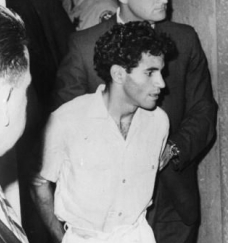
The aggrieved Palestinian was not marked by fate to suffer that last extremity of the law, however; instead, his sentence was commuted to life imprisonment when all existing death penalty statutes were invalidated in 1972.*
As a result, Sirhan Sirhan remains alive as of this writing, serving that sentence in the Golden State’s Pleasant Valley State Prison. He’ll be next up for parole in 2011.
(In a parole appeal back in 1982 — he’s been on a bit of a losing streak — the convicted assassin had the chutzpah to complain that “if Robert Kennedy were alive today, I believe he would not countenance singling me out for this kind of treatment.”)
Although the guy was seen in a crowded room pulling the trigger (onlookers tackled him) and he subsequently confessed to the deed, there has long been a conspiratorial counternarrative suggesting that other shooters were there, too. It’s pretty hard to say that the guy who emptied his chamber in front of dozens of witnesses wasn’t involved, but there are versions of this where he’s a Manchurian Candidate-style hypnotized patsy.
Politics: much more interesting in the 1960s.
Precisely because that is so, this particular man’s crime attracts retrospective interest for what followed: the charismatic Democratic frontrunner from Camelot cut down; the sinister Richard Nixon arising in his place to bomb Cambodia, burgle Watergate, and create the Environmental Protection Agency. Sirhan Sirhan “assassinated modern U.S. history.”
Sirhan Sirhan himself has contributed to the trippy theorizing about his case by being all over the map on it. At one point, he attempted to plead guilty and draw the death penalty; the trial judge forced him to go through with a defense. Subsequently, as noted, he’s whinged for an early release. He’s claimed to have had no memory of the attack, which certainly isn’t what he said after he got arrested.
Ultimately, the most self-evident explanation has always been the first one that he offered: “I did it for my country.”
Kennedy was a strong advocate of that policy, and his death happened to coincide with the anniversary of war.
Maybe that’s just what they want you to think. But it has to be allowed that the cause in question has claimed more lives than just RFK’s.
* People v. Anderson, decided by the California Supreme Court. Later that same year, the U.S. Supreme Court would issue Furman v. Georgia, which would have had the same effect for Sirhan Sirhan.
Expect to not live long after you deal the final fatal blow to a royal personage.
A boy, Pierre Basile, was executed on this date in 1199 for shooting King Richard the Lionhearted* with an arrow expelled from his crossbow.
The wound wasn’t fatal to Richard I; the gangrene was. (French page) Although the king pardoned the boy for the shot before dying, Richard’s right hand man, French Provencal warrior Mercadier, would hear none of it. After the king’s death, Mercadier stormed Chateau de Chalus-Chabrol, defended weakly by Basile, then flayed him alive before hanging him.
Little is known of the boy defender. Also known as Bertran de Gurdun and John Sabroz (the various names suggest we’ll never know his real name), Basile was one of only two knights defending the castle against the king’s siege.
This castle protected the southern approach to Limoges and was betwixt routes from Paris and Spain and the Mediterranean Sea and the Atlantic Ocean. The English army openly mocked its defenses as the siege continued. The ramparts were cobbled together with makeshift armor. A shield was constructed out of a frying pan.
Knowing the castle would fall sooner than later, the English were lax in their siege, though eager for the riches inside. (Supposedly within the castle walls was a treasure trove of Roman gold.)
Richard I, as feudal overlord, claimed it for himself and no boy knights were going to get in his way. The king had been in the area suppressing a revolt by Viscount Aimar V of Limoges. The viscount’s forces had been decimated by the king’s army. The riches for the win lay in the castle and Basile stood atop it.
It was early evening, March 25, 1199, when Richard walked around the castle perimeter without his chainmail on. Arrows had been shot from the ramparts by Basile but were paid little attention. The king applauded when one arrow was aimed at him. The next arrow fired struck the king in the left shoulder near the neck.
The king returned to the privacy of his tent to pull it out. He couldn’t. The surgeon Hoveden, Mercadier’s personal physician, was summoned. He removed the arrow, but not swiftly, or cleanly. Gangrene quickly set in. The king asked for the crossbowman. The boy, Basile, appeared before the stricken king, expecting to be executed on the spot. The boy spoke first, saying he had tried to kill Richard because the king had killed the boy’s father and two brothers.
“Live on,” the king replied, “and by my bounty behold the light of day.”
He ordered the boy set free and, further, sent him away with 100 shillings. Deliriously jubilant at the king’s decision, the boy quickly returned to the castle.
On April 6, in the arms of his mother, Richard I died. His remains were buried at the foot of the tower from which Basile shot the arrow.
And with the king died his chivalry towards Basile.
Mercadier, who had entered the king’s service in 1184 and fought in battles in Berry and Brittany, Flanders and Normandy, brought the castle’s defenders to a swift and punishing death.
Hanging the defenders, he took the boy and flayed him first — that is, he removed the boy’s skin while he was still alive. Then Pierre Basile was hung, and his body consigned in an unmarked grave.

 This wealthy roue (Danish Wikipedia page) was famous for his affairs innumerable.


 Most notable among the victims of what Colombian President Alvaro Uribe called
  During his abnormally protracted* (for the times) 12 years fighting death,
 I thought Chessman must be dead but no, there was another agonizing period during which he choked on the gas. And again. And then again. There was a long period, another deep gasp. At the fourth such straining, Chessman’s head lolled in a half circle, coming forward so that he faced downward with his chin almost touching his chest. This must be the end. But the dying went on.
 The aggrieved Palestinian was not marked by fate to suffer that last extremity of the law, however; instead, his sentence was commuted to life imprisonment when all existing death penalty statutes were invalidated in 1972.*

