Jesus of Nazareth, King of the Jews

Images of the Crucifixion



(Thanks to Jeffrey Fisher [jeffreyfisher at me.com] for the guest post.)

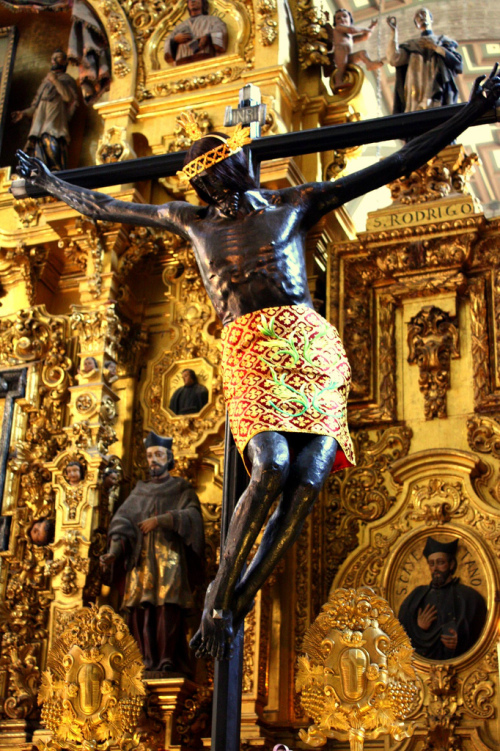
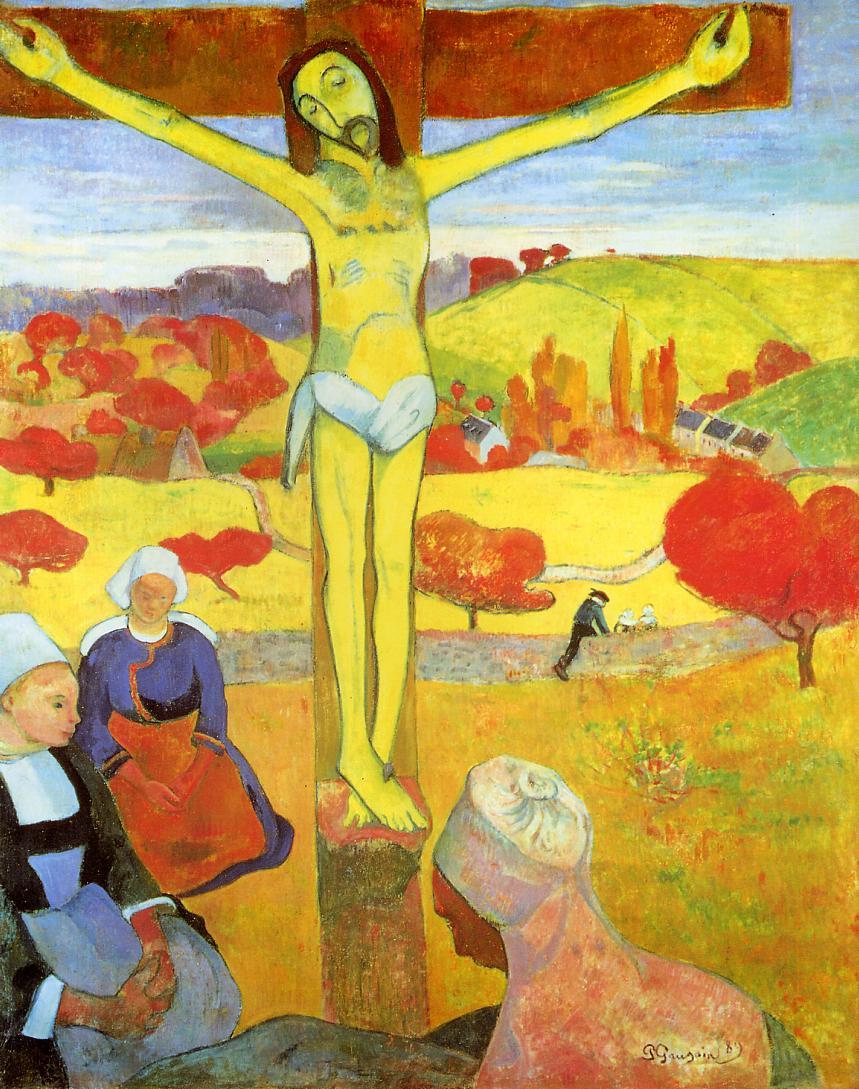
On Good Friday every year,* Christians around the world commemorate the death by crucifixion of Jesus of Nazareth, rabbi, prophet, Son of God, Son of Man, messiah, and all-around trouble-maker.

The truth is that very little is known of Jesus’ life and teachings from verifiable accounts, but this has not stopped generation after generation of Christians from telling his story, beginning with Jesus’ semi-official biographers, the evangelists of the New Testament. Almost everything we know about the life and teachings of the physical human being Jesus are in those writings, which do not portray him always in compatible ways, and which are almost entirely unconfirmed by any external source. The Roman historian Tacitus mentions (with disdain if not disgust) Jesus’ cult following, as does the Jewish historian and philosopher Josephus, but neither gives us anything to work with as historians (or, for that matter, as theologians). For the record, Suetonius and Pliny also talk about Christians, but these piecemeal sources tell us much more about Roman perceptions of Christians than about Christ and his teachings, or even necessarily Christian beliefs and practices.

What, then, can we reasonably say about Jesus?

It is almost impossible to find universal agreement around anything more than a few basics, including most importantly Jesus’ crucifixion. The Gospels narrate it; Paul the Apostle (who never met Jesus in the flesh, as it were) hangs his theology on it, together with the equally important resurrection; and no contemporary sources (Christian or otherwise) dispute it.

But it’s when we ask why Jesus was crucified that things start to get interesting.

What did he do? The two men he is traditionally said to have been crucified with are commonly understood to be “robbers,” but that they were common criminals is highly unlikely. Crucifixion is a horrible death designed to make a very public statement about the crucified, the sort of thing you use on gladiator-slave rebels like Spartacus, not on pickpockets and roustabouts. The Greek term used for these two men (lestai) is consistent with the description of the released Barabbas as one who had participated in rebellious activities, whose “criminality” was related to his revolutionary business. Moreover, the name “Barabbas” means literally “son of the father,” a purely symbolic and surely entirely fictional name, and that the people choose to have him released indicates their affinity for him as a thorn in the side of the Romans. He is thus contrasted with Jesus, the other son of the father, the peaceful (apocalyptic) revolutionary.

So Jesus would have been crucified as a political criminal, a rebel. This would make sense of accounts of his having been identified by the Romans as “Iesus Nazarenus Rex Iudaeorum”: “Jesus of Nazareth, King of the Jews.” Anyone claiming to be king (and “son of God” was a Jewish way of talking about the king of Israel recorded clearly in Psalm 2), would, if taken seriously, be understood as challenging Roman authority.

Insofar as Jesus seems to have been deliberately poking the Romans’ local running dogs, the Sadducees and the Temple priests, his seizure and termination were surely inevitable. If his teaching is as opposed to violence and unconcerned with “politics” as it seems to have been, it’s hard to believe the Romans would have noticed him without some prodding, this coming not from the “crowd,” but from the leadership (who in Mark and Matthew incite the crowd). Indeed, the priests and scribes look for ways to arrest him when the crowds are not around, because they fear a riot.

If we take the Gospel of Mark at all seriously, Jesus was preaching a new kingdom of God, an apocalyptic redemption of the people of the earth by God’s direct intervention (and with Jesus as the sacrificial pesach lamb). If we take the Gospel of Luke seriously, Jesus spoke in a classic prophetic mode, calling people — Jew and Gentile both — to care for the oppressed of the earth, the poor and the hungry and the helpless. Both Jesuses called for people to be better to each other, to love each other, and indeed to love each other when love was, according to common sense, the foolish thing.

Why would this get you executed?

Well, in itself, it wouldn’t. But the Gospel of Mark tells us of Jesus speaking with a man who realizes that all the animal sacrifices in the world don’t amount to a hill of beans (in that crazy world). When love counts more than sacrifice, we are undermining the Temple. When we go into the Temple, start knocking things over, and say it’s become about robbing the poor and not about loving God and one’s neighbor, we are undermining the Temple. And to undermine the Temple’s authority is also to undermine Rome’s authority, and Rome’s cash flow.

Jesus, like the Essenes he may or may not have associated with, was a purist.

The Temple was full of collaborators and exploiters, the kind seen before in the history of Israel (and berated by prophets like Isaiah and Amos), the kind hated also by the Dead Sea community of apocalyptic purists awaiting a final showdown between God and evil (i.e., the Roman Empire and their local potentates, the Temple authorities).

Jesus, like other Jewish prophets before him, thought that Judaism was about something. That it was somehow about justice and not just about following rules or waiting around for things to get better: that it was about our making the world a better place, and not just making our own lives better.

Start talking that way and get people on your side, and you’re fairly likely to get killed, even twenty centuries later.

* Though the actual date (even the year) of the execution marked by the movable feast of Good Friday is fundamentally unknowable, there are some present-day astronomer types who’d like to sell you April 3, 33 A.D.

On this day..

1843: 17 who drew the black beans

This date in 1843 was a good one to just stick with the guacamole.

Though the Republic of Texas (it would join the United States in 1846) had won its independence from Mexico a few years before, hostilities between the two continued.

Skirmishes in the frontierlands at length triggered a Texan reprisal-slash-plundering expedition.

The officially independent Somervell Expedition of volunteer Texan militiamen captured a couple of Mexican towns, then disbanded to go home. Those members of it optimistic about their chances for more raiding set off for Ciudad Mier* — the Mier Expedition.

Their optimism was misplaced.

The Mier Expedition was a flop, and the irate Mexican President Santa Anna ordered the entire band shot to make an example. Anglo diplomatic wrangling got him to go down to shooting one tenth of the band.

Well, you’ve gotta pick that tenth somehow.

The Black Bean Lottery

So on this day, 176 potentially condemned men were made to draw a bean from a pot containing 159 white ones and 17 fatal black ones.

For the lucky 159, there was no rush quite like winning your life from a legume, as this survivors’ account describes:

I knew then that I was safe, and the revulsion of feeling was so great and rapid that I can compare it to nothing except the sudden lifting of an immense weight from off one’s shoulders. I felt as light as a feather.

The 17 for whom the cosmos had ordained frijoles negros took a quick leave of their companions, and were shot in two batches. (Here is a thorough discussion of the entire affair.)

It was a typically dicey death by musketry, with lots of people requiring multiple volleys. One of the 17, one James Shepherd, even survived the execution altogether by playing dead. (He fled during the night, but was later recaptured and [successfully] re-shot.)

The most hated man (by the Mexicans), Ewen Cameron, pulled white, but Santa Anna thought better of letting him draw air and had him separately executed a month later. The rest of the lottery’s “winners” languished in prisons and work camps for more than a year of continued Texas-Mexico hostility, until they were amnestied and released in September 1844 — many destined to renew hostilities in the imminent Mexican-American War.

That survivor quoted above, William “Bigfoot” Wallace, was one of those re-enlistees. His colorful career with the Texas Rangers earned him a minor star in the firmament of Americana; he appears in Larry McMurty’s Lonesome Dove prequel Dead Man’s Walk … only in that version, he gets cinematically black-beaned at the big moment, as in this clip from the miniseries of the same title.

* The town is latterly famous as a key transit point for arms smuggling to Fidel Castro to supply the Cuban Revolution.

On this day..

1603: Not Tommaso Campanella

The wise were forced to live as the mad were accustomed, in order to shun death, such that the greatest lunatic now possesses the royal burdens. The wise now lived alone with their wisdom, behind closed doors, applauding only in public the others’ mad and twisted caprices.

-Tommaso Campanella

On this date in 1603, freaky-deaky Dominican philosopher Tommaso Campanella drew a life sentence — avoiding execution by dint of a painfully convincing performance of insanity.

Campanella had some problematically heterodox notions about the sun (namely, that it was going to consume the earth) and everything under it, and had had a recent scrape with the Inquisition.

What really got him in trouble was trucking with a Calabrian conspiracy to overthrow Spanish domination, apparently a product of the monk’s millenarian anticipation of a sort of proto-communist revolution.

Campanella was a strange guy, but this was quite a far-out plot.

As Joan Kelly-Gadol writes in this fine tome,

This took place, let it be noted, after he had written two works advocating a Papal monarchy for Italy and the world and two works promoting the interests of the Spanish Empire also in Italy and throughout the world.

Past performance is no guarantee of future returns. Once the conspiracy was betrayed,

Campanella was imprisoned … in the Castel Nuovo, one of the principal fortresses in which the Spaniards maintained a military garrison. He was arraigned before the civil tribunal for rebellion and before the ecclesiastical tribunal for heresy. His “examination” which began in January 1600 was gruesome. He claimed innocence in his first interrogation before the civil tribunal, was thrown into a dungeon, actually a cleft in the bedrock of the Castle, to remain there for seven days. Then followed torture. He “confessed,” admitting that he preached about the coming political upheaval but denying that he was part of a conspiracy to bring it about …

His desperation at this point can be gauged by the fact that by April of 1600 he began to feign madness. The ecclesiastical action against him began now, and he persisted in this attitude of insanity through three interrogations, including an hour of torture … On the fourth and fifth of June 1601, he was subjected to the cruel torture of “the vigil” to test whether his insanity was genuine. This was the usual torture of the rope, suspending the body of the victim by his tied hands over a blade which cut into his flesh whenever he yielded to the strain of holding himself in the air; but the vigil refined this cruelty by continuing it for forty hours. Campanella endured the ordeal without breaking.

And it wasn’t just a feat of toughness to beat the torturer at his own game, impressive as it is on those terms alone: Campanella pulled off a genius gambit exploiting the Inquisition’s own legal machinery to duck the separate capital charges he faced in civil and ecclesiastical court.

Joseph Scalzo’s “Campanella, Foucault, and Madness in Late-Sixteenth Century Italy”,* an academic paper that reads like a thriller, narrates Campanella’s “dangerous competition” with his persecutors.

In fine: on Easter Sunday 1600,** as he was approaching conviction and condemnation in his state trial for treason, Campanella began his insanity ploy, successfully forcing a delay in that case and initiating his separate church trial for heresy.

Then, by remaining stubbornly committed to what most of his examiners believed was a charade, Campanella won … by forcing them to inflict that juridically determinative 40-hour “vigil” torture.

the jurisprudence of the time accorded torture so much force, such as to annul all other proofs and “to purge circumstantial evidence”; if the torture had been vigorous and unusual. The accused came, all the more to avail himself of the result obtained, according to the scholarship of the criminologists most in vogue. Thus, Campanella had judicially to be regarded as insane, although everyone was persuaded that he probably simulated insanity. The consequence, in the tribunal of the Holy Office, was not indifferent: He was a “relapsed heretic,” and even if repentant, he would have been disgraced and consigned to the secular court of justice, which would have executed him; being mad, he could no longer suffer condemnation, and in the circumstance in which he might already have been condemned, he would have been spared the death penalty, to reason and repent.

(this is Scalzo’s quotation of Luigi Amabile, an Italian who wrote the book on Campanella; I have been unable to find the Amabile original online.)

Home free.

Having reached this judicial safe haven, Campanella soon — in fact, according to the man who tortured him, literally on the walk from the vigil back to his cell — resumed a recognizable rationality.

He’d languish in prison until 1626 (a few years after he got out, he had to flee to France), but he made the most of it. Campanella wrote his magnum opus, the utopian City of the Sun, while awaiting his sentence in 1602. A number of other works on a wide array of subjects — science, philosophy, theology, political governance (he returned to giving the Spanish empire supportive advice), a vigorous defense of Galileo — were also composed during his 27 years under lock and key.

Campanella’s visionary anticipation of radical egalitarianism would, like Thomas More‘s, help shape the utopian literary genre. But Campanella’s take, while still a theocratic one, lent itself to distinctly more subversive interpretation.†

For example, this Brezhnev-era Soviet essay‡ (unearthed and translated by Executed Today friend and sometime guest-blogger Sonechka) decants the Dominican’s heretical notions into Marxist orthodoxy.

How many times were the communists denounced by their enemies for this “commonality of wives”! Scientific communism, certainly, is not responsible for the figments of a monk like Campanella. But it is instructive to penetrate his logic. It is not commodification or dehumanization that hides behind Campanella’s “commonality of wives”. The women of the “City of Sun” have the same rights as men … The “commonality of women” is equivalent to the “commonality of men” on the basis of mutual equality. That is why, though [we are] decisively rejecting this type of family-free communism, it is necessary to consider who stands on the higher moral grounds — Campanella’s woman, alien to deceit and pretense, or a false bourgeois woman, whose lot in life is adultery and legalized prostitution.

Ultimately, this wild man not only got the high moral ground: he got to die in bed. Once in a while, we get a happy(ish) ending.

So although it actually has nothing to do with Tommaso, “La Campanella”“Little Bell”, a Paganini violin concerto — allows us here at this blog (in common with our day’s hero) an atypically soothing* denouement.

* Joseph Scalzo, “Campanella, Foucault, and Madness in Late-Sixteenth Century Italy”, The Sixteenth Century Journal, Vol. 21, No. 3 (Autumn, 1990)

** Campanella’s Easter 1600 madness was initiated only a few weeks after fellow intellectual omnivore Giordano Bruno was burned for heresy up the road in Rome. Strictly coincidence.

† Since so much of Campanella’s work was produced while the author was under duress — fighting capital charges, applying for clemency and release — it remains disputable just which parts of it can be taken to represent his real beliefs.

‡ L. Vorob’ev. “Utopija i dejstvitelnost”. (“Utopia and Reality”) in Utopicheskij roman XVI-XVII vekov (Utopian Novel of XVI-XVII century); Series “Biblioteka vsemirnoj literatury”, Khudozhestevnnaja literature, Moscow, 1971, p. 19.

On this day..

2008: Nine hanged in Iran

Iran has been dinged for ramping up its execution pace in the wake of its mid-2009 crisis of political authority. (Like this, just yesterday.)

There might well be something to that, but Iran’s “baseline” starting point for any such escalation is already pretty high, and had already been trending up.

It was in that spirit at dawn this day last year that Tehran’s Evin Prison conducted a mass hanging of eight men and one woman, with a tenth potential victim spared at the last moment only due to the absence of his family.

All were executed for homicide, including the woman, one “Tayyabeh”, who insisted that she was tortured into confessing to burying her 8-year-old stepdaughter alive.

On this day..

1781: The slaves of the Zong, for the insurance

Beginning this day in 1781, the captain of the slave ship Zong began throwing his cargo overboard in a still-notorious case combining the horrors of the Middle Passage with the cruel rapacity of capital.

The Liverpool-based ship was en route from Africa to Jamaica, there to exchange its human chattel for New World produce bound for the European market.

Characteristically for slave ships, it was inhumanly packed: more economical for a slaver to overcrowd its captives and write off the ones who died than to maximize slaves’ chances of survival. And on this particular ship, malnutrition and disease claimed more than 60 slaves (as well as seven crew members).


Underwater sculpture off Grenada commemorating slaves thrown overboard during the Middle Passage.

With many more in danger of expiring, Captain Luke Collingwood reasoned that the cargo would be a loss if it succumbed, but that shippers’ insurance would reimburse the firm “when slaves are killed, or thrown into thrown into the sea in order to quell an insurrection.” Over a three-day span beginning Nov. 29, 1781, Collingwood had 133 still-living but sick slaves cast overboard;* “the last ten victims sprang disdainfully from the grasp of their executioners, and leaped into the sea triumphantly embracing death.” (Source)

This gave the ship’s owners — the good captain himself was not among them — the chance to attempt an insurance scam.

This historical-philosophical book (review, a pdf) analyzes the Zong affair as the emblematic “inauguration of a long twentieth century underwritten by the development of an Atlantic cycle of capital accumulation.”

When the Zong landed having lost in total more than half of its original 440 slaves (and Collingwood himself, that fastidious servant of his shareholders), its owners did indeed attempt to recoup the many who had been intentionally killed. Smelling fraud, the insurer refused to pay.

There followed the signal case of Gregson v. Gilbert, a dry insurance trial that also became a beacon of the slave system’s blood-chilling jurisprudential logic.

After a jury sided with the claimant shippers against the insurers, the matter hit a wide public on appeal before Lord Chief Justice Mansfield when abolitionist activists Granville Sharp and Olaudah Equiano seized upon its conscience-shocking quality.

While Sharp and Equiano agitated unavailingly for a homicide investigation, the insurer — which was itself in the very same business of human bondage as the shipper — self-righteously posed “as counsel for millions of mankind, and the cause of humanity in general.” (Source) Its interests, after all, would be served by the least possible indemnity for slaves murdered in passage.

Solicitor-General John Lee — “the learned advocate for Liverpool iniquity,” in Sharp’s estimation — successfully insisted upon limiting the case to its commercial considerations.

What is this claim that human people have been thrown overboard? This is a case of chattels or goods. Blacks are goods and property; it is madness to accuse these well serving honourable men of murder. They acted out of necessity and in the most appropriate manner for the cause. The late Captain Collingwood acted in the interest of his ship to protect the safety of his crew. To question the judgment of an experienced, well-travelled captain held in the highest regard is one of folly, especially when talking of slaves. The case is the same as if horses had been thrown overboard. (Quoted here; Wikipedia has it “as if wood had been thrown overboard.”)

Lord Mansfield agreed, “(though it shocks one very much) that the case of slaves was the same as … horses,” and simply found with the insurers that no liability attached them since the killings were voluntary rather than necessary.

Nobody was ever prosecuted.


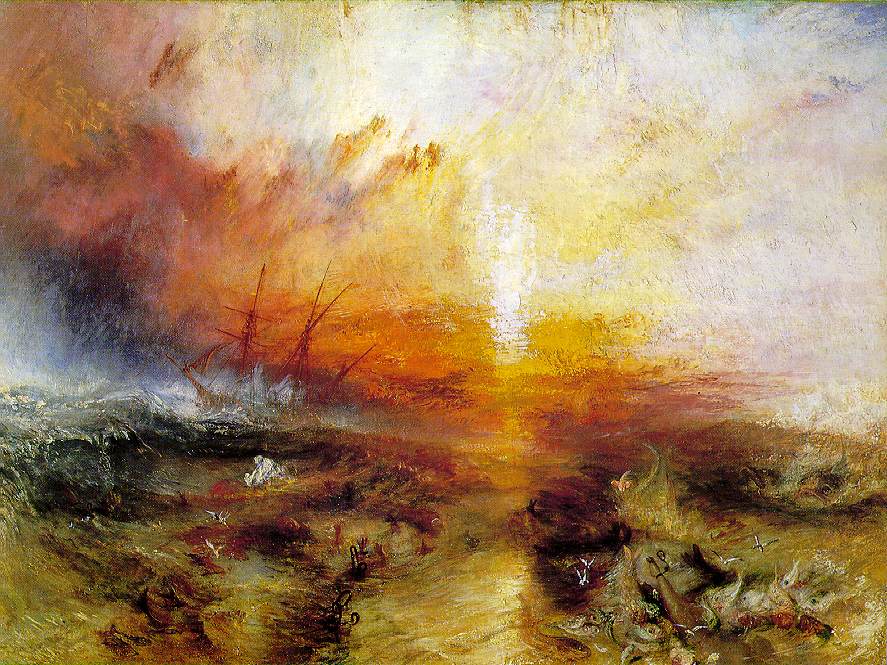
The disturbing 1840 Turner seascape “Slavers throwing overboard the Dead and Dying – Typon [sic] coming on”, also known simply as “The Slave Ship”, is widely thought to have been inspired by the Zong episode. The allusion would have been well-known to his contemporaries.

* One of the 133 survived by climbing back aboard the ship.

On this day..

1946: The Nuremberg Trial War Criminals

Victor’s justice was never better served than this date in 1946, when the brass of Third Reich hung for crimes against humanity during the late World War II.

[audio:http://www.stelzriede.com/ms/mus/nuremexe.mp3]

(From this page of original period audio files.)

The landmark legal proceeding* is covered well enough in many other sources for this humble venue to break new ground.

Apart from trailblazing international law, the trial was notable for the gut-punching film of German atrocities; this relatively novel piece of evidence is available for perusal thanks to the magic of the Internet. Caution: Strong stuff. An hour’s worth of Nazi atrocities.The climactic hangings in the predawn hours this day in Nuremberg were conducted by an American hangman who used the American standard drop rather than the British table calibrated for efficacious neck-snapping. As a result, at least some hangings were botched strangulation jobs, a circumstance which has occasionally attracted charges of intentional barbarism.

Media eyewitness Kingsbury Smith’s taut report of the night’s executions (well worth the full read) described just such an ugly end for propagandist Julius Streicher.

At that instant the trap opened with a loud bang. He went down kicking. When the rope snapped taut with the body swinging wildly, groans could be heard from within the concealed interior of the scaffold. Finally, the hangman, who had descended from the gallows platform, lifted the black canvas curtain and went inside. Something happened that put a stop to the groans and brought the rope to a standstill. After it was over I was not in the mood to ask what he did, but I assume that he grabbed the swinging body of and pulled down on it. We were all of the opinion that Streicher had strangled.

There were in all 12 condemned to death at Nuremberg; all hanged this day except Martin Bormann (condemned in absentia; it was only years later that his death during the Nazi regime’s 1945 Gotterdammerung was established) and Hermann Goering (who cheated the executioner with a cyanide capsule two hours before hanging). The ten to die this day were:

* Its resultant Nuremberg Principles comprise a lofty articulation of principles whose actual application, as Noam Chomsky has observed, would have meant that “every post-war American president would have been hanged.”

On this day..

1788: William “Deacon” Brodie, Dr. Jekyll and Mr. Hyde inspiration

On this date in 1788, the real-life Dr. Jekyll and Mr. Hyde was hanged at Edinburgh.


The Execution of Deacon Brodie, by Alexander Hay Ritchie.

William Brodie, respectable burgher by day, Deacon of the Guild of Wrights, wasn’t the type for the gallows. Actually, the upright citizen is said to have proposed an improvement in the old Tolbooth gallows, replacing the old-school ladders with a forward-thinking drop mechanism.

“Brodie,” says Traditions of Edinburgh, “was the first who proved the excellence of [the] improvement … He inspected the thing with a professional air, and seemed to view the result of his ingenuity with a smile of satisfaction.”*

Insouciance in the face of mortality … but Brodie had plenty of practice in compartmentalization.

With a gambling habit, a couple of mistresses, and five kids, Brodie the oleaginous society man had a double life, or treble, or more. By and by, the well-known tendency of such profligate pastimes to lead a man to venture his neck in order to keep up appearances worked its will upon Brodie, who began using his contracts with Edinburgh’s upper crust to case their houses and copy their keys … returning at night to burgle his employers.

It was taking on partners that did in the budding master thief; inevitably, someone flipped to dodge the gallows himself. Brodie’s cover was blown, and he hanged with his confederate George Smith, keeping up appearances to the very end.

A century later, native Edinburgher Robert Louis Stevenson would tap this extraordinary local history (and maybe some similar predecessors) as inspiration for that classic novelistic exploration of the soul’s duality, The Strange Case of Dr. Jekyll and Mr. Hyde.

In fact, prior to that work’s 1886 publication, Stevenson (who grew up with Brodie furniture in the house) co-wrote a play called Deacon Brodie, or The Double Life.

That earlier composition hasn’t been entrusted to celluloid, to my knowledge (though there is a Deacon Brodie film of recent vintage). But Jekyll and Hyde has been.

Brodie’s striking case does not live on only through his literary doppleganger(s); you can enjoy the company of the hanged criminal to this day on Edinburgh’s Royal Mile at Deacon Brodie’s Tavern.

Brodie himself is supposed to have made his own bid to live on by surviving the hanging. William Roughead in Classic Crimes describes these machinations whose generally attested failure is now and again disputed anew.

Of the plans, various and futile, formed for the resuscitation of the Deacon there are two contemporary and competing versions. One is that the hangman was bribed to tamper with the rope, so as to give a short fall and avoid dislocation of the vertebrae. But by an excess of caution that officer first made it too short and then too long. The body, when cut down, was placed in a cart and driven furiously round the back of the Castle to the Deacon’s woodyard at the foot of Brodie’s Close, so that animation might be restored as in the historic case of “half-hangit Maggie Dickson,” a lady whose departed spirit was recalled by similar Jehu methods. In his own workshop his veins were opened by a French surgeon, whose services had been retained to that end; but all the resources of science could not bring the Deacon back to life. According to another account, he had, before leaving his cell for the last time, been supplied with a small silver tube for insertion in his throat at the final ceremony in order to prevent suffocation, and wires were carried down both his sides from head to foot to counteract the jerk of the fall. In spite of these precautions and of subsequent bleeding by a surgeon, his friends had reluctantly to admit that “Brodie was fairly gone.”

* This “tradition” of Edinburgh is kin to a folkloric subgenre and should not at all be presumed dependable. Roughead:

Of the many picturesque legends of old Edinburgh which, in defiance of truth, cling like ivy about her vanished past, one of the most persistent is that Deacon Brodie was the first to suffer upon the new drop which he himself designed. This myth, upon research, I found myself reluctantly compelled to disprove. He may have planned the “moveable platform for the execution of criminals,” which the Town Council caused to be erected in 1786 at the west end of the Tolbooth; but it was certainly not of his construction, nor was he the first to benefit by its ingenuity. The place of execution was the roof of a low building which projected from the west gable of the prison — roughly where the Buccleuch statue now stands. A beam was drawn out from an aperture in the wall above the platform and from this depended the fatal rope.

On this day..

1972: Mohamed Oufkir

When last we met Mohamed Oufkir in these pages, he was violently suppressing an attempted coup against Morocco’s King Hassan II.

Mohamed Oufkir’s wife and six children were “disappeared” to a desert prison, not to emerge for 18 years. Daughter Malika, a royal favorite in happier times, wrote Stolen Lives about that ordeal. (Interview | Another)

We find him today, 13 months later as the arrow of time flies, in the same story — on the other end of the gun-barrel.

At around 4 o’clock this afternoon, a stunning attempt on the monarch took place as he flew back to Morocco from France. The king’s 727 was attacked by F-5 fighters of the Moroccan Air Force, surviving, it is said, when the quick-thinking king himself took the radio, pretended to be a flight engineer, and informed the attacking fighters that the pilots were dead and the king mortally wounded.

The ruse tricked the attacking pilots into allowing the crippled plane to make its landing in Rabat; they returned too late to strafe the airfield when they realized their mistake.

This quashed coup was swiftly laid at the door of Oufkir, the powerful Defence Minister.

Oufkir was declared to have committed suicide late this night, or else in the small hours of August 17; this still-standing official explanation has always had its doubters, with more extravagant versions implicating the offended sovereign himself in dealing out the punishment. Probably not, but here’s foreign correspondent Stephen O. Douglas’s reconstruction in Morocco Under King Hassan:

[Interior Minister Mohamed] Benhima said that when Oufkir arrived at the Skhirat palace at 11 p.m. he was met in an anteroom by General Mawlay Hafid and Colonel Dlimi, and when he realised that the king knew he had masterminded the plot he pulled out a revolver saying, ‘I know what to expect.’ Benhima added, ‘The two witnesses tried to stop him. In the struggle he fired three shots, one wounding him in the chest, the second I don’t know where, but the third was the most fatal.’ He said this was ‘the truthful and authentic version’.

‘General Oufkir committed suicide. He was not killed. It has been asked if it was a suicide of loyalty or a suicide of treason. Well then, I am authorised to tell you, to certify that since 1 p.m. today, and considering the elements of inquiry we have in our possession, I can affirm that it was a suicide of treason and not a suicide of loyalty,’ Benhima said.

Later at the same news conference, Benhima indicated he was just as astonished as most of the journalists. He said he and Oufkir were ‘great friends. We appreciated each other very much and had confidence in each other. We had a common denominator: our loyalty, and I think we wore the same decoration, given to us on the same day for the same reasons. He was a great patriot, a great minister. As I just told one of your colleagues, I cannot figure how he could have done what he did. But he is one of the most attractive people I have known, and what I have said about him today is painful to me, but the truth had to be told.’

I learned later that during the fatal night a military ambulance took Oufkir’s blood-stained body back to his Souissi house where it was placed on the floor of a playroom. His wife Fatima was away on vacation on the Mediterranean coast and there were very few people in the house. They found Oufkir had four bullet wounds, three in the back and the fourth having gone through the nape of his neck and out through his left eye, shattering his glasses, the coup de grace. Suddenly someone decided it was a mistake to send the corpse back to his family and it was hastily retrieved the same night. Thus evidence that he may have been ‘suicided’ disappeared.

Hassan somehow escaped the day with his crown, but with two attempts to overthrow him over the previous 13 months and a need to purge the many unreliable Oufkir loyalists in the armed forces — well, as the London Times put it (Aug. 22, 1972), “short of his incredible good fortune there is little else that can be cited in real terms to guarantee the perpetuation of his rule.” You could have made good coin wagering informed observers of the time that Hassan would live and reign another 27 years and be internationally saluted at his peaceful death at age 70.

On this day..

1997: Zoleykhah Kadkhoda survives stoning

On this date in 1997, Zoleykhah Kadkhoda was tried, condemned, and immediately stoned in the West Azerbaijan (Iran) city of Bukan.

Less commonly used but still to this day among the execution methods in Iran, stoning involves burying the victim in a hole — a man to his waist, a woman to her chest — and pelting him or her with rocks until dead. Plainly a horrible way to go, stoning is typically associated with adultery, which was Kadkhoda’s crime.

Kadkhoda made international headlines by surviving her attempted execution, either (accounts differ) because of popular intervention in the heavily Kurdish town, or by reviving at the morgue after being taken for dead.

International pressure caused the death sentence to be lifted; Kadkhoda was released later in that year.

On this day..

1795: The last Montagnards

On this date in 1795, the Mountain that had so recently dominated revolutionary France was destroyed by the blade.

This largely forgotten date is actually a significant milestone of those years’ imbroglio: the date on which the French bourgeoisie achieved its revolution by slaying the last sans-culottes-affiliated deputies in punishment for the last sans-culottes uprising.

In the year since the fall of Robespierre, a White Terror had purged his former adherents — or in class terms, had put Madame Guillotine to work pushing the Paris working class out of its former political authority.

The latter’s last hurrah of resistance was the Prairal Rebellion of May 20, 1795, when a mob stormed the Convention.

In the florid narration of Thomas Carlyle,

[I]t billows free through all Corridors; within and without, far as the eye reaches, nothing but Bedlam, and the great Deep broken loose! … Insurrection rages; rolls its drums; will read its Paper of Grievances, will have this decreed, will have that.

… National Representation, deluged with black Sansculottism, glides out; for help elsewhere, for safety elsewhere; here is no help.

About four in the afternoon, there remain hardly more than some Sixty Members: mere friends, or even secret leaders; a remnant of the Mountain-crest, held in silence by Thermidorian thraldom. Now is the time for them; now or never let them descend, and speak! They descend, these Sixty, invited by Sansculottism: Romme of the New Calendar, Ruhl of the Sacred Phial, Goujon, Duquesnoy, Soubrany, and the rest. Glad Sansculottism forms a ring for them; Romme takes the President’s chair; they begin resolving and decreeing. Fast enough now comes Decree after Decree, in alternate brief strains, or strophe and antistrophe, — what will cheapen bread, what will awaken the dormant lion. And at every new decree,* Sansculottism shouts “Decreed, decreed!” and rolls its drums.

Fast enough; the work of months in hours, — when see, a Figure enters … And then Gilt Youth, with levelled bayonets, countenances screwed to the sticking-place! Tramp, tramp, with bayonets gleaming in the lamp-light: what can one do, worn down with long riot, grown heartless, dark, hungry, but roll back, but rush back, and escape who can? The very windows need to be thrown up, that Sansculottism may escape fast enough. Money-changer Sections and Gilt Youth sweep them forth, with steel besom, far into the depths of Saint-Antoine. Triumph once more! The Decrees of that Sixty are not so much as rescinded; they are declared null and non-extant. Romme, Ruhl, Goujon and the ringleaders, some thirteen in all, are decreed Accused. Permanent-session ends at three in the morning. Sansculottism, once more flung resupine, lies sprawling; sprawling its last.

The so-called Cretois were hailed before a tribunal; six were condemned to death on this date.**

They dramatically attempted to cheat the headsman by stabbing themselves after the trial, somehow passing down the line without intervention a single knife smuggled by Goujon.

Three of them died of their self-inflicted injuries. The other three went immediately to the guillotine.

“They were,” Carlyle concludes, “the Ultimi Romanorum … Sansculottism sprawls no more. The dormant lion has become a dead one; and now, as we see, any hoof may smite him.”

* According to A Popular History of France from the First Revolution to the Present Time, one of the decrees was abolition of the death penalty “except in the case of emigrants and forgers of assignats.”

** Other less treasonably culpable former Montagnards who had not cast their lot squarely with the Thermidorians were proscribed or otherwise cut off from power in the aftermath of the Prairal rebellion.

On this day..