1864: Klatsassin and four fellow Tsilhqot’ins

On this date in 1864, five Tsilhqot’in warriors were hanged as common criminals in Quesnel, British Columbia, for resisting white incursion during the Chilcotin War.

The only possibly authentic image of Klatsassin extant. (From this image archive.)

An indigenous nation in northern B.C., the Tsilhqot’in or Chilcotin* had been relatively insulated — though not completely isolated; they had well-established fur-trading contacts from the early 19th century — from the colonization that had swept the continent over the preceding centuries.

In 1862, two cataclysms turned that world upside down.

First, a smallpox epidemic sweeping out of mining camps decimated the Tsilhqot’in population.

Second, gold was discovered in the adjacent inland Cariboo region — and the ensuing gold rush to the inaccessible vein saw whites laying multiple roads through Tsilhqot’in territory. At least one of the entrepreneurs racing to complete the first road might have exploited tribal labor and forced women into prostitution.

The specific internal mechanisms and deliberations that triggered the response are lost to us, but the community must have felt itself under siege — and certainly the building projects, unchecked, would serve to project crown authority into the tribal land. The roads, too, are a specific trigger in the European encounter with North American natives. If it had not been gold, it would have been something else, and soon.

The Chilcotin War or Chilcotin Uprising erupted in April 1864 when a Tsilhqot’in party slew a civilian road-building crew. Bloodthirsty rumors (sometimes unreliable) of Indian atrocities quickly set abroad in the colonial capitals.

Despite almost limitless land to disappear into, the leader, Klatsassin (or Klattasine, or Klatsassan), was captured that August with seven of his followers by the expedient of luring him under assurance that they would be treated as prisoners of war.

Instead, they were tried as common murderers. Five were condemned — including both Klatsassin and his son. (Two others were arrested the following year, and one of them hanged as well.)

In 1993, the government of British Columbia apologized for the executions.

There’s an out-of-print (but available used) book, The Chilcotin War by a descendant of one of the whites killed in it. Several links in this piece go to the excellent canadianmysteries.ca site on this incident, which contains a trove of text from primary documents of the time.

And “Canadian Mysteries” is the apt title. “Klatsassin,” in the native tongue, simply means, “we do not know his name.”


The peak in the center of this photograph is “Mount Klattasine,” and the glacier stretching towards the upper right is also named for the hanged war chief.

* Many other transliterations are possible: e.g., Tsilqut’in, T?inlhqot’in, Chilkhodin, Tsilkótin, Tsilkotin.

On this day..

1865: Champ Ferguson, Confederate guerrilla

On this date in 1865, Champ Ferguson was controversially hanged at Nashville for the “murders” he committed as a Confederate guerrilla.

There seems to be some slight difference of opinion (and do click that link) over Champ‘s role in the War Between the States.

Had the Confederate cause prevailed, he probably would have been a hero. Since history is written by the winners … here he is instead.

For reasons that lie in the uncertain junction between personal enmity and sectional loyalty, the war’s start saw Ferguson terrorizing Union supporters in the Kentucky-Tennessee borderlands, operating primarily around Sparta, Tenn.

These were not only state borders, but borders between the rival federal and Confederate territories. Civil War borders, obviously, were hazy and violently contested affairs: Kentucky was northern-controlled but claimed by both sides (it had rival governments); Tennessee seceded only after Fort Sumter.

Loyalties within Kentucky and Tennessee were divided as well. Ferguson’s own brother died fighting for the Union, and his cousin was killed by Ferguson’s own men. But the main battles were fought far away, leaving the conflict to play out locally.

In many cases … guerrillas identifying with the Confederacy operated well outside Confederate lines and Confederate control, leading to a certain ambiguity in official attitudes, since they did have their uses.

Guerrilla activity was … a feature of those up-country or back-country areas of states like North Carolina, Georgia, Alabama, Tennessee and Kentucky, in which there were significant internal divisions in terms of sympathy for Confederacy or Union … guerrilla conflict was the only direct face of war experienced by many in Tennessee and Kentucky, since the movements of the main armies remained distant from them throughout. Unionist guerrillas, for example, controlled many of the counties of eastern Tennessee, while Confederate guerrillas disputed Union control of western Kentucky and middle Tennessee. One of the ironies of the situation in the Appalachians, the Cumberlands and the Ozarks was that, while these areas of rugged terrain were favoured by Confederate guerrillas, they were also the very areas within the Confederacy which most Union sympathisers inhabited

-Ian Beckett, Modern Insurgencies and Counter-Insurgencies

That was Ferguson — a “legendary Confederate partisan and guerrilla” or little better than a bandit, depending on your point of view. Either way, he was feared by area Unionists and renowned for killing prisoners. Stories of his savagery — severing heads and the like — made the rounds. Ferguson would argue (and did) that he did nothing his enemies weren’t also doing. (The New York Times printed a lengthy account (.pdf) of Ferguson’s versions of the many killings he was accused of — disputing some, frankly acknowledging many.)

That brings us back to winners and losers.

Ferguson, of course, got the losers’ treatment after the war; while vendettas against rank and file Confederate officers were not on the agenda, Ferguson’s irregular status and unbecoming reputation set him up for a war crimes trial. All attempts to claim wartime protections were rejected.

The Times account of his hanging this day — witnessed by his wife and 16-year-old daughter; their alleged rape is sometimes given as the reason for Ferguson’s campaign — is picturesque. (.pdf)

He stood composedly on the drop some twenty minutes, while the charges, specifications and sentence were read by Col. Shafter. He nodded recognition to several persons in the crowd, and shifted his position in an impatient manner while the sentence was being read. To some specifications he inclined his head in assent. To others he shook his head. That about Elam Huddleston caused him to say, “I can tell it better than that.” When the speaker read, “To all of which the prisoner pleads not guilty,” he said, “I don’t now.”


An 1865 Harper’s illustration of the hanging. See the way the troops surround the scaffold? There’s a bit of folklore that the military did that in order to fake the hanging and cut him down still alive.

Along with Henry Wirz, commandant of the notorious Confederate prison Andersonville, Ferguson was the only Confederate executed for Civil War “war crimes.”

Arguably somewhat neglected as a Civil War figure, Ferguson still has a few books detailing his life. An interview with the a author of the newly-published Cumberland Blood: Champ Ferguson’s Civil War is here.

A few books about Champ Ferguson

On this day..

1660: Major-General Thomas Harrison, the first of the regicides

On this date in 1660, the restored House of Stuart began a week of bloody justice against Charles I‘s regicides by hanging, drawing and quartering Thomas Harrison at Charing Cross.

Stuart Little

Charles’ son and heir Charles II had been stuck on the continent during the 1650’s, until the Commonwealth came apart from its own internal contradictions after the death of Oliver Cromwell.

With anarchy looming, suddenly monarchy didn’t look so bad — and Charles II had a way back into the saddle.

Beheads I Win …

The first thing on everyone’s mind was what to do about the little matter of having lopped off his dad’s head.

Political reality drove the settlement: nearly everyone in the English gentry had in some manner acquiesced to the Commonwealth during its decade-plus turn steering the ship of state; an expansive line on treason would be a nonstarter. At the same time, His Soon-To-Be-Royal-Again Majesty expected a few examples made to do right by the old man and keep king-killing well off his future subjects’ agenda.

Result: the Indemnity and Oblivion Act, granting a free pardon to all supporters of the Commonwealth save a handful of those most directly implicated in Charles I’s execution.

Weeks of frantic negotiating between the parties and private settlements of borderline cases with the royalist camp preceded the action. But Thomas Harrison wasn’t part of any of it.

… Entrails you Lose.

The rigid Puritan, one of 59 who signed the last king’s death warrant and at one time the commander of England’s armies, had been on the outs with everyone since Cromwell set up the Protectorate in 1653. Godly Tom was a “Fifth Monarchist,” anticipating the imminent return of Christ perhaps in conjunction with the imminent year 1666 … and no government felt safe about these millenarians. He’d been imprisoned several times by the Protectorate, too.

Though many attainted regicides fled for Europe or America, Harrison (possibly motivated by age and infirmity) hung out, waited for arrest, and took his punishment stolidly.

God hath covered my head many times in the day of Battle. By God I have leaped over a wall, by God I have runned through a Troop, and by my God I will go through this death.

Specifically meaning, drawn on a hurdle from Newgate to Charing Cross (with a fine vantage for the doomed on Whitehall, where Charles I had met his end), hanged but revived, his genitalia cut off and bowels carved out and burned while still conscious, and finally beheaded and his body divided into quarters for gruesome public display around town.

You have selected regicide.

Harrison died on a Saturday, and his was the opening act of a busy week in the bowel-burning business; nine other fellow regicides condemned with him would share that fate during the week ahead:

  • John Carew, on Monday the 15th;
  • John Cook and Hugh Peters, on Tuesday the 16th;
  • Thomas Scot, Gregory Clemen, Adrian Scroop and John Jones, on Wednesday the 17th;
  • Francis Hacker and Daniel Axtel, on Friday the 19th.

Harrison was chosen as the first partly, perhaps, because the Fifth Monarchists were (justifiably) considered a still-extant menace, and partly because, as one account had it,

[h]e was a fierce and bloody enthusiast. And it was believed, that, while the army was in doubt, whether it was fitter to kill the king privately, or to bring him to an open trial, that he offered, if a private way was settled on, to be the man that should do it. So he was begun with. But, however reasonable this might be in itself, it had a very ill effect: for he was a man of great heat and resolution, fixed in his principles, and so persuaded of them, that he never looked after any interests of his own, but had opposed Cromwell when he set up for himself. He went through all the indignities and severities of his execution, in which the letter of the law in cases of treason was punctually observed, with a calmness or rather a cheerfulness that astonished the spectators.

“As cheerful as any man could do in that condition”

And this coda is attested by the age’s famous diarist, Samuel Pepys, whose neat and oft-quoted summation of Harrison’s fate runs thus:

I went out to Charing Cross, to see Major-General Harrison hanged, drawn, and quartered; which was done there, he looking as cheerful as any man could do in that condition … Thus it was my chance to see the King beheaded at White Hall, and to see the first blood shed in revenge for the blood of the King at Charing Cross.

Who overcomes by force hath overcome but half his foe

As might be expected, vindicated royalists sought more blood than the handful of exemplars could furnish. What compromise could expiate the sin of regicide?

Poet and polemicist John Milton, having been propagandist-in-chief for the now-abortive revolution, endured the jeers of his enemies for the conspicuously apolitical stuff (a grammar book!) by which he would set his table in the years ahead.

Upon John Milton’s not suffering for his traiterous Book when the Tryers were executed, 1660.

That thou escaped’st that vengeance, which o’ertook,
Milton, thy regicides, and thy own book,
Was clemency in Charles beyond compare:
And yet thy doom doth prove more grievous far.
Old, sickly, poor, stark blind, thou writest for bread:
So for to live thoud’st call Salmasius from the dead.

(Claudius Salmasius was a French intellectual whose defense of the Stuart royal rights had been savaged by Milton during the Protectorate.)

It’s thanks to the Indemnity and Oblivion Act’s not sending Milton the way of General Harrison that we have Paradise Lost.

On this day..

1915: Nurse Edith Cavell, “patriotism is not enough”

Early this morning in 1915, the German military occupying Belgium shot aid worker Edith Cavell at Brussels for aiding the British war effort.

The matronly nurse had been condemned only the day before by a German military court for helping Allied soldiers escape from behind German lines — charges Cavell readily admitted. The British chaplain who attended her the night before her death reported her saying (not actually her last words, but recalled as her parting sentiment, as it were):

But this I would say, standing as I do in view of God and eternity, I realize that patriotism is not enough. I must have no hatred or bitterness toward any one.

So naturally, she immediately became the Entente’s bloody banner of the barbarous Hun, helping dramatically ramp up recruitment for the other team’s set of moral cretins.

The thing is, the Germans actually had a point. Cavell ran a nursing school in Brussels, and courageously stuck around when the Germans smashed through Belgium as World War I opened. She’s sometimes remembered as getting in hot water for treating the wounded regardless of nationality, but she did a lot more than that: she got involved with an underground railroad funneling Allied soldiers back to enemy countries.

It was one of those impossible trials of conscience that wartime brings: Cavell, whose hospital was subsumed by the Red Cross during the war, should technically have remained neutral; her actions did bring material aid to Germany’s foes.

However, Belgian, French and English troops caught behind lines by the Germans’ lightning advance were in danger themselves of summary execution, as were civilians who harbored them. Neutrally treating them and handing them over as POWs might have been tantamount to killing many of them, especially in the first few months of the war. Though Edith Cavell said that “I am happy to die for my country,” her actions look more humanitarian than nationalistic — the best choice to be made when no good ones are available. Patriotism of a higher order, if you like.

Probably Cavell’s was a case tailor-made for executive clemency, but Germany was keen to send one of those proverbial messages: civilians in occupied countries had best stay out of the war. Despite the frantic lobbying of England’s ambassadors (and, ominously for Germany, those of the United States), the sentence was carried out on both Cavell and a fellow-traveler in her network, Belgian Philippe Baucq.

Clumsy propagandists, the Kaiser’s boys badly misjudged the message so sent.

In the face of intense international outcry, Germany soon found itself defending its actions (.pdf), and then commuting the sentences (.pdf again) of Cavell’s other collaborators.

None of this abated Cavell’s stupendous propaganda value to Germany’s enemies. And — holy wow, the graying 49-year-old gets made over into quite the heartbreaker in most of these.

The nurse’s repute — and she was said to have struck a Joan of Arc-like chord in those parts — caused a renaissance for the name “Edith” among French and Belgian newborns, most notably singer Edith Piaf (born in December 1915). While Cavell’s sacrifice did nothing to stem her name’s declining Anglo (or at least American) popularity, there is a Mount Edith Cavell named for her in Canada, and a plethora of monuments and public spaces dedicated to her throughout the Allied powers’ lands. (Here are just a handful.) And she still packs enough symbolic punch for the current British Prime Minister Gordon Brown to deploy her in the propagandist’s subtler modern arts.

There’s plenty more about her online, but world headquarters (with information about the Cavell Festival) is edithcavell.org.uk. There’s also a stupendous collection of text and images (several already used in this post) at the sometimes slow-loading but endlessly fascinating site The Great War in a Different Light.

Dutch speakers might enjoy this podcast:

[audio:http://veertienachttien.web-log.nl/mijn_weblog/files/068_va_edith_cavell.mp3]

On this day..

1979: Francisco Macías Nguema, President for Life

In the early afternoon this date, Equatorial Guinea’s former President for Life was sentenced to death with six aides at the end of a four-day trial for murder, treason, embezzlement, and genocide.

That evening, the seven were shot at Malabo’s Blabich Prison.

Nguema Biyoto Masie, nee Francisco Macías Nguema, rose from the Spanish colonial bureaucracy to win the first post-independence presidency of the minuscule African state.

He quickly created a one-party state and increasingly nutty cult of personality, answering to such horror-comic nicknames as “Unique Miracle”.

Nguema’s Unique Miracle for Equatorial Guinea was a Pol Pot-style catastrophe, killing or driving out most of the population (including Nguema’s own wife), eviscerating the economy, and getting into military brinksmanship with neighboring Nigeria.*

His nephew, Teodoro Obiang Nguema Mbasogo, overthrew him a few weeks before this date. Despite the speedy resolution of the case, international observers on the scene considered it a fair enough trial and the dictator’s guilt duly established; procedurally, the execution happened immediately because he was tried by the highest court in the land and there was nowhere to appeal.


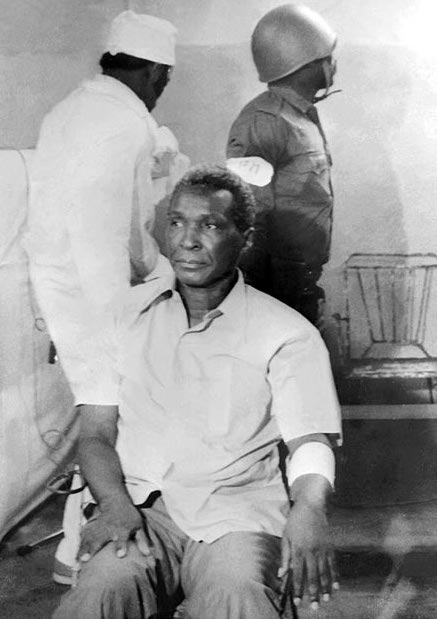
Francisco Macias Nguema during his trial.

Still, the shooting itself was handled by hired Moroccan troops, rather than citizens of Equatorial Guinea: Nguema had convinced quite a lot of people that he had magic powers, and the locals weren’t eager to be the ones to test the proposition.

Bloody but necessary first step to parliamentary democracy?

Not quite. Teodoro Obiang Nguema Mbasogo, one of the worst dictators you’ve never heard of, still runs Equatorial Guinea in much the manner of his predecessor to this day.


Did we mention that Equatorial Guinea has oil?

* Francisco Macias Nguema’s daughter, “Empress Bella Syttam Macias”, lives in Utah and defends her dad. She seems to have been too young to have been personally involved in anything unsavory in the 70’s.

On this day..

1560: Arnaud du Tilh, alias Martin Guerre

On this date in 1560, a French peasant was hanged outside the home he had made with another man’s wife in the southwestern French village of Artigat (or Artigues).

A poignant, perplexing tale of identity and social place — and possibly even of love — the story of Martin Guerre is at once exactingly local to its time and place, and timeless in its principals’ humanity.

As told in Natalie Zemon Davis’ captivating social history The Return of Martin Guerre, the restless (or ill-tempered) young titular peasant — impotent with his wife Bertrande, tense living with his father-in-law, chafing in rural Artigat — got out of town in 1548, joined one of the soldiering companies crisscrossing Europe, and was heard of no more.

In the centuries before fingerprints, credit cards, cell phones and Facebook, Guerre just disappeared. Constrained by Catholic law not to remarry without proof of his death, Bertrande just had to wait.

Until “Martin” returned in 1556 simply by reappearing at Artigat — moved in with Bertrande — resumed the vanished man’s name and with it his place in the village. There were suspicions from the first that he wasn’t quite right … but this man had Martin’s stories, and the villagers didn’t have so much as a photograph to test him against.

Martin was accepted in Artigat for three-plus years, fathered two children with Bertrande, and managed the estate as head of household. In Davis’s telling, he appears much the better husband and father than the pre-1548 version, and this bolsters her case that Bertrande must have been complicit in the fraud that unraveled in 1560.

Property and inheritance conflicts with Martin Guerre’s uncle (now married to Bertrande’s widowed mother) brought to the courts the novel case: was this man really Martin Guerre?

The inconclusive tools for establishing identity and a deft defense by “Martin” must have made for a riveting legal drama (French link) — with villagers taking up competing sides and the man put to the test of his memory of Martin’s life, which he impressively aced. So thoroughly did the man command the role that

the gesture, deportment, air, and mode of speaking of the prisoner were cool, consistent, and steady; while those who appeared in the cause of truth were embarrassed, hesitating, confused, and on certain points contradictory in their evidence. (Source)

On the point, perhaps, of acquittal, the case was resolved like any legal potboiler should be: with the dramatic reappearance of the real Martin — for so all the conflicting witnesses quickly agreed him to be, and so confessed the imposter husband, Arnaud du Tilh (or Arnaud du Tilb), a peasant from a nearby village also nicknamed “Pansette”. A onetime army buddy of Guerre’s, the enterprising du Tilh had been mistaken for Guerre, and had pieced together enough of the absconded husband’s life that by dint of total recall and superhuman audacity, he made for his own the place in the world that Martin Guerre disdained.

The sentence of the court was that Martin Arnaud

make amende honorable in the marketplace of Artigat, in his shirt, his head and feet being bare, a halter about his neck, and holding in his hands a lighted torch; to beg pardon of God, the king, and the justice of the nation; of the said Martin Guerre, and de Rols his wife; and this being done, the said du Tilh shall be delivered into the hands of the executioner, who after making him pass through the streets, and other public places in the said town of Artigat, with a rope about his neck, at last shall bring him before the house of the said Martin Guerre, where, on a gallows set up for that purpose, he shall be hanged and strangled, and afterwards his body shall be burnt. (Source of the translation, slightly tidied up based on the French version here)

Arnaud du Tilh, and Martin Guerre with him, passed thereupon into the historical memory, for in assigning names to bodies, had the court really sorted out who was who? What does it mean to drop out of one’s society … and what rights can one expect to command upon returning? What did it mean to be Martin Guerre but to live in the house of Martin Guerre and manage the affairs of Martin Guerre? And the characters: Arnaud with his mysterious spark of bravado; Martin and his sudden and unexplained reappearance; the two of them as if cast for one another’s roles in life and crossed up by the gods.

And the mysterious Bertrande — what did she do, and what did she want?

A bit of Rorschach history, then, which accounts for the still-robust liveliness the tale enjoys four and a half centuries later. And let’s admit: a bit of wistfulness for the time you could start on a clean sheet just by changing your name. (Although illiterate 16th century peasants had achieved TSA-quality security protocols in this respect.)

Natalie Zemon Davis, whose own account has been criticized for overclaiming Bertrande’s role and motivations, also consulted as she was writing it for a Gerard Depardieu film of the same title.

The same story transplanted to the Civil War United States yielded the 1993 film Sommersby:

And if you must, you can see Martin Guerre in show tunes.

(This medley sequence has second and third parts as well.)

On this day..

1599: Beatrice Cenci and her family, for parricide

On the morning this day in 1599, the Cenci family — mother Lucrezia, son Giacomo, and immortal tragic heartthrob Beatrice — were put to death at Sant’Angelo Bridge for murdering the clan’s tyrannous father.

Francesco Cenci, the victim, was more accustomed to making victims of his own: detested around the Eternal City, he indulged his violent temper and fleshy lusts with the impunity of a wealthy cardinal’s son. By all accounts, he enjoyed pushing around his family, too.

This much is stipulated. What lies beyond is legend.

But the legend is why we’re dallying with Beatrice today, so we might as well begin there: in fear that her father would rape her, it goes, Beatrice tried to turn to the authorities, who let mean old dad walk on account of his connections. Desperate to protect herself from incest, Beatrice and family arrange to batter his gulliver and toss him over a balcony to make it look like suicide.

Slight problem: it didn’t look very much like suicide.

So the family was hauled in and tortured, and eventually Lucrezia and Beatrice (both beheaded) and Giacomo (quartered after suffering the mazzolatura of an incapacitating hammer blow to the head followed by gory lethal knifework by the executioner) all paid the price while the youngest child watched, spared death but condemned to life in the galleys.

(The papacy gobbled up the patricides’ estate, which puts a fine point on the ironically-named Pope Clement VIII‘s law-and-order stance on the appeal for mercy, and his subsequent edicts to quash public comment on the affair.)

Then Beatrice’s body — the part below the neck — contrived to disrobe when fumbled by the brethren taking it away for burial.

You’ve got to admit it’s pretty romantic. Some versions even hold that the responsible executioners died violently themselves within a month, or that a ghostly Beatrice returns to the scene of her demise on this anniversary.

And not a word of Italian fluency will be necessary to catch the gist of this excerpt from this 1969 Lucio Fulci film:

It’s a little too Romantic, as in capital-R.

While the case was a true sensation Rome at the turn of the 17th century, the legend as we know it was heavily constructed in the 19th century … and specifically Percy Bysshe Shelley, who heard the story in Italy* where it had persevered as local folklore. A girl who killed her despot-father, executed by the despotic agents of the Divine Father? You don’t get into the canon without knowing what to do with that kind of material.

And he had this charming painting of her to boot:

Shelley amped up the menaced-virginal-purity theme, made the bloodshed a lot more demure, and turned it into a long poem, “The Cenci” (available on Google Books, and on Bartleby.com) which in Melville’s description proceeds from putting its protagonist between the “two most horrible crimes possible to civilized humanity — incest and parricide.”

This doesn’t all actually turn out to be well supported: at a minimum, Shelley inflated an incest allegation of doubtful lineage into accomplished fact. Beatrice’s camp did not raise this claim until just before her execution, when it needed a high card for clemency. The loutish victim eventually got his own biographer, who strongly disputed the incest charges. (Francesco also sports his own Italian Wikipedia page.)

From Shelley’s influential quill** into the DNA of western literature: Stendahl tapped the vein, as did Artaud, and risorgimento figure Francesco Domenico Guerrazzi; both Melville and Hawthorne used that painting so captivating to Shelley as plot devices (Dickens loved the painting, too). American sculptor Harriet Hosmer worked Cenci’s complex sensuality in marble.

Remarkable how the tradition in its modern incarnation proceeds root and branch from Shelley’s apprehension of a single painting, and how his reading stamped itself upon the canvas for later observers — like Hawthorne, writing in his journal:

It is the very saddest picture that ever was painted, or conceived; there is an unfathomable depth and sorrow in the eyes; the sense of it comes to you by a sort of intuition. … It is the most profoundly wrought picture in the world; no artist did it, or could do it again. Guido may have held the brush, but he painted better than he knew. I wish, however, it were possible for some spectator, of deep sensibility, to see the picture without knowing anything of the subject or history; for no doubt we bring all our knowledge of the Cenci tragedy to the interpretation of the picture.

He wrote better than he knew: the painting is no longer attributed to Guido Reni, and it’s doubtful whether it’s a portrait of Beatrice at all. One wonders if it would retain its place in Hawthorne’s estimation as a local washer-woman modeling for an allegory.

* Apparently you can still crash at the same place Shelley first got hep to Cenci.

** Kick back with some polysyllabic literary analysis of Shelley’s Cenci stuff.

On this day..

1642: Thomas Granger and the beasts he lay with

On this date in 1642, a teenager was hanged in the Plymouth colony for bestiality — in accordance with the law of the Pentateuch.

William Bradford — we just met him, trying to keep things cool with the Indians — relates the “very sadde accidente of the like foule nature in this govermente”:

Ther was a youth whose name was Thomas Granger; he was servant to an honest man of Duxbery, being aboute 16 or 17 years of age. (His father and mother lived at the same time at Sityate.) He was this year detected of buggery (and indicted for the same) with a mare, a cowe, tow goats, five sheep, 2 calves, and a turkey. Horrible it is to mention, but the truth of the historie requires it. He was first discovered by one that accidentally saw his lewd practise towards the mare. (I forbear perticulers.) Being upon it examined and committed, in the end he not only confest the fact with that beast at that time, but sundrie times before, and at severall times with all the rest of the forenamed in his indictmente; and this his free-confession was not only in private to the magistrates, (though at first he strived to deney it,) but to sundrie, both ministers and others, and afterwards, upon his indictemente, to the whole court and jury; and confirmed it at his execution. And whereas some of the sheep could not so well be knowne by his description of them, others with them were brought before him, and he declared which were they, and which were not. And accordingly he was cast by the jury, and condemned, and after executed about the 8 of Sept 1642. A very sade spectakle it was; for first the mare, and then the cowe, and the rest of the lesser catle, were kild before his face, according to the law, Levit: 20.15 and then he him selfe was executed.* The catle were all cast into a great and large pitte that was digged of purposs for them, and no use made of any part of them.

So, pilgrims: weird about sex, a bit rough with the punishment. No wonder they got a rep.

Granger is the first juvenile known to be executed in the territory of the modern United States — if you like, you could read it as the start of a pattern, even though almost a century would pass before the next such execution. “Juvenile” is a relative term, of course, since we see our day’s victim across a historical redefinition (arguably, outright creation) of “childhood” in the centuries to come: Granger left a wife and daughter.

“Sodomy, rapes, buggery,” were one of the five classes of crimes punishable by death according to the Plymouth Colony’s 1636 statutes. Still, Granger’s is the only one of ten recorded Plymouth Colony executions not imposed for murder (Source, via.) — not that other hot-blooded Puritans, including later zoophiles, didn’t get themselves into hot water.

American poet Charles Olson reimagined Thomas Granger in the 1940’s by remixing William Bradford’s narrative into a startlingly poignant piece, “There was a Youth whose Name was Thomas Granger”:

From the beginning, SIN
and the reason, note, known from the start

says Mr. Bradford: As it is with waters when
their streames are stopped or damed up, wickednes

(Morton, Morton, Morton)
here by strict laws as in no more,
or so much, that I have known or heard of,
and ye same nerly looked unto
(Tom Granger)
so, as it cannot rune in a comone road of liberty
as it would, and is inclined,

it searches every wher (everywhere)
and breaks out wher it getts vente, says he

Rest, Tom, in your pit where they put you
a great & large pitte digged of purposs for them
of Duxbery, servant, being aboute 16. or 17. years of age
his father & mother living at the time at Sityate

espetially drunkennes & unclainnes
incontinencie betweene persons unmaried
but some maried persons allso
And that which is worse
(things fearfull to name)

HAVE BROAK FORTH OFTENER THAN ONCE
IN THIS LAND

2
indicated for ye same) with
a mare, a cowe, tow goats, five sheep, 2. calves
and a turkey (Plymouth Plantation)

Now follows ye ministers answers

3
Mr Charles Channcys a reverend, godly, very larned man
who shortly thereafter, due to a difference aboute baptising
he holding it ought only to be by diping
that sprinkling was unlawful, removed him selfe
to the same Sityate, a minister to ye church ther

in this case proved, by reference to ye judicials of Moyses
& see: Luther, Calvin, Hen: Bulin:. Theo: Beza. Zanch:
what greevous sin in ye sight of God,
by ye instigation of burning lusts, set on fire of hell,

to procede to contactum & fricationem ad emissionem seminis,
&c.,
& yt contra naturam, or to attempt ye grosse acts of

4

Mr Bradford: I forbear perticulers.
And accordingly he was cast by ye jury,
and condemned.

It being demanded of him
the youth confessed he had it of another
who had long used it in old England,
and they kept cattle together.

And after executed about ye 8. Of Septr, 1642.
A very sade spectakle it was; for first the mare,
and then ye cowe, and ye rest of ye lesser catle,

were kild before his face, according to ye law
Levit: 20.15.

and then he him selfe

and no use made of any part of them

* The hangman, John Holmes — no, not that one — claimed a fee “for x weeks dyett for Granger £1., and for executing Granger and viij beasts, £2.10.0.” His count of executed beasts falls short of the total (12) enumerated by Bradford, presumably accounted by the difficulty in identifying the sheep.

On this day..

1943: 186 prisoners at Plotzensee Prison

As dark fell on the evening of September 7, 1943, a mass execution of 186 death row prisoners — including six with unresolved clemency appeals — began at Berlin’s bomb-damaged Plotzensee Prison, continuing by candlelight until the following morning.

An Allied air raid the night of September 3-4 had struck the facility, allowing four prisoners to escape and damaging the guillotine and execution shed where sentences were normally carried out. Coincidentally, that had come hours after Hitler had (as was his wont, in common with many a politician to the present day) castigated the judiciary for the dilatory rigmarole that allowed the condemned to delay their fate with legal appeals.

Converging circumstances generated sensible elite consensus:

That is the last thing we need, that after the air raids a few hundred condemned to death would be let loose on the population in the Reich capital.
-Goebbels

Instead, at the order of Reich Minister of Justice Otto George Thierack, cases were quickly tied up for a night of mass hangings.

Protestant pastor Harold Poelchau described (pdf) what he witnessed.

As darkness fell on September 7 the mass murders began. The night was cold. Every now and then the darkness was lit up by exploding bombs. The beams of the searchlights danced across the sky. The men were assembled in several columns one behind the other. They stood there, at first uncertain about what was going to happen to them. Then they realized. Eight men at a time were called by name and led away. Those remaining hardly moved at all. Only an occasional whisper with my Catholic colleague and myself … Once the executioners interrupted their work because bombs thundered down nearby. The five rows of eight men already lined up had to be confined to their cells again for a while. Then the murdering continued. All these men were hanged. … The executions had to be carried out by candlelight because the electric light had failed. It was only in the early morning at about eight o’clock that the exhausted executioners paused in their work, only to continue with renewed strength in the evening.

And as Poelchau intimates, the fearful harvest of September 7-8 was not the end of the massacre. Dozens more followed over the ensuing days, for a total of more than 250 executions at Plotzensee September 7-12.

Notable among the victims was 27-year-old German-Dutch concert pianist Karlrobert Kreiten, memorialized at this German page. He’d been a little too loose with his distaste for Hitler and been arrested on the eve of a concert a few months before.

In 2003, Dutch composer Rudi Martinus van Dijk debuted his Kreiten’s Passion, an excerpt fo which can be enjoyed on the composer’s homepage.

On this day..

1638: Three (of four) English colonists for murdering a Native American

Four hundred years removed from the events surrounding the colonization of Massachusetts by English settlers through the 1620’s, it’s difficult to properly evaluate the mindsets of either colonist or colonizer in this time of violent encounters and expansive cultural shifts.

The 1638 case of Arthur Peach, Thomas Jackson, Richard Stinnings, and Daniel Cross serves as a potent reminder that the relationship between the interlopers and natives in the early years of these meetings was driven as much by tribal politics as by interpersonal attitudes.

Peach, by all accounts, was not on track to be elected Plymouth Man of the Year. A servant of Edward Winslow, one of the Mayflower originals responsible for political gaming with the native leaders, Peach was dispatched to serve in the Pequot War in 1637. The war pitted English colonists and some of their tribal neighbors against the Pequots and resulted in the slaughter of hundreds of Pequot in several attacks.

Peach went work-idle in the post-war years, enjoying his remaining youth: he frequently drank and spent evenings in merriment with his friends, accumulating a sizable debt in the process; said merriment also extended to impregnating Dorothy Temple, a servant of Stephen Hopkins (who was, in one of the less surprising twists, later charged with allowing drunken merriment of his servants in his house).

Plymouth Colony leader William Bradford: Can’t we all get along?

William Bradford speculates that it was to escape punishment for this latter social offense that Peach convinced three other indentured servants to break their bonds and follow him to the nearby Dutch plantations. No matter the motive, they were ill-advised to join him.

Along the way, the quartet came across a man of the Nipmuc tribe (allied with the English and Narragansett during the recent war) named Penowanyanquis. They convinced him to stay, smoked a pipe and talked trade, then stabbed and robbed him, leaving him for what they thought was dead; Penowanyanquis was found on the road and lived for several more days, plenty of time to describe his attackers to first his tribesmen, then the Englishman Roger Williams.

The Plymouth authorities accepted the case (in Plymouth, though the event occurred far from its apparent jurisdiction) in the interests of maintaining the tenuous peace with the New England natives — in Bradford’s words, “The Gov[ernment] in the Bay were aquented with it, but refferrd it hither, because it was done in this jurissdiction; but pressed by all means that justice might be done in it; or els the countrie must rise and see justice done, otherwise it would raise a warr.”

Peach, Jackson, and Stinnings were caught at Aquidneck Island, while Cross fled to Piscataqua (New Hampshire), where it was traditional for locals to refuse to help Plymouth colonials. The three detainees were tried, with much of the trial devoted to proving that Penowanyanquis was, in fact, dead. It took two Narragansett to affirm upon pain of their own heads that Penowanyanquis had succumbed to his injuries, but their testimony sent three whites to the gallows for killing an Indian; for the second time since the Plymouth colony was established 18 years prior, a murderer was hanged.*

The oddity of the affair is not that such a conviction occurred — it was a long-standing colonial tradition to uphold treaties with natives through civil law and break them in a variety of other ways — but the reaction of persons involved before and during the trial. To wit:

Ousamequin coming from Plymouth told me that the four men were all guilty. I answered but one; he replied true, one wounded him, but all lay in wait two days and assisted. Also that the principal must not die, for he was Mr. Winslow’s man; and also that the Indian was by birth a Nipmuck man, so not worthy that any other man should die for him.

Ousamequin, here making the case that Peach should be spared, was another name for Massasoit, the old chief of the Pokanoket whose special kinship with Peach’s indenturerer Winslow was cemented after the settler brought a severely ill Massasoit European remedies when the chief was struck with an unnamed ailment in 1623.

Nor, indeed, were the colonists uniformly positive about the event: Bradford reports that “[s]ome of the rude and ignorant sorte murmured that any English should be put to death for the Indean.”

Massasoit himself seems to have been the only thing holding the colonial relationship together: Metacomet (“King Philip”) took the title of Great Sachem shortly after Massasoit’s death, and his alliances with other tribes exacerbated the harsh feeling towards English attempts to Christianize their neighboring “heathens”. With the white population expanding swiftly beyond its early boundaries, a small event was bound to spell trouble, and when the Christian convert John Sassamon (an Indian) was found murdered and three Wampanoag were executed for the deed, Indian sovereignty was impugned.

King Philip’s War was on, and it did not end well for the native Americans.

No.

To his credit, Peach still produced a son, and Temple’s pregnancy ended the public life of Hopkins. Hopkins was charged with mistreating Temple, who was his indentured servant, and ordered to pay for both her and her child through the two years remaining on her contract.

Hopkins dissented and was jailed, bailed out four days later by John Holmes, who purchased Temple’s servitude for a whopping three pounds (somewhere between 1/4 and 1/2 the price of a cow). Her son remains unnamed in the record, but after giving birth, Temple was charged with producing a bastard child and whipped. Her fate thereafter is lost to the mists of history, as are the future exploits of Daniel Cross.

* The first was Mayflower original John Billington, who was executed in 1630 for shooting John Newcomen to resolve what was apparently a long-standing dispute.

On this day..