1896: Chief Uwini of the Maholi

This date in 1896 during the Second Matabele War saw the execution by field court-martial of the rebellious Chief Uwini.

This war, in present-day Zimbabwe, featured a revolt of the Matabele (Ndebele) people against Cecil Rhodes’s* British South African Company.

In the field, it was a short-lived affair.

Ndebele rebels slew over 200 white settlers in Matabeleland and Mashonaland during the first week of the surprising rising in March 1896. But most settlers were able to hunker down in he town of Bulawayo behind makeshift breastworks.

Up to 15,000 Ndebele warriors menaced this little citadel, but were deterred from storming it by the settlers’ modern weapons — artillery and the legendary Maxim gun** — until relieved in May. (Rhodes himself led one of the relief columns.) At that point, the rebels retreated to their strongholds, fragmented from one another, and generally got picked off or bought off group by group over the ensuing months.

One of the men arriving with Rhodes’s relief column was Robert Baden-Powell, an army scout who will bring us to this date’s feature execution.

Baden-Powell was dispatched with a squadron of cavalry to pacify the area northeast of Bulwayo. When he arrived there, one of the main rebel chiefs in the Somabula Forest, Chief Uwini, had just been taken prisoner.

“He was badly wounded in the shoulder, but, enraged at being a prisoner, he would allow nothing to be done for him; no sooner had the surgeon bandaged hi than he tore the dressings off again. He was a fine, truculent-looking savage, and boasted that he had always been able to hold his own against any enemies in this stronghold of his, but now that he was captured he only wished to die.”

-Baden-Powell (Source)

This prisoner put Baden-Powell in a conundrum. He had written orders to turn prisoners over to the Native Commission for civil handling (whether trial or otherwise).

Uwini had been induced to surrender by another officer’s promise to spare his life. However, this wounded chief could not be escorted five days back to Bulawayo by a force large enough to protect against the likely rescue attempt by his followers without abandoning his mission. Neither could Uwini be brought along on the patrol.

Something had to give.

Baden-Powell decided it would be the safe-conduct promise.

“I have taken another step, which I hope you will not disapprove of — viz. — trying Uweena by Court Martial,” Baden-Powell wrote his superiors on September 13. “He is the big chief of this part, we have lots of evidence that he instigated rebellion and murders of whites, he is badly wounded, we cannot send him to Buluwayo, and I must be leaving this with some of the senior officers tonight. So if the court find him guilty and sentence him to be shot I shall take on myself the responsibility of confirming it. The effect too should be very good for being carried out promptly and at his own stronghold — and we have a good number of rebels, prisoners and refugees, here to witness it & report it to the remainder.”

Another letter dated later that same day confirmed that the expected sentence had indeed been rendered, and Uwini had been ceremoniously shot that evening at sunset before the walls of the enemy fortress, in the presence of as many witnesses as Baden-Powell could find.

This quasi-juridical field execution put Baden-Powell in front of a court of inquiry after the fact. The court exonerated him, citing the circumstances and the purported effect of the execution in cowing the local insurgents.

Despite leaving the court of inquiry “without a stain on my character,” in Baden-Powell’s own words, this incident can’t help but throw a morally questionable shade for later observers. And this agent of empire does have later observers — because Lord Baden-Powell (as he eventually became styled) would go on to found the Scout Movement.† His 1907 boys scouting camp and subsequent book laid the foundation for the ensuing decades’ Anglo scouting tradition.

And this very Matabele War contributed crucial parts of the scouting backstory. It was in the course of this campaign that Baden-Powell became acquainted with the American scout and adventurer Frederick Russell Burnham. The two struck up a lifelong friendship, and Baden-Powell cribbed notes from the ranger’s guile (like wood “scoutcraft”) his counterpart had picked up on the dwindling American frontier. It was also in Rhodesia that Baden-Powell first wore the Stetson hat and neckerchief combination that would become a distinctive look both for Baden-Powell himself, and for the scout movement he launched.

* As of this story’s setting, the place in question had just begun to be called Rhodesia.

** It is in the context of Great Britain’s colonial adventures in Africa in this period (though not specifically just those of Matabeleland) that Hilaire Belloc published his 1898 poem “The Modern Traveller”. In it, a character named “Blood” gave this early machine gun its definitive literary tribute: it’s the couplet highlighted below, but the larger excerpt may be illuminating.

Blood understood the Native mind.
He said: “We must be firm but kind.”

A Mutiny resulted.
I never shall forget the way
That Blood upon this awful day
Preserved us all from death.
He stood upon a little mound,
Cast his lethargic eyes around,
And said beneath his breath:

“Whatever happens we have got
The Maxim Gun, and they have not.”

He marked them in their rude advance,
He hushed their rebel cheers ;
With one extremely vulgar glance
He broke the Mutineers.
(I have a picture in my book
Of how he quelled them with a look.)
We shot and hanged a few, and then
The rest became devoted men.

And here I wish to say a word
Upon the way my heart was stirred
By those pathetic faces.
Surely our simple duty here
Is both imperative and clear;
While they support us, we should lend
Our every effort to defend,
And from a higher point of view
To give the full direction due
To all the native races.
And I, throughout the expedition,
Insisted upon this position.

† Baden-Powell also counseled scouts to be unflinching should the “duty” arise to hang a man.

On this day..

509 B.C.E.: The Sons of Brutus

August 21 is the harvest-time feast of Consualia, honoring the Roman god of grain storage, Consus.

We mark on this occasion the legendary capital punishment inflicted by Lucius Junius Brutus when he was consul of the ancient Roman Republic upon two rebels — his own sons, Titus and Tiberius.

The great Brutus had been one of the leaders of the revolt that expelled Rome’s last king, Lucius Tarquinius — reputedly after the king’s son raped Lucius’s kinswoman Lucretia. (Brutus was also Tarquin’s nephew.)

Upon completing his coup, Brutus immediately summoned the populace to swear an oath that no king would ever rule Rome again. So potent was the civic memory of this event that even centuries later when the Republic was well gone, Rome’s emperors dared not appropriate such an incendiary title as “King”.

But that was for a later time, after the winners wrote the history.

The exiled Etruscan king, subsequent Romans’ eternal watchword for tyranny, got the boot about 510 B.C.E., and in 509 was still hanging about looking for an opportunity to re-seat his dynasty. The plot he hatched is known as the Tarquinian conspiracy, and Brutus, to his grief, would discover that his own children had adhered to it. The statesman’s willingness to put his own flesh and blood to death for the security of Rome would long stand as a parable of manful patriotism.

Our account here is from Livy (line breaks have been added for readability), and the excuse to approximate this undated execution to summer’s harvest-time is bolded therein.

liberty was well nigh lost by treachery and fraud, a thing they had never apprehended. There were, among the Roman youth, several young men of no mean families, who, during the regal government, had pursued their pleasures without any restraint; being of the same age with, and companions of, the young Tarquins, and accustomed to live in princely style.

Longing for that licentiousness, now that the privileges of all were equalized, they complained that the liberty of others has been converted to their slavery: “that a king was a human being, from whom you can obtain, where right, or where wrong may be necessary; that there was room for favour and for kindness; that he could be angry, and could forgive; that he knew the difference between a friend and an enemy; that laws were a deaf, inexorable thing, more beneficial and advantageous for the poor than the rich; that they allowed of no relaxation or indulgence, if you transgress bounds; that it was a perilous state, amid so so many human errors, to live solely by one’s integrity.”

Whilst their minds were already thus discontented of their own accord, ambassadors from the royal family come unexpectedly, demanding restitution of their effects merely, without any mention of return. After their application was heard in the senate, the deliberation on it lasted for several days, (fearing) lest the non-restitution might be a pretext for war, and the restitution a fund and assistance for war. In the mean time the ambassadors were planning different schemes; openly demanding the property, they secretly concerted measures for recovering the throne, and soliciting them as if for the object which appeared to be under consideration, they sound their feelings; to those by whom their proposals were favourably received they give letters from the Tarquins, and confer with them about admitting the royal family into the city secretly by night.

The matter was first intrusted to brothers of the name of Vitellii and those of the name of Aquilii. A sister of the Vitellii had been married to Brutus the consul, and the issue of that marriage were young men, Titus and Tiberius; these also their uncles admit into a participation of the plot: several young noblemen also were taken in as associates, the memory of whose names has been lost from distance of time. In the mean time, when that opinion had prevailed in the senate, which recommended the giving back of the property, and the ambassadors made use of this as a pretext for delay in the city, because they had obtained from the consuls time to procure modes of conveyance, by which they might convey away the effects of the royal family; all this time they spend in consulting with the conspirators, and by pressing they succeed in having letters given to them for the Tarquins. For otherwise how were they to believe that the accounts brought by the ambassadors on matters of such importance were not idle?

The letters, given to be a pledge of their sincerity, discovered the plot; for when, the day before the ambassadors set out to the Tarquins, they had supped by chance at the house of the Vitellii, and the conspirators there in private discoursed much together concerning their new design, as is natural, one of the slaves, who had already perceived what was going on, overheard their conversation; but waited for the occasion when the letters should be given to the ambassadors, the detection of which would prove the transaction; when he perceived that they were given, he laid the whole affair before the consuls. The consuls, having left their home to seize the ambassadors and conspirators, crushed the whole affair without any tumult; particular care being taken of the letters, lest they should escape them.

The traitors being immediately thrown into chains, a little doubt was entertained respecting the ambassadors, and though they deserved to be considered as enemies, the law of nations however prevailed.

The question concerning the restitution of the tyrants’ effects, which the senate had formerly voted, came again under consideration. The fathers, fired with indignation, expressly forbad them either to be restored or confiscated. They were given to be rifled by the people, that after being made participators in the royal plunder, they might lose for ever all hopes of a reconciliation with the Tarquins. A field belonging to them, which lay between the city and the Tiber, having been consecrated to Mars, has been called the Campus Martius. It happened that there was a crop of corn* upon it ready to be cut down, which produce of the field, as they thought it unlawful to use, after it was reaped, a great number of men carried the corn and straw in baskets, and threw them into the Tiber, which then flowed with shallow water, as is usual in the heat of summer; that thus the heaps of corn as it stuck in the shallows became settled when covered over with mud: by these and the afflux of other things, which the river happened to bring thither, an island was formed by degrees. Afterwards I believe that mounds were added, and that aid was afforded by art, that a surface so well raised might be firm enough for sustaining temples and porticoes.

After plundering the tyrants’ effects, the traitors were condemned and capital punishment inflicted. Their punishment was the more remarkable, because the consulship imposed on the father the office of punishing his own children, and him who should have been removed as a spectator, fortune assigned as the person to exact the punishment.

Young men of the highest quality stood tied to a stake; but the consul’s sons attracted the eyes of all the spectators from the rest of the criminals, as from persons unknown; nor did the people pity them more on account of the severity of the punishment, than the horrid crime by which they had deserved it.

“That they, in that year particularly, should have brought themselves to betray into the hands of Tarquin, formerly a proud tyrant, and now an exasperated exile, their country just delivered, their father its deliverer, the consulate which took its rise from the family of the Junii, the fathers, the people, and whatever belonged either to the gods or the citizens of Rome.”

The consuls seated themselves in their tribunal, and the lictors, being despatched to inflict punishment, strip them naked, beat them with rods, and strike off their heads. Whilst during all this time, the father, his looks and his countenance, presented a touching spectacle, the feelings of the father bursting forth occasionally during the office of superintending the public execution.


Bummer: Jacques-Louis David‘s 1784 painting, Lictors Bring Home the Sons of Brutus.

This Brutus was an ancestor of the Brutus who helped assassinate Julius Caesar, and that later et tu, Brutus is commonly represented as having been convinced to turn against his friend and patron by, in part, the example of his legendary namesake.

O, you and I have heard our fathers say,
There was a Brutus once that would have brooked
The eternal devil to keep his state in Rome
As easily as a king.

-Cassius to Brutus in Shakespeare’s Julius Caesar (Act 1, Scene 2)

* “Corn” meaning not American maize, of course — which was not available before the Columbian exchange — but the word’s earlier meaning of whatever was the local grain: wheat, barley, and millet in Rome’s case. (The word corn derives from the Latin granum.)

On this day..

1909: Dervish Vahdeti, for the 31 March Incident

EXECUTIONS IN CONSTANTINOPLE

(From our own correspondent.)

CONSTANTINOPLE July 19.

Cherkess Mehmet Pasha, popularly known as Kaba Sakal — i.e., “twisted beard,” the torturer and former aide-de-camp of [Sultan] Abdul Hamid, Yusuf Pasha, Commandant of Erzerum, the Dervish Vahdeti, chief of the Jemiyeti Mohammadeieh, Hakki Bey, the notorious spy, and eight officers and soldiers who took part in the recent mutiny, were publicly executed at dawn.

London Times, July 20, 1909

The Ottoman Empire in 1908 experienced the Young Turk Revolution, curbing the power of the sultan in a brief constitutional-monarchy era that would take the foundering state through the First World War.

Unsurprisingly, the reigning, formerly-supreme monarch was nonplussed at this brake on executive authority.

He backed the 31 Mart Vakasi, or 31 March Incident,* a counter-coup by conservative and Islamist elements in Istanbul to overthrow the Young Turks and re-establish the sultan’s power. Already the Porte was resorting to an assertion of Islamic political identity to hold the “sick man of Europe” together — and already that had resulted in some appalling atrocities.

For a few days the rightists, incited by Dervish Vahdeti, had Istanbul in hand. Vahdeti was a 40-year-old Cypriot who published Volkan, an Islamist newspaper in Istanbul; the 31 March Incident is sometimes also known as the Revolt of Dervish Vahdeti. (Biographical details source)

Once again, Armenian blood flowed. News of the revolt triggered an attack by Turks in the Anatolian city of Adana upon that city’s Armenian Christians. The resulting Adana Massacre claimed 15,000 to 30,000 lives throughout the Adana province.

Indeed, the Adana massacre quite outlasted the counter-coup, resulting in going debate over the extent to which the Young Turks themselves blessed the pogroms. These guys had their own fraught relations with Turkey’s Armenians; of course, they’d eventually have the Armenian genocide to answer for.

As for the event at hand, Second Army Corps and Third Army Corps dispatched Dervish Vahdeti’s revolt with ease. These units still loyal to the Young Turks reached Istanbul from Salonika within days of the uprising. (Among their number was the 27-year-old Mustafa Kemal — later known as Ataturk, the founding statesman of modern, post-Ottoman Turkey.)

The mutiny collapsed with little effective resistance upon this Macedonian intervention, and the military had the run of the place — not for sack but for a severe clamp-down on the Islamic party. According to Nader Sohrabi, “some two hundred movement participants were hanged en masse, on row after row of scaffolds erected in public space by the order of military courts” in the crackdown.

The 74 constitutionalist soldiers who died to put down the 31 March Incident are honored at a Monument of Liberty in Istanbul.

* The Ottomans were on the Julian calendar-based Rumi calendar, so March 31 in Istanbul corresponded to April 13 in western Europe. Similarly, this date’s hangings took place on July 6, not July 19, per the local Turkish date.

On this day..

1827: Isaac Desha pardoned by Gov. Joseph Desha

On this day in Kentucky in 1827, a plainly guilty murderer who was on to his third trial received an unconditional pardon. His name was Isaac Desha and his father, Joseph, was the state governor.

The murder was committed in 1824. Isaac Desha had separated from his wife, who was reportedly “terrified” of him, and was staying in Richard Dogget’s roadside tavern/inn on the border of Fleming County. On November 2 of that year, Francis Baker showed up and checked himself into the inn. A newspaperman from Mississippi, he was en route to New Jersey where he planned to get married. He was well-dressed and had a lot of luggage with him.

Baker wanted to visit a local man whom Desha also happened to know, and Desha volunteered to take him there. The two men set off together, Desha riding his bay horse and Baker on a gray mare, carrying two saddlebags.

They never arrived at their mutual acquaintance’s home.

Two hours later, a neighbor named Milton Ball noticed a gray mare, with saddle and bridle but no rider, wandering aimlessly on the highway. He caught it and was trying to find the owner when he encountered another riderless horse. This one he recognized as Desha’s. It had a saddle but no bridle.

Milton Ball got his brother, who took the horse to Desha’s residence. No one was home and he left it there.

As Ball was still trying to identify the gray horse’s owner, he came upon Isaac Desha walking down the road carrying two saddlebags. Desha identified the mare as his own property and took it from Ball, and they parted ways.

Awhile later, Francis Baker’s saddlebags were found empty and abandoned. The man never returned to the inn. The locals put two and two together and looked warily at Desha, but there was no hard evidence of foul play and he was the governor’s son, after all, so they said nothing.

That hard evidence turned up within a week, in the form of Francis Baker’s brutalized corpse — partially stripped, and hidden behind a fallen tree only yards from where Desha had been seen carrying the saddlebags. He’d been beaten with some blunt object and his throat was slit, and he had unusual stab wounds that were “four-square” shaped.

Fragments of a horse bridle and a whip were recovered from the scene; Desha owned a horse whip with a heavy handle that could have inflicted the injuries that killed Baker. Desha also owned a dagger that, it turned out, precisely matched the oddly shaped stab holes in Baker’s shirt.

The circumstantial evidence continued to pile up: the mare Desha had claimed as his own turned out to be Baker’s horse, and he also had Baker’s gold watch and the clothing and money that had been packed in Baker’s saddlebags. Desha claimed he’d randomly encountered two unknown men who’d sold the horse to him, and that he didn’t recognize it as stolen property, even though he’d been riding with Francis Baker only hours beforehand.

As for the watch, money and clothes, Desha didn’t even try to account for those.

He was arrested, and tried for murder in January 1825. The case was sensational and they had to move the trial elsewhere because the court determined Desha couldn’t get a fair trial locally. His father hired the finest defense attorney that there was, but the jury took only an hour to convict and recommended a death sentence.

Desha’s attorneys immediately appealed the verdict and sentence. One of the issues was that the sheriff had stayed with the jury during their deliberations, something Desha’s defense said was improper. The sheriff had presumably watched over the jury because a number of them got anonymous notes threatening to burn them in effigy if they voted to convict.

(Not threats to burn the jurors, mind. Threats to burn their effigies.)

The appeals court judge, one George “Peg Leg” Shannon, agreed with the defense and overturned the verdict. The fact that he was good friends with Desha’s father the governor had nothing to do with it, he said, and the outrage among the citizenry and angry editorials in the newspapers would never make him admit otherwise.

Desha got his second trial in September 1825 and got convicted and sentenced to death again. Once again the case was overturned on appeal, this time because the prosecution had not proved Francis Baker’s murder took place in Fleming County like the indictment said.

The local papers called the trial a “farce” and ranted about corruption within the judiciary. The Winchester Gazette editorialized, “It would seem that justice has either bade adieu to Kentucky, or that her judges are the most corrupt and desperate men living.”

But there was nothing to be done about it: Desha would have to be tried a third time. He was, in February 1826, well over a year after the murder, and the third jury convicted him too.

Desha despaired over his third conviction and attempted suicide in July of that year, slitting his throat in his cell. He very nearly succeeded, and the surgeon who brought him back from the brink had to put in a silver tube to reinforce his severed windpipe. For the rest of his life he could speak only in a whisper. The tube needed to be removed regularly for cleaning, and every time this happened Desha endured a terrible feeling of suffocation.

whereas the whole of the evidence against the said Isaac B. Desha being circumstantial, and from much of it being irreconcileable, I have no doubt of his being innocent of the foul charge; therefore is an object worthy of executive clemency.

Now, know ye, that in consideration of the premises, and by virtue of the power vested in me by the constitution, I have thought proper, and do hereby grant to the said Isaac B. Desha a full and free pardon for the supposed offence, as alleged against him in the bill of indictment …

Given under my hand at Frankfort, on the 18th day of June, A.D. 1827, and in the 36th year of the Commonwealth.

By the Governor.
Jos. DESHA.

Desha’s murder conviction was once more under appeal, but his suicide attempt had left him in such poor health that a sympathetic doctor signed an order saying keeping him in jail was endangering his life. He was released on bond pending the outcome of his appeal.

In March 1827, his lawyers tried to get the murder case dismissed on procedural grounds. Request denied. In June they filed for dismissal again, because the court had failed to seat a full panel of impartial jurors. (Desha used all his juror challenges to help keep the count down.)

Request denied again, and what’s worse, the court decided Isaac Desha’s health had improved enough that he could withstand the rigors of jail. He was remanded into custody.

Governor Desha still had one last card up his sleeve, and it was a trump. On June 18, the same day Isaac was ordered back behind bars, his father rose in court and issued him an unconditional pardon on the spot.

Joseph Desha committed political suicide when he pardoned his son. Isaac’s crime, and the obvious favors afforded him by the justice system, severely damaged the governor’s reputation.

Contrary to popular belief, Joseph didn’t resign after pardoning his son. He quietly finished out his term, retired to his farm and never entered politics again. He died in 1842.

As for Isaac Desha, there’s a legend that he moved to Honduras or Hawaii and has descendants still living there. In fact, although he did head west after his release from jail, he never made it further than Texas.

Like a lot of pioneers, he surely hoped he could put his former troubles behind him. But Isaac Desha carried trouble with him: in Texas, he allegedly robbed and killed a fellow traveler in a crime remarkably similar to Francis Parker’s murder. He was charged with murder yet again and this time he didn’t have an influential father to protect him.

Desha escaped the death penalty one last time, though, by dying of a fever on August 13, 1828, the day before his murder trial was supposed to start. He was twenty-six.

On this day..

1897: Choka Ebin, by his own relatives

(Thanks to Meaghan Good of the Charley Project for the guest post. -ed.)

On this day in 1897, Choka Ebin (Eben), a full-blooded Creek Indian, was executed in Perry, Oklahoma for the murder of Laura Anthony. He’d killed her just three weeks before, on May 23, and was arrested that same day. The law required Ebin’s own tribe to try and sentence him, and his own nearest kin to perform the execution — a precaution against the execution initiating a blood feud.

Ebin remained free between his conviction and his execution. He was supposed to die on June 4, but sent word that he was too sick to ride to town, and got a ten-day reprieve. On June 14 he dutifully appeared and turned himself in to the authorities.

He was placed on his knees on a chair, and his father and brother, Riley and Palko, took positions twelve paces back and fired their Winchester rifles.

The bullets hit the target dead center: shot in the heart, Ebin died within seconds. Riley and Palko then put his body in a coffin and took it home to bury. (Here’s a short contemporary newspaper blurb in a pdf)

On this day..

1884: Charles Henry, iced in the Arctic

On this date in 1884, U.S. Army Private Charles B. Henry of the Lady Franklin Bay Expedition (LFBE) was summarily executed in the distant northern reaches* of present-day Nunavut.


It’s waaaaaay up there. Click to view larger map, but don’t expect details.

The “Greely expedition” — so called after its commander, Adolphus Greely — was dispatched from Washington in the enthusiasm of the First International Polar Year. This was a multinational collaborative to gather scientific data about the globe’s frigid polar reaches; technically, this first IPY spanned 1882 to 1883, but the ill-starred Greely mission set out in 1881.

The LFBE was headed for a narrow icebound inlet named for a woman who lost her explorer husband on an Arctic voyage. That bay juts like a dead tree limb out of the Robeson Channel into the remote northern wildernesses of Ellesmere Island.

The mission laid down for the 25 men of the Lady Franklin Bay Expedition in 1881 was to establish a weather station, and to collect astronomical and geomagnetic data.

But long before the starving remnants of that crew put Private Henry to sudden death, they had supplanted that noble endeavor with the classic objective of polar adventure: mere survival.

Matters started promisingly enough: the ship that ferried these men to their ordeal dropped them without incident at a natural harbor in Lady Franklin Bay, where the intrepid men built Fort Conger — a sturdy frame house 65′ x 21′ x 14′. They would spend the next two years making scientific measurements, exploring, and awaiting planned resupply ships in the summers.

Ice-choked waters, however, do not open reliably to this location. The resupply missions in both 1882 and 1883 failed — and left the mission with a life-or-death choice.

Per prearranged contingency, the supply ships, should they not be able to reach Camp Conger, were to drop their provisions at a backup location. Much against his men’s will, Greely gave up Camp Conger to chase this hypothetical cache. Camp Conger was more difficult for any future ships to reach but was secure, warm enough, and blessed with seal-hunting enough to keep the team in good health.

Camp Sabine was reached only after a terrifying and near-fatal float down the coast in an ice floe (!) and it proved when they reached it a much less congenial spot for wilderness survival. The resupply missions that hadn’t reached Camp Conger had failed so thoroughly that only a very small drop had even made it to Camp Sabine. Conditions prevented the party from returning to Camp Conger or from crossing the water to another inhabited Arctic station: instead, they wintered in the mouth of hell; seal-hunting here was not favorable, and most days they were only able to supplement their dwindling cache of life-giving calories with a few shrimp and scraps of lichen peeled off the frozen rocks.

Not only ravenous hunger afflicted the party, but scurvy too, and still worse a morale collapse among party members who regarded Lieutenant Greely’s leadership very lightly. Huddled in a makeshift stone hut, three years gone from hearth and home, bored and helpless and stretching out less-than-subsistence rations as far as possible and farther, nerves began to fray … and party members began to succumb to conditions.

Charles Buck Henry did not wear well on this desperate party.

“Henry” was actually the new alias of a German immigrant formerly known as Charles Henry Buck. Buck had served time for embezzling whiskey money from a frontier cavalry company, then escaped and slew a Chinese man in a Deadwood, S.D. brawl. Henry stole from the expedition’s small store of food: he was not the only one, but he was perhaps the baldest thief and the one with the fewest redeeming features that would balance this behavior. He’d been confined in March to his sleeping bag as the closest thing to punishment that Greely could visit on him. Still, Henry stole more. Resentful comrades ostracized him, while silently sizing up the discomfiting likelihood that the hulking German would be odds-on to kill any man among them in a fair scrap.

This day, Greely finally caught him stealing once too often.

Notwithstanding promises given by Pvt C.B. Henry yesterday [to stop stealing] he has since as acknowledged to me tampered with seal thongs if not other food … This pertinacity and audacity is the destruction of this party if not at once ended. Pvt Henry will be Shot today all care being taken to prevent his injuring any one as his physical strength is greater than that of any two men. Decide the manner of death by two ball and one blank cartridge. This order is imperative & absolutely necessary for any chance of life.

A.W. Greely
1 Lt. 5 Cav. ASO & Asst
Cmdg. L.F.B. Expd

That order Greely issued to his able assistant, Sgt. David L. Brainard. Brainard proceeded to gather two other men who contrived to “execute” Henry by a stratagem of approaching Henry armed, but casual, and distracting the unrestrained condemned man long enough to get the drop on him. They shot him dead just as Henry recognized his danger and started to lunge for a nearby axe — an incredibly chancy engagement that could easily have turned the whole expedition into a hyperboreal edition of “The Most Dangerous Game” had the mountainous Henry avoided or survived that gunshot.

Instead, his body with its fatal bullet wound was discovered by accident when the Greely party was at long last rescued later that June, and returned along with just seven** (barely) living souls out of the 25 who set sail in 1881. Those fortunate survivors — the relief mission’s commander reported them “crying like children, hugging each other, frantic with joy”† as their rescue vessel pulled into view — would be forever defined by their participation in the LFBE: toasted for their survival story while also dogged by dark rumors of cannibalism.

According to polar and maritime historian Glenn Stein, FRGS, who spent several years researching this jaw-dropping case,‡ they also closely husbanded the story of their one-time mate’s execution. Mr. Stein is also U.S. Liaison a present-day polar journey, the South 2014 Expedition, and he was gracious enough to speak with Executed Today about the LFBE’s execution.


ET: The Lady Franklin Bay Expedition was a U.S. expedition launched as part of the first International Polar Year. Could you situate the LFBE in the context of polar expeditions at this time?

GS: In the years following the 1875-76 British Arctic Expedition, it was suggested that nations should stop competing for geographical discoveries and instead dispatch a series of coordinated expeditions dedicated to scientific research. Eleven nations took part in the first International Polar Year (IPY) 1882-83, and the United States contributed two components to its first participation in an international scientific effort. In 1881, it was decided that the U.S. Army Signal Corps would establish one scientific station 500 miles from the North Pole, at Lady Franklin Bay, Grinnell Land. The other station was at Point Barrow, Alaska.

The executed man in this instance is Charles Henry, formerly known as Charles Buck. This man had a pretty disreputable history. How was he able to get on this expedition? – And, how did he become the Chicago Times correspondent for this journey? Did he actually file any stories?

Buck enlisted in the Fifth Cavalry under the alias Charles B. Henry, and wrote to Lieutenant Greely from Fort Sidney, Nebraska, in April 1881, volunteering for the expedition. Henry had the strong recommendation of his company commander, Captain George T. Price, to back him up. Greely and Price were friends, so Greely leaned toward taking Henry (who repeatedly telegraphed Greely with reminders of his availability). Another story is that Henry joined from Fort Sidney when one of the original expedition members deserted just before it was to leave. However, as far as I’m aware, there was only one desertion from the LFBE, and that person was replaced by Private Roderick R. Schneider, First Artillery.

Supposedly, since Henry was the only volunteer from the Fifth Cavalry, with a strong recommendation from post commander Lieutenant Colonel Compton, Greely decided to take him.

According to A.L. Todd’s Abandoned (1961), before joining the expedition back East, Henry “got permission to stop off in Chicago to visit relatives, and managed to make an arrangement with the Chicago Times to act as that paper’s special correspondent with the Lady Franklin Bay Expedition.” In his Ghosts of Cape Sabine, Len Guttridge (2000) made references to Henry’s newspaper articles: “One or two eventually published in the Chicago Times attested to an effective if florid command of the English language.”

This expedition lasted three years, 1881-1884, and it came to a considerable amount of grief. Could you sketch out what happened to the LFBE, and how it found itself in such a perilous situation in its last months?

By the end of August 1881, a frame house was constructed at Lady Franklin Bay and named Fort Conger. Over the next two years scientific data was collected and sledging parties were sent out, discovering many new geographic features, and setting north, east, and west “farthest” records. Because of the mismanagement of resupply expeditions from the United States, expedition members initiated a planned retreat by boat to Cape Sabine in August 1883 — but the journey turned into a nightmare. The party eventually ended up at Cape Sabine, where the men constructed a stone house for the winter, with an upturned boat for a roof. It was christened Camp Clay. Throughout the following months, the men’s spirits and energy dwindled, and constant hunger was now their companion. Worse, food was being stolen from the commissary storehouse. More than once, angry accusations flew back and forth within the party. The daily ration for each type of food was measured out to hundredths of an ounce.

The first death occurred on Jan. 18, 1884, when Sergeant William H. Cross died of starvation. In spite of the privations, only one man died that winter, even though scurvy was also present. In the spring Death returned with a vengeance.

So by the end, there’s a party near to starvation, just scraping by on a starvation diet. Naturally there’s a temptation for people to steal from the camp rations.

Henry wasn’t the only person to have stolen, but it seems from your description like he was the most distinctly resented by the rest of the party. Why was that?

During his time at Fort Conger, Henry was the originator of many profane remarks, misdeeds, and lies, so Greely and others had learned not to trust him.

Until the publication of my article, “An Arctic Execution,” LFBE historians consistently wrote that no one on the expedition knew of Henry’s criminal history as a forger, thief and accused murderer. However, I discovered within Sergeant Brainard’s unpublished daily notes that he definitely knew of Henry’s past — so who else knew as well? In consequence, although others also stole food, Henry would have been treated with less tolerance.

The specific details of the execution, and the variations on the story that are given later, are quite fascinating. The execution was ordered by the camp commander, but Henry was not confined and had no idea what was coming, because the shooting party could have been in some danger as well. Given the rough and ready circumstances, why then, does the execution party go to such elaborate ends to anonymize the shooter? There’s the “three guns, two balls” order, and then they can’t comply with that since there’s only one usable rifle, so they swear an oath among themselves never to tell.

Firing squad duty obviously preys upon the conscious and subconscious mind. It’s possible that passing the rifle around and swearing an oath replaced the anonymity provided by the “three guns, two balls” order. Keep in mind that, if the three men survived their Arctic ordeal, their participation could impact them for the rest of their lives — in and out of the Army.

This was particularly true of Sergeant Brainard, who was promised a commission by Greely. Decades after the execution, Brainard declared that “no matter what the provocation, the family of a man doesn’t want to think of him as an executioner.”

As a factual matter, it was either Brainard or Francis Long who pulled the trigger, since Frederick distracted Henry and lured Henry into the trap.


Charles Henry (left), and his two potential executioners: David Brainard (center) and Francis Long (right).

What’s left of Henry is buried in New York. If you really wanted to find out what happened, you would have to exhume the remains. Henry’s sister, Dora Buck, did request the exhumation and autopsy of his body, but these were never allowed to take place. Officially, as my article notes, Henry’s remains were buried with full military honors. What we are left with today are cemetery records, which state that Charles Henry “Died of Starvation.”

And you think Brainard carefully managed the way the dangerous execution story got out.

Brainard is like a historian’s dream. Not only was he there, not only was he a very intelligent individual — but he made a record of many things, keeping daily notes that go from start to finish.

I hand-copied each page, three years of field notes, and I referenced these in my article. Those notes represent his impressions at the time they were written, not edited versions. One crucial thing Brainard recorded about Henry was that he “is a born thief as his 7th Cavalry name will show — a perfect fiend.” That’s significant, because it doesn’t appear in Brainard’s published writings. Why omit that piece of information? There’s one reason: Brainard knew beforehand that Henry was a criminal, and if it was known Brainard possessed this information, then he may appear prejudicial regarding the decision to shoot Henry.

It starts to add up, because who had control of the expedition members’ journals on the passage home? Brainard.

Who wrote up an incomplete journal on the way home — and then, many months later, turned in writings covering several more months — but ending in March 1884? Brainard.

I’ve examined the three volumes of his original journal. Everything was very carefully written, and Brainard made sure the story he wanted told got into these journals.

And what transpired afterward?

Sgt. Brainard had been promised a commission by Greely for his leadership on the LFBE. That’s a huge deal — to get commissioned from the ranks for gallant and meritorious service, and not even in wartime, but peacetime. At that time, and for many years thereafter, he was the only living officer of the Army, active or retired, holding a commission awarded for specific distinguished services. I believe Brainard was a “good guy” and a stand-up guy, but at the same time, would he really chance ruining his opportunity to get that commission? The whole execution business could have made things really difficult for him.

When they evacuated Fort Conger, and later on were literally floating south on a piece of ice, there was almost a mutiny. The mutineers went to Brainard, saying Greely had to be relieved of command, that he was going to get everyone killed. But Brainard wouldn’t go along with it — in part, he probably realized it would destroy his future.

You have to start looking at these motivations; and it’s not an entirely unsympathetic view, because people in these positions had jobs to do.

It took a lot of pushing to get Brainard’s commission to Second Lieutenant approved, and this didn’t happen until October 1886. In 1917, when he was near the end of his career, he was actually appointed Brigadier General. Brainard went from buck private to Brigadier General!

After the LFBE’s rescue later in 1884, how was the matter of the execution handled? I’m reading between the lines here, but it seems to me that, while it was not a secret, it was also downplayed as a public matter in the immediate aftermath — Henry buried with full military honors, that sort of thing. As it emerged more publicly thereafter, was there ever any controversy or a significant sentiment that Greely had handled the situation improperly? Was there ever a question about the legality of his order?

Greely made a verbal report regarding the execution to his departmental superiors several days before Henry’s burial. He then wrote to Adjutant General of the Army R.C. Drum in August 1884, to report Henry’s execution and request that a court of inquiry be ordered or a court martial convened regarding the matter. Drum responded in November 1884 that after examining the expedition’s records, “the Secretary of War entertains no doubt of the necessity, and the entire propriety of your action in ordering the execution of Private Henry, under the circumstances and in the manner set forth in your report.”

It was understood that any military officer operating in the field possesses a fair degree of discretion in carrying out orders, and Greely had Henry executed in order to preserve lives.

Newspaper articles certainly featured Henry’s execution, but stories of cannibalism (including the condition of Henry’s remains) and the political scandal related to the mishandling of the attempted relief of Greely prior to his rescue were much more high profile stories.

You have a professional interest in polar exploration, and obviously starvation risks are endemic to these situations when matters go awry. Have you encountered any similar instances of a polar party executing one of its members for the sake of maintaining discipline?

A somewhat similar execution scenario, also an attempt to preserve the lives of starving men, had played out during Sir John Franklin’s 1819-22 Arctic Land Expedition. A detachment of four men from the expedition, including Surgeon John Richardson, discovered that their comrade, Midshipman Robert Hood, had been murdered by an Iroquois voyageur named Michel Teroahauté (also known as Ferohaite).

Under the circumstances, Richardson shot Michel to save their own lives.

How did you come to find out about this story and why did you decide to research it in such depth? Over a century on from the events themselves, what does the fate of Charles Henry have to tell us today?

I can trace back my knowledge of the execution to at least September 1988, when I bought a copy of The Polar Passion, by Farley Mowat (1967). Several years later, I acquired a large collection of items once belonging to General Brainard, which included most of his medals and orders, photographs, books, and a bone knife he brought back from the Arctic. Brainard is a fascinating historical figure and human being (I like to call him the quintessential American), and I spent a good deal of time researching and writing about his life. In the process I discovered there were many contradictory details about the execution.

On July 13, 2005, I was sitting at an outside bar in Jamaica, when it dawned on me that if I dug deep enough, I just might be able to figure out what really happened during the execution of Private Henry.

So, I began jotting down notes on three 4″ x 5″ pieces of paper — “1. Primary Question: Who was the shooter?” Of the three men involved, the evidence dictates the trigger man must have been either Brainard or Long — but in the absence of conclusive evidence we’ll probably never know which one. And I ultimately decided that’s okay, because it’s the way the three wretched souls wanted it to be on that fateful summer day in 1884, and I needed to respect their wishes.

The events during the Lady Franklin Bay Expedition, especially Charles Henry’s fate, are reminders of how crises bring out the best — and worst — in human nature. At various times in our lives we’re all confronted with personal crises: how we deal with them is what counts. Writing “An Arctic Execution” forced me to stretch my mind beyond what I thought were its limits to attempt to understand defining moments in the lives of human beings who were at the brink of oblivion.

A few books about the Greely expedition

* This expedition established a “farthest north” record: it was for the next several years the most northerly latitude that any explorer could document ever attaining.

** One of the seven retrieved by the Thetis, Sgt. Joseph Elison, was at death’s door. Wasted to 78 pounds and stricken with frostbite and gangrene that required his rescuers to amputate both hands and both legs, Elison died at sea — leaving just six survivors of the Lady Franklin Bay Expedition who would ever again set foot on American soil.

San Francisco Bulletin, July 18, 1884, quoting Winfield Scott Schley — later famous as a Spanish-American War hero.

‡ Glenn M. Stein, “An Arctic Execution: Private Charles B. Henry of the United States Lady Franklin Bay Expedition 1881-84,” Arctic, Vol. 64, No. 4 (December 2011). Read it here (pdf).

On this day..

1573: Meister Frantz Schmidt’s first execution

On this date in 1573, 19-year-old Frantz Schmidt — heretofore only an apprentice to his father’s craft — conducted his first solo hanging. As the body of the thief hung there, his father or perhaps another established Scharfrichter stepped forward and ritually slapped the teenage hangman three times, announcing his successful passage into the ranks of Germany’s master executioners.

“Leinhardt Russ of Zeyern, a thief. Executed with the rope at the city of Steinach. Was my first execution.” Those words begin Meister Frantz’s remarkable diary* of 361 hangings, beheadings, breakings-on-the-wheel, drownings, and burnings — as well as many other sub-capital punishments, primarily as the executioner of Nuremberg from 1578 to 1617.

Nuremberg executioner Frantz Schmidt at work in 1584.

Executioners occupied a strange outcast social niche, with charge not only of death sentences but of other dishonorable public tasks. Either as cause or consequence of this, the profession carried its own stigma for underworld less-than-respectable behavior; it was not unheard-of for a shady executioner to wind up climbing the scaffold as patient rather than hangman.

But in his 45-year career, the sober Meister Frantz operated with ahead-of-his-time dignity and sobriety, so much so that Schmidt was granted citizenship in Nuremberg and eventually had his civic honor officially restored. He freed himself and his heirs from the social pollution inherent to his life’s work.

Joel Harrington of Vanderbilt has authored a new book titled The Faithful Executioner: Life and Death, Honor and Shame in the Turbulent Sixteenth Century, a fascinating account not only of Frantz Schmidt’s life but the world he inhabited. Dr. Harrington was good enough to chat with Executed Today.**


Book CoverET: Your book is built around a sort of life’s mission by Frantz Schmidt to return himself and his family to respectable-ness. Certainly he accomplished this marvelously in the end, but I’m curious how firm do you feel is the inference that this was his specific intent from the start?

JH: I have no doubts that as a child, Frantz Schmidt was repeatedly told the tale of his family’s fall from grace, especially since he can still remember so many details even as an old man. We also know from his own words in his appeal to the emperor to restore that lost honor that his grandfather, father, and his own children all felt the sting of this stigma. Finally, the late-in-life struggles to assert that regain honor — against the challenges of his bitter successor — further underscore the centrality of this mission in Frantz Schmidt’s life.

Executioners often had a family trade at this point, but the Schmidts — specifically the father, Heinrich Schmidt — had a bizarre path into this business via the German nobility’s old prerogatives. Could you explicate the “ancient custom” that allowed Albrecht Alcibiades to force Frantz’s father Heinrich, who was not an executioner, to become one? And for that matter, the social customs that then led Heinrich’s neighbors in Hof to treat him as a dishonored untouchable after he was forced to carry out these three executions — rather than viewing him, as we might today, as himself a victim who ought to be helped to get back to his real life?

Most European laws in the early sixteenth century were customary and highly localized. Legal codification throughout jurisdictions was just getting underway. This meant that two villages only a few miles apart might have very different traditions regarding something like execution. In the larger cities, such as Nuremberg, and well organized territorial states, such as the prince-bishopric of Bamberg, standing executioners on salary were the norm. But in many of the hundreds of tiny German states during this period, execution by the victim’s oldest male relative or by another local male was still practiced.

In the case of Hof, the margrave intentionally invoked an ancient and outdated tradition because he was in a hurry to get the job done. The stigma around the job of executioner in general was, by contrast, nearly universal. There seems to have been a little less hostility in southern German states but nobody would have openly socialized with an executioner or his family. As I describe in the book, the severity of this stigma — like all social prejudices — would depend on the individual or occasion in question. So, while some people clearly had sympathy for Meister Frantz, there were still stark boundaries of propriety as to how they might express that sympathy.

Executioners had charge of a variety of disreputable tasks and spheres of civil live: refuse, prostitutes, lepers, torture, and so forth. I’m struck by the importance of Schmidt’s Nuremberg assistant, “the Lion”, in allowing the faithful executioner to (somewhat) separate some of the most visibly dishonorable tasks from Schmdit’s direct purview. Just as a realistic matter, could Frantz Schmidt have reached respectability had he himself had to handle everything personally?

You’re right, the Lion played a key role in this respect. The broader evolution of the job was also significant, from a kind of catch-all for various unpleasant tasks to a civic professional focused on interrogation and punishment. You can also see this in the clothing that executioners start to wear in the sixteenth and seventeenth centuries, usually either colorful bourgeois outfits or military garb.

Frantz Schmidt’s later entries have a great deal of detail, and you use that to tease out the executioner’s psychology, and the way he thinks about crime, sin, choice, and misfortune in his mature adulthood. It’s quite intriguing. Why, however, did Schmidt begin his journal in the first place? Is there something his shorter, earlier entries tell us about the younger man and the evolution of his views of the “poor sinners” he handled?

After a long time — and especially after I found the oldest version of the journal — I figured out that he started the journal upon his 1578 appointment in Nuremberg. This means that he reconstructed the executions of the previous five years from memory (and without dates).

Why then? The timing strongly suggested to me that he was already thinking about using the journal as a supporting document in his eventual appeal to have his honor restored.

As for changes over time, the most obvious ones are that his passages become much longer, more detailed, and more concerned with motivations and explanations than the earlier, bare-bones accounts. The main evolution in his thinking about poor sinners shows both harsher judgments of those who squandered countless chances to reform and greater pity for those who simply make a bad decision in the heat of the moment.

You have a fascinating chapter devoted to Schmidt’s sidelight as a healer, and to the important ways this practice intersected with executioners’ expertise in [harming] the body. I was amazed that Frantz Schmidt himself also took part in the era’s dissection trend. If one were a regular Nuremberger at this time, would one have any compunctions about a medical consultation with the executioner, a man one might otherwise shun? If a non-executioner physician were available too, would there be any intrinsic preference for the physician as a more respectable figure?

Yes, it’s quite a paradox. You would think that most people would be squeamish or embarrassed about consulting an executioner on medical matters, but by his own estimate Frantz Schmidt saw 15,000 patients over the course of 45 years — fifty times the number of individuals he executed. So he must have been doing something right.

This journal was (re-)discovered at an interesting point, at the beginning of the 19th century when public executions are ending but romantic German nationalism is beginning. How has “Frantz Schmidt” the present-day cultural figure been used and misused by we moderns? What’s the most important misapprehension that reading his diary ought to dispel for us?

This is really the focus of my epilogue, which discusses how “medieval” executioners have been used for the purposes of “enlightened” penal reform, nineteenth-century gothic fantasies, and in modern tourism to elicit disgust, amusement, or even the glorification of pain and suffering. My chief goal in writing the book was to get closer to understanding one such man in his own terms and in the context of his own society. To the degree that the book succeeds, parts of his world will look bizarre and alien, while other aspects (especially how people treat each other) will be strikingly familiar.

* Print-on-demand editions of Schmidt’s original diary are on the market. Although these derive from what I believe to be public domain translations, I have not been able to locate a free English copy online; German speakers can read it here.

** Also recommended: this podcast interview with Dr. Harrington.

On this day..

1881: George Parrott, future footwear

(Thanks to Meaghan Good of the Charley Project for the guest post. -ed.)

On this date in 1881, George Parrott, a cattle rustler popularly known as Big Nose George, was lynched in Rawlins, Wyoming.

His story doesn’t end with his death, however: as his Wikipedia entry notes, Parrott was notable for “Banditry, Murder, being made into a pair of shoes.” Oh, and being pickled.

The series of events that lead to Parrott’s death began on August 19, 1878, when he and his gang tried to wreck a train near Medicine Bow, Wyoming so they could rob it. They loosened a rail and waited patiently, but an alert section foreman spotted the loose rail and notified railroad authorities, who came and fixed it before the train arrived.
Realizing the law would be after them, Parrott’s gang fled toward Elk Mountain and hid in Rattlesnake Canyon, waiting to ambush the posse they knew would be coming.

As soon as the lawmen were within their rifle sights, the bandits opened fire. Parrott killed Tip Vincent, a Union Pacific Railroad agent; one of the other fugitives, “Dutch” Charley Bates, killed Deputy Sheriff Robert Widdowfield. The gang then fled and hid out in Montana for a span, eventually reaching Canada — and all the while continuing their criminal ways.

Parrott couldn’t keep his mouth shut about his outlaw exploits and bragged everywhere he went. Inevitably, someone who’d heard one of his stories went to Rawlins and happened to mention the hook-nosed man who’d tried to derail a train, then killed two people when their plan failed.

“Dutch” Charley Bates was arrested in Green River, Wyoming in December 1878 and put on a train bound for Rawlins to face trial. Ironically, it was the same train he’d tried to derail earlier that year.

But Bates never made it to Rawlins: when the train made a stop at Carbon City, a group of masked vigilantes overpowered Bates’s guards, hauled him off the train, forced him to confess to his crimes and then hoisted him up on a rope to slowly strangle to death.

Parrott remained at large and the reward for his capture grew to $2,000 before his big mouth got him into trouble again. He and his gang had held up several stagecoaches and pulled off a particularly lucrative job in July 1880. He bragged about it to a lady friend, who told other people, and eventually word reached the ears of the Rawlins sheriff. Within hours he was under arrest.

In a repeat of the Bates lynching, a posse forced Parrott from his Rawlins-bound train in Carbon City. R. Michael Wilson, in his book Frontier Justice in the Wild West, writes what happened next:

They escorted him onto the station platform, put a noose around his neck, yanked him up, then lowered him and asked for a full confession. When he hesitated the men pulled him up several times and then promised that if he confessed, he would be given a fair trial — but if he did not confess, he would be hung. Parrott talked, and once he began, he gave every detail of his various criminal ventures, some of which were quite a surprise to the vigilantes. The mob, true to their word, then returned the prisoner to the custody of Sheriff Rankin.

That’s touching behavior for a vigilante mob, but it sure feels like Carbon City could stand to tighten up its railroad security.

At any rate, Parrott was tried for Tip Vincent’s murder in the fall of 1880, convicted, and sentenced to death.

However, on March 20, 1881, thirteen days before he was scheduled to hang, he made a desperate escape attempt. Though Parrott managed to knock Sheriff Rankin unconscious, Mrs. Rankin foiled the breakout by locking up the cells before Parrott could get out. Extra guards were assigned to watch him after that.

As Wilson records,

Sheriff Rankin asked the townsmen to wait the short time remaining before the prisoner was to be legally hanged, but the general opinion was that the sheriff had taken enough abuse from the prisoner and that Parrott might yet escape if left to await his fate on April 2. On March 22 at 10:55 p.m., a party of thirty masked men went to the jail and removed Parrott. They marched him to the telegraph pole … A rope was placed over the crossbeam of a telegraph pole, the noose was secured around the prisoner’s neck, and Parrott was forced to stand upon a barrel. Parrott begged piteously to be shot and cried out that it was cruel to hang him, but his pleas were ignored.

They kicked the barrel out from under him, but it was too short: the rope and Parrott’s neck stretched enough so that his toes touched the ground.

The mob cut him down and went and got a ladder. Parrott climbed it and said he would jump off and break his neck, but as far as the vigilantes were concerned, that was too good for him: they pulled the ladder away instead, and he slowly strangled to death, tearing off one of his ears in the process.

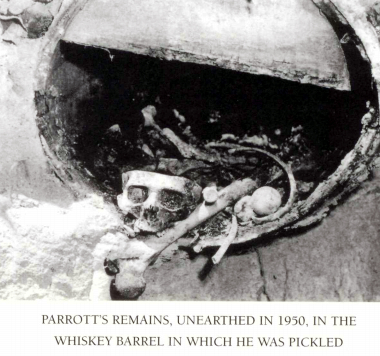
Drs. Thomas Maghee and John Eugene Osborne conducted the autopsy, examined Parrott’s brain, and could find no apparent abnormalities. Osborne then removed a large piece of skin from the dead man’s chest, kept the skullcap, and put the rest of the body in a whiskey barrel full of saline solution, effectively pickling it. The barrel was buried without ceremony, and Dr. Osborne had the skin tanned. He sent the leather to a shoemaker, who made him a pair of shoes with it.

Dr. Osborne was disappointed that Parrott’s nipples weren’t on the tips of the toes like he’d requested (!!!), but you can’t have everything you want in life.

He wore the human leather shoes on special occasions, including at his inaugural ball when he was elected governor of Wyoming in 1890. The skullcap he gave to his fifteen-year-old female assistant, Lillian Heath, who used it variously as a doorstop and an ashtray. (She would grow up to become the first female doctor in Wyoming.)

Parrott’s pickled remains were dug up at a construction site in 1950, and identified after some confusion. His skull, as well as the shoes, are now on display at the Carbon County Museum.

On this day..

1825: Peggy Facto, Plattsburgh infanticide

On this date in 1825, a woman named Peggy Facto was hung on Plattsburgh, N.Y.‘s Broad Street Arsenal Lot.

Facto — or “Facteau,” which variant recalls the French influence here on the shores of Lake Champlain — started her way to the gallows the previous autumn when some neighborhood dogs unearthed the remains of a human infant. It had been partially burned in a fireplace, and when found it still had fast about its throat the cord used to choke it to death. (Plus, of course, the dogs had done their own damage.)

This hideous discovery led back to our day’s principal character, the local mother of two [living] children whose husband had abandoned her due to her affair with a guy named Francis LaBare. Both Peggy and Francis were indicted for “being moved and seduced by the instigation of the devil” to murder their inconvenient bastard immediately after birth.

They faced separate trials for the crime, just hours apart on January 19, 1825, on very similar evidence. Witnesses established the discovery of the body, and an acquaintance named Mary Chandreau testified that she had seen Peggy Facto in an obvious late stage of pregnancy that August. This woman also visited Peggy Facto in jail before trial, and testified that Peggy admitted to having taken a string from one of her gowns to furnish the strangulation-cord.

While this evidence was sufficient to condemn Peggy Facto upon mere minutes of juror deliberation, the same case against Francis LaBare resulted in an acquittal. The mother, who did not testify at her own trial, did take the stand at LaBare’s trial, claiming (according to the notes of the judge), that immediately after she delivered the child, Facto

asked [LaBare] to go find her mother & he refused. She then asked him to go find Mrs. Chandreau & he refused, and next asked him if he meant to let her die there & he said the damned old bitch, I can do better than she can. She then requested him to help her & he did & then the child was born & he took it out and went off & was gone an hour, and when he returned … he came towards her with a knife & threatened her life if she said anything about it.

This quote, and much of what is known about Peggy Facto generally, comes via the research of Plattsburgh judge Penelope Clute. See here and here for HTML versions of the article, or here for a pdf.

It’s difficult to account, on the face of it, for the wildly differential outcomes of these trials; the all-male juries might have something to do with it.

At any rate, while LaBare walked, judge Reuben Walworth* pronounced Facto’s fate with enough fury for two … and a distinct disbelief in Facto’s attempt to blame LaBare:

there are very strong reasons for the belief that your own wicked hands have perpetrated the horrid deed. And if there was any other guilty participator in the murder, that your own wickedness and depravity instigated and persuaded him to participate in your crime. To the crime of murder, you have added the crime of perjury, and that in the face of Heaven, and even on the very threshhold of eternity. I am also constrained to say, it is much to be feared, that you will meet more than one murdered child, as an accusing spirit at the bar of Heaven.

Wretched and deluded woman! In vain was the foul and unnatural murder committed under the protecting shade of night, in your lone and sequestered dwelling, where no human eye was near to witness your guilt.

Facto’s only “appeal” after her half-day trial was the clemency consideration of Gov. DeWitt Clinton, a petition that ended up garnering a great deal of popular support, on three stated grounds:

  1. doubts with many as to the guilt of the convict
  2. as to this being a case that requires a public example
  3. As to the policy of executing any person for the crime of murder when the public opinion is much divided on this subject

Even Judge Walworth ultimately supported this appeal, despite his confidence “that the woman was perfectly abandoned and depraved and that she had destroyed this child and probably the one the year previous, not for the purpose of hiding her shame which was open and apparent to everybody that saw her but for the purpose of ridding herself of the trouble of taking care of them and providing for their support.”

The governor disagreed, arguing that the sort of enlightened people who signed on to death penalty appeals were out of touch with the rank terror necessary to keep the criminal orders cowed.**

So on March 18, 1825, an enormous crowd (fretfully many of them women) summoned from all the nearby towns slogged through spring-muddied roads to be duly cowed by the execution of the infanticide. The condemned, visibly terrified, barely made it through her death-ritual without fainting away, but she managed to re-assert her innocence from the gallows. (Some of the firsthand newspapering is here.)

After execution, Peggy Facto’s remains were turned over to the Medical Society for dissection. “A great many went to see her body, although it had been agreed that it should not be seen,” one woman later recollected in her memoirs. “Many young men went. So much talk was made of this that they said that no other body should ever be given to the doctors.”

* Walworth was a man of illustrious descent; one ancestor, William Walworth, was the Lord Mayor of London who killed Wat Tyler.

Judge Walworth would later become, for two decades, New York’s highest-ranking judicial officer; Walworth, N.Y. and Walworth County, Wisc. are named for him. But the American Walworths were bound for a tragic end … including a scandalous murder.

** “Their excellent character elevates them above those feelings which govern the conduct of the depraved … if terror loses its influence with them then indeed the life of no man will be secure.” For more on the evolution of the idea of “exemplary deterrence” as the death penalty’s raison d’etre, see Paul Friedland.

On this day..

1662: Rose Cullender and Amy Denny, Bury St. Edmunds witches

On this date in 1662, two elderly women were hung at Bury St. Edmunds for bewitching various neighborhood children.

This trial, the second notable witch trial at Bury St. Edmunds in the mid-17th century, got going when a well-off merchant, Samuel Pacy repeatedly declined to buy herring from Amy Denny (also spelled Deny or Duny in various accounts). Denny was heard muttering something indistinct as she left the house, and soon Pacy’s daughter Deborah was seized by the “most violent fits, feeling most extream pain in her Stomach, like the pricking of Pins, and Shreeking out in a most dreadful manner like unto a Whelp, and not like unto a sensible Creature.”

Actually, Deborah had already been hit with “”was suddenly taken with a Lameness in her Leggs, so that she could not stand” even before Amy Denny’s visit. Nonetheless, she apparently called out Amy Denny’s name during her throes of this most recent affliction. When an area doctor couldn’t diagnose the situation, Pacy finally filed a witchcraft complaint.

That was Oct. 28, 1661, when Amy Denny was clapped in irons. Two days later, the heretofore unperturbed eldest daughter (age: 11) came down with the same stuff. Anyone with a bit of experience in multiple-child is probably conjuring up an alternative hypothesis right this moment.

Both girls now commenced a litany of woes, coughing up pins, and reporting visions of evil little witches’ familiars like mice and flies, and having dreams “that Amy Duny and Rose Cullender would appear before them holding their Fists at them, threatning, That if they related either what they saw or heard, that they would Torment them Ten times more than eve they did before.”

Rose Cullender was another local widow of advanced age. Like Denny, Cullender had a pre-existing reputation as a witch.

By the time these two crones went on trial on March 10 — a week before their hangings — three other teenage girls were rocking the same symptoms. They even showed up to court, where they “fell into strange and violent fits, screeking out in a most sad manner, so that they could not in any wise give any Instructions in the Court who were the Cause of their Distemper.” Yet another woman deposed that Amy Denny had, several years before, bewitched both of her children, killing one of them: she said she caught a toad lurking around her ailing child, threw it in the fire, and the next day Denny was covered with burns. She didn’t say why she hadn’t mentioned any of this before.

The scientist Thomas Browne turned up to provide expert testimony that witchcraft did exist and that “the Devil” could exacerbate otherwise natural illnesses arising from an imbalance of the four humours.

stir up and excite such humors, super-abounding in [human] Bodies to a great excess, whereby he did in an extraordinary manner afflict them with such distempers as their bodies were most subject to, as particularly appeared in these children; for he conceived, that these swooning fits were natural, and nothing else but that they call the Mother, but only heightened to a great excess by the subtlety of the devil, cooperating with the malice of these which we term witches, at whose instance he doth these villanies.

Despite the court’s confidence as to the existence of witchcraft (The judge — more on him in a bit — instructed the jury that there could be no question on this point, only as to whether the children at hand were indeed bewitched at the defendants’ hands), it did its best impression of skepticism, trying to verify the sorcery by means of whatever tests it could. Unfortunately, the era’s forensics left something to be desired.

Samuel Pacy’s daughters’ reactions to Amy Denny were tested in a few different ways. For instance, as they sat near-comatose with fists clenched, nobody in the court could pry open their stubborn hands … but they popped right open when Amy Denny touched them. Elizabeth once broke out of her torpor to scratch and claw wildly at Amy Denny.

This little girl failed a more plausible test, however. When she was blindfolded and touched by two different women, she had the same reaction to both Amy Denny and the control contact. This embarrassing result was waved off by the widespread conviction in the courtroom that nobody “should counterfeit such Distempers, being accompanied with such various Circumstances, much less Children; and for so long time.” By the time of the trial, it was fully five months since Amy Denny had tried to get the Pacys to buy her darn herring.

In the end, none of the six still-living children supposedly affected by the witches testified directly. Their creepy presence in court did the talking for them. Within the hour after jurors handed down convictions for both women, all the children were freed of their symptoms. Both women, however, refused the many imprecations to confess and set their souls right before execution on March 17.

Noted jurist Matthew Hale heard the case (he was fresh off an assignment trying Charles I‘s regicides). Hale later became Chief Justice of the King’s Bench.

And his authority in this case survived his death in 1676. In the 1680s there was a (slightly misdated) pamphlet published, “A Tryal of Witches at the Assizes Held at Bury St. Edmonds for the County of Suffolk; on the Tenth day of March, 1664”.

Hale’s reputation gave the weight of juridical precedent to his witchcraft superstition.

Across the pond in New England, the Salem witch trials judges would refer to this very case when determining to admit so-called “spectral evidence” from the shitty little fabulistspossessed children who accused various townsfolk of enspelling them.

Witch trials apologist Cotton Mather dedicated a whole chapter (under the title “A Modern Instance of Witches, Discovered and Condemned in a Tryal, before that Celebrated Judg, Sir Matthew Hale”) to the authority established by the Cullender-Denny trial.

It may cast some Light upon the Dark things now in America, if we just give a glance upon the like things lately happening in Europe. We may see the Witchcrafts here most exactly resemble the Witchcrafts there; and we may learn what sort of Devils do trouble the World.

The Venerable Baxter very truly says, [“]Judge Hale was a Person, than whom no man was more Backward to condemn a Witch, without full Evidence.[“]

Now, one of his latest Printed Accounts about a Tryal of Witches, is of what was before him … it was a Tryal, much considered by the Judges of New-England.

… [Mather spends several pages outlining the investigation and trial] …

The next Morning, the Children with their Parents, came to the Lodgings of the Lord Chief Justice [i.e., Hale, although he was not Chief Justice in 1662], and were in as good health as ever in their Lives; being restored within half an Hour after the Witches were Convicted.

The Witches were Executed, and Confessed nothing; which indeed will not be wondered by them, who Consider and Entertain the Judgment of a Judicious Writer, That the Unpardonable Sin, is most usually Committed by Professors of the Christian Religion, falling into Witchcraft.

We will now proceed unto several of the like Trials among our selves.

On this day..