1969: The peasants of Thanh Phong (allegedly)

Late this night in 1969, a platoon of seven Navy SEALs slipped into the Mekong Delta village of Thanh Phong.*

At their head was a 25-year-old lieutenant, the future United States Senator Bob Kerrey.

Thanh Phong was reportedly an official U.S. Army free fire zone. That meant that any Vietnamese civilians within it were presumptively enemies and could be slain at will — according to the U.S. Army, if not to any recognizable law of war.

In Thanh Phong, they were slain. Nearly every single person in the town.

Gregory Vistica’s disturbing investigation brought this story to wide public attention in 2001; he subsequently expanded his investigation into a book.

Kerrey’s Raiders — the commando team’s comradely self-designation — were hunting a local National Liberation Front “general secretary” purported to be in Thanh Phong. By “hunting,” we mean they intended to murder him; given the nature and timing of the operation, it was presumably part of the brute-force assassination program Operation Speedy Express and/or its equally sinister CIA-run cousin, the Phoenix Program.

On this particular mission, Lt. Kerrey’s team first encountered an unexpected hut, not on their map. Fearing the people inhabiting it would blow their cover, they entered and killed the five inhabitants: quietly, intimately, at close quarters with their knives. It was an old man, a woman, and three young children. It’s a nasty business but it’s not what qualifies Thanh Phong as a potential execution … though it may explain the execution that followed.

After these unfortunate villagers were disposed of, the SEALs moved on towards the doomed hamlet. This same platoon had been to Thanh Phong two weeks before, and reported then that it held nothing but a few women. On February 25, they found much the same scene: no “general secretary.” Just 16 women and children.

Gerhard Klann, one of Kerrey’s men, described the SEALs’ actions that night in this interview with 60 Minutes’ Dan Rather:

Rather: What’d you do this time?

Klann: We gathered everybody up, searched the place, searched everything.

Rather: What was the make-up of this group?

Klann: Probably a majority of em were kids. And women. And some younger women.

Rather: So you got all the people out of there.

Klann: We herded them together and in a group.

Rather: Were any of these people armed?

Klann: I don’t believe so.

Rather: Fair to say you didn’t see any weapons?

Klann: I didn’t see any.

Rather: Did you decide pretty quickly or not that the target of your mission, the Viet Cong leader, was not among them?

Klann: Yeah, we got together and we were, hey the guy ain’t here. Now we got these people, what do we do now?

Rather: What did you do then?

Klann: We killed them.

Rather: What do you mean, you killed em?

Klann: We shot them all.

Rather: Was an order given for that or was it more or less spontaneous?

Klann: I don’t think we would have acted spontaneously on something like that. There was an order given.

Rather: What was the order?

Klann: To kill them.

Rather: Why?

Klann: Cause we’d already compromised ourselves by killing the other group.

Rather: Whose responsibility, whose obligation as it to say that?

Klann: The ultimate responsibility fell on Bob Kerrey.

Rather: Do you remember him saying that?

Klann: I don’t remember his exact words, but he was the officer in charge. The call was his.

Rather: And then what happened?

Klann: We lined up, and we opened fire.

Rather: Individually or raked them with automatic weapons fire?

Klann: No. We, we just slaughtered them. It was automatic weapons fire. Rifle fire.

Rather: At roughly what range?

Klann: Six feet, ten feet, very close.

Rather: Then did the shooting stop?

Klann: Yeah, for a little bit.

Rather: Was it quiet?

Klann: It was dead quiet. It was dead quiet. Then you could just hear certain people, hear their moaning. So we would just fire into that area until it was silent there. And that was it. And, and until, we were sure that everybody was dead.

Rather: You said certain people were moaning or making noises. Were all those adults?

Klann: A few. I remember one baby still crying. That baby was probably the last one alive.

Rather: What happened to that baby?

Klann: Shot like the rest of em.

Klann’s testimony of a summary execution comports with that of a Vietnamese woman who says she hid on the outskirts of the tiny village and witnessed the slaughter.

Bob Kerrey has a different version of these events. The reader is invited to peruse the evidence available and conclude as desired; for me, Kerrey’s version is not very persuasive especially given the witness testimony to the contrary and the known normalization of atrocities in Indochina.

Kerrey agrees with Klann that the entire village ended up slaughtered together in a heap; a complaint against this atrocity was officially filed with the Army by Vietnamese locals within days of the incident, so there’s not much scope to deny the outcome. But Kerrey claims this happened when the SEAL team received incoming fire as they approached the village, then started shooting back wildly in the dark. Only after the bullets stopped flying did they find the civilians 50 to 100 yards further on.

Improbably — but much more consistent with an intentional, close-range massacre — all these women and children chanced to be huddled together, and all of them were stone dead from the crossfire. Not a one of these people accidentally winged in the night was wounded but alive, says Kerrey.

Kerrey’s commentary in Vistica’s initial story and its follow-ups suggests the judicious politician he had by that time become. In 2001 he had just retired from the Senate and was an elder statesman in government; he was said to be weighing a 2004 presidential bid. (His actual next gig, not anticipated at the time the story broke, was the 9/11 Commission.)

In interviews with Vistica and subsequently, Kerrey waffled and qualified cagily — shifting from a flat denial, to a weird acknowledgment that “it’s possible a slight version of that happened.” He wouldn’t commit to asserting that there really was incoming fire. He moved the conversation wherever possible to the abiding torments of conscience and the slipperiness of memory and perspective, as if this could span the distance from “summary execution” to “accidentally killed in the crossfire.” He maintained that there were only men in the first hut — that hut, alone among the village — but that this was only an indirect recollection since he didn’t enter it or participate in the killings.

“Please understand,” Kerrey emailed to Vistica in 2000, “that my memory of this event is clouded by the fog of the evening, age and desire.” Desire is a striking word to select.

For all their plausible deniability, Kerrey’s remarks on this matter markedly lacked indignation at bearing such a monstrous charge. Kerrey’s great and unfeigned sense of personal guilt was oddly mirrored by his inability to own a specifically culpable act. The Senator expressly declined to deny Gerhard Klann’s “memory.” (Klann said Kerrey urged him not to talk about Thanh Phong.)

Kerrey won a Bronze Star for Thanh Phong. “The net result of his patrol,” according to a citation Kerrey has acknowledged is fanciful, “was 21 Viet Cong killed, two hooches destroyed and two enemy weapons captured.”

Seventeen days after Thanh Phong, Kerrey’s service career came to an end when a grenade exploded at his feet during another assassination mission. Kerrey earned the Congressional Medal of Honor for continuing to direct fire while crippled by wounds on that day; by accounts, he spent the several years following mired deep in depression.

“I went out on a mission and after it was over I was so ashamed I wanted to die,” he said of Thanh Phong in 2001. “This is killing me. I’m tired of people describing me as a hero and holding this inside.”

It goes without saying that war crimes in Vietnam remain much too sensitive for the U.S. to grapple with formally. The story is out there now, but it’s been effectively reburied as far as the American public memory goes — another everyday horror in a horrible conflict. More information might oneday surface, but the matter will only be adjudicated between Gerhard Klann, Bob Kerrey, their comrades that night, and their Maker.

Not so in Vietnam where — with all due respect to the pangs that conscience can exact — the real victims lie.

February 25, 1969 has a dedicated exhibit in Ho Chi Minh City’s War Remnants Museum.


A display of the sewer pipe where the three children killed at the first hut tried to hide, along with photographs and an explanatory placard describing the Thanh Phong massacre, at the War Remnants Museum in Ho Chi Minh City. (cc) images by Schwede66.

* The only other member of the team who has spoken publicly, Mike Ambrose, backs Klann’s version of the hut narrative, and (mostly) Kerrey’s version of the (non-)execution. As Vistica’s initial investigation was going public, Kerrey convened a meeting of the other Raiders, their first since Vietnam; the group issued a statement denying that they had committed an execution of prisoners.

On this day..

Purim

February 24, 2013 is the Jewish festival of Purim. (Actually, it began at sundown last night.)

This holiday, corresponding to 14 Adar of the Hebrew calendar, falls on different dates of the Gregorian calendar (most often in March). It commemorates a bloody story from the Book of Esther. (The quotes in this post are from this translation of Esther.)

The factual historicity of Esther is pretty questionable, but that debate is a bit beside the point for purposes of the present post. As folklore or fact, the story of Esther and Mordecai, of their near-destruction and the consequent execution of their persecutor, is a staple of tradition and literature.


The thumbnail version of the Purim story has Esther (Hadassah), a Jew living in the Persian capital of Susa, plucked out of obscurity to become the (or a) queen of a “King Ahasverus”.

If Esther has a historical basis, this would be about the fourth or fifth century B.C.E., and “Ahasverus” could be Xerxes (the guy who invaded Greece and made Herodotus famous), or the much later Artaxerxes II.

Esther is an orphan being raised by her cousin Mordecai, and when Esther wins “Who Wants To Live In The Persian Harem?” Mordecai advises her to keep judiciously silent about her Hebrew lineage.

Mordecai doesn’t manage the same trick, however, and offends the king’s powerful minister Haman by refusing to bow to him. This gets the overweening Haman upset at not only Mordecai but at all Jews who share his anti-idolatry scruples, and Haman persuades King Ahasverus to authorize their indiscriminate slaughter:

“There is a certain people scattered abroad and dispersed among the peoples in all the provinces of your kingdom; their laws are different from those of every other people, and they do not keep the king’s laws, so that it is not for the king’s profit to tolerate them. If it please the king, let it be decreed that they be destroyed.”

13 Adar is the date fixed for the Jews’ destruction, by pur, a casting of lots — hence the festival’s eventual date and name. Haman, of course, does not realize that this policy makes Esther his enemy.

In order to save her cousin and her people, Esther must risk a death sentence of her own by approaching the king unbidden in his inner chambers. Mordecai charges her to her duty with a timeless moral force:

“Think not that in the king’s palace you will escape any more than all the other Jews. For if you keep silence at such a time as this, relief and deliverance will rise for the Jews from another quarter, but you and your father’s house will perish. And who knows whether you have not come to the kingdom for such a time as this?”

Esther pulls this dangerous maneuver off, and gains thereby a private audience with just the king and Haman. There, she springs her trap — revealing her Jewish identity.

The king again said to Esther, “What is your petition, Queen Esther? It shall be granted you. And what is your request? Even to the half of my kingdom, it shall be fulfilled.”

Then Queen Esther answered, “If I have found favor in your sight, O king, and if it please the king, let my life be given me at my petition, and my people at my request. For we are sold, I and my people, to be destroyed, to be slain, and to be annihilated. If we had been sold merely as slaves, men and women, I would have held my peace; for our affliction is not to be compared with the loss to the king.”

Then King Ahasverus said to Queen Esther, “Who is he, and where is he, that would presume to do this?”

And Esther said, “A foe and enemy! This wicked Haman!” Then Haman was in terror before the king and the queen.

Word arrives at this inopportune juncture that Haman, who has been gleefully preparing his vengeance, has just had completed a 50-cubit (~20-meter) gallows to execute Mordecai upon. The enraged king instead orders Haman hung on it.

“Hanging” Haman on the “gallows” was traditionally interpreted in the ancient and medieval world as crucifixion,* or some analogously excrutiating way to die.

By any method of execution, though, the dramatic power of the scene — sudden reversal of fortune, virtue elevated over wickedness, the oppressed turning the tables on their oppressors, divine deliverance — is obvious.

Haman and his gallows have consequently stood as a potent literary device ever since: for perfidious council; for violent anti-Semitism; for unusually spectacular punishment (to be hung “as high as Haman”); for the concept of getting one’s comeuppance or being hoisted by one’s own petard.

At least the guy was remembered. Hands up if you can name any other ancient Persian courtier.


“The Punishment of Haman” is a corner of Michelangelo’s Sistine Chapel.

However, this satisfying palace politics turnabout is not the end of the story, and punishment is not reserved only for the wicked minister.

Esther persuades the king not only to revoke Haman’s order, but to issue a new one — one that Esther and Mordecai will write tabula rasa over the king’s seal.

The writing was in the name of King Ahasverus and sealed with the king’s ring, and letters were sent by mounted couriers riding on swift horses that were used in the king’s service, bred from the royal stud. By these the king allowed the Jews who were in every city to gather and defend their lives, to destroy, to slay, and to annihilate any armed force of any people or province that might attack them, with their children and women, and to plunder their goods, upon one day throughout all the provinces of King Ahasverus, on the thirteenth day of the twelfth month, which is the month of Adar

So the Jews smote all their enemies with the sword, slaughtering, and destroying them, and did as they pleased to those who hated them. In Susa the capital itself the Jews slew and destroyed five hundred men, and also slew Parshandatha and Dalphon and Aspatha and Poratha and Adalia and Aridatha and Parmashta and Arisai and Aridai and Vaizatha, the ten sons of Haman the son of Hammedatha, the enemy of the Jews; but they laid no hand on the plunder. That very day the number of those slain in Susa the capital was reported to the king.

And the king said to Queen Esther, “In Susa the capital the Jews have slain five hundred men and also the ten sons of Haman. What then have they done in the rest of the king’s provinces! Now what is your petition? It shall be granted you. And what further is your request? It shall be fulfilled.”

And Esther said, “If it please the king, let the Jews who are in Susa be allowed tomorrow also to do according to this day’s edict. And let the ten sons of Haman be hanged on the gallows.”

So the king commanded this to be done; a decree was issued in Susa, and the ten sons of Haman were hanged. The Jews who were in Susa gathered also on the fourteenth day of the month of Adar and they slew three hundred men in Susa; but they laid no hands on the plunder.

Now the other Jews who were in the king’s provinces also gathered to defend their lives, and got relief from their enemies, and slew seventy-five thousand of those who hated them; but they laid no hands on the plunder.


This bloodbath is obviously a bit more ethically problematic than Haman’s individual fate.

Now, sure, this is an event of questionable authenticity situated in Iron Age tribal mores and exaggerated by the ubiquitous ancient inflation of head counts. The subtext (“defend their lives” … “relief from their enemies”) also implies something like civil strife, blows exchanged rather than merely blows delivered. The overt text says that the victims were people who intended to do exactly the same thing to the Jews.

Still, the plain words on the page says 75,000 humans were slaughtered by a mobilized ethno-nationalist group, “children and women” among them. Just imagine the same parable about a Serb in a Bosnian king’s court, and say a little thanksgiving that the Book of Esther doesn’t identify these 75,000 as constituents of any specific demographic group that remains a going concern today.

Purim is a beloved holiday among its celebrants, but most any explication of it on the Internet comes with a comment thread agonizing over (or rationalizing) the body count. (For example.)

That part of the narrative has unsurprisingly invited highly prejudicial interpretations, especially among hostile Christian interlocutors (pdf).

American pastor Washington Gladden called the first Purim “a fiendish outbreak of fanatical cruelty.”

The fact that the story was told, and that it gained great popularity among the Jews, and by some of those in later ages came to be regarded as one of the most sacred books of their canon is, however, a revelation to us of the extent to which the most baleful and horrible passions may be cherished in the name of religion … it is not merely true that these atrocities are here recited; they are clearly indorsed.

The Nazis promoted the Jews-as-mass-murderers version, too; there’s even an instance where the Zdunska Wola ghetto was required to provide ten Jews to hang for the ten hanged sons of Haman. The frothing anti-Semitic propagandist Julius Streicher, being positioned on the trap for execution after the Nuremberg trials, reportedly bellowed “Purim Fest 1946!” to the witnesses.

Blessedly Purim Fest is not ultimately defined by the likes of Streicher, nor by the bloodthirstiness that is this site’s regrettable stock in trade. For most observants it’s simply one of the most joyous holidays of the year, a time for gifts and feasting and dress-up and carnivals and celebration sometimes thought of as the “Jewish Mardi Gras” or “Jewish Halloween”. Adherents have even been encouraged in all religious solemnity to drink in celebration until they can no longer tell “blessed be Mordecai” from “cursed be Haman.”

Deliverance indeed. L’chaim.

* The concept of Haman crucified in turn encouraged Jews under Christendom to use the figure of Haman (who once upon a time, could be subject to Guy Fawkes-like effigy-burning on Purim) as a veiled stand-in for the current oppressor Christ, and/or encouraged Judeophobic Christians to impute this intention to Purim observances.

On this day..

1864: The Kinston hangings

Even the most casual student of the U.S. Civil War will know of Confederate Gen. George Pickett, namesake of Pickett’s Charge during the 1863 Battle of Gettysburg.

But it was for what Pickett did on this date in 1864 — much less well-recalled today but to the 1864 New York Times correspondent exemplifying “the madness of rebel leaders” — that he had to flee to Canada after the war, for fear of being prosecuted for committing a war crime.

Book CoverGeneral Pickett is far removed now from the high-water mark of the Confederacy, scrapping in eastern North Carolina, where loyalties in the Civil War are quite divided.

There, the federals had held the town of New Bern going on two long years. Pickett was detailed to mount an assault upon it, which failed, but netted him a number of Union prisoners.

Desertion plagued the Confederate army in general.

North Carolina men in particular had a reputation (of arguable veracity) for absenting themselves; and, as the state as a whole was the most reluctant (and last) seceder, no small number of those deserters were ducking out for ideological reasons. Plenty of onetime Confederate conscripts who conceived greater loyalty to the Union than to their state shed gray uniforms for blue.

Licking his wounds from the New Bern sortie down the road at Kinston, Pickett recognized a couple of his prisoners as his own former soldiers. They had a testy exchange with the beaten general, and Pickett had them up for a summary court martial in a flash. On February 5, Joe Haskett and David Jones were hanged for desertion.


There followed an interesting exchange between the rival commanders.

Intending to forestall any tit-for-tat killings of POWs, the Union general warned Pickett to treat them humanely.

Major-General Pickett,
Dept. of Virginia and North Carolina, Confederate Army:
General: I have the honor to include a list of 53 soldiers of the U. S. Government who are supposed to have fallen into your hands on your late hasty retreat from before New Berne. They are the loyal and true North Carolinians and duly enlisted in the Second North Carolina Infantry. I ask for them the same treatment in all respects as you will mete out to other prisoners of war.

I am, very respectfully, your obedient servant,
JOHN J PECK

Pickett must not have appreciated having his martial prowess busted on by his opposite number, because he returned a sarcastic reply promising to use Peck’s list to identify deserters. (In a subsequent letter, he threatened to meet retaliations with 10-for-1 hangings. Pickett showed an “imperious and vaunting temper” in the postwar judgment of Attorney General Holt. Or more directly put, he comes off as an asshole.)

GENERAL: Your communication of the 13th instant is at hand. I have the honor to state in my reply that you have made a slight mistake in regard to numbers, 325 having “fallen into your(our) hands in your (our) late hasty retreat from before New Berne,” instead of the list of 53 with which you have so kindly furnished me, and which will enable me to bring to justice many who have up to this time escaped their just deserts. I herewith return you the names of those who have been tried and convicted by court-martial for desertion from the Confederate service and taken with arms in hand, “duly enlisted in the Second North Carolina Infantry, U S Army.” They have been duly executed according to law and the custom of war.

Your letter and list will, of course, prevent any mercy being shown any of the remaining number, should proper and just proof be brought of their having deserted the Confederate colors, many of these men pleading in extenuation that they have been forced into the ranks of the Federal Government.

Extending to you my thanks for your opportune list,

I remain, very respectfully, your obedient servant,
G. E. PICKETT

He did it, too.

The Confederate chaplain John Paris recounted for his side’s press the scene, a baker’s dozen of men on a large platform, heads sacked, an unknown cross-eyed executioner waiting to strip the bodies of their clothes as payment. Most were local boys, dying shockingly under the eyes of their own family and acquaintances. Reportedly, a number of shaken Confederate soldiers deserted to New Bern after witnessing the scene.

The thirteen marched to the gallows with apparent resignation. Some of them I hope were prepared for their doom. Others I fear were not. On the scaffold they were all arranged in one row. At a given signal, the trap fell, and they were in eternity in a few moments. The scene was truly appalling. But it was as truly the deserters doom. Many of them said I never expected to come to such a end as this. But yet were deserters, and as such they ought to have expected such a doom. The names of these misguided men were, John I Brock, Wm. Haddock, Jesse Summerlin, A I Brittain, Wm. Jones, Lewis Freeman, Calvin Huffman, Stephen Jones, Joseph Brock, Lewis Taylor, Charles Cuthrell, W. C. Daughtry and John Freeman.

The knell of vengeance has sounded. … deserters in North Carolina must now open their eyes, from the mountain to the seaboard. Desertion has become in our army a desperate disease, and desperate cases require desperate remedies. Let fathers, mothers, brothers, sisters and wives, exhort their friends at all times to be faithful to their country under all circumstances.

In all, 22 alleged deserters hanged over the course of February in this affair, the 13 executed together on February 15 obviously accounting for the lion’s share. The incident is the likely inspiration for the novella published later in 1864 by a Confederate North Carolina cavalryman: The Deserter’s Daughter; most certainly, Kinston made the rounds in the North to great indignation.

And an event so notorious was bound to draw attention with the end of the war: even in 1864, the New York Times had editorialized demanding “instant and relentless retaliation … there could be no such thing as acquiescence or empty protest. Even if the Government could bring itself to this abject mood, the public indignation would not tolerate it.” Officers who had been stationed at New Bern did not neglect to keep this sentiment alive in the chain of command, pushing for punitive action to avenge their former comrades.

In the end, there would be none.

Playing it safe, Pickett skipped out for Canada (and even changed his appearance) in 1865 as a board appointed by Secretary of War Edwin Stanton opined that he and other parties to the hangings were “guilty of crimes too heinous to be excused by the United States government … there should be a military commission immediately appointed for [their] trial … to inflict upon [them] their just punishment.” That was especially so as it emerged that some of the hanged had “deserted” from stuff like bridge guards and state militias — not (in the view of prosecution-minded Unionists) the Confederate army proper.

But as the investigations continued into 1866, they zeroed in on Pickett as their specific target. And, they ran out of steam — or into a stone wall.

In 1866, Pickett appealed from exile to Ulysses S. Grant, who just so happened to be an old West Point chum of Pickett’s.* “Certain evil disposed persons,” Pickett wrote, “are attempting to re-open the troubles of the past.” With the Supreme Court’s Ex parte Milligan ruling, the prospect of a military tribunal evaporated.

Grant had the case shelved, even against Congressional appeals, until everybody just gave up and dropped it. “I do not see how good, either to the friends of the deceased, or by fixing an example for the future, can be secured by his trial now,” Grant said once of his old associate. Plus ça change.

Pickett lived until 1875, selling insurance without legal molestation but also shadowed by the dark cloud of Kinston. After his death at age 50, his wife went on to rehabilitate Pickett’s reputation in the popular eye.

But not in every eye.

As late as the turn of the century, a veteran’s polemic was dedicated to excoriating not only Pickett, but Grant and the Union men who had declined to punish him.

We’ve only outlined the Kinston story in this post, but much more detailed narratives can be found at:

* In fairness to U.S. Grant, we are bound to report his stated reason for opposing any prosecution of Pickett: it would violate the grant of clemency he himself had made to secure General Lee’s surrender at Appomattox.

On this day..

1841: Archilla Smith, Trail of Tears Cherokee

On this date in 1841, Archilla Smith was hanged over a tree branch in Cherokee Country (since the gallows hadn’t been delivered in time) for the murder of John MacIntosh.

Our narrative for this event is Indian Justice: A Cherokee Murder Trial at Tahlequah in 1840, a volume derived from the reports of 19th century poet John Howard Payne, who’s best known for writing “Home! Sweet Home!”.

Payne lived with the Cherokees in Georgia immediately preceding their forcible removal to Oklahoma along the Trial of Tears, and then repaired to Oklahoma with the evicted tribe. (Payne unsuccessfully lobbied the U.S. Congress against its removal policy.)

The procurement of Cherokee signatures on the treaty that gave legal cover to the tribe’s expulsion from Georgia was a source of bitter controversy … and a generation of internecine violence. Our principal for this date’s post, Archilla Smith, himself affixed an X-mark to this notorious document, and he was defended at the trial in question here by another signer, Stand Watie.

Payne’s book, however, does not much treat the political context of Indian removal, nor even read as something like a true crime book: the brawl between the killer and the victim, two aggressive men with a passing and private quarrel, is little more than the background fact; the question for the jury turned on little but the degree of wilfulness or intent in the fatal stab wound Smith dealt, and various witnesses describe the same scene of their melee with slight differences of shading.

Rather, it’s a courtroom drama, and an outsider’s sketch of Cherokee jurisprudence (amalgamating tribal and Anglo-Saxon practices) circa 1840. It’s also the first newspaper any Oklahoma trial.

There as no appearance of bitter feeling on either side. The accused and the judge and jury and spectators, all seemed in the best of humor with one another. The accused smoked much of the time; and his judge, and most of the jury, every now and then would get up and go across the log-court to him with “Arley, lend me your pipe;” and receive his pipe from his mouth (as is the Indian custom); and revel in the loan of a five minutes’ smoke. … The wife and handsome young daughter of the accused attended … His three young sons, one a boy about ten, — the others about twelve and fifteen, were in the court room nearly all the time, and often sat by their father’s side.

-Payne

At one point, the judge digresses into the ancient right of clan vengeance and dismisses it in view of the “improved” system. But Payne’s postscript notes that one of Smith’s own jurors (from the first jury) would himself be killed just days after the execution when the juror attempted to exact family retribution on a murderer who had been acquitted in court. This is the snapshot of an evolving society.

Archilla Smith’s first jury hung. The second jury tried to hang, but was forced by the judge to come to a conclusion. Finally, it convicted Smith on December 26, 1840. Smith took word of his fate evenly.

“You are every one of you old acquaintances of mine, Jurors,” he remarked after hearing his fate. “You have been several days engaged about my difficulty. But I have no hard thoughts against any one of you, Jurors, nor Judge, against you. I believe your object has been that my trial should be a fair one.”

Cherokee law required that after five days, the sentence be executed. Accordingly, the hanging was fixed for New Year’s Day at noon.

Because there was also no tribal prison, Smith was simply held under guard in a log hut, and was able to get around the new Cherokee capital of Tahlequah with those guards. In Payne’s narrative, this invites no trouble on the part of the prisoner, whose bonhommie even after his death sentence belies the ill-tempered knife-slayer described by court witnesses. (Though Smith did once try to bribe his guard to let him escape.)

Accordingly, on one of those five days between sentence and hanging, Archilla Smith and his friends simply rode up to the Cherokee Chief John Ross to appeal personally for a pardon. He’d obtained about two hundred signatures on a petition supporting such an act of clemency.

Nevertheless, Ross, a foe of the removal treaty and of Stand Watie,* told them that the matter was out of his hands … but Smith and his party still ate dinner at Ross’s home that evening and nothing untoward occurred. Open hospitality was a Cherokee custom, and Ross regularly entertained dozens of visitors at his two-and-a-half-story log house, “as many as the table can accommodate.”

When the hang-day finally came, two different men preached under the noose.

The first, an Anglo named Worcester, who issued a bog-standard 19th century Anglo hanging sermon in English:

Almighty God! We see before us an awful instance of thy power. May it eventuate in an equally impressive exemplification of thy love. May the bitter fruit of the one sin for which atonement is now about to be exacted, procure the pardon of many. May it not only produce sincere penitence and consequent acceptance with thee, in the unhappy sufferer who now stands upon the threshold of eternity, but operate as a warning to all who either witness or hear of his fate. May it show this people to what dreadful results intemperance may lead; and when they see that the great commandment ‘whoso sheddeth man’s blood, by man shall his blood be shed’ cannot be evaded; may it bring them to a salutary meditation through which all may be converted. In the name and through the meditation of our blessed Savior, we ask that the influences of the Holy Spirit may draw this blessing on the nation; and may the victim now offered up to the violated laws have cause to bless a doom, which if it awaken him to a proper knowledge of Thee and of himself will yet prove to him a happiness and a mercy into thy hands, oh blessed Savior, we commend his spirit.

The second gallows-preacher was a half-blood Protestant minister named Reverend Young Wolf — and this reverend had actually been the foreman of the jury which condemned Archilla Smith in the first place. Young Wolf preached in Cherokee, thus:

God of heaven! Creator of all things! Thou, who knowest our inmost thoughts I pray to thee have mercy on this man. He is standing on the threshold of death. He will presently leave this world to enter the world of spirits. Thou canst see into his heart. Thou art aware whether the charge for which he suffers is true or not. If he is guilty, I supplicate thee to forgive all his sins. Into thy hand we submit ourselves. We assemble together as a people to witness the death which our friend is about to suffer; and may it make us remember that we too, are born to die sooner or later, and prepare to meet thee in peace. May the view of thy power which we are now beholding, humble us before thee. May we continue humble. We are now about to part with our friend Archilla. We give him up to thee. May he receive thy pardon for his sins, that hereafter we may all come together again before thy throne and unite there in thy praise!

The doomed addressed the multitude last.

He, too, spoke in Cherokee, and the natives whom Payne spoke with were divided as to whether the “escapes” and “third time” which Smith mentioned referred to the two times that his juries refused to convict him, or to two previous, undetected crimes.

Friends, I will speak a few words. We are to part. You will presently behold how evil comes. I do not suffer under the decree of my Creator but by the law passed at Tahlequah. — Friends, you must take warning. — I think, perhaps, that my being hated has brought me to this. No man can hope every time to escape; and the third I have been overtaken by the law. But avoid such practices. — I suppose I was preordained to be executed in this manner. I am ready to die. I do not fear to die. I have a hope, there, to live in peace. (Tears now gushed from his eyes.) I should not have shed tears had not the women come here to see me. — I have no more to say.

* Ross and Watie were lead figures of the rival factions within the Cherokee polity, and they would be recognized as opposing chiefs by the Union and the Confederacy (respectively) during the coming U.S. Civil War. Stand Watie lives on in bar bets: he has the distinction of being the last Confederate general (and his First Indian Brigade the last Confederate force in the field) to surrender to the Union, on June 23, 1865.

On this day..

1996: Lem Tuggle, Tim Kaine client

Tim Kaine, who governed the Commonwealth of Virginia from 2006 to 2010 and was just last month elected to the U.S. Senate, had a different service to perform on this date in 1996.

Kaine saw his client, double-murderer Lem Tuggle, to the Virginia execution chamber on December 12, 1996.

In 1983, fresh off parole for a 1971 homicide, Tuggle raped and shot 52-year-old Jessie Geneva Havens.

“From past experience, I would like to talk to an attorney,” he told the officer who arrested him. “I’ll probably tell you the full story later.”

In this selfsame spring of 1983, 25-year-old Timothy Michael Kaine was receiving his J.D. from Harvard Law. He moved to Richmond, Va., with his classmate Anne Holton, daughter of the state’s former governor.

Kaine and Holton married in 1984.

This was also an eventful year for the now-twice-convicted killer Lem Tuggle: together with five other condemned inmates, Tuggle sensationally busted out of Mecklenburg Correctional Center — capturing several prison guards, making up a phony bomb threat, and simply strolling out the gates in their stolen uniforms during the confusion.

The “Mecklenburg Six”* cast a terrifying pall in the headlines of June 1984; it took weeks to recapture them all. Tuggle, sensibly, made a bid for Canada’s death-penalty-free soil, only sparing Ottawa a major diplomatic headache when he stopped to rob a Vermont diner for gas money and got arrested.

Kaine’s path was destined to cross with this notorious convict, but not for some years yet. In the meantime, the idealistic young J.D. in his first year at the bar was getting acquainted with death row when he accepted a pro bono legal appointment to represent condemned killer Richard Lee Whitley.

A lifelong Catholic who had spent a youthful finding-himself year working at a mission in Honduras, Kaine was (and remains) a death penalty opponent. This would later prove a sticky wicket, but mid-1980s Kaine didn’t have a career in politics on his radar, as evidenced by his distinctly impolitic remark that “murder is wrong in the gulag, in Afghanistan, in Soweto, in the mountains of Guatemala, in Fairfax County … and even the Spring Street Penitentiary.”

Later, when he was in politics, Kaine would tell a reporter profiling him during the 2005 gubernatorial campaign that he didn’t want the assignment but would have felt like a “hypocrite” to refuse it. The Commonwealth was less easily overcome than Kaine’s scruples, and Whitley died in Virginia’s electric chair on June 6, 1987.

“I just remember sitting on my back step late and just having a couple of beers and just staring out at my backyard,” Kaine recalled of the night he lost his client.

Having had this first taste of failing with a man’s life on the line while being publicly vilified for his work, Kaine signed on to represent Tuggle in 1989.

By the time Tuggle’s legal rope ran out in 1996, Tim Kaine was a 38-year-old Richmond city council member — the trailhead for his new and now-familiar career in politics.

As Kaine elevated himself into a statewide figure in the early 2000s, his death penalty position came in for some controversy which Kaine finessed by taking the position that while he himself opposed capital punishment, he would enforce the state’s death penalty law in his capacity as governor.**

Death penalty stuff has ample third-rail potential, but especially in Kaine’s gubernatorial race, his own personal legal work at the defense bar became fodder for some truly repellent attack ads by the mouthbreather lobby who tried to put Kaine personally on the hook for Tuggle’s crimes by virtue of having represented the man in court.

* The other five were Linwood Briley, James Briley, Earl Clanton, Willie Leroy Jones, and Derick Peterson. All of these men were also executed.

** That was indeed the case. Gov. Kaine commuted only one death sentence, that of Percy Walton, while allowing 11 others to go forward. D.C. sniper John Muhammad was the most notorious man with Kaine’s signature on his death warrant.

On this day..

1864: Retaliatory executions by John Mosby

Though executioners don’t quite bat 1.000 — who does, at any human endeavor? — the field on the whole succeeds more often than not.

On this date in 1864, the Confederate guerrilla John S. Mosby had seven Union prisoners executed, but he only managed to kill three of them — an efficiency very well below the Mendoza Line for the executioner’s trade.

It was a rare competence gap for the brilliant cavalryman.

The irregulars Mosby commanded in the Shenandoah Valley had frustrated for six months the consolidation of rampant northern armies, thereby preserving the Confederate capital of Richmond and extending the Civil War.

The situation had quick become intolerable for the Union, and Gen. Ulysses Grant emphasized (pdf) to Gen. Phil Sheridan the cruel anti-insurgent tactics he would countenance for “the necessity of clearing out the country so that it would not support Mosby’s gang. So long as the war lasts they must be prevented from raising another crop.”

By way of example-setting, the Union army had summarily executed six of Mosby’s rangers at Front Royal in September — followed by a seventh who was captured in early October in Rappahanock County.

Incensed, the Confederate “gray ghost” began stockpiling blue bodies from the offending command of George Armstrong Custer — yes, the Little Bighorn guy; he was perceived by Mosby to be responsible for the atrocity, although the actual paper trail on the execution order seems to be a little sketchy.

Mosby, who fancied himself the genteel sort who would closely abide the laws of war when fighting for the right to maintain human chattel, sent a lawlerly appeal up the chain of command seeking permission “to hang an equal number of Custer’s men.” General Robert E. Lee and Confederate Secretary of War James Sedden granted it.

Twenty-seven captives were therefore assembled and subjected to a lethal lottery. Jay Simson’s Custer and the Front Royal Executions of 1864 recounts this horrible affair in an excrutiatingly page-turning narration.

The preparations began innocently enough on a quiet Sunday morning (November 6, 1864) when 27 Union prisoners of war were ushered with no explanation about what was happening out of a brick storehouse located in Rectortown, Virginia …

[They] were then marched to the banks of Goose Creek, about half a mile away. some, but definitely not all, of this specially selected pool of 27 prisoners belonged to Custer’s commands both past and present … [but] of the seven men eventually selected to die on Mosby’s orders only two were actually members of the Michigan Cavalry Brigade.

All 27 of the prisoners were lined up along Goose Creek and then made to draw slips of paper from a hat. Twenty of those slips of paper which were part of the macabre lottery were simply that, blank pieces of paper. The other seven — one for each of Mosby’s men executed at Front Royal and in Rappahanock County — were marked with a number …

Of the men who were forced to draw those slips of paper, some of them simply stared into space. Others, once they understood what was happening, prayed. There were a few of them who simply broke down.

Among the prisoners was a young drummer boy … who broke down completely, sobbing … He drew a blank slip and immediately proclaimed: “Damn it, ain’t I lucky!” When a second drummer boy was found to be unlucky enough to have drawn one of the marked slips of paper, upon the request of the men who had been spared, Mosby personally ordered the boy to be released from the seven condemned prisoners and the 18 remaining prisoners (excluding the first drummer boy) drew from the slips of paper for a second time.

Then one of the seven adults also got himself swapped out of the scrap by flashing a Masonic sign at a Confederate lodge member. The things that stand between life and death.

Out of the nine to come under death’s pall and the seven who were actually marched overnight to the place of execution (as close to Custer’s camp as Mosby dared) only three were there successfully ushered past death’s threshold.

At 4 a.m. on Monday, November 7, 1864 (the day before the election which would give Abraham Lincoln his second term in the White House and would therefore become the signature on the death warrant of the Confederacy), the Rangers and their prisoners reached the execution site in Beemer’s Woods, a mile west of Berryville, and the executions were carried forward. However, everything did not go exactly according to plan.

In the pre-dawn darkness and confusion (either through carelessness or lack of caring for their orders, since none of the prisoners had actually been involved in depredations against Confederate civilians) the Rangers allowed two of the seven prisoners (one of whom, G.H. Soule, 5th Michigan Cavalry Regiment, punched out a guard) to escape outright. Two other prisoners were apparently shot in the head, but surviving, having only been grazed, also escaped since they pretended, and were apparently believed, to be dead. The remaining three prisoners were hanged. The identities and whether or not these three prisoners were members of either Custer or Powell’s commands are unknown. Lt. Thompson, in accordance with his orders attached a placard to one of the hanged men (just as similar placards had been attached to the bodies of all three of Mosby’s hanged men). Mosby’s placard read: “These men have been hung in retaliation for an equal number of Colonel Mosby’s men hung by order of General Custer at Front Royal. Measure for Measure.”

Believing his purpose accomplished, or at any rate close enough for rebel government work, Mosby then wrote to Union General Sheridan justifying the action and assuring him that future “prisoners falling into my hands will be treated with the kindness due to their condition, unless some new act of barbarity shall compel me, reluctantly, to adopt a line of policy repugnant to humanity.”

The letter, and the 3-out-of-7 reprisal, actually worked — with no further measures exacted for measure or tits given for tat. For the waning months of the war the rival forces confined themselves to killing one another on the battlefield, and not in the stockade.

Well, mostly: one of the conspirators in the plot to assassinate Abraham Lincoln in April 1865 — which did assassinate Lincoln, but was really a wider attempt to decapitate the entire northern government — was a former Mosby’s ranger named Lewis Powell aka Payne. Lincoln killer John Wilkes Booth also seemed to flee in Mosby’s direction (Mosby’s units were still in the field, not covered by the April 9 Appomattox surrender.) There exists an unproven but delicious speculative hypothesis that the hand of John Mosby was among those behind an exponentially more ambitious “line of policy repugnant to humanity.”

Be that as it may, Mosby actually became a Republican after the war — for which he received some Southern death threats — and lived fifty eventful years. Among other things, the aged Mosby regaled the young George Patton (whose father Mosby knew) with Civil War stories.

On this day..

1912: George Redding, making Emile Gauvreau’s career

On this date in 1912, investigative reporter Emile Gauvreau saw George Redding hanged at the Connecticut State Prison in Wethersfield.

“When I left the prison to write my story,” Gauvreau later wrote in his memoir My Last Million Readers,* “I found out why newspapermen drank and I had my first half tumbler of cognac.”

Gauvreau was 21 years old, and he wasn’t a pup any longer.

This hard-charging journo from a rough-and-tumbler age would later make a name for himself pioneering the lowbrow Big Apple tabloid style with his New York Graphic. (“The PornoGraphic”, it was nicknamed.)

And he made his bones for that classic career in newsprint — from high school dropout to cub reporter to the heights of the profession — by making bones of George Redding.

The case was the mysterious February 1912 murder of a Hamden produce peddler by the name of Morris Greenberg. Greenberg was lured to a wooded area en route to buy from a local farmer and shot dead there for his cash. Police were stumped.

Gauvreau at the time was busting hard at the police desk of the New Haven Journal-Courier (since merged into the New Haven Register). He took a page from Sherlock Holmes and went to work on the sensational case freelance … painstakingly eliminating Hamden residents until he was left with George Redding.

Redding was a young man on the make himself, a charming 21-year-old playwright who’d been throwing a lot of money around lately and was known to carry a sidearm.

Circling his friends and paramours, Gauvreau sealed the young man’s fate by laying hands on a damning confessional that Redding had sent a friend. Gauvreau even stage-managed the arrest so that he could shock rival papers and police detectives by breaking the whole story in his paper. All that was left for police was extracting Redding’s confession.

(According to Legal executions in New England: A Comprehensive Reference, 1623-1960, the perp at first denied the crime. “By the following day, however, there was a marked change in Redding. He said that Greenberg’s ghost had appeared to him in the night and so he dare not deny his guilt any longer.”)

* Quote via this Columbia Journalism Review profile.

On this day..

1347: Not the Six Burghers of Calais

On this date in 1347, the city of Calais yielded to an English siege.


The siege of Calais, from Jean de Wavrin‘s Chroniques d’Angleterre. (More images)

Edward III had proceeded to invest Calais directly after the previous year’s staggering win at Crecy. The crippled French leadership could not relieve the city, and after fruitlessly probing for an opening, the relief army marched away at the start of August 1347.

By this time reduced to eating vermin and ordure, the starved city had little choice but to capitulate. According to Froissart’s account, the king declared that “the Calesians have done him so much mischief, and have, by their obstinate defence, cost him so many lives and so much money, that he is mightily enraged.” He wasn’t only sore about the city’s holding out over the preceding year: Calais was notorious as a refuge for English Channel pirates who had long bedeviled the commerce of Edward’s realm.

As a condition for sparing the rest of the town, Edward demanded that six of its leading citizens present themselves to him, “with bare heads and feet, with ropes round their necks, and the keys of the town and castle in their hands.” Edward seems truly to have meant (much against the conscience of his own nobles) to put these men to death “for that the Calesians had done him so much damage, it was proper they should suffer for it.”

This information caused the greatest lamentations and despair [in Calais]; so that the hardest heart would have had compassion on them; even the lord de Vienne wept bitterly.

After a short time, the most wealthy citizen of the town, by name Eustace de St. Pierre, rose up and said: “Gentlemen, both high and low, it would be a very great pity to suffer so many people to die through famine, if any means could be found to prevent it; and it would be highly meritorious in the eyes of our Saviour, if such misery could be averted. I have such faith and trust in finding grace before God, if I die to save my townsmen, that I name myself as first of the six.” When Eustace had done speaking, they all rose up and almost worshipped him: many cast themselves at his feet with tears and groans Another citizen, very rich and respected, rose up and said, he would be the second to his companion, Eustace; his name was John Daire. After him, James Wisant, who was very rich in merchandise and lands, offered himself, as companion to his two cousins; as did Peter Wisant, his brother. Two others then named themselves, which completed the number demanded by the king of England.

Wealthy elites sacrificing themselves for the greater good? The past really is a different country.

These six duly presented themselves, nearly naked and haltered and braced to bear the brunt of Edward’s vengeance. The English king had the executioner summoned … and then, Edward’s (very pregnant) queen Philippa dramatically fell to her knees

and with tears said, “Ah, gentle sir, since I have crossed the sea with great danger to see you, I have never asked you one favour: now, I most humbly ask as a gift, for the sake of the Son of the blessed Mary, and for your love to me, that you will be merciful to these six men.”

The king looked at her for some time in silence, and then said; “Ah, lady, I wish you had been anywhere else than here: you have entreated in such a manner that I cannot refuse you; I therefore give them to you, to do as you please with them.” The queen conducted the six citizens to her apartments, and had the halters taken from round their necks, after which she new clothed them, and served them with a plentiful dinner: she then presented each with six nobles, and had them escorted out of the camp in safety.

Edward still had the last laugh when it came to Calesian carnage.

This nigh-unconquerable foothold on the French coast would persist in English hands for two centuries: the first century spanned the Hundred Years’ War, which England was licensed to protract by dint of (and France would not settle because of) the menacing northern base England won this day. “Each will have to take up his shield,” ran a French verse cited in Barbara Tuchman’s A Distant Mirror: The Calamitous 14th Century, “For we’ll have no peace till they give back Calais.”


The Six Burghers persisted even longer than that.

George Bernard Shaw wrote a one-act play standing the story on its head, in which a henpecked Edward exasperatedly yields to his nagging wife’s merciful caprice, to the open derision of the burghers themselves.

A bit more exalted of spirited is Rodin‘s sculpture group Les Bourgeois de Calais — rendering six emaciated, suffering, and courageous figures.

I have, as it were, threaded them one behind the other, because in the indecision of the last inner combat which ensues, between their devotion to their cause and their fear of dying, each of them is isolated in front of his conscience. They are still questioning themselves to know if they have the strength to accomplish the supreme sacrifice–their soul pushes them onward, but their feet refuse to walk.

They drag themselves along painfully, as much because of the feebleness to which famine has reduced them as because of the terrifying nature of the sacrifice … And certainly, if I have succeeded in showing how much the body, weakened by the most cruel sufferings, still holds on to life, how much power it still has over the spirit that is consumed with bravery, I can congratulate myself on not having remained beneath the noble theme I dealt with.

Rodin

The discriminating connoisseur of Middle English may also enjoy Laurence Minot‘s poetic celebration of the siege of Calais. (Helpful explanatory annotations.)

Part of the Themed Set: Scary Escapes.

On this day..

1693: Elizabeth Emerson

(Thanks for the guest post to Robert Wilhelm of the Murder By Gaslight historic crime blog, and author of the book Murder And Mayhem in Essex County. Executed Today readers are sure to enjoy Wilhelm’s detailed investigations into long-lost historic crime. -ed.)

The Emersons of Haverhill, Massachusetts, were the kind of family that just could not stay out of trouble. Death was a common feature in the Emerson household; only nine of their fifteen children survived infancy. Michael Emerson’s first child, Hannah, would marry Thomas Duston and, become famous for escaping Indian captivity by murdering and scalping ten of her captors.

The sixth child was a daughter named Elizabeth, born in 1664. Twelve years later, Michael was brought to court “for cruel and excessive beating of his daughter with a flail swingle and for kicking her, and was fined and bound to good behavior.” Corporal punishment was not considered wrong in and of itself, but Michael’s beating of Elizabeth was criminally excessive. There is no way to know why Elizabeth was being punished, but the impression is, that she was a rambunctious, strong-willed child living in a violent household.

Another of Elizabeth’s sisters, Mary Emerson, was married in 1683 to Hugh Mathews of Newbury. Though there is no record of premature offspring, Hugh and Mary were both brought to court and found guilty of fornication before marriage. They were sentenced to be “fined or severely whipped.”

Perhaps with her sister as an example, Elizabeth also engaged in premarital sex. In 1686, Elizabeth Emerson gave birth to an illegitimate daughter she named Dorothy. It is not clear whether Elizabeth was ever punished for this, but court records indicate that Michael Emerson accused a neighbor, Timothy Swan, of being the father. Timothy’s father, Robert Swan, vehemently denied that Timothy was the father because he “… had charged him not to go into that wicked house and his son had obeyed and furthermore his son could not abide the jade.” He further threatened to “carry the case to Boston” if Timothy was formally accused. Michael did not pursue the charges and little Dorothy remained fatherless.

Five years later, with Elizabeth and her daughter still living at her parents’ house, Elizabeth became pregnant again. She somehow managed to keep this a secret from her parents, but the neighbors were suspicious. Sometime during the night of May 7, 1691, Elizabeth, who slept at the foot of the bed where her mother and father slept, gave birth to twins without waking her parents. The twins were either stillborn or murdered by their mother. She hid the bodies in a trunk for three days then sewed them into a sack and buried them in the backyard.

The following Sunday, while her parents were at church, the neighbors who had suspected Elizabeth’s pregnancy, came to the house with a warrant from the magistrates of Haverhill. While the women examined Elizabeth, the men went to the backyard and found the bodies buried in a shallow grave. Elizabeth was arrested for murdering her bastard infants.

Elizabeth maintained that she had kept the pregnancy and birth a secret out of fear. Her mother had been suspicious, but whenever asked about it, Elizabeth denied she was pregnant. Michael claimed he had no idea that Elizabeth was pregnant but this time put the blame on Samuel Ladd, age 42, a married man, nine years older than Elizabeth. Elizabeth also named Samuel Ladd as the father, saying that the “begetting” had taken place at an inn house. She also stated that Ladd was the only man with whom she had ever slept, implying that Dorothy was Ladd’s daughter as well.

Although Samuel Ladd had been previously found guilty of a misdemeanor and fined for an earlier episode involving sexual advances on a younger woman, Ladd was never questioned in Elizabeth Emerson’s case. Elizabeth was already the mother of a bastard child, and Samuel Ladd was the son of an early settler — her story was not believed.

Elizabeth Emerson was sentenced to hang and remanded to the custody of the Boston prison on May 13, 1691. An accompanying letter explained the facts and said that she had been examined for “whore-dom.” By English law, concealment of the death of a bastard child had been punishable by execution. Though this law had been repealed in England, it was still on the books in Massachusetts. It did not matter whether Elizabeth Emerson had murdered her babies or merely concealed their death — she would be hanged.

The hanging was scheduled for 1693. Elizabeth was imprisoned during the height of the Salem witch trials, and though he played an active role in the trials, Reverend Cotton Mather found time to take an interest in her case. Mather worked on her soul and before her execution Elizabeth confessed that “when they were born, I was not unsensible, that at least one of them was alive; but such a Wretch was I, as to use a Murderous Carriage towards them, in the place where I lay, on purpose to dispatch them out of the World.” But Mather believed she had more to confess and held little hope for her salvation.

Elizabeth Emerson was hanged in Boston on June 8, 1693, along with a black indentured servant named Grace. Before the execution Cotton Mather preached a sermon during which he read the following declaration written by Elizabeth:

I am a Miserable Sinner; and I have Justly Provoked the Holy God to leave me unto that Folly of my own Heart, for which I am now Condemned to Dy … I believe, the chief thing that hath, brought me, into my present Condition, is my Disobedience to my Parents: I despised all their Godly Counsils and Reproofs; and I was always an Haughty and Stubborn Spirit. So that now I am become a dreadful Instance of the Curs of God belonging to Disobedient Children.

Get Murder and Mayhem in Essex County here.

On this day..

1686: Paskah Rose, Jack Ketch interregnum

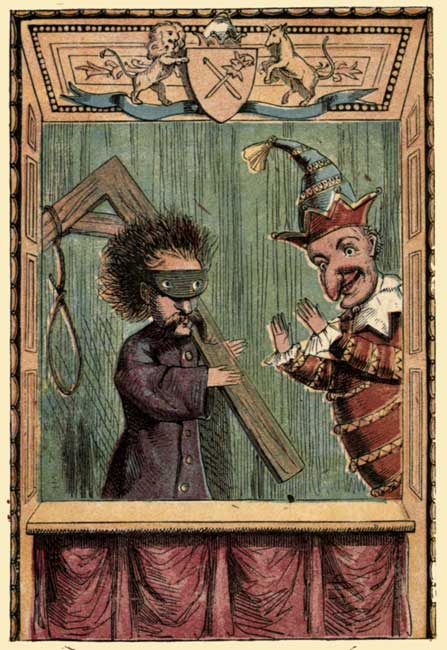
On this date in 1686, the English executioner Paskah (or Pascha) Rose was hanged at Tyburn for burglary — by his predecessor and his successor, the famed hangman Jack Ketch.

(c) image from Peter Herring, used with permission. Also see this illustration

The “Jack Ketch” character from a Punch and Judy puppet show: traditionally, Punch gets the better of their meeting and hangs Jack Ketch.

The Irish immigrant Ketch is the first name in English executioners. Indeed, you can call any of his successors right down to Pierrepoint a “Jack Ketch” and be perfectly understood.

The immediate successor, however, was Ketch’s own assistant — who inherited top billing after Ketch went to jail for “affronting” a sheriff.

Jack Ketch had been trodding the scaffold-boards, hanging, beheading, and drawing-and-quartering for two-plus decades at that point: he’s thought to have been appointed in 1663, and he’d inserted himself into those performances rather more prominently than an executioner ought by botching some of Restoration England’s most high-profile executions.

There’s little reliable information about these early executioners, but it seems Ketch’s reputation for clumsiness had forced him to issue an “Apologie” justifying himself.

But the man unquestionably had longevity in his favor, which is more than Paskah Rose could say.

Within months of becoming the chief London executioner, Rose and another man were chased down in the act of burgling clothes from a house, “the Goods found in Rose’s Breeches.”

Rose and his co-defendant Edward Smith accordingly hanged along with three others at Tyburn this date — by Jack Ketch, now returned from his carceral retirement for one last tour.

Ketch died late that same year of 1686, but has lived on in any number of ballads, doggerels and broadsides immortalizing the name. He was surely aided in this by the less impressive caliber of many who succeeded him: it wasn’t long after Ketch dispatched Pascha Rose that another “Jack Ketch” — an ignoble profession that wouldn’t until centuries hence be drawn from the country’s respectable classes — also met Pascha Rose’s same fate.

There’s a now-public-domain Autobiography of Jack Ketch by 19th century English writer Charles Whitehead.

On this day..