1730: Sally Bassett, Bermuda slave

(Thanks to Meaghan Good of the Charley Project for the guest post. -ed.)

Perhaps on this day in 1730,* an elderly mulatto slave named Sarah or Sally Bassett was burned at the stake for attempted murder in the British Caribbean colony of Bermuda.

Sally was the property of Thomas Forster, as was her granddaughter, Beck. (Thomas Forster was the grandson of Josias Forster, who was governor of Bermuda from 1642 to 1643.) The Forster family lived in Sandys Parish.

Being so old, Sally wasn’t worth much: her value was appraised at one pound, four shillings and sixpence, or about $160 in modern U.S. currency. She also had the reputation of a troublemaker: in 1713, for example, she was whipped the length of Southampton Parish after being accused of threats, property damage and killing livestock.

On December 18, 1729, Sally allegedly gave two bags of poison, said to be “white toade”** and “manchineel root”, to her granddaughter, Beck, and told her to poison Thomas, his wife Sarah, and Nancey, another slave in the Forster household.

Beck slipped a dose into the master and mistress’s food, “where if her Mistress did but smell on’t twould poison her.” She put the rest of the poison in the kitchen door, where Nancey found it and “by only looking at it ye said. Nancey was poyson’d.” (Quotes are as cited in Slaves and Slaveholders in Bermuda, 1616-1782.)

Sally was not arrested and charged with the crime until June 2, nearly six months later. The victims were all still “sick and Lye in a very Languishing and dangerous Condition,” but Sarah Forster was at least well enough to drag herself out of her sickbed and testify against her slaves.

Beck was acquitted but Sally, “not having the fear of God before her Eyes, Butt being moved and seduced by ye Instigation of the Devil,” was convicted of petit treason for her attempt on her master and mistress’s lives.

Although she maintained her innocence, she was sentenced to death.

Barefoot, wearing only pants and a loose blouse, on the way to the place of execution Sally is said to have looked at the crowds rushing to see the show and quipped, “No use you hurrying folks, there’ll be no fun ’til I get there!” When she looked at the logs waiting to fuel the fire she supposedly said, “Ain’t they darlin’?”

She was burned alive on an unusually hot day, in public, either on an island off Southampton Parish or at Crow Lane at the east end of Hamilton Harbor. After her death a purple Bermudiana, Bermuda’s official flower, is reputed to have grown in the ashes. Days later, Bermuda enacted new laws to tighten control of the “many heinous and grievous Crimes as of that Secret and barbarous way of Murdering by Poison and other Murders … many times Committed by negroes and other Slaves and many times malitiously attempted by them.”

Sally’s death has passed on into legend and is considered part of Bermuda’s cultural heritage. Even today, nearly three hundred years later, a very hot day in Bermuda is sometimes called a Sally Basset day. In 2009, a ten-foot statue of Sally was dedicated at the Cabinet Office grounds in Hamilton, the first time in Bermuda that a slave was so memorialized.

* There are some shouts for June 21, 1730. If there is an authoritative primary document establishing the execution date with certainty, we have not been able to unearth it.

** The involvement of white toad, as historian Justin Pope observes, points — alarmingly for 18th century white Bermudians; intriguingly for posterity — to transatlantic black (in multiple senses) economies.

There were no indigenous white toads in Bermuda. However, as noted by the Bermudian historian Clarence Maxwell, poisonous toads were used in ceremonies among Akan speaking peoples in the tropical forests of West Africa and carried into the voudou traditions of San Domingue.

… If there really was a white toad used in the Bermuda poisoning conspiracy, then it was almost certainly brought to the colony by a slave mariner who believed he was arming a spiritual practitioner against her enemies. It was not something that Sarah Bassett could have asked for lightly. The person who purchased the item would have easily been able to discover, or at least suspect, its usage. Whoever carried it had to be trusted. The toad would have had to been captured or cultivated in the tropical forests of West Africa or northern South America, purchased in the slave markets of towns like Paramaraibo, on the Surinam River of Dutch Guyana, or in the markets of Elmina, on the southern coast of West Africa. We can only surmise the origins of the poisonous toad, yet its very presence on the island of Bermuda suggests a trade in poisons, betweens slave societies and through the hands of black mariners.

On this day..

1621: John Rowse, unnatural father

(Thanks for the guest post to Thames boatman and picaresque pamphleteer John Taylor, the self-described “Water Poet”. Taylor has a minor cottage industry of social historians devoted to his varied output, like one of the first credited palindromes, “Lewd did I live, & evil I did dwel” … which would exactly suit John Rowse, the early modern sybarite turned murderer whom the Water Poet favored with the prose below, under the original title of “The Unnatural Father.” We’ve filled in wiktionary links to some of the more interesting archaic usages here; for the writer’s rich supply of loose-women synonyms please consult the Dungeons & Dragons random harlot table. — ed.)

As a chain consists of divers links, and every link depends, and is invoked upon one another, even so our sins, being the chain wherewith Satan doth bind and manacle us, are so knit, twisted, and soldered together, that without our firm faith ascending, and God’s grace descending, we can never be freed from those infernal fetters; for sloth is linked with drunkenness, drunkenness with fornication and adultery, and adultery with murder, and so of all the rest of the temptations, suggestions, and actions, wherewith miserable men and women are insnared and led captive into perpetual perdition, except the mercy of our gracious God be our defence and safeguard.

For a lamentable example of the devil’s malice, and man’s misery; this party, of whom I treat at this time, was a wretch, not to be matched, a fellow not to be fellowed, and one that scarce hath an equal, for matchless misery, and unnatural murder. But to the matter.

This John Rowse being a fishmonger in London, gave over his trade and lived altogether in the town of Ewell, near Nonsuch, in the county of Surrey, ten miles from London, where he had land of his own for himself and his heirs for ever to the valne of fifty pounds a year, with which he lived in good and honest fashion, being well reputed of all his neighbours, and in good estimation with gentlemen and others that dwelt in the adjoining villages.

Until at the last he married a very honest and comely woman, with whom he lived quietly and in good fashion some six months, till the devil sent an instrument of his to disturb their matrimonial happiness; for they wanting a maidservant, did entertain into their house a wench, whose name was Jane Blundell, who in short time was better acquainted with her master’s bed than honesty required, which in time was found out and known by her mistress, and brake the peace, in such sort, between the said Rowse and his wife, that in the end, after two year’s continuance, it brake the poor woman’s heart, that she died and left her husband a widower, where he and his whore were the more free to use their cursed contentments, and ungodly embracements.

Yet that estate of being unmarried, was displeasing to him, so that he took to wife another woman, who for her outward feature, and inward qualities was every way fit for a very honest man, although it were her hard fortune to match otherwise.

With this last wife of his he lived much discontented, by reason of his keeping his lewd trull in his house, so that by his daily riot, excessive drinking and unproportionable spending, his estate began to be much impoverished, much of his land mortgaged and forfeited, himself above two hundred pounds indebted, and in process of time to be, as a lewd liver, of all his honest neighbours rejected and contemned.

His estate and credit being almost past recovery wasted and impaired, he forsook his wife, came up to London with his wench, where he fell into a new league with a corrupted friend; who, as he said, did most courteously cozen him of all that ever he had, and whom at this time I forbear to name, because it was John Rowse his request before his execution, that he should not be named in any book or ballad, but yet upon a die his name may be picked out betwixt a Cinq and a Trois. This false friend of his, as he said, did persuade him to leave his wife for altogether, and did lodge and board him and his paramour certain weeks in his house, and afterward caused him and her to be lodged, having changed his name, as man and wife in an honest man’s house near Bishops-gate, at Bevis Marks.

Where they continued so long, till his money was gone, as indeed he never had much; but now and then small petty sums from his secret friend aforesaid, and he being fearful to be smooked out by his creditors, was counselled to leave his country and depart for Ireland. And before his going over sea, his friend wrought so, that all his land was made over in trust to him, and bonds, covenants, and leases made, as fully bought and sold for a sum of two hundred and threescore pounds. Of all which money the said Rowse did take the Sacrament at his death, that he never did receive one penny, but he said now and then he had five or ten shillings at a time from his said friend, and never above twenty shillings. And all that ever he had of him, being summed together, was not above three and twenty pounds, the which moneys his friend did pay himself out of his rents. But some more friend to him, than he was to himself, did doubt that he was cheated of his land; whereupon, to make all sure, he said that his false friend did so far prevail with him, that he the said Rowse took an oath in the open court at Westminster Hall, that he had lawfully sold his land, and had received the sum above said, in full satisfaction and payment, and his said friend did vow and protest many times unto him, with such oaths, and vehement curses, that he never would deceive his trust, but that at any time when he would command all those forged bonds and leases, that he would surrender them unto him, and that he should never be damnified by them or him, to the value of one half penny. Upon which protestations, he said, he was enticed to undo himself out of all his earthly possessions, and by a false oath to make hazard of his inheritance in heaven.

In Ireland he staid not long, but came over again, and was by his friend persuaded to go into the low countries; which he did, never minding his wife and two small children which he had by her, having likewise a brace of bastards by his whore, as some say, but he said that but one of them was of his begetting. But he, after some stay in Holland, saw that he could not fadge there, according to his desire and withal, suspecting that he was cheated of his land, and above all, much perplexed in his conscience for the false oath that he had taken, pondering his miserable estate, and rueing his unkindness to his wife, and unnatural dealing to his children, thinking with himself what course were best to take to help himself out of so many miseries which did incompass him, he came over again into England to his too dear friend, demanding of him his bonds and leases of his land which he had put him in trust withal. But then his friend did manifest himself what he was, and told him plainly, that he had no writings, nor any land of his, but what he had dearly bought and paid for. All which, Rowse replied unto him, was false, as his own conscience knew. Then said the other, have I not here in my custody your hand and seal to confirm my lawful possession of your land? and moreover, have I not a record of an oath in open court, which you took concerning the truth of all our bargain? And seeing that I have all these especial points of the law, as an oath, indentures, and a sure possession, take what course you will, for I am resolved to hold what I have.

These, or the like words, in effect passed betwixt Rowse and his friend, trusty Roger, which entering at his ears, pierced his heart like daggers; and being out of money and credit, a man much infamous for his bad life, indebted beyond all possible means of payment, a perjured wretch to cozen himself, having no place or means to feed or lodge, and fearful of being arrested, having so much abused his wife, and so little regarded his children, being now brought to the pit’s brim of desperation, not knowing amongst these calamities which way to turn himself, he resolved at last to go home to Ewell again to his much wronged wife for his last refuge in extremity.

The poor woman received him with joy, and his children with all gladness welcomed home the prodigal father, with whom he remained in much discontentment and perplexity of mind. The devil still tempting him to mischief and despair, putting him in mind of his former better estate, comparing pleasures past with present miseries; and he revolving that he had been a man in that town, had been a gentleman’s companion of good reputation and calling, that he had friends, lands, money, apparel, and credit, with means sufficient to have left for the maintenance of his family, and that now he had nothing left him but poverty and beggary, and that his two children were like to be left to go from door to door for their living.

Being thus tormented and tossed with restless imaginations, he seeing daily to his further grief, the poor case of his children, and fearing that worse would befall them hereafter, he resolved to work some means to take away their languishing lives by a speedy and untimely death, the which practice of his, by the devil’s instigation and assistance, he effected as followeth.

To be sure that nobody should stop or prevent his devilish enterprise, he sent his wife to London on a frivolous errand for a riding coat; and she being gone somewhat timely and too soon in the morning, both her children being in bed and fast asleep, being two very pretty girls, one of the age of six years, and the other four years old, none being in the house but themselves, their unfortunate father and his ghostly counsellor, the doors being fast locked; he having an excellent spring of water in the cellar of his house, which to a good mind that would have employed it well would have been a blessing, for the water is that of crystalline purity and clearness, that Queen Elizabeth of famous memory would daily send for it for her own use, in which he purposed to drown his poor innocent children sleeping. For he going into the chamber where they lay, took the youngest of them named Elizabeth forth of her bed and carried her down the stairs into his cellar, and there put her in the spring of water, holding down her head under that pure element with his hands, till at last the poor harmless soul and body parted one from another.

Which first act of this his inhuman tragedy being ended, he carried the dead corpse up three pair of stairs, and laying it down on the floor, left it, and went down into the chamber where his other daughter named Mary was in bed; being newly awakened, and seeing her father, demanded of him where her sister was? To whom he made answer that he would bring her where she was. So taking her in his arms he carried her down towards the cellar, and as he was on the cellar stairs she asked him what he would do, and whither he would carry her? Fear nothing, my child, quoth he, I will bring thee up again presently; and being come to the spring, as before he had done with the other, so he performed the last unfatherly deed upon her; and to be as good as his word, carried her up the stairs and laid her by her sister. That done, he laid them out and covered them both with a sheet, walking up and down his house weeping and lamenting his own misery and his friend’s treachery, that was the main ground of all his misfortunes and the death of his children; and though there was time and opportunity enough for him to fly, and to seek for safety, yet the burthen and guilt of his conscience was so heavy to him, and his desperate case was so extreme, that he never offered to depart, but as a man weary of his life, would, and did stay, till such time as ho was apprehended and sent to prison, where he lay till he was rewarded with a just deserved death.

What his other intents were after be had drowned his children is uncertain, for he drew his sword and laid it naked on a table, and after he gat a poor woman down into the cellar, and in the same place where the two infants lost their lives, he did help the woman to wring a buck of his clothes, and then he requested her to help to convey his goods out of his house, for he said that be feared that the sheriff of Surrey would come and seize upon all. But the woman not thinking of any of the harm that was done, imagined that he had meant that his goods would be seized for debt and not for murder.

But to return to the miserable mother of the murdered children, she said that her heart throbbed all the day, as fore-boding some heavy mischance to come; and having done her business that she came about to London, as soon as she came home she asked for her children, to whom her husband answered that they were at a neighbour’s house in the town. Then said she, I will go thither to fetch them home. No, quoth he, I will go myself presently for them. Then said his wife, let the poor woman that is here go and bring them home. But at last she saw such delay was used, she was going herself, then her husband told her that he had sent them to a kinsman’s of his at a village called Sutton, four miles from Ewell, and that he provided well for them, and prayed her to be contented and fear nothing for they were well. These double tales of his made her to doubt somewhat was amiss, therefore she entreated him for God’s sake to tell her truly where they were. Whereupon he said, “If you will needs know where they are, go but up the stairs into such a chamber and there you shall find them. But in what a lamentable perplexity of mind the poor woman was when she perceived how and which way they lost their lives, any Christian that hath an heart of flesh may imagine. Presently the constable was sent for, who took him into his custody, who amongst other talk, demanded of him why and how he could commit so unnatural a fact as to murder his children? To whom he answered that he did it because he was not able to keep them, and that he was loth they should go about the town a begging; and moreover, that they were his own, and being so, that he might do what he would with them, and that they had their lives from him, and therefore he had taken their lives from them, and was contented to lose his life for them; for he was sure that their miseries were past, and for his part, he had an assured hope to go to them, though they could not come to him.

So being had before justice his examination was very brief, for he confessed all the whole circumstances of the matter freely, so that he was sent to the common prison of Surrey called the White Lion, where he remained fourteen or fifteen weeks a wonderful penitent prisoner, never, or very seldom, being without a bible or some other good book meditating upon; and when any one did but mention his children, he would fetch a deep sigh and weep, desiring every one to pray for him; and upon his own earnest request, he was prayed for at Paul’s Cross, and at most of the churches in London, and at many in the country, and at the Sessions holden at Croydon the latter end of June last. He made such free confession at the bar, declaring the manner of his life, his odious drinking, his abominable whoring, his cruel murder, and the false dealing of his deceitful friend, which was the cause of his final wreck, with which relations of his pronounced with such vehemency and protestations, he moved all that heard him to commiseration and pity.

So according to law and justice, he was there condemned and judged for the murdering of his two children to be hanged; which judgment was executed on him at the common gallows at Croydon, on Monday the second day of June, 1621, where he died with great penitency and remorse of conscience.

This was the lamentable end of John Rowse, a man of the age of fifty years, and one that might have lived and died in better fashion, if he had laid hold on the grace of heaven, and craved God’s protection and fatherly assistance. But of all that herein is declared, this one thing which I now declare, is most lamentable and remarkable, which is that Ewell being a market town not much above ten miles from London, in a Christian kingdom, and such a kingdom where the all-saving Word of the ever-living God is most diligently, sincerely, and plentifully preached; and yet amidst this diligence, as it were in the circle or centre of his sincerity, and in the flood of this plenty, the town of Ewell hath neither preacher nor pastor. For although the parsonage be able to maintain a sufficient preacher, yet the living being in a layman’s hand, is rented out to another for a great sum, and yet no preacher maintained there. Now the chief landlord out of his portion doth allow but seven pounds yearly for a reader, and the other that doth hire the parsonage at a great rent doth give the said reader four pounds the year more out of his means and courtesy. And by this means the town is served with a poor old man that is half blind, and by reason of his age can scarcely read. For all the world knows that so small a stipend cannot find a good preacher, books, and very hardly bread to live on; so that the poor souls dwelling there are in danger of famishing for want of a good preacher to break the Bread of Life unto them. For a sermon amongst them is as rare as warm weather in December or ice in July; both which I have seen in England though but seldom.

And as the wolf is most bold with the sheep when there is either no shepherd or an impotent, insufficient one, so the devil perhaps took his advantage of this wretched man, seeing he was so badly guarded and so weakly guided to withstand his force and malice; for where God is least known and called upon, there Satan hath most power and domination. But howsoever, I wish with all my heart, that that town and many more were better provided than they are, and then such numbers of souls would not be in hazard to perish; nor so many sufficient scholars that can preach and teach well, live in penury through want of maintenance. I could run further upon this point, but that I shortly purpose to touch it more to the quick in another book.

By this man’s fall we may see an example of God’s justice against drunkenness, whoredom and murder. The devil being the first author, who was a murderer from the beginning; who filled Cain with envy that he murdered his brother Abel; who tempted David first to adultery and afterwards to murder; who provoked Herod to cause the blessed servant of God, John Baptist, to lose his head, because he told him it was not lawful for him to marry his brother Philip’s wife; and who was the provoker of the aforesaid Herod to murder all the innocent male children in his kingdom. And let us but mark and consider the plagues and punishments that God hath inflicted upon murderers, adulterers, and incestuous persons. First Cain, although by his birth he was the first man that ever was born, a prince by his birth, and heir apparent to all the world, yet for the murder by him committed on his brother, he was the first vagabond and runagate on the face of the earth, almost fearful of his own shadow; and after he had lived a long time terrified in conscience, was himself slain, as is supposed, by Lamech, Simeon, and Levi. The sons of Jacob were accursed of their Father for the slaughter of the Sichemites; Joab, the captain of David’s host, was slain for the murdering of Abner; David himself, for the death of Urias and the adultery committed with Bethsheba, was continually plagued and vexed with the sword of war, with the rebellion of his own sons, and with the untimely deaths of Amnon and Absalom. Banuah and Rechab, for the slaying of Ishbosheth the son of Saul, they were both by David’s commandment put to death, who had both their hands and feet cut off, and were afterwards hanged over the Pool in Hebron, (Samuel 2. 4.) The examples are infinite out of divine and human histories, that God did never suffer murder to go unrewarded; and this miserable man, of whom I have here related, is a most manifest spectacle of God’s revenging vengeance for that crying and heinous sin.

As concerning lust and incontinency, it is a short pleasure bought with long pain, a honeyed poison, a gul of shame, a pickpurse, a breeder of diseases, a gall to the conscience, a corrosive to the heart, turning man’s wit into foolish madness, the body’s bane and the soul’s perdition. It is excessive in youth and odious in age, besides God himself doth denounce most fearful threats against fornicators and adulterers, as the apostle saith, that whoremongers and adulterers shall not inherit the kingdom of heaven, (1 Cor. 6. 9). And God himself saith, that he will be a swift witness against adulterers, (Mal. 3. 5). And the wise man saith, that because of the whorish woman, a man is brought to a morsel of bread, and a woman will hunt for the precious life of a man; for saith he, can a man take fire in his bosom, and his clothes not be burnt 1 or can a man go up on hot coals, and his feet not be burnt? So he that goeth into his neighbour’s wife, shall not be innocent, (Prov. 6, 27, 28, 29). Abimeleoh, one of the sons of Gideon, murdered three-score and ten of his brethren, and in reward thereof, by the just judgment of God, a woman with a piece of a millstone beat out his brains, after he had usurped the kmgdom three years (Judges 9th). Our English chronicles make mention that Roger Mortimer, Lord Baron of Wallingford, murdered his master, King Edward the second, and caused the King’s uncle, Edmund, Earl of Kent, causelessly to be beheaded; but God’s justice overtook him at last, so that for the said murders he was shamefully executed. Humphrey, Duke of Gloucester, was murdered in the Abbey of Bury by William de la Poole, Duke of Suffolk, who afterwards was beheaded himself on the sea by a pirate. Arden of Faversham, and Page of Plymouth, both their murders are fresh in memory, and the fearful ends of their wives and their aiders in those bloody actions will never be forgotten.

It is too manifestly known what a number of stepmothers and strumpets have most inhumanly murdered their children, and for the same have most deservedly been executed. But in the memory of man, nor scarcely in any history, it is not to be found, that a father did ever take two innocent children out of their beds, and with weeping tears of pitiless pity and unmerciful mercy, to drown them, showing such compassionate cruelty and sorrowful sighing, remorseless remorse in that most unfatherly and unnatural deed.

All which may be attributed to the malice of the devil, whose will and endeavour is that none should be saved who lays out his traps and snares, entangling some with lust, some with covetousness, some with ambition, drunkenness, envy, murder, sloth or any vice whereto he sees a man or a woman most inclined unto, as he did by this wretched man lulling him, as it were, in the cradle of sensuality and ungodly delight, until such time as all his means, reputation, and credit was gone, and nothing left him but misery and reproach. Then he leads him along through doubts and fears to have no hope in God’s providence, persuading his conscience that his sins were unpardonable, and his estate and credit unrecoverable.

With these suggestions he led him on to despair, and in desperation to kill his children and make shipwreck of his own soul, in which the diligence of the devil appeareth, that he labours and travels incessantly; and as Saint Bernard saith, in the last day shall rise in condemnation against us, because he hath ever been more diligent to destroy souls than we have been to save them. And for a conclusion, let us beseech God of his infinite mercy to defend us from all the subtle temptations of Satan.


JOHN ROWSE his prayer for pardon of his lewd life, which he used to pray in the time of his imprisonment.

God of my soul and body, have mercy upon me; the one I have cast away by my folly, and the other is likely to perish in thy fury, unless in thy great mercy thou save it. Sly sins are deep seas to drown me; I am swallowed up in the bottomless gulf of my own transgressions. With Cain I have been a murderer, and with Judas a betrayer of the innocent. My body is a slave to Satan, and my wretched soul is devoured up by hell. Black have been my thoughts, and blacker are my deeds. I have been the devil’s instrument, and am now become the scorn of men; a serpent upon earth, and an outcast from heaven. What therefore can become of me, miserable caitiff? If I look to my Redeemer, to him I am an arch-traitor, if upon earth, it is drowned with blood of my shedding, if into hell, there I see my conscience burning in the brimstone lake. God of my soul and body have mercy therefore upon; save me, O save me, or else I perish for ever. I die for ever in the world to come, unless, sweet Lord, thou catchest my repentant soul in thine arms. O save me, save me, save me.


JOHN ROWSE of Ewell, his own arraignment, confession, condemnation, and judgment of himself whilst he lay prisoner in the White Lion, for drowning of his two children.

I am arraign’d at the black dreadful bar,
Where sins, so red as scarlet, judges are;
All my indictments are my horrid crimes,
Whose story will affright succeeding times,
As, now, they drive the present into wonder,
Making men tremble as trees struck with thunder.

If any asks what evidence comes in?
O ’tis my conscience, which hath ever been
A thousand witnesses: and now it tells
A tale, to cast me to ten thousand hells.

The jury are my thoughts, upright in this,
They sentence me to death for doing amiss:
Examinations more there need not then,
Than what’s confess’d here both to God and men.

That crier of the court is my black shame,
Which when it calls my jury doth proclaim,
Unless, as they are summon’d, they appear,
To give true verdict of the prisoner,
They shall have heavy fines upon them set,

Such, as may make them die deep in heaven’s debt;
About me round sit and innocence and truth,
As clerks to this high court; and little Ruth
From peoples eyes is cast upon my face,
Because my facts are barbarous, damn’d and base.

The officers that ’bout me, thick, are plac’d,
To guard me to my death, when I am cast,
Are the black stings my speckled soul now feels,
Which like to furies dog me, close at heels.
The hangman that attends me, is despair,
And gnawing worms my fellow-prisoners are.

His Indictment for Murder of his Children.

The first who, at this Sessions, loud doth call me
Is murder, whose grim visage doth appal me;
His eyes are fires, his voice rough wind out-roars,
And on my head the Divine vengeance scores;
So fast and fearfully I sink to ground,
And wish I were in twenty oceans drownd.

He says, I have a bloody villain been,
And, to prove this, ripe evidence steps in,
Brow’d like myself, justice so brings about,
That black sins still hunt one another out;
‘Tis like a rotten frame ready to fall,
For one main post being shaken, pulls down all.

To this indictment, holding up my hand,
Fettered with terrors more than irons stand,
And being asked what to the bill I say,
Guilty, I cry. O dreadful Sessions day!

His Judgment

For these thick Stygian streams in which th’ast sworn,
Thy guilt hath on thee laid this bitter doom;
Thy loath’d life on a tree of shame must take
A leave compelled by law, e’er old age make
Her signed pass-port ready. Thy offence
No longer can for days on earth dispense.
Time blot thy name out of this bloody roll,
And so the Lord have mercy on my soul.

His speech what he could say for himself.

O wretched caitiff! what persuasive breath,
Can call back this just sentence of quick death?
I beg no boon, but mercy at God’s hands,
The King of Kings, the Sovereign that commands
Both soul and body, O let him forgive
My treason to his throne, and whilst I live,
Jibbets and racks shall torture limb by limb,
Through worlds of deaths I’ll break to fly to him.
My birth-day gave not to my mother’s womb,
More ease, than this shall joys, whene’er it come.
My body mould to earth, sins sink to hell,
My penitent soul win heaven, vain world farewell.

On this day..

1794: The neighbors of Susan Sorel, the female atheist

(Thanks to Lewis Goldsmith aka “Stewarton” for the guest post, cribbed from his The Female Revolutionary Plutarch -ed.)

Susan Sorel

The Female Atheist

Mais tout passe, et tout meurt, tel est l’arret du sort;
L’instant ou nous naissons est un pas vers la mort.

That the hardened criminal should silence or repulse the clamour of his conscience, and in a trembling despair call out “There is no God!” cannot be surprising; his enormities bid defiance to a divinity; he cannot endure to think of what he has such dreadful reason to fear; the very idea of an omnipotent God must to him be a hell upon earth. But that modest virtue, pure morality, honour, and loyalty, should be misled, to embrace the shocking, despairing, and destructive tenets of atheism, and disbelieve and deny a remunerator of good and evil, after all the abominations witnessed in France since the revolution, loudly proclaims the dangerous progress infidelity has made in that country, as well as the dangerous effects of the sophistical notions disseminated in the works of a Voltaire, Rousseau, Diderot, Helvetius, Raynal, and other French philosophers.

Susan Sorel had inherited from her parents property producing about nine thousand livres (375 l.) per annum, near Metz, in ci-devant Lorrain. She had from her youth evinced an inclination for literary information and for a studious life; and when at the age of twenty-five, by the death of her parents, she became mistress of her fortune, she declined all offers of marriage entirely, to avoid all interruption to the gratification of her leading passion for reading. The revolution, and the famine and the horrors that accompanied it, gave her an opportunity to gain the admiration of all her neighbours by acts of generosity, that announced a heart as tender and liberal as a mind noble and philanthropic. She not only distributed among the poor all her superfluities, but frequently refused herself the necessaries of life to relieve suffering humanity. She paid no visits, and received but little company. Though she never went to church herself, she advised her servants never to neglect mass or vespers. She frequently presented the curate of her parish with liberal donations; and when in the beginning of 1794 the republicans proscribed and pursued him with all other christian priests, she, at the risk of her own life, concealed him in her house, and paid the same attention and respect to him as if she had belonged to his flock, or been one of the faithful. Four days before her death she presented him with a purse containing one hundred louis-d’ors, and a passport which would carry him safe to Germany, for which she had paid the same sum.

On the 21st of May 1794, she invited forty-four children of her neighbours to a dinner and ball, which continued till past midnight. She seemed not only composed and tranquil, but lively and gay, partaking with pleasure in the enjoyments and amusements of innocence and youth. When they retired she gave them each a louis-d’or in money, to be spent when monarchy was restored in France, and six yards of white riband to decorate themselves with on the same occasion.

A few weeks before, she had caused a small summer-house, or rather hut of dry wood, to be constructed in her garden, which she furnished in a neat and plain manner. Half an hour after the children had left her, the gardener heard reports of pistols, and looking out observed the hut on fire on all sides; and before he could procure any water or assistance to extinguish it, the hut was consumed, and Mademoiselle Sorel reduced to ashes. She probably had this hut built only to serve her as a funeral pile.

As soon as it was day-light the servants sent for the justice of peace (in France they have ho coroners), who, after taking an inventory of her effects, put a seal on the house. He found upon the table in her study a letter addressed to himself. In it she made him a present of fifty louis-d’ors, desiring him to have her ashes collected to be thrown into the river Moselle. She informed him that it was not by accident but by design, that she had burned the hut and herself, having chosen that death as the most agreeable and the most clean in departing from a world she detested so much, that she preferred to it even an annihilation, of which she was certain. She stated that, not to surwive the day she had calmly fixed on for her exit, she had set the hut on fire before she shot herself. She asked him to have her last will read at the department, as well as the papers accompanying it, some of which she hoped would give consolation to the wretched, and explain and palliate her conduct to the good and loyal.

My Last Will and Testament

In the name of no God! I, Susan Sorel, sound in mind and body, de bequeath all my landed property and estate, all my household furniture, money, and valuables; in few words, every thing that can be called mine upon earth, (after two years wages have been paid to each of my servants), to his Majesty the king of France and Navarre, Louis XVII or his heirs and successors, to be disposed of by him or by them, as he or they judge and think proper, to some unfortunate sufferer whom the revolution has ruined for his attachment to his lawful sovereign. Until the restoration of royalty, Nicholas Nerein and Jacques Meunier, my neighbours, whom I appoint my executors, are requested to see that my lands are well cultivated and my rents paid; and to distribute the same to the full amount among all the poor of our parish, deducting only six hundred livres (25 l.) a year each for their trouble. They may either let or occupy themselves my principal dwelling, upon condition of keeping it in the best possible repair, until it with every thing else can be delivered up to the rightful owner; such a one as is nominated by the first Bourbon who is acknowledged a King of France and Navarre. Written, signed, and sealed by myself, at ten o’clock in the morning, May 21st, 1794; or, in the republican jargon, Floreal 30th, year II of the republic, one and indivisible.

(Signed)
SUSAN SOREL.

My Last Creed.

The world has never been created, but produced by incomprehensible, mechanical causes and occurrences, and has by degrees become nearly as it is. It will remain with little variation in the same state’ to all eternity.

A God is the invention of fear, and the idol of folly and ignorance. I too in my youth worshipped a God, adored his Son, prayed to a virgin-mother, and knelt before human saints. I too confessed, fasted, subjected myself to mortifications, and wore relics. I too attended church, followed processions, prostrated myself before the host, sung hymns, and made vows. My sincere piety, my ardent devotion, was first shaken by seeing the prosperity of crime, the sufferings of innocence, and the misfortunes of virtue.

When I saw the best and most virtuous king that ever ruled France, in return for his pure and patriotic wishes to make his subjects free and happy, rewarded by ingratitude, insults, and pains — I said, No, there is no God!

When his loyal life-guards were murdered in doing their duty, and their known assassins remained unpunished — I said, No, there is no God!

When this good king was carried to Paris, and there detained a prisoner by those very subjects to whom he had offered liberty, and outrage was added to confinement — I said, No, there is no God!

When with his nobly resigned queen and family, he was arrested and ill-treated in a journey he had undertaken to restore order to his kingdom, and tranquillity and happiness to his subjects — I said, No, no, there is no God!.

When first treacherously assaulted in his own palace, and afterwards barbarously dragged from the throne he was so worthy to occupy, to a prison his virtues purified and sanctified — No! no! no! said I, there can be no God!

When, in the course of a few months, his innocent blood was shed by the hands of criminals on a scaffold erected for criminals — It is impossible, said I, it is impossible there can be any God!

When I saw honour and loyalty bleeding and flying, and robbers, rebels, and regicides victorious — No! no! said I, there is no God!

When I saw altars erected to Marat, and heard that his sanguinary accomplices pronounced his apotheosis, without being crushed by the thunder of heaven — No! no! no! said I, there is no God!

When I read that a prostitute was worshipped upon an altar consecrated to a God who did not revenge this sacrilegious outrage — No! no! said I, there is no God!

When Marie Antoinette, whose courage, sufferings, and resignation, were so great and so edifying, and whose faults and errors were so few and so exaggerated, ascended the same scaffold where her royal consort Louis XVI had bled — No! no! no! said I, there is no God!

When the model of fennale virtue and purity, of religious sanctity, of parental and sisterly heroism, the royal Princess Madame Elizabeth, was condemned by regicide murderers to die like the parricide or assassin — No! no! no! said I, there never has been, there never can be a God!

It is time, said I, to depart from a world where every thing vile, corrupt, and guilty, is fortunate, and where every thing elevated, good, generous, and honourable, is wretched. If there is another world, what have I to apprehend? My life is pure; the blood of no being have I shed; the property of no person have I plundered; the rights of no individual have I invaded, and the reputation of no person have I injured. I may therefore, said I, reduce myself to ashes, to annihilation, with as much indifference as I strip myself of my garment when I undress to go to bed. Should a God, a supernatural being, whom I am unable to comprehend or to believe in ; should he really exist, and have created such vile creatures as man and woman, I — humble I, am no shame, no disgrace to his work, to his performance! Though not confiding in him myself, I have not only not prevented any body from doing so, but have encouraged and enjoined many to trust in his justice and his bounty. It is also true, I observed that those I thus advised had neither energy of character, for strength of mind, to see in themselves every thing inferior, equal, and above them. For their repose they required some terrific superior — a Robespierre in the heavens to bow to, to tremble before.

To my young neighbours, whose innocent enjoyments made my last hours so happy, and my journey into the shades of oblivion so easy.

Sweet children! die soon, or misery is your lot; die soon, or you will deplore existence as a curse. Die soon, or the assassin’s dagger will stab you, the poisoned tooth of the calumniator wound you; or, what is worse, and more insupportable, the arrow of wretchedness will pierce your tender bosom without killing you, suspend you for years between existence and annihilation, and leave you just enough of life to feel all its horrors. Die soon, or you will, like myself, witness that what disgraces human nature prospers, what degrades it succeeds. Die soon, or you will see modesty trampled upon by impertinent or rude audacity; folly and impertinence tyrannize over wisdom and prudence; and unpunished ferocity intimidate equally the brave and the coward, the good and the bad, the virtuous and the wicked. Die soon, or you will die a thousand times before you expire. To die is nothing; you must all die sooner or later: it is only the agony of death that is terrible, insufferable.

To my good neighbours, Nicholas Nerein and Jacques Meuitier.

My will and the charge entrusted to you, my friends, prove how sincerely I esteem you, and my confidence in you. Shew yourselves worthy of it by discharging your duty faithfully. You know since the death of my nephews I have no relations left: I therefore do not infringe on the ties of consanguinity in presenting my offering to loyalty. As the last proof of my friendship for you both when, tired of living, I bequeath you my example of dying. Embrace your wives and children on the part of your and their departed friend,

SUSAN SOREL.


The department of the Moselle, instead of approving of the will of Susan Sorel, considered her as an enemy of the republic, who by suicide had prevented the effect of national justice, and therefore confiscated her property for the benefit of the nation. Nicholas Nerein and Jacques Meunier they caused to be arrested as suspected, and delivered up to the revolutionary tribunal, which condemned them both to death as accomplices of Susan Sorel. They were executed on the 28th of May, 1794.

On the back of the paper containing what she called Her Last Creed, were written the following lines:

On a vue souvent des athees
Vertueux malgre leurs erreurs:
Leurs opinion infectees
N’avoient point infectes leurs moeurs.
Spinosa fut doux, juste, aimable:
Le Dieu que son esprit coupable
Avoit follement combattu,
Prenant pitie de sa foiblesse,
Lui laissa l’humain sagesse,
Et les ombres de la vertu.

On this day..

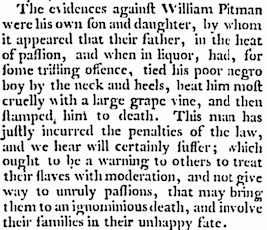
1775: William Pitman, for murdering his slave

(Thanks to Meaghan Good of the Charley Project for the guest post. -ed.)

On this date in 1775,* plantation owner William Pitman was hanged for murder in King George County, Virginia.

Pitman had a reputation as a brutal man and was no stranger to the Virginia courts; he had been making appearances since the 1750s. So perhaps it was not surprising that he got strung up eventually.

Virginia Gazette, Apr. 21, 1775

What is surprising, indeed perhaps unprecedented, is that the murder victim was one of his own slaves.

The Virginia Gazette, which published the sole surviving account of the incident, says that Pitman, “in liquor” and “in the heat of passion” lost his temper, “tied his poor negro boy by his neck and heels,” and beat him with a large grapevine before stomping him to death.

Pitman can hardly have been the first, or the last, slaveowner to slaughter his own “property” but it was usually impossible to get a conviction because blacks were not allowed to testify against whites in court. In this case, however, two white people — Pitman’s own son and daughter — sealed the case by giving evidence against their father.

The Gazette, writing on April 21, said Pitman had “justly incurred the penalties of the law” and said hopefully that the story might be “a warning to others to treat their slaves with moderation, and not give way to unruly passions, that my bring them to an ignominious death, and involve their families in their unhappy fate.”

* Pitman’s hanging “yesterday” is reported in the Saturday, May 13 issue of the Virginia Gazette — a different Virginia Gazette from the one quoted in this post, as it happens: three competing papers used this same branding; the report in this post’s body on the circumstances of Pitman’s conviction comes from Dixon and Hunter’s Gazette, while the May 13 item establishing the hanging date is from Alexander Purdie’s Gazette.

Purdie’s May 13 edition further adds that when the sheriff came to fetch him on the fatal day, “Pitman made some resistance, but was soon overpowered; he behaved with decency at the place of execution, and attributed his unhappy fate to the effect of intemperate drinking.”

On this day..

1887: Charles Smith

(Thanks to Meaghan Good of the Charley Project for the guest post. -ed.)

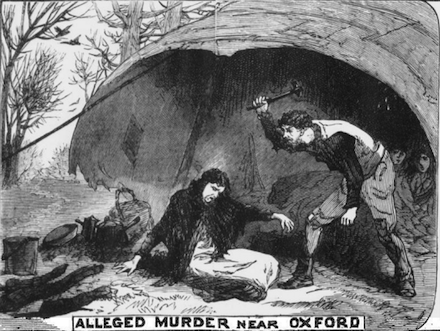
On this date in 1887, 63-year-old Charles Smith was judicially hanged at Oxford Castle Prison by James Berry. He’d brutally murdered his wife in front of their children that February.

The Smith family were Gypsies: Charles, his wife Lucy, their 17-year-old daughter Oceana (known as Oshey) and their 11-year-old son Prince Albert. As Nicola Sly notes in her book Oxfordshire Murders,

The lifestyle of Gypsy families in 1887 was not one to be envied. The traveling people were at the mercy of the weather all year round, whether the heat of summer or the bitter cold of winter. Forced to scratch a living any way they could, many supplemented their meager income with a little poaching or petty theft. Thus they were very rarely welcomed in any area and were always in fear of the local police who almost invariably moved them on wherever they tried to settle.

According to this account, Lucy had borne many children, but only four lived long. By the time of the murder, one of the children had died and one, a daughter named Elizabeth, had grown up and left home.

Charles’s siblings regularly got in trouble with the law, and at least one of his siblings was transported for sheep theft. He and Lucy, however, were somewhat more fortunate: Lucy possessed a valid peddler’s license. In the 1881 censuses, both had their occupations listed as “hawker.” Charles made baskets, skewers, roasting forks, meat stands and pegs which his wife sold.

Throughout their lives Charles and his family traveled around Oxfordshire, pitching a tent wherever they could find a place, and in February 1887, they were camped on public land near Headlington. They’d been there before and were friendly with some of the local residents, including a couple coincidentally also named Smith.

Charles was a violent man who regularly beat his wife and children; Oshey stated he beat his wife every day, and Prince Albert would later testify, “He has been knocking my mother about nearly all his life.”

At one point the domestic violence had gotten so bad that Lucy had gone so far as to take out a formal complaint against her husband for cruelty. She never followed up on it, though.

On the 18th of February, Kate and George Smith, who lived in a nearby cottage, visited the tent and noted Lucy was visibly bruised. They asked Charles why he’d beaten her and he wouldn’t give a reason, but said it was over something that happened thirty years before.

The visitors advised him to forgive and forget, but Charles acted surly and hostile for the rest of the day. Lucy was so frightened of him that for a long time she stayed outside the tent in the bitter cold, and only partially dressed, rather than go inside where her husband was. At bedtime she finally came in.

In the early hours of the next morning, Charles began shouting at his wife, waking the children. As Oshey and Prince Albert watched in horror, their father picked up a hammer and attacked Lucy, beating her on her head, back and legs until he was too tired to do it anymore. Then he laid down and went peacefully asleep.

Mortally wounded, Lucy crawled out of the tent to get some water from a nearby stream. She never returned, and eventually Oshey went out to check on her and found her dead.

When Charles realized what he’d done, he sank to his knees beside Lucy’s battered corpse and sobbed, crying, “My wench, my wench!”

Oshey and Prince Albert ran for help, going to the same neighbors who’d visited the night before. When Kate Smith answered the door, Oshey blurted, “My Mammy’s dead. He’s been and killed her with the hammer.”

Kate and George rushed to the scene of the crime. Charles had dragged Lucy’s body into the tent and lain it out on some straw. He told them Lucy had “fallen down” and died. George told everyone he was going to fetch a doctor, but instead he went to the police, returning with two constables. By then Charles had calmed down and said casually, “Good morning. I have got a dead ‘un this morning.”

One of the constables searched the tent and found the bloodstained hammer concealed under some straw. Charles, whose coat was also bloodstained, was placed under arrest for the willful murder of his wife. The autopsy showed she’d died of a fractured skull; Charles had hit her head with the hammer three or four times.

At the ensuing trial in April, Oshey was the star witness against her father, although Charles kept shouting that she was telling lies and was a “nasty, wicked wretch.” Prince Albert testified also, as did Kate and George Smith.

The defense argued that Charles had no intention of killing his wife and there was no motive, and so it was a case of manslaughter. However, the jury returned a verdict of murder.

After he was condemned to die, Charles turned to religion for solace, praying with the prison chaplain. Some of his relatives came to visit, although Oshey and Prince Albert stayed away. His eldest daughter Elizabeth made the strange observation that “when he was a drunkard there was not a kinder man living, that something or somebody turned him into a teetotaler, and from that time he had been a cruel wretch.”

While walking to the scaffold, Charles fainted on the trapdoor just before James Berry drew the bolt. The hanging went smoothly and it was judged he died quickly and painlessly.

As for the orphaned Oshey and Prince Albert, it was recorded that “through the noble hearted philanthropy, of Miss Skene, of this City, the girl Oceana has been placed in a Home in York, and boy the Prince Albert, through the same thoughtfulness, will also be brought up to acquire the means of earning an honest livelihood.”

On this day..

1859: Oscar Jackson lynched, precipitating the Wright County War

(Thanks to Meaghan Good of the Charley Project for the guest post. -ed.)

The story of what would become known as the Wright County War began on September 21, 1858, when Henry A. Wallace was found lying dead in a clump of willows on his own farm, his head bashed in. He had last been seen alive on August 27, twenty-five days earlier.

Wallace’s employee, Oscar F. Jackson, was the prime suspect in his murder. Jackson had agreed to help Wallace reap his hay crop in exchange for a portion of the harvest, and on August 27 the two men had been seen working together in the fields near where Wallace’s body was later found.

Jackson showed a curious lack of concern about his boss’s disappearance. He never even bothered to tell the authorities he was missing, and when neighbors noted that Wallace hadn’t been seen in weeks and decided to launch a search, Jackson declined to join in. An impoverished sharecropper, Jackson also seemed to have become suddenly flush with cash — an oddity because like most of the residents of Wright County, Jackson was poor, still struggling to recover from the Panic of 1857. Wallace was comparatively well-off.

A grand jury indicted Jackson for his employer’s murder, but the case against him was incredibly feeble. At the trial, Jackson’s attorneys pointed out that no one had seen the murder or could even determine the day it took place, and suggested any number of people could have visited Wallace and killed him at any time during that three-and-a-half-week period that he was missing.

The jury quite rightly gave Jackson the benefit of doubt and acquitted him on April 3, 1859, after eighteen hours of deliberation.

That night, a lynch party of fifteen men chased him into the woods. Fearing for his life, Jackson fled to St. Paul.

The local citizenry — among them Henry Wallace’s brother, Hiram — were not prepared to let the matter rest. And, horrifyingly, neither was the Wright County Sheriff, George M. Bertram,* or the justice of the peace, Cyrus Chase Jenks.

Five days after Jackson’s acquittal, the three men went to find the presumed murderer in Hennepin County. There, Hiram Wallace swore out a complaint against Jackson accusing him of theft, and Jenks issued a warrant for his arrest. Never mind that Jenks did not have jurisdiction outside of Wright County: Sheriff Bertram delivered the warrant to Alfred Brackett, the deputy sheriff of Hennepin County, and asked him to serve it.

Walter N. Trenery wrote in his 1962 book, Murder in Minnesota,

Brackett found Jackson in St. Paul’s Apollo Saloon the next day. Handcuffing his prisoner, the deputy set out with him for St. Anthony by buggy. Jackson pleaded for time to call his attorney, but at first Brackett would not allow it. On the ride Jackson insisted that his arrest was based on a false charge, the purpose of which was to get him back to Rockford [in Wright County] where he would be murdered… Brackett reconsidered. When the two men reached St. Anthony, he sent word to Jackson’s counsel and persuaded the Wright County sheriff to spend the night in town before starting back to Rockford.

The implacable Sheriff Bertram

Jackson’s lawyer hastily drew up a writ of habeas corpus and before the day was out he’d served it to Sheriff Bertram. The Hon. Isaac Atwater, a Minnesota Supreme Court justice, ordered Jackson’s release on April 11. He was immediately re-arrested, however, as by then Jenks and Bertram had realized their error, gone back to Wright County and drawn up a second warrant. Jackson’s attorney responded with a second writ of habeas corpus, and on April 13, the man was ordered released again.

His friends had pooled their money and come up with enough for him to leave Minnesota forever, but for some reason Jackson returned to Rockford instead of skipping town. The residents of Wright County still wanted to lynch him, and to that end a neighbor swore out yet another phony complaint against him and yet another justice of the peace issued yet another warrant for his arrest.

A mob virtually tore Jackson’s cabin and its contents to pieces and set several fires. They surrounded the home of Jackson’s father-in-law, George Holdship, where the fugitive was reported to be hiding, and set more fires.

On April 24, Sheriff Bertram arrived at Holdship’s residence, and after he swore Jackson would not be harmed, arrested Jackson and took him away.

According to John D. Bessler’s book Legacy Of Violence: Lynch Mobs And Executions In Minnesota,

Less than half a mile from the house an armed mob overtook Sheriff Bertram’s procession. The sheriff relinquished power without resistance and rode off with the deputies, failing to even report the incident. After taunting Jackson throughout the night, the mob strung him up, even as his wife arrived to plead for mercy. Her pleas ignored, she was sent away distraught and empty-handed. The bloodthirsty mob hauled Jackson up and down times, failing to get Jackson to confess but successfully mangling his neck. Only when Jackson was hoisted up for a third time, at 2:00 P.M. on April 25, did his neck break. Jackson’s body was left dangling from a beam that protruded from Wallace’s cabin.

A coroner’s jury was called on the same day Jackson died and decided he had met with his death at the hands of some person or persons unknown. “The jury was not likely,” Trenery noted dryly, “to accuse its own members.”

But the story didn’t end there.

At the time of Oscar Jackson’s lynching, Minnesota had been a state for less than a year; it was admitted to the Union on May 11, 1858. Their first state governor, Henry Hastings Sibley, was anxious to maintain the rule of law, which had been besmirched by the Jackson outrage. One newspaper said, a tad melodramatically, “Wright County will be painted black upon the map of Minnesota — a patch of loathsome leprosy upon the fair surface of the land.”

Sibley offered a $500 reward for the arrest and conviction of anyone concerned with the lynching. It went unclaimed and the lynching started to slip away into obscurity, until July, when Oscar Jackson’s wife spotted Emery W. Moore (called “Emory” or “Aymer” in some accounts) at a gathering in Minnehaha Falls. Moore had been a member of the lynch mob, and it was his warrant that lead to Jackson’s arrest at his father-in-law’s house.

Mrs. Jackson alerted St. Paul’s chief of police, who arrested Moore for murder, and he was sent to Rockford to stand trial.

What followed, as Trenery describes it, was something of a solemn farce:

To prevent further collusion among local officials, the governor directed Charles H. Berry, the state’s attorney general, to conduct the prosecution in person. Berry opened the preliminary examination in Monticello on July 31, 1859, with an angry mob swarming about the building, shouting and threatening the agents of law enforcement. Mrs. Jackson, testifying for the prosecution, clearly and unequivocally named the leaders of the lynch mob and described the circumstances under which her husband had died. When the Wright County sheriff took the stand to explain how the mob had overwhelmed him and took Jackson from his custody, the attorney general found the sheriff’s explanation so unsatisfactory that he ordered Bertram arrested and held as an accomplice in the lynching. Berry then discovered that certain prosecution witnesses had mysteriously disappeared before they could testify, and he was forced to adjourn the hearing before it had been in session a full day.

To add insult to injury, that evening the vigilantes descended on the place where Emery Moore was confined, set him free, and melted into the darkness.

Berry returned to St. Paul and reported all this to the governor.

Fed up, Sibley declared Wright County to be “in a state of insurrection” and sent in the state militia to put a stop to mob justice and force the county officials to do their damn jobs. Three units — the Pioneer Guards, the St. Paul City Guards and the Stillwater Guards — marched in, aided by 35 special policemen.

The results were mixed. At first the militia was unable to find any members of the lynch mob, the locals just shrugged their shoulders when asked where they had gone, and the sheriff and other officials refused outright to cooperate. Only when they found out Governor Sibley was on his way over to personally take charge did the county officials “find” and arrest three suspected lynchers: Emery Moore, Hiram S. Angell, and J.E. Jenks.**

Satisfied, the governor sent the state militia home. The three-day occupation was later facetiously dubbed the Wright County War. It was a bloodless war.

The arrested men were almost immediately set free on a $500 bail, and in October, a grand jury refused to indict them. In the end, no one at all was punished for Oscar Jackson’s death, and Henry Wallace’s murder was never officially solved.

Charles Bryant groused in his History of the Upper Mississippi Valley,

And so the drama ended; the curtain fell; and the so-called “Wright county war” was a thing of the past. Its effects, however, long remained in the enormous expense incurred, which, with other criminal cases of less magnitude, created an indebtedness almost resulting in bankruptcy, and depreciating county orders to less than thirty-five cents on the dollar.

Of the principals involved in this story:

  • Sheriff Bertram left office in 1860 and was succeeded by W. Smith Brookins.
  • Cyrus Jenks died in Meeker City, Minnesota in 1897. He was almost 90 years old.
  • Governor Sibley stayed in office until 1860, and did not seek reelection. In 1862, he was appointed colonel of the Minnesota Militia and led them against the Native Americans in the Dakota War.
  • Charles Berry was later appointed as a judge in the Idaho Territory. He died in 1900.
  • Alfred Brackett fought in the Civil War, leading what would become Brackett’s Battallion, which served longer than any other Minnesota unit. The unit fought against the Confederates between 1861 and 1864, then became part of the Northwestern Indian Expedition in the Dakota Territory.
  • Hiram Angell also fought in the Civil War, with the Third Minnesota Volunteer Infantry Regiment. He died in St. Louis, Kentucky on April 5, 1862.
  • J.E. Jenks got elected to Minnesota’s House of Representatives in the 1870s and served for a year.

Nearly twenty years after Henry Wallace’s death, first his gold watch and then his rifle were found near the former site of Oscar Jackson’s cabin.

* Wright County boasts a Bertram Chain of Lakes, named for Sheriff Bertram.

** J.E. Jenks was probably Cyrus Jenks’s son; records note that Cyrus had a son named John Edwin Jenks who would have been about 22 years old in 1859, which matches J.E.’s first name and age.

On this day..

1505: One Bolognese thief hanged, and another saved by Saint Nicholas

(Thanks to Augustinian friar Cherubino Ghirardacci for today’s guest post, from his History of Bologna. The Saint Nicholas in question for this picturesque vignette is not Santa Claus (though that figure’s real-life inspiration also had an averted execution to his hagiography) but the medieval mystic Saint Nicholas of Tolentino … a popular Italian saint who appears to have obtained an informal niche profile as the intercessor who would help a fellow survive a hanging: he had already been credited with saving a man wrongfully accused of murder who hung four days on the gallows in 14th century Aquila. -ed.)

It has happened in these days, that is to say on April 15, Tuesday, that two thieves have been hanged; one sixty years old and one about eighteen, and the execution took place on the usual spot, that is in the cattle market; and the minister of justice ordered that they should be left hanging upon the gallows until the usual hour, when the members of the Company of the Dead came to remove them for burial, and having taken down from the gibbet the old man and having placed him on the bier, they then deposed the youth, called Pietro Antonio of Bologna. He had been adopted by one who dwelt in the Borgo of San Pietro, and was already a novice of San Jacomo; this one was found alive and of so much vivacity it seemed as though he had been reposing on his bed asleep: but however with the neck injured, because the halter had entered into it, and had almost sawn through the throat.

The bystanders, marvelling much at this unusual sight, quickly had him carried to the Hospital to care for him; and there came a messenger from the Senate to see, and to hear everything that had happened; and Pietro Antonio said that he had been helped by the glorious saint Nicholas of Tolentino, to whom he had vowed, that if he escaped this opprobrious death, he would vest himself in his habit, and that he being on the gallows, the glorious St. Nicholas supported him by holding the soles of his feet in his hands. This was considered a marvellous miracle in the city, and every one ran to visit him and hear him discourse.

On Sunday, April 27, the Brothers of San Jacomo came in procession to the Hospital to fetch the above-mentioned Pietro Antonio and to conduct him to San Jacomo, and they pass together with the “Compagnia della Morte” behind San Petronio and before this church, and they go before the palace of the family Antiani, and below the “Madonna del Popolo”; and the condemned man is dressed in white with a black mantle, and with no cap on his head, and with the same halter round his neck with which he was hanged. When he reaches this spot, he falls on his knees and adores the Queen of Heaven, and wishing to rise, the simple women around tear off some of his clothes in devotional excitement; but being covered with another cape, he arrives at the church of San Jacopo, and there in the presence of all the city, the halter is taken from his neck and laid by him on the altar; and by the reverend prior of that said convent, Master Giovanni de Ripis, he was solemnly dressed in the Carmelite habit and called Brother Nicholas, in honour and reverence of St. Nicholas of Tolentino; and the ceremonies of vesting him being over, the friars meanwhile chanting the Te Deum Laudamus, he was presented by the said Prior to the very holy image of the glorious St. Nicholas, which is behind the choir in the chapel of St. Thomas Apostle and St. Nicholas, now called of the Madonna of Heaven, because when he made his vow he had in his mind this venerated image. Then he placed there his votive offering, his true portrait painted on canvas, and also the same halter with which he was hanged, the which things one may still see today in this said church.

He lived four years very devoutly, tending the sick; but then, tempted by the devil, he threw away his habit, and giving himself once more to thieving he was taken and hanged with the golden halter to the long balcony of the Podestà, and died for his sins.

The record of this miracle appears, with all the expenses, in an authentic book of 148 pages, in the Sacristy of these said monks, where are mentioned the sums spent on the procession, and miracle, and of the votive panel picture, which was made by master Ercolese, painter, and cost in all lire 3 and soldi 11.

On this day..

1819: Robert Dean, “rational incoherence”

(Thanks to Meaghan Good of the Charley Project for the guest post. -ed.)

On this date in 1819, an apprentice watch engraver named Robert Dean was hanged at. St. George’s Fields, Surrey for the murder of Mary Ann Albert, age four.

The crime appeared, on the surface, to be without motive. Robert was a coworker and good friend of Mary Ann’s uncle, Joseph Williams, and he also became close to Joseph’s sister, Mary Albert. On his frequent visits to the Albert family, he would play adoringly with Mary’s daughter, little Mary Ann.

On the day of the murder, Dean met Joseph at Mary Albert’s house and little Mary Ann sat in his lap for a time. Then Dean and Joseph left the house, but after they had walked only a short distance, Dean made an excuse to go back to the Albert residence. He asked for permission to take Mary Ann for a short walk, and her mother agreed. When they didn’t return, she went out looking for them and was horrified to see her daughter stumbling toward her, blood spurting from a deep gash in her throat.

Mary summoned a doctor, but it was too late: the child died within the hour.

Robert Dean turned himself in to the authorities several days later. Prior to his trial he penned a confession that offered a perplexing reason behind his terrible actions:

On Friday evening last I met a young man named Joseph Williams with whom I had long been intimate, at Mrs. Albert’s house in Jacques-court, Thomas-street. I had long been acquainted with a young woman named Sarah Longman, daughter of Mr. L. at the Grapes, Church-row, Aldgate; my affection for her was extremely great; I had for some time corresponded with her. A dispute unhappily arose; I wrote to her on the subject, expressing my regret at the unfortunate rupture, described the very great regard which I entertained for her, implored her to consent to reconciliation, and begged that she would write me an easily answer. She never replied to my letter. Her father called upon me, and wished that the connexion might be discontinued. These circumstances had an indescribable effect upon my mind; I was miserably unhappy, and was incapable for attending to my business, and gave myself up entirely to despair. I endeavored to prevail upon her to renew the correspondence. I felt that I could not be happy in this world without her, and was determined to leave it. Thoughts of a dreadful description entered my mind, and must have proceeded from the Devil. I felt that I should leave the world in a state of happiness if I could murder her, and determined to perpetrate the deed. I had been home from two days, business not being very brisk, and on Friday evening I called to see Williams, at Mrs. Albert’s. We both came out together and walked in company to the theater. We did not go in; I told Williams that I wanted to see a gentleman in the Borough, and should go that way. We parted and I returned to Mrs. Albert’s. After talking in a very friendly manner with the family, I asked for a knife and they gave me a case-knife. I took an opportunity of concealing it unperceived in my pocket. I shortly went out with the child to buy her some apples, which having done, I returned to the court. A sudden thought came over my mind, that if I murdered the child, who was innocent, I should not commit so great a crime as murdering Sarah Longman, who was older, and as I imagined, has sins to answer for. In a moment I pulled the knife out of my pocket, put the child down out of my arms, held her head back and cut her little throat. In an instant I imagined that I was in the midst of flaming fire, and the court appeared to me like the entrance of hell. I ran away, not knowing where I went or what I did; I wandered about in a state of distraction until I surrendered myself up to the watch-house.

In other words, Robert Dean, spurned by his lover, chose to take out his rage on a toddler, “who was an innocent,” whose family liked and trusted him, and who had nothing to do with the love affair at all. Mary Ann Albert’s mother was obliged to testify against him at trial, and the Newgate Calendar records that when she “beheld the prisoner at the bar, she burst into an hysteric scream of horror, and was for a long time incapable of giving her evidence, until she was relieved by a flood of tears.”

His guilt was never in doubt; for those who saw him at trial he “appeared to be in a kind of idiotic stupor” and “being called upon to make his defence, merely said in a wild manner, that he was not guilty.” (Trewman’s Exeter Flying Post, April 8, 1819)

Dean’s disordered thoughts likewise governed his embrace of the death sentence; “his general appearance was that of a maniac, but on all subjects he spoke rationally, although often incoherently.” Did he fear to hang? The example of Enlightenment philosophers comforted him. “Why should I complain, knowing as I do that the change I am going to make is for the better? Where is Voltaire now? — in hell: where is Tom Paine? — in hell: God have mercy upon them as he has upon me.”

A cast of Dean’s head was made after his execution and phrenologists made a careful study of it. According to their findings,

Disappointment in love, aided perhaps by other causes, appears to have produced diseased action in the brain: and the different mental faculties are here seen acting like so many limbs of an automaton, when their different organs happen to be excited by external objects, those which are largest always taking the lead. Thus Amativeness, and apparently Adhesiveness, excite Destructiveness, and Dean first resolved to kill Sarah Longman. The little child, however, fell accidentally in his way, and his Veneration and Benevolence seem to have started into activity in favour of his young woman: he would not kill her because “she would have much sin to answer for.” Impelled, however, by the diseased energy of his large Destructiveness, he could not refrain from murder, but slew the infant, to whom nevertheless he had previously been tenderly attached. After giving scope to Destructiveness, his moral organs came into action, and he was overwhelmed with remorse, and gave himself up to the police.

On this day..

1724: Sister Geltruda and Fra Romualdo, at a Palermo auto de fe

(Thanks to Henry Charles Lea for the guest post, which first appeared in his The Inquisition in the Spanish Dependencies: Sicily – Naples – Sardinia – Milan – The Canaries – Mexico – Peru – New Granada. The Inquisition was abolished in Sicily in 1782, but an interesting Palermo museum preserves its artifacts. -ed.)

When, in 1718, Savoy exchanged Sicily with Austria for Sardinia, the Emperor Charles VI would not endure this dependence of the [Inquisition] tribunal upon a foreign power and procured, in 1720, from Clement XI a brief transferring the supremacy to Vienna. In accordance, however, with the persistent Hapsburg claims on the crown of Spain, the Inquisition remained Spanish. A supreme council for it was created in Vienna, with Juan Navarro, Bishop of Albarracin as chief who, although resident there gratified himself with the title of Inquisidor-general de Espana, but in 1723 he was succeeded by Cardinal Emeric, Archbishop of Kolocz.

Apparently it was deemed necessary to justify this elaborate machinery with a demonstration and, on April 6, 1724, an auto de fe was celebrated at Palermo with great splendor, the expenses being defrayed by the emperor.


Detail view (click for the full image) of a French print of the auto de fe.

Twenty-six delinquents were penanced, consisting as usual mostly of cases of blasphemy, bigamy and sorcery, but the spectacle would have been incomplete without concremation and two unfortunates, who had languished in prison since 1699, were brought out for that purpose. They were Geltruda, a beguine, and Fra Romualdo, a friar, accused of Quietism and Molinism, with the accompanying heresies of illuminism and impeccability. Their long imprisonment, with torture and ill-usage, seems to have turned their brains, and they had been condemned to relaxation as impenitent in 1705 and 1709, but the sentences had never been carried out and they were now brought from their dungeons and burnt alive.


Detail view (click for the full image) of an engraving, The Great Auto De Fe At Palermo Italy 6 April 1724

Less notable was an auto de fe of March 22, 1732, in which Antonio Canzoneri was burnt alive as a contumacious and relapsed heretic.

On this day..

1828: William Dyon and John Dyon, all in the family

(Thanks to Meaghan Good of the Charley Project for the guest post. -ed.)

On this date in 1828, William Dyon, 45, and his son, John, 23, were hanged for the murder of William’s brother, who was also named John.

The brothers had fallen out over their father’s inheritance; William Dyon Sr. had favored John’s family over William Jr.’s. Writing dramatically of the case in his book Foul Deeds and Suspicious Deaths in Doncaster, Stephen Wade described the brothers as

sons of a Lincolnshire farmer, and the two boys were so different that this tale almost attains a biblical resonance, with jealousy, brooding and resentment, and finally a deathly hatred that led one brother to a bloody death; and the other to the scaffold. It is a Cain and Abel story, but with more than one layer of evil: William Dyon was joined by his son, John, in the murder.

According to contemporary account, from his youth William was “of a Wild disposition, and addicted to low sports; in his youth, a frequenter of cocking matches [and] bull baits.” While William joined “scenes of riot and dissipation,” John was a much steadier sort and very helpful to his father on the farm. Dyon Sr. was wealthy and he rewarded his more filial son with 63 acres of land, followed by cash gifts amounting to £300 sterling, while giving William nothing.

When he drafted his will he also favored John, virtually ignoring his other son.

William and his son planned out the murder more than a week in advance, enlisting the help of another man named John White who had known both brothers for years. John Dyon was walking through the front gate of his farm, 800 yards from his house, when he was ambushed by his brother and nephew and shot to death on the evening of February 16, 1828. His family didn’t find him until morning.

The victim was lying in the grass by the gate, stiff and cold, shot in the chest. He was carrying about £40 and an expensive watch, so robbery was ruled out as a motive for his death.

The inquest that followed returned a verdict of “willful murder by person or persons unknown,” but suspicion had already fallen on the embittered relatives.

Both Dyon pere and fils had been seen loitering near the farm with guns; they claimed to be hunting, but it wasn’t the right time of year for that. They had also asked people what time the victim normally returned home from the Doncaster market.

Their enmity towards the victim was well­known in the area and many witnesses remembered hearing William threaten his brother and even say outright that he planned to murder him. After John’s death he was seen boasting about his crime in the local pub.

The investigating magistrate actually performed some CSI work: he noticed a pair of boot tracks at the site of the murder and saw that the wearer had walked with their feet turned outward. William Dyon walked in that way.

Furthermore, the prints were from a left boot and a right boot; not many shoes were made left­ and right­footed during that time period, but William owned a pair that was.

The two suspects produced an alibi, initially confirmed by William’s brother­in­law and his servant: they were at home at the time of the murder. But this collapsed when both witnesses recanted. Then their accomplice, White, came forward with his evidence.

Lincoln, Rutland, and Stamford Mercury, April 11, 1828

By the time of the trial, there wasn’t much of a defense left to offer. The jury deliberated five minutes before voting guilty for both defendants.

On the scaffold under 10,000 eyes, John acknowledged the justice of his sentence. William, who had been caught passing notes to his son in gaol enjoining him to keep his silence, merely announced that “the Lord will pardon my sins.” A friend of the victim wanted to buy the execution ropes, but he was turned away.

“The bodies,” Wade wrote, “were dissected by the anatomists and their skins tanned.”

On this day..