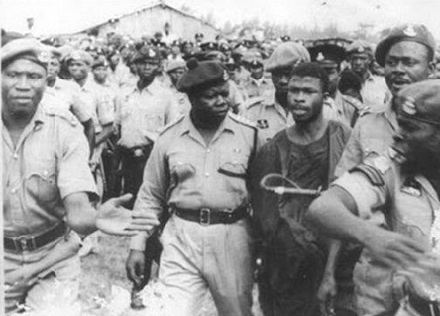
1971: Ishola Oyenusi, smiling to his death

On this date in 1971, the Nigerian robber Ishola Oyenusi — “smil[ing] to his death,” in the words of the next day’s paper — was publicly shot with his gang at Lagos Bar Beach.

Dubbed “the most dangerous criminal of this decade” even though the Seventies were barely underway, “Doctor” Oyenusi — as he liked to style himself — sprang out of the wreckage of the 1967-1970 Nigerian Civil War, a charismatic, cocksure gangster whose lordly disdain for the law cast the terrifying portent of social breakdown.

Beyond Oyenusi loomed a systematic collapse of order that long outlived him. In years to come, other celebrity crime lords would follow; eventually, armed robbery proliferated into a frightfully ubiquitous feature of life in Lagos. Maybe the Doctor smiled at the stake because he foresaw his legacy.

Disturbingly unable to combat the plague systematically, authorities would resort to occasional high-profile executions instead, provided, of course, that the culprit’s misappropriations were of the retail street-crime variety, rather than the fruits of wholesale corruption.

Oyenusi was never in the same universe with such exalted impunity as enjoyed by the masters of the state. He got into the robbery business back in 1959, boosting a car (and murdering its owner into the bargain) to make it rain for his broke girlfriend. While he eventually expanded his operations into a brutal syndicate, he was still just a hoodlum; the infamy that packed the Bar Beach with 30,000 fellow humans who booed and jeered Oyenusi to the stake was merely enough to make him worth the quashing. (He was condemned to death specifically for a raid on the WAHUM factory in March 1971 that also claimed the life of a police constable.)

Six members of Oyenusi’s crime ring went with him to the stake on the same occasion. An eighth man was also shot in the batch for an unrelated armed carjacking.

There is a 1977 film by Nigerian director Eddie Ugbomah based on this flamboyant gangster’s life, The Rise and Fall of Dr. Oyenusi.

On this day..

1771: Matthias Klostermayr, the Bavarian Hiasl

On this date in 1771, the German outlaw Matthias Klostermayr was broken on the wheel in Dillingen.

The “Bavarian Robin Hood” (English Wikipedia entry | German) led a band of poachers (their merriness or lack thereof is unrecorded) who in the 1760s did a famous business, exploiting the jigsaw of tiny statelets in the region to keep the heat off by ducking across a border every few weeks.

Their exploits zestily raiding the hated private hunting preserves of haughty lords elevated them in the popular imagination to social bandits. They’re really said to have distributed a portion of their booty to the poor. They were slated with nine homicides during their run, of game wardens or soldiers whom they did not hesitate to handle much less generously. The gang’s long run proliferated legends multiplying their prowess, even crediting them with supernatural powers like invulnerability to bullets.

Klostermayr was the subject of folk songs even in his lifetime, and that exposure meant that he eventually became the subject of multilateral coordination among the principalities whose limited jurisdictions he so expertly exploited. A 1769 mutual-assistance arrangement permitted authorities to cross the border in hot pursuit; by the end of 1770, an outright military expedition with 300 troops had been arranged. They took Klostermayr by storm on January 14, 1771 in the town of Osterzell; the theater and the shooting club still carry Klostermayr’s name in Osterzell, a small testament to the robber’s enduring popularity two and a half centuries on from his death.

That death was bound to be a demonstrative one, revenging all the offenses Klostermayr had done to his superiors.

The agonizing public shattering of his bones on the breaking wheel, preserved for us in graphic drawings, did no disfavors to the bandit’s fame. Buttressed by his thinly-veiled appearance a few years later as the protagonist of Schiller‘s first play, The Robbers, Klostermayr’s renown persists in Germanophone Europe right down to the present day.


Detail view (click for a larger image) of the terrifying device on which Bavarian outlaw Matthias Klostermayr was stretched out to have his limbs crushed with a breaking-wheel on September 6, 1772.

Detail view (click for a larger image) of Matthias Klostermayr being broken on the wheel.

On this day..

1782: Bartolina Sisa, indigenous rebel

September 5 is International Indigenous Women’s Day, in honor of the torturous execution in Bolivia on this date in 1782 of the Aymara peasant rebel Bartolina Sisa.

Sisa (English Wikipedia entry | Spanish) shared with her husband Tupac Katari leadership of a huge indigenous uprising against the Spanish.

Eighteen months before Bartolina’s execution, she and Tupac Katari — Julian Apasa, to use his given name before he staked out a nom de guerre claiming the inheritance of Tupac Amaru and Tomas Katari — laid La Paz* under siege with an army 40,000 strong. Over the course of that spring summer, the Bolivian capital lost 10,000 souls and teetered on the brink of collapse — actually in two separate three-month sieges with a brief interim between.

Bartolina Sisa was recognized by the rebels as the coequal of her husband; the two took command decisions together in consultation.

As such, when the siege was finally relieved and the natives defeated that October, Sisa was in line to share her husband’s fate. This was easy to effect because she had been betrayed into Spanish hands between the first and second sieges. Her enemies refused Tupac Katari’s every blandishment to exchange her, and in time had the cruel pleasure of forcing her to watch her defeated husband’s butchery. Nearly a year later Sisa tasted a like fate, and her body was thereafter chopped up to display as a warning in various towns to cow potential future native insurgents.

A present-day peasant women’s union bears Sisa’s name, the Bartolina Sisa Confederation; the president of Brazil’s 2006 Constituent Assembly that drafted the country’s current constitution was an indigenous Quechua woman named Silvia Lazarte, who was the Bartolina Sisa Confederation’s former executive secretary.

* The city‘s full original name was Nuestra Señora de La Paz, “Our Lady of Peace”. It was founded in 1548 at the site of a former indigenous village and the “peace” referred to is the restoration of calm after Gonzalo Pizarro‘s rising.

On this day..

1822: Francisco Javier de Elio

On this date in 1922, Spanish royalist Gen. Francisco Javier de Elio was garroted in Republican Valencia.

Elio (English Wikipedia link | Spanish) was a career Spanish officer noted for being the last Viceroy of the Rio de la Plata in South America.

The Rio de la Plata forms the border between present-day Uruguay and Argentina, and by the time Elio self-proclaimed his viceregal rank, the May Revolution had confined Spanish authority to Uruguay.* He maintained the Spanish monarchy’s power in Montevideo until revolutionaries routed his forces at the Battle of Las Piedras** and Elio had to return to Spain.

This was just in time for the Spanish crown, as that country’s liberals had answered the chaos of the French invasion by promulgating in 1812 one of Europe’s most forward-thinking constitutions. King Ferdinand VII wholly repudiated this constitution upon his re-enthronement at the end of the Napoleonic Wars, and this soon led to yet another liberal revolt in 1820† and yet another French invasion.

Elio, who administered Valencia with a rough hand for Ferdinand, was such a ferocious monarchist that revolutionaries took him prisoner in the 1820-1823 “Liberal Triennum”. The attempt by a group of mutinous cannoniers in 1822 to place Elio at their head (with or without the general’s foreknowledge) led to his condemnation by a military court.

The September 26 London Times preserves two accounts by opposing partisans of Elio’s end.

EXECUTION OF GENERAL ELIO

The infamous General Elio has at length suffered the pain of death (by the garotte). His execution took place this morning at 11 o’clock, after having been publicly divested of his rank and honours. The General was not condemned on account of his conduct as Captain General, but in consequence of the revolt of the cannoniers who occupied the fort of Valencia, on the 30th of May. Being tried before an ordinary Court Martial on the 2d of June, at which General Villa-Campa presided, he was on the 27th of August adjudged to the most ignominious death known to the Spanish laws, that of the garotte. This sentence, submitted to the Auditor of War to be revised, was not only approved, but the Auditor demanded its immediate execution, comformably to the martial law of the 17th of April, 1821. The arrival of the Brigadier Espina, who was provisionally invested with the military command of this district was regarded as the signal for the execution. If it had been retarded, we should have broken into the prison, and ourselves have conducted the victim to the scaffold. The people maintained that demeanour which becomes an heroic nation, and accompanied the culprit to the scaffold with shouts of — ‘To death with Elio! his blood will cement the constitutional edifice.’

And a contasting version …

The scaffold on which General Elio was strangled at Valencia, on the 4th instant, was erected close to a delightful garden which belonged to him when he was all-powerful in that town. It appears that this spot was selected in order that his tragical end might be marked by a circumstance which was calculated to make him regret life. One of our journals, which is at all times distinguished for its violence, affirms that General Eio, previously to walking to the scaffold, knelt down and asked pardon of the authorities who were present, for all the mischief he had occasioned — this is wholly false. Above 12,000 persons were witnesses of the firmness which he showed on this sad occasion, and of the last words which he pronounced. The General protested his innocence in the face of God and man; he declared that he had only carried into execution the orders which he had received from the Government during the period of his command; that he was utterly unconnected with the revolt of the cannoniers; and, finally, that he begged of God to pardon his murderers, as he himself forgave them. ‘I wish,’ he added, ‘that my blood may be the last which is shed in Spain. Spain will one day do justice to the purity of my intentions, and repeat the cry which is now my last prayer — ‘”Long live the King and religion.”‘

* When a Spanish colony, Uruguay was known as the Banda Oriental.

** The date of this decisive battle, May 18 (1812), is still kept as a Uruguayan national holiday.

† Guess what happened to the guy who led that 1820 revolt.

On this day..

1878: Sevier Lewis, a family affair

(Thanks to Meaghan Good of the Charley Project for the guest post. -ed.)

On August 30, 1878, Sevier (aka Severe, Savier) Lewis was hanged in Empire City, Oregon — today known as Coos Bay — for the murder of his much younger half-brother, Zachariah T. “Zack” Lewis on May 22, 1876.

The brothers were two of Hiram Hamilton Lewis’s nine children. Hiram was 74 years old at the time of Zack’s murder, and ambitious in spite of his age: he was running for state legislature.

Sevier, who was in his early fifties, was married and had seven children. Zack was twenty-five, single and still living at home. It was said he’d taken an interest in Sevier’s sixteen-year-old daughter Sylvia. Her father warned him to stay away, but Zack wouldn’t listen and kept coming around pestering his niece with unwanted advances. Finally Sevier had had enough.

Well, that’s one version of the story. Here’s another one:

Sylvia confided to her young uncle that she’d been raped by her father, and become pregnant. Zack went to Sevier and told him to stop the molestation immediately or he would tell the entire family what he had done. He helped Sylvia move in with her grandparents to protect her, and told Sevier that if he touched her again, he would kill him. Sevier touched her again.

These starkly contrasting purported motives may assign which characters, in the ensuing violent tableau, don the white hats and which the black. But either way, one late spring day, Sevier loaded his gun and went to his father’s home where he found little brother working in the fields. Sevier shot him dead, and then took flight.

In December 1877, a full year and a half after the shock murder and probably about the time Sevier was getting comfortable with having gotten away with it, a Coos County man chanced to recognize the fugitive in a hotel bar in Seattle and had him arrested.

Sevier’s own father and Sevier’s own son both testified against him at the subsequent trial, traveling 200 miles to to so. His defense attorney didn’t try to pretend he was innocent and only pleaded for a recommendation of mercy. He was convicted of his brother’s murder in June 1878 and sentenced to be hanged by the neck until dead. The judge also ordered him to cough up $830.10 in court costs, including $21 worth of beer he’d been prescribed during his incarceration.


Oregonian, August 31, 1878.

Lewis’s scaffold speech was bitter and disjointed — “bravado and blasphemy on the gallows,” the Portland Oregonian headlined it. He rambled on about how everyone was prejudiced against him, expressed love for his family and added, “If I could die a thousand times and save my daughter I would do it. If I could save her I would be satisfied to die.”

Author Diane L. Goeres-Gardner describes his final moments in her book Necktie Parties: Legal Executions in Oregon, 1851-1905:

Defiant, stubborn and vindictive, he finally forced Sheriff Aiken to manhandle him closer to the hanging rope. Even as the black cap was pulled over his head and he was being pushed forward he yelled, “What in the hell are you doing that for? I am not afraid to die.”

It was a clean hanging. His neck snapped and Sevier Lewis died within minutes.

What happened to Hiram Lewis’s political aspirations? Well, given the scandal, it’s no surprise that he lost the election. He moved to Lane County after Zack’s murder and died in 1879, supposedly of a broken heart.

What can history tell us about which brother to believe? Was Sevier really trying to protect his daughter, or did Zack pay the ultimate price for his attempt to rescue Sylvia from her predatory father?

Andie E. Jensen, author of Hangman’s Call: The Executions and Lynchings of Coos County, Oregon 1854-1925, studied the available records and notes that Sevier’s youngest child Lucy’s year of birth is unknown — the dates range from 1875 to 1877 — while all his other children had their exact date and place of birth recorded. He speculates that Lucy, said to be the daughter of Sevier and his wife Elizabeth, was in fact Sylvia’s child.

“Fact or fiction,” he concludes, “we will never know for sure. The end result was the execution of Sevier Lewis, whose act of murder victimized more than just his half brother Zack.”

On this day..

1610: Roger Cadwallador, English priest

On this date in 1610, the priest Roger Cadwallador was hanged, drawn, and quartered in Herefordshire, where he had maintained an illicit Catholic ministry for 16 years.

Having spent most of the morning in spiritual preparation (for his end) about ten o’clock he took some corporal food, viz. a little comfortable broth; and calling for a pint of claret wine and sugar, on occasion of a friend that was come to visit him, he made use of the words of bishop Fisher in the like case, as he said, when he was taking a cordial, before the like combat of death; fortitudinem meam ad te domine custodian, Saying in English, he took it to make himself strong to suffer for God. Then as if he had been to go to a feast, he put on his wedding-garment (viz. a new suit of cloaths) which a friend had provided for him, from top to toe, whom he requited with a good and godly exhortation, counselling him to persevere till death in the catholic faith; and giving him directions to bestow twelve pence of his money on the porter; for he kept two shillings in his own pocket to bestow on him that was to lead and drive the horse, when he went to execution.

His jailer pressed him repeatedly, as was usual, to apostasize and save his flesh. The terrors of the gallows being quite real even to martyrs, this menace surely worked for some … but never, it seems for those who reach these grim annals.

Being taken off the hurdle, and brought within sight of the gallows, and the block whereon he was to be quartered, they shewed him these and other instruments of death, leading him between two great fires, the one prepared to burn his heart and bowels, the other to boil his head and quarters: and thinking the sight of these did somewhat terrify him, they promised him once more that none of them should touch him, if he would take the oath; but his christian courage made him persist in his resolution of dying in that quarrel.

Cadwallador would need every drop of that resolution when an artlessly executed hanging unintentionally left him quite sensible to experience the horrors of having his trunk ripped open to tear out organs that would feed those great fires. When “the unskilful executioner”

came to turn the ladder … [Cadwallador] said aloud five or six times, In manus tuas Domine commendo spiritum meum. Into thy hands, O Lord, I commend my spirit. And lastly, Domine accipe spiritum meum. Lord receive my spirit. He hunt very long, and in extraordinary pain, by reason that the knot, through the unskilfulness of the hangman, came to be directly under his chin, serving only to pain, and not to dispatch him.

Insomuch that when the people were persuaded that he was thoroughly dead, he put up his hand to the halter, as if he had either meant to shew how his case stood, or else to ease himself: but bethinking himself better, and perhaps a scruple coming into his head to concur to hasten his own death; he had scarce touched the halter, but that he presently pulled away his hand. And within the space of a Pater-noster after, he lifted up his hand again to make the sign of the cross; which made all the standers by much amazed; and some of the vulgar desirous to rid him of his pain, lifted him upwards by the legs twice or thrice, letting him fall again with a swag.

Then after a little rest, when they thought him quite dead, he was cut down: but when he was brought to the block to be quartered, before the bloody butcher could pull off his doublet, he revived and began to breathe; which the multitude perceiving began to murmur; which made the under-sheriff cry out to the executioner to hasten: but before they had stripped him naked he was come to a very perfect breathing.

It was long after they had opened him before they could find his heart, which, notwithstanding, panted in their hands when it was pulled out.

As soon as the head was cut off, one of the sheriff’s men lifted it up on the point of a halbert, expecting the applause of the people, who made no sign that the fact was pleasing to them. Nay, they that were present were struck at the sight, and said, this priest’s behaviour and death would give great confirmation to all the papists of Herefordshire: which saying fell out to be true; for it ministered to them great courage and comfort.

Cadwallador was beatified in 1987.

On this day..

1806: Johann Philipp Palm, press martyr

Gentlemen, you must not mistake me. I admit that the French Emperor is a tyrant. I admit that he is a monster. I admit that he is the sworn foe of our nation, and, if you will, of the whole human race. But, gentlemen, we must be just to our great enemy. We must not forget that he once shot a bookseller.

–Thomas Campbell

Nuremberg bookseller Johann Philipp Palm was shot on this date in 1806 for publishing a manifesto against the French occupation.

For centuries a proud Free Imperial City, Nuremberg had over the few months preceding Palm’s martyrdom been smushed up by the conquering Grande Armee into an amalgamated French client, the Confederation of the Rhine.

This was a huge political shakeup. Even the Empire of which Nuremberg had been a Free Imperial City was no more: the 854-year-old Holy Roman Empire was dissolved in 1806, a casualty of the Battle of Austerlitz. At just 25,000 residents and far removed from its mercantile preeminence of yesteryear,* Nuremberg wasn’t even one of the Confederation of the Rhine’s 16 constituent polities: it had been rolled up into Bavaria, in a partial cleanup of the tiny Kleinstaaten pocking the old German map.

Nuremberg’s prostration in this arrangement mirrored Germany’s as a whole vis-a-vis the Corsican. Napoleon was the official “protector” of the Confederation of the Rhine, and its end of the protection racket entailed shipping conscripts to the French army.

The Confederation of the Rhine ultimately included four kingdoms, five grand duchies, 13 duchies, 17 principalities, and the Free Hansa towns of Hamburg, Lübeck, and Bremen, and covered much of the territory of present-day Germany (sans Prussia). For some odd reason, Germans whose dreams of national unification were beginning to stir weren’t too enthusiastic about having it marshaled by France.

In July of 1806, Palm gave voice to the sentiment by publishing a 144-page treatise, Germany in its Deep Humiliation. (It’s available online in an 1877 printing at archive.org.) The identity of the seditious author(s) he resolutely kept secret, but it’s commonly attributed now to Count Friedrich Julius Heinrich von Soden.

Palm had the fortune or sense to be safely away in Prussia by the time irate Frenchmen raided his shop, but was caught after he boldly slipped back into the city against all sensible advice. He was transferred to a fortress at Braunau am Inn, and shot there.

His death made him an early national martyr (“involuntary hero”, in the words of a 2006 Braunau bicentennial remembrance), and his name is still preserved on a variety of streets in German cities. In Palm’s native Schorndorf, the Palm Pharmacy building sports plaques honoring the martyr. And a Palm Foundation awards, every two years, a Johann Philipp Palm Prize journalism prize. It’s announced on this date, each even-numbered year. (Update: Salijon Abdurakhmanov of Uzbekistan and Nazikha Saeed of Bahrain received the 2014 Palm awards.)

A publishing house, Palm und Enke, actually founded post-Napoleon by the uncle under whom our Johann Palm completed his apprenticeship, still exists today. (It is no longer in the control of any Palm relative, however.)

Braunau am Inn, now a charming little burg of 16,000 just over the border into Austria, is probably best recognized in the wider world these days as the birthplace of Adolf Hitler … and it turns out the little future Nazi was deeply stirred by Palm’s model of patriotic sacrifice, albeit less so his model of an independent press. We find out all about Hitler’s admiration of Palm in the very first stanzas of Mein Kampf.

Volume 1: A Reckoning

CHAPTER 1
IN THE HOUSE OF MY PARENTS

Today it seems to me providential that Fate should have chosen Braunau on the Inn as my birthplace. For this little town lies on the boundary between two German states which we of the younger generation at least have made it our life work to reunite by every means at our disposal.

German-Austria must return to the great German mother country, and not because of any economic considerations. No, and again no: even if such a union were unimportant from an economic point of view; yes, even if it were harmful, it must nevertheless take place. One blood demands one Reich. Never will the German nation possess the moral right to engage in colonial politics until, at least, it embraces its own sons within a single state. Only when the Reich borders include the very last German, but can no longer guarantee his daily bread, will the moral right to acquire foreign soil arise from the distress of our own people. Their sword will become our plow, and from the tears of war the daily bread of future generations will grow. And so this little city on the border seems to me the symbol of a great mission. And in another respect as well, it looms as an admonition to the present day. More than a hundred years ago, this insignificant place had the distinction of being immortalized in the annals at least of German history, for it was the scene of a tragic catastrophe which gripped the entire German nation. At the time of our fatherland’s deepest humiliation, Johannes Palm of Nuremberg, burgher, bookseller, uncompromising nationalist and French hater, died there for the Germany which he loved so passionately even in her misfortune. He had stubbornly refused to denounce his accomplices who were in fact his superiors. In thus he resembled Leo Schlageter. And like him, he was denounced to the French by a representative of his government An Augsburg police chief won this unenviable fame, thus furnishing an example for our modern German officials in Herr Severing‘s Reich.

In this little town on the Inn, gilded by the rays of German martyrdom, Bavarian by blood, technically Austrian, lived my parents in the late eighties of the past century; my father a dutiful civil servants my mother giving all her being to the household, and devoted above all to us children in eternal, loving care Little remains in my memory of this period, for after a few years my father had to leave the little border city he had learned to love, moving down the Inn to take a new position in Passau, that is, in Germany proper.

* Back when being the executioner of Nuremberg was a plum assignment.

On this day..

1833: A 13-year-old slave girl

(Thanks to Meaghan Good of the Charley Project for the guest post. -ed.)

On Tuesday, the 23rd inst., Harriet, slave of JAMES H. SHEPPERD, JR., aged about 13 years, was convicted of the murder, by drowning, of a son of ALEXANDER McKENZIE, Esq., of Hardeman county; she was sentenced to be hung on the 23rd of August. The boy deceased, was aged about 5 years, and was drowned in a common flour barrel fixed in a spring near the residence of his father. (Source)

On this date in 1833, a thirteen-year-old slave girl was hanged for murder in Bolivar, Tennessee.

The teenager, called Harriet, belonged to James H. Shepperd, Jr. On some unspecified date, she drowned a five-year-old boy, the son of Alexander McKenzie, in a flour barrel near his home in Hardeman County.

A local news account noted, “The circumstances as detailed by the witnesses on the trial, show the transaction to have been one of the most wanton and aggravated murders, perhaps ever committed by a female so young, and created considerable excitement in the minds of a virtuous community.” Harriet was convicted on July 23 and executed exactly a month later.

Harriet was the youngest female ever legally executed in Tennessee. She was not, however, the youngest person in the state to meet with that fate. That honor goes to twelve-year-old Jesse Ward, also a slave, who was hanged for arson in Knoxville in 1809. He burned down his master’s house and several barns because he was angry at being whipped.

On this day..

1879: Joseph Davidenko, Sergei Chubarov, and Dmitri Lizogoub

On this date in 1879, three Russian nihilists were hanged for an attempted regicide.

Revolutionary nihilism flowered in 1870s Russia; in the words of the movement’s expatriate crier Stepniak,

In 1870 the whole of advanced Russia was anarchist … The socialists of this epoch based all their hopes upon the peasants. Thousands of young people of both sexes went upon a crusade among the peasants; the more exalted with the object of calling them to open rebellion, the more moderate with the intention of preparing the ground for future revolution by peaceful socialist propaganda. This was one of the most touching and characteristic episodes of the younger movement, when the motto “All for the people and nothing for ourselves” was the order of the day.

…

This socialist crusade was a complete failure. … In the course of 1873 and 1874 fifteen hundred propagandists and agitators, or their friends and supposed accomplices, were arrested in the thirty-seven provinces of the empire, and thrown into prison. Half of them were released after a few months’ detention; the rest were kept in preliminary confinement from two to four years, during which seventy-three either died or lost their reason. In 1877 one hundred ninety-three were tried and condemned to various punishments, from simple exile to ten years of hard labor in the mines of Siberia …

But theories, once adopted, do not disappear so easily. The passions spoke first; and men began to act in the right direction before they had reasoned out their action. The wanton cruelty with which political prisoners were treated, the horrors of preliminary detention, the barbarous punishment inflicted for trifling offences — all this proved unendurable even to the mild, patient Russians. The spirit of revenge was kindled, giving birth to the first attacks upon the Government, known by the name of terrorism.

We have met these passionate Russians time and again in these pages, of course. And like this group, the movement’s ne plus ultra objective was taking out the tsar himself.

The reader will have noticed that Stepniak’s leading players are elites gone to rouse the masses to rebellion rather than creatures of the masses themselves. One of the leading figures in this date’s group, Dmitri Lizogoub — many transliterations are possible: Lissogub, Lizogoob, etc. — was a wealthy nobleman; indeed, he was one of his comrades’ chief financiers. The “Saint of Nihilism” was turned in by his own steward for the opportunity to collect as his bounty the small remainder of Lizogoub’s estate. Sergei Chubarov, another nobleman, instigated the assassination plan for which they die: to greet a state visit by the much-targeted Alexander II to Nikolaev explosively.

It was after a dragnet of putative subversives in the wake of Soloviev‘s April 1879 assassination attempt that our batch for today was rounded up and put before a military proceeding among a group of 28 terrorists. Others received terms of prison or Siberian exile; Lizogoub, Chubarov, and a Black Sea fleet deserter named Joseph Davidenko publicly hanged together at the Odessa race-course. Two others of their circle, Wittenberg and Lobovenko, were executed in the subsequent days at Nikolaev.

This particular conspiracy was detected in time, but conspiracies in general did not abate in the wake of harsh punishment: if anything, dreams of tyrannicide redoubled. Given the sheer volume of plots against the Autocrat of All the Russias, one, inevitably, finally got through.

On this day..

1851: John McCaffary, the last hanged by Wisconsin

On this date in 1851, the domestic abuser John McCaffary (or McCaffrey) was publicly hanged in Kenosha, Wisconsin.* His crime — singularly ill-concealed — was a noisy row with his wife Bridgett that ended with him tipping her into a rain barrell and holding her in it until she stopped moving.

Neighbors alerted by Bridgett’s shrieks arrived to find the newly-minted widower redwet-handed, and his late wife stuffed in the backyard butt.

There had been a few executions in Wisconsin before McCaffary’s, but this was the first one after Wisconsin attained statehood in 1848. It was attended by a large crowd of 2,000 to 3,000 onlookers — a third of them female, to the special chagrin of newsmen.

And those 2,000 to 3,000 onlookers, as it turned out, witnessed something never to be repeated. From that day until this, the state of Wisconsin has never again put a human to death.**

The crowd played a part in that eventuality. Wisconsin was a reforming northern state — in a few years, the anti-slavery Republican Party would be founded there — and the spectacle of public enjoyment under the gallows struck as regrettable the sorts of people who, say, write Madison Democrat editorials. (“Murder before the people, with its horrors removed by the respectability of those engaged in its execution.” (Source))

Christopher Latham Sholes, a Kenosha publisher whose main claim to historic fame was later inventing the first commercially successful typewriter,† was seated in the Wisconsin State Assembly in 1852 as a Free Soiler. He too had denounced the execution in his newspaper — “the crowd has been indulged in its insane passion for the sight of a judicially murdered man … we hope this will be the last execution that shall ever disgrace the mercy-expecting citizens of the State of Wisconsin.” (See It Happened In Wisconsin, 2nd, or this link.) As a legislator, he put his political capital where his editorials were and spearheaded a successful campaign to get rid of capital punishment.

On July 12, 1853, Wisconsin followed the example of its neighbor, Michigan, and abolished the death penalty full stop.


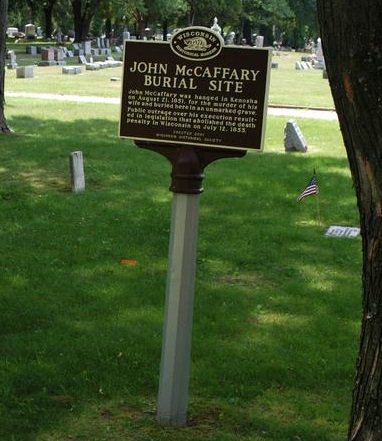
Burial marker for McCaffary in Kenosha’s Green Ridge Cemetery, erected in 2001. ((cc) image from Matt Hucke.) The McCaffary house on Court Street is also a registered historic landmark, and possibly haunted by Bridgett’s ghost.

There’s a handy roundup of resources related to the McCaffary execution here.

* The present-day name. Kenosha was then known as Southport.

** According to Invitation to an Execution: A History of the Death Penalty in the United States, there was an 1868 Wisconsin execution under Oneida (not Wisconsin) law, conducted on tribal lands.

† Said typewriter also debuted the now-standard QWERTY keyboard layout.

On this day..