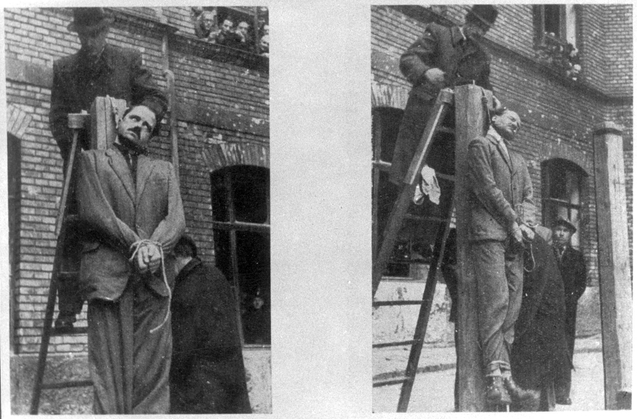
On this date in 1763, fifteen-year-old Elizabeth Morton was hanged on Gallows Hill, Nottingham for the murder of her employer’s two-year-old daughter.
Elizabeth, a servant girl employed by the farmer John Oliver and his family in the parish of Walkeringham, was caught after attempting to kill one of the Olivers’ other children. Loretta Loach describes Elizabeth’s crime in her book The Devil’s Children: A History of Childhood and Murder:
In August 1762, Mrs. Oliver found one of her children under some straw in a barn, “struggling in the agonies of death, the blood gushing from its mouth, nose and eyes.” The child recovered and accused Elizabeth. The servant was immediately suspected of having strangled the family’s two-year-old daughter Mary, who had been found dead in her cradle months earlier.
Elizabeth confessed to the crime, but said she had been incited to commit it by a gentleman in black who came to bed with her and told her she must murder two of her master’s children. She could not feel easy, she said, until she had done as he directed. Despite the fact that the report in the Annual Register suggested she was an “idiot” (which would have been grounds for a pardon), she was executed…
After she was hanged, her body was dissected and then buried in a village near her home.
On this date in 1857, a robber-murderer named Francis Richeux was publicly guillotined in Paris before a crowd of 12,000 to 15,000 people.
One of those onlookers was a 28-year-old Russian noble, fresh from the Crimean War and abroad on his first European trip: Leo Tolstoy.*
Overcome with curiosity, Tolstoy (as he recorded in his diary; here it is in Russian)
rose at seven o’clock and drove to see an execution. A stout, white, healthy neck and breast: he kissed the Gospels, and then — Death. How senseless … I have not received this strong impression for naught. I am not a man of politics. Morals and art I know, love, and [understand]. The guillotine long prevented my sleeping and obliged me to reflect.
The spectacle made such an impression on me that it will be long before I get over it. I have seen many horrors in war and in the Caucasus, but if a man were torn to pieces in my presence it would not have been so repulsive as this ingenious and elegant machine by means of which they killed a strong, hale, healthy man in an instant. There [in war] it is not a question of the rational [will], but the human feeling of passion, while here it is a question of calm and convenient murder finely worked out, and there’s nothing grand about it. The insolent, arrogant desire to carry out justice, the law of God. Justice, which is determined by lawyers every one of whom, basing himself on honor, religion, and truth, contradicts each other. With these same formalities they have murdered both the king and Chenier, both republicans and aristocrats.† . . Then the repulsive crowd, the father explaining to his daughter what a convenient and ingenious mechanism it is, and so forth. The law of man — rubbish! The truth is that the state is a conspiracy not only for exploitation, but chiefly to corrupt its citizens. But all the same states exist, and moreover in this imperfect form. And they cannot pass from this system into socialism . . . For my part, I can only see in all this repulsive lie what is loathsome, evil, and I do not want to, and cannot, sort out where there is more and where there is less. I understand moral laws, the laws of morality and religion, binding on no one, that lead people forward and promise a harmonious future; I feel the laws of art which always bring happiness; but the laws of politics constitute for me such an awful lie that I cannot see in them a better or worse. All this is what I felt, understood, and recognized today. And this recognition at least to some extent relieves the burden of the impression for me . . . From this day forward I will not only never go to see such a thing again, but I will never serve any government anywhere.**
He wasn’t kidding about that long insomnia, either: the impression startled him, permanently. Recalling the effect years later in his Confessions, Tolstoy still attributed to it an important confirmation of his egalitarian philosophy.
When I saw the head separate from the body, and how they both thumped into the box at the same moment, I understood, not with my mind but with my whole being, that no theory of the reasonableness of our present progress can justify this deed; and that though everybody from the creation of the world, on whatever theory, had held it to be necessary, I know it to be unnecessary and bad; and therefore the arbiter of what is good and evil is not what people say and do, and is not progress, but is my heart and I.
Tolstoy developed the same theme further a few years later in What Is to Be Done? … the shade of the long-forgotten Francis Richeux still haunting the great man of letters.
Thirty years ago in Paris I once saw how, in the presence of thousands of spectators, they cut a man’s head off with a guillotine. I knew that the man was a dreadful criminal; I knew all the arguments that have been written in defence of that kind of action, and I knew it was done deliberately and intentionally, but at the moment the head and body separated and fell into the box I gasped, and realized not with my mind nor with my heart but with my whole being, that all the arguments in defence of capital punishment are wicked nonsense, and that however many people may combine to commit murder — the worst of all crimes — and whatever they may call themselves, murder remains murder, and that this crime had been committed before my eyes, and I by my presence and nonintervention had approved and shared in it. In the same way now, at the sight of the hunger, cold, and degradation of thousands of people, I understood not with my mind or my heart but with my whole being; that the existence of tens of thousands of such people in Moscow — while I and thousands of others over-eat ourselves with beef-steaks and sturgeon and cover our horses and floors with cloth or carpets — no matter what all the learned men in the world may say about its necessity — is a crime, not committed once but constantly; and that I with my luxury not merely tolerate it but share in it. (PDF source | Original Russian)
* Among Tolstoy’s other activities in Paris was hanging around Turgenev … but the two mostly irritated one another. Nevertheless, they shared a distaste for the guillotine, at least to judge by Turgenev’s repulsion at seeing it in action years later.
** Two days after the execution, Tolstoy left Paris for Geneva. Execution-disgust is a suggestive speculation, although Henri Troyat argues that it merely gave him a “dramatic excuse” to stop putting off travel plans he had already made.
“Mr Joseph Hani was hanged for treason in the Burj at 5 a.m. At 8 a.m. 40 families deported.
-Diary of Mrs. Harry Dorman, April 5, 1916*
The unfortunate Joseph Hani — Yusuf al-Hani — was among the worthies of Beirut’s Maronite Christian community to petition the French consulate for western aid in detaching Lebanon from the Ottoman Empire.
With the development of World War I, the French ambassador Francois Georges-Picot abandoned the embassy … without removing or destroying this sort of incriminating correspondence. As a result, the Turks ransacked the embassy and identified several dozen of reproachable loyalty to the Porte to put to death.
May 6 — Martyrs’ Day — honors these victims, but Hani was among the very first of them.
While most of the other Maronite signers were able to fly, Hani stuck around to face the music. A British agent was able to contact the implicated characters in Aley Prison, and received the plaintive answer,
‘Where are the English? Where are the French? Why are we left like this?’
* I believe an ancestor of the current president of the American University of Beirut, Peter Dorman. The source of the diary citation is Nicholas Z. Ajay Jr.’s “Political Intrigue and Suppression in Lebanon during World War I” in International Journal of Middle East Studies, Apr., 1974.
On this date in 1098, Antioch’s besieged Muslim defenders martyred a Crusader knight who refused to secure a ransom for himself.
The armies of the First Crusade had pressed their way through Anatolia and had laid to siege these past five months the ancient Syrian city of Antioch. (It’s in modern Turkey now, where it’s known as Antakya.)
On April 3, 1098, by the account of the priest Peter Tudebode, an eyewitness to the event,
the Turks led to the top of an Antiochian wall a noble knight, Rainald Porchet [alternatively, Rainaud or Reynaud Porquet], whom they had imprisoned in a foul dungeon. They then told him that he should inquire from the Christian pilgrims how much they would pay for his ransom before he lost his head.
According to Encounter Between Enemies: Captivity and Ransom in the Latin Kingdom of Jerusalem — a source which ought to know, if any would — marching a guy out to appeal to his comrades was little to the Antiochians but the time-honored practice of ransoming captured VIPs, “the usual diplomatic method of starting a peaceful encounter with the enemy, in the between-fighting interlude.” It’s not like this sort of hostage-hocking was unknown to Europeans; even hundreds of years later, France cratered its economy by ransoming its captured king from the English.
To the shock of the garrison, Porchet went all clash-of-civilizations on this routine diplomacy.
From the heights of the wall Rainald addressed the leaders: “My lords, it matters not if I die, and I pray you, my brothers, that you pay no ransom for me. But be certain in the faith of Christ and the Holy Sepulchre that God is with you and shall be forever. You have slain all the leaders and the bravest men of Antioch; namely, twelve emirs and fifteen thousand noblemen, and no one remains to give battle with you or to defend the city.”
The Turks asked what Rainald had said. The interpreter replied: “Nothing good concerning you was said.”
The emir, Yaghi Siyan, immediately ordered him to descend from the wall and spoke to him through an interpreter: “Rainald, do you wish to enjoy life honorably with us?”
Rainald replied: “How can I live honorably with you without sinning?”
The emir answered: “Deny your God, whom you worship and believe, and accept Mohammed and our other gods. If you do so we shall give to you all that you desire such as gold, horses, mules, and many other worldly goods which you wish, as well as wives and inheritances; and we shall enrich you with great lands.”
Yaghi Siyan was obliged to make this proposition of apostasy to his prisoner as a prelude to executing him.
Rainald replied to the emir: “Give me time for consideration;” and the emir gladly agreed. Rainald with clasped hands knelt in prayer to the east; humbly he asked God that He come to his aid and transport with dignity his soul to the bosom of Abraham.
When the emir saw Rainald in prayer, he called his interpreter and said to him: “What was Rainald’s answer?”
The interpreter then said: “He completely denies your god. He also refuses your worldly goods and your gods.”
After hearing this report, the emir was extremely irritated and ordered the immediate beheading of Rainald, and so the Turks with great pleasure chopped off his head: Swiftly the angels, joyfully singing the Psalms of David, bore his soul and lifted it before the sight of God for Whose love he had undergone martyrdom.
Rainald got himself a starring role in the Chanson d’Antioche, an epic poem celebrating the Crusade, for this pious self-sacrifice. We can only presume that his name- and numberless compatriots in the dungeons, who also paid the price for Rainald’s obstinacy, were satisfied with suffering the same fate but only getting a role in the chorus.
Then the emir, in a towering rage because he could not make Rainald turn apostate, at once ordered all the pilgrims in Antioch to be brought before him with their hands bound bend their backs. When they had come before him; he ordered them stripped stark naked, and as they stood in the nude he commanded that they be bound with ropes in a circle. He then had chaff, firewood, and hay piled around them, and finally as enemies of God he ordered them put to the torch.
The Christians, those knights of Christ, shrieked and screamed so that their voices resounded in heaven to God for whose love their flesh and bones were cremated; and so they all entered martyrdom on this day wearing in heaven their white stoles before the Lord, for Whom they had so loyally suffered in the reign of our Lord Jesus Christ, to Whom is the honor and glory now and throughout eternity. Amen.
In these heady early months of the Crusades, when the enterprise stumbled from near-disaster to miraculous success, the renown of Porchet et al was clinched by the siege’s success in early June — just days ahead of the arrival of a Turkish relief force which thereafter had to content itself with besieging the now-Crusader-held city.
When this second siege was repelled with the help of the Christians’ convenient — staged, one might think — “discovery” of the Holy Lance of Antioch, everyone had to know that the Big Guy was truly on their side.
On this date in 1674, Benjamin Gourd (or Goad) was hanged for bestiality in Puritan Massachusetts.
Six New England colonists (pdf) had died for bestiality up through 1662, but the sentence was falling out of fashion.
Gourd, caught having his way with a mare “at noon day in an open yard” and within sight of the gallows, has the distinction of being the last colonist of the future United States put to death for fauna-philia. And even the jury that sentenced him was noticeably reluctant about dooming the 17-year-old.
Well, preacher Samuel Danforth wasn’t going to have any of this ungodly backsliding on Gourd’s ungodly backsliding.
the Earth groans under the burthen of such Wickedness. You pity his Youth and tender years, but I pray pity the holy Law of God, which is shamefully violated; pity the glorious Name of God, which is horribly profaned; pity the Land, which is fearfully polluted and defiled.
We think Corey Robin will recognize Danforth’s indictment of the youth’s “licentious liberty” obtained in defiance of an unnamed Master as the root of all his ruin, and any American with an AM radio dial will recognize the rest.
Being at length, by the good hand of God, brought under the Yoke of Government and Service, (which might have bridled and restrained him from such wickedness) he violently brake away from his Master, and with an high hand boldly and impudently, like a childe of Belial, shook off that Yoke of God, casting reproach and disgrace upon his Master. Having now obtained a licentious liberty, he grew so impudent in his wickedness, as to commit this horrid Villany in the sight of the Sun, and in the open field, even at Noon-day; proclaiming his sin like Sodom. Though he be a Youth in respect of years, yet he is grown old in wickedness, and ripe for Vengeance.
“It is unjust that that which is rightly judged should result in prejudice to us and bring damage to others …”
-Edward II, letter concerning the Pierre Vigier case
One is like to reckon the phenomenon of the interminabledeath penaltyappeal a modern construct, product of the present day’s moral confusion or juridical inefficiency.
It’s been right about 700 years exactly since Pierre Vigier was hanged in the February-April neighborhood, in the year of our Lord 1312, for his impolitic sentiments on the governance of his native province. This medieval execution went with a very modern-sounding 12 years of indeteminate appeals.
Still, it is true what they say — “The past is a foreign country: they do things differently there.” In this foreign country, Gascony by name, they did the hanging first … and then did the appeals.
Our source here (virtually the only source short of plumbing the archives) is Joseph Kicklighter’s “English Bordeaux in conflict: the execution of Pierre Vigier de la Rousselle and its aftermath, 1312-24” from the Journal of Medieval History, no. 9 (1983).
And the source of all the judicial chaos was the bizarre situation of one king as a rival king’s vassal.
Gascony at this time was a sort of feudal leftover of the Angevin Empire whose Plantagenet descendants were still kings of England. This remaining Plantagenet patrimony* in southwestern France was a going source of conflict between the realms, the most recent of which had been expedientlysettled by making the English king also Duke of Gascony … and (with respect to Gascony) the French king his liege lord.
Seated French king Philip IV accepts the homage of his “vassal” Edward I.
The territory was worth the “submission”: ducal Gascony’s fertile land gave England a bounty in crops and wine. And the inevitable rivalry over sway in Gascony easily knocked on to the courts. As Barbara Tuchman put it in A Distant Mirror,
[t]he King of France still retained superior sovereignty under the formula of superioritas et resortum, which gave the inhabitants the right of appeal to the ultimate sovereign. Since his decisions were more than likely to go in their favor against their English overlord, and since the citizens, knowing this, exercised the right frequently, the situation was an endless source of conflict.
It was during such a conflict, when the rival factions of the Gascon capital of Bordeaux had the city in virtual anarchy as they jockeyed for power under the nominal lordship of English king Edward II, that the onetime royal castellan Pierre Vigier de la Rouselle apparently dumped on one of the new officials in conversation with a couple of informants.
The municipal government arrested Vigier and had him hanged — quickly, before Vigier’s inevitable attempted appeal to Parlement could save him.
(This all went down just a couple months before Edward II suffered a Gascon humiliation closer to home, when the Gascon nobleman Piers Gaveston, Edward’s dear friend and suspected lover, was executed by rival English lords.)**
Vigier’s aggrieved sons did pursue the appeal (it is they who provide posterity the circumstances of Pierre’s condemnation, so handle the story with care: one latter-day hypothesis is that Vigier was an outright rebel against the new appointees). Inevitably, the French backed their claim, allowing them undercut Edward’s ducal authority.
Productive relationship.
From there, the matter sank into an intractable mire of feudal Europe’s overlapping political authorities and factional rivalries. Parlement decreed some penalties. King Philip remitted some of them as a diplomatic gesture. The sons renewed their complaint. Bordeaux authorities tried to put the matter to bed by persecuting Vigier’s persecutors, only to be slapped down by an indignant King Edward. Persons were seized only to be ordered released, and estates likewise. Just as there was no single unambiguous authority to adjudicate it, there was no single wrongdoer to investigate, no single injury to repair (besides the matter of honor, there was the dead man’s property, and the fact that he was buried in unconsecrated ground), and no single arrangement of interested parties between the Vigier sons on the one side and the Plantagenet king on the other.
Edward seems to have taken particular affront at this imposition on his routine authority, and one must bear in mind that at this stage even the concept of sovereignty as we think of it today was simply not on the map. In some ways, the French appeals policy was pioneering it.
But as the suit bumped up and down or got kicked down the road by a Parlement that was probably enjoying its sport, Edward tried to dispose of it through such expedients as harassing its supporters and attempting to bankrupt the Vigiers. All this, naturally, just got rolled into the messy ol’ case.
Kicklighter:
Only time itself finally ended the appeal … in March 1324, King Charles IV announced the indefinite postponement of all ducal litigation at the Parlement of Paris becase of a mounting Anglo-French crisis which would soon lead to the brief War of Saint-Sardos. But even during the war, the court continued to deal with some aspects of the case; and the appeal was still under judgment when the Anglo-French feudal relationship was resumed with the accession of Edward III to the English throne.† It seems likely … Parlement had dropped the case by the 1330’s … in all probability, the Vigier case had lost the critical importance with which the king-duke and his officials had regarded it for so long. One might, with some justification, wonder why the appeal had ever enjoyed such attention.‡
“It was not the dynastic question that brought about the war,” wrote the historian T.F. Tout. “The fundamental difference between the two countries lay in the impossible position of Edward in Gascony.”
** Potentially topical to this digressive connection: Edward’s loyal aide in Bordeaux, a gentleman by the name of Arnaud Caillau, may have been a cousin of Piers Gaveston. Edward certainly had a supportive Gascon faction that his own resentful alleged vassals were frequently keen to harass; maybe the whole Vigier intervention just struck a little too close to home.
† The reader will recall that Edward III’s route to power involved his French mother and her lover invading England and overthrowing Edward II. So there was a good deal of more interesting politics going on around this time than Pierre Vigier’s endless procedural appeal.
‡ Lest we misrepresent Kicklighter, he does go on to attempt to explain this hypothetical wonder as “a certain indication of the limited power of the English in Gascony.” I prefer my own stopping-point.
On this date in 1946, fascist Hungarian politicians Laszlo Baky and Laszlo Endre were executed by hanging in Budapest for their role in the decimation of Hungarian Jewry.
These two charmers were major figures in Hungary’s horrible final months of World War II.
This occupation lifted the virulent anti-semites Baky and Endre into national power, because along with keeping Hungary in the Axis coalition, the Nazis also forcibly overcame its junior partner’s former reticence about Jewish genocide.
Adolf Eichmann arrived into Nazified Hungary and used our day’s two principals (along with another executed collaborator, Andor Jaross, they’re known as the “deportation trio”) as his instruments. Within months, hundreds of thousands of Hungarian Jews were being shipped to the gas chambers. This period is one of the waypoints of pernicious Nazi race theory, when the collapsing German regime spent military resources urgently needed at the front to organize the mass slaughter of Jews.*
And they had to work fast, because by that next winter the Red Army was seizing Budapest. These enthusiastic fascist operators did not fare well by the postwar government.
* To do justice to the breadth of the human capacity, this is also the time and place where we find Raoul Wallenberg minting lifesaving Swedish passports by the thousands.
On this date* in 1815, Anthony Lingard was hanged for murder and robbery at Derby.
Lingard strangled the widow who operated the Wardlow Miers tollbooth in order to rob her poor possessions and lavish those ill-gotten proceeds upon the girl he had impregnated — “with a view to induce her to father the child upon some other person.” That’s the world without contraception for you.
Lingard’s girl thought this bribe fishy and gave him back the widow’s incriminatingly distinctive shoes after hearing reports that footwear had been taken from the murder scene. Then, she testified against him at the Derby Assizes (Lingard had also confessed the crime). Tried on Saturday the 25th, convicted “after a few minutes,” and strung up in front of the county gaol at noontime Tuesday, Lingard “met his fate with a firmness which would deserve the praise of fortitude if it was not the result of insensibility. He appeared but little agitated or dejected by his dreadful situation.”
Rather than the increasingly standard post-execution coda of anatomization, Lingard’s body was given over to a use of more ancient vintage: gibbeting.
Hung up in chains on the aptly named Gibbot Field in Wardlow near the spot of the murder, Lingard’s bleaching bones provided a grisly object lesson to passersby of the consequences of crime. Or, maybe not: though the novelty at first made a crowd-pleasing spectacle, it soon faded into the scenery.
A few years later, a 16-year-old girl poisoned off a rival in the very shadow of the gibbet, winding up executed for her trouble. A younger fellow named William Lingard eventually drew a death sentence for highway robbery committed near his own older brother’s clanking remains — a sentence commuted to convict transportation.
If what was left of Anthony Lingard failed to overawe his criminal counterparts, it did at least leave an impression on poet William Newton, who penned this sad meditation on the local landmark, found in full here. (It must have helped his perspective that Newton was into his sixties when the young pup hanged.)
“The supposed Soliloquy of a Father, under the Gibbet of his Son; upon one of the Peak Mountains”
TIME — Midnight. SCENE — A Storm.
Art thou, my Son, suspended here on high? —
Ah! what a sight to meet a Father’s eye!
To see what most I prized, what most I loved.
What most I cherish’d, — and once most approved,
Hung in mid air to feast the nauseous worm.
And waving horrid in the midnight storm!
Let me be calm; — down, down, my swelling soul;
Ye winds, be still, — ye thunders, cease to roll!
No! ye fierce winds, in all your fury rage;
Ye thunders, roll; ye elements, engage;
O’er me be all your mutual terrors spread.
And tear the thin hairs from my frenzied head:
Bring all your wrathful stores from either pole.
And strike your arrows through my burning soul :
I feel not, — fear not, — care not, — shrink not, — when
I know, — believe, — and feel, — ye are not men!
Storms but fulfil the high decrees of God,
But man usurps his sceptre and his rod.
Tears from his hand the ensigns of his power.
To be the petty tyrant of an hour.
My Son! My Son! how dreadful was thy crime!
Thy name stands branded to remotest time;
Gives all thy kindred to the eye of scorn,
Both those who are, and those that may be born;
Scatters through ages on thy hapless race
In every stage of life, and death, — disgrace:
In youth’s gay prime, in manhood’s perfect bloom.
Ah! more, — it ends not, dies not, on the tomb!
O woman! woman! choicest blessing given.
If pure; — the highest gift of highest heaven!
If lax, corrupt, deceitful, — worse than hell!
Worse than the worst of demons dare to tell!
It was thy lot, ill-fated Son! to find
Thy doom pour’d on thee by the faithless kind;
Fraudful, and false, their treacherous snares they spread.
And whelm’d destruction on thy thoughtless head.
To die, to perish from the face of earth.
Oblivion closing on thy name and birth.
Hid under ground from each invidious eye,
From every curious, every rancorous spy,
Was what thy crime deserved: — not more;
The rest seems cruelty. — When heretofore
Our barbarous sires the aweful Gibbet rear’d.
The Gibbet only, not the laws were fear’d:
The untutored ruffian, of an untaught clime,
Fear’d more the punishment than dreaded crime.
We boast refinement, say our laws are mild.
Dealt equally to all, the man, the child: —
But ye, who, argue thus, come here and see,
Feel with a Father’s feelings; — feel with me!
See that poor shrivell’d form the tempest brave.
See the red lightning strike, the waters lave.
The thunders volleying on that fenceless breast! —
Who can see this, and wish him not at rest?
At rest, — vague word! — the immaterial mind
Perhaps even now is floating on the wind: —
Ah! no, — not mind, — not spirit, — but the shell;
The mind ere this has drank of Mercy’s well:
‘Tis not for that I feel, for that I sigh.
But sweltering, putrid, rank mortality.
O! blind to truth, to all experience blind.
Who think such spectacles improve mankind:
Bid untamed youth on such sights feast his eyes,
Harden you may, but never humanise.
Ye who have life, or death, at your command.
If crime demand it, let the offender die.
But let no more the Gibbet brave the sky:
No more let vengeance on the dead be hurl’d.
But hide the victim from a gazing world.
Anthony Lingard was the last person ever gibbeted in Derbyshire. England abolished gibbeting and hanging in chains full stop in the 1830s.
* The date March 8 is widely attributed on other sites, but the primary documentation for March 28 is unambiguous. I want to suspect a seminal typo somewhere that’s been copied a thousand other times over.
On this date in 1947, Hisakazu (or Hisaichi) Tanaka was shot by the Chinese Koumintang for war crimes committed during the Japanese occupation of China.
Captured in Canton at the end of the war, Tanaka was tried by the Allied occupiers for permitting the execution of a downed American airman on April 6, 1945. That unnamed airman had been tried in wartime Japan for targeting civilians during his bombing raid, a judgment that Tanaka’s tribunal vociferously disputed.
Though he drew a hanging sentence for that offense, it was not carried out: instead, the doomed general was handed over to the Chinese nationalists to answer for the depredations of his 23rd army.
No surprise, the outcome there was pretty much the same.
On this date in 1555* — crying, “away, thou false prophet!” at the priest sent to hector him in his last moments — William Hunter was burned in Brentwood, Essex for Protestantism.
Here in the last brief moment of official Catholicism under Queen Mary, our apprentice silk-weaver was caught reading the Bible for himself in the local chapel.
Called in for questioning, both Hunter and the civil authorities decided it was worth his life to dispute the doctrine of transubstantiation. Catholic pro, Hunter con, of course.
A couple of years later, the very justice who had first examined Hunter received a grant to found a school. Brentwood School is still going strong in its fifth century, and on its grounds — directly adjacent, in fact, to the school’s first purpose-built room** — rests a stone for the edification of the generations of Anglican pupils who followed. It honors the young man who died to crack open a book.
WILLIAM HUNTER. MARTYR. Committed to the Flames March 26th MDLV.
Christian Reader, learn from his example to value the privilege of an open Bible. And be careful to maintain it.
An elm tree planted at that spot came to be known as the Martyrs Elm.
1847 illustration of Brentwood School and the Martyrs Elm.
* This is the date per Foxe’s Book of Martyrs; others give March 27. The memorial stone carries the day for our purposes in view of contradictory sourcing.
** The legend that Brentwood School was founded as the justice’s penance for dooming Hunter seems to be unfounded.