This date in 1832 was the Republic’s only execution of a female in Tyler County, West Virginia (then part of Virginia): a slave named Lucy who murdered the daughter of a neighboring family.
Detail on this case comes salvaged from the now-defunct (we think) death penalty history site Before the Needles:
Just across Middle Island from the Wells home lived a family which had a daughter named Mary Ann Fletcher.
Communication between the two homes was by canoe or johnboat and quite frequently Lucy was sent to the creek bank to set Miss Fletcher across the stream for a visit to the Wells home when they heard a halloo from the opposite shore. For some reason Lucy became intensely jealous of the attention which her master’s family lavished on the young Fletcher girl and determined to slay her.
One day after visiting the Wells home Lucy was sent with Miss Fletcher to set her across the creek and after a little longer delay than usual Lucy returned to “Stonehurst” her usual calm self, but later in the evening Mr. Fletcher came to the creek bank and hallooed across to “Stonehurst” and asked if they would send Mary Ann home immediately, as it was growing late.
Squire Wells and his family wondered what had happened, but did not think of anything wrong untill Mr. Fletcher called to them a second time. Lights were secured by both families who went to the crossing and in a short time the body of Mary Ann, drowned, was discovered.
An examination of the body disclosed the she had evidently died from foul play, because the fingers of both hands had been badly crushed and she also had bruises on her head and face. Lucy was immediately suspected and shortly confessed that she had pushed Miss Fletcher out of the boat, and when she did not readily drown, and had caught the sides of the canoe with her hands, she (Lucy) had pounded Miss Fletchers hands with the paddle, struck her over the head several times and pushed her under the surface of the stream.
On this date in 1778, Revolutionary War-era bandit James Fitzpatrick was hanged — very badly — at Chester, Pennsylvania.
Fitzpatrick was then, and still is now, a legendary character in Chester County. He’s better known as “Captain Fitz” or, with a bit more flair, “Sandy Flash”.
Born to Irish immigrants in Chester, Fitzpatrick joined up with the Continental Army when the Revolutionary War broke out.
But after being subject to the commonplace but brutal punishment of flogging for some failure of military discipline, Fitzpatrick deserted, swimming off Long Island in the dead of night and eventually returning home. There, he was recognized as a deserter and clapped in jail until he agreed to fight again.
All this built up a terrific grudge in the young man’s heart, and he “agreed” just long enough to get out from behind bars and abscond again. After warding off yet another press gang sent to retrieve him, Fitzpatrick vengefully took to the road.
This was not necessarily out of bounds for Fitzpatrick’s milieu. As detailed by Rosemary Warden (“‘The Infamous Fitch’: The Tory Bandit, James Fitzpatrick of Chester County,” Pennsylvania History Summer 1995):
Fitzpatrick’s bold outlawry must be seen against the background of many Chester Countians’ lack ofsupport for the Revolution, ranging from passive neutrality to outright loyalism. Forty percent were Quaker, settled most heavily in the eastern township. Only a small number actively supported the Revolution or the British cause … Fitzpatrick’s two favorite targets, militia recruiters and tax collectors, often met violent opposition in Chester County during this period, and not always from loyalists …
It is not surprising that revolutionary General Anthony Wayne wrote to Council President Thomas Wharton in the spring of 1778, to suggest that he stop recruiting troops in Chester County, a wasted effort, and concentrate on raising men in Berks, Lancaster, York, or Cumberland Counties. Nor is it surprising that a loyalist bandit who particularly targeted militia officers would find clandestine support and safe hideouts in Cheser County.
Playing to the hilt the part of “Tory highwayman,” Captain Fitz targeted Chester County Whigs, and especially agents of the revolutionary government. And he did not neglect the opportunity to inflict with the flog the suffering he had once endured himself. Still,
Despite his many crimes, there was a rough chivalry in the character of the man which exhibited itself in his marked gallantry towards women, in his open, generous disposition to aid them on when ill fortune bore heavily; indeed, he was never known to rob a poor man or ill-treat a female. Many are the instances related when he bestowed upon the destitute that which he had taken from those in good circumstances, and the weak or defenseless never suffered at his hands. On one occasion an old woman, who made a meagre living by peddling from house to house odds and ends of female apparel, encountered Fitzpatrick in the neighborhood of Caln Friends’ meeting-house. She was at the time on her way to Philadelphia to buy goods, and all the money she possessed was on her person. She had never seen Capt. Fitzpatrick, and she informed, the tall, handsome stranger that she was told that the outlaw had made some demonstrations in that neighborhood a short time before, and she was afraid that she might fall in with him and be robbed of all her money. Fitzpatrick, by a few questions, drew from her the particulars of her business, and her difficulty in winning an honest livelihood. He then good naturedly told her she need be under no apprehension, Fitzpatrick never warred upon the weak or defenseless, that she was talking to that personage; and taking a purse from his pocket containing several gold pieces, he gave it to her to aid her in increasing her scanty stock of goods. Then, wishing her a safe journey, he turned into the woods and disappeared.
What a guy.
His prey among the Whig well-to-do not being constrained to treat Fitz with any similar measure of gallantry, the bandit was at length captured when, in the course of raiding a household, he briefly set down his weapons — and his hostages jumped him. (The hostages in question had an argument with each other afterwards over who should get the reward.)
“Sandy Flash” is a prominent character in Bayard Taylor‘s portrait of revolutionary Pennsylvania, The Story of Kennett, where, Turpin-like, he’s “transformed” (the author’s own words) “from a living terror into a romantic name.” Here, Bayard dramatizes an allegedly real exploit, in which Fitzpatrick boldly presents himself at a public inn* where a posse hunting him has holed up.
All eyes, turned towards the crossing of the roads, beheld, just rounding the corner-house, fifty paces distant, a short, broad-shouldered, determined figure, making directly for the tavern. His face was red and freckled, his thin lips half-parted with a grin which showed the flash of white teeth between them, and his eyes sparkled with the light of a cold, fierce courage. He had a double-barrelled musket on his shoulder, and there were four pistols in the tight leathern belt about his waist.
Barton turned deadly pale as he beheld this man. An astonished silence fell upon the group, but, the next moment, some voice exclaimed, in an undertone, which, nevertheless, every one heard,—
“By the living Lord! Sandy Flash himself!”
There was a general confused movement, of which Alfred Barton took advantage to partly cover his heavy body by one of the porch-pillars. Some of the volunteers started back, others pressed closer together. The pert youth, alone, who was to form the third party, brought his musket to his shoulder.
Quick as lightning Sandy Flash drew a pistol from his belt and levelled it at the young man’s breast.
“Ground arms!” he cried, “or you are a dead man.”
He was obeyed, although slowly and with grinding teeth.
“Stand aside!” he then commanded. “You have pluck, and I should hate to shoot you. Make way, the rest o’ ye! I’ve saved ye the trouble o’ ridin’ far to find me. Whoever puts finger to trigger, falls. Back, back, I say, and open the door for me!”
Still advancing as he spoke, and shifting his pistol so as to cover now one, now another of the group, he reached the tavern-porch. Some one opened the door of the barroom, which swung inwards. The highwayman strode directly to the bar, and there stood, facing the open door, while he cried to the trembling bar-keeper,—
“A glass o’ Rye, good and strong!”
It was set before him. Holding the musket in his arm, he took the glass, drank, wiped his mouth with the back of his hand, and then, spinning a silver dollar into the air, said, as it rang upon the floor,—
“I stand treat to-day; let the rest o’ the gentlemen drink at my expense!”
He then walked out, and slowly retreated backwards towards the corner-house, covering his retreat with the levelled pistol, and the flash of his dauntless eye.
* Specifically, the Unicorn, a patriotic tavern. Filed under “small world”: this pub was owned by Joseph Shippen, the uncle of the woman who would marry soon-to-be–turncoat Benedict Arnold.
On this date in 1896, the not-yet-a-state of New Mexico executed four convicted murderers in three separate towns.
Actually, six men had been scheduled to swing, but two got reprieved. New Mexico wasn’t trying to win some kind efficiency contest … it just worked out that way.
The unlucky four were Dionicio Sandoval in Albuquerque, Antonio Gonzales in Roswell, and Perfecto Padilla and Rosario Ring in Tierra Amarilla. Their stories are told in R. Michael Wilson’s Legal Executions in the Western Territories, 1847-1911. All four were convicted of quite ordinary murders.
Sandoval, a sheep herder, shot another sheep herder who accused him of stealing animals from his flock. The sheep didn’t even belong to either one of them: both men were tending herds owned by the Bernalillo County commissioner.
Gonzales had a buddy named Eugenio Aragon who asked him to help kill someone who was threatening to prosecute Aragon for the theft of some lumber. Always eager to help out a buddy, Gonzales assisted in the homicide, only to find himself arrested and then deserted by his so-called friend. (Aragon slit his own throat in jail, leaving Gonzales to face the noose alone.)
Padilla supposedly killed a miner with his own pick for two burros, a hat and a $30 watch. The evidence at his trial was very shaky and many people believe he was an innocent man, perhaps deliberately railroaded for mysterious reasons.
Ring had come to New Mexico from the Colorado territory, which had gotten too hot for him; he was a suspect there in the murder of his wife and baby, and if he did that crime the near brush with the law did not teach him caution in his new environs: one night during a drunken spree he broke a beer bottle over another man’s head, then shot him in the back. The victim died in his mother’s arms. Ring had a friend who was with him that night and started the fight, and they were tried together for the murder, but the friend was acquitted.
Padilla and Ring were not actually hung together side by side as is sometimes done; instead, Padilla went first while Ring waited his turn beside the scaffold. After they cut Padilla’s body down, Ring stepped up.
That’s all, folks.
In 1897, New Mexico would repeat their “four executions in one day” trick by hanging four men, two of them brothers, for a single murder.
One needn’t look to far to find venom and cruelty around the institution of capital punishment.
But the human potential is wonderfully plastic, and without unduly romanticizing the act of strangling on a hemp rope a fellow who has committed homicide, even this extremity carries the potential for catalyzing reconciliation across the threshold of death itself.
This date’s public hanging in Crestview, Florida of Jake Martin and Putnam Ponsell was marked by a remarkable display of contrition and forgiveness that symbolically brought the hanged men back into the community they had wronged even as they were dropped to their deaths.
Martin and Ponsell had hitched a ride with a local and then beaten him to death and rifled the body — that was on July 4, less than 12 weeks before execution.
We will venture to impute to these fellows genuine repentance. At court, Ponsell confessed to the crime without any guarantee from the state. He then testified against Martin, who denied the charge and then “broke down and made a full confession.” (Macon Telegraph, Sep. 8, 1921)
(Martin, granted, broke down only after conviction. Ponsell’s firm and open-hearted embrace of responsibility was openly admired by observers.)
This human sentiment would be reciprocated. Here’s the remarkable newspaper report from execution date (a wire story run in a number of papers, this version from the Augusta Chronicle, Sep. 24, 1921).
Murderers Pay Death Penalty While Crowd Boosts Collection.
Crestvew, Fla., Sept. 23 — A double execution took place here today when Putman[sic] Ponsell and Jake Martin, paid the death penalty for the murder of John Tuggle on July 4th, near this place. The trap was sprung at 19 minutes past 12 and the men were pronounced dead in 18 minutes.
A crowd estimated at 10,000 persons had gathered to witness the hanging which was a public one.
Both Ponsell and Martin admited their guilt just before the execution and a letter from the mother of John Tuggle was read to the men in which she said that she had forgiven them.
A collection was taken up in the rod for the benefit of the wife and two children of Ponsell and he wife and one child of Martin who are destitute and more than a thousand dollars was contributed.
(No doubt this touching reconciliation with the gallows crowd was greatly aided by the circumstance of Martin and Ponsell’s whiteness.)
According to this recent news story, our quiescent bludgeoner Ponsell left behind a letter addressed “To Young Mankind.” The actual contents of this straighten-up-and-fly-right manifesto do not appear to be available online, unfortunately.
Martin and Ponsell didn’t save their lives. But maybe a Dostoyevsky might have hoped that they saved their souls.
On this date in 1675, an Indian (tribe uncertain insofar as I can ascertain) named Little John (or John Littlejohn) was publicly executed on Boston Common for murder.
Though the attributed crime was of a venial variety, the situation was conditioned by a dirty war of ethnic cleansing that had only just that summer erupted — King Philip’s War.
Strained by a series of Native American raids, Little John — lying in jail for murder — apparently became a popular target of Bostonian fury, which was a very bad place to be. Just a few days before this execution, two accredited Indian envoys in the city had been hailed as King Philip’s warriors by two whites, and upon that “recognition” put to death.
about the 10th of September, at nine O’clock at Night, there gathered together about forty Men (some of Note) and came to the House of Captain James Oliver; two or three of them went into the Entry to desire to speak with him, which was to desire him to be their Leader, and they should joyn together and go break open the Prison, and take one Indian out thence and Hang him: Captain Oliver hearing their Request, took his Cane and cudgelled them stoutly, and so for that Time dismist the Company; which had he but in the least countenanced, it might have been accompanied with ill Events in the End. Immediately Captain Oliver went and acquainted Mr. Ting his Neighbor, (a Justice of Peace) and they both went next Morning and acquainted the Governour, who thank’d Captain Oliver for what he had done last Night, but this rested not here; For the Commonalty were so enraged …
an Order was issued out for the Execution of that one (notorious above the rest) Indian, and accordingly he was led by a Rope about his Neck to the Gallows; when he came there, the Executioners (for there were many) flung one End over the Post, and so hoised him up like a Dog, three or four Times, he being yet half alive and half dead; then came an Indian, a Friend of his, and with his Knife made a Hole in his Breast to his Heart, and sucked out his Heart-Blood: Being asked his Reason therefore, his Answer, Umh, Umh nu, Me stronger as I was before, me be so strong as me and he too, he be ver strong Man fore he die.
Thus with the Dog-like Death (good enough) of one poor Heathen, was the Peoples Rage laid in some Measure, but in a short Time it began to work (not without Cause enough).
“I set off upon a very good Horse; it was then about 11 o’Clock, and very pleasant. After I had passed Charlestown Neck, and got nearly opposite where Mark was hung in chains, I saw two men on Horse back, under a Tree. When I got near them, I discovered they were British officers.”
This useful Cambridge landmark* so nearly catastrophic for the cause of American liberty had been supplied this date in 1755 by the fruit of American liberty’s original sin: slavery.
“Mark” was a Massachusetts slave who, for the crime of offing his master Captain John Codman — “willfully felloniously and Traiterously put a Deadly Poison called Arsenick into a Vial of Water” because Captain John had separated Mark from his family — was entombed in colonial cartography by means of hanging, tarring, and gibbeting in an iron cage.
This exceptional sentence was mirrored by the rare-for-North-America fate of burning alive meted out to Mark’s fellow-slave and co-conspirator, Phillis.
They were adjudged to have committed not merely murder, but that archaic offense of petty treason — betraying not their sovereign but their natural superior.
Besides Mark’s becoming a literal landmark, theirs was a landmark case: Mark and Phillis were the only people ever convicted (pdf) for petit treason in Massachusetts.
The records of this trial are preserved in a public domain volume available from Google books; we’re particularly drawn to a tangential mention in this tome of a British governor‘s defense of capital punishment as a specifically oligarchical strategy: “Whilst the people of this country lived from hand to mouth, and had very little wealth … capital punishment might in a great measure be avoided; but when by the acquisition, diffusion, and general intercourse of wealth, the temptations to fraud are abundantly increased, the terrors of it must be also proportionably enlarged; otherwise if, through a false tenderness for wicked men, the laws should not be sufficient to protect the property of the honest and industrious …”
borne on the night-wind of the Past,
Through all our history, to the last,
In the hour of darkness and peril and need,
The people will waken and listen to hear
The hurrying hoof-beats of that steed,
And the midnight message of Paul Revere.
* A nicely tarred corpse will really keep for you: one colonial doctor observing this gibbet in years past had noted that Mark’s “skin was but little broken altho’ he had been hanging there near three or four years.” This is the kind of Founding Fathers’ wisdom that latter-day America has so sadly turned its back on.
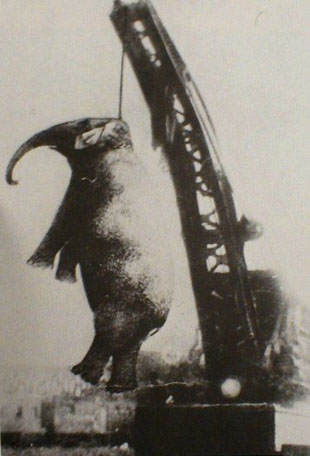
On this date in 1916 — true story — this happened.
Five-ton circus elephant Mary (yes, she has her own Wikipedia page) was in Kingsport, Tennessee on the chintzy fairgrounds touring circuit with Sparks World Famous Circus.
Billed as as “The Largest Living Land Animal on Earth,”* this exotic creature was a prime draw for the circus — and also a beloved pet of the Sparks family.
Unfortunately, this valuable asset was placed in the temporary stewardship of an inexperienced “under keeper” whom the circus had had to scoop up at a recent stop to cover staff turnover. Between shows on September 12, that fellow somehow (accounts conflict) enraged Mary, and (again according to one version among several) she
“collided its trunk vice-like [sic] about [the under keeper’s] body, lifted him 10 feet in the air, then dashed him with fury to the ground … and with the full force of her biestly [sic] fury is said to have sunk her giant tusks entirely through his body. The animal then trampled the dying form of Eldridge as if seeking a murderous triumph, then with a sudden … swing of her massive foot hurled his body into the crowd.”
It’s apparent in this report that the facts of an already-sensational event almost instantly began disappearing into its spectacle. See the largest land animal on earth! See it maul its handler to death! But what happened next lifted Mary all the way to legend.
The owners knew they had to euthanize the “mankiller,” or if they didn’t know they were soon persuaded by mushrooming press attention and towns threatening to ban the Sparks circus.
But how? They couldn’t shoot Mary to death — she apparently survived gunshots from the vengeful crowd in the immediate aftermath of the trampling; firearms just didn’t pack the wallop to put down a pachyderm in 1916. The area didn’t have the sort of electrical juice available that Thomas Edison had once used to drop a circus elephant during his weird campaign for the electric chair.
The choice for the baleful logistical task of killing a 10,000-pound evildoer was hanging, selected over “crushing it between railroad cars.”
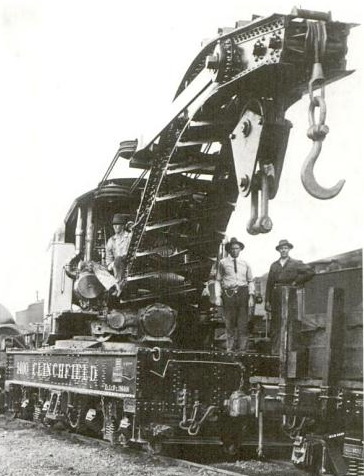
And for stringing up “Murderous Mary”, you need no ordinary gallows. No, for this job, you’re using the hoist on a train derrick and an industrial-strength chain for a noose.
The actual train derrick that hanged Mary the elephant. The leftmost man, seated on the machine, is the “executioner” who worked the controls, according toThe Day They Hung the Elephant.
The railroad was game for the operation, provided the circus would come to it. So on this date, the circus train cars loaded up for the nearest usable train derrickscaffold at Erwin, Tennessee.
There, a procession of all five Sparks elephants — the routine was supposed to keep Mary compliant, and it did the trick even though some observers later remembered the condemned creature behaving unusually skittishly — marched to the railyard.
There Mary was noosed with a 7/8″ chain and hoisted up. The chain broke, and the animal shattered its hip crashing to the ground; another, still larger, chain, did the trick on the second try.
There’s something about this event abidingly piteous, even shameful. It may be for that reason that it’s also abidingly mysterious. The particulars about what happened on the day they hanged the elephant and what became of the body (a steamshovel dug a grave, but the exact location was never marked and there’s a wild story that it was dug up later for ivory) are the topics of conflicting, nth-hand rumors. Some in Erwin don’t to this day want to discuss the matter. Others, just the opposite.
Image (c) John Pugh of SourceToSea.net and used with permission.
* Sparks evidently kept the “largest living land animal” marquee in use for Mary’s successor, as indicated by this 1919 poster (pdf) for the show.
On this date in 1861, Vermont private William Scott of the new-formed Army of the Potomac, then fortifying Washington D.C. for the unfolding Civil War in the aftermath of Bull Run, was led out for execution for having fallen asleep at his post.
The so-called Sleeping Sentinel took a sick comrade’s watch even though he himself was bushed, and … well, you know the rest.
Condemned for a dereliction of duty which “may endanger the safety of a command, or even of the whole army” (the words of the army’s commander Gen. McClellan), Scott still attracted widespread sympathy due to the obviously sympathetic nature of his situation. He was a youth new to war, with an exemplary military record outside of his forty winks.
“The American people,” reckoned the New York Times, “are quite unprepared to hear of a measure of such fearful and unwarned rigor as that which was awarded private SCOTT.”
Appeals went straight to the White House, which was conveniently located in the Army of the Potomac’s back yard, and freshman president Abraham Lincoln magnanimously spared the lad.
Still, wanting to use the case to impress military discipline upon the rabble of corn-fed conscripts, that clemency was delivered with a terrifyingly dramatic flourish. Scott was left to contemplate his last hours on the earth, and, Dostoyevsky-like, marched out to the stake ostensibly to face the firing squad. Only then did he and his fellow-soldiers hear the commutation order.*
This exhilarating climax did not long stay the hand of the Reaper, as it transpired.
Scott died in battle the following spring. In death he lives on, as befits the habitues of these pages: fellow Vermonter Lucius E. Chittenden, who was serving in the U.S. Treasury when all this sleeping sentinel stuff went down, commemorated William Scott for posterity in a subsequent entry to the merciful-Lincoln mythology, a postwar volume titled Lincoln and the Sleeping Sentinel.
The story was also made into a 1914 silent film, which sadly doesn’t seem to be available online: but never fear, this syrupy poem will amply represent our Sentinel’s contribution to the canon.
But God is love – and finite minds can faintly comprehend
How gentle Mercy, in His rule, may with stern Justice blend;
And this poor soldier, seized and bound, found none to justify,
While war’s inexorable law decreed that he must die.
‘Twas night. In a secluded room, with measured tread and slow,
A statesman of commanding mien paced gravely to and fro.
Oppressed, he pondered on a land by civil discord rent;
On brothers armed in deadly strife: it was the President!
The woes of thirty millions filled his burdened heart with grief;
Embattled hosts, on land and sea, acknowledged him their chief;
And yet, amid the din of war, he heard the plaintive cry
Of that poor soldier, as he lay in prison, doomed to die!
‘Twas morning. On a tented field, and through the heated haze,
Flashed back, from lines of burnished arms, the sun’s effulgent blaze;
While, from a somber prison house, seen slowly to emerge,
A sad procession, o’er the sward, moved to a muffled dirge.
And in the midst, with faltering step, and pale and anxious face,
In manacles, between two guards, a soldier had his place.
A youth, led out to die; and yet it was not death, but shame,
That smote his gallant heart with dread, and shook his manly frame!
Still on, before the marshalled ranks, the train pursued its way,
Up to the designated spot, whereon a coffin lay-
His coffin! And, with reeling brain, despairing, desolate-
He took his station by its side, abandoned to his fate!
Then came across his wavering sight strange pictures in the air:
He saw his distant mountain home; he saw his parents there;
He saw them bowed with hopeless grief, through fast declining years;
He saw a nameless grave; and then, the vision closed-in tears!
Yet once again. In double file, advancing, then, he saw
Twelve comrades, sternly set apart to execute the law-
But saw no more; his senses swam-deep darkness settled round-
And, shuddering, he awaited now the fatal volley’s sound!
Then suddenly was heard the sounds of steeds and wheels approach,
And, rolling through a cloud of dust, appeared a stately coach.
On, past the guards, and through the field, its rapid course was bent,
Till, halting, ‘mid the lines was seen the nation’s President!**
He came to save that stricken soul, now waking from despair;
And from a thousand voices rose a shout which rent the air!
The pardoned soldier understood the tones of jubilee,
And, bounding from his fetters, blessed the hand that made him free!
A few letters from Scott’s own hand are preserved here. A (defunct) mini-blog exploring the case in detail can be perused here.
* There was actually American precedent for this sort of stagey non-execution in a case from the War of 1812.
** Obviously, Lincoln did not actually bring his presidential person to the execution grounds to issue this pardon in the flesh: in fact, the presiding officer on-site simply read out the pardon: “the President of the United States has expressed a wish that as this is the first condemnation to death in this army for this crime, mercy may be extended to the criminal.”
On this date in 1768, Isaac Frasier hanged at Fairfield, Connecticut for his career of (as the pamphlet told it) “Abominable Thefts”.
Frasier took to his larcenous ways from a very young age, and committed a host of thefts from the time of his minority apprenticed to a tightfisted shoemaker. For the volume and audacity of his thefts, Frasier was a sort of Charlie Peace of colonial New England with the significant difference that he was also extraordinarily bad about conducting his career in serial burglary without (repeated) detection.
And so Frasier was caught, over and over and over again: really, he might have thought about a different vocation. Eventually he ran afoul of an 18th-century three strikes law allowing the execution of repeat offenders. (And drawing in its case some lively public debate over the justice of hanging a man for a mere property crime under any circumstances whatsoever.
Anyway, thanks to his want of both restraint and wile, Frasier was clapped in irons, whipped, branded, sold to a privateer, had an ear cropped, whipped some more. He lost his wife after one arrest (that wasn’t juridical penalty, just a modicum of shame.)
He had a gift for escape which jibed well with his gift for arrest, but every time he busted out of stir he returned instantly to burglary with a positively alcoholic compulsion.
Even when he effected his last jailbreak while already under sentence of death for recidivism, he exercised not an iota of discretion but invited his swift recapture by frantically plundering every shopkeep he laid eyes on in a whirlwind tour of Connecticut and environs. Just one last fix for the road.
Last Wednesday evening the notorious FRASIER, who was under sentence of death for burglary, as has been mentioned, was brought from Worcester, (where he was taken up for theft, and whipt) and re-committed to the goal [sic] in this town, from whence he escaped about a month since, — in which time he has committed five or six burglaries and thefts, and traveled near 500 miles. The next night but one after his escape, he broke open no less than three shops in Middletown, from one of which he stole 70l. value in goods and cash. The Superior Court now sitting in Fairfield, have given strict orders, that he should be loaded with chains, and the goal guarded every night till the time of his execution …
“Excessive Wickedness, the Way to an untimely Death.” That was the title of the gallows sermon they gave for him. At least they couldn’t knock him for idleness.
This date is the bicentennial of the first public execution in Seneca County, New York. (There would only be one other.)
Future New York Gov. Joseph C. Yates — for whom the adjacent Yates County is named — was already a state Supreme Court justice when he repaired to the newly-built county courthouse in tiny Ovid to judge the case of the cottonmouthed contract clodhopper.
Yates duly condemned John Andrews to hang on account of murdering (pdf) a local distillery worker for the rather disproportionate offense of not ladling Andrews a drink of whisky after Andrews had completed some odd job or other for the place.
Sometimes a man takes a drink. Sometimes a drink takes a man.
Surrounded by the usual contingent of Militia and the surging crowd that had assembled from the town and surrounding contryside through the earlier circulation of handbills that had declared the unusual event as a sort of holiday, the noose was adjusted and Andrews quickly jerked into eternity. Some of the spectators had taken to the roof-tops, others were perched in nearby trees, and parents held their children high on their shoulders for a better view. No other event, save the General Trainings of Militia, called together so many people as did a hanging in those early times. Years afterwards, the stumps of the gallows were pointed out, as a spectator recalled the details of that momentous day. Some three years later, Reuben Tingley, who lived in close proximity to the Court-House in this village, killed his wife by a blow on the head with an axe, and then cut his own throat. The murder and suicide on October 28, 1814, saved the county the expense of an execution, but deprived the curious of an opportunity to witness a second public hanging, a fact that might have well been foremost in the mind of the murderer after having dispatched his wife. (Source)



 The so-called
