1875: Six in Fort Smith under Hanging Judge Isaac Parker

I have ever had the single aim of justice in view … ‘Do equal and exact justice,’ is my motto, and I have often said to the grand jury, ‘Permit no innocent man to be punished, but let no guilty man escape.’

–Judge Isaac Parker

On this date in 1875, the most famous — or infamous, depending on your perspective — “hanging judge” of the American West dropped the trap on his noosing career with his first six hangings at Fort Smith, Arkansas.

Isaac Parker, around the time he arrived at Fort Smith

Isaac Parker had parlayed a legal career in Missouri into a congressional seat, when the fall of the Arkansas Republican party’s fortunes late in Reconstruction swept him out of office in 1874.

No problem: his co-partisan president, Ulysses S. Grant, appointed Parker to a federal judgeship in neighboring Arkansas. It’s upon that renowned tenure that the man’s reputation, uh, hangs.

Parker arrived at Fort Smith on May 4, 1875, the youngest federal judge in the west and a man whose jurisdiction included the lawless Indian Territory (present-day Oklahoma).

This expanse of land, the final destination of the Trail of Tears, had once been preserved for tribes forcibly “removed” from eastern North America.

But by the post-Civil War years, the frontier was sweeping past on iron wheels … and as long as Indian Territory remained (mostly) protected from white settlement, it remained a sparsely-populated refuge for outlaws.

Pandemonium in the Territory was only exacerbated by the Fort Smith court’s reputation for corruption and inefficiency; the office was open for Parker’s appointment because his predecessor had resigned to avoid impeachment.

Judge Isaac Parker came to clean up the place.

Fort Smith was an unusual portfolio for a federal judge. While most of Parker’s colleagues were confined to the tedium of interstate civil litigation, Parker was the court of first call for many regular criminal cases in the Indian Territory which in other jurisdictions would have been a state matter. He estimated in 1885 Congressional testimony that seven-eighths of his caseload came from Indian Territory.*

And in those cases he quickly established himself a reputation for severity.

“I never hanged a man,” Parker said of himself later in life. “The law hanged him. I was only its instrument.”

But make yourself the law’s instrument to the tune of 79 hangings, and folks are bound to sit up and take notice.


“they nearly hung me for stealin’ a horse
in Fort Smith Arkansas.

Judge Parker said guilty and the gavel came down
just like a cannon shot …”

At his court’s very first sitting in May 1875, Parker death-sentenced a murderer — Daniel Evans, who came straight from frontier central casting and had murdered a man for his boots.

As that year unfolded, he added enough condemned men to the bowels of the miserable jail nicknamed “Hell on the Border” — for an eight-strong hanging date to christen September.

One of the eight had his sentence commuted due to youth.

One was shot trying to escape.

And the other six were the debut crop for the mass-occupancy gallows that Parker ordered constructed at Fort Smith. (Its capacity was a full dozen.)


Modern replica at Fort Smith — today a national historic site — of Judge Parker’s gallows. (cc) image from photoguyinmo.

The clientele was six unconnected murderers, committing various atrocities for various motives and aptly embodying the region’s ethnic diversity.

  • Evans, white
  • James Moore, white
  • Samuel Fooy, quarter Cherokee
  • Smoker Mankiller, Cherokee
  • Edmond Campbell, black
  • John Whittington, white

And the audience? Five thousand or so reportedly on hand in Fort Smith this date, plus a national media audience … and posterity deep into the second century since this sturdy magistrate donned his first black cap and set about putting chaos into order with a rope in his hand.


New York Tmes, September 4, 1875.

Whatever one might have to say about his methods, Parker presents a magnetic personality, a figure so truly of his own time and place that he obligingly died just weeks after his court was finally relieved of its Oklahoman jurisdiction in 1896. He’d never hang around to jolt our anachronism meter by weighing in on trench warfare or cubism.

Parker is undoubtedly a more layered figure than his “hanging judge” reputation would suggest, and even his life’s project to bring his unruly jurisdiction to heel was more complicated than just being a hardass. (He had a significant administrative challenge to manage his chronically underfunded court, and he needed to foster the sense of communal reciprocity and legal integrity that would encourage fellow-citizens to turn up for jury duty and witness testimony that make the law’s everyday business possible.) The judge was famous for the long hours he kept, and capital cases were never more than a tiny fraction of his work.

Parker was notorious (slash-beloved, again depending on perspective) for his prosecution-friendly courtrooms, but even the tough sentences he handed down came in his mind from a place of tough love. He wrote late in life that

not one of [those he suffered to long prison terms for violent crimes], no matter how depraved, had entirely lost that better part of human nature …

The object of punishment is to revive, that in some cases, almost extinct spark, to lift the man up, to stamp out his bad nature and wicked disposition, that his better and God given traits may assert themselves.*

Still, whether you prefer him as the stern avatar of law on an outlaw plain or bloodthirsty yahoo, Parker’s ready amenability to latter-day Hollywood tropes will surely maintain his popularity in the cultural rookery of wild west cutouts.

Among numerous other reference points, the novel True Grit, and the 1969 and 2010 films based on it, use Judge Parker’s Fort Smith as the heroine’s embarkation point — with her dangerous journey carrying her into the untamed Indian Territory on his doorstep.

Pat Hingle’s “Judge Fenton” (from “Fort Grant”) in the Clint Eastwood western Hang ‘Em High also shows an unmistakable debt to the Judge Parker persona.

A few books about Judge Parker


Spare a thought, too, for the man operating the ropes and levers this date.

George Maledon, named Fort Smith’s official hangman just a couple of years before Isaac Parker’s appointment, would enforce the Hanging Judge’s hanging sentences into the 1890s: 60-plus executions in all, plus five other escaping prisoners he gunned down, all in a day’s work for an Arkansas lawman.

Maledon has a sad coda to this story, which wasn’t so upbeat to begin with.

The year after the veteran hangman hung up his hood and opened a grocery store, Maledon’s daughter was murdered. The bereaved father’s friend Judge Parker, still on the bench at that time, condemned the killer to die in a case we’ll suggest might have warranted a recusal by present-day standards. Nevertheless, a successful appeal balked Maledon’s successor of the malefactor, and the disgusted ex-executioner got his species of payback by taking the accoutrement of his late profession on the road as a traveling act.

There, under the billing of “the Prince of Hangmen,” Maledon lectured and exhibited old hanging ropes and pictures of the outlaws they had choked.

People of all classes flocked to the show grounds, crowded about the lecturer and filled the tent, viewing the gruesome relics and listening to the old hangman’s recital of soul-stirring events as he pointed out the…instruments of his vocation. (Source)

* See Mary Stolerg, “Politician, Populist, Reformer: A Reesamination of ‘Hanging Judge’ Isaac C. Parker”, The Arkansas Historical Quarterly, Spring 1988

Part of the Themed Set: Americana.

On this day..

1772: Moses Paul

On this date in 1772, the town of New Haven, Connecticut hanged a Mohegan Indian named Moses Paul for a drunken homicide. He’d been kicked out of a tavern as an unruly sot, and vengefully beat to death outside it a (white) fellow-customer with whom he had quarreled.

Notable to the reported “concourse” of attendees as the first execution in those parts for more than twenty years, it comes to posterity as the occasion for an interesting milestone: the first known Native American publication in America was Samson Occom‘s “A Sermon Preached at the Execution of Moses Paul, an Indian”. (pdf)

Occom, himself a Mohegan, was a Presbyterian divine whom the condemned solicited to deliver the hanging sermon. So the multitudes assembled were also treated to the edification of seeing an Indian preach from the scaffold, which may have been yet another first.

Occom’s sermon went predictably long on the hark-ye-to-this-warning Christian boilerplate (as a convert from heathenism, Occom did not want for zeal). But the speaker was also plainly self-conscious of his racial position,and took pains to invoke the egalitarianism of the afterlife:* the same death and judgment awaiting “Negroes, Indians, English, or … what nations soever.”

Given the liquor-induced crime that was even then a stereotype of Indian susceptibilities, Occom concluded “address[ing] myself to the Indians, my bretheren and kindred according to the flesh” with a call to temperance in view of the waste he saw laid to his own communities:

My Poor Kindred,

You see the woeful consequences of sin, by seeing this our poor miserable countryman now before us, who is to die this day for his sins and great wickedness. And it was the sin of drunkenness that has brought this destruction and untimely death upon him … this abominable, this beastly and accursed sin of drunkenness, that has stript us of every desirable comfort in this life; by this we are poor miserable and wretched; by this sin we have no name nor credit in the world among polite nations, for this sin we are despised in the world … when we are intoxicated with strong drink we drown our rational powers, by which we are distinguished from the brutal creation we unman ourselves, and bring ourselves not only level with the beasts of the field, but seven degrees beneath them.

…

Drunkenness is so common amongst us, that even our young men, (and what is still more shocking) young women are not ashamed to get drunk.

…

break off from your drunkenness … O let us reform our lives, and live as becomes dying creatures, in time to come. Let us be persuaded that we are accountable creatures to God, and we must be called to an account in a few days … Fight against all sins, and especially the sin that easily besets you, and behave in time to come as becomes rational creatures.

Ava Chamberlain’s “The Execution of Moses Paul: A Story of Crime and Contact in Eighteenth-Century Connecticut”, published in The New England Quarterly (September 2004) has a detailed summary of this case, Paul’s unsuccessful efforts to appeal around the question of premeditation, and the historiographical riddle left by Occom’s voluble commentary vis-a-vis his subject’s near-total silence.

* Our colonial Calvinist anticipated Marxist aphorists with the remark, “whether we concern ourselves with death or not, it will concern itself with us.” The colonists present probably would have appreciated the occasion more had they known they were participating in an Internet meme.

Part of the Themed Set: Americana.

On this day..

1500: 18 thieves in Rome

Tourism is pretty essential to the Roman economy, and for as long as there have been dumb foreigners come to gawk, the Caput Mundi has supplied robbers alert to relieve them of their opes mundi.

And as it happens, that’s been for quite a long time. They don’t call it the Eternal City for nothing.


Ponte Sant’Angelo. (Hanged corpses not included.) The bridge was built by Emperor Hadrian in the early second century. (cc) image from Jimmy Harris.

On this date in 1500, a gang of 18 brigands were all hanged (Italian link) along Rome’s Ponte Sant’Angelo for their activities preying on traveling pilgrims.

One of those executed was an orderly at the nearby Ospedale S. Spirito, whose particular specialty was casing the infirmaries for weakened patients

This death penalty venue facing the Vatican’s Castel Sant’Angelo across the Tiber saw plenty of traffic in its day. Bookending the other end of the 16th century, it would host the legendary execution of Beatrice Cenci.

On this day..

1823: Natty and Louie, Demerara rebels

This date in 1823 was that of the trial, conviction, and immediate execution of the first two men to suffer under color of law for the 1823 slave revolt in Demerara.

A sugar-producing colony recently ceded from the Netherlands to Britain (today, Demerara is part of Guyana), Demerara’s population was nearly 95% slaves. They would author one of the New World’s largest slave rebellions.

Ten thousand-plus are thought to have taken part in the rising — short-lived despite the numbers — starting on Aug. 18.

At the insistence of a well-regarded older slave named Quamina — nowadays honored as a Guyanese national hero — the rebels paradoxically committed themselves to nonviolence. Very few whites died; most plantation owners taken were simply tied up and held prisoner, to be rescued when government troops quelled the disturbance over the next few days.

This consideration was not reciprocated, including to Quamina himself: he was summarily executed upon capture, one of scores of rebels so treated.

But even while scattered mutineers still maintained themselves in the bush, “proper” judicial proceedings commenced on this date. (They’d been authorized just the day before. No time to stand on ceremony.)

Well … maybe a little ceremony.

Since these were the first public executions, they were carried out with great solemnity. A procession was formed to conduct the prisoners to the gallows that had been erected on the Parade Ground at Cumingsburg. First came an advance guard, followed by blacks beaing empty coffins. Then came the prisoners between guards, the garrison chaplain, and the band of the First Battalion, Demerara militia …

The procession moved slowly through the streets, the band playing a funeral march. As the procession passed up the main street of Cumingsburg, the whole of the Marine Battalion turned out and presented arms, until the procession had passed. When the prisoners were executed, a gun shot announced their deaths.

This author reports that, in contrast with the raucous scaffold support given popular “traitors” in the British homeland like Arthur Thistlewood, “in Demerara, silence and gloom surrounded the prisoners’ deaths. Those who dared to speak said they were dying for the sake of religion.”

Many would go to that silent gloom: two more the next day; four on the day after that; 47 judicially executed by the end of September. Different sources give different counts, so we’ll just say, look, it was more than a handful.

But in addition to whatever religious weight the condemned might have reckoned their sacrifice, they also died in the cause of slavery abolition. Alarmed by the scale of the uprising and not a little put off by the brutishness of its suppression, Parliament pressured on its overseas possessions to relieve the lot of the slave. Fewer beatings, a morsel of education, as a hedge against the danger of revolution. How about a bit of enlightened self-interest?

A decade after these hangings — a decade nearly to the day — London had had enough half-measures and, spurred on by yet another New World slave revolt, abolished slavery altogether.

On this day..

1782: David Tyrie, the last hanged, drawn, and quartered

On this date in 1782, a crowd contemporaries pegged at 100,000 mobbed the gruesome public execution of David Tyrie — the last man hanged, drawn, and quartered in British history.

Tyrie was a Scotsman clerking at a Portsmouth naval office, who was caught in a treacherous correspondence with the French. He lacked political pull of his own and either the means or inclination to shop confederates, and therefore faced the full weight of the treason statute.

Said venerable statute, a theatrically bloody relic of the Middle Ages popularized by Edward I for terrorizing malcontent subjects, had persisted for half a millennium or so and in its grisly Tudor efflorescence crowned the careers of saints, terrorists, lovers, fighters, and Shakespeare characters.

Tyrie might have been small time by those standards, but he wore it well this date — “played the man,” in the old parlance — before the throng on Southsea Common.

From the time he was put on the sledge, till be came to the gibbet, he continued in an unconcerned conversation with the gaoler, in which he expressed that he thought there were not three better, sounder, or honester hearts in the kingdom, than his own, which was just going to be burnt. That there was only one thing which gave him concern, which was, that his father was living, and he feared this misfortune would bring his grey hairs with sorrow to the grave. He declined saying a word to the populace, observing, that he knew not why he was to feed or gratify the idle curiosity of the multitude. He never hung his head the whole time. — When arrived at the place of execution, no halter was provided, upon which he smiled, and expressed astonishment as the inattention and neglect of his executioners; and indeed the business would have been retarded for some time, had not a rope and pulley been procured out of a lugger that lay under shore, during which time he read several passages in a bible he carried in his hand. – Before he was drawn up, he delivered a paper, setting forth, that he had authorised no person to publish any account of his life, nor was there any one who knew sufficiently of him to give any genuine particulars of his transactions in the world.

After hanging exactly twenty-two minutes, he was lowered upon the sledge, and the sentence literally put in execution. His head was severed from his body, his heart taken out and burnt, his privities cut off, and his body quartered. He was then put into a coffin, and buried among the pebbles by the sea-side; but no sooner had the officers retired, but the sailors dug up the coffin, took out the body, and cut it in a thousand pieces, every one carrying away a piece of his body to shew their messmates on board. — A more dreadful, affecting execution was perhaps never seen.


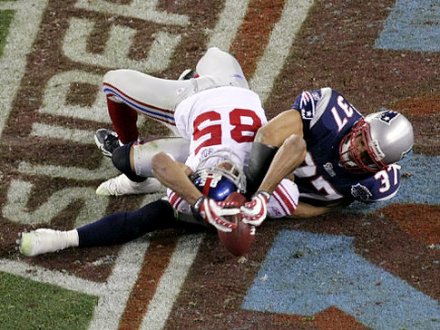
Before disemboweling, he was probably stretched out somewhat like David Tyree.

In fact, it was so dreadful (including many injuries in the distasteful rush for souvenirs) that they stopped doing it. Only gradually: Edward Marcus Despard, for instance, was sentenced to drawing and quartering, but they only hanged him to death and cut off his head posthumously. In 1814, that sentence — hanging plus posthumous beheading — formally replaced the old disemboweling-and-quartering bit as the penalty for treason.

(The invaluable CapitalPunishmentUK.org says that one James O’Coigley suffered hanging, drawing, and quartering in 1798 for that year’s Irish Rebellion; however, the Newgate Calendar’s record says that O’Coigley was “merely” hanged and beheaded, like Despard.)

On this day..

1594: Ishikawa Goemon, bandit

On this date in 1594, legendary Japanese outlaw and folk hero Ishikawa Goemon was boiled to death in oil for attempting to assassinate Toyotomi Hideyoshi.

And he’s supposed to have had his son thrown into the kettle* with him, and, boiling to death himself, to have held the boy aloft out of harm’s way.

A 19th-century image painted by Toyokuni III of Goemon in one of the several kabuki plays he features in.

Ishikawa is a sort of Japanese Robin Hood figure, and the (very much) that isn’t offered by the documentary record is helpfully expanded in folklore.

Trained in forbidden ninja ways? Check.

Or maybe a samurai? Why not?

Henchman named “rat boy”? Oh, yes.

Just what his beef with national unifier Toyotomi Hideyoshi might have been is also subject to the exigencies of the story at hand. Let it be oppression or something, good enough for one of those classic outlaw-with-a-heart-of-gold retorts against condemnation for his thieving career.

It is you who are the robber who stole the whole country!

He gets to be the title character of the 2009 film Goemon:

Thanks to the inevitable marketing tie-ins, the world also has a Goemon action figure.

Personally, and especially because I would lose all these nifty accessories, I much prefer the adorable Goemon Cosbaby series.

* As a result of this famous exit, a Goeomon-buro (Goemon bath) in Japanese refers to a large iron kettle-shaped bathtub.

On this day..

1851: Two men hanged and one lynched in Sacramento

On this date in 1851, three men were publicly hanged from a scaffold at Fourth and O Street in Sacramento, California: John Thompson* and James Gibson legally, and William Robinson under color of lynch law.

According to Ken Gonzales-Day’s Lynching in the West: 1850-1935, all three had been condemned to death under the brand-new state‘s brand-new Criminal Practices Act, making theft a capital offense.

They had assaulted and robbed a guy on the streets of Sacramento a few weeks previous, and the local vigilance committee had already made plain its impatience with the matter: upon the granting of a legal motion to stay the trial three days in order to allow the defense to actually prepare, an orderly posse had firmly forced the court back into session to proceed with the speediest of trials. Any outcome other than death could scarcely have come to pass.

Nonetheless, California governor John McDougall made bold to stay one of the hangings, that of William Robinson.**

The San Francisco-based Alta California — which had previously (August 1, 1851) editorialized in strong support of the forced trial: “If our courts would in all cases act, the people would have no occasion for assuming the responsibility of ferretting out criminals, and awarding them their proper punishment” — narrated (September 1, 1851) a, er, popular veto of that gubernatorial mercy.

The Executions in Sacramento City

The Sacramento papers of Saturday are filled with accounts of the exciting scenes that have transpired in that city within a few days past.

We condense from the Sacramento Union, a decription [sic] of the occurrences of Friday last.

THE SCENES OF YESTERDAY. — By daylight yesterdat morning, teams, horsemen and pedestrians, were seen pouring into the city from every direction, and at an early hour the city was crowded with miners and strangers from the country, who had come in to witness the execution of the three culprits, Thompson, Gibson and Robinson.

Soon after nine o’clock, a rumor ran through the city, that a respite of Robinson’s sentence had been received from the Governor, and that the day of his execution was to be postponed until the 19th day of September. …

As the hour for the execution drew nigh, the crowd around the Station House became immense, and there was evidently a fixed determination in the minds of the populace that the prisoner, Robinson, should suffer the same penalty as the other two culprits, and that, too, in spite of the Governor’s proclamation …

The Sheriff, after reading the reprieve, ordered the two prisoners, Gibson and Thompson, to be taken to the place of execution, and likewise commanded the “Guards” to convey the prisoner, Robinson, to the Prison brig. The former two were then placed in a wagon, with their arms securely pinioned, and driven rapidly off, in company with the officers, to the scaffold.

The “Guards” then brought out Robinson, and attempted to convey him to the prison brig, but were compelled, on the corner of 2d street, to deliver their prisoner to the people, who placed him in a cart, and thus, surrounded by the “Guards,” were escorted to a grove near the place where the scaffold was erected.

A committee was appointed who were to take charge of the execution of Robinson after the legal authorities had performed their duty.

While these proceedings were going on at the grove, the final peparations for the execution of the unfortunate men, Gibson and Thompson, were progressing. …

The prisoners bore themselves with the greatest fortitude throughout the whole of this tragical scene, and not the slightest agitation was perceptible. At the moment the cord was cut, a cry was heard — “Now for Robinson.” The shout went up from the dense throng, “Hang the scoundrel!” — “Bring him here!” — “Let him hang too!”

The scene which followed was the most terrific we ever witnessed. The thronging crowds rushed for the station house in the greatest excitement, and on all sides was heard the thrilling cry, “Hang the rascal!” In the mean time the Sheriff, having performed his duty efficiently and faithfully, retired from the scene, as did also the officers with whom he was connected.

The muffled drum of the Guards announced that the culprit Robinson was approaching. The crowd gave way, the Committee with their prisoner slowly and solemnly ascended the scaffold, and the Guards formed a hollow square around it below.

Robinson appeared perfectly cool and collected, and on being requested to address the crowd, came forward, and in a clear voice made another confession. He evidently appeared desirous of creating a sensation, and accordingly commenced by alleging the grossest and most unfounded charges against men who stand high in this community … we do not feel ourselves justified on such evidence as this, in proclaiming to the world that officers who have heretofore been deemed perfectly upright and honourable, are no better than felons.

…

After the events of Friday, a portion of the excited populace assembled during the evening, and hung John McDougal in effigy. This proceeding, perhaps, was more the result of a hasty and excited spirit on the part of the few, than the calm reflection of the public mind, although the Union apologizes for the act by observing that persons engaged in it did not desire to cast obloquy on the office, but to exhibit their contempt for its incumbent.

* Thompson’s real name was evidently McDermott. The Espy file of historical American executions calls him “Thornton,” though it’s not clear whether this was yet another alias or simply an erroneous entry in the database.

** According to a different article in the same September 1, 1851 Alta California, the governor’s grounds for clemency were “the conviction of about thirty men … that Robinson was quite guiltless of the offence with which he stood charged. That false testimony had been trumped up to convict him, that he was not a hardened man, had fought the battles of his country, and finally, (as stated in a letter from a clergyman) he was quite a promising youth, of pious education, and possessing a ‘good understanding of the Christian doctrines.'”

On this day..

1941: Sixteen Yugoslav partisans and one German soldier

On this date in 1941, this happened.

These sixteen blindfolded Yugoslav Partisans about to be shot at Smederevska Palanka were joined in death by one conscientious German soldier who refused to help carry out the massacre. (Or not. See comments.)

The Partisans were Tito’s Communist guerrilla movement against the Nazi occupation and while they were up against it at this early date, they would in due time wind up on the winning side and help birth the postwar government.

Their legacy remains in every European sports page as the namesake of the Belgrade sports association Partizan founded immediately after the war. It’s the umbrella entity for the frequent Serbian football and basketball champions as well as a variety of other sports. (Current world tennis no. 1 Novak Djokovic played for Partizan, for instance.)

On this day..

1692: Martha Carrier, ferocious woman

This date in 1692 was the third of four execution dates during the notorious Salem witch trials.

Five souls were dispatched at Gallows Hill this date. With the executioner’s due respect to John Willard, George Burroughs, George Jacobs, Sr. and The Crucible main character John Proctor, we’re elated this date to focus on the only woman among them — Martha Carrier.

Carrier is the subject of the recent historical novel The Heretic’s Daughter by her tenth-generation descendant Kathleen Kent, whom we’re delighted to welcome for an interview on this anniversary.

How did you first learn of your connection to Martha Carrier, and how does your family feel about this link?

I was very fortunate to have heard stories of the colonial Carriers from the time I was a young child. My first memory of hearing about the Salem witch trials was when I was eight years old, visiting my maternal grandmother. She was the first one to tell me that my grandmother back nine generations, Martha Carrier, had been hanged as a witch in 1692. When I asked her if Martha was in fact a witch, my grandmother said, “Sweetheart, there are no such things as witches, just ferocious women.”

She, along with the rest of my family, had a great sense of pride over Martha’s courage in standing up to her accusers. She was one of the few people, out of the 150 New Englanders accused of practicing witchcraft, who not only refused to admit to being guilty, but also never accused anyone else of being a witch, which most people did to save themselves.

Your book tells the story of Martha Carrier from the perspective of her 10-year-old daughter. As an author, how did you approach the research, especially when it comes to Martha as an individual? Is that something you were able to source pretty strongly or did it require a lot of filling in the blanks?

The Heretic’s Daughter was my first novel, and it took five years of research and writing to complete it.

Fortunately, there is a wealth of historical information about the colonies during that time. The courts where the witch trials were conducted kept very meticulous records so I was able to gather a lot of facts regarding the magistrates and deponents, as well as the accused. There are so many wonderful fiction and non-fiction books alike that have been written about the Salem witch trials, but I wanted to write a very personal story about the Carrier family; how they lived day to day, how they survived disease, Indian raids, hostility from their neighbors, and ultimately the witch trials. I was able to weave in a lot of my family’s stories — the cow that gave golden milk, Andrew’s near death experience in the prison — that have been passed down through 10 generations.

When I first began working on the book, it was written from Martha’s point of view, but I decided it would make more compelling reading if the narrator was one of the Carrier children, Sarah, and it is through her eyes that we see the growing hysteria over witchcraft, and her struggle with Martha’s strong, unyielding character. This theme of mother-daughter conflict is central to the book’s development.

So, who was Martha Carrier and why did she become one of the people caught up in the Salem witch trials?

Martha Carrier had evidently long been resented by the community in Andover, where the Carrier family lived during the Salem witch trials, because of her forceful nature. She argued over boundary lines with several neighbors (which was a common occurrence amongst the settlers), telling one neighbor, “I will stick as close to you as bark on a tree.” (source: Salem witch trial deposition; see this document) She was also married to a man who had fought in the English Civil War, and was widely rumored to be one of the executioners of King Charles I of England. Martha fell outside of the Puritan ideal of what a woman was supposed to be and was so vocal in her own defense during the trials that when she was asked by her judges if she had ever seen the Devil, she responded by telling them that the only devils she had ever seen were the men sitting in judgment before her.


One of 20 granite benches commemorating the Salem witch trial victims at a memorial. (cc) image from Deaf RED Bear.

Her own children accused her of witchcraft. Are you descended through those kids as well? And do we know anything about how they later dealt with or rationalized that act?

My family is descended from Tom, Jr., and I learned the full genealogy at an early age from my grandparents. Four of Martha’s five children were arrested to compel her to admit to being guilty. Her two oldest sons were arrested first, and they were tortured until they agreed to testify against their mother. Tom and Sarah were then arrested — the real Sarah being only 7 years old at the time, and the second youngest child to be imprisoned during the trials — and they quickly admitted that they, too, were complicit in witchcraft.

During the research, I discovered how truly awful the conditions were in the Salem jail. Nearly half of the 150 people arrested from towns all over New England were under the age of 18. The surprising thing was not that people died, but that anyone survived at all. The four children were kept imprisoned for months after their mother was hanged and they were finally released in the fall of 1692. Within a few years, their father, Thomas, collected his children and grandchildren and moved to the wilds of Connecticut to start a new life.

How did she try to defend herself?

Martha Carrier was so vocal in her own defense during the trials that Cotton Mather, one of the most famous theologians of his day, named her the “Queen of Hell.”

This Rampant Hag, Martha Carrier, was the Person, of whom the Confessions of the Witches, and of her own Children among the rest, agreed, That the Devil had promised her, she should be Queen of Hell.

–Mather

When she was confronted by the accusing girls, she turned to her judges and said, “It is a shameful thing that you should listen to these folks who are out of their wits.”

By the time of her arrest, several women had already been sentenced to be hanged, and she knew that her refusal to confess would mean death. She never wavered in her testimony and never accused another person to save herself, even when her four children were arrested and two of her sons were tortured.

Do you feel like she’s an overlooked figure in this affair? She’s not, for instance, even a character in The Crucible.

Arthur Miller did extensive research for The Crucible, but he did make changes to the historical facts for fictional purposes: for example John Proctor was in his seventies during the trials; hardly the strapping figure played by Daniel Day Lewis in the film adaptation.

There were so many remarkable people and events during the trials that he had to choose selectively in order to illustrate his primary motivation in writing the play which was to shed light on the McCarthy era communist “witch” trials.

Nathaniel Hawthorne wrote about Martha Carrier, as did Cotton Mather, but her forceful character made her a difficult subject, especially when there were more motherly figures like Rebecca Nurse, or titillating young characters like Abigail Williams to explore.

At this distance of time, Martha Carrier must have a great many descendants. Are you in touch with other branches of the family?

Soon after publishing The Heretic’s Daughter, I started getting emails and letters from fellow descendents of Thomas and Martha Carrier telling me that they, too, had heard many of the stories that I had grown up with.

For the release of my second novel, The Wolves of Andover, about Thomas Carrier’s life, I decided it would be fun to invite some of these extended family members to Salem for a book launch. On November 5th, 2010, nearly 250 Carrier descendents, some of them flying in from as far away as Washington State, California and Arizona, came to Salem for a weekend of author talks, receptions and story swapping. A video on my web site captured some of the highlights from that remarkable weekend.

We came as strangers and left Salem as family.

Ultimately, what’s changed about you yourself from your literary encounter with this famous ancestor?

The Salem witch trials were a dark period in American history, but from researching those events I discovered that positive changes occurred over time in the judicial system, the penal system, and for religious tolerance. I am awe-struck by the courage and fortitude of the settlers who sacrificed so much for their children and grandchildren.

And I am especially proud of my heritage: that my 9x great-grandmother defended her principles and conscience, even in the face of death. An interviewer once asked if, having written the novel, I felt I was speaking for Martha Carrier, and I said that I felt she had been speaking for me. A ferocious woman indeed!

With your second book, The Wolves of Andover, you’ve written two about the Carrier family. What’s your next project?

Wolves is a prequel to Heretic, as it explores the life of Thomas Carrier during the English Civil War and his journey to the new world from London.

I am about halfway through my third novel, but this one is quite different from the first two. It takes place during reconstruction era Texas in 1870, and chronicles a particularly chaotic, violent time in Texas history.

There’s another fine interview with Kathleen Kent here. -ed.

On this day..

1634: Urbain Grandier, for the Loudon possessions

On this date in 1634, a Paris tribunal “declare[d] the said Urbain Grandier duly guilty of the crime of sorcery, evil spells, and the possession visited upon some Ursuline nuns of this town of Loudon and of other laywomen mentioned at the trial, together with other crimes resulting from the above. For redress of these, he has been condemned … to be taken to the Place of Saine-Croix of this said town, to be tied to a post on a pile of faggots that is to be built in the said Place. There his body is to be burned alive … and his ashes are to be scattered to the winds.”

The sentence was immediately enforced.

These Loudon possessions were a disgraceful carnival of simulated enspellment by the local Ursuline nuns engineered to destroy Grandier, a parish priest with a knack for acquiring enemies.

Alexandre Dumas, pere would write about Grandier in his Crimes Célèbres, and later in a stand-alone play. In Dumas’s rendering, Grandier arrived in Loudon as a handsome outsider, eloquent in the pulpit and doubly so in pursuit of a pretty girl,* as inexorable as Shylock in his victorious lawsuits against the local grandees.

Most recklessly of all, he made a foe of Cardinal Richelieu — snubbing him, opposing him politically, and (so it was alleged) authoring a scathing and anonymous lampoon of the Grey Eminence.

When Richelieu’s deputy came to town, the locals got the Ursuline nuns into their fits and got Grandier fast-tracked for hell.

The nuns put on a circus of frothing, profane, hip-thrusting demoniac possession accusing Grandier of bewitchment as they melodramatically underwent exorcism. (Fabulously attended, these public displays of possession and exorcism went on for several years after Grandier’s death as a perverse tourist attraction.)

Richelieu’s guy arranged to try Grandier in his own court (no appeal possible) and threatened to arrest for treason anyone who testified in his defense. In case that were insufficient advantage, a contract with Lucifer — a literal, signed document — was produced for the magistrates’ edification.


In fairness, this “contract” must have been a hell of a lot of fun to forge.

Heck, even nuns who tried to recant were turned away. Must be back under Lucifer’s influence!

Before proceeding to the stake, Grandier was subjected to one last “extraordinary” torture. His holy persecutors, “lest the Devils should have the power to resist the blows of a profane man, such as the hangman was, they themselves took the hammers and tortured the unhappy man” until the bone marrow leaked from his legs. Satan’s subcontractor suffered the blows without confessing or naming an accomplice.

In 1952, Aldous Huxley molded the horrible Grandier story into a non-fiction novel, The Devils of Loudun. Huxley’s take helped to popularize the tale — one that polemicists in the 17th century also recognized as an injustice — for the modern era of flesh minced by ideological madness.

From beginning to end, the trial proved a farce in which the condemnation of the accused was a foregone conclusion. By means of a series of trumped-up charges reinforced by an official philosophy and falsified theological dogmas, the resources of the state were mobilized to crush the offending individual. Huxley is not slow to point to the modern counterpart of such proceedings, notably in Fascist or Communist countries.

-Book review by S. van Dantzich, The Australian Quarterly, June 1954

Evidently, it struck a chord.

A 1971 cinematic adaptation of this book, The Devils, a captivating and sacrilegious tapestry of violent, sexual, and religious iconography, won critical praise and censor board bans, as well as an “X” rating in the United States. It’s hard to find, but worth the trouble.

Huxley’s book also formed the basis for an operatic interpretation, Die Teufel von Loudun (The Devils of Loudun)

* As we’ve seen, French priests making sexy time stood in danger from their game-less counterparts.

On this day..