On this date last year, the Taliban carried out the public stoning of an adulterous couple who had attempted to elope in northern Afghanistan.
“Even family members were involved,” the New York Times reported, “both in the stoning and in tricking the couple into returning after they had fled.”
as a Taliban mullah prepared to read the judgment of a religious court, the lovers, a 25-year-old man named Khayyam and a 19-year-old woman named Siddiqa, defiantly confessed in public to their relationship. “They said, ‘We love each other no matter what happens,'” [local farmer Nadir] Khan said.
The executions were the latest in a series of cases where the Taliban have imposed their harsh version of Shariah law for social crimes, reminiscent of their behavior during their decade of ruling the country. In recent years, Taliban officials have sought to play down their bloody punishments of the past, as they concentrated on building up popular support.
“We see it as a sign of a new confidence on the part of the Taliban in the application of their rules, like they did in the ’90s,” said Nader Nadery, a senior commissioner on the Afghanistan Independent Human Rights Commission. “We do see it as a trend. They’re showing more strength in recent months, not just in attacks, but including their own way of implementing laws, arbitrary and extrajudicial killings.”
This nostalgic emblem of bygone pastoral idylls doubles as a great place to dump a body. (cc) image from boodie131.
This date in 1828, throngs of thousands at Bury St. Edmunds saw the climax of the Red Barn Murder case in the form of the public hanging of William Corder.
This broadsideblockbuster got its start in a Suffolk village, where a local ladies’ man and his paramour plotted a rendezvous at the titular shed for the purpose of elopement — she having become pregnant by the young man’s offices.
When the meeting was over, Corder had vanished from town … and Maria Marten had just plain vanished.
Almost a year later, Maria Marten’s stepmother began reporting dreams that the poor girl had been murdered and stashed in the barn. And sure enough, when they searched it, there lay Maria — with William Corder’s handkerchief around her neck. Corder was found in London living with his new wife.
(About the stepmom: she was just a year older than her “daughter”, and considering her essential role in divining the body’s location, has to be considered suspect herself. It’s not too hard to picture her as Maria’s rival for the tomcatting Corder. She never faced any charges, though.)
In a standing-room-only trial that commenced a mere four days before the hanging — papers reported shortages of post-horses owing to the influx of rubberneckers — Corder failed to persuade anyone that he merited the least bit of mercy with his cockamamie story that Marten done shot herself through the eye.* He was doomed by the jury with 35 minutes’ deliberation.
The London Times (Aug. 11, 1828) waxed unctuously pleased with this circumstance.
We congratulate the country on a manifest improvement in the condition of its moral feeling, since the sickly sensibility of the press, and of the multitude to whose foul taste it ministered, was wont to declare itself on the side of ruthless and treacherous murder, and to stifle at once every movement of honest compassion for the victim, and all reverence for the principles by which justice is vindicated and human society held together.
Another base ruffian has now equalled or exceeded Thurtell in guilt, and is about to follow him in the experience of lawful retribution. To the honour of the people, we have not yet heard one ejaculation of unnatural pity for the miscreant who deliberately butchered the mother of his infant on pretence of accompanying her to the altar. Corder has united in this one deed of horror — if it be his only one — whatever the heart revolts at most in the conduct of man to woman. He seduced — then betrayed — then massacred the wretched creature, in cold blood; and providential were the means of his detection, as his crime was hateful to God and man.
Why will not unhappy females bethink themselves before it be too late, that he who is depraved enough to corrupt their innocence, has already made no small advance in that course which ends too often in his exacting from them the only remaining sacrifice?
Corder left the scaffold just as he had reached it, corrupting females all the way down.
Seated on a wall, which gave a commanding view of the whole scene, were several ladies, dressed in the first style of fashion. I mention this fact because it shows the intense curiosity prevalent in this county respecting every action of Corder: for nothing else could have brought respectables females to behold a catastrophe so uncongenial with the usual kindness and benevolence of the female character.
–London Times, Aug. 12, 1828
An account of the trial is long since in the public domain and available free from Google books; especially recommended is the collection of dozens of Victorian-Craigslist notes Corder received when he advertised for a wife upon reaching London.
Also of interest: this journal article comparing popular ballads around the case, and even linking to a recorded performance.
As befits such a magnetic public spectacle, Corder’s body was slated for a long afterlife as a macabre totem of the principles by which justice is vindicated.
His corpse was publicly displayed — some 5,000 people are reported to have filed past it — and the hanging rope sold off in increments. Gruesome relics from the case — Corder’s scalp, his death mask, a book bound in his skin — were harvested for exhibition. (Tourists also poured into Corder’s village of Polstead, stripping souvenirs from the red barn and chipping Maria Marten’s gravestone down to the nub.)
While the traditional ballads are to be expected …
this venial crime among commoners has sustained popular memory of sufficient longevity to put the Red Barn Murder onto such unanticipated media as the silver screen …
On this date in 1523, a Norman hermit named Jean Vallière was burned at the stake at a Paris pig market, while the books of the humanistic nobleman Louis de Berquin were burned in front of Notre Dame by the Paris parlement.
Berquin would follow Valliere’s fate ere that first decade of Lutheranism was out, but the obscurity who died on this date seems to have been an Augustinian preacher whose zany idea that Jesus was the son of Joseph and not God would have been no more welcomed by Luther than by Rome.
Friend and foe alike tended to project onto Luther any old subversive project that wanted either the imprimatur of theological credibility or the brand of the heresiarch and his “pestilential doctrine full of execrable errors.” (That’s how the Sorbonne condemned Luther in 1521.)
In this case, guilt by association was intended to intimidate with Valliere’s example scholars like Berquin. A most particular threat was a clique of reform-oriented intellectuals at Meaux under the leadership of Jacques Lefevre d’Etaples; d’Etaples that very year of 1523 completed a French translation of the New Testament.
These folk in Meaux persisted only under the personal protection of the French King Francis I and his reformist sister Marguerite of Navarre. Their project of reform within the church never really took, and neither did the Meaux circle commit itself to martyrdom for the new faith(s). But Marguerite of Navarre’s grandson would be the man to settle this century’s French Wars of Religion by conquering as a Huguenot, converting to Catholicism, and ruling illustriously as Henri IV.
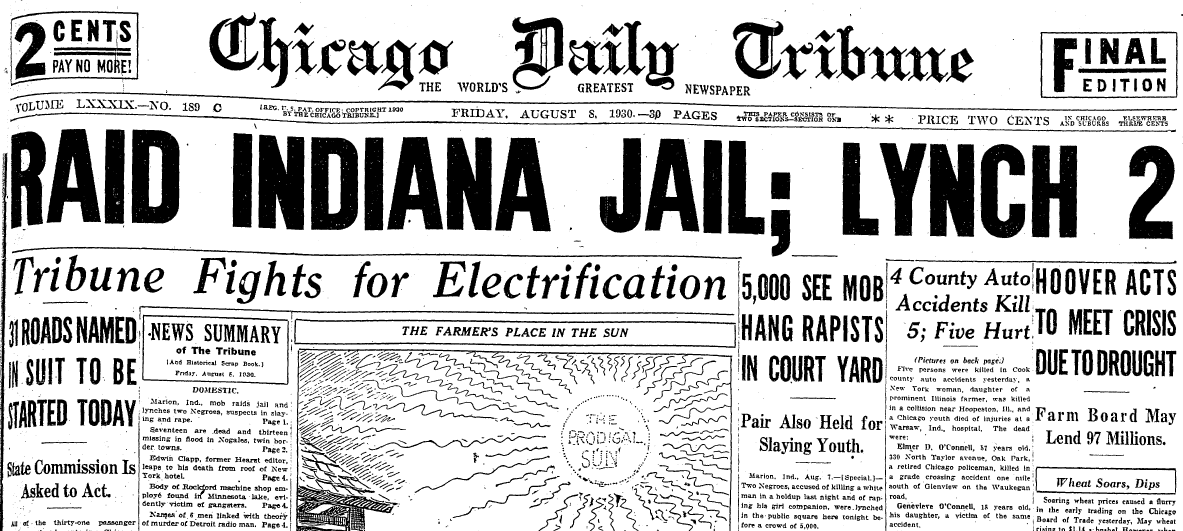
On this date in 1930, two black youths were lynched in Marion, Indiana for murdering a white man and raping his girlfriend.
(The rape allegation — although it, and not the homicide, seems to have been the thing that triggered the lynching — was subsequently withdrawn, and there were even rumors that the white girlfriend was a lover and confederate of one of the lynched men. It’s just one strand in the very human tapestry around the “last classic lynching north of the Mason-Dixon line” explored by Cynthia Carr in Our Town: A Heartland Lynching, a Haunted Town, and the Hidden History of White America.)
Shipp, who is said to have confessed killing the white man, Claude Deeter, 23, of Fairmount, Ind., was hanged from an elm tree in the courthouse yard. Smith, whom the girl identified as her assailant, was thrown from a third floor window of the jail with a noose around his neck and strangled.
…
Reports of the crimes and confessions, published in Marion newspapers this afternoon, stirred this quiet community of 23,000 to intense excitement. There was no hint of the impending violence, however, until 8:30 p.m., when a motorcade of Deeter’s fellow townsmen arrived from Fairmount.
The Fairmount delegation, numbering about 100, gathered in the public square, openly displaying their guns and shouting for a lynching … The sheriff led his deputies to the front door, argued a moment with the leaders of the mob and then ordered the tear bombs thrown. Blinded, the lynchers fell back for a few minutes, but returned and began the sledge hammer siege which forced the jail doors within ten minutes. No shots were fired on either side.
Following the lynching the mob gathered in the square for an hour, some proposing to drive the 2,000 members of the Negro colony from the city and burn their dwellings. Peace officers from Indianapolis, Kokomo, Fort Wayne, and other towns were arriving however, and gradually the mob broke up.
The corpses hung in the square for hours, attracting throngs of gawkers — including a photographer able to snap this picture:
Teacher/poet Abel Meeropol ran across this photo of the Shipp-Smith lynching a few years later in a magazine, and it so “haunted” him — his word — that he penned the anti-lynching poem “Strange Fruit”. You know it from Billie Holiday‘s arresting vocal rendition.
Southern trees bear strange fruit
Blood on the leaves
Blood at the root
Black bodies swinging in the southern breeze
Strange fruit hanging from the poplar trees
Pastoral scene of the gallant south
The bulging eyes and the twisted mouth
The scent of magnolia sweet and fresh
Then the sudden smell of burning flesh
Here is a fruit for the crows to pluck
for the rain to gather
for the wind to suck
for the sun to rot
for the tree to drop
Here is a strange and bitter crop
Abel Meeropol was no passing sentimentalist himself, but a prolific left-wing activist. During the McCarthy years, he adopted the children of the Rosenbergs when the latter were electrocuted as Soviet spies. As faithfully as those two orphaned boys have carried the torch for their lost birth parents, they also still carry an adoptive surname: Michael Meeropol and Robert Meeropol.
A third person was almost lynched in the same Marion, Ind., incident, but 16-year-old James Cameron (sometimes called “Herbert” or “Robert” in the 1930 news reports) managed to convince the mob that he wasn’t involved. Just how he managed this feat and what he’d really been up to is another strand of Carr’s tapestry: many of the Marion blacks as well as whites she interviewed overtly mistrusted Cameron.
At any rate, the crowd let him off with a beating, and Cameron served time as an accessory to the crime.
After release, he became an anti-lynching activist in Indiana and, later, Wisconsin — where he founded a (since-shuttered) Black Holocaust Museum. He started several NAACP chapters.
In the more immediate aftermath, it was far from a given that this date’s effusion of summary justice wouldn’t cascade into a generalized racial pogrom.
As the Tribune article notes, the lynch mob mulled attacking the black community, ultimately dissuaded by the gradual arrival of lawmen. By the next day, the Indiana national guard had occupied Marion. The Tribune on Aug. 10 reported the town “peaceful to all outward appearances but acutely aware of an undercurrent of racial antagonism that it feared might flame into open warfare at any moment.”
Lest this seem a bit over-the-top, recall that all this went down just a few years since a lynch mob in Tulsa had metastasized into one of America’s most notorious race riots. The prospect of wholesale bloodletting was very real.
When the local attorney general and grand jury waved away the small matter of punishing mob leaders, several of whom were publicly known by name, Indianapolis attorney general (and Marion native) James M. Ogden drove up to town and personally filed indictments, to the fury of white residents.
“It was astonishing to see and feel the mob atmosphere that still prevailed nearly seven months after the murder,” wrote a correspondent for The Nation. Ogden’s deputies were “looked upon as enemies of the community, not only by the mob, but also by most of the court officials.” After all-white juries acquitted the first two people tried, the state dropped its remaining indictments.
The maelstrom of race and politics and history that emerged from that first fatal transaction — a brutal but banal Lover’s Lane heist — grew so far beyond the original cast of criminal and victim that they practically became secondary to the story.
On August 8, 1930, a wire story datelined Fairmount, Ind., ran in the Indianapolis Star (but not the Marion papers):
Deep regret that the negro slayers of their son Claude, were lynched in Marion last night by a mob, was expressed today by Mr. and Mrs. William Deeter, members of the Apostolic faith, a sect similar to the Quakers.
“God should have been the judge,” said the elderly Deeter. “They had no right to do it,” his wife assented.
Both are opposed to capital punishment and did not want to see the negroes put to death for their crime.
On this date in 1909, Georges-Henri Duchemin was guillotined in Paris for murdering his mother. It was the first execution in that city in a decade.
An aimless gadabout, Duchemin mostly sponged off his dear mom, and the filial bond of nature proved insufficiently developed to restrain him strangling the old lady when she held out on him one time.
The ungrateful child made off with a couple hundred francs, but his sister knew right where to direct the police.
His lawyer bid to represent the killer as unbalanced (French link; most of the material on this criminal is in French). The general public horror of parricide and the undisguisedly mercenary nature of the murder made it a no-go.
France had taken a death penalty hiatus of three-plus years from late 1905 to early 1909, under the anti-death penalty president Armand Fallieres. But even those in the first half of the decade had been elsewhere than the capital: Paris hadn’t seen the national razor shave a head since Alfred Peugnez in 1899.
“[Juve] led Fandon just behind the guillotine, to the side where the severed head would fall into the basket. ‘We shall see the poor devil get out of the carriage, and being fastened on to the bascule, and pulled into the lunette.’ He went on talking as if to divert his own mind from the thing before him. ‘That’s the best place for seeing things: I stood there when Peugnez was guillotined, a long time ago now, and I was there again in 1909 when Duchemin, the parricide, was executed.-
–Fantomas
On this date in 2007, cousins Majid and Hossein Kavousifar (or Kavoosifar, or Kavoosi-far) were publicly hanged in Tehran for murdering a judge.
The judge in question had been noted for clapping some democracy activists in jail, but the authorities insisted that the case wasn’t political — that Majid admitted targeting Hassan Moghaddas (whose outsized portrait grotesquely decorated the scene) in a personal vendetta, as well as killing a couple of other people in a string of robberies.
Age-appropriate entertainment? A spectator at the hanging.
And while the 24-year-old Hossein died in fright, 28-year-old Majid played to those onlookers in the most insouciant execution pictures you’ll ever want to see.
Warning: Graphic images (and video) follow. (Many more can be searched up around the web.)
On this date in 1588, three Catholic priests were hanged, drawn, and quartered at St. Mary’s Bridge in Derbyshire.
Though we find Catholic proselytizers at risk of their lives throughout the Elizabethan period, at few moments was the profession of the Old Faith more fraught than during the summer of 1588.
Elizabeth’s Catholic rival Mary, Queen of Scots had lost her head just the year before, having been the focal point of one too many Catholic plots to overthrow Elizabeth. England’s support for Dutch Protestants rebelling against Spain had drawn the Spanish Armada, a feared invasion force even at this moment beginning to engage the English navy a couple of weeks ahead of its ultimate defeat. Even the French Wars of Religion were running white-hot, with an ultra-Catholic pogrom in Paris that spring.
If ever the wrong religion constituted treason, this was the time.
This also made it a great moment for zealous local authorities to crack down on suspected Catholics. When that happened in Derbyshire, a raid of a recusant‘s property (prompted by a tip from the target’s nephew) turned up two Popish clerics living in the lovely medieval manor house on-site, Padley Chapel.
Fathers Nicholas Garlick and Robert Ludlam were condemned within days to a traitor’s death for endeavoring to “seduce” the Queen’s subjects to Catholicism.* Their few hours left in this vale of tears were sufficient to firm the resolve of a wavering fellow-priest, Richard Simpson, who joined Garlick and Ludlam on the scaffold.
A hagiography of these men — they have all since been beatified — notes that the less steely Simpson “suffered with great constancy, though not with such (remarkable) signs of joy and alacrity as the other two.” But considering he was out there getting disemboweled for God and you’re just sitting around reading some blog, you probably ought to cut him a little slack.
When Garlick did the ladder kiss,
And Sympson after hie,
Methought that there St. Andrew was
Desirous for to die.
When Ludlam lookèd smilingly,
And joyful did remain,
It seemed St. Stephen was standing by,
For to be stoned again.
And what if Sympson seemed to yield,
For doubt and dread to die;
He rose again, and won the field
And died most constantly.
His watching, fasting, shirt of hair;
His speech, his death, and all,
Do record give, do witness bear,
He wailed his former fall.
There are still pilgrimages made in honor of the “Padley Martyrs” every year on the anniversary of the priests’ arrest, July 12.
* Garlick, at least, had been a specific target of priest-hunters for some time; he appears in reports to Francis Walsingham‘s spy network, where he is once accursed as “the demonite,” presumably for taking part in some well-publicized exorcisms in 1585-1586. (These exorcisms seem to be reflected in Shakespeare’s King Lear.) There’s a very large pdf touching the “demonite” reference: a scan of the public-domain 19th century tome The Troubles of our Catholic Forefathers.
This Northumberland lord, whose name hints at his reputation for for ferocity and impetuousness, was not necessarily incensed in principle at Henry Bolingbroke‘s usurpation of the English crown as Henry IV. In fact, he took an appointment to put down the anti-Lancastrian rebellion of Welsh troublemakerOwain Glyndwr. (Percy didn’t succeed.)
But this royal imposter didn’t pay off Percy richly enough in either coin or respect.
Hotspur left Wales to whomp the Scots at the Battle of Humbleton Hill, but King Henry’s demand that he turn over the big-name prisoners taken in that battle (instead of ransoming them for profit) — coupled with Henry’s own refusal to ransom Hotspur’s brother-in-law Edmund Mortimer from Welsh captivity — provoked a furious row between “king” and “subject”. Henry IV is supposed to have denounced Henry Percy a traitor and drawn a blade on him.
Alas: the field wasn’t kind to the Percies this time.
A revolt raised by a guy named Hotspur should hardly fail for want of ambition, and this one was the hottest of spurs: the Percies (with our day’s principal, Uncle Worcester) made a pact with Glyndwr (still going strong in Wales) and Glyndwr’s hostage-turned-son-in-law Edmund Mortimer (who was the uncle of the kid who should have been king) to give Bolingbroke the boot and carve up the realm between them.
Shakespeare represents this argument at the start of Henry IV, Part 1, and the conflict it engenders will drive that play’s story. This is Hotspur privately fuming after Henry has refused to help Mortimer (Act I, Scene 3):
let my soul
Want mercy, if I do not join with him: [i.e., Mortimer]
Yea, on his part I’ll empty all these veins,
And shed my dear blood drop by drop in the dust,
But I will lift the down-trod Mortimer
As high in the air as this unthankful king,
As this ingrate and canker’d Bolingbroke.
Orson Welles’ Chimes at Midnight abridges this and several other Shakespeare plays, and its opening action — after the Falstaff and credits — sets our stage. Worcester here is played by French Connection villain Fernando Rey.
Shrewbury was the result, a battle that up to the moment it commenced seemed amenable to mediation. Worcester himself negotiated face to face with King Henry, but refused to submit himself trusting the sovereign’s mercy. “On you must rest the blood shed this day,” Henry told him.
Some of that blood was Hotspur’s, as a result of a freak combat injury: he took a fatal arrow to the face when he raised his armor’s visor to get some air.**
Worcester didn’t outlive him by much — as depicted in Act V, Scene 4, he was summarily executed shortly after the battle:
KING HENRY IV
Thus ever did rebellion find rebuke.
Ill-spirited Worcester! did not we send grace,
Pardon and terms of love to all of you?
And wouldst thou turn our offers contrary?
Misuse the tenor of thy kinsman’s trust?
Three knights upon our party slain to-day,
A noble earl and many a creature else
Had been alive this hour,
If like a Christian thou hadst truly borne
Betwixt our armies true intelligence.
EARL OF WORCESTER
What I have done my safety urged me to;
And I embrace this fortune patiently,
Since not to be avoided it falls on me.
KING HENRY IV
Bear Worcester to the death and Vernon too:
Other offenders we will pause upon.
(Vernon was one of two knights executed with Worcester in Shrewsbury.)
* Yes, the English football club Tottenham Hotspur is named for the dashing Henry Percy. “Audere Est Facere” is the team’s motto, “to dare is to do” … even though that totally didn’t work out for Hotspur himself.
** Oddly enough, Hotspur’s opposite number Prince Henry (the future victor of Agincourt, Henry V), also got shot in the face in this battle.
In our late constant disputes at our tables (where by the by every Person has his own waiting man behind him) we have I am afraid been too careless of Expressions, especially when the topic of American rebellion has been by the Disaffected amongst us, dwelt upon and brandished of with strains of Virtuous Heroism.
…
what mind of a Slave will not recoil and burn into Resentment; when he shall have been the frequent witness of Sedition and Ingratitude in the Conduct of his Master — when he shall hear the Obligation of a subject to his Lord spurn’d at — the Blood spilt by Rebells extoll’d … Obedience to Laws and Authority upon all these Occasions mentioned with a strong Idea of Slavery. And Men toasted into Immortal Honours for Encountering Death in every form, rather than submit to Slavery let its Chains be ever so gilded.
Dear Liberty has rang in the heart of every House-bred Slave, in one form or other, for these Ten years past — While we only talk’d about it, they went no farther than their private reflections upon us & it: but as soon as we came to blows, we find them fast at our heels. Such has been the seeds sown in the minds of our Domestics by our Wise-Acre Patriots.
The departure of this regiment was the pre-arranged signal for the parish’s slaves — both imported Coromantee and, more ominously for the slaveholder, the generally less-rebellious Creoles — to mount a general rising.
The only reason it didn’t happen was because it was sniffed out — after the regiment left, but before the date planned out by slaves passing word from estate to estate.
For a century or so, lucrative sugar and coffee cultivation on the island (and elsewherearound the thought to have been imported to Jamaica before the slave trade was abolished in 1808.
Planters reaped stupendous profits from this harvest of misery, but perpetually stood in danger of reaping the whirlwind, too. At the time of the intended rebellion, there were 20 or more slaves for every white around Hanover. A Hanover militia officer said in the days after the plot was uncovered that he was “deeply Concerned in the Intended Insurrection, the Number of the Troop is small and the Duty severe, Our apprehensions are great upon the occasion as we know not where it will end.” As the number of implicated slaves mounted past 100, a planter lamented that “there appears to be no end to this horrid affair.”
As jumpy as they were, the authorities managed to keep a lid on this situation through the usual methods, which gives this site its excuse to notice the affair.
We have try’d — found Guilty and Executed Yesterday the following Conspirators, Blue Hole Harry, and Leander of the Spring Estate, Charles of the Baulk, Peter of Batchelors Hall, Prince belonging to John Priest of Lucea, and Quamino to Sir Simon Clarke, these are the Chief Ring-leaders and the most Active in Promoting the Intended Insurrection and We propose proceeding tomorrow in trying the Other Chiefs.
-Report to Sir Basil Keith from the magistrates of Hanover, Jamaica, July 20, 1776
For more, see Richard B. Sheridan, “The Jamaican Slave Insurrection Scare of 1776 and the American Revolution,” The Journal of Negro History July, 1976, which is the source of the quotes in this article.
This date in 1300 saw the execution in Parma, Italy of Gerard Segarelli, the founder of the order of the Apostolic Brethren who are perhaps better known for Segarelli’s apocalyptic successor, Fra Dolcino.
Despite the tendency of his follower to eclipse his star, Segarelli was himself a formidable religious reformer in a time flowering with expressions of popular piety that regularly confounded the prelates.
Joined as Dolcino and Segarelli are in this fascinating period, Executed Today aptly welcomes back Dr. Jerry Pierce to talk Segarelli. He’s already shed some light on Dolcino in these pages.
Dr. Pierce is completing a forthcoming book on the Apostles.
You view Segarelli as a very different sort of character from Dolcino.
One of the big issues in studying Segarelli is that he’s always tied to Dolcino. I mean, Segarelli does die a heretic, but he’s always tied to the biggest heresy. He actually founds his order in 1260 and he’s not executed until 1300, so that’s 40 years.
Doctrinally, the reason Segarelli didn’t have any issues for so long is that as far as we can tell, he never had an anti-clerical agenda. Unlike Dolcino, he doesn’t go around calling the Church the “Whore of Babylon”.
Even at the end?
No. Basically, the reason he’s executed is that he refuses to renounce his movement, it’s not that he has any doctrinal errors or anything like that.
He’s basically like a Franciscan, just 50 years later. It’s this popular, penitential movement. They have tons of support throughout central Italy, support from the lay people who provide them with shelter and food. They’re basically doing the stuff that Francis and the early Franciscans did, wandering around exhibiting the ascetic lifestyle. And it’s okay for lay people to do this at this point. Everybody does this.
Why does everybody do this? This century has an explosion of penitential religious mass movements.
Personally, I think it has to do with economics — you have the growth of cities, growth of money economy. These are urban movements. Segarelli’s in Parma, the flagellants are in Parma and other cities.
It has to do with living in this world of growing wealth, growing towns, hearing this message of poverty preached from the pulpit and then they look around and say, “wait a minute.”
Different individuals come to this conclusion — Francis, Peter Waldo, Segarelli — I don’t think they had an idea about founding a movement. They were just trying to do something to preserve their souls.
And these other groups like the Franciscans also face an internal tension between the spirit of ascetic poverty and the institutional Church.
Even before Segarelli, the guy who’s the head of the Franciscans in one letter that he wrote said, “people wandering in Italy would rather run into robbers on the road than two begging Franciscans because at least they know the robbers’ intentions.”
A lot of authors say that Segarelli is an offshoot of the poor spiritual Franciscans. But he has no connection. He tried to join the Franciscan order, but the poor order founded by St. Francis says, “yeah, you don’t have the right pedigree to be a Franciscan,” which really goes to show how institutionalized and closed the Franciscans had already become.
Most of the stuff we have about Segarelli for his first 20 years or so is from a rival Franciscan named Salimbene who’s mad that he’s making such headway. He actually says that he can’t believe that his fellow citizens are giving more to Segarelli and his Apostles than they ever did to the Franciscans. And that colors how they talk about them: in his eyes, Segarelli is a rustic from the country.
Did Segarelli preach at all?
He goes around telling people to do penance, and the Franciscan chronicler makes fun of him because he doesn’t say the Latin version, he uses the vernacular: penitenziagite instead of the Latin penitentiam agite.
Most of it was by example. You don’t have access, really, to a Bible as a lay person; this was a way for people to sort of experience the religious life without becoming a nun or a monk.
So for these first decades of his career, if he’s attracting all this criticism, why is he still tolerated?
Because he’s not really a threat. It’s a good way to channel lay piety without it becoming a threat or anything.
Bear in mind, this is after the Waldensians, after the Crusade against the Albigensians — and both of those groups talked about poverty. This gives Church figures a pretty good idea that, hey, maybe we should be accepting of these movements.
The Bishop of Parma accepted Segarelli. There was apparently a group of Apostolic sisters who did the same thing, and the Bishop of Parma sort of wrote a document saying that you get a partial indulgence for giving to them.
Given this institutional semi-support, why wasn’t Segarelli’s movement also corrupted?
There are other leaders than Segarelli, and some do have this issue. One guy is the brother of the podesta of Bologna, a pretty wealthy dude. He takes over this movement and he’s basically using people’s donations to buy horses and ride around in nice clothes. There’s a huge civil war within the Apostles. At one point Segarelli himself gets kidnapped by rival members.
It’s not until the 1280s that they start really running into problems with respect to the Catholic hierarchy, and the problem is because of the general proliferation of the lay movements. Two different popes lay out guidelines saying unestablished religious orders need to join established orders or just disband. But then you see people in the Apostolic movement ignoring that, moving into actually preaching things, which is potentially heretical, and they start attacking the Franciscans, the Friars Minor, by referring to themselves as the Friars Minimi, “the least.” The Franciscans are pretty powerful and they start going against the Apostles.
But Segarelli himself stays clear of this?
Segarelli himself doesn’t really take a leadership role even though he’s the founder. He’s sort of hands-off.
You can argue that he has some issues because he won’t follow authority when they tell him to disband. But it was after the group had been around for so long, it’d be like telling the Franciscans 40 years on, “sorry.” Early in the movement, the Apostles had actually gone to different members of the hurch hierarhy asking for a rule under which they could operate. So they’re not trying to be insurrectionaries.
How does it all break down for the Apostles, then?
It’d be too easy to say that it’s just greedy Franciscans. I think the other part is you have people who are getting into the movement, people like Dolcino, who have other agenda. And the Church is worried that they’re unregulated and without control you get improper doctrine being preached.
When it comes to it, Segarelli just refuses to disband. The Apostles had really grown beyond his personal control anyway. But at one point he escapes from the bishop’s palace where he’s sort of under house arrest and resumes his preaching, and they’re like, “all right, enough.”
What do we know about Segarelli’s relationship with Dolcino?
We think that Dolcino may have joined the order around 1290, but it’s all hearsay. Dolcino talks some about Segarelli.
What’s Segarelli’s long-term legacy?
It’s not heresy to be associated with Segarelli after he’s executed. We have Inquisitional trial records for several years after Segarelli in places like Bologna and other areas. There’s even some evidence that there were followers in France and Germany.
As time goes on, there’s a lot of people in Italy itself like Dolcino who appropriate the movement, so you have modern writers who talk about Segarelli and Dolcino as proto-Communists, or Segarelli as the real Franciscans. Some of them have an axe to grind against the institutional Church.


 This

 An aimless gadabout, Duchemin mostly sponged off his dear mom, and the filial bond of nature proved insufficiently developed to restrain him strangling the old lady when she held out on him one time.