1952: Liu Qingshan and Zhang Zishan, the first corruption executions in Red China

China has been clamping down on official malfeasance lately, but corruption trials have a long and storied vintage in the realm.

The very oldest casket in the cellar has stamped upon it this date in 1952, when Maoist China carried out its first corruption executions.


The public trial of Liu Qingshan and Zhang Zishan. (Source.)

“Faithful and unyielding” during wartime, Liu Qingshan and Zhang Zishan exploited their resulting positions of authority to plunder economic development money.

Theirs was the signal case in an anti-corruption “campaign against three evils” that ended late in 1952, with the announcement that 196,000 party members and cadres had been convicted of something. (Cited here.)

One then-youthful man remembered that

in the winter of 1951, Mao launched a national campaign against what he called the three evils — corruption, waste, and bureaucracy. Taking advantage of the winter holidays, students were sent to various places as members of so called Tiger Hunting Teams. With six other students I was sent to the Art Supply Service then attached to our school. It was housed two miles from the campus. I worked there under the office of the Campaign Against the Three Evils. The entire staff and all the workers were organized to study Party policies attached to this campaign. The staff was then called upon to make a clean breast of their crimes and accuse others they knew to be criminals as well. These crimes included embezzling, forgery, theft, bribery and other white collar crimes. Some suspects were already being locked up in isolated rooms within the offices. Most of those locked up were directors on various levels. Some were even old Party members from the early Yanan days. We had no mercy on those we saw to be “criminals.”

I learned from the newspaper that corruption and waste had become very serious problems indeed. It also revealed how Party cadres had degenerated from revolutionary heroes into grafters. The best example we were told of was two senior cadres, the secretaries of the Tianjin Prefectural Party Committee, Liu Qing-san and Zhang Zi-shan, who were even sentenced to death for their crimes. The Party wanted to show that its own members were not exempt from justice. In showing this, they concurred with the old Chinese belief that it was best to execute one as a warning to a hundred.

Took the words right out of Mao’s mouth.

Only if we execute the two of them, can we prevent 20, 200, 2,000 or 20,000 corrupt officials from committing various crimes.

… although of course, that was a primitive age; one could hardly expect that sort of startling yield on investment in today’s on-the-go China. “[T]he effect would not be so great. To show our determination, we would have to execute several more than two.”

On this day..

1619: Lucilio Vanini, aka Giulio Cesare

On this date* in 1619, Italian freethinker Lucilio Vanini was adorned with a placard reading ‘Ateiste et blasphemateur du nom de Dieu’ and taken to Toulouse’s Place du Salin where he had his blasphemous tongue cut out,** then was strangled and burned at the stake.

You can think of Vanini as a sort of Giordano Bruno mini-me — a bit less intellectually distinguished, a bit less famous, but doing the same peripatetic, pantheistic act before orthodoxy ran him down.

Ordained a priest (like Bruno), Vanini’s 34 years were spent perambulating (like Bruno): France, Switzerland, the Low Countries, even England, where he briefly auditioned Anglicanism.

Alas, (like Bruno) the libertine monk’s occult philosophy had no real home; he fled Paris for Toulouse (the place Bruno earned his doctorate), and was there charged with blasphemy.

Vanini veiled his dangerous speculations in nominally pietistic cant, but he probably could have done better misdirection than a title like De Admirandis Naturae Reginae Deaeque Mortalium Arcanis (Of the Marvelous Secrets of the Queen and Goddess Nature — available in Latin from Google books).

Vanini was bold enough to suggest an equivalency between human and animal souls, and reckon both mortal. Though his works purported to prove the existence of God, and he even made to his accusers a version of the “first cause” argument, they thought (probably rightly) he wasn’t being serious.

They also thought (again, probably rightly) Vanini and his aristocratic patrons were debauched; Vanini’s execution kicked off a dangerous crisis for hedonists in France and elsewhere in the 1620s.

There’s much more about Vanini in French here, and in English in this chapter of the public-domain The Skeptics of the Italian Renaissance.

* Some sources report Feb. 19. The source of this discrepancy isn’t clear to me; the then-10-day gap between the Julian and Gregorian calendars is an obvious suspect, but as this execution took place in Catholic France, the modern Gregorian calendar had been adopted decades before.

In any event, primary documentation appears to me to support the 9th.

” le samedi neuvième du mois de février … fut donné arrêt au rapport de M. de Catel, conseiller au parlement, par lequel il [Vanini] fut condamné à être traîné sur une claie, droit à l’Eglise Saint-Etienne, où il serait dépouillé en chemise, tenant un flambeau ardent en main, la hart [la corde avec laquelle on étranglait les criminels.] au col, et, tout à genoux devant la grande porte de la dite église, demanderait pardon à Dieu, au roi, à la justice, et de là … serait conduit à la place du Salin où, assis sur un poteau, la langue lui serait coupée, puis serait étranglé, son corps brûlé et réduit en cendres; ce qui fut exécuté le même jour.”

** “Before putting fire to the stake, Vanini was ordered to put forth his sacrilegious tongue for the knife. He refused; it was necessary to employ pincers to draw it forth, and when the executioner’s instrument seized and cut it off never was heard a more horrible cry. One might have thought that he heard the bellowing of an ox which was being slaughtered.” (Source) This account of the magistrate Gramont has to be considered in view of his interest in showing the condemned inadequate to his jaunty resolve, “Let us go, let us go joyfully to die, as becomes a philosopher.”

On this day..

1852: Martin Merino, Jesuit assassin

On this date in 1852, a 63-year-old Jesuit priest was garroted outside Madrid’s Toledo Gate for attempting to assassinate Queen Isabella II.

Only five days before, Martin Merino y Gomez (Spanish Wikipedia link) had slipped into the palace wearing his clerical robes, and planted a dagger in the Queen’s side. (Non-fatally; her corset partly shielded the blow.)

Despite some speculation that he might have been connected to some more elaborate plot, investigation found him to be a lone nut, “crazed with Liberal doctrines, disordered vanity, and bilious disease.”

Neither a clear motive nor a real link to any other actor was ever established. Merino died as a lone nut, and then his parricidal remains were burned to ashes and scattered to the winds.

On this day..

1885: George Gibson and Wayne Powers

As of today, Scott County, Va., has gone 125 years since its last hanging — the execution in Estillville* of George Gibson and Wayne Powers for the drunken murder of a comrade.

Wayne Powers and Jonas Powers (brothers), and George Gibson and William Gibson (no relation), were on the road to West Virginia looking for opportunity and all that jazz, when the last-named William Gibson was slain by his traveling companions.

The crime was either one of minute pecuniary interest (the three survivors divided up the few dollars William had on him, and the clothes off his back), or just some inane drunken midnight quarrel between men who all happened to be well-armed.

At any rate, the inebriated killers “spent nearly the entire night trying to burn the body with a fire made of fence rails, and were thus discovered.”

Though all three were condemned, Jonas Powers was reprieved as not actually involved in the killing; both his brother and George Gibson used their scaffold time to insist upon his innocence. He was not ultimately executed.

His less fortunate companions did not neglect to blame Demon Rum for their woes, and took their leave of this earth doing their little bit to speed the day of a ruinous social policy.

O! may the cup of intoxicating drink never touch their lips, for it was this that has brought a fate so terrible upon their father. Society would do well to banish liquor forever from its midst. I, who have been decoyed to my ruin by it, might with some show of just reproach turn upon that people whose laws license this most deadly and dangerous of all agents, and say, ‘shake not thy glory locks at me.’”

The hanging itself was technically private, but the doomed men were trotted out on a stand outside the jail yard to address three thousand onlookers, and many of the public climbed trees to watch the gallows proceedings over the walls.

* Estillville is today known as Gate City. If the name rings a bell, it might be for its recent foray into the electoral fraud headlines.

On this day..

1529: Ludwig Haetzer, Anabaptist

On this date in 1529, Biblical translator Ludwig Hätzer (or Haetzer, or Hetzer) had his head lopped off with a sword in the town square Konstanz (Constance) where he had first been ordained a priest. The charge against him was adultery … but his real crime was his Protestant radicalism.

Haetzer, a Hebrew scholar, was of that first generation of church reformers who pushed dangerously beyond the reforms intended by more respectable types like Luther and Zwingli.

The latter actually took Haetzer under his wing in 1523 for his erudite denunciation of religious imagery, and tapped him to help translate the Old Testament.

But Haetzer started rolling with wilder-eyed types like Michael Sattler and getting thrown out of cities and the like. The young priest’s own thinking evolved over the 1520s towards a rejection of infant baptism, and sacraments, and marriage.

There was also a sect among them the members of which wished, together with all things else, to have their wives in common; but they were soon suppressed by the other Brethren of the community, and driven out. Many inculpated Hut and Hätzer as leaders of this sect. If this be true, these men at all events atoned for their sin.

According to Alcohol: A Social and Cultural History, Haetzer was even the first divine to publicly denounce boozing — in a German treatise available free online, On Evangelical Drinking.

He wasn’t opposed to all corporal diversions, however.

Protestant authorities in Constance arrested him for living in sin with Anna Regel.

After his execution for sexual impropriety, anti-Trinitarian writings were discovered and judiciously destroyed; this biography claims that some Unitarians view him as their proto-martyr.

On this day..

1461: Owen Tudor, sire of sires

A Welsh courtier with the boldness to bed the queen lost his head this date in 1461 … but his career in usurpation was just getting started.

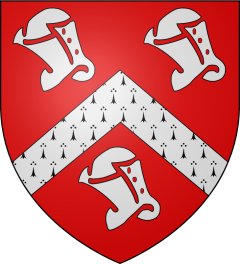
Owen Tudor’s coat of arms.

The House of Tudor that would come to rule England counted Owen its sire; the four-year-old grandson he left at his death grew up to become the first Tudor monarch, Henry VII.

Owen produced the root of this august line with Dowager Queen Catherine of Valois, the French princess Henry V had extracted as part of the price of peace after Agincourt.

That union was supposed to join the two great realms, but Henry V unexpectedly kicked the bucket in 1422, leaving an infant son who was not only unable to hold the French throne … he was too unstable to hold the English throne, either.

Unless he was a seer, suave Owen must not have been thinking dynasties when he took the Queen as his lover (and eventually his wife via a secret marriage in the early 1430s).

They produced six children, but it wasn’t the bedroom politics that did our prolific father in, at least not directly. Only decades later, when ownership of the crown was up for grabs in the War of the Roses and Owen loyally led Lancastrian forces at a battle he was unwise enough to lose, did he give up his head for the pedestrian crime of backing the wrong horse.

Owen reportedly thought he had stature enough to expect a reprieve until the very last moment, when the executioner’s ripping his collar caused him to sigh,

The head which used to lie in Queen Catherine’s lap, would now lie in the executioner’s basket.

In time, Owen’s descendants would get to pull the same trick, because the doomed cause in whose service Owen Tudor lost his life swept clear England’s political chessboard and made possible his own line’s accession.

Elizabethan poet Michael Drayton later versified Owen’s prodigious conquest in “Owen Tudor to Queen Catherine”.

When first mine eyes beheld your princely name,
And found from whence this friendly letter came;
Is in excess of joy, I bad forgot.
Whether I saw it, or I saw it not:

My panting heart doth bid mine eyes proceed,
My dazzled eyes invite my tongue to read,
Which wanting their direction, dully mist it:
My lips, which should have spoke, were dumb, and kist it,

And left the paper in my trembling hand,
When all my senses did amazed stand :
Even as a mother coming to her child,
Which from her presence hath been long exil’d,

With gentle arms his tender neck doth strain,
Now kissing it, now clipping it again;
And yet excessive joy deludes her so,
As still she doubts, if this be hers, or no.

At length, awaken’d from this pleasing dream,
When passion somewhat left to be extreme,
My longing eyes with their fair object meet,
Where ev’ry letter’s pleasing, each word sweet.

It was not Henry’s conquests, nor his court,
That had the power to win me by report;
Nor was his dreadful terrour-striking name,
The cause that I from Wales to England came:

For Christian Rhodes, and our religion’s truth,
To great achievement first had won my youth:
Th’ brave adventure did my valour prove,
Before I e’er knew what it was to love.

Nor came I hither by some poor event,
But by th’ eternal destinies’ consent;
Whose uncomprised wisdom did foresee,
That you in marriage should be link’d to me.

By our great Merlin was it not foretold,
(Amongst his holy prophesies enroll’d)
When first he did of Tndor’s name divine,
That kings and queens should follow in our line?

And that the helm (the Tudors ancient crest)
Should with the golden flow’r-de-luce be drest ?
As that the leek (our country’s! chief renown!)
Should grow with roses in the English crown –

As Charles his daughter, you the lilly wear;
As Henry’s queen, the blushing rose you bear;
By France’s conquest, and by England’s oath,
You are the true-made dowager of both :

Both in your crown, both in your cheek together,
Join Tether’s love to yours, and yours to Tether.
Then cast no future doubts, nor fear no hate,
When it so long hath been fore-told by fate ;

And by the all-disposing doom of Heav’n,
Before our births, we to one bed were giv’n.
No Pallas here, nor Juno is at all,
When I to Venus yield the golden ball:

Nor when the Grecians wonder I enjoy,
None in revenge to kindle fire in Troy.
And have not strange events divin’d to us,
That in our love we should be prosperous ?

When in your presence I was call’d to dance,
In lofty tricks whilst I myself advance,
And in a turn my footing fail’d by hap,
Was’t not my chance to light into your lap ?

Who would not judge it fortune’s greatest grace,
Sith he must fall, to fall in such a place ?
His birth from Heav’n, your Tudor not derives,
Nor stands on tip-toes in superlatives,

Although the envious English do devise
A thousand jests of our hyperbolies;
Nor do I claim that plot by ancient deeds,
Where Phoebus pasture his fire-breathing steeds:

Nor do I boast my god-made grandsire’s scars,
Nor giants trophies in the Titans wars:
Nor feign my birth (your princely ears to please)
By three nights getting, as was Hercules:

Nor do I forge my long descent to rim
From aged Neptune, or the glorious Sun:
And yet in Wales, with them that famous be,
Our learned bards do sing my pedigree

And boast my birth from great Cadwallader,
From old Caer-Septon, in mount Palador:
And from Eneon’s line, the South-Wales king,
By Theodor, the Tudors’ name do bring.

My royal mother’s princely stock began
From her great grandame, fair Gwenellian,
By true descent from Leolin the great,
As well from North-Wales, as fair Powsland’s seal.

Though for our princely genealogy
I do not stand to make apology:
Yet who with judgment’s true impartial eyes,
Shall look from whence our name at did first rise,

Shall find, that fortune is to us in debt
And why not Tudor, as Plantagenet?

Nor that term Croggen, nick name of disgrace
Us’d as a by-word now in ev’ry place,
Shall blot our blood, or wrong a Welshman’s name,
Which was at first begot with England’s shame.

Our valiant swords our right did still maintain,
Against that cruel, proud, usurping Dane,
Buckling besides in many dang’rous fights,
With Norway, Swethens, and with Muscovites;

And kept our native language now thus long,
And to this day yet never chang’d our tungue:
When they which now our nation fain would tame,
Subdu’d, have lost their country and their name.

Nor ever could the Saxons’ swords provoke
Our British necks to hear their servile yoke:
Where Cambria’s pleasant countries bounded be
With swelling Severn, and the holy Dee:

And since great Brutus first arrived, have stood
The only remnant of the Trojan blood.
To every man is not allotted chance,
To boast with Henry, to have conquer’d France:

Yet if my fortune be thus rais’d by thee,
This may presage a further good to me;
And our Saint David, in the Britons’ right,
May join with George, the sainted English knight:

And old Caer-merdin, Merlin’s famous town,
Not scorn’d by London, though of such renown.

Ah, would to God that hour my hopes attend,
Were with my wish brought to desired end !
Blame me not, madam, though I thus desire,
Many there be, that after you inquire;

Till now your beauty in night’s bosom slept,
What eye durst stir, where awful Henry kept ?
Who durst attempt to sail but near the bay,
Where that all-conqu’ring great, Alcides lay ?

Your beauty now is set a royal prize,
And kings repair to cheapen merchandise.
If you but walk to take the breathing air,
Orithia makes me that I Boreas fear:

If to the fire, Jove once in light’ning came.
And fair Egina makes me fear the flame:
If in the Sun, then sad suspicion dreams
Phoebus should spread Lucothoe in his beams:

If in a fountain you do cool your blood,
Neptune, I fear, which once came in a flood:
If with your maids, I dread Apollo’s rape,
Who cous’ned Chion in an old wife’s shape :

If you do banquet, Bacchus makes me dread,
Who in a grape Erigone did feed :
And if myself your chamber-door should keep,
Yet fear I Hermes coming in a sleep.

Pardon (sweet queen) if I offend in this,
In these delays love most impatient is:
And youth wants pow’r his hot spleen to suppress,
When hope already banquets in excess.

Though Henry’d fame in me you shall not find,
Yet that which better shall content your mind;
But only in the title of a king
Was his advantage, in no other thing:

If in his love more pleasure you did take,
Never let queen trust Briton for my sake.
Yet judge me not from modesty exempt,
That I another Phaeton’s charge attempt;

My mind, that thus your favours dare aspire,
Shows, that ’tis touch’d with a celestial fire:
If I do fault, the more is beauty’s blame,
When she herself is author of the same;

“All men to some one quality incline,”
Only to love is naturally mine.

Thou art by beauty famous, as by birth,
Ordain’d by Heav’n to cheer the drooping Earth :
Add faithful love unto your greater state,
And be alike in all things fortunate.

A king might promise more, I not deny,
But yet (by Heav’n) he lov’d not more than I.
And thus I leave, till time my faith approve,
I cease to write, but never cease to love.

Aficionados of old tyme history novelizations can also kick back with Owen Tudor: An Historical Romance.

On this day..

1685: Robert Pollack and Robert Millar, Covenanters

On this date in 1685, Robert Pollack and Robert Millar (or Pollock and Miller) were hanged in Edinburgh as Covenanters.

An East Kilbride shoemaker and a Rutherglen mason, respectively, they were a tick and a tock in the Killing Time — lost like tears in rain amid the torrent of Presbyterian martyrs.

These adhered to James Renwick‘s subversive doctrine of Scottish presbyter control against the overweening Anglican Episcopacy, a conflict of characteristically comingling religious and political characters.

Since most of the Covenanter-killing was being done summarily by soldiers in the field, these Roberts were actually the rare gallows-birds to be condemned in civil court, for which trouble they strangled at the Gallowlee on the road from Edinburgh to Peith.

Their last testaments can be read here, along with those of many other such martyrs.

Forsake not the assembling of yourselves together, and employ your strength in the holding up of the fallen-down standard of our Lord, and if ye be found real in this duty, ye shall either be a temple, which shall be a glorious sight, or else ye shall be transported, and be a member of the Church triumphant; so ye shall be no loser, but a noble gainer either of the ways.

-Robert Millar

Though not up to the fame of having their own statuary, Pollack/Pollock has a place on the Covenanter monument in East Kilbride … where the martyrs’ spiritual descendants recently held the movement’s first open-air Conventicle since the 1680s.

Part of the Themed Set: Resistance and Rebellion in the Restoration.

On this day..

1673: Mary Carleton, “German princess”

On this date in 1673 ended the adventures of “German princess” and early modern celebrity Mary Carleton.

Mary vaulted into the ranks of famous-for-being-famous in 1663, when the pamphleteering forerunners of Perez Hilton caught wind of a bigamy scandal wherein Mary, presenting herself as a mysterious German noble, had hitched with 18-year-old law student John Carleton and run through his money.

Once the public made her acquaintance … well, there was just something about Mary.

Over two dozen pamphlets are known sensationalizing her subsequent trial and acquittal for hubby-hopping, including post-acquittal volleys by both John and Mary.

(These pamphlets don’t currently appear to be available in their original forms online, but substantial excerpts from the most famous of them can be found in the public domain 1914 book The Mary Carleton narratives, 1663-1673: a missing chapter in the history of literature. This volume argues the Carleton publications are a stylistic progenitor of the English novel as it emerged in the hands of, for instance, Defoe. We certainly would be remiss not to notice here our real-life anti-heroine’s parallels (pdf) with Moll Flanders.)

Actually the daughter of a Canterbury fiddler, Moll Carleton was accused of having ditched her first spouse (a shoemaker) for a surgeon, then ditched the surgeon for John Carleton.

Having adroitly beat that rap in a court of law (if not exactly in the court of public opinion) “the German Princess” went into show business; that ubiquitous diarist Samuel Pepys caught her on stage, playing herself, remarking

I’ve passed one trial, but it is my fear
I shall receive a rigid sentence here:
You think me a bold cheat, put case ’twere so,
Which of you are not? Now you’d swear I know.
But do not, lest that you deserve to be
Censur’d worse than you can censure me:,
The world’s a cheat, and we that move in it,
In our degrees, do exercise our wit;
And better ’tis to get a glorious name,
However got, than live by common fame.

Well, why not?

In a time with scant social mobility for women, Carleton — which is the name by which she’s been remembered although she was born “Mary Moders” — carved it out with the tools at her disposal, which makes her an irresistible academic subject.*

Carleton/Moders is nearly the anti-Martin Guerre: whereas the male Arnaud du Tilh subsumed his own identity to insinuate himself into the existing social part of “Martin Guerre”, Mary Carleton’s shifty identity excised her from the social circumstances that would otherwise define her. (She was even reported to have taking to masculine cross-dressing.) Paradoxically, her fictitious biography enabled her to be taken for her own self, which explains why she stuck with her blank-slate “German origins” backstory after it had been publicly discredited.

And after the stage gig had run its course and her identity become disposable once again, she easily resumed her marital perambulations.

Mary Jo Kietzman called Carleton’s life “self-serialization.” The Newgate Calendar sanctimoniously records some of her adventures.

After a few years below the Restoration radar, Carleton was caught up for petty larceny and given a death sentence commuted to penal transportation to Jamaica. (England had just seized it from Spain during Cromwell‘s Protectorate.)

Two years later, she returned to England — not the only one to prefer the danger of Tyburn to the rigors (and obscurity) of the colonies.

She could only live as herself at the peril of her life. And on this day, she clinched her lasting fame at the end of a rope.

* e.g., Mihoko Suzuki, “The Case of Mary Carleton: Representing the Female Subject, 1663-73,” Tulsa Studies in Women’s Literature, Vol. 12, No. 1 (Spring, 1993).

Part of the Themed Set: Resistance and Rebellion in the Restoration.

On this day..

1670: Claude Duval, gentleman highwayman

It’s been 340 years since the immortal highwayman Claude Duval (or Du Val, or Du Vall) went to the Tyburn gallows and was turned off into legend as the ne plus ultra of English gentleman thieves.

Duval, actually, was French, an import to Isles in the train of some forgotten noble migrating with the restoration of royal prerogatives.

On the English highway, this formerly impecunious retainer coruscated as a knight of the road, the very model of the chivalrous outlaw against whom the likes of Dick Turpin would be compared to disadvantage. Macaulay recorded

how Claude Duval, the French page of the Duke of Richmond, took to the road, became captain of a formidable gang, and had the honour to be named first in a royal proclamation against notorious offenders; how at the head of his troop he stopped a lady’s coach, in which there was a booty of four hundred pounds; how he took only one hundred, and suffered the fair owner to ransom the rest by dancing a coranto with him on the heath;


William Powell Frith‘s painting (1860) of Claude Duval dancing with his prey.

how his vivacious gallantry stole away the hearts of all women; how his dexterity at sword and pistol made him a terror to all men; how, at length, in the year 1670, he was seized when overcome by wine; how dames of high rank visited him in prison, and with tears interceded for his life; how the king would have granted a pardon, but for the interference of Judge Morton, the terror of highwaymen, who threatened to resign his office unless the law were carried into full effect; and how, after the execution, the corpse lay in state with all the pomp of scutcheons, wax lights, black hangings and mutes, till the same cruel judge, who had intercepted the mercy of the crown, sent officers to disturb the obsequies. In these anecdotes there is doubtless a large mixture of fable; but they are not on that account unworthy of being recorded; for it is both an authentic and an important fact, that such tales, whether false or true, were heard by our ancestors with eagerness and faith.

Gillian Spraggs justifiably observes that no matter how genuinely gallant the brigand, his profession entailed relieving others of their rightful produce by main force. But then, the same could be said of the lords of the realm.

No, although Duval’s legend invites debunking, this must be for another blog.

We take Duval here at his mythological acme: he is the patron saint of the early modern bandit, the Superman of English outlawry, succoring with the fantasy of freedom upon the road the thousands of porters and scullery maids and apprentices chained to their oars below-decks upon Britannia’s ship of state.

What matter the rest?

This day, we toast Claude Duval, the Knight of the Road, in the manner of the fetching inscription (since destroyed by fire) under which he was reportedly buried:

Here lies DuVall: Reder, if male thou art,
Look to thy purse; if female, to thy heart.
Much havoc has he made of both; for all
Men he made to stand, and women he made to fall
The second Conqueror of the Norman race,
Knights to his arm did yield, and ladies to his face.
Old Tyburn’s glory; England’s illustrious Thief,
Du Vall, the ladies’ joy; Du Vall, the ladies’ grief.

Part of the Themed Set: Resistance and Rebellion in the Restoration.

On this day..

1661: Thomas Venner and the Fifth Monarchy Men

On this date in 1661, the restored English monarchy made an end to the interregnum’s religious crazies.

A few other images of Thomas Venner are available here.

“It is difficult in these days to follow with patience, or even with complete seriousness, all the ramifications of Fifth Monarchy speculation,” writes historian Louise Fargo Brown, whose gratis tome The Political Activities of the Baptists and Fifth Monarchy Men in England proceeds to do just that.

This blog wants for both patience and seriousness, so we’ll sum up that Venner et al were the holy rollers of the day, the true whack-jobs in the millenarian hustle of Cromwellian England.

Venner himself was born in New England, and there’s a zippy bio of him in The New England Historical and Genealogical Register. The North American colonies and Parliamentarian Britain helped to incubate political/religious heterodoxy for one another, and Venner was not the only budding religious zealot in the distant marches to emigrate to London after Charles I lost his head.

There the cooper became an outspoken apostle of the Fifth Monarchists, a part of Cromwell’s coalition made for disappointment with the mundane machinations of statecraft. Relieved in time of any a share in General Ironsides’ burden of helming the state in choppy waters, the men of the Fifth Monarchy were at liberty, to retire with their slide rules and philosopher’s stones to calculate the (imminent) date of the apocalypse foretold by Daniel and pursue the maxim not yet born that, starting with a mistake, a remorseless logician can end up in Bedlam.

All well and good to mock from posterity, and from a country where Left Behind is a bestseller no less. To be fair to the Monarchy Men, one could as well say that the egalitarian political language of these “arrant Radicals and levellers” just happened to be scriptural.* They would hardly be the last to foretell a golden age made ready by the slaying of a king, not by a long shot.

At any rate, our Bostonian tradesman became such an outspoken prophet of the return of “King Jesus” that Cromwell was obliged to clap him in irons.

Venner didn’t take the hint well, nor other more salutary warnings, and Venner instigated a riot of his few dozen followers at the start of January 1661 that took London unawares and did some damage before it was put down.

Diarist Samuel Pepys records of the riots that

[a] thing that never was heard of, that so few men should dare and do so much mischief. Their word was, “The King Jesus, and the heads upon the gates.” Few of them would receive any quarter, but such as were taken by force and kept alive; expecting Jesus to come here and reign in the world presently, and will not believe yet but their work will be carried on though they do die.

Thomas Venner and his compatriot Roger Hodgkins died that traitor’s death this day, along with William Oxman and Giles Pritchard, the latter two having their sentences commuted to simple hanging and posthumous beheading. The remaining survivors of his band climbed the scaffold two days later.

* e.g., “Then shall the Oppressor cease and no more complaining be heard in the streets. Taxes should be no more. And Trade and industry should abound. … The poor should have bread, and the Army no more in Arrears. Prison doors should be open and Debtors satisfied without Arrests … then peace and safety, plenty and prosperity, should overflow the land.” (Cited by Brown)

Part of the Themed Set: Resistance and Rebellion in the Restoration.

On this day..