
California on April 7, 1836 saw the first known installment of what would become a rich tradition of history of vigilance committee lynchings in the state — over an affair of the heart.
This was Alta California under Mexican rulership, a decade before the Yankees gobbled it up in the Mexican-American War.
Maria del Rosario Villa had abandoned her husband Domingo Felix (or Feliz) back in 1834 to take up with a vaquero named Gervasio Alipas (or Alipaz). The honor-stricken husband spent two years fruitlessly trying to reconcile until in 1836 at his behest the alcalde successfully pressured Maria into returning to her husband.
But on the couple’s return trip to their ranch, the lover Alipas intercepted them and did the husband Felix to death. Narciso Botello’s* annals describe that Alipas “took hold of his [Felix’s] horse and threw himself on Felix, grabbed him by his neckerchief, and pulled him off, dragging him along downhill and twisting the neckerchief, strangling him” — then pitched the choking victim into a gully where he finished him off with a machete. “Later it was proven by the tracks that the wife had been present.” (Source) She helped him dump the body near San Gabriel Mission, too.
Outraged both by the dastardly murder and by the wanton violation of matrimony that precipitated it, a gang of 55 organized themselves as a Junta of the Defenders of the Public Safety, led by Victor Prudon, a recent arrival to the area from the Hijar-Padres colony.** As no militia could be mustered inclined to oppose its will, on April 7 the junta forced open the jail where Alipas was interred, stood him up behind a church, and shot him to death. Villa — being held in an apartment at a private residence — was likewise forced out and marched to a nearby stable where she got the same treatment.
The vigilantes deposited the bodies back at the jail with the communique,
Junta of the Defendres of the Public Safety —
To the First constitutional Alcalde:
The dead bodies of Gervacio Alispaz and Maria del Rosario Villa are at your disposal. We also forward you the jail keys that you may deliver them to whomsoever is on guard. In case you are in need of men to serve as guards we are at your disposal.
God and Liberty. Angeles, April 7, 1836.
Victor Prudon, President
Manuel Arzaga, Secretary
And that was the end of the Defenders of the Public Safety, who disbanded a few days later, never to reconstitute. Indeed, while vigilance committees became regular features on the Californian landscape in later years, this is the sole such incident ever known to have occurred there under Spanish or Mexican rule.
* A Mexican who would serve two terms in the state assembly of California after it became a U.S. state in 1850.
** Mexico at this point was still in its first generation of independence; its hold on sparsely-populated California was not strong — and the missions set down there to convert natives to Christianity and project a Spanish presence had Russian competition.
The Hijar-Padres colony (Padres was the name of the colony’s organizer, Hijar its financier) was a nucleus of 200-odd souls dispatched to settle in California by one of the liberal intra-Santa Anna governments. The leaders soon became embroiled in a complex political rivalry with California’s governor and the colony itself failed to take root, its emissaries settling and taking work wherever they could. Many set down roots in California’s “Southlands” where Los Angeles, then just a small town but still the regional capital, would one day splay out its sunlit superhighways. While colonists were involved in the vigilance committee proceedings, no member of the love triangle was a colonist. (See C. Alan Hutchinson, “An Official List of the Members of the Híjar-Padrés Colony for Mexican California, 1834,” Pacific Historical Review, Aug. 1973.)
On this day..
- 1733: Samuel Partridge, very stupid and unconcern'd
- 1595: Henry Walpole, martyred at York
- 1995: Nicholas Ingram
- 1900: William Pepo, the first hanged in Teton County, Montana
- 1764: John Nelson, Liverpool robber
- 1979: Amir-Abbas Hoveyda, Iranian Prime Minister
- 1933: The "killers" of Pavlik Morozov
- 1903: George Chapman, Ripper suspect
- 1590: Anne Pedersdotter, Norwegian witch
- 1520: Gaspar Quesada, Magellan's expedition mutineer
- 1739: Dick Turpin, outlaw legend
- 2007: Du'a Khalil Aswad, honor killing victim
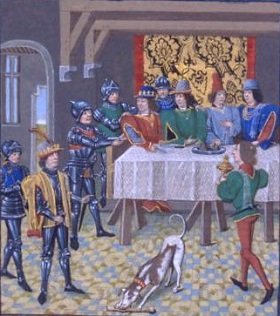 The king of France, on Tuesday the 5th of April, which was the Tuesday after midlent Sunday, set out early, completely armed, from Mainville, attended by about one hundred lances. There were with him his son the earl of Anjou, his brother the duke of Orleans, the lord John d’Artois, earl of Eu, the lord Charles his brother, cousins-german to the king, the earl of Tancarville, sir Arnold d’Andreghen, marshal of France, and many other barons and knights. They rode straight for the castle of Rouen, by a back way, without passing through the town, and on entering found, in the hall of the castle, Charles, duke of Normandy, Charles king of Navarre, John earl of Harcourt, the lords de Preaux, de Clerc, de Graville, and some others seated at dinner. The king immediately ordered them all, except the dauphin, to be arrested, as also sir William and sir Louis de Harcourt, brothers to the earl, the lord Fricquet de Friquart, the lord de Tournebeu, the lord Maubué de Mamesnars, two squires called Oliver Doublet and John de Vaubatu, and many others. He had them shut up in different rooms in the castle; and his reason for so doing was, that, since the reconciliation made on occasion of the death of the constable of France, the king of Navarre had conspired and done many things contrary to the honour of the king, and the good of his realm: the earl of Harcourt had also used many injurious expressions in the castle of Vaudreuil, when an assembly was holden there to grant a subsidy to the king of France against the said king, in order to prevent, as much as lay in his power, the subsidy from being agreed to. The king, after this, sat down to dinner, and afterwards, mounting his horse, rode, attended by all his company, to a field behind the castle, called the Field of Pardon.
 While we have many examples of martyrs attributed to
  Valdivia got his start in New World bloodsport in the train of the Pizarro brothers, and cashed in with mining concessions as a reward for his able service in the Pizarros’ campaign against yet another conquistador,
  Okulicki (
 We are, at length, arriving at the unfortunate party whose execution occasions this post.

 The
The 