Salnave stood at the head of a triumvirate that promulgated a new and more democratic constitution in 1867, abolishing the president-for-life position that his predecessors had asserted — but the political rearrangement collapsed within months and saw the the president and legislature at loggerheads, and then at outright civil war as regional risings multiplied against Salnave.
The president held out under bombardment in the capital of Port-au-Prince until the last days of 1869, when he fled to what he believed was the safety in the Dominican Republic — only to be arrested by the Dominican general Jose Maria Cabral and handed back over to the now-triumphant Haitian rebels. They had Salnave tried on January 15 and immediately executed that same day.
It was perhaps around the winter outset of 546 BCE that the Lydian king Croesus was captured and executed or spared by the Persians.
Famed for his wealth — he funded the construction of the Temple of Artemis, one of the Seven Wonders* — Croesus was heir to a 600-year-old empire dominating western Anatolia. Herodotus credits the Lydians as the inventors of coinage, a likely basis for the “rich as Croesus” expression.
Would that he had been so rich in wisdom.
In perhaps 547 BCE, Croesus launched a war against the rising power on his eastern border — the Persian Achaemenid Empire, led by Cyrus the Great. In a classic ancient own-goal, Croesus got the thumbs-up for this adventure from the Oracle of Delphi, who told the Lydian envoys that if Croesus fought Persia, he would destroy a great empire.** That empire turned out be his own.
After fighting to a stalemate in the autumn of 547, Croesus retired to his capital of Sardis to winter, believing war would abate with the end of the campaigning season — even dismissing his allies until the spring.
Cyrus surprised him instead, marching aggressively on Sardis and putting it to siege after routing a much larger Lydian army at the Battle of Thymbra.† It wasn’t long before the Persians found an ill-defended entrance into the city’s citadel via a mountain ascent, and fulfilled the Pythian priestess’s prophecy.
We have no certain record of Croesus’s actual fate; the histories for him come from later Greeks, whose accounts are contradictory and even folklorish; J.A.S. Evans suggests in a 1978 scholarly exploration that the Greeks were equally in the dark about the matter but that “Croesus had become a figure of myth, who stood outside the conventional restraints of chronology.”
Herodotus renders his version thus, turning the action on Croesus’s remembrance of a previous encounter with the Greek wise man Solon, who had counseled him that wealth is not happiness:
The Persians gained Sardis and took Croesus prisoner. Croesus had ruled fourteen years and been besieged fourteen days. Fulfilling the oracle, he had destroyed his own great empire.
The Persians took him and brought him to Cyrus, who erected a pyre and mounted Croesus atop it, bound in chains, with twice seven sons of the Lydians beside him. Cyrus may have intended to sacrifice him as a victory-offering to some god, or he may have wished to fulfill a vow, or perhaps he had heard that Croesus was pious and put him atop the pyre to find out if some divinity would deliver him from being burned alive. So Cyrus did this.
As Croesus stood on the pyre, even though he was in such a wretched position it occurred to him that Solon had spoken with god’s help when he had said that no one among the living is fortunate. When this occurred to him, he heaved a deep sigh and groaned aloud after long silence, calling out three times the name “Solon.” Cyrus heard and ordered the interpreters to ask Croesus who he was invoking … He explained that first Solon the Athenian had come and seen all his fortune and spoken as if he despised it. Now everything had turned out for him as Solon had said, speaking no more of him than of every human being, especially those who think themselves fortunate.
While Croesus was relating all this, the pyre had been lit and the edges were on fire. When Cyrus heard from the interpreters what Croesus said, he relented and considered that he, a human being, was burning alive another human being, one his equal in good fortune.
In addition, he feared retribution, reflecting how there is nothing stable in human affairs. He ordered that the blazing fire be extinguished as quickly as possible, and that Croesus and those with him be taken down, but despite their efforts they could not master the fire.
Then the Lydians say that Croesus understood Cyrus’ change of heart, and when he saw everyone trying to extinguish the fire but unable to check it, he invoked Apollo, crying out that if Apollo had ever been given any pleasing gift by him, let him offer help and deliver him from the present evil.
Thus he in tears invoked the god, and suddenly out of a clear and windless sky clouds gathered, a storm broke, and it rained violently, extinguishing the pyre.
Even in this one text, Cyrus both does and does not execute Croesus, a figure whose proportions of historicity and legend are impossible to measure. In different variants of this tragic fall, Croesus puts up his own pyre for desperate self-immolation like the Steward of Gondor …
… or it is or is not successfully extinguished. A post-pyre Croesus then goes on to become a dutiful slave of Cyrus, the relationship of conquered and conquering kings full of aphorism and fable-ready vignettes with no dependable historical warrant.
* For the pedants in the room, the “Seven Wonders” roster was composed later in antiquity, and the Temple of Artemis made the list based on its rebuild version after the one put up by Croesus had been torched by the fame-seeking Herostratus.
** Croesus rated the Delphic oracle’s advice highly. Aesop, the fable guy got himself executed by the Delphians by misbehaving while in the course of delivering a tribute from Croesus.
† Allegedly, the unnerving sight of Cyrus’s camels arrayed for battle panicked the Lydian cavalry into flight.
Joaquin Casillas Lumpuy, an officer of Cuba’s defeated Batista regime, died on this date in 1959 — either executed, or killed in a struggle trying to escape his executioners. (Both reports, amounting to the same thing, went abroad.)
Casillas most “distinguished” himself by carrying out the Batista dictatorship’s 1948 murder of trade unionist Jesus Menendez.* He served a token jail sentence for his trouble.**
Restored to his situation, Casillas was called upon to defend Fulgencio Batista once again in the last days of 1958 at the Battle of Santa Clara — what would prove to be the decisive battle clinching the triumph of the Cuban Revolution. The battle was won on New Year’s Day, and Casillas captured that day by revolutionary commander Che Guevara.
“The sources contradict each other concerning names and numbers,” writes Paco Ignacio Taibo in Guevara, Also Known as Che, “but there is no doubt that in the hours following the liberation of Santa Clara, Che signed death warrants for several of Batista’s policeman whom the people accused of being torturers and rapists … including Casillas Lumpuy.”
Quoting Che now, Taibo continues: “‘I did no more and no less than the situation demanded — i.e., the death sentence for those twelve murderers, because they had committed crimes against the people, not against us.'” They would scarcely be the last.
Meanwhile,
the crowds in Havana were exacting a long-delayed justice. A sort of reasoned and selective vandalism took hold of the crowds, who attacked the gas stations belonging to Shell, which was said to have collaborated with Batista by giving him tanks. They also destroyed the casinos belonging to the American Mafia and the Batista underworld, trashed parking meters — one of the regime’s scams — and attacked houses belonging to leading figures in the dictatorship.
* Casillas carried out the murder in a law enforcement guise: sent on some pretext to arrest Menendez, Casillas shot his man dead when Menendez flexed his parliamentary immunity and told the cop to pound sand.
** Casillas’s defense lawyer in the Menendez proceeding was Jose Miro Cardona, who briefly became Prime Minister of post-Batista Cuba but had a much longer career as a prominent anti-Castro exile. As chair of the Cuban Revolutionary Council, he was the potential head of state had the 1961 Bay of Pigs invasion succeeded.
Two mass shootings of U.S. World War II infantrymen in Belgium marked this date in 1944.
It was the second day of the Battle of the Bulge, Nazi Germany’s surprise last offensive in the Ardennes. Hitler, in an inspired albeit ultimately unsuccessful gambit, intended here to burst through the thin-spread Allied line under cover of air power-negating foul weather, and still his western front enemies in time to fortify his east before the Red Army could destroy the Reich.
Needing to inflict a demoralizing lightning defeat, Hitler authorized rougher treatment of POWs than was usual on the western front, resulting in six weeks of savage no-quarter fighting and battlefield atrocities more characteristic of the eastern front. Our focus today is two such instances.
Wereth Eleven
Eleven artillerists from the all-black 333rd Field Artillery Battalion — having taken refuge at a farmhouse in the village of Wereth after their position was overrun during the German offensive — were arrested by the SS on December 17, 1944, taken to a nearby field, and summarily executed.
A monument in Wereth commemorates the massacre. (cc) image from Herald Post.
A villager named Matthias Langer had willingly taken them in, but an informer in the community made the Germans aware of their presence.
So, as dusk fell, a patrol of SS men pulled up to Langer’s home and took the black Americans into custody. They weren’t ever seen alive again.
Their bodies were recovered after Americans recaptured the position weeks later, showing the injuries of gratuitous brutalization inflicted before their murder.
However, the U.S. Army closed its investigation hastily and kept the soldiers’ families in the dark about the nature of the men’s deaths.
It only came to public light many years later thanks to Matthias Langer’s son, Hermann — who was a 12-year-old boy during the Battle of the Bulge but could never shake the haunting sight of the frightened refugees being marched away under German guns.
Malmedy Massacre
About 10 kilometers away on the same day, a column of approximately 120 American POWs was machine-gunned without warning by its German captors in a field near the village of Malmedy — which is where those who survived fled to for safety.
This Malmedy Massacre, which is much the larger and better-known atrocity compared to that of Wereth, claimed 84 lives.*
It also resulted in a postwar death sentence for the German commander Joachim Peiper — although that sentence was never carried out, at least not judicially. Controversially freed in 1956, Peiper was assassinated in 1976: an unknown group calling itself the Avengers claimed credit.
* The figure of 72 is sometimes given; this appears to describe the count of bodies initially (in January 1945) recovered in the meadow where the shooting took place. An additional 12 victims of the massacre were discovered in outlying stretches over the following weeks: men who had managed to flee some distance before they were felled. This same unit also massacred other prisoners in the surrounding days.
The first “executions” meted out by Mormon captors to the Aiken or Aikin Party men who were attempting to cross the war-footing territory eastward from California took place on November 25, 1857, and were as clumsy as they were brutal.
Under the pretext of escorting them out of the state, Thomas Aiken, John Aiken, John “Colonel” Eichard, and Andrew Jackson “Honesty” Jones reached the small settlement of Salt Creek, Utah, on November 24. They had their least peaceful sleep there that night while their guides, acting on orders from the top of the state’s hierarchy, planned their murders.
Four toughs dispatched by Bishop Jacob Bigler slipped out of Nephi before dawn the next day. They’d ride on ahead, and later that evening “accidentally” meet the southbound Aiken men and their escorts, presenting themselves as a chance encounter on the trails to share a camp that night. These toughs plus the escorts gave the Mormons an 8-to-4 advantage on their prisoners, which was still only good enough to kill 2-of-4 when the time came:
David Bigler’s 2007 Western Historical Quarterly article, “The Aiken Party Executions and the Utah War, 1857-1858.”
After supper, the newcomers sat around the fire singing. “Each assassin had selected his man. At a signal from [Porter] Rockwell, [the] four men drew a bar of iron each from his sleeve and struck his victim on the head. Collett did not stun his man and was getting worsted. Rockwell fired across the camp fire and wounded the man in the back. Two escaped and got back to Salt Creek.”
We don’t actually know which two died at the camp and which two made it back to Salt Creek. Bigler suspects Thomas Aiken and John Eichard were the victims to die on the 25th; the editors of Mormon assassin Bill Hickman‘s confessional autobiography make it Thomas Aiken and Honesty Jones.
The doomed men were stopping at T. B. Foote’s, and some persons in the family afterwards testified to having heard the council that condemned them. The selected murderers, at 11 p.m., started from the Tithing House and got ahead of the Aikins, who did not start till dayhght. The latter reached the Sevier River, when Rockwell informed them they could find no other camp that day; they halted, when the other party approached and asked to camp with them, for which permission was granted. The weary men removed their arms and heavy clothing, and were soon lost in sleep — that sleep which for two of them was to have no waking on earth. All seemed fit for their damnable purpose, and yet the murderers hesitated. As near as can be determined, they still feared that all could not be done with perfect secrecy, and determined to use no firearms. With this view the escort and the party from Nephi attacked the sleeping men with clubs and the kingbolts of the wagons. Two died without a struggle.
On this date in 1635, Dutch soldiers occupying Formosa (Taiwan) massacred 26 people of the holdout aboriginal village of Mattau.
The Dutch had established themselves in southern Formosa from 1624 but their authority there was at first tenuous, and violently contested by some of the island’s natives. The Dutch spent the 1620s shoring up their Fort Zeelandia outpost and carefully noting the grudges to avenge.
Come 1635 the Europeans felt ready to deal out a little payback. First in line was a village some two or three thousand strong known as Mattau — today, the Madou District in the Tainan metropolis — whose people had bloodied the Dutch back in 1629 by repelling an expedition to the tune of 63 casualties.
Taiwanese aborigines, from Olfert Dapper, Gedenkwaerdig bedryf (1670)
It is well known to you all how some years ago the inhabitants of the village of Mattau most treacherously and shamefully killed sixty of your servants. On account of their great cunning they were most successful in their treachery, so that all of our people were killed without one of our enemies being even wounded. This was looked upon by them as a great unheard-of victory, and it filled them with pride. Not only Mattau but other villages, as Soulang and Bakloan, began to rebel against us, and matters took so serious a turn that we hardly ventured to set foot on Formosa. They even went so far as to hint that they would chase us from Tayouan. All this perplexed the Governor to such a degree that he scarcely ventured to leave the precincts of the Fort at night …
as long as Mattau remained unchastised the inhabitants showed a bold face, imagining that we had not the power, and did not dare to avenge the frightful crime that had been committed against us, by attacking their village. Consequently, we were regarded with very much contempt by all the people, especially by those of Mattau, who often showed how very little they were afraid of us, venturing not only to ill-treat the Chinese provided with our licences, but even tearing up Your Excellencies’ own passports and treating them with contempt. Governor Putmans, seeing how insolent these people had become, and that such conduct was no longer to be borne, very earnestly begged Governor-general Brouwer to send hither a sufficient military force to humble them and adequately defend the settlement. This enforcement of law and order was also very desirable on account of the Chinese residing here; because the security and prosperity of their sugar plantations required our protection against the natives, who were continually damaging them, as appeared from the many complaints that were made to us. Again, we who were occupied in the spiritual cultivation, with the conversion of these people of Sinkan — from time immemorial enemies of Mattau — foresaw that, if the people of Mattau were not humiliated, it was probable that one day this village would be fired by them and the inhabitants chased away; we then being left as shepherds without their flocks. In order that the foundation of our building might be rendered firmer in the future, the Governor-general was also requested by us to send a sufficient military force, and in the month of August 1635 the troops happily arrived.
After some deliberation about the place which should be first attacked, Governor Putmans decided to assault Mattau first and foremost; because the people there had done us most injury, and because victory could more easily be obtained by attacking a village in our neighbourhood than one village situated at a distance. Hence, on 22 November 1635 we received a communication from the Governor in which he desired us to meet him with some men of Sinkan. We resolved to do so next morning. We also told the Sinkandians what our plan was, and urged them to join us, so that the friendly relationship between us might thereby be rendered closer. To this they agreed.
We had not proceeded far on our march when the Sinkandians joined us, armed in their usual manner, thus proving their allegiance. They reported that one of the chief men of Mattau had been captured and put in irons in Sinkan. Soon after, we approached the village of Bakloan, very near which we had to pass. In order to prevent its inhabitants from taking flight, we endeavoured to calm their fears, assuring them that no harm would be done to them. Not far from Bakloan, we received tidings that the Sinkan men had already cut off a head, which they came to show while the blood was still flowing from it.
The sun was beginning to set when we reached the river near Mattau, and as the locality was quite unknown to us, many considered that it would be more prudent to pass the night on the bank of the river. But on His Honour receiving further information about the place, and hearing from the Sinkan men that the inhabitants of Mattau were preparing to flee, so as to leave us nothing but an empty village in the morning, he resolved to make victory all the greater by attacking Mattau that very night. Animated by the greatest courage, and heeding no obstacle whatever, we suddenly, to the great dismay of the inhabitants, appeared in the village, and the enemy did not venture to offer any resistance. Having passed along some of the streets, a rest was given to the men, a suitable place for passing the night was chosen, and the Sinkandians were securely placed in the midst of us. Next day the village was set on fire; and we found that in all twenty-six men of Mattau had been killed.
This demonstrative massacre, combined with the Lamey Island massacre a few months later, did vigorous work for the pacification campaign; not only the Mattau but other natives who heard news of the slaughter soon sued for peaceful submission to the Dutch hegemony — which in turn permitted the peaceable cultivation of Chinese sugar plantations most profitable to the Dutch East India Company.
These sisters of Catholicism’s Visitandine or Visitation Order were the last remaining to watch over their convent, which had been mostly evacuated for fear of anti-clerical violence in the unfolding Spanish Civil War.
Indeed, even these seven felt it wiser to stay in a nearby apartment where they secreted the convent’s treasures and kept their holy orders as quiet as possible.
Their precautions were justified — but insufficient. On the night of November 17, weeks after the Spanish capital was besieged by the Francoists an anarchist militia tossed the place, interrogated them, and then returned the next day to have them summarily executed on the outskirts of town.
“I beg God that the marvelous example of these women who shed their blood for Christ, pardoning from their hearts their executioners,” Pope John Paul II said when beatifying these sisters in 1998, “may succeed in softening the hearts of those who today use terror and violence to impose their will upon others.”
* Technically, only Sisters Gabriela de Hinojosa, Teresa Cavestany, Josefa Barrera, Ines Zudaire, Engracia Lecuona, and Angela Olaizola were shot on the 18th. Sister Cecilia Cendoya escaped her captors but later turned herself in and obtained the crown of martyrdom a few days afterwards.
On this date in 1989, Sri Lankan Marxist revolutionary Rohana Wijeweera was — by at least some accounts, properly disputed by the authorities — summarily executed
Moscow-educated at Lumumba University, Wijeweera showed his leftist bona fides by forming a splinter party breaking with the Ceylon Communist Party.
An abortive 1971 rising landed Wijeweera a long prison sentence, but he was amnestied in time to run a distant third in Sri Lanka’s 1982 presidential election.
The JVP — which increasingly also verged towards Sinhalese nationalism — then proceeded to foment a second and much more vigorous rebellion that ran from 1987 to 1989 which was suppressed in the usual ways. There’d be no prison amnesty for Rohana Wijeweera this time.
Officially, Wijeweera’s death in captivity is attributed to crossfire during an ambush shootout with his partisans. Sure. Here’s what Sri Lankan General (and later M.P.) Sarath Munasinghe had to say about Wijeweera’s end:
The time was 11.30pm [on November 12, 1989]. We reached the premises of HQ ‘Operation Combine’. There were many officers of other services too. We were conducted to the conference table where Rohana Wijeweera was seated. I was given a chair just opposite Wijeweera across the table. I commenced having a conversation with him. Mr Ernie Wijesuriya, director, National Intelligence Bureau, his deputy and some others were present. I spoke to Rohana Wijeweera at length.
Whenever I questioned him in English, he answered in Sinhalese. In fact, he asked me whether I knew the Russian language. I replied in the negative. Rohana Wijeweera told me that his second language was Russian. He told me all about his personal life, initially at Bandarawela and later at Ulapane in Kandy. He was reluctant to talk about the activities of the JVP.
While this discussion was going on, the ‘Operation Combine’ commander was with his deputy in the adjoining room, which was his office. Just past midnight, the deputy Defense Minister General Ranjan Wijeratne walked in and sat at the head of the conference table. Gen Wijeratne asked few questions, but Rohana Wijeweera did not respond. Gen. Wijeratne joined the ‘Operation Combine’ commander in his office. We continued with our conversation. We had many cups of plain tea (dark tea), while talking. I made a request to Rohana Wijeweera to advise his membership to refrain from violence. He agreed after persuasion. So we managed to record his words and also his picture in still camera.
After some time, a well-known Superintendent of Police arrived at the HQ Operation Combine. As the police officer walked in, he held Rohana Wijeweera’s hair from the rear and gave two taps on Wijeweera’s cheek. Wijeweera looked back, and having identified the officer said, ‘I knew it had to be a person like you’. The police officer joined the Minister and Operation Combined Commander. We continued with our conversation. Wijeweera related a few interesting stories. One day, a group of JVP activists had visited the residence of Nimal Kirthisri Attanayake [Rohana Wijeweera] at Ulapane. They demanded money for their movement. Wijeweera responded quickly by giving Rs 100. The youngsters did not have a clue about their leader. Wijeweera was full of smiles when he divulged this story.
The time was around 3.45am on 13 November 1989. I was informed to conclude the questioning and to take Rohana Wijeweera downstairs. Together we walked downstairs and were close to each other. Wijeweera held my hand and said, ‘I am very happy I met you even at the last moment. I may not live any longer. Please convey my message to my wife’. Rohana Wijeweera’s message contained five important points. They were all very personal matters concerning his family.
Moments later, Wijeweera was blindfolded and helped into the rear seat of a green Pajero. Two people sat on either side of Wijeweera. There were others at the rear of the vehicle. Just then a senior police officer arrived near the vehicle. I politely rejected his invitation to join them. The Pajero took off. I joined Col Lionel Balagalle standing near the main entrance of the Operation Combine HQ building. We were having a brief chat when a senior officer came downstairs to get into his car. We greeted him. He was in a very good mood. But the atmosphere changed all of a sudden. A military police officer appeared in front of us. The senior officer blasted him for not accompanying Wijeweera and party. The military officer dashed towards his vehicle and sped away. The senior officer departed. We also went home thinking of a good sleep.
Late in the morning I was busy getting Wijeweera’s photograph printed. No one would recognise Wijeweera without his beard. So I had to seek help and add the beard to Wijeweera’s photograph. It was done very well. Late in the afternoon there was a press conference at the Joint Operation Command. Minister Ranjan Wijeratne briefed the press. ‘Wijeweera and HB Herath [another JVP leader] had been taken to a house just outside Colombo, where the JVP had hidden part of their treasure. While the search was in progress, Herath pulled out a pistol and shot Wijeweera dead’. The minister went on to give more details. Subsequent to the killing of Wijeweera, violence by the JVP ceased gradually and there was peace in the country, except in the north and east. [i.e., the zone of the entirely separate Tamil Tigers insurgency -ed.]
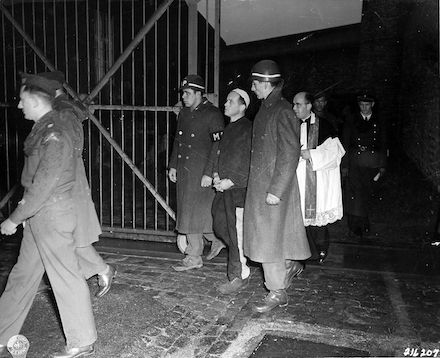
The U.S. Army hanged five German civilians as war criminals at Bruchsal Prison on this date in 1945. Their crime: lynching the crew of a downed American bomber, the day after Allied bombing raids devastated the manufacturing town of Rüsselsheim.
The lynching is known as the Rüsselsheim Massacre, and it claimed the lives of six of the nine flyers of a B-24 Liberator cheekily christened Wham! Bam! Thank You, Ma’m!. One of their number survived thanks to his shrapnel wounds, which saw him safely to hospital while his comrades were being transported.
The other two were simply lucky to survive the beatings administered by a mob of enraged civilians who caught sight of the Americans under the escort of only two German soldiers. On the night of August 25-26, Britain’s Royal Air Force had dumped more than 1,600 tons of explosives on Rüsselsheim to destroy the Opel factory and rail lines there. It was only the latest, and ultimately the largest, of several raids on the town dating back to July. A later U.S. study reckoned 315 Opel workers killed and 277 injured during the July-August raids, to say nothing of the devastation on other townspeople and on Opel’s slave labor.* A POW, Frenchman Pierre Cuillier, recorded of the August 25-26 attack that “a bomb fell on the dug-out for Russian women. We hear of 119 victims, a number that in reality is surely much higher.”
Under the circumstances, the good folk of Rüsselsheim were not pleased on the morning of the 26th to see Allied airmen in their town being marched to a train transfer … even if, and surely the distinction must fail to impress amid the smoldering rubble of one’s own hometown, this particular American crew had not been part of this particular British bombing. (The Americans had been shot down two days earlier en route to do a similar thing to Hanover.)
“There are the terror flyers. Tear them to pieces! Beat them to death! They have destroyed our houses!” cried Margarete Witzler and Käthe Reinhardt. As the Americans protested, the crowd overpowered the guards and took its rough revenge with whatever bludgeons were ready to hand.
At last, Joseph Hartgen, an air raid warden, finished them off with his pistol … or at least, finished off six before his chamber went empty.
Spoiler alert: it will not go well for Herr Hartgen.
Somehow the two un-shot men, Sgt. William M. Adams, and Sgt. Sidney E. Brown, still drew enough breath by the end of the ordeal to sneak away when they were being dumped into a mass grave. Captured again a few days later, they survived the war in a POW camp.**
Eleven Rüsselsheimers stood trial in Darmstadt for these Lynchmorde by July, when war was still raging in the Pacific: it was the very first war crimes proceeding under U.S. occupation.
The defendants tried out a pre-Nuremberg version of the “only following orders” defense, blaming Nazi propaganda against bomber crews for inciting the murders. The U.S. prosecutor† scoffed: “They were all grown men and women. If they are called on to commit the murder and they do, they are just as responsible as any other murderers.”
Harten and six others of the 11 caught death sentences, but the two women — Witzler and Reinhardt — both had their sentences reduced.
Warning: Although not graphic, this is a video of actual hangings.
** Brown lived long enough to return to Rüsselsheim at official invitation in 2001 for a formal apology. However, at the time of the trial, it was still mysterious how there came to be only six exhumed bodies from eight lynched airmen: Adams and Brown only emerged out of the mass of returning POWs after convictions had already been secured.
† The army prosecutor at the proceeding was one Lt. Col. Leon Jaworski, but he’s better known for hunting larger game later in his career as the special prosecutor during the Watergate investigations. (Jaworski is the guy embattled President Richard Nixon appointed after firing Archibald Cox in the Saturday Night Massacre.) Jaworski’s eventual legal victory over the White House in United States v. Nixon obtained the incriminating Watergate tapes in late July of 1974, forcing Nixon’s resignation just days afterwards, on August 9, 1974.
Every night we cut off thirty heads, and those of several chiefs; that will teach them, I think, a good lesson.”
-Napoleon to the Directory on October 27, 1799, after crushing the Revolt of Cairo
Napoleon’s private secretary on the adventure in Egypt, Louis Antoine Fauvelet de Bourrienne, claimed that Napoleon exaggerated for effect, and the executions were more in the neighborhood of a dozen per night. The beheaded corpses were stuffed in sacks and tossed into the Nile.
Some time after the revolt of Cairo, the necessity of ensuring our own safety urged the commission of a horrible act of cruelty. A tribe of Arabs in the neighbourhood of Cairo had surprised and massacred a party of French. The general-in-chief ordered his aide-de-camp, Croisier, to proceed to the spot, surround the tribe, destroy their huts, kill all the men, and conduct the rest of the population to Cairo. The order was to decapitate the victims, to bring their heads in sacks to Cairo, to be exhibited to the people. Eugene Beauharnais accompanied Croisier, who joyfully set out on this horrible expedition, in the hope of obliterating all recollection of the affair of Damanhour.
Next day the party returned. Many of the poor Arab women had been delivered on the road, and the children had perished of hunger, heat, and fatigue. About four o’clock, a troop of asses arrived in Ezbekyeh Place, laden with sacks. The sacks were opened and the heads rolled out before the assembled populace. I cannot describe the horror I experienced; but, at the same time, I must acknowledge that this butchery ensured for a considerable time the tranquility and even the existence of the little caravans which were obliged to travel in all directions for the service of the army.

 Salnave was a general who in 1866 overthrew and replaced president Fabre Geffrard — an act which “profoundly unsettled the country.”
 Casillas most “distinguished” himself by carrying out the Batista dictatorship’s 1948 murder of trade unionist


 Moscow-educated at