1460: Richard Neville, Earl of Salisbury

On the 31st of December in 1460, the Earl of Salisbury was beheaded the day after the Lancastrians routed the Yorkists at the Battle of Wakefield.

Salisbury — Richard Neville by name — was brother-in-law to the Yorkist claimant (and namesake) Richard Plantagenet, Duke of York, so you can guess which side Neville backed during these Wars of the Roses.

Actually, although your guess is spot on for the instance at hand, overlapping kin networks and cutthroat politicking made for an indistinct border between Lancastrians and Yorkists that some actors willingly crisscrossed. Richard Neville’s cousin Thomas Neville, for example, was a Lancastrian, who switched to the Yorkists, and then switched back to the Lancastrians. All this goes to show the treacherous environment for nobles who could go from the orbit of royal power themselves straight to the headsman’s block with each new battlefield reversal. And Salisbury, he was Team White Rose* right on down the line.

(The Neville family’s running feud with their fellow northern magnates, the Percys, helped to catalyze the York-Lancaster rivalry into open warfare.)

Salisbury led the Yorkist side to a notable early victory at the September 1459 Battle of Blore Heath, cunningly baiting the Lancastrians into a disadvantageous charge across a brook by feigning retreat. Then, runs Hall’s chronicle, “the Earl of Salisbury, which knew the sleights, strategies and policies of warlike affairs, suddenly returned, and shortly encountered with the Lord Audley and his chief captains, ere the residue of his army could pass the water … [and] so eagerly fought, that they slew the [Lancastrian commander] Lord Audley, and all his captains, and discomfited all the remnant of his people.”

The Yorkists didn’t do as well at the Battle of Ludford Bridge three weeks later and their leaders (Salisbury included) had to flee England to regroup.

This 1459-1461 period has especially rapid reversals of fortune for the contending parties in the Wars of the Roses, who seemed to alternate between them the results of the latest battle and with it the leadership of England.

As the most recent losers, Salisbury and his son, the Earl of Warwick — known as the “kingmaker”, this younger Richard Neville was one of the pivotal figures of the dynastic wars — had to flee England with many of the Yorkist leaders. But they mounted a re-invasion from Calais where Warwick was constable and the Nevilles pere and fils led separate columns that overran London, and captured the Lancastrian King Henry VI. Suddenly, the ex-fugitive York was the Lord Protector, England’s de facto ruler, and its de jure successor.

But as had been the case one year before, fickle Fortune abandoned the House of York almost immediately after raising it up. Two months later, their forces ventured battle with a much larger army of the regrouping Lancastrians; as night fell on December 30, 1460, York himself lay dead in his armor while his kinsman Salisbury was a prisoner with just hours left to live.

This was, of course, very far from the end for the Yorkist party, for both men left their causes to capable heirs. York’s 18-year-old son Edward inherited his father’s claims to the throne of England; together with Warwick, they counterattacked and crushed the Lancastrians at Towton on March 29, 1461** — finally deposing Henry VI and enthroning York’s eldest son as King Edward IV.

And they all lived happily ever after.

* The competing Rose devices used by the Yorkists, the Lancastrians, and the eventual Tudors, are one of the four suit markers we’ve used in our unique Executed Today playing card set. Pick up a pack or eight today why don’t you?

** The undercard fight to Towton was February’s Battle of Mortimer’s Cross, which also featured a crushing defeat of the Lancastrians — led on that occasion by a commander whom the Yorkists subsequently put to death, Owen Tudor.

Against any odds one could care to name, it was this Owen Tudor’s descendant who would eventually emerge from the Wars of the Roses as England’s legitimate-ish king, Henry VII — founder of the Tudor dynasty so very fruitful for this here execution blog.

On this day..

1757: Father Andreas Faulhaber, seal of the confessional martyr

On this date in 1757, Catholic priest Andreas Faulhaber was hanged at the order of Frederick the Great to defend the seal of the confessional.

Frederick had been appointed by the Heavenly Father, and a cruel earthly one, to a task far too monumental to tarry with theology: lifting the Kingdom of Prussia from the morass of German principalities and into the ranks of Europe’s great powers. Frederick was nominally a Protestant, as was the bulk of his domain, and der Alte Fritz once remarked that this profession pleasingly liberated his sovereignty from papal interference; his real doctrine was nothing but pragmatism.

Accordingly, the great enlightened absolutist sponsored Jesuit educators where schools were needed and Jewish merchants where trade was needed.

Disgusted at Frederick’s aggressive war on Austria, Voltaire scribbled to a friend,

I’ve seen his good intentions dropped
At the first trumpet blast.
They are nothing more than kings;
And live their lives with bloody things,
They take or rape a few provinces
To suit their ambitious ends
I give up, say goodbye princes
I want no one now but friends.

(Source)

But Voltaire did not in fact break with his royal admirer and correspondent over Silesia.

Frederick christened his new reign in 1740-42 by ripping the wealthy* province of Silesia away from the Habsburgs.

The Habsburgs were Prussia’s Catholic rivals for preeminence in central Europe and Silesia too was heavily Catholic, so Frederick extended over that province as liberal a grant of religious toleration as he might.

But the attachments of men for the kings of their forefathers are not always so easily displaced, and neither are those of kings for the most lucrative soil of their patrimony. Austria made two subsequent attempts to retrieve Silesia; together with Frederick’s initial invasion, these are the Silesian Wars.

The last of the three was itself just one theater of the gigantic Seven Years’ War. The conflict between Prussia and Austria over Silesia, and the complex continental diplomatic entanglements** each power effected in its pursuit, were among the root causes of that entire globe-spanning conflict.

Prussia won the first two Silesian Wars handily, but the third was a much more doubtful affair — indeed, Prussia was well on its way to defeat before the shock death of the Russian empress delivered that country into the hands of an unabashed Germanophile who pulled Russia out of the war.

But in view of Frederick the Great’s strained situation prior to this providential deliverance, some of his Silesian subjects made free to prefer their prospective Catholic/Austrian allegiance to that of their recent conqueror.

Desertions among Silesian conscripts, some of them even escaping to Austrian lines, called down the dark side of the religious toleration policy. Frederick let people pray as they liked so that he could rule as he liked; here, when he suspected the Silesian Catholic clergy of countenancing wartime disloyalty among their flock, those religious scruples had overstepped their proper sphere.

And so at last we come to our day’s execution.

One young man caught attempting to desert Frederick’s army was captured and interrogated by his commanders. He allowed that he had undertaken the sacrament of confession before escaping, and expressed to the priest his intention to abandon the army.

The priest, Father Andreas Faulhaber, was arrested on this basis, but between his calm defense of himself and the deserter’s shifting, unreliable story, the military court found little basis to proceed. The impression one gets is that the contemplated desertion was not the main thrust of the confession and that Father Faulhaber accordingly discouraged the sin in passing but didn’t bother to dwell on the point.

The impression is difficult to substantiate because the padre rigorously kept the seal of the confessional — another imposition demanded by faith that secular authorities who had armies to field preferred not to honor.

But evidently looking to serve notice that the monarch’s religious indifference could not be used to abrogate subjects’ responsibility to the state, Frederick himself ordered Faulhaber’s sudden execution for the morning of December 30.

The unfortunate priest only discovered his impending fate moments before it was enacted, but still refused under the makeshift gallows to give up anything incriminating about his parishioner. “Hang up the Jesuit Faulhaber, but let him not have a confessor,” read the order, according to this decidedly Catholic account, which adds that Faulhaber was not actually a Jesuit at all, and the word only added to invoke the going 18th century prejudice against that order.

Prussia won this war, too. It kept Silesia in Prussian hands, and then German hands, for two centuries. The bulk of Silesia was transferred to Poland after World War II.

* Silesia provided one-quarter of all the Habsburgs’ tax revenue, according to Frederick the Great: A Life in Deed and Letters.

** For the Seven Years’ War, Austria made common cause with its traditional foe, France: one consequence of this arrangement was the betrothal of the Austrian princess Marie Antoinette to the future French king Louis XVI.

On this day..

1939: Fifty-six Poles shot in retaliation at Bochnia

We owe this discomfiting executioner’s-eye view from the ranks of German soldiers as they gun down Poles in the town of Bochnia on December 18, 1939 to a partisan attack two days prior by a Polish underground organization called White Eagle. Fifty-six civilians were executed in retaliation.

On this day..

1975: Isobel Lobato, wife of East Timor’s Prime Minister

On this date in 1975, the wife of East Timor’s Prime Minister was publicly executed on the docks of her conquered country’s capital.

By the happenstances of colonial expansion, East Timor, a 15,000-square kilometer half-island in the Lesser Sundas, chanced to have the Portuguese flag planted on its soil instead of (as characterized the rest of its surrounding Indonesian archipelago) the Dutch.

Because of this, Timor-Leste did not walk the same path trod by Indonesia: it did not share in Indonesia’s 1945 revolution breaking away from the Netherlands, nor in the 1965 coup d’etat that put the Suharto military dictatorship in charge of that country.

While these years of living dangerously played out throughout the vast island chains, and even in West Timor, little East Timor remained Portuguese property into the 1970s.

But by that time, colonialism was wearing out its welcome in that onetime maritime empire. A long-running, and ever more unpopular, war against independence fighters in Portugal’s African colonies finally helped to trigger the mother country’s 1974-75 Carnation Revolution and a new regime interested in immediate decolonization.

Abruptly — arguably, too abruptly — Portugal began divesting herself of her onetime empire’s onetime jewels, including not only East Timor but Goa on the coast of India (oops), and the African states of Guinea, Mozambique, and Angola. These would immediately become contested violently by proxies backed by the United States and the Soviet Union.

Though easily the least lucrative and strategically essential of these forsaken colonies, Timor too felt the the Cold War’s hand.

Western-allied Suharto eyed warily the Timorese left-wing insurgent movement turned political party that went so far as to declared Timorese independence in November of 1975. In response, Indonesia gathered the main opposition parties under its own umbrella and had them produce a declaration calling for — wouldn’t you know it? — unification with Indonesia.

By that time, the fall of 1975, it was becoming apparent that such a unification would soon be a fait accompli. Indonesian commandos were penetrating East Timor, even making bold enough to murder western journalists. On December 7, 1975, Indonesia invaded East Timor with the blessing of Washington, D.C.*

The ensuing 24-year occupation was a notorious bloodbath, and Indonesian troops set the standard right from day one … or, in this case, day two.

On December 8, in the now-occupied capital city of Dili, dozens of Timorese elites were marched to the quay under the frightened gaze of their countrymen and -women, and there publicly shot into the harbor. Notable among them was Isobel Lobato, the wife of Nicolau Lobato, who had been the prime minister of Timor’s brief moment of independence in 1975.

Nicolau Lobato himself did not share his wife’s fate, however. He escaped into the bush where he helped lead a remarkably persistent anti-occupation guerrilla movement until he was finally killed in a firefight in 1978. Post-independence, Dili’s Presidente Nicolau Lobato International Airport was re-named in his honor.

* President Gerald Ford and his fell henchman Henry Kissinger flew out of Jakarta hours before the invasion, arriving in Hawaii where they would demur on reporters’ inquiries as to whether they had green-lighted the unfolding incursion. Daniel Patrick Moynihan, who was at that time America’s U.N. envoy, boasted in his memoirs that “The United States wished things to turn out as they did, and worked to bring this about. The Department of State desired that the United Nations prove utterly ineffective in whatever measures it undertook. This task was given to me, and I carried it forward with no inconsiderable success.”

On this day..

1865: The Jacksonville Mutineers

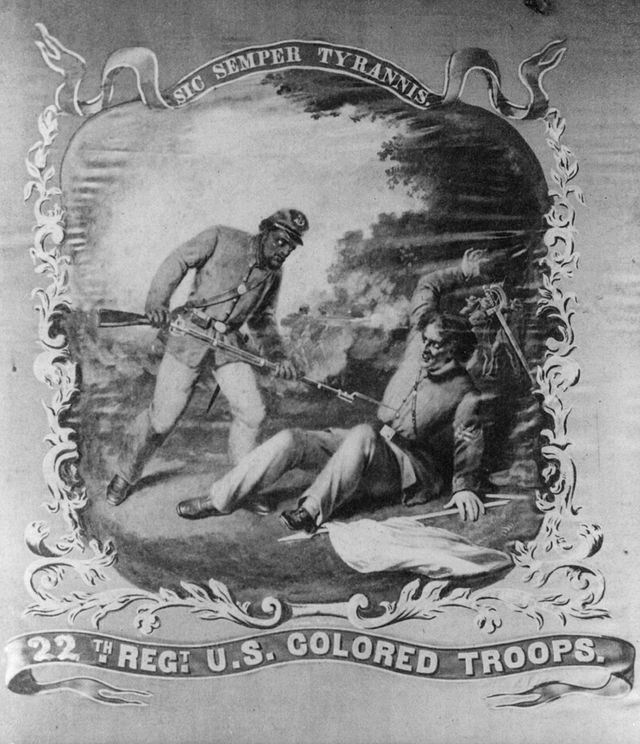
On this date in 1865, six African-American infantrymen were shot in Fernandina, Florida, for the Jacksonville Mutiny.

Formed in 1863, the 3rd Infantry Regiment, United States Colored Troops served in the trenchworks around Fort Wagner — the grinding siege in the summer of 1863 that followed the bloody attempt to storm the fort immortalized in the 1989 film Glory.

The Third was subsequently transferred to Union-occupied Jacksonville, Florida for duty garrisoning a conquered town of the Confederacy whose white citizens chafed doubly at their presence. But the unit had weathered both the boredom of the garrison and the hostility of white Floridians, and was set to muster out and return home on Halloween of 1865.

All U.S. Colored Troop regiments were officered by white men, putting an inevitable racial tinge on the inherent potential tension between enlistees and their commanders — the triggering event in our story. Heading the Third was a fellow named John L. Brower, Lieutenant Colonel by rank courtesy of his political connections but of nearly no actual military experience.

Ohio National Guard Judge Advocate General Kevin Bennett, in his 1992 article about the mutiny,* calls Brower a “martinet”; elevated to command of the Third on September 12 for what should have been a mostly ceremonial interim, Brower delighted in enforcing stringent wartime discipline months after Appomattox. While no man welcomes the taste of the lash when he’s one foot out the door back to civilian life, excess discipline meted out by cruel white overseers was particularly bad form for Colored Troop regiments.

From the standpoint of black Americans, the war had been all about destroying slavery; they had practically had to force this objective, and their own presence,** into the conflict. Being strung up by the thumbs for petty theft — Brower’s decreed punishment for one of his charges on October 29 — was far too evocative of the hated Slave Power.

“Inexperienced officers often assumed that because these men had been slaves before enlistment, they would bear to be treated as such afterwards,” one white Colored Troop commander later remembered. “Experience proved to the contrary. Any punishment resembling that meted out by the overseers caused irreparable damage.”†


The inclination of black troops to reject servile treatment and the anxiety that this provoked among their officers and the larger white community must surely be read in view of the perplexing new conditions following the Civil War.

Even among whites who supported it in principle, slavery abolition meant an unsettling and uncertain rearrangement of civilization — or at least, it potentially meant that. Would the economy continue to function without slavery? Would the daily conventions and assumptions that had sustained whites north and south have to be entirely renegotiated?

“Once let the black man get upon his person the brass letter, U.S., let him get an eagle on his button, and a musket on his shoulder and bullets in his pocket, there is no power on earth that can deny that he has earned the right to citizenship,” Frederick Douglass had proclaimed. Now that the war had finished, what else did those musket-toting sable fellows think they had earned the right to?

Press reports over the course of 1865 show a continuing theme of “Negro mutinies”: it is for wiser studies than this post to determine whether the trend such stories represent is disturbances among the black soldiery, or an exaggerated preoccupation among their white countrymen. In either event, Jacksonville was very far from unique even if the punishments were exemplary.


From the June 16, 1865 Cleveland Plain Dealer, concerning black soldiers on a steamer bound for Texas calling at Fort Monroe who, chagrined at the assignment, refused to permit the steamer’s resuming its journey.


From the June 19, 1865 Philadelphia Inquirer, concerning a company refusing to embark for Texas. “Certain evil disposed persons put it into the heads of these credulous colored soldiers that they were to be sent to Texas as servants for the white troops,” runs the report. “Doubtless some secret enemies of the Government instilled similar subtle falsehoods into the simple minds of the blacks who were disarmed at Fortress Monroe a few days ago.”


From the September 30, 1865 Daily National Intelligencer (Washington, D.C.), concerning a mutiny reported near Hilton, N.C.


From the Oct. 1, 1865 Daily Constitutionalist (Augusta, Ga.), reporting a disturbance begun when a black regiment demonstrated against a court-martial for one of their comrades accused (and acquitted) of stealing a hat.

In the midst of all of this — right about the time of the incident in this post, in fact — bulletins reached American shores of the Morant Bay Rebellion, a bloody rebellion of black laborers in British-controlled Jamaica. Slavery had been abolished on that Caribbean island more than 30 years prior: what did that uprising augur for the races in these United States?


Subtext becomes text: the Norwich (Conn.) Aurora, December 23, 1865. “The African released from restraint, and the passion of the savage provoked, will realize the scenes formerly witnessed in Hayti.” (The full article (pdf))

For our case, the name of the man punished like a slave is lost, but we do know what he did: steal some molasses from the kitchen. That’s how six of his comrades ultimately wound up looking down the barrels of their executioners.

A Lt. Greybill caught the greedy nosher and decreed a rough summary punishment, which the arriving Brower arrived helped to enforce on the resisting prisoner. “Tying up by the thumbs” was a brutal and humiliating treatment that lifted the man by those digits (often dislocated in the process) until only his toes remained on the ground, barely supporting his weight, and left him there for hours. In the film 12 Years a Slave, we see a man subjected to this sort of tiptoeing, but with a rope about the neck instead of about the thumbs.

Other enlisted men gathered around this pitiful scene, complaining about what they saw. A Private Jacob Plowden, who will eventually number among our day’s six executees, cried out that “it was a damn shame for a man to be tied up like that, white soldiers were not tied up that way nor other colored soldiers, only in our regiment.”

Plowden announced that “there was not going to be any more of it, that he would die on the spot but he would be damned if he wasn’t the man to cut him down.” Another private, Jonathan Miller, joined the incitement — “Let’s take him down, we are not going to have any more of tying men up by the thumbs.” A number of the black soldiers, 25 to 35 or so, began advancing on Brower and the hanging molasses-thief. Brower drew his sidearm and fired into them, wounding a man and sending the soldiers scurrying — some dispersing, but other dashing off to tents to arm themselves.

Several non-lethal fights now occurred in various spots around the camp between soldiers and officers, and eventually between the disaffected soldiers and arriving brethren from Company K, who had been summoned to calm the situation.

Lt. Col. Brower exchanged shots with several of the men who armed themselves, and in a bit of symmetry with the distasteful punishment that had started the whole mess, he had his thumb shot off in the process. One of the privates who had been heard complaining of the thumb-hanging, now playing peacemaker, grabbed the injured officer and escorted him to a safe building, warning some men who tried to pursue them to “stop their damn foolishness.”

Elsewhere, a Lt. Fenno sabered a protestor, and got bashed over the head with a fence-post in response. Neither injury was life-threatening to its recipient. Some shots were exchanged elsewhere in camp and/or fired demonstratively into the air, again to no fatal effect. And a Private James Thomas cut down the post where the source of all the disturbance, the fellow who just wanted an extra ration of molasses, was hanging.

This was the whole of the commotion, which Company K reinforcements soon quelled.

In a speedy series of court-martials lasting from Oct. 31 to Nov. 3, thirteen men were convicted of mutiny in this affair, and a fourteenth of conduct prejudicial to good order (his offense: not during the mutiny but after all was over, saying of Brower, “the God-damned son of a bitch, he shot my cousin. Where is he? Let me see him.”) A fifteenth man was acquitted. All 15 accused mounted their own defense, without counsel or aid — generally endeavoring to show that they had either not armed themselves or (and this was the decisive factor for the six whose conviction carried a death sentence) not fired their weapon.

The trial itself posed interesting procedural dilemmas, which Bennett explores at length in his article: first, because it was a mutiny case, the white officers of the Third who comprised the jurors were also, awkwardly, the brother-officers of the witnesses who testified against the mutineers.

And second, although the Civil War was over, Florida still technically remained in a state of rebellion, and this enabled the unit to convene a general court-martial, issue death sentences, and even carry them out without allowing any appeal to Washington. General John Foster gave the final approval to the sentences and transmitted case files to Washington after the fact; that was all the six condemned had by way of legal or executive review.

On December 10, he received a telegraph ordering him to suspend one of the death sentences in response to an inquiry raised by U.S. Senator Edgar Cowan: Cowan had been contacted by one of his constituents, who represented that Private David Craig, whom the constituent had raised from childhood, had written him complaining of his wrongful conviction. According to Sen. Cowan, the allegation was that Craig had been directed to collect arms from the mutineers as the disturbance came to an end, but was thereafter arrested in the confusion for being armed with the weapons he collected. But December 10 was nine days too late, and the late Private Craig’s case file disturbingly seems to have been lost from the National Archives.

The other five shot by musketry this date were:

  • Joseph Green
  • James Allen
  • Jacob Plowden
  • Joseph Nathaniel
  • Thomas Howard

Lt. Col. Brower only testified at one of the courts-martial, and was sent home almost immediately afterwards. He’d lost his thumb for his adventure as an officer and a gentleman, but between the original provocative punishment that he helped enforce, and then inflaming a tense situation by shooting at his soldiers, the brass was probably just as pleased to see him go as were his subordinates.

The non-executed mutineers who received prison terms (up to 15 years) had their sentences commuted following a review in 1866. The rest of the regiment mustered out as scheduled at the end of October, two days after the Jacksonville Mutiny.

* B. Kevin Bennett, “The Jacksonville Mutiny”, Civil War History, Volume 38, Number 1, March 1992. Bennett’s article is the source of all of the quotes in this post not otherwise cited.

** See I Freed Myself, or this podcast interview with its author, David Williams.

† See here for a fascinating instance of this at sea in June 1865, by the author of Becoming American under Fire: Irish Americans, African Americans, and the Politics of Citizenship during the Civil War Era

On this day..

1936: Jose Antonio Primo de Rivera, Falange founder

On this date in 1936, the Spanish Republicans shot Don José Antonio Primo de Rivera y Sáenz de Heredia, 1st Duke of Primo de Rivera, 3rd Marquis of Estella, Grandee of Spain.

The son of Spain’s 1920s dictator, Primo de Rivera founded in 1933 the Falange, Spain’s native fascist movement.

At the October 29 founding convention that year at Madrid’s Theatre of Comedy, Primo de Rivera scathingly pilloried the wan democratic rituals that coming years’ conflict would sweep aside. “The most ruinous system of wasted energy,” he jeered at liberal democracy, where men with leadership waste their talents in hollow electoral hustling and parliamentary rigmarole while the nonsensical ephemeral whims of a formless plurality pass for the vision he attributed to the time before Rousseau ruined everything. “What alone mattered to the liberal state was that a certain number of gentlemen be sitting at the polling station, that the voting start at eight o’clock and end at four, that the ballot boxes not get smashed — when being smashed is the noblest aspiration of all ballot boxes.” (The full speech is available in Spanish here.)

Primo de Rivera espoused for Falangismo the same impulses — of unity, of destiny, of national rebirth, of the triumphant collective — that animated Europe’s similar extreme right stirrings in those years. Only 35 years before, Spain had lost her empire, near enough in memory to inform an acute ache of loss.

In a poetic sweep we will raise this fervent devotion to Spain; we will make sacrifices, we will renounce the easy life and we will triumph, a triumph that — you know this well — we shall not obtain in the upcoming elections. In these elections vote the lesser evil. But your Spain will not be born out of them, nor does our frame for action reside there. That is a murky atmosphere, spent, like a tavern’s after a night of dissipation. Our station is not there. I am a candidate, yes, but I take part in these elections without faith or respect. And I say this now, when so doing may cost me every vote. I couldn’t care less. We are not going to squabble with the establishment over the unsavory left-overs of a soiled banquet. Our station is outside though we may provisionally pass by the other one. Our place is out in the clear air, beneath a moonlit sky, cradling a rifle, and the stars overhead. Let the others party on. We stand outside vigilant; earnest and self-confident we divine the sunrise in the joy of our hearts.

Unlike the Naziism in Germany or Fascism in Italy, Falangism never grew into a force capable of conquering state power itself. Just thirty-three months after Primo de Rivera’s founding address, the Spanish Civil War erupted. The Falangists’ alliance with Francisco Franco — after the war, they would be combined with the Carlists into the only legal political association* in Francoist Spain — spelled great gains for their membership rolls but it was still the General who called the shots.**

Primo de Rivera’s share in this alliance was a voluptuous cult of personality as Spain’s preeminent right-wing martyr, fine posthumous work if you can get it mitigated only by the necessity of undergoing the martyrdom. The fascist prophet was already in prison at the time Franco struck the first blow of the war: he’d been arrested in Madrid on weapons charges. From his cell he carried on a brazen correspondence with Nationalists conniving to subvert the hated Spanish Republic, and when his activities were discovered and prosecuted that autumn in light of Franco’s July revolt they could scarcely have been better framed to incur the utmost measure of judicial wrath.

In consequence of his martyrdom, November 20 remains down to the present a hallowed day for the far right in Spain.


“Cara al Sol” (“Facing the Sun”) is the Falangist anthem; the lyrics are generally credited to Primo de Rivera.

* The Falange Española Tradicionalista y de las Juntas de Ofensiva Nacional-Sindicalista, or “Spanish Traditionalist Phalanx of the Assemblies of National-Syndicalist Offensive” (FET y de las JONS) — or less exhaustingly, the Movimiento Nacional (National Movement).

** Primo de Rivera and Franco didn’t like each other much personally, either.

On this day..

1326: Edmund FitzAlan, the Earl of Arundel

On this date in 1326, Edmund FitzAlan, Earl of Arundel was beheaded at Hereford for his support of King Edward II, during the rebellion of Queen Isabella and her lover Roger Mortimer.

Arundel’s relationship with doomed king had not always been so fatally chummy. That he turned out to be one of the few great nobles to back Edward against his wife’s adulterous coup d’etat would probably have surprised his own younger self — for 15 years before his execution he had joined the Lords Ordainers in opposition to Edward and hated royal favorite Piers Gaveston. Indeed, Arundel was one of the men who eventually condemned Gaveston to execution. Two years after that, he passed on aiding Edward’s Scottish campaign and the upshot of that was the great defeat of Bannockburn.

But these two foes were able to see their way to an arrangement as the 1310s unfolded, and Arundel married his son — the boy who would succeed as the next Earl of Arundel when our man got his head cut off* — to the daughter of the next royal favorite, Hugh Despenser.

This dynastic alliance with the man swiftly becoming the most powerful lord in England put Arundel firmly on Team Edward, with very lucrative results. When other nobles who hated the new favorite rebelled in the early 1320s, Arundel helped to put that disturbance down, and pocketed portions of the traitors’ forfeited estates for his trouble — including that of the attainted Mortimer himself.

These enemies were permanent.

Mortimer managed to escape the Tower of London and fled into exile, eventually taking up with the disaffected Queen Isabella, who was a French princess herself. When Mortimer and Isabella mounted an invasion in 1326, Arundell and his brother-in-law Surrey were the only earls to keep the king’s side. (Temporarily: Surrey made peace with the new regime when it carried the day.)

Captured by John Charleton, a Welsh landowner who’d been personally piqued by Arundel’s growing acquisitions in that region, he was hauled before Queen Isabella and put to summary execution. But not too summary: there’s a report by a chronicler that the “worthless wretch” wielding the blade required no fewer than 22 hacks to part head from shoulders.

Kathryn Warner’s excellent and venerable Edward II blog has a very thorough post on the Earl of Arundell as well as a separate one on John Daniel and Robert de Micheldever, two obscure courtiers who shared the same fate on the same occasion.

(Warner has also just recently — in October of 2014 — published her book about Edward II.)

* Technically Richard FitzAlan only became the 10th Earl of Arundel in 1331, when Edward III, having deposed the regime of his mother and Mortimer, re-granted the title. This fellow had a long and distinguished career that culminated in a touchingly intimate sarcophagus likeness with his wife, which inspired the 20th century Philip Larkin poem “An Arundel Tomb”. (“What will survive of us is love.”)

Things worked out less beautifully for his son, the 11th Earl of Arundel: that guy also exited via executioner.

On this day..

1591: Barnabe Brisson, at the hands of the Sixteen

On this date in 1591, the summary execution of Barnabe Brisson and two other French doctors of law signaled the beginning of the end of France’s Wars of Religion.

After the untimely death of Henri II in a freak jousting accident, his widow Catherine de’ Medici employed three frustrating decades shuttling the late monarch’s uninspiring offspring onto the throne only to see each in his turn die young and without issue. We are by these late years on to the last of Henri II’s sons — Henri III of France.

Actually, Henri wasn’t the last: just the last left alive. He had a younger brother, Francis, Duke of Anjou, who dropped dead in 1584 of malaria and left Henri III as the only Valois male. The heir presumptive after Henri III was his Calvinist brother-in-law Henri of Navarre. Spoiler alert: by the end of this post, Henri of Navarre is going to get there as King Henri IV.

The Catholic-vs.-Huguenot Wars of Religion had raged in France for many years but the last major installment of the bloody serial was the War of the Three Henrys: the two Henris aforesaid, plus the Duke of Guise, also named Henri — the standard-bearer of Catholic zealots.

Our present-day presumption of live-and-let-live spirituality was bequeathed from the Enlightenment only after it had been hard-won by centuries previous. In France of the 1500s, the most extreme (but by no means marginal) Catholic party saw the very existence of a Huguenot faction — and the fact that more moderate Catholic politiques were prepared to tolerate and treat with them — as an existential threat to the kingdom. Catholicism in the literal universal sense was intrinsic to France itself: if she should cease to be so, what would become of her? A 1589 pamphlet extolled what

an admirable thing [it is] to view the ardor and the devotion of everyone in France, the air resounding with prayer and processions of our youth who are purified by our prayers and by the common voice which is spread throughout this kingdom; we demonstrate that the benedictions and maledictions of a people have great effects.

With such great effects at stake, the pious ought not abide any fooling around with Providence. “If your brother, your friend, and your wife all of whom you hold dear wish to strip you of your faith,” wrote Louis D’Orleans in 1588, “kill them, cut their throats and sacrifice them to God.”*

This was a faction for whom Henri of Navarre’s prospective succession was absolutely intolerable, which makes it somewhat ironic that they themselves soon turned prospect into reality.

King Henri III was a Catholic himself, of course, and this irreconcilable Catholic League was part of what you might call his base. But though initially allied, the League’s attempts to dominate the young king led Henri III to execute a daring breakout: on December 23, 1588, he summoned the Duke of Guise to confer with him at the Chateau de Blois and there had his bodyguards murder Guise on the spot.


Just two Henries now …** (Executed Today’s court painter Paul Delaroche interprets that same scene here.)

The resulting fury of the Catholic League was so great that the king soon fled Paris and made common cause with Henri of Navarre. Now the civil war was the two Henris together — and the Catholic League opposing them. We come here to our date’s principal character, Barnabe Brisson (English Wikipedia entry | French), a distinguished jurist† in the Parlement of France. While most of this chamber followed the king out of Paris, Brisson chose to remain. “The Sixteen,”‡ the council of Catholic militants who now ruled Paris with the support of a populist militia, elevated Brisson to President of the Parlement.

In 1589 the Henris besieged staunchly Catholic Paris in an attempt to bring the civil war to a close. In a classic Pyrrhic victory, the League defeated this attempt by having a priest assassinate King Henri.


… and now we’re down to the last Henri.

While this action did break the siege, and avenge the murder of Guise, it made Henri of Navarre into King Henri IV. (Told you we’d get there.) The Catholic League’s attempt to recognize the new king’s uncle, a Cardinal, as the successor went nowhere at all, and at any rate this man himself died in 1590.

This succession greatly deepened the internal tension among Paris Catholics between the uncompromising men of the Sixteen and the moderate politiques, and the latter party’s interest in finding with the legitimate king a settlement that looked increasingly inevitable. After all, were these armed commoners really going to rule Paris indefinitely?


An armed march of the Holy League in Paris in 1590. (Anonymous painting)

The situation provoked the ultras among Paris’s ruling Sixteen to more desperate measures in a vain effort to maintain control. Their faction’s own post-Guise leader among the high nobility, the Duke of Mayenne, had refused inducements to seize the crown himself or to seat a sovereign provided by the League’s Hapsburg allies. He too was visibly sliding towards an accommodation with the heretic king. (He would reach one in 1596.) In much the same camp was an establishment figure like Brisson whose staying behind in Paris during the confused situation of 1588-1589 was scarcely intended to declare that his allegiance to creed surpassed all care for order. The man was a lawyer, after all.

During Mayenne’s absence from the capital in the autumn of 1591, the Sixteen mounted a radical internal coup and attempted to purge the city’s moderates. Brisson was arrested walking to work on the morning of the 15th and subjected along with two other jurists to a sham snap trial. All three were hung by lunchtime, and per a proposal floated among the council that afternoon were the next morning fitted with denunciatory placards and displayed on gibbets at the Place de Greve.

Barnabé Brisson, a chief traitor and heretic

Claude Larcher, an instigator of treacherous politiques

Jean Tardiff, an enemy of God and of Catholic princes

Their shocking exhibition was intended to incite a “St. Barthelemy des politiques” — a St. Bartholomew’s Day-esque pogrom against the politique moderates.

But the Sixteen had badly misjudged the mood of the city. The crowd beheld the mangled corpses silently, full of horror or pity — emblematic of the turning-point France was nearing in its interminable confessional strife. Despite the Catholic League’s strength in Paris, most Parisians were losing their appetite for bloodshed. The Duke of Mayenne was back in the capital by the end of the month and underscored the coming arrangements by seizing four of the Sixteen for summary execution themselves.

Two years later, Henri IV at last took Paris in hand by making a nominal conversion to Catholicism with the legendary (alleged) remark, “Paris is worth a Mass.”§

French speakers may enjoy this 19th century pdf biography of Brisson by Alfred Giraud.

* “Du Contemnement de la mort. Discours accomode a la miserable condition de ce temps” (blockquoted section) and Replique pour le Catholique Anglois, contre le Catolique associe des Huguenots (D’Orleans quote). Both via Dalia Leonardo in “Cut off This Rotten Member”: The Rhetoric of Heresy, Sin, and Disease in the Ideology of the French Catholic League,” The Catholic Historical Review, April 2002.

** Also of interest: this 1908 silent film of the assassination of the Duc de Guise, scored by Saint-Saens.

† Brisson’s dictionary of Justinian legal terminology remained in print until 1805. He also in 1587 produced a compilation of the laws of France as Le Code du Roy Henri III.

‡ The Sixteen were delegates of Paris’s quarters, assembled by the Duke of Mayenne. For detail on the composition and internal history of The Sixteen, see J.H.M. Salmon, “The Paris Sixteen, 1584-94: The Social Analysis of a Revolutionary Movement,” The Journal of Modern History, December 1972.

§ In the end, of course, an entirely unreconciled Catholic extremist assassinated Henri IV in 1610.

On this day..

1898: Sokong, Lavari, and Kruba of the Imperri

Three Sierra Leone natives whose November 7, 1898 hanging we recall here might have had their fate written in the stars before time itself began, but a much more proximate document was the understanding concluded among European powers at the Berlin Conference of 1884-85.


“Deal table in the middle, plain chairs all round the walls, on one end a large shining map, marked with all the colors of a rainbow. There was a vast amount of red — good to see at any time, because one knows that some real work is done in there, a deuce of a lot of blue, a little green, smears of orange, and, on the East Coast, a purple patch, to show where the jolly pioneers of progress drink the jolly lager-beer.” –Joseph Conrad

This summit aimed to regularize the so-called “scramble for Africa” among rival European empires by setting forth some rules about who got to plant what flags where. One of those rules was known as the Principle of Effective Occupation: as the name suggests, the Principle was that a colonial power actually had to be in something like control of the territory it proposed to call its own.

The Berlin Conference kicked off a generation of frenetic jockeying and conquest that carved up the continent.

Further to Effective Occupation, the British expanded their longstanding coastal presence at Freetown by, in 1896, annexing the inland regions into something now christened the Protectorate of Sierra Leone.

All that Protectorating didn’t come cheap. Who better to pay for it than the Protectorated?

Britain’s proconsul accordingly dropped a Hut Tax on his subjects — a ruinously steep one that stoked an 1898 rebellion known as the Hut Tax War. The brief but bloody war (actually an amalgamation of two distinct rebellions, north and south) cost hundreds of lives on each side, not sparing civilians.

British colonial agent Thomas Joshua Alldridge, who authored several studies of the colony and its inhabitants, was part of the July expedition raiding a town called Bambaia on Sherbro Island.

I had already sent to the chief of this town, giving him an ultimatum — that if he would not by a certain day, come up and tender his unconditional submission, a punitive expedition would be the result. He was a notoriously bad character and did some terrible things, for which he was afterwards tried and hanged. The disregarding of the ultimatum caused the present expedition. I was informed that when we arrived at the waterside he had cleared out with the people before we could get into the town. Presently a few people returned, and it was evident that he was in hiding near; but to attempt to hunt for men in the African bush is a waste of time, the bush being their natural stronghold.

I sent messages by the people, and had it loudly called out that if he would return to the town by 4 o’clock that I would not destroy the place, but that if he did not appear before me by that time it would be burnt. As he did not do so and I could get no information whatever, the straggling and outlying parts of the town were fired, and in the morning the town itself was destroyed.

Hangings like the one Alldridge references here for the chief of Bambaia were meted out in great number to rebel leadership, some 96 executions known in just a few months. Alldridge knew the country in peacetime and not just in war, and would eventually publish several studies of the country from his observations. (The text just quoted comes from one such.)

In this 1896 photo, Alldridge recorded the election by the chiefs of Imperri — a region of Sherbro Island — of a paramount chief (Sokong). He’s the rightmost of the two seated men, wearing a black top hat; beside him sits a counselor described by Alldridge as the Imperri Prime Minister (Lavari).

The quality of this image isn’t the best; it’s just taken from a Google images scan of Alldridge’s public domain book A Transformed Colony: Sierra Leone, as it Was, and as it Is. Alldridge notes that both the Sokong and the Lavari later “suffered the full penalty of the law” for the rebellion.

That would presumably make those two leaders also part of this portrait, taken just four months before the rebellion’s outbreak at a meeting of Imperri chiefs in that town of Bambaia which Alldridge would later put to the torch:

This latter photo is online in a number of locations with the same descriptive caption:

Identified beneath the print are the Sokong, the Prime Minister and ‘a principal Kruba’ (military leader) with the following remark: ‘all of whom were tried for murder and hanged at Bonthe, Sherbro, 7th November 1898′.

Unfortunately, I’ve never been able to find a version of this photo that actually reproduces in situ the identifications alluded to. Perhaps there is a reader who can identify the Sokong and Lavari from the first picture in the second?

On this day..

1864: Four Confederate soldiers, under Burbridge’s Order 59

The Martyrs Monument of Midway, Ky., honors four Confederates publicly executed by the Union one hundred fifty years ago today.

A brutally contested frontier zone between North and South, Kentucky at this point was under martial law, governed by General Stephen Burbridge — but nearly anarchic on the ground in some areas.

In an effort to quell the activities of Confederate guerrillas-slash-outlaws, Burbridge issued a still-notorious directive called Order 59: Citing the “rapid increase in this district of lawless bands of armed men,” the order threatened to expel Southern sympathizers and seize their property. Moreover, it warned: “Whenever an unarmed Union citizen is murdered, four guerrillas will be selected from the prison and publicly shot to death at the most convenient place near the scene of the outrages.”

The outrages in question for this occasion were raids on Midway horse farms* (allegedly led by “Sue Mundy”) that, on November 1, resulted in a shootout fatal to one Adam Harper Jr.

Agreeably to Order 59, Burbridge had four of his prisoners — men with no specific connection to Harper’s death — shot on the town’s commons, forcing the local populace to attend the scene.

Rest
Soldiers
Rest
Thy
Warfare
Oe’r [sic?]

M. Jackson
J. Jackson
C. Rigsner
N. Adams

Shot by order of
Genl. Burbridge
Nov. 5 1864
In retaliation

Our Confederate Dead

Burbridge would be dismissed, and his Order 59 revoked, early the next year. “Thank God and President Lincoln,” was the reaction of the Louisville Journal.

Three other similar monuments in Kentucky (in Eminence, Jeffersontown, and St. Joseph) honor other soldiers executed under Burbridge’s retaliation policy.

* Midway knows from horses.

On this day..