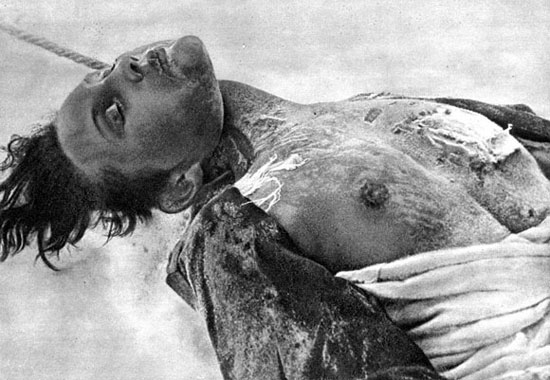
We’ve touched in these pages — one of our earliest posts, in fact — on Soviet war heroine Zoya Kosmodemyanskaya, a teenager executed by the advancing German army in November 1941 for conducting partisan attacks behind enemy lines.
Zoya’s story became known after the Red Army recaptured village of Petrishchevo, where she was hanged. A January 27, 1942 Pravda article recounted the gallows defiance of the young guerrilla, whom villagers knew only by her nom de guerre, “Tanya”. She had withstood German torture, refused to give them any information, and at her hanging incited her countrymen and -women to resist the invaders. She’s still to this day a beloved national martyr in Russia, which is why she’s also an Ace in our execution playing cards.
The young woman on the gallows, and in the ghastly post-mortem pictures with her left breast mutilated swiftly became propaganda grist for Moscow.
Zoya’s instant Joan of Arc-like legend invited investigation of the precise circumstances of her capture and death … and this in turn meant extremely dangerous scrutiny for any Soviet citizen in her environs whose behavior in those last days could be held to be in any way sub-heroic.
This brings us to today’s unfortunate entry, Vasily Klubkov, a humble mail-sorter before the war whose picture belongs in the dictionary next to “poor luckless sod.” Just him, Zoya, and everyone else on the terrible Eastern Front.
It was on this date* in 1942 that Klubkov paid the penalty for Zoya’s sacrifice.
Vasily Klubkov and Boris Krainov were other partisans who had been detailed along with Zoya Kosmodemyanskaya to torch some enemy assets on the same mission around Petrishchevo. Practically children all, they each acted independently from the others; long story short, Zoya and Vasily Klubkov were both captured.
Zoya fiercely endured every torture the Germans could throw at her, but Klubkov was made of softer stuff. When an officer pointed a gun at his head and demanded some answers, Klubkov started talking.
“I was a coward,” he later admitted. “I was scared I would be shot.”
Now, this admission very much against his own safety was made to the NKVD in March 1942, and since we already know that Vasily Klubkov was the sort to fold under torture, we can well imagine that the NKVD also got whatever it wanted out of the misfortunate young man. Considering the politicized quality of the trial and the circumstances of the “confession,” it has to be treated with caveats.
Under NKVD pressure, Klubkov signed off on a version of events that just so happened to mesh beautifully with the iconography already forming around the hanged “Tanya”: namely, that he was brought face-to-face with his fellow-prisoner and confirmed her identity, whereas she refused to breathe a word to her captors; that he saw her stripped naked and bashed with truncheons for hours and still summon the fortitude to refuse her interrogators the least satisfaction. Pavel Klubkov gave posterity firsthand evidence of Zoya Kosmodemyanskaya’s heroism in captivity.
“Klubkov may have been telling the truth, since it’s easy to imagine a terrified teenager on his first mission agreeing to his German captors’ demands,” notes Andrew Nagorski in The Greatest Battle: Stalin, Hitler, and the Desperate Struggle for Moscow That Changed the Course of World War II. “But there’s no way of knowing for sure how he really behaved, since he surely was just as terrified when he was interrogated by the NKVD. Or how much of what he said about Zoya was accurate, since the NKVD may already have been preparing the transcript with the idea of her elevation to mythic status.”
Heck, the reason the NKVD even had Klubkov to interrogate was that he escaped German custody, another big character red flag as far as the Soviets were concerned. That he escaped from the same custody that martyred Zoya Kosmodemyanskaya probably sealed his fate before he received his first pistol-whipping. NKVD records paint a kid who has already given up.
Well he might have. The verdict of the court was surely ordained from the start, but it was formally delivered on April 3: “Execution by shooting, without confiscation of property due to its absence.”
* Though there are some cites for April 3 out there, it appears that April 3 was the date of his conviction by a military tribunal and April 16 his execution date. This is a bit of a protracted delay by wartime Soviet tribunal standards, but then, Klubkov would have been a person of relevance to the state itself. The highest-ranking official who thought he could approve Klubkov’s execution without asking anyone else might have been a little further up the food chain than for your run-of-the-mill deserter.
On this date in 1942, two Jewish men were hanged in the city of Sosnowiec (pronounced sos-no-vitz) in Nazi-occupied Poland, and two more were hanged in the nearby city of Bedzin (pronounced ben-jin).
These executions were witnessed by thousands of people and carefully choreographed, as historian Mary Fulbrook records in her book A Small Town Near Auschwitz:*
The hangings in Bedzin and Sosnowiec had been orchestrated in advance, in meticulous detail, by the Police President in Sosnowiec. The execution in Bedzin was to take place one hour later than the one in Sosnowiec. As much thought was given by the police authorities to questions of security and seating arrangements as might be appropriate for a modern open-air musical concert: this was not to be a simple punishment for an individual offense, as had happened innumerable times, but rather a mass spectacle, intended to have a major impact on the audience…
The identities of the executed Jews in Bedzin have been lost to history. (Correction: Per Yad Vashem, they were Jehuda Warman and “Feffer” (no first name).) They were hanged at the old Jewish cemetery on the corner of Zawale Street, before a crowd of about 5,000, at 5:00 p.m. Jewish workers in the Bedzin Ghetto had their work identity cards confiscated that day and were let out of work early, at 4:00 p.m., and ordered to watch the hangings. Only after they witnessed the executions did they get their work cards back. The bodies remained hanging on the scaffold until 7:30 p.m.
The condemned men in Sosnowiec were 30-year-old Mayer Kohn and his father, Nachun or Nahum.
Nachun (left, with wife) and Mayer.
They’d been caught trading on the black market, probably trying to feed their families, as no one could live long on the official rations. But as Fulbrook points out, the actual offense didn’t matter much to the Nazis:
These coordinated public spectacles of mass hangings do not seem … to have been in direct response to a particular crime; it seems there was a policy of ‘any Jew will do’, although infringements of German rules (including not only black market dealings but also very trivial ‘offenses’) were adduced as the ostensible ‘reason’ for these executions.
Thousands of people, both Jews and Germans, watched Mayer and Nachun Kohn die, then quietly went home.
Although virtually the entire Kohn family perished at the hands of the Nazis, Mayer and Nachun Kohn can claim a bit of immortality by virtue of being mentioned in Maus, Art Spiegelman’s famous graphic novel about the Holocaust: the author’s father, Vladek, hailed from Sosnowiec.
On this date in 1944, Joseph Epstein* was shot with 18 others at Mont-Valerien outside Paris for their parts in the World War II French Resistance.
Joseph — “Jurek”, really — was born in Poland, but his communist politics got him harried out of Poland and Czechoslovakia and onward to France in the early 1930s.
There he completed his law studies, but was unable practice since he wasn’t a Frenchman.
But he was a perfect recruit for the international republican brigades of the imminent Spanish Civil War (he commanded an artillery battery named in honor of Tudor Vladimirescu).
War would drive Joseph Epstein hither and yon for his remaining years. After a spell in a French POW camp for Spanish Civil War refugees, Epstein signed up for the Foreign Legion, got captured and sent to a German POW camp, escaped to Switzerland, and returned to France.
There as “Colonel Gilles” of the communist resistance organization Francs-Tireurs et Partisans, he became the commissionaire of military operations for the capital and pioneered a shift in tactics towards guerrilla strikes using larger teams. Resistance fighter (and later, historian of the Resistance) Henri Nogueresexplained:
Most of the comrades adopted the three comrades system. But in Paris there were policemen and German soldiers everywhere: Joseph Epstein preferred to engage fifteen to twenty fighters per operation … [because] if in Paris during daylight, three persons only had to attack a military unit, there will always be a danger to be arrested that could lead to a partial or complete failure. By contrast, with a larger group, it was possible to gain a superiority if adopting a discrete strategy. The operations in Paris conducted in 1943 were placed under Colonel Gilles’ authority.
Epstein was arrested in the autumn of 1943 at a meeting with Missak Manouchian, and withstood months of brutal torture without so much as revealing his real name or national origin.
While this is a standard accomplishment in a Resistance martyrology, the proof of it in this case was that the ensuing “Manouchian Group” show trial, and the resulting famed “Affiche Rouge” poster, took great pains to depict Resistance members as foreigners and criminals.
As a Polish Jew who regularly ordered assassinations, Epstein would have made a fine exhibit … if the Nazis had known who he was. Instead, he’s conspicuous only by his absence.
The ironic consequence, according toanother Resistance veteran, was that “The man who, by far, was the greatest officer in all of France, the greatest tactician of the People’s War, is unknown to the general public. Of all military leaders, he was the most audacious, the most capable, the one who gave the French Resistance its originality compared to other European countries.”
In the early 15th century, France had stacked upon the woes of the Hundred Years War those of a civil war — between Armagnacs and Burgundians.
Burgundy, doughty duchy of Nibelungenlied renown, stretched to the Low Countries and was a gestating wealthy merchant state that perhaps had more in common with the English than with feudal, agrarian France. What Burgundy and England demonstrably had in common from 1419 was an alliance. Together, they bossed the northern half of what is now France during the endless Hundred Years War.
Thanks to this timely arrangement, the English came to occupy Paris — in Burgundian possession since 1418, when said party had bloodily ejected the French royalist Armagnacs.
Into this very low ebb of Valois fortunes entered Joan of Arc.
It is true that the king has made a truce with the duke of Burgundy for fifteen days and that the duke is to turn over the city of Paris at the end of fifteen days. Yet you should not marvel if I do not enter that city so quickly. I am not content with these truces and do not know if I will keep them.
-Joan of Arc, in a letter to Reims
Late in the 1420s, the illiterate farm girl somehow reversed the failing fortunes of the southerly French court. Joan, of course, will die at an English stake … but it is the Burgundians who will capture her.
At any rate, in 1429, Joan showed up and the French suddenly began going from victory to victory, knocking English and Burgundian heads in north-central France and culminating with having Charles VII crowned at Reims … which is actually north (well, northeast) of Paris.
Although Joan’s attack on Paris failed, advancing French arms put the fear of Holy Maid in the city and also cut off quite a lot of its rural food supply. “The capital itself was in a frightful state. As a result of interrupted communication and exposed supply routes, together with harassment by brigands and peasants, many Parisians were starving.”
Good times.
This naturally led some of the Armagnac-inclined citizens of Paris to think about ways to give the city back up to the French. We take up the narration of Anatole France, on a plot revolving around the “Seigneur de l’Ours,” or Jaquet Guillaume. (From here (HTML), or here (PDF).)
He was not of gentle birth and his arms were the sign of his hostelry. It was the custom in those days to give the title of Seigneur to the masters of the great Paris inns. Thus Colin, who kept the inn at the Temple Gate, was known as Seigneur du Boisseau. The hôtel de l’Ours stood in the Rue Saint-Antoine, near the Gate properly called La Porte Baudoyer, but commonly known as Porte Baudet, Baudet possessing the double advantage over Baudoyer of being shorter and more comprehensible. It was an ancient and famous inn, equal in renown to the most famous, to the inn of L’Arbre Sec, in the street of that name, to the Fleur de Lis near the Pont Neuf, to the Epée in the Rue Saint-Denis, and to the Chapeau Fétu of the Rue Croix-du-Tirouer. As early as King Charles V’s reign the inn was much frequented. Before huge fires the spits were turning all day long, and there were hot bread, fresh herrings, and wine of Auxerre in plenty. But since then the plunderings of men-at-arms had laid waste the countryside, and travellers no longer ventured forth for fear of being robbed and slain. Knights and pilgrims had ceased coming into the town. Only wolves came by night and devoured little children in the streets. There were no fagots in the grate, no dough in the kneading-trough. Armagnacs and Burgundians had drunk all the wine, laid waste all the vineyards, and nought was left in the cellar save a poor piquette of apples and of plums.
The Seigneur de l’Ours … was the proprietor of the house with the sign of the Bear (l’Ours). He held it by right of his wife Jeannette, and had come into possession of it in the following manner.
Fourteen years before, when King Henry with his knighthood had not yet landed in France, the host of the Bear Inn had been the King’s sergeant-at-arms, one Jean Roche, a man of wealth and fair fame. He was a devoted follower of the Duke of Burgundy, and that was what ruined him. Paris was then occupied by the Armagnacs. In the year 1416, in order to turn them out of the city, Jean Roche concerted with divers burgesses. The plot was to be carried out on Easter Day, which that year fell on the 29th of April. But the Armagnacs discovered it. They threw the conspirators into prison and brought them to trial. On the first Saturday in May the Seigneur de l’Ours was carried to the market place in a tumbrel with Durand de Brie, a dyer, master of the sixty cross-bowmen of Paris, and Jean Perquin, pin-maker and brasier. All three were beheaded, and the body of the Seigneur de l’Ours was hanged at Montfaucon where it remained until the entrance of the Burgundians. Six weeks after their coming, in July, 1418, his body was taken down from gibbet and buried in consecrated ground.
Now the widow of Jean Roche had a daughter by a first marriage. Her name was Jeannette; she took for her first husband a certain Bernard le Breton; for her second, Jaquet Guillaume, who was not rich. He owed money to Maître Jean Fleury, a clerk at law and the King’s secretary. His wife’s affairs were not more prosperous; her father’s goods had been confiscated and she had been obliged to redeem a part of her maternal inheritance. In 1424, the couple were short of money, and they sold a house, concealing the fact that it was mortgaged. Being charged by the purchaser, they were thrown into prison, where they aggravated their offence by suborning two witnesses, one a priest, the other a chambermaid. Fortunately for them, they procured a pardon.
The Jaquet Guillaume couple, therefore, were in a sorry plight. There remained to them, however, the inheritance of Jean Roche, the inn near the Place Baudet, at the sign of the Bear, the title of which Jaquet Guillaume bore. This second Seigneur de l’Ours was to be as strongly Armagnac as the other had been Burgundian, and was to pay the same price for his opinions.
Six years had passed since his release from prison, when, in the March of 1430, there was plotted by the Carmelites of Melun and certain burgesses of Paris that conspiracy which we mentioned on the occasion of Jeanne’s departure for l’Île de France. It was not the first plot into which the Carmelites had entered; they had plotted that rising which had been on the point of breaking out on the Day of the Nativity, when the Maid was leading the attack near La Porte Saint-Honoré; but never before had so many burgesses and so many notables entered into a conspiracy. A clerk of the Treasury, Maître Jean de la Chapelle, two magistrates of the Châtelet, Maître Renaud Savin and Maître Pierre Morant, a very wealthy man, named Jean de Calais, burgesses, merchants, artisans, more than one hundred and fifty persons, held the threads of this vast web, and among them, Jaquet Guillaume, Seigneur de l’Ours.
The Carmelites of Melun directed the whole. Clad as artisans, they went from King to burgesses, from burgesses to King; they kept up the communications between those within and those without, and regulated all the details of the enterprise. One of them asked the conspirators for a written undertaking to bring the King’s men into the city. Such a demand looks as if the majority of the conspirators were in the pay of the Royal Council.
In exchange for this undertaking these monks brought acts of oblivion signed by the King. For the people of Paris to be induced to receive the Prince, whom they still called Dauphin, they must needs be assured of a full and complete amnesty. For more than ten years, while the English and Burgundians had been holding the town, no one had felt altogether free from the reproach of their lawful sovereign and the men of his party. And all the more desirous were they for Charles of Valois to forget the past when they recalled the cruel vengeance taken by the Armagnacs after the suppression of the Butchers.
One of the conspirators, Jaquet Perdriel, advocated the sounding of a trumpet and the reading of the acts of oblivion on Sunday at the Porte Baudet.
“I have no doubt,” he said, “but that we shall be joined by the craftsmen, who, in great numbers will flock to hear the reading.”
He intended leading them to the Saint Antoine Gate and opening it to the King’s men who were lying in ambush close by.
Some eighty or a hundred Scotchmen, dressed as Englishmen, wearing the Saint Andrew’s cross, were then to enter the town, bringing in fish and cattle.
“They will enter boldly by the Saint-Denys Gate,” said Perdriel, “and take possession of it. Whereupon the King’s men will enter in force by the Porte Saint Antoine.”
The plan was deemed good, except that it was considered better for the King’s men to come in by the Saint-Denys Gate.
On Sunday, the 12th of March, the second Sunday in Lent, Maître Jean de la Chapelle invited the magistrate Renaud Savin to come to the tavern of La Pomme de Pin and meet divers other conspirators in order to arrive at an understanding touching what was best to be done. They decided that on a certain day, under pretext of going to see his vines at Chapelle-Saint-Denys, Jean de Calais should join the King’s men outside the walls, make himself known to them by unfurling a white standard and bring them into the town. It was further determined that Maître Morant and a goodly company of citizens with him, should hold themselves in readiness in the taverns of the Rue Saint-Denys to support the French when they came in. In one of the taverns of this street must have been the Seigneur de l’Ours, who, dwelling near by, had undertaken to bring together divers folk of the neighbourhood.
The conspirators were acting in perfect agreement. All they now awaited was to be informed of the day chosen by the Royal Council; and they believed the attempt was to be made on the following Sunday. But on the 21st of March Brother Pierre d’Allée, Prior of the Carmelites of Melun, was taken by the English. Put to the torture, he confessed the plot and named his accomplices. On the information he gave, more than one hundred and fifty persons were arrested and tried. On the 8th of April, the Eve of Palm Sunday, seven of the most important were taken to the market-place on a tumbrel. They were: Jean de la Chapelle, clerk of the Treasury; Renaud Savin and Pierre Morant, magistrates at the Châtelet; Guillaume Perdriau; Jean le François, called Baudrin; Jean le Rigueur, baker, and Jaquet Guillaume, Seigneur de l’Ours. All seven were beheaded by the executioner, who afterwards quartered the bodies of Jean de la Chapelle and of Baudrin.
Jaquet Perdriel was merely deprived of his possessions. Jean de Calais soon procured a pardon. Jeannette, the wife of Jaquet Guillaume, was banished from the kingdom and her goods confiscated.
Joan, for her part, had taken a noble prisoner named Franquet d’Arras. Anatole France says that after the plot was discovered, she attempted to exchange that hostage for Jaquet Guillaume. Having no affirmative reply, Joan proceeded to execute Arras shortly before her capture in May 1430 — a fact that was used against her at her trial.
It was in the spring of 1206 that the Mongol warlord Temujin was formally elevated by a council of nomadic chiefs to the title posterity knows him — “Genghis Khan”.
That makes this as good a time as any to mark the completely undated but deeply personal execution that Temujin inflicted on his childhood friend turned rival Jamukha in order to attain that position.
Jamukha was one of the last obstacles to consolidating Temujin’s own rule. His elimination cleared the way for the spring 1206 council adorning Temujin with the title Genghis Khan; this event also marks the traditional founding moment for the renowned Mongol Empire.
Temujin was by this time already past his 40th year, and he had spent that lifetime — for this much was already a plentiful allotment for a steppe warrior — maneuvering by conquest and diplomacy into leadership of Mongolia’s multifarious clans and confederations.
According to our only source for the execution, The Secret History of the Mongols,* Jamukha (or Jamuka, or Jamuga) was the young Temujin’s blood-brother; he had risked himself as a companion-at-arms with the teenage Temujin to recover the latter’s kidnapped bride from a neighboring tribe.
But Jamukha, too, was a young man on the make then, and it was not yet written that it was he who would be a foil in Temujin’s story instead of the other way around; indeed, it was Jamukha’s Jadaran clan that had rank and to whom Temujin’s family had once owed allegiance. Genghis Khan began his political life as a parvenu with questionable innovations like raising commoners to military command and sharing spoils outside of aristocratic circles. To judge from the results, history vindicated these decisions.
As both men rose to prominence in their own webs of family and alliance, it chanced that Jamukha headed the last bloc of nomadic Mongols opposing Temujin. They sparred, often savagely, for close to a decade before Temujin finally prevailed.
The Secret History records a spring 1205 campaign commencing against the Naiman and Merkids, tribes of Jamukha’s holdout coalition who eventually succumbed to Temujin’s arms over what reads like a period of months. This sent Jamukha fleeing into the wilderness with just a handful of followers.
At an unspecified point presumably either late in 1205 or early in 1206, those followers turned on Jamukha and handed him over to Temujin.
The Secret History says Temujin was maybe still a little sentimental about his old friend even after the bloodshed that had passed between him. For one thing, he immediately executed Jamukha’s betrayers.
But now that he had the humbled Jamukha in hand, defeated and no longer a threat, Temujin implored his rival to accept forgiveness and a place in that future greatest land empire in history.
Let us be companions. Now, we are joined together once again, we should remind each other of things we have forgotten. Wake each other from our sleep. Even when you went away and were apart from me, you were still my lucky, blessed sworn brother. Surely, in the days of killing and being killed, the pit of your stomach and your heart pained for me. Surely, in the days of saying and being slain, your breast and your heart pained for me.
Jamukha was, maybe, a little more realistic about things.
Now, when the world is ready for you, what use is there in my becoming a companion to you? On the contrary, sworn brother, in the black night I would haunt your dreams, in the bright day I would trouble your heart. I would be the louse in your collar, I would become the splinter in your door-panel.
Kill me and lay down my dead bones in the high ground. Then eternally and forever, I will protect the seed of your seed, and become a blessing for them.
And on that prophecy, too, you’d say that history vindicated the Mongols.
Temujin had his old friend and rival’s back broken — a noble death without any blood spilled — and gave him a decent burial. And then, perhaps with Jamukha watching over them as promised, Temujin and his heirs started conquering pretty much everythinginsight.
* There are full text transcripts of the Secret History in various languages here.
On this date in 1916, German forces occupying Belgium shot Gabrielle Petit at Schaarbeek for espionage.
Petit, orphaned as a child, was a 21-year-old Brussels saleswoman and governess when the First World War began.
In 1914, she helped her wounded fiance, soldier Maurice Gobert, cross the front lines into the Netherlands to rejoin his unit.
This was already a no-no — just the thing, in fact, that would soon get British nurse Edith Cavell shot by the Hun. But Petit went way beyond into outright espionage.
Having impressed British officers upon her successful delivery of Maurice by relating everything she could remember about the German army’s disposition, she got a crash course in spycraft and returned back over the lines. For a year and a half, she continued funneling information about troop movements as well as distributing the then-underground (but today still-extant) newspaper La Libre Belgique.
Captured in February 1916, she refused to trade her life for the identity of any other operative, and was shot for spying.
Although Gabrielle Petit didn’t get anything like Nurse Cavell’s wartime propaganda play, her story became well-known after the Armistice and resulted in a state funeral, various films and books, and a monument in Brussels’ Place Saint-Jean.
On this date in 1944, the dashing Royal Air Force adventurer and prisoner of war Roger Bushell was shot for his key role orchestrating World War II’s most famous prison break — the Great Escape.
Richard Attenborough plays the Bushell-based character “Roger Bartlett” in The Great Escape, the film based on the story.
South African-born, Cambridge-educated, a pitch-perfect speaker of German and French, Bushell turned in his barristers’ briefs for fighter wings when World War II got underway.
But he was not meant to add Knight of the Air to his c.v., for his Spitfire was downed in its first engagement in May 1940. Bushell wound up in German custody, where he proved to possess a preternatural aptitude for escape.
He slipped German custody in June 1941 and made it within steps of Switzerland before a border guard nabbed him.
Nothing daunted, Bushell escaped again in October 1941 and successfully laid low in Czechoslovakia for months … long enough to finally get swept up in the reprisal roundups following the 1942 assassination of Reinhard Heydrich.
By now he’d wound up in Stalag Luft III, a POW camp adjacent the Silesian town of Sagan (today, Zagan, Poland). Here Bushell would author his breakout masterpiece.
In truth it was a collaborative effort of astonishing scale. Captured soldiers characteristically fled custody, as Bushell himself had before, in ones or twos, or in small groups.
In this camp, Bushell conceived and rigorously managed an industrial-scale operation aiming to bust out more than 200 inmates. “Only” 76 ultimately got out, more than enough for the utter consternation of the Third Reich.
Bushell was going to go big to go home; in fact, his alpha-male code-name among the escape plan’s initiates was “Big X”. Big X mobilized some 600 prisoners to work on three simultaneous escape tunnels, nicknamed “Tom”, “Dick” and “Harry”. Sunk 9 meters underground to stymie German anti-digging seismographs, the tunnels entailed a complex, months-long logistical operation for disposing of dirt, buttressing walls, pumping air. Nor did the escape plans end at the camp wire: teams prepared clothing, papers, maps, money. Every escaping prisoner had a plan and a cover story.
We had a mapping section which turned out 400 maps of the area. Forged passes, they worked day and night turning out some brilliant passes which passed stringent Gestapo checks later on. They were mostly artists, led by an artist called Tim Whelan who was later shot. The clothing department made very good clothes and suits. Compasses, food, you name it, intelligence of course. And train times, we knew all the train times.
One of the tunnels was found, and one was abandoned, but “Harry” was completed. 102 meters long, it stretched just beyond Stalag Luft III’s outer perimeter, and agonizingly shy of the nearby tree line. On the night of March 24-25 1944, 76 men (Bushell included) slipped out of “Harry” at intervals minutes apart, and into the freezing dark, scurrying into the woods with silent prayers that the nearby guard tower would not throw a spotlight in their direction. The 77th escapee was finally spotted emerging by camp sentries and captured, shutting down the whole operation.
Despite their prepared plans, the runners were very deep within German territory, and in the dead of a moonless night. Successfully completing their escapes would require crossing land on foot in the snow, navigating multiple Reich train platforms without catching the eye of now-hyper-vigilant inspectors, crossing hundreds of kilometers of territory, and passing off accents and forged papers with credible aplomb.
Not many could really manage this: the honor — the duty, as Bushell and many others thought — was in the attempt.
In all, 73 of the 76 escapees in this caper were recaptured within days. (Click here for the stories of the three who actually got away.)
A furious Adolf Hitler personally ordered everyone concerned executed when news broke of the escape, a flagrant violation of the laws of war. His advisors, concerned at triggering possible reprisals, managed to talk the boss down to the nice round number of 50 executions, a … 31.5% less extensive flagrant violation of the laws of war? Germans too suffered the regime’s fury; Hitler was talked off executing the camp commandant, but that guy lost his job. Some workmen from whom the escapees had stolen electrical cable for work on the tunnel were shot for having failed to report the theft.
And the 50 whom the Reich’s leadership had decided to kill* were shot out of hand at various times and places from March 29 to April 12.**
Their somewhat reduced ranks did not much lessen the ferocity of the Allies’ postwar manhunt for the parties involved in conducting it; the “Stalag Luft III murders” were announced in Parliament as soon as May 1944 and became the subject of a dedicated trial in 1947. The convictions in that case led to a mass hanging for war crimes in Hameln, Germany on February 27, 1948.
For his part, Bushell takes his final rest in Posnan, Poland. Although the men shot on this and succeeding nights for the Great Escape are interred at various spots, a monument near the old camp site at Sagan/Zagan permanently honors “the 50”.
* The specific 50 were chosen by Artur Nebe, who would later be executed by the Nazis himself. The selections were heavy on happenstance; while eastern Europeans and the escape leadership were predictably included, many others were in or out by the feeblest of reasons. For example, the Germans are thought to have passed on shooting escapees named “Nelson” and “Churchill” for no better cause than their conceivable relationship to the famous Britons of those names.
Pushing 70, the Kurd was a longtime pillar of the Iraqi Ba’ath party and had served in a variety of posts since it took power in 1968. For instance, he brought his management expertise to the Ministry of Industry: “I don’t know anything about industry. All I know is that anyone who doesn’t work hard will be executed.”
He was noted for his role in orchestrating Saddam Hussein’s terrifying 1979 internal purge.
While the first operations of America’s 2003 invasion took place on March 19, it was March 20, 2003 local time that the land invasion proper commenced. That made Ramadan’s execution a fourth-anniversary gift to the occupier’s preposterous foreign policy blunder.
Which was all too bad, since Ramadan had also floated a 2002 plan to avert conflict: have Saddam Hussein fight a duel with George W. Bush. Of course, the offer was declined. “An irresponsible statement,” replied the spokesman of a government that was at that moment engaged in a mendacious campaign to justify its coming aggressive war with creative fables about Iraq’s nuclear capacity.
As the name advertises, this outpost aimed to minister to the Hurons (Wyandot); to that end, Brebeuf — who learned the local tongue well enough to write a catechism and a dictionary — composed the still-beloved Christmas song “Huron Carol”.
Brebeuf’s own missives recording Huron established him an energetic chronicler who has been styled Canada’s first serious ethnographer. For instance, Brebeuf on the POW treatment he saw the Huron dish out:
when they seize some of their enemies, they treat them with all the cruelty they can devise. Five or six days will sometimes pass in assuaging their wrath, and in burning them at a slow fire; and they are not satisfied with seeing their skins entirely roasted, — they open the legs, the thighs, the arms, and the most fleshy parts, and thrust therein glowing brands, or red-hot hatchets … After having at last brained a victim, if he was a brave man, they tear out his heart, roast it on the coals, and distribute it in pieces to the young men; they think that this renders them courageous … we hope, with the assistance of Heaven, that the knowledge of the true God will entirely banish from this Country such barbarity. (From the Jesuit Relations, volume 10)
Well … not just yet.
Brebeuf regrettably foreshadowed his own ghastly fate, for during his ministry, the Huron and Iroquois went to war. No fewer than eight men posted to Brebeuf’s mission were martyred during 1640s Huron-Iroquois wars.
On March 16, 1649, Iroquois captured Brebeuf and Lalemant, and subjected them to a horrific death just like the sort of thing Brebeuf had seen inflicted by the Huron. Other Jesuit missionaries recorded the tortures from eyewitness accounts given in the subsequent weeks:
As soon as they were taken captive, they were stripped naked, and some of their nails were torn out; and the welcome which they received upon entering the village of St. Ignace was a hailstorm of blows with sticks upon their shoulders, their loins, their legs, their breasts, their bellies, and their faces, — there being no part of their bodies which did not then endure its torment.
Father Jean de Brebeuf, overwhelmed under the burden of these blows, did not on that account lose care for his flock; seeing himself surrounded with Christians whom he had instructed, and who were in captivity with him, he said to them: “My children, let us lift our eyes to Heaven at the height of our afflictions; let us remember that God is the witness of our sufferings, and will soon be our exceeding great reward. Let us die in this faith; and let us hope from his goodness the fulfillment of his promises. I have more pity for you than for myself; but sustain with courage the few remaining torments. They will end with our lives; the glory which follows them will never have an end.” “Echon,” they said to him (this is the name which the Hurons gave the Father), “our spirits will be in Heaven when our bodies shall be suffering on earth. Pray to God for us, that he may show us mercy; we will invoke him even until death.”
Some Huron Infidels — former captives of the Iroquois, naturalized among them, and former enemies of the Faith — were irritated by these words, and because our Fathers in their captivity had not their tongues captive. They cut off the hands of one, and pierce the other with sharp awls and iron points; they apply under their armpits and upon their loins hatchets heated red in the fire, and put a necklace of these about their necks in such a way that all the motions of their bodies gave them a new torture. For, if they attempted to lean forward, the red-hot hatchets which hung behind them burned the shoulders everywhere; and if they thought to avoid that pain, bending back a little, their stomachs and breasts experienced a similar torment; if they stood upright, without leaning to one side or the other, these glowing hatchets, touching them alike on all sides, were a double torture to them. They put about them belts of bark, filled with pitch and resin, to which they set fire, which scorched the whole of their bodies.
At the height of these torments, Father Gabriel Lallement lifted his eyes to Heaven, clasping his hands from time to time, and uttering sighs to God, whom he invoked to his aid. Father Jean de Brebeuf suffered like a rock, insensible to the fires and the flames, without uttering any cry, and keeping a profound silence, which astonished his executioners themselves: no doubt, his heart was then reposing in his God. Then, returning to himself, he preached to those Infidels, and still more to many good Christian captives, who had compassion on him.
Those butchers, indignant at his zeal, in order to hinder him from further speaking of God, girdled his mouth, cut off his nose, and tore off his lips; but his blood spoke much more loudly than his lips had done; and, his heart not being yet torn out, his tongue did not fail to render him service until the last sigh, for blessing God for these torments, and for animating the Christians more vigorously than he had ever done.
In derision of holy Baptism, — which these good Fathers had so charitably administered even at the breach, and in the hottest of the fight,—those wretches, enemies of the Faith, bethought themselves to baptize them with boiling water. Their bodies were entirely bathed with it, two or three times, and more, with biting gibes, which accompanied these torments. “We baptize thee,” said these wretches, “to the end that thou mayst be blessed in Heaven; for without proper Baptism one cannot be saved.” Others added, mocking, “we treat thee as a friend, since we shall be the cause of thy greatest happiness up in Heaven; thank us for so many good offices, — for, the more thou sufferest, the more thy God will reward thee.”
These were Infidel Hurons, former captives of the Iroquois, and, of old, enemies of the Faith, — who, having previously had sufficient instruction for their salvation, impiously abused it, — in reality, for the glory of the Fathers; but it is much to be feared that it was also for their own misfortune.
The more these torments were augmented, the more the Fathers entreated God that their sins should not be the cause of the reprobation of these poor blind ones, whom they pardoned with all their heart. It is surely now that they say in repose, Transivimus per ignem et aquam, et eduxisti nos in refrigerium.
When they were fastened to the post where they suffered these torments, and where they were to die, they knelt down, they embraced it with joy, and kissed it piously as the object of their desires and their love, and as a sure and final pledge of their salvation. They were there some time in prayers, and longer than those butchers were willing to permit them. They put out Father Gabriel Lallement’s eyes and applied burning coals in the hollows of the same.
Their tortures were not of the same duration. Father Jean de Brebeuf was at the height of his torments at about three o’clock on the same day of the capture, the 16th day of March, and rendered up his soul about four o ‘ clock in the evening. Father Gabriel Lallement endured longer, from six o’clock in the evening until about nine o’clock the next morning, the seventeenth of March.
Before their death, both their hearts were torn out, by means of an opening above the breast; and those Barbarians inhumanly feasted thereon, drinking their blood quite warm, which they drew from its source with sacrilegious hands. While still quite full of life, pieces of flesh were removed from their thighs, from the calves of the legs, and from their arms, — which those executioners placed on coals to roast, and ate in their sight.
They had slashed their bodies in various parts; and, in order to increase the feeling of pain, they had thrust into these wounds red-hot hatchets.
Father Jean de Brebeuf had had the skin which covered his skull torn away; they had cut off his feet and torn the flesh from his thighs, even to the bone, and had split, with the blow of a hatchet, one of his jaws in two.
Father Gabriel Lallement had received a hatchet- blow on the left ear, which they had driven into his brain, which appeared exposed; we saw no part of his body, from the feet even to the head, which had not been broiled, and in which he had not been burned alive,—even the eyes, into which those impious ones had thrust burning coals.
They had broiled their tongues, repeatedly putting into their mouths flaming brands, and burning pieces of bark, — not willing that they should invoke, in dying, him for whom they were suffering, and who could never die in their hearts. I have learned all this from persons worthy of credence, who have seen it, and reported it to me personally, and who were then captives with them, — but who having been reserved to be put to death at another time, found means to escape.
But let us leave these objects of horror, and these monsters of cruelty; since one day all those parts will be endowed with an immortal glory, the greatness of their torments will be the measure of their happiness, and, from now on, they live in the repose of the Saints, and will dwell in it forever.
Brebeuf’s intercultural legacy allegedly lives on in sport form. Though it’s unverifiable folklore, it is said that Brebeuf saw Iroquois tribesmen playing the game of baggataway and, reckoning the sticks used to manipulate the ball resembled bishops’ croziers, conferred upon the game the name lacrosse.
Europeanized versions of this game (“with a few genteel refinements”) remain wildly popular in Canada, and are growing throughout North America. Lax bros can be found especially in the environs of well-heeled private high schools … like Brebeuf Jesuit Prep School (Indianapolis, Indiana).
This date in 1777 saw the public execution of “John the Painter” — a Scotsman who had been christened “James Aitken” at his birth less than 25 years before, but who had run through countless aliases in his adult life as a (mostly) petty thief.
But this man was not a hapless victim of England’s Bloody Code, although he often enough offended the capital statutes against petty property crime.
Rather, the scraggly redhead with the thick Scottish brogue was the author of a stunning act of domestic terrorism, in England, in freelance support of the rebellious American colonies an ocean away.
“So dangerous an individual to the kingdom as this man perhaps never existed,” in the judgment of the Newgate Calendar, who knew him as “John Hill” — just one of Aitken’s many aliases. “and whose confession and repentence can hardly soften the abhorrence felt on the contemplation of the extent of his crimes.”
James Aitken, aka John Hill, aka John the Painter — for this last was, unfortunately, the unprofitable occupation of his apprenticeship training — fired the Portsmouth dockyards on December 7, 1776, then followed that up with an attack on the Bristol dock and city shortly after the New Year, as well as an unsuccessful attempt to ignite the Plymouth quay.
Although he was well-read for his class, he was not ideological, not a zealot of any creed religious or secular.
He was not American himself even in the loose sense that term could hold for the immigrant proto-nation. His only brush with that land was brief and unedifying: fearing his many thefts had made London a bit too hot for him, he signed on as an indentured servant and shipped out to the colonies in 1773 and slave-like labor in the fields. He escaped his master in 1775 and immediately shipped back to Europe, leaving no evidence of any revolutionary contacts.
And he wasn’t a madman. Just lonely, as evidenced, Warner says, by the “sad and always desperate invitations” to drink with which he plied the newest of acquaintances, to their discomfort. “He asked complete strangers to drink with him because he was lonely, and loneliness overrode his reason. His invitations always came too quickly, and his conversation and his manner always just a little off.” He even invited this indiscreet attention when on the incendiary job.
James Aitken reads like an Enlightenment version of the disaffected loser “going postal” on a world that could barely see him to tread upon him. His fondest desire from childhood was that classic Scots aspiration, the army commission. The closest he came was a series of short-term army enlistments to pocket the enrollment bonus, each of which he deserted as soon as practicable. (He did dream that his terrorism spree would earn him an appointment in the Americans’ Continental Army.)
Back in Britain after his unsuccessful foray in the colonies, Aitken conceived a disordered affinity for the burgeoning patriotic cause of the colonies he had recently fled. (Warner thinks he read Thomas Paine‘s Common Sense.) Only accidentally, when he overheard boozers at an Oxford pub chatting about the importance of the dockyards to the British Navy, did the heretofore aimless Aitken animate his wanderings with a new revolutionary purpose: he, scorned nobody, could win the War of Independence by crippling these facilities.
I spent two days in the contemplation of this malicious design, and promised myself immortal honour in the accomplishment of it. I beheld it in the light of a truly heroic enterprise, such as never would have been equalled to the end of time. I was persuaded it would entitle me to the first rank in America, and flattered myself with the ambition of becoming the admiration of the world! (Source)
Aitken was not a criminal mastermind, but there was a plausibility to the plot that fluttered the Admiralty’s heart once the details emerged. The dockyards were critical. They were also — Aitken readily perceived this as he began to case them — scarcely guarded; at Portsmouth, Aitken came and went as he pleased, freely schlepping his materiel in and out. (His attempt at Portsmouth set the subsequent facilities more on guard; the man’s initial plan to hit five different dockyards in sequence would ultimately have been as self-defeating as the 9/11 hijackers planning to commandeer a different plane on five consecutive days … but this was the way Aitken had to conceive it since he lacked the charisma or leadership aptitude to form a cell of fellow-travelers for a coordinated attack.)
Before launching himself into history, Aitken made an autumn 1776 visit to Paris to call upon the American representative there, Silas Deane.
Deane’s own recounting says he was struck by the wildness of Aitken’s scheme. But he was sufficiently taken with the prospective payoff to lend it his blessing, and “sponsor” it to the extent of giving the Scotsman a little pocket money to make his way back to England. He would later defend himself against “respectable persons,” presumably British ones, who “[regard] me equally criminal with the actor.”
[S]upposing me to be the liege subject, not of Great Brittain, but of a foreign independant Nation, at the Time at War with Great Brittain, and that imagining that I had found a favorable opportunity, & met with a proper Agent to destroy, at one blow, the Fleet & armaments preparing to carry, and to spread devastation, and bloodshed in my Country, and that I improved the favorable moment, and attempted through this agency, to effect this great object; on this view of the case I am confident that every one of common sense & impartiality must acquit me, nay more though they rejoice at the defeat of the enterprize they must approve of the motives, which influenced me to engage in it, motives no less than a desire to weaken a declared Enemy, and to preserve my Country, by every means in my power, from the horrors, and distress of Fire and desolation.
… if it was a noble, and most honorable Action in Lord Rodney to defeat the Count de Grasse, would not the Man who at equal hazard of his Life, had set fire to the Count’s Squadron in Brest, & thereby have equally defeated his expedition, been entitled (at least in the Court of Common sense) to the same Honors?
This was certainly good enough to convince Aitken that he torched in the name of Liberty, and he made his way back to set his plan in motion.
After botching his first attempt at Portsmouth and getting locked in the rope house — he pounded on the door until he got someone to open up, then bluffed his way out of the situation — Aitken got the least mileage possible from a superficially successful attack.
At about 3:30 p.m. on Saturday, December 7, Aitken fired three homemade incendiaries in the rope house and slipped away in what witnesses would later reconstruct as an evident state of agitation. The flames soon gutted the brick building (the damage would eventually reckon to £20,000) but he was this close to an exponentially more impressive bit of sabotage.
To begin with, many of his matches failed to start up Aitken’s jerry-built fuses. (This is also what caused his initial arson attempt to abort.) Having been once bitten by finding himself locked into the rope house at night, Aitken made his next trip earlier in the afternoon: that ensured that plenty of dockhands would still be in the vicinity to contain the fire to the one building. It also meant that the tide was in, and the nearby brig swollen with two thousand pounds of gunpowder could be easily put out to sea and away from danger as soon as the alarm went up.*
Admiralty investigators weren’t even sure at first that it was arson. Yards in the era of wood ships and wood buildings had a lot of flammable materials lying around. Fires happened.
Aitken soon dispelled any possible confusion.
Finding the Royal Navy dockyards at Plymouth too vigilant for his machinations, Aitken settled on an ambitious, and again somewhat plausible, scheme to engulf the densely-populated port of Bristol — dockyard and city alike. Repeatedly his blazes petered out or were suppressed. They did little consequential damage, but raised a rapidly-escalating panic at revolutionary incendiaries abroad, and it did not take long to link them to Portsmouth. (Copycat attempts and crackpot anonymous letters threatening same also started popping up elsewhere in the realm.)
“I have not the least doubt that the late fires have been the effects of premeditated malice,” wrote Bristol’s M.P. — the political philosopher Edmund Burke. Naturally this only had the effect of silencing potentially considerable pro-American sentiment in Bristol and throughout the realm. Lord Germain exploited the terrorist panic to push through a February 1777 Treason Act aimed at the American colonies. It authorized detention of suspected rebels without habeas corpus protection at His Majesty’s pleasure.
Aitken himself, though, was at the end of his own fuse. At Sir John Fielding‘s urging, the Admiralty posted an eye-popping £1,000 reward for the terrorists’ (multiple attackers were presumed, owing to the quantity of fires) capture. The arsonist was in irons with a week; a gaoler had noticed him and recognized Aitken’s fit to the description of the unknown Scotsman who had been seen in the vicinity of some of these blazes which Fielding had published in his crime clearinghouse periodical, Hue and Cry.** That man rode off after the suspect and overtook him in the village of Odiham,† where an exhausted and by now fatalistic Aitken surrendered without a fight.
The mizzenmast of the docked HMS Arethusa was removed and set up on land to hang this enemy of the navy outside the walls of the damaged Portsmouth dockyard.
Upon it, they would hang their man as high as Haman: after being turned off, a team of workmen hoisted Aitken’s still-strangling body 60 feet into the air. It’s reportedly the highest gallows ever known to be erected in England, and for the benefit of anyone who didn’t get a good enough look at the spectacle, his body remained conspicuously suspended in chains for years thereafter at Fort Blockhouse, overlooking the Portsmouth harbor as it rotted away.
One might expect that a man who had turned his face against king and country to such an extent would make his end defiantly. James Aitken, once again, defies expectations here, sounding submissive and contrite in the officially reported last words.
I asked John the Painter author Jessica Warner what it was that the state hoped a prisoner like Aitken would say from the scaffold. How did condemned prisoners typically come to shape their last words in (usual) conformity to the expected models? Was it usually necessary for somebody to convince them to do so?
JW: I can only speak for eighteenth-century England. The so-called “dying speeches” of the condemned follow a pretty predictable pattern: the condemned man expresses contrition for his crime, warns others against following his example, and says, in so many words, that he is reconciled with his Creator. That’s the official version, and really two things are going on here: the prisoner is in effect upholding the state’s right to take his life while also upholding the moral order of the Ancien Regime, its laws as much as its religious teachings. I say “official” because just about all dying speeches were penned by other people, the most notorious being the succession of chaplains (ordinaries) who presided over the condemned prisoners at Newgate. It was a bit of a standing joke that dying speeches were printed before they were delivered. The irony is that shorthand was used in the eighteenth century, and so theoretically it was possible to take down exactly what prisoners said.
Popular expectations, to the extent that they can be penetrated, also expected the condemned to make a good end, a good end being measured in terms of bravery bordering on contemptuous indifference to one’s fate. It’s hard to reconcile this indifference with the regret the prisoner was supposed to express.
ET: Did the fact that Aitken was a hated state criminal, rather than an everyday felon, alter anything about the role he was expected to play in the execution ritual?
JW: I don’t think so. The various accounts of his last moments read suspiciously like those you find in other dying speeches. Given the fact that he was a Scot who had poor social skills and who was also more than a little off his head, it beggars belief that he would have performed his part so well and in so conventional a fashion. I don’t doubt, though, that he made a brave end of it.
* The original Portsmouth plan was to start with a diversionary fire in the city itself, and then burn the dockyard while fire engines were occupied with the previous blaze. Again, his imagination outstripped his reach as a lone wolf: the attempt to kindle this preliminary fire just got him run out of his boarding-house and made the landlady a later witness against him.
** For more on Fielding’s criminal investigation reforms, see this post.

 This brings us to today’s unfortunate entry, Vasily Klubkov, a humble mail-sorter before the war whose picture belongs in the dictionary next to “poor luckless sod.” Just him, Zoya, and everyone else on the terrible Eastern Front.


 Petit, orphaned as a child, was a 21-year-old Brussels saleswoman and governess when the First World War began.


 But this man was not a hapless victim of England’s Bloody Code, although he often enough offended the capital statutes against petty property crime.