1497: Michael An Gof and Thomas Flamank, leaders of the Cornish Rebellion

On this date* in 1497, two commoners who led an uprising against the Tudor dynasty were hanged at Tyburn.

Sore about a tax hike imposed to fight a Scots army supporting pretender Perkin Warbeck, Cornwall rose against Henry VII early in 1497.

“Henry Tudor’s” legitimacy on an English throne he had recently conquered was still a bit shaky, which is why he had to worry about pretenders to begin with (and also why his son would become so infamous looking for heirs).

Despite disappointingly finding no help for their cause in oft-rebellious Kent, the Cornish men decided to go it alone.


A statue of Michael Joseph An Gof and Thomas Flamank. Image (c) John Durrant and used with permission.

Under the leadership of blacksmith Michael Joseph (or Michael An Gof; An Gof simply translates as the man’s profession) and barrister Thomas Flamank (or Flammock) — injudiciously joined by one Lord Audley** — 15,000 or so marched to the outskirts of London, where they were trounced in the Battle of Deptford Bridge.

As commoners, Joseph and Flamank were condemned to the barbarous hanging-drawing-quartering death, but Henry commuted it to simple hanging with posthumous dismembering lest the popular leaders’ public torture spark fresh trouble in their native stomping-grounds. (Michael Joseph prophesied that posterity would confer upon these martyrs “a name perpetual and a fame permanent and immortal.” The authorities still did the dismembering bits, only posthumously, and put the heads up on pikes.)

After all, the fact that these troublemakers had marched right up to London before anyone had opposed them underscored Henry’s own potential vulnerability. Even the noble that Henry sent out to whip the marchers might have had one finger to the wind before deciding which side would be the winner.

As events would prove, the king was right to worry.

First as tragedy, then as farce

Seeing how much latent disaffection had been readily converted to action in Cornwall, Perkin Warbeck decided to make his big move later that same year in 1497 by landing there near Land’s End.

A few thousand joined the ensuing Second Cornish Uprising, but it came to much the same end — and resulted, this time, in Warbeck’s own capture and eventual execution.

* Some Wikipedia articles assert June 24, but June 27 seems attested by better authorities. I have not been able to pin down primary documentation proving either date, but the maintenance of June 27th as “An Gof Day” disposes the case. (There was a big 500th anniversary march for the occasion in 1997.) Claims that all three were executed on June 28 appear to be simply mistaken.

** As a peer, Audley got the chop instead of the hemp: he was beheaded on June 28. The rank-and-file were generally pardoned.

On this day..

1441: Corrado Trinci, Lord of Foligno

On this date in 1441, Corrado Trinci was executed in Foligno.

Once the hereditary lord of that venerable town,* Trinci (English Wikipedia page | Italian), had turned tetchy with his Guelph family’s onetime papal patrons and suffered the consequences.

As the proper captain of an Italian city-state in the 15th century, Trinci had taken a few spins around the wheel of fortune in battle with his neighbors. He kicked off his reign in operatically sanguinary style when a neighboring town‘s castellan murdered Trinci’s brothers, suspecting one of them of adultery with his wife. Trinci revenged himself by sacking Nocera Umbra, which still holds a civic relay race (Italian link) commemorating the occasion.

Trinci didn’t fare as well when it came to picking on someone his own size.

For the next generation, Trinci would do the Machiavellian dance characteristic of his time and station — by turns allied with, at war with, or plotting with the papacy, Condottiero Francesco Sforza, the archbishop of Florence, and miscellaneous other peninsular neighbors and rivals. He was down. He was back up. He was beaten. He fought back. Etc.

Trinci pushed the wheel of fortune one turn too far by rebelling (again) against papal authority in the mid-1430s. His march on the Vatican-controlled Duchy of Spoleto was an initial success —

Corrado brought to Foligno four hundred youths of Spoleto, the standard of Spoleto, the chains, the locks from the city gates, the seal, and the clapper from the great bell of the commune.

Durante Dorio, as quoted and translated by Sergio Bertelli

That was in 1436. By 1439, Foligno itself (with Trinci inside it) had capitulated to a papal siege. Spoleto really wanted its clapper back.

Trinci was imprisoned with his family, and after a couple years’ languishing, put to death on this date. While both the English and Italian Wikipedia entries currently assert that he was strangled, the principal source for this gentleman’s biography, the freely-available Istoria della Famiglia Trinci by Durante Dorio, flatly asserts that the washed-up brawler was dispatched by decapitato.

By whatever method Corrado laid down his life, he retired with it not only the fame of his family but its Lordship of Foligno. The title fell extinct: Foligno became part of the Papal States and remain so right up to Italy’s 19th century unification.

* When next in central Italy, be sure to visit the lovely Palazzo Trinci. Corrado commissioned the Ottaviano Nelli frescoes in the chapel.

On this day..

1461: Owen Tudor, sire of sires

A Welsh courtier with the boldness to bed the queen lost his head this date in 1461 … but his career in usurpation was just getting started.

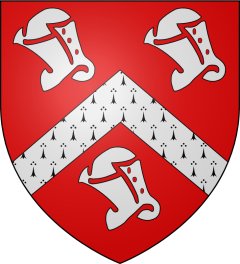
Owen Tudor’s coat of arms.

The House of Tudor that would come to rule England counted Owen its sire; the four-year-old grandson he left at his death grew up to become the first Tudor monarch, Henry VII.

Owen produced the root of this august line with Dowager Queen Catherine of Valois, the French princess Henry V had extracted as part of the price of peace after Agincourt.

That union was supposed to join the two great realms, but Henry V unexpectedly kicked the bucket in 1422, leaving an infant son who was not only unable to hold the French throne … he was too unstable to hold the English throne, either.

Unless he was a seer, suave Owen must not have been thinking dynasties when he took the Queen as his lover (and eventually his wife via a secret marriage in the early 1430s).

They produced six children, but it wasn’t the bedroom politics that did our prolific father in, at least not directly. Only decades later, when ownership of the crown was up for grabs in the War of the Roses and Owen loyally led Lancastrian forces at a battle he was unwise enough to lose, did he give up his head for the pedestrian crime of backing the wrong horse.

Owen reportedly thought he had stature enough to expect a reprieve until the very last moment, when the executioner’s ripping his collar caused him to sigh,

The head which used to lie in Queen Catherine’s lap, would now lie in the executioner’s basket.

In time, Owen’s descendants would get to pull the same trick, because the doomed cause in whose service Owen Tudor lost his life swept clear England’s political chessboard and made possible his own line’s accession.

Elizabethan poet Michael Drayton later versified Owen’s prodigious conquest in “Owen Tudor to Queen Catherine”.

When first mine eyes beheld your princely name,
And found from whence this friendly letter came;
Is in excess of joy, I bad forgot.
Whether I saw it, or I saw it not:

My panting heart doth bid mine eyes proceed,
My dazzled eyes invite my tongue to read,
Which wanting their direction, dully mist it:
My lips, which should have spoke, were dumb, and kist it,

And left the paper in my trembling hand,
When all my senses did amazed stand :
Even as a mother coming to her child,
Which from her presence hath been long exil’d,

With gentle arms his tender neck doth strain,
Now kissing it, now clipping it again;
And yet excessive joy deludes her so,
As still she doubts, if this be hers, or no.

At length, awaken’d from this pleasing dream,
When passion somewhat left to be extreme,
My longing eyes with their fair object meet,
Where ev’ry letter’s pleasing, each word sweet.

It was not Henry’s conquests, nor his court,
That had the power to win me by report;
Nor was his dreadful terrour-striking name,
The cause that I from Wales to England came:

For Christian Rhodes, and our religion’s truth,
To great achievement first had won my youth:
Th’ brave adventure did my valour prove,
Before I e’er knew what it was to love.

Nor came I hither by some poor event,
But by th’ eternal destinies’ consent;
Whose uncomprised wisdom did foresee,
That you in marriage should be link’d to me.

By our great Merlin was it not foretold,
(Amongst his holy prophesies enroll’d)
When first he did of Tndor’s name divine,
That kings and queens should follow in our line?

And that the helm (the Tudors ancient crest)
Should with the golden flow’r-de-luce be drest ?
As that the leek (our country’s! chief renown!)
Should grow with roses in the English crown –

As Charles his daughter, you the lilly wear;
As Henry’s queen, the blushing rose you bear;
By France’s conquest, and by England’s oath,
You are the true-made dowager of both :

Both in your crown, both in your cheek together,
Join Tether’s love to yours, and yours to Tether.
Then cast no future doubts, nor fear no hate,
When it so long hath been fore-told by fate ;

And by the all-disposing doom of Heav’n,
Before our births, we to one bed were giv’n.
No Pallas here, nor Juno is at all,
When I to Venus yield the golden ball:

Nor when the Grecians wonder I enjoy,
None in revenge to kindle fire in Troy.
And have not strange events divin’d to us,
That in our love we should be prosperous ?

When in your presence I was call’d to dance,
In lofty tricks whilst I myself advance,
And in a turn my footing fail’d by hap,
Was’t not my chance to light into your lap ?

Who would not judge it fortune’s greatest grace,
Sith he must fall, to fall in such a place ?
His birth from Heav’n, your Tudor not derives,
Nor stands on tip-toes in superlatives,

Although the envious English do devise
A thousand jests of our hyperbolies;
Nor do I claim that plot by ancient deeds,
Where Phoebus pasture his fire-breathing steeds:

Nor do I boast my god-made grandsire’s scars,
Nor giants trophies in the Titans wars:
Nor feign my birth (your princely ears to please)
By three nights getting, as was Hercules:

Nor do I forge my long descent to rim
From aged Neptune, or the glorious Sun:
And yet in Wales, with them that famous be,
Our learned bards do sing my pedigree

And boast my birth from great Cadwallader,
From old Caer-Septon, in mount Palador:
And from Eneon’s line, the South-Wales king,
By Theodor, the Tudors’ name do bring.

My royal mother’s princely stock began
From her great grandame, fair Gwenellian,
By true descent from Leolin the great,
As well from North-Wales, as fair Powsland’s seal.

Though for our princely genealogy
I do not stand to make apology:
Yet who with judgment’s true impartial eyes,
Shall look from whence our name at did first rise,

Shall find, that fortune is to us in debt
And why not Tudor, as Plantagenet?

Nor that term Croggen, nick name of disgrace
Us’d as a by-word now in ev’ry place,
Shall blot our blood, or wrong a Welshman’s name,
Which was at first begot with England’s shame.

Our valiant swords our right did still maintain,
Against that cruel, proud, usurping Dane,
Buckling besides in many dang’rous fights,
With Norway, Swethens, and with Muscovites;

And kept our native language now thus long,
And to this day yet never chang’d our tungue:
When they which now our nation fain would tame,
Subdu’d, have lost their country and their name.

Nor ever could the Saxons’ swords provoke
Our British necks to hear their servile yoke:
Where Cambria’s pleasant countries bounded be
With swelling Severn, and the holy Dee:

And since great Brutus first arrived, have stood
The only remnant of the Trojan blood.
To every man is not allotted chance,
To boast with Henry, to have conquer’d France:

Yet if my fortune be thus rais’d by thee,
This may presage a further good to me;
And our Saint David, in the Britons’ right,
May join with George, the sainted English knight:

And old Caer-merdin, Merlin’s famous town,
Not scorn’d by London, though of such renown.

Ah, would to God that hour my hopes attend,
Were with my wish brought to desired end !
Blame me not, madam, though I thus desire,
Many there be, that after you inquire;

Till now your beauty in night’s bosom slept,
What eye durst stir, where awful Henry kept ?
Who durst attempt to sail but near the bay,
Where that all-conqu’ring great, Alcides lay ?

Your beauty now is set a royal prize,
And kings repair to cheapen merchandise.
If you but walk to take the breathing air,
Orithia makes me that I Boreas fear:

If to the fire, Jove once in light’ning came.
And fair Egina makes me fear the flame:
If in the Sun, then sad suspicion dreams
Phoebus should spread Lucothoe in his beams:

If in a fountain you do cool your blood,
Neptune, I fear, which once came in a flood:
If with your maids, I dread Apollo’s rape,
Who cous’ned Chion in an old wife’s shape :

If you do banquet, Bacchus makes me dread,
Who in a grape Erigone did feed :
And if myself your chamber-door should keep,
Yet fear I Hermes coming in a sleep.

Pardon (sweet queen) if I offend in this,
In these delays love most impatient is:
And youth wants pow’r his hot spleen to suppress,
When hope already banquets in excess.

Though Henry’d fame in me you shall not find,
Yet that which better shall content your mind;
But only in the title of a king
Was his advantage, in no other thing:

If in his love more pleasure you did take,
Never let queen trust Briton for my sake.
Yet judge me not from modesty exempt,
That I another Phaeton’s charge attempt;

My mind, that thus your favours dare aspire,
Shows, that ’tis touch’d with a celestial fire:
If I do fault, the more is beauty’s blame,
When she herself is author of the same;

“All men to some one quality incline,”
Only to love is naturally mine.

Thou art by beauty famous, as by birth,
Ordain’d by Heav’n to cheer the drooping Earth :
Add faithful love unto your greater state,
And be alike in all things fortunate.

A king might promise more, I not deny,
But yet (by Heav’n) he lov’d not more than I.
And thus I leave, till time my faith approve,
I cease to write, but never cease to love.

Aficionados of old tyme history novelizations can also kick back with Owen Tudor: An Historical Romance.

On this day..

1463: David of Trebizond and his heirs

On this date in 1463, the last regal claimants of Byzantium’s last successor state were executed in Constantinople.

They were, by this time, two years deposed from actual power. David of Trebizond (aka David Comnenos) had inherited the enclave“empire” clinging to the Black Sea coast in 1459, and proved himself “a fit agent for consummating the ruin of an empire.”

Specifically, he cleverly set about needling the overwhelming Turkish power on his borders by vainly attempting to stir up another Crusade, and refused to pay the Mohammedan tribute.

Having recently reduced the impregnable fastness of Constantinople, Mehmed the Conqueror handily availed this provocation to overrun Trebizond.

David and kin made out okay by this calamitous extinction of the Byzantine candle, negotiating in the summer of 1461 an arrangement to settle in Adrianople under the sultan’s protection (and monitoring).

Two years later, David was reportedly caught plotting against the keeper of his gilded cage once more, and Mehmed had the former Emperor, his sons, a nephew and a brother-in-law beheaded, neatly extinguishing the last people with any lineal claim the late Greek imperium.

Theodore Spandounes, a Venetian of Byzantine refugee stock writing in the early 16th century,* claims this was a set-up by Mehmet, “ravenously thirsting for Christian blood,” and that the Komnenoi were given the chance to convert to Islam and atoned their poor statecraft with holy martyrdom.

Furthermore,

Mehmed confiscated all the property of the imperial family of Trebizond and condemned the Empress [Helen Kantakouzene or Cantacuzene] to pay 15,000 ducats within three days or be executed. Her servants, who were Mehmed’s prisoners in Constantinople, worked from dawn to dusk to raise the money and paid it … [but] she had no desire to remain in this world; and, clad in sackcloth, she who had been accustomed to regal finery, refused to eat meat any more and built herself a hovel covered in straw in which she slept rough. Mehmed had decreed that no one was to bury the bodies under pain of death. They were to be left for the dogs and ravens to devour. But the sainted Empress secretly acquired a spade and with her own delicate hands as best she could dug a trench in her hut. All day long she defended the corpses against the animals and at night she took them one by one and gave them burial. Thus did God give her the grace to bury her husband and her sons; and a few days later she too died.

* And writing, it should be observed, with the polemical intent of persuading western powers to go fight the Ottomans.

On this day..

1415: French prisoners at the Battle of Agincourt

This day is called the feast of Crispian.
He that outlives this day and comes safe home,
Will stand o’ tiptoe when the day is named
And rouse him at the name of Crispian.
He that shall see this day, and live old age,
Will yearly on the vigil feast his neighbors
And say, “Tomorrow is Saint Crispian.”
Then will he strip his sleeve and show his scars,
And say, “These wounds I had on Crispin’s day.”

…And Crispin Crispian shall ne’er go by,
From this day to the ending of the world,
But we in it shall be remembered-
We few, we happy few, we band of brothers.

Henry V, Act 4, Scene 3

In the world of Henry V, the Battle of Agincourt is a source of bursting pride for the English, a wellspring of superiority over the French and proof of the soul of those from the Isle. In spite of the inspiring speeches, the battle has passed into history as one of the enduring examples of a well-positioned army besting a much larger force.

Were it not for the story of the triumphant underdog, Agincourt would have fallen into international obscurity with much of the Hundred Years’ War, a simmering conflict for the French throne that spanned from 1337 to 1453. The notoriety of the Hundred Years’ War comes not from its intensity but from its longevity and breadth: an international conflict that swept up hundreds of wealthy European houses, it featured the first significant post-Roman standing armies, organized cavalry, and formative nationalism in both France and England.

The interminable war centered around the English crown’s claim to succession of the French throne — a claim events had overtaken by the end of the conflict in 1453 — and had already been going off and on for nearly eighty years as we lay our scene in 1415, with King Henry V of England initiating what would be known as the Lancastrian War.

Henry’s English and Welsh forces battered the French port of Harfleur starting in August 1415, which was the first holding to fall to the invading army. Almost immediately after taking control in late September of that year, the English king made a curious decision to march across Northern France from Harfleur to Calais, approximately 100 miles away.

As he tromped northeast, French troops shadowed his movements, and Henry made several attempts to shake them. After passing through Frévent, Henry turned his men north. He crossed the last major tributary of the Canche River south of Maisoncelle, hopeful that the exhausting trip was nearly through. His scouts, however, had hairy news for their king: the French force had cut the corner and was amassing north of their position. The way was blocked.

Archer? I Hardly Knew Her!

Agincourt (now spelled Azincourt) lay across a ploughed field from Tramecourt, making for a narrow defile not suited to maximizing the French force’s advantage in numbers and heavy cavalry.

Nevertheless, that advantage was considerable, or at least has conventionally been thought so, and it was in the face of desperately dwindling supplies that Henry was forced to initiate battle. The opposing French forces, ostensibly commanded by Constable Charles d’Albret, Comte de Dreux, and Marshal Boucicaut, Jean Le Maingre, allegedly outnumbered the British by at least 2 to 1 (estimates range as high as 6 to 1*).

The English drew up longbowmen in a wedge along the woods adjacent the field (map), and it was these positions that provided the decisive turn.

When the Gallic banners advanced, the English archers moved into firing range and dug in palings they had hastily manufactured from the local forest; this made a direct assault problematic while the woods prevented a flanking maneuver. French cavalry attempted to dislodge them with a concerted assault, but the defensive postures held, and the cavalry was turned away. All the while, the hail of arrows mowed down the flower of French chivalry, whose lines crumbled in panic and disorder.

As one contemporaneous account states**:

Before, however, the general attack commenced, numbers of the French were slain and severely wounded by the English bowmen. At length the English gained on them so much, and were so close, that excepting the front line, and such as had shortened their lances, the enemy could not raise their hands against them. The division under sir Clugnet de Brabant, of eight hundred men-at-arms, who were intended to break through the English archers, were reduced to seven score, who vainly attempted it. True it is, that sir William de Saveuses, who had been also ordered on this service, quitted his troop, thinking they would follow him, to attack the English, but he was shot dead from off his horse. The others had their horses so severely handled by the archers, that, smarting from pain, they galloped on the van division and threw it into the utmost confusion, breaking the line in many places. The horses were become unmanageable, so that horses and riders were tumbling on the ground, and the whole army was thrown into disorder, and forced back on some lands that had been just sown with corn. Others, from fear of death, fled; and this caused so universal a panic in the army that great part followed the example.

A confused chain of command in the French camp (the English, of course, were personally commanded by their sovereign) facilitated the rout.

Despite their military status, d’Albret and Boucicaut were outranked by several of the nobles heading the lines behind them, said nobles being prone to glory-seeking freelance charges as chivalrous as they were tactically unavailing. The Constable led the front line, followed by the Duke of Bar and the Duke of d’Alençon.

After the disastrous first charge, what remained of the second line moved in to join the fray. The French peasantry was massacred during the fight, and Constable d’Albret and the Duke of d’Alençon, along with the Duke of Orleans and Duke of Barant, along with several other nobles, fell during the assault, further disorganizing the French. (The highest-ranking English casualty was the Duke of York.)

With thousands of French dead, the third line, headed by the Count of Merle and Count of Falconberg, fell away before they entered the battle. While England’s longbows dominated the field, France’s bowmen never even participated in the battle, squeezed to the back by too many bluebloods demanding the right to charge.

Only 100-200 English are thought to have died this day; the death toll for the French was in the thousands, with hundreds more taken prisoner.


Uh-oh.

It is a portion of this lot summarily executed during the battle who offer this blog an excuse to survey the battlefield.

After a successful raid on the English supply van — the signal French achievement in the battle, and one that briefly threatened to knock out the monarch himself and turn the tide — Henry got worried that his oversized contingent of French prisoners was liable to get loose and wreak havoc in his rear. He issued the expedient but decidedly unseemly order to put his captives to death.†

Parts 1, 2, 3 and 4 of this documentary, which among other things unpacks the longbow’s actual role in the victory, given that English arrows could not penetrate French knights’ plate armor.

The Battle of Agincourt has inspired innumerable interpreters, from Shakespeare to Star Trek.

Shakespeare’s classic Henry V is frequently staged, and has hit the silver screen multiply — here’s Laurence Olivier’s version of the stirring St. Crispin’s Day speech followed by the start of battle from the 1944 production addressed to the martial fervor of World War II.

There are plans to adapt Bernard Cornwell’s Agincourt to film as well.

In the nonfiction world, Lt. Col Alfred Burne’s The Agincourt War focuses on the military side of the battle while Juliet Barker’s Agincourt: The King, the Campaign, the Battle and Agincourt: Henry V and the Battle That Made England.

The year after Agincourt, Henry V claimed all of Normandy, and in subsequent years forced the French to sign the Treaty of Troyes in 1420, which established the line of succession for Henry’s heirs to unify the crowns of the adversaries. Henry’s grand plan was foiled by his untimely death just two months after the death of King Charles VI of France, which left Henry VI — then less than a year old — as the heir to both English and French thrones.

The Dauphin Charles of France, officially disinherited by Troyes but still widely supported in France, swooped in to claim power in France, but internal dissent made his rule difficult; 30 years later (and after the intervention of Joan of Arc), Charles finally expelled the English from Aquitaine, and brought all France together not under the House of Lancaster but under the House of Valois.

* Accounts are sketchy in this regard. Some modern analysis puts the values at 4:3 for the French. However, contemporaneous accounts suggest a much heavier French advantage. Of course, people are notoriously bad at crowd estimation.

** Translation by Thomas Johnes.

† Shakespeare covers this notorious massacre as well, in Act 4, Scene 6 (the next scene opens with Englishmen horrified at the order, but the matter drops as they realize they’ve won the battle)

Alarum
But, hark! what new alarum is this same?
The French have reinforced their scatter’d men:
Then every soldier kill his prisoners:
Give the word through.

Part of the Daily Double: Agincourt.

On this day..

1415: Bardolph, Hal’s friend

On this date in 1415, on the eve of the Battle of Agincourt, the young English King Henry V approved the execution of his onetime boon companion Bardolph in William Shakespeare’s Henry V.

The fictional Bardolph had been the ruddy-nosed friend of Henry’s in the Henry IV plays (Part 1, Part 2), where the hard-drinking, rabble-rousing young prince is a disappointment to the father who fears his heir will never merit the throne.

By Henry V, the boy has become the ruler, and launched an audacious incursion into France during the Hundred Years’ War.

Hal’s willingness to own the rough decisions of statecraft — in this case having his friend put to death further to his win-French-hearts-and-minds policy — is part of his coming of age as Henry V.

Whether that means Hal’s maturation into regal dignity or the corruption of his humanity by power is up to the reader.

KING

How now Fluellen, cam’st thou from the Bridge?

FLUELLEN

I, so please your Maiestie: The Duke of Exeter
ha’s very gallantly maintain’d the Pridge; the French is
gone off, looke you, and there is gallant and most praue
passages: marry, th’ athuersarie was haue possession of
the Pridge, but he is enforced to retyre, and the Duke of
Exeter is Master of the Pridge: I can tell your Maiestie,
the Duke is a praue man

KING

What men haue you lost, Fluellen?

FLUELLEN

The perdition of th’ athuersarie hath beene very
great, reasonnable great: marry for my part, I thinke the
Duke hath lost neuer a man, but one that is like to be executed
for robbing a Church, one Bardolph, if your Maiestie
know the man: his face is all bubukles and whelkes,
and knobs, and flames a fire, and his lippes blowes at his
nose, and it is like a coale of fire, sometimes plew, and
sometimes red, but his nose is executed, and his fire’s
out

KING

Wee would haue all such offendors so cut off:
and we giue expresse charge, that in our Marches through
the Countrey, there be nothing compell’d from the Villages;
nothing taken, but pay’d for: none of the French
vpbrayded or abused in disdainefull Language; for when
Leuitie and Crueltie play for a Kingdome, the gentler
Gamester is the soonest winner.

This is Laurence Olivier’s 1944 version of the scene, with the commoner Bardolph well off-camera:

… and Kenneth Branagh’s more pathos-laden 1989 interpretation, with the king wavering a moment as he locks eyes with his doomed subject, and flashing back to bygone scenes of conviviality before delivering his troop the stern lesson of his friend’s strangling:

Although Bardolph himself and his prior relationship with his sovereign are fiction, the action of the scene actually proceeds from reality. Shakespeare has (as is his wont) cribbed Holinshed, who relates that Henry’s army was under strict orders not to pillage the countryside, and observed that discipline to a man —

except one, which was, that a souldiour tooke a pix out of a church, for which he was apprehended, and the king not once remooved [i.e., he halted] till the box was restored, and the offendor strangled. The people of the countries thereabout, hearing of such zeale in him, to the maintenance of justice, ministered to his armie victuals, and other necessaries, although by open proclamation so to doo they were prohibited.*

* As quoted in the very apt 1992 “Shakespeare’s Henry the Fifth and the Law of War” by Theodor Meron, American Journal of International Law, vol. 86, no. 1.

Part of the Daily Double: Agincourt.

On this day..

1409: Jean de Montagu

Six hundred years ago today, onetime royal favorite Jean de Montagu* was, at the instigation of his powerful noble rival, beheaded in Paris and his body hung up at Montfaucon.

Montagu (French link) was the 50-something scion of an ennobled notary — or else the illegitimate produce of King Charles V, whose ennobled notary had been induced to claim him. Regardless his blood, the lad made himself quite wealthy with a virtuous cycle of administrative acumen and political connection, winning a variety of honorary posts and riches aplenty he did not shy from displaying. Typical “New Money” type.

Sadly for Montagu, this cycle crested during the reign of Charles VI, also known as Charles the Mad for his bouts of illucidity.

“History,” wrote Barbara Tuchman, “never more cruelly demonstrated the vulnerability of a nation to the person of its chief of state than in the affliction of France beginning [with Charles’ first spell of insanity] in 1392.”

Charles the Mad’s erratic tenure would help bring French fortunes to the low ebb from which Joan of Arc would retrieve them.

Montagu’s period sob story was that his wealth earned him the enmity of nasty Duke of Burgundy John the Fearless,** who induced King Charles during one of the latter’s episodes to affix on Montagu responsibility for the crown’s financial shortfalls. Our day’s victim was arrested on October 7, 1409, tortured into a confession, and beheaded in Paris October 17.

Montagu’s surviving family had the verdict reversed within three years, which would have been a better deal for them had the family’s main branch not been wiped out three years after that at the Battle of Agincourt.

For the wider benefit of posterity, the beheaded lord also left a fair collection of endowed building projects in his lands in Marcoussis, including (French links all): the usual village church; a Celestine monastery; and a picturesque castle unfortunately devastated during the French Revolution but once resembling this:


Atmospheric old sketch from here; others here.

* Not to be confused with his (likewise beheaded) contemporary across the channel, John Montagu, Earl of Salisbury.

** John the Fearless had most recently been seen engineering the infamous murder of the king’s brother, and surviving by dint of his ransom potential the hecatomb of the last crusade.

On this day..

1468: Charles de Melun, governor of Paris

On this date in 1468, Charles de Melun (French link) was executed at Andelys by Louis XI on a trumped-up treason charge.

The execution stemmed from a civil war fought by crown against nobles struggling to preserve their feudal rights — and specifically, a 1465 battle won by the nobles’ intrepid standard-bearer Charles the Bold. Louis was grumpy at his governor of Paris for not relieving him in time, and when the wheel of courtly politics turned sufficiently, that incident supplied enough suspicion to destroy Melun.

Hear now of Melun from The History of the Bastile, and of Its Principal Captives.

The war, caused by the League of the Public Good, which restored liberty and fortune to Chabannes, deprived his enemy, the count de Melun, not only of both, but of life also. When we are told that Melun was so addicted to pleasure, luxury and sloth, as to have acquired the name of the Sardanapalus of his times, we can form no very flattering estimate of his character. Yet he stood high in the good graces of Louis XI, and participated largely in the spoils of Chabannes. In his capacity of governor of Paris and the Bastile, he was also entrusted with the custody of that nobleman. It was not till after the battle of Montlheri that Louis began to suspect him. The monarch had, indeed, some excuse for suspicion. Melun had at least been criminally negligent, in a post which demanded the utmost vigilance. He had prevented a sally from the city during the battle, which might have turned the scale in the king’s favour, and he had been ignorant of, or winked at, a correspondence carried on with the chiefs of the League by some of the disaffected citizens. These indications of treachery were strengthened by two circumstances; some of the cannon of the Bastile had been spiked, and the gates of the fortress, on the side next the country, had been left open while the besiegers were making an attack. The escape of Chabannes might also afford a reason for doubting his keeper’s fidelity. Louis, however, was, at this moment, too closely pressed by his numerous enemies to enter into an investigation of the subject; and he, therefore, only dismissed the governor.


The Battle of Montlhery

Melun retired to his estates, and imagined that the storm was blown over. He was mistaken. As soon as Louis had disembarrassed himself, he instituted a rigid enquiry into the conduct of his disgraced favourite. One of the most active in pushing it on was a man who was indebted to the count for his rise in life; the cardinal Balue, of whom further mention is about to be made. The result of the enquiry was, a charge of having maintained a secret correspondence with the heads of the League, especially with the duke of Britanny. Melun was in consequence arrested, and conveyed to Chateau Galliard, in Normandy, by the provost Tristan l’Hermite, of infamous memory.*

The trial was commenced without delay, and, as he refused to confess to any crime, he was put to the torture. With respect to his correspondence with the chiefs of the League, he avowed it, but pleaded that it had the king’s sanction. It is probable that this was really the case. Many motives might have induced the king to allow of his officer corresponding with the enemy. But Louis had now resolved upon the destruction of Melun; and, as he never scrupled at falsehood when he had any point to gain by it, he denied that he had given the permission. By adding that he had long had cause to be dissatisfied with the prisoner, he gave a broad hint as to what kind of verdict he desired.** The judges, as in duty bound, pronounced Melun guilty, and he was consigned to the scaffold. His execution took place in 1468. Of his confiscated property, a considerable portion was bestowed on Charbannes.

It is said, that the executioner having only wounded him at the first stroke, Melun raised his head from the block, and declared, that he had not deserved death, but that, since the king willed it, he was satisfied. If this be true, we must own that tame submission to the injustice of a despot was never more strikingly displayed.

Had Melun lived but a little longer, he might have triumphed in the downfall and punishment of his ungrateful enemy, the cardinal, which took place in 1469 … The cardinal, and his his friend and agent William d’Harancourt, bishop of Verdun, were in close correspondence with his enemies.†

Though Melun generally goes down as a guy who caught a bum rap — probably even Louis XI thought so, given the subsequent fall of Melun’s rivals — this 19th century history of France observes that such consideration turns on noblesse oblige, for while “such crime on the part of a burgess was considered worthy of death, nobles practised breach of faith as a pastime, and a lucrative one, until it was rendered a serious matter by sending the guilty to the scaffold.”

* For instance, in Victor Hugo’s The Hunchback of Notre Dame, Tristan l’Hermite is the man dispatched by Louis XI to seize Esmeralda from the cathedral for hanging.

** According to The Law of Treason and Treason Trials in Later Medieval France, Louis XI actually testified at Melun’s trial. Talk about a star witness.

† More about Balue’s disgrace here.

On this day..

1474: A cock and its eggs

“On the Thursday before St. Lawrence’s Day,” writes Gross in his Kurtze Basler Kronik, “they burned a cock on the Kolenberg, together with an egg which he had laid,* for they feared that a dragon might be hatched therefrom. The executioner cut open the cock and found three more eggs in him. For, as Vicentius saith in the sixth book of his Speculum Naturale, it hath always been held that a cock in his old age may lay an egg, whence ariseth a basilisk, if it be hatched out on a dungheap by the serpent called coluber. Wherefore the basilisk is half cock and half serpent. He saith also that certain persons declare they have seen basilisks hatched from such eggs. (Source)

* “The cock,” George Ives reassures, “was possibly an hermaphrodite or, more likely, a crowing hen.”

On this day..

1405: Richard le Scrope and Thomas de Mowbray, without color of law

On this date in 1405, Henry IV had two rebellious peers beheaded on his authority at York.


The lower panels of this stained glass in St. Andrew’s Church, Bishopthorpe, depict the trial of Archbishop Scrope. Image (c) Roger Walton and used with permission.

Richard le Scrope, Archbishop of York, and Thomas de Mowbray, Earl of Norfolk, had both become estranged from Henry Bolingbroke, the noble who had wrested control of the English crown as Henry IV.

Since Henry’s legitimacy was dubious, he faced even more than a monarch’s usual ration of plots and rebellions — most famously that of young Sir Henry Percy, remembered as “Hotspur” in Shakespeare’s Henry IV part 1.

That particular enemy met his end in 1403, but old man Percy was soon back to fomenting from his expansive holdings in the north.

Mowbray, a disaffected teenager, and Scrope, a seasoned prelate who should have known better, were drawn into the next intrigue — by “the odor of French promises or rewards,” their enemies charged. A noble loyal to Henry intercepted their modest force and (so the story goes*) by representing to accept Scrope’s offer to parley induced the rebels to disband, whereupon the ringleaders were arrested.

Henry demanded their immediate condemnation; Chief Justice William Gascoigne insisted upon their right to be judged by other peers of the realm (and upon the inviolability of the archbishop**). The hot-blooded† Henry was inclined not to bother, and simply had their heads lopped off on his own authority.

Shakespeare treats this episode in Henry IV, part 2:

HASTINGS [another rebellious lord, who shared the same fate]

Our Army is dispers’d:
Like youthfull Steeres, unyoak’d, they tooke their course
East, West, North, South: or like a Schoole, broke up,
Each hurryes towards his home, and sporting place

WESTMORLAND

Good tidings (my Lord Hastings) for the which,
I doe arrest thee (Traytor) of high Treason:
And you Lord Arch-bishop, and you Lord Mowbray,
Of Capitall Treason, I attach you both

MOWBRAY

Is this proceeding just, and honorable?

WESTMORLAND

Is your Assembly so?

BISHOP SCROPE

Will you thus breake your faith?

JOHN

I pawn’d thee none:
I promis’d you redresse of these same Grievances
Whereof you did complaine; which, by mine Honor,
I will performe, with a most Christian care.
But for you (Rebels) looke to taste the due
Meet for Rebellion, and such Acts as yours.
Most shallowly did you these Armes commence,
Fondly brought here, and foolishly sent hence.
Strike up our Drummes, pursue the scatter’d stray,
Heaven, and not wee, have safely fought to day.
Some guard these Traitors to the Block of Death,
Treasons true Bed, and yeelder up of breath.

(See this scene played here.)

Scrope’s execution in particular played very badly as an arrogation of secular power over the ecclesiastical authorities. The pope was persuaded not to excommunicate Henry — that step would be reserved a later King Henry — but many contemporaries viewed the monarch’s subsequent (and ultimately fatal) bouts with disfiguring “leprosy” as a judgment from above St. Peter’s throne.

This Google books freebie has much more on the cast of characters at the center of this day’s action.

* This popular version has its opponents; the rebels may have simply surrendered when they recognized their hopeless military disadvantage.

** Interestingly, the very uncle of the noble who effected the arrest of Scrope and Mowbray had been implicated a traitor a generation before by the Merciless Parliament. Unlike many, Alexander Neville was spared a death sentence for his perceived proximity to Richard II … because he was, as Scrope would become, the Archbishop of York.

† Henry was making noises about destroying York altogether as punishment for its disloyalty as he rode there following the “Battle” of Shipton Moor. Residents of that northern city met him in poses of desperate submission — dressed in sackcloth, ropes about their necks, offering up their weapons.

On this day..