1479: Bernardo di Bandino Baroncelli, sketched by Leonardo da Vinci

On this date in 1479, a fugitive of the previous year’s Pazzi Conspiracy — an ill-starred attempt by the Pazzi family to overthrow the Medici — was hanged in Florence.

Bernardo Baroncelli had actually struck the first blow on the Pazzi conspiracy’s big day, planting a dagger in the chest of Giuliano di Piero de’ Medici in the theatrical setting of Florence’s Duomo, with the theatrical declaration, “Here, traitor!”

Must’ve been a sight to see. Giuliano wound up dead, but the rest didn’t work out so well.

Baroncelli, however, managed to evade the resulting paroxysm of civic vengeance and hightail it to Ottoman Istanbul, where he had some contacts.

Unfortunately for Bernardo, Florence had some contacts there, too. Ottoman relations with the various Italian city-states were actually quite strong, and Florence in particular enjoyed lucrative trade arrangements bringing its wool textiles to Bursa to exchange for silk.

So you can understand the effusion for Mehmet the Conqueror* (and the interest of said Mehmet the Conqueror) in this bit of Florentine diplomatic correspondence quoted in The Papacy and the Levant:

By letters of Bernardo Peruzzi we have learned with great pleasure how that most glorious prince [Mehmet] has seized Bernardo Bandini, most heinous parricide and traitor to his country, and declares himself willing to do with him whatever we may want — a decision certainly in keeping with the love and great favor he has always shown toward our Republic and our people as well as with the justice of his most serene Majesty … although as a result of the innumerable benefits done by his most glorious Majesty in the past for the Republic and our people, we owe him the greatest indebtedness and are the most faithful and obedient sons of his Majesty, nevertheless because of this last benefit it would be impossible to describe the extent to which our obligation to his most serene Majesty has grown.

A Florentine representative quickly sailed for the Ottoman capital to make the arrangements, and returned with the hated Bandini on Dec. 24. Five days later, he was hanged over the side of the Bargello.

Florentine native son Leonardo da Vinci sketched the hanging man (the sketch is now in the Musee Bonnat), diligently noting his clothing.

A tan colored skull-cap, a doublet of black serge, a black jerkin, lined and the collar covered with a black and red stippled velvet.
A blue coat lined with fur of fox’s breasts.
Black hose.
Bernardo di Bandino Baroncelli.

In the video game Assassin’s Creed II, one of the missions (assigned by Giuliano’s surviving brother, Lorenzo the Magnificent) is to kill Bernardo Baroncelli … but not with trade relations and diplomacy.

* Conqueror of Istanbul/Constantinople, among other things.

On this day..

1499: Perkin Warbeck, Princes in the Tower pretender

(Thanks to Meaghan Good of the Charley Project for the guest post. -ed.)

On this day in 1499, Perkin Warbeck, pretender to the English throne, was hung at Tyburn for treason. He didn’t fare as well as the previous royal pretender, Lambert Simnel, who was pardoned by King Henry VII and made a spit-turner in the royal kitchens.

Warbeck claimed he was Richard, Duke of York, the younger son of King Edward IV. Richard and his older brother, the would-be Edward V, mysteriously vanished around 1483, allegedly murdered by their allegedly evil uncle Richard III, who had already had them declared illegitimate. (Shakespeare made this version — which was congenial to the ruling Tudor dynasty of his time — the standard in Richard III; the play channeled Thomas More‘s history of Richard.)

The murder story has never been proven and the princes’ bodies were never identified, leaving a yeasty petri dish for pretenders to grow and multiply — and so they did.

Warbeck, who later admitted he was actually born in Tournai, in Flanders, in approximately 1474 (his father is described by one source as “a renegade Jew”) first claimed to be the Duke of York either while at the court of Burgundy in France in 1490, or while serving a silk merchant in Ireland in 1491.

He did bear a strong resemblance to Edward IV, but there is no evidence that he was really Richard of York or that he and the late king were related in any way.

Nonetheless, his claim was soon recognized by Charles VIII, King of France … and it naturally appealed to the fledgling Tudor dynasty’s potential internal rivals, too.

Margaret of Burgundy, who was Edward IV’s sister and the disappeared Duke of York’s aunt, was one of these educated the pretender about “his” history and the ways of the English court, and she helped finance Warbeck’s attempted conquest of England in 1495. It went badly from the beginning: Warbeck’s army was trounced and 150 of his troops were killed on the beach in Kent before he even made it ashore. Warbeck fled to Ireland and then Scotland.

Warbeck had more success in his second invasion attempt, in Cornwall in 1497 on the heels of the Cornish Rebellion.

Warbeck promised an end to the exorbitant taxes levied on the citizenry, which welcomed both pretender and promise with open arms. His army grew to 6,000 or 7,000 men, and Warbeck began calling himself Richard IV of England, but when he found out King Henry was after him he panicked and deserted his men.

He was captured and imprisoned at the infamous Tower of London, but not before being “paraded through the streets on horseback amid much hooting and derision of the citizens.”

The execution was not until 1499, and only after it was alleged that Warbeck tried to escape with a real royal claimant, Edward Plantagenet, Earl of Warwick. On November 23, Warbeck was taken from the Tower to Tyburn, where he read out a confession and was hanged. His wife, Lady Catherine Gordon, a cousin of the King of Scotland, had a better fate; she was given a pension and a job of lady-in-waiting to the Queen.

At least she didn’t have to turn a kitchen spit.

On this day..

1492: Sir Nicholas de Mimsy-Porpington, Nearly Headless Nick

(Thanks to Elizabeth M. Hull for the guest post. -ed.)

Post-mortem resident of Gryffindor House, Hogwarts School of Witchcraft and Wizardry, Hogsmeade, U.K.

A minor character in J.K. Rowling’s Harry Potter saga, Nearly Headless Nick remains one of the most memorable. Executed — badly — on Halloween of 1492, Sir Nicholas de Mimsy-Porpington became the ghost of Gryffindor House. The school has about 20 resident ghosts: the Grey Lady (Helena Ravenclaw) and the Bloody Baron of Slytherin House died violently as well, in a murder-suicide.

Rowling says that her editor suggested that she cut a ballad Mimsy-Porpington wrote about himself from The Chamber of Secrets. In the song, the ghost claimed to have been executed for “a mistake any wizard could make,” a “piffling error,” a case of wizardry gone wrong. Asked by Lady Grieve (otherwise unknown) to straighten her teeth, Mimsy-Porpington seems to have given her a tusk. “They” imprisoned the piffler immediately, though he cried all night that he could fix his mistake, and his beheading followed the next morning.

Unfortunately for Mimsy-Porpington, his was not the only incompetence: “they’d mislaid the rock/Where they usually sharpened the axe”! The “cack-handed twit” of a headsman said “this may sting a bit” to the gibbering wizard, and swung the axe in the air. Alas, unable to sharpen the blade, the executioner was reduced to bestowing numerous blows: “But oh the blunt blade! No difference it made,” the ghost sang,

My head was still definitely there.
The axeman he hacked and he whacked and he thwacked,
“Won’t be too long,” he assured me,
But quick it was not, and the bone-headed clot
Took forty-five goes ’til he floored me.

(The full ballad is here and here; the original handwritten version can be seen here.)

After repeated strokes of the edgeless axe, Mimsy-Porpington finally expired. On festival occasions, he re-enacts his near-beheading, a show quite popular with the Hogwarts student body (Prisoner of Azkaban, p. 159).

However, the bone-headed, cloddish headsman was unable to completely behead the wizard. As Ron Weasly notes, the ghost is merely nearly headless.


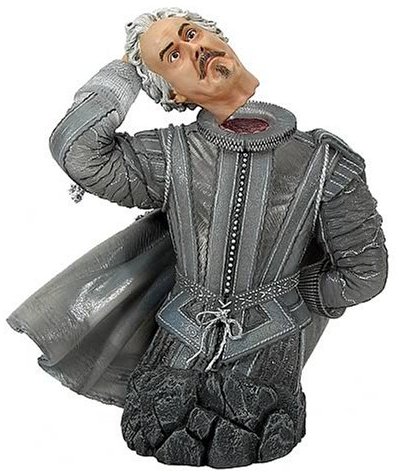
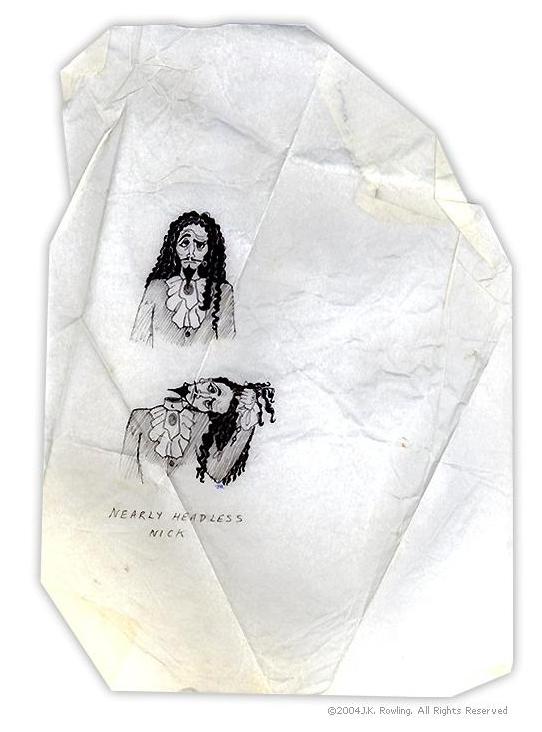
Nick, as played in the Harry Potter films by John Cleese. Rowling’s own original sketch of Nearly Headless Nick is here.

While he gets a great deal of pleasure from entertaining Hogwarts residents by swinging “his whole head . . . off his neck and . . . onto his shoulder as if it was on a hinge” (Sorceror’s Stone, p. 124), his condition limits his access to the dizziest heights of post-mortem society. Beheading was an aristocratic execution, meant to bring a swift death to the privileged, those able to hunt legally in their lifetime. In the afterlife, the beheaded aristocrats have established a “Headless Hunt” Club, and have blackballed Mimsy-Porpington, who misses their entrance requirements by that much: “‘half an inch of skin and sinew holding my neck on.'” Unable to participate in Club sports like “Horseback Head-Juggling and Head Polo,” Mimsy-Porpington is denied admission into the elite society (Chamber of Secrets, p. 124).

Sadly, their scorn for his crippling condition is not limited to exclusion from their company.

Mimsy-Porpington’s five hundredth Deathday anniversary party, held on Halloween 1992, welcomes hundreds of ghosts from as far away as Kent to a feast of rotten fish, putrid, “maggoty haggis,” and a tombstone cake with grey icing, while an orchestra of 30 musical saws plays waltzes. The Deathday Boy’s speech is interrupted by the members of the Headless Hunt: “Sir Properly Decapitated-Podmore” begins a game of Head Hockey, sending his own head sailing past the humiliated Mimsy-Porpington as he tries to address his guests (Chamber of Secrets, p. 132-7).

Somehow the courageous Gryffindor ghost overcomes this diabolical heads-up-manship and several months as a petrified cloud to live a useful afterlife, helping Harry many times. Most significantly, in the final pages of The Order of the Phoenix, a traumatized and grieving Harry turns to Mimsy-Porpington, hoping to discover a way to keep his dead friend and guardian Sirius Black alive. “‘You’re dead,'” Harry says, “‘But you’re still here, aren’t you? … People can come back, right? As ghosts. They don’t have to disappear completely.'” Mimsy-Porpington gently tells Harry that he can only “‘walk palely'” where his living self once trod, “‘neither here nor there,'” hovering between life and death for fear of the unknown. However, Black risked his life joyously and died laughing; he will not linger between death and life. Harry must live on without him.

There may be historical precedent for Mimsy-Porpington’s death in the botched execution of James Scott, Duke of Monmouth (1685), when the notorious Jack Ketch took five blows to kill the rebel, and finally had to use a knife to sever the last “skin and sinew” connecting the head to the corpse. Monmouth’s hairstyle in portraits from the late 1600s resembles that drawn by Rowling in her sketch of Nearly Headless Nick, although that sketch shows a beard style from the early 1600s, nearly 70 years earlier. Moreover, the ghost enters Harry Potter’s life wearing an Elizabethan neck ruff and says that he has not eaten in nearly 400 years, implying a death in the late 1500s.

In spite of this wibbly-wobbly timeline, Mimsy-Porpington’s deathdate establishes the firm chronology of Rowling’s series: the five hundredth anniversary of his death in 1492 would fall in 1992; therefore the events of Chamber of Secrets (published in 1997) must occur in 1992. The dating of the series is confirmed five books later by the tombstones of Harry’s parents, who died on Halloween Day, 1981 (Deathly Hallows, p. 328). For J.K. Rowling, death, the last enemy — not life — marks the measure of this world’s time.

On this day..

1401: Klaus Stortebeker, Victual Brother pirate

On this date in 1401,* “Victual Brother” Klaus Störtebeker was beheaded in Hamburg.

Statue of Klaus Stortebeker. (cc) image from blariog

This legendary freebooter terrorized the Hanseatic League‘s trading channels from Novgorod to London in the 1390s.

He was the most famous of a company of privateers who’d been hired out in 1392 to place their thumb on the scale of Scandinavian dynastic politics** — notably, supplying Stockholm during a siege, from which service they obtained† the nickname Victual Brothers. It stuck, even when operations had moved far beyond the larder.

In the mid-1390s, the “brothers” turned against Danes and Hanse alike, raiding coasts and plundering sea trade from their base in the shattered port of Visby.

Klaus, the most famous of them, is still remembered today “like Che Guevara, a freedom fighter, but also like Robin Hood, because he fights the rich in the name of the poor”:‡ folk hero-outlaws, men of the pirate utopia.

Whatever debunking that legend might invite, its existence speaks to that timeless romance of the road. And then there’s that kernel of truth, or so one hopes: after Stortebeker’s death, the remnants would persist as the Likedeelers, “those who share equally.”

The buccaneer’s end, after capture by Simon of Utrecht, was equally legendary: he’s supposed to have made a scaffold pact with the headsman to spare any of his mates he could walk past once decapitated.

Rising from the chop like St. Denis, the headless trunk of Stortebeker lurched past 11 of them before the executioner himself tripped it up. (In the most embroidered version of this story, Hamburg not only didn’t honor the promise, it executed the executioner when all was said and done. But we’re pretty comfortable saying that once we reach the headless zombie pirate part of the story, the reader has carte blanche to rewrite anything not to liking.)

Drink up me hearties yo ho! “Stortebeker” itself just means, “quaff the mug.”

Klaus Störtebecker is our master
advised by Godeke Michels!
Shoot through the waves like storm, just faster
The Flying Dutchman’s godfather
Gaffer is the ships goblin
Let’s tackle, crew!
Life is bauble!
We are the hell of Helgoland

Our bloody flag is cracking the mast
Rats scurrying on the floor
A skeleton is our guest
On the sail there are strange shadows
The mermaid is swimming in our wake
Laugh, crew!
Life is bauble!
Still ruling is the hell of Helgoland

And when our ship makes its last run
Laugh while like a coffin she goes down
We die an ancient pirate’s way
Today we fight, tomorrow we drown
In green algae and white sand
Land ho, crew, land!
Life is bauble!
Such dies the hell of Helgoland

-Folk song honoring Klaus Stortebeker
(translated here)

* As often for events at this distance of time, the dates are a little bit shaky; 1400, rather than 1401, has been proposed for the actual year of Stortebeker’s execution; October 21 rather than October 20 is also given on some sites. Folklore more so than almanac blogs has the luxury of indifference to such particulars.

** The Victual Brothers were initially retained to oppose the adroit Danish Queen Margaret. She would face (and brush aside) even weirder challenges to her rule en route to lashing together the Kalmar Union under Danish regional hegemony.

Alternate explanation: food-based euphemisms for piracy trace to armies’ victual officers, and their unscrupulous methods of filling the mess hall.

‡ In a continuing spirit of democratic larceny — or as a gang symbol for the local Hell’s Angels, whatever — our man’s alleged skull was stolen from a Hamburg museum earlier this year.

On this day..

1470: John Tiptoft, Butcher of England

On this date in 1470, cultured and bloodthirsty* English noble John Tiptoft, Earl of Worcester was beheaded at Tower Hill during the War of the Roses.

Tiptoft’s calling card says he’s one of England’s first Renaissance men — literally so, because after cutting his teeth at Oxford, he spent several years in Padua, Ferrara, Rome and Florence, brushing up on Latin and law.

Besides culture and erudition, Tiptoft is supposed to have picked up from his Italianate exposure a taste for that fragmented peninsula’s barbarous political jockeying.*

Back in Britain from the start of the 1460s, Worcester aligned with the Yorkists during the War of the Roses, and made liberal use in both England and Ireland of his continental savvy in matters of torture, earning that unflattering sobriquet Butcher.

Tiptoft gave them the material, exercising,” in his constabulary post, “more extreme crueltie (as the fame wet) then princely pity.” For instance, when putting down one revolt,

the Kynge Edwarde came to Southamptone, and commawndede the Erle of Worcetere to sitt and juge suche menne as were taken … and so xx. persones of gentylmen and yomenne were hangede, drawne, and quartered, and hedede; and after that thei hanged uppe by the leggys, and a stake made scharpe at bothe endes, whereof one ende was putt in att bottokys, and the other ende ther heddes were putt uppe one; for whiche the peple of the londe were gretely displesyd; and evere afterwarde the Erle of Worcestre was gretely behatede emonge the peple, for ther dysordinate dethe that he used, contrarye to the lawe of the londe.

Too bad for the gretely behatede Erle of Worcestre that this was an era when anyone‘s uppance could be coming at any time.

This last, well, butchery was effected against supporters of the Earl of Warwick, the “kingmaker” whose fluid alliances shaped the royal jostle in the mid-15th century.

And the trouble for Tiptoft was that Warwick’s 1470 revolt against Tiptoft’s ally and kin Edward IVworked. Okay, only temporarily, but it was long enough to do in John Tiptoft.

For a brief moment, the Yorkist cause waned and the Lancastrian waxed; during the brief moment, the Butcher of England was haled before the Lancastrian Earl of Oxford, a man who occupied that office because Tiptoft had executed his father and elder brother.

The wheel of fortune had turned. A massive, jeering crowd turned out to see Tiptoft de-topfed. He asked the executioner to do it in three strokes rather than one, in honor of the Trinity.


Prayerful: John Tiptoft’s tomb at Ely Cathedral. (He’s flanked by two of his three wives, one of whom is in the foreground.) Image used with permission.

Tiptoft [wrote Henry Pancoast] was the most learned man among the English nobility of his time … [he] reflects his age at its best and worst. He was set at a confluence of evil influences, when civil strife following the Hundred years War [sic] had debauched the English nobility. Abroad he came close to that Italy which Machiavelli called “the corrupter of the world.” Yet a new intellectual life was growing, and Tiptoft’s career alternates between scholarship and political intrigues. He shows us how early the new spirit was astir in England, and how it was retarded; is is the “butcher” and “the first fruits of the Italian Renaissance.”

You can explore a bit more about John Tiptoft in the first third of this BBC radio 4 program, with author Alison Weir. (Her Tudor books burn up the bestseller lists, but she’s also written about the War of the Roses.) Or, look up the Household of Worcester, a medieval re-enactment society that takes name and inspiration from our day’s butchered butcher.

* This supposed southern influence on our friend the Earl might well be true, but it also strikes this author as an answer in search of a question. It’s hardly necessary to posit foreign influence to explain brutality in 15th century England, nor to explain educated men with a taste for cruelty.

But Tiptoft’s “wanton ferocity,” says Pancoast, “brings to mind the Italian proverb, quoted by Ascham in proof of the brutalizing effect of Italy upon the English nature: Inglese Itilianato e un diabolo incarnato.”

Since oiled stakes up buttocks were no more characteristic of Italian jurisprudence than English, the obvious place one might inquire for an outside influence would be that better-known diabolo incarnato, Vlad the Impaler: stories of Vlad Dracula’s then-contemporary skewerings were even then circulating and magnifying in the 15th century’s fresh new media channel, the printing press.

On this day..

1401: Llywelyn ap Gruffydd Fychan, an army marching on his stomach

(Thanks to Jonathan Shipley of A Writer’s Desk for the guest post. -ed.)

It was on this day that a Welsh squire, Llywelyn ap Gruffydd Fychan, was gruesomely executed for thwarting the efforts of King Henry IV’s forces to squelch Welsh resistance to English rule.

First, the man’s stomach was cut out and cooked in front of him. Then, he was hanged, drawn and quartered.

The torturous execution took several hours before he succumbed to death. Then, a grisly postscript: his salted remains were sent to other Welsh towns to deter Welshmen from opposing the king.

Rewind to October, 1399.

Henry IV has been crowned King of England after overcoming the unpopular Richard II. Henry had his predecessor imprisoned and killed, then displayed at St. Paul’s Cathedral to prove to his supporters that he was gone.

Little surprise much of Henry’s reign was spent defending himself against plots, rebellions and assassination attempts. One rebellion? That of Owain Glydwr, who declared himself Prince of Wales in 1400.

This didn’t sit well with the new king. Armed men were sent out to find this treasonous Welshman. Found them they did, though perhaps they wished they hadn’t. In the summer of 1401, on the slopes of Pumlumon, Owain Glydwr crushed Henry’s army. This, too, did not sit well with the king.

Give me leave
To tell you once again that at my birth
The front of heaven was full of fiery shapes,
The goats ran from the mountains, and the herds
Were strangely clamorous to the frighted fields.
These signs have mark’d me extraordinary;
And all the courses of my life do show
I am not in the roll of common men.
Where is he living, clipp’d in with the sea
That chides the banks of England, Scotland, Wales,
Which calls me pupil, or hath read to me?

-Glendower (Glyndwr) in Shakespeare’s Henry IV, Part I

Henry then led a huge army, arriving in Llandovery, to capture this meddling countryman prince.

It was here that the English military met a 60-year-old man. A land owner from Caeo, his name was Llywelyn ap Gruffydd Fychan and the English army strongly suggested he assist them in helping locate Owain Glydwr. Llywelyn agreed.

Little did the English know, as they chased Glyndwr, that Llywelyn was taking them in the wrong direction.

He had two sons, did this Llywelyn, in Owain’s army. Though he knew he’d undoubtedly pay the ultimate sacrifice, he would not betray the Welsh people and his own family but leading the English king to the insurrectionists.

And so he led the English army on a wild goose chase.

For weeks Llywelyn lead the king and his forces through the uplands of Deheubarth. All the while Owain and his men made their escape the opposite direction to consolidate, grow, and fortify.

The king’s patience became taxed. He began to see that Llywelyn was not taking them to their man.

Angrily, the king drug Llywelyn to the town of Llandovery. In front of the castle gates, there in the town square, he was disemboweled and dismembered. Though Glyndwr’s war of liberation fizzled out, Owain was never captured nor betrayed.

Fast forward to the year 2001.

600 years after Llywelyn’s execution, a sculpture is erected. Standing 16 feet tall, erected by the castle he died in front of, is a statue of a cloaked figure, spear and shield in hand, atop a stone base inscribed with Welsh verse.

It is he, Llywelyn, commemorating his ultimate sacrifice.


Llywelyn’s striking steel statue stands watch over Llandovery. Images (c) Canis Major and stused with permission.

On this day..

1471: Thomas Neville, the Bastard Faulconbridge

On this date in 1471, Lancastrian commander Thomas Neville was beheaded in the War of the Roses.

“The bastard Faulconbridge” (Fauconberg, Falconbridge) got his illegitimacy from dad, the Earl of Kent, and like William Neville, young Thomas played both sides of the aisle during the decades-long dynastic struggle.

Thomas made his most famous mark in May of 1471, leading a Lancastrian column to meet up at London with another led by Margaret of Anjou. Unfortunately for Neville, Margaret’s army was trounced at the Battle of Tewkesbury, leaving the Bastard on his own.

Still, he made a solo go of attacking London — “stirring of coles & proud port,” in the judgment of Holinshed, “with hautinesse of hart & violence of hand thin|king to beare downe the people, as an innudation or flowing of water streams dooth all before it: yet he came short of his purpose, & pulled vpon his owne pate finall destruction: though he thought himselfe a man ordeined to glorie.”

Thomas Neuill, bastard sonne to that valiant cap|teine the lord Thomas Fauconbridge (who had late|lie before beene sent to the sea by the earle of War|wike, and after fallen to practise pirasie) had spoiled diuerse merchants ships, Portingals and others, in breach of the ancient amitie that long had continued betwixt the realms of England and Portingale; and furthermore, had now got to him a great number of mariners, out of all parts of the land, and manie traitors and misgouerned people from each quarter of the realme, beside diuerse also foorth of other coun|tries that delighted in theft and robberies, meaning to worke some exploit against the king.

And verelie, his puissance increased dailie, for ha|uing béene at Calis, and brought from thence into Kent manie euill disposed persons, he began to ga|ther his power in that countrie, meaning (as was thought) to attempt some great and wicked enter|prise. After the kings comming to Couentrie, he receiued aduertisements, that this bastard was come before London, with manie thousands of men by land, and also in ships by water, purposing to rob and spoile the citie. Manie Kentishmen were willing to assist him in this mischieuous enterprise, and other were forced against their wils to go with him, or else to aid him with their substance and monie, insomuch that within a short time, he had got togither sixtéene or seuentene thousand men, as they accompted them|selues.

With these he came before the citie of London the twelfe of Maie, in the quarrell (as he pretended) of king Henrie, whome he also meant to haue out of the Tower, & to restore him againe vnto his crowne & roiall dignitie …

The attack gave London a fright, but was eventually repelled; the Bastard fled town as King Edward IV, fresh from Tewkesbury, approached.* He seems to have copped a pardon, but he was beheaded in unclear circumstances (Holinshed says, after resuming his career in piracy — but royal perfidy seems equally likely), and his head shipped to London Bridge for pike-topping duty.


A distant spinoff of the dynasty is rumored to have founded the Falcon Crest estate.

There’s a bastard Faulconbridge in the Shakespeare canon; oddly enough he’s not found in the Henry VI series … but as the central character in the rarely-performed King John. Apart from the name, this fictional Bastard Philip Faulconbridge doesn’t seem to have a lot in common with our man.

* Just hours after resuming London, Edward’s party murdered the theretofore imprisoned Yorkist claimant that Neville had meant to liberate, Henry VI. Henry was wed to Margaret of Anjou, truly an ill-starred marriage.

On this day..

1437: Jan Rohác z Dubé, Hussite marshal

On this date in 1437, Hussite marshal Jan Rohác z Dubé was hanged in Prague.

The Bohemian commander had upheld throughout the Hussite Wars the cause of its namesake heretical priest. (There’s a Czech biography of Rohac here.)

The Hussites had a nice run in the 1420s — no less a personage than Joan of Arc took time out from French battlefields to dictate an anti-Hussite jeremiad threatening to “remove your madness and foul superstition, taking away either your heresy or your lives” — but eventually succumbed to repeated papal onslaughts.

They were decisively crushed at the 1434 Battle of Lipany … but Rohac survived it, and “emerg[ed] from the ashes” like “a phoenix”, the last champion of the forbidden sect.

Rohac rallied the remnants of his partisans to a fortress named Sion* near Kutna Hora, where they were besieged and ultimately overwhelmed.

Days later, he was demonstratively executed in Prague, where all this Hussite trouble had started.

The people of Prague, as an act of intimidation directed at dissenters, were forced … to watch the gruesome display. Clad in his red baronial robes, with a sign draped around his neck stating his condemnation, Rohac was hung by a gold chain from the top of a three-story gallows. Beneath him hung the bodies of the Sion garrison.

Present-day Jan Rohac appreciation is best done Czech.

This bio is available reprinted from a public domain source. There’s also a 1947 Czechoslovakian film (appropriately titled Jan Rohác z Dubé, but also known in English as Warriors of Faith) celebrating Rohac’s exploits.

* No truth to the rumor that the Hussites’ doings in doomed Sion inspired the techno rave scene in the city of the same name in The Matrix.

On this day..

1460: The residents of Amlas, impaled by Vlad Dracula

This date is the 550th anniversary of (in)famous Wallachian dictator/vampire prototype Vlad III Tepes‘s destruction of the town of Amlas, impaling all its surviving citizens.

The signature execution form of “Vlad the Impaler” was as nasty as it sounds: still-living victim mounted on a long, oiled stake driven through the rectum and emerging through the mouth to expire agonizingly over a period of hours or days. Or, alternatively, stuck through the midsection, leaving the subject horizontally mounted like a flopping fish.

And he had frequent recourse to it during his long struggle for power in the treacherous 1450s and 1460s, the period* when Vlad III became famous for the iron-willed cruelty required to exercise power in a Wallachia squeezed between the expanding Ottoman Empire and Hungary.

It was this terrifying period from the late 1450s that made Vlad Dracula — the titular second name inherited from his father‘s investment into the Order of the Dragon, Draco in Latin — the namesake for Bram Stoker‘s famous bloodthirsty Transylvanian noble, and the granddaddy of all its lucrative latter-day offspring.

(Bram Stoker didn’t invent the vampire myth, and the notion that Vlad Dracula “is” Count Dracula is one of those bits of popular folklore that’s become academically unfashionable. But still.)

The historical Vlad has his latter-day defenders, who see him as a nation-builder. Certainly, both the man himself and his vulnerable frontier principality were menaced by innumerable threats both foreign and domestic.

This date’s massacre was to deal with one such, Germans in the territory of Transylvania, which lay to the north of Vlad’s own Wallachia. Both realms are part of present-day Romania, and they were closely connected in Vlad’s time as well; the young Dracula himself was born in Transylvania, and Transylvanian towns had helped him take the Wallachian throne with the support of Hungary.

So far, everyone was on the same page. But when a power struggle erupted for the Hungarian throne in 1457, the “Saxon” emigres who formed the upper crust of merchants in Transylvania (supported by a vast sea of Romanian peasants) backed the Holy Roman Emperor while Vlad supported the usurping Hunyadi family that had so ably patronized him.** It’s quite a bit more dizzyingly complex than that, but the bottom line is that commercial and political conflicts soon saw Vlad Dracula mounting a campaign of Transylvanian terror from 1458 onward.

During the summer of 1460 Dracula organized his final raid on Transylvania. This time he attacked townships and villages in the district of Amlas known as the “Land of the Forest” or Unterwald … The meistersinger Beheim gives the exact date of the attack as falling on the feast day of Saint Bartholomew in the year 1460: August 24. Dracula struck in the early morning after “passing through the great forest” with his cavalry force. He burned the town of Amlas and impaled all the citizens, a priest having led the procession to the burial scene …

Dracula’s raid on Amlas was aimed at eliminating any remaining dissident resistance and at killing rival contenders to his throne … Dracula knew, for instance, that … the boyar Bogdan Doboca, was hiding in the village of Sercaia, in the Fagaras district. So he had the entire village razed to the ground; it had to be completely repopulated in the following century. Similar was the fat of the village of Mica. The narrator Beheim tells us that Dracula burned or destroyed half the communities in the Amlas district, including the capital city by that name. He “assembled all the citizens and all those he could find” from other villages and hanged them on hooks and pitchforks, after having had his men hack them to pieces with knives, swords, and sabers. Amlas was reduced to a ghost town, as it still is today, and other villages such as Saliste, Apodul de Sus, and Tilisca were similarly destroyed. Beheim claims that altogether some 30,000 Germans were killed during this Dracula raid on the district of Amlas.

Impressive as this date’s butchery would have been — although we know it from German propagandists who figure to have made the most of it — it was simply of a piece with Vlad’s Transylvanian campaign. To this campaign, Florescu and McNally attribute an impressive catalogue of atrocities, such as:

  • Slaughtering all the inhabitants of a village named Bod
  • Impaling one of his own captains who reported an inability to take an enemy position “for the inhabitants are brave and well fortified”
  • Boiling alive 600 Saxon merchants
  • Impaling as spies 41 Saxons who came to Wallachia to learn the Romanian language
  • Forcing one captured rival claimant with Saxon support to go through a Mass for the dead clothed in funerary vestments before personally beheading him

Fleeing Germans carrying spine-tingling eyewitness accounts and rumors of even worse made a happy match with that new media technology, the printing press, giving Dracula continental infamy and a purchase on future literary immortality.

“The horror genre conformed to the tastes of the fifteenth-century reading public as much as it does today,” observe those same authors Florescu and McNally in another volume. “No fewer than thirteen different fiteenth- and sixteenth-century Dracula stories have been discovered thus far in the various German states.”

The St. Bartholomew’s Day 1460 events are seemingly sometimes conflated† with a more famous bloodbath during the spring of 1459, when Vlad arranged a demonstrative mass impaling on the outskirts of Brasov.‡

All those whom he had taken captive, men and women, young and old, chlidren, he had impaled on the hill by the chapel and all around the hill, and under them he proceeded to eat at table and enjoyed himself in that way.

It’s this 1459 event that provides us the most horribly recognizable images of Dracula’s reign, with the insouciant Wallachian prince enjoying his repast amid a thicket of impaled wretches.

* 1456 to 1462, specifically, which was the second (and most consequential) of the three different periods Vlad III was Prince of Wallachia. The Ottomans drove him out in 1462, and he took refuge in Hungary before a return bid in 1476, which ended in his own death in battle.

** And specifically, Mihaly Szilagy (Hungarian link), the uncle of the ascendant king Matthias Corvinus. The latter would seek to woo Saxon support, and he had an on-again, off-again relationship with Vlad Dracula. Wallachia was a small buffer state from the standpoint of a greater power like Hungary, and Wallachia’s ruler a political instrument no matter how much impaling he might do.

† Perhaps because Brasov’s Church of St. Bartholomew was among the targets ravaged by Dracula’s force?

‡ Attack staged from picturesquely vampiric Castle Bran.

On this day..

1419: The (first) Defenestration of Prague

(Thanks to Meaghan Good of the Charley Project for the guest post. -ed.)

On this day in 1419, an angry mob of Hussite peasant rebels stormed the town hall on Charles Square in Prague and threw the judge, the mayor and several city council members (either seven or thirteen; accounts differ) out the window. They all either died in the fall or were killed by the crowd outside.

The event has been the subject of several paintings, as well as being beautifully illustrated in Lego form and also reenacted.

Hussites followed a Christian reformer, Jan Hus, who was one of the forerunners of the Protestant Reformation. Hus was eventually excommunicated and burned as a heretic. The cause of the July 30 riot was the city council’s refusal to release from custody several Hussite prisoners.

The mob, led by the Hussite priest Jan Želivský and future general Jan Žižka, marched to the town hall, but they only became violent after someone inside the building threw a stone at them. After that there was no stopping them.

The riot had far-reaching consequences, inasmuch as it is seen as the start of the Hussite Wars, which lasted until 1434 or so and involved government-sponsored military action against the Hussites as well as Hussites fighting amongst themselves.

This event has come to be known as the First Defenestration of Prague. That is, I’m sure we all can agree, an AWESOME name, and probably the principal reason the riot is still remembered today. The word “defenestration” comes from Latin: de-, meaning “out of,” and fenestra, “window.”

The Czechs have a habit of throwing people out of windows at critical junctures in history; since 1419 there has been at least one more (nonfatal, but more famous) Defenestration of Prague, in 1618. A couple of similar events since then have sometimes been called the Third Defenestration of Prague, though this is not universally agreed upon.

On this day..