1880: George Bennett, assassin of George Brown

He has gone to his death through an oversight on my part. It was a foolish thing for me to have drawn the revolver, but I was in liquor or I would have never done it. I could not control the event. I went there purely on a matter of business and my business was very simple and very plain. The result was as it was. I am prepared to die.

-George Bennett

George Bennett hanged at Toronto on this date in 1880 for murdering George Brown.

By far the more consequential figure in the transaction was the victim. One of the Fathers of Confederation, the visionary Scottish emigre bequeathed to the country he helped to shape such institutions as the Liberal Party and the Toronto Globe (now the Globe and Mail, after a 20th century merger with a rival newspaper). His personal and political rivalry with Conservative lion John A. Macdonald, and the “Great Coalition” formed by these two to steer a faltering polity deadlocked by the mutual vetoes Anglophones and Francophones towards the Canadian Confederation, is the subject of a fine 2011 CBC film, John A.: Birth of a Country.

Brown’s killer, and our date’s principal, was Brown’s employee for five-ish years, as an engineer in the boiler room. He had a dissolute, chaotic life, marked by frequent domestic disturbances and heavy drinking. It was his propensity for turning up to work drunk that set in motion the tragedy, for his mishandling of the boiler one night early in 1880 led to his dismissal by the foreman.

A great scribbler of words, Bennett in this time produced copy by turns vengeful and despairing, and of course he kept hitting the bottle. On March 25, he turned up at his former workplace where he rantingly accosted several former coworkers. By late afternoon he’d found his way to George Brown’s office, and inviting himself in he proceeded to importune the publisher with his disordered grievances. At last he pressed Brown to sign a paper affirming his length of employment. Brown had little idea who this impertinent drunk was, and still less that the impertinent drunk was armed; the boss’s attempts to redirect Bennett to his supervisor or the business administrators to address his paperwork request enraged his ex-employee, who suddenly produced a pistol and through a scuffle put a ball into George Brown.
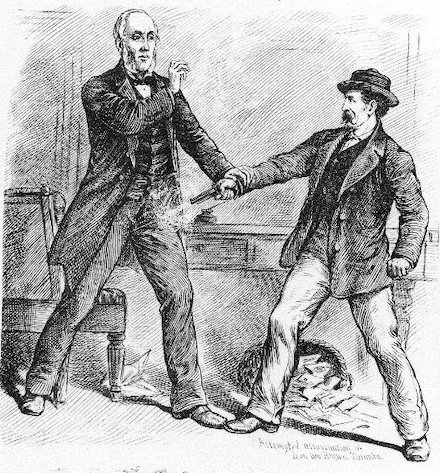
One wouldn’t think the injury pictured above would be fatal; indeed, the next day’s Globe exulted that “Yesterday afternoon one of the most seditious and dastardly attempts at murder ever made in this city took place in the private office of the Hon. George Brown in the Globe Building. Fortunately, owning mainly to Mr. Brown’s presence of mind and superior physical strength, the attempt was unsuccessful, the only results being a severe flesh wound to the thigh and the nervous prostration which is the inevitable result of such an encounter. Had the miscreant who made the murderous assault been a little more prompt in taking his aim, or had the pistol been of a different construction, the attempt could hardly have resulted so favourably, for he persisted in his efforts to effect his bloody purpose until he was overpowered and the weapon was wrenched from his grasp.” But the relief proved premature when the leg wound torn by Bennett’s bullet turned gangrenous and eventually — seven weeks later — killed Brown.

Monuments to the murdered statesman abound in Canada, including the Second Empire home he built and died in, preserved as the historic George Brown House, and George Brown College. His whiskered statue strides on Parliament Hill.

Brown’s widow returned to Scotland with her children, and the Canadian hero’s son George Mackenzie Brown followed his father’s career in both printing and politicking: per Wikipedia, “As a publisher, he produced Arthur Conan Doyle’s books; as a politician, he beat him to win election to the House of Commons.”

On this day..

1881: Albert and Charles Talbott, bad sons

Dr. Perry H. Talbott was among the most prominent citizens of Nodaway County, Missouri. In addition to being a skilled physician, Talbott was state legislator, a writer and a newspaper editor. He was a civic minded citizen with strong beliefs, highly admired by friends and neighbors. But towards his family, Dr. Talbott was cold and distant. Miserly and neglectful, he had little interaction with his children beyond the occasional scolding. When Dr. Talbott was shot by an unknown assassin on September 18, 1880, in his dying breath he blamed his political enemies. The Nodaway county authorities, however, believed the killer was someone closer to home.

-Profile of the July 22, 1881 Marysville, Missouri hanging of Albert and Charles Talbott at friend of he site Murder By Gaslight. Enjoy in full here.

On this day..

1821: Fulgencio Yegros, former Paraguay head of state

Fulgencio Yegros was executed on this date in 1821.

Yegros (English Wikipedia entry | Spanish) was one of the key conspirators in the 1811 mutiny that brought about independent Paraguay and subsequently the chief of the five-man Junta Superior Gubernativa — making him at least arguably Paraguay’s first head of state.

His run didn’t last long; by 1814, this career officer had been sidelined by a far more potent character, Jose Gaspar Rodriguez de Francia. Francia’s despotism drew resistance from Asuncion‘s Creole elites, including the retired Yegros, whose participation in an 1820 plot to overthrow the government was betrayed — and whose furious repression with dozens of executions initiates a period of absolute dictatorship marked as the “Franciato”, to terminate only with the man’s death in 1840.

Four days after his former 1811 revolution collaborator Pedro Juan Caballero committed suicide in prison — leaving scrawled on his prison walls the words “I know that suicide is against the law of God and man, but the Tyrant’s thirst for blood shall not be quenched with mine” — Yegros became part of the quenching. He and seven other conspirators, notably Dr. Juan Aristegui and Captain Miguel Montiel, were shot under an orange tree just outside Francia’s state residence, probably while the dictator himself watched. “Those not killed by the initial volley were dispatched by machete or bayonet, for the executioners, three in number, were permitted but one ball each per victim.” (Source)

On this day..

1894: Patrick Prendergast, mayor-murderer

Patrick Eugene Joseph Prendergast, a madman who assassinated the mayor of Chicago, was hanged on this date in 1894.

Prendergast seems to have been a mentally unbalanced character from his early childhood; one might speculatively attribute it to a youthful head injury, or the very early death of his father, or the strains of an impecunious life that pushed his mother to migrate from Ireland to New York.

The year of our Lord 1893 finds him making his way as a newspaper distributor and fixated on the election of Carter Harrison, Sr.* to his fifth non-consecutive term as mayor. Harrison secured the win and was sworn in during the spring of that year, in time to preside paternally over the Chicago World’s Fair.

Prendergast was an ordinary Chicagoan who had extraordinary expectations from the Democratic machine. In a situation reminding of the nutter who murdered President James Garfield when he wasn’t appointed ambassador to France, Prendergrast anticipated from his political cause the boon of patronage vastly outstripping his rank. In Prendergast’s case, that meant an expected appointment as the city’s Corporation Counsel, which would have been as lucrative as it was unmerited.

When that didn’t happen, Prendergast did what any concerned citizen would do and called personally at the mayor’s house to shoot him dead.

The man’s lucidity was the only real question in the courts and — again like Garfield’s assassin — they decided he was sane enough for gallows. Notably, he was defended in a post-conviction sanity hearing (though not at trial) by 37-year-old Clarence Darrow. Not yet a legend, Darrow by this quixotic turn signals his life’s imminent pivot from established corporate lawyer — which was the job he held at the time of representing Prendergast — to populist crusader — which was the mission he embarked upon within a few weeks, resigning like a king from the railroad that employed him to represent the militant who was leading a strike against that railroad.

In his eventful life, Darrow was involved in some 50 murder cases, many of the headline variety. Prendergast was the only man ever represented by Darrow who swung.

He makes a brief and ranting appearance in the 1991 made-for-TV movie Darrow, seen below from about 8:30.

* Not to be confused with his son, Carter Harrison, Jr., who would also go on to win Chicago’s mayoralty.

On this day..

1822: Gullah Jack

The slave Gullah* Jack was executed by South Carolina on this date in 1822, for his involvement in Denmark Vesey‘s attempted rebellion.

Angola-born, he’d been imported to the United States by prolific Florida slave-trader Zephaniah Kingsley. Kingsley described Jack as a priest in his own country, and whilst owned by a Charleston man named Paul Pritchard he’s known to have been involved in that city’s African Methodist Episcopal congregation — the same frequented by Vesey.

The late historian Sterling Stuckey parses the simpatico between Vesey’s insurrectionary Christiniaty and Gullah Jack’s Angolan mysticism in Slave Culture: Nationalist Theory & the Foundations of Black America, referencing testimony elicited by the tribunal investigating the Denmark Vesey conspiracy.

Gullah Jack’s sentence
9th July, 1922 — Jack, a slave belonging to Paul Pritchard, commonly called GULLAH JACK, and sometimes COUTER JACK, was brought up, and sentence pronounced by L.H. KENNEDY, Presiding Magistrate.

JACK PRITCHARD — The Court, after deliberately considering all the circumstances of you case, are perfectly satisfied of your guilt. In the prosecution of your wicked designs, you were not satisfied with resorting to natural and ordinary means, but endeavored to enlist on your behalf, all the powers of darkness, and employed for that purpose, the most disgusting mummery and superstition. You represented yourself as invulnerable; that you could neither be taken nor destroyed and that all who fought under your banners would be invincible. While such wretched expedients are calculated to inspire the confidence, or to alarm the fears of the ignorant and credulous, they excite no other emotion in the mind of the intelligent and enlightened, but contempt and disgust. Your boasted Charms have not preserved yourself, and of course could not protect others. “Your Altars and your Gods have sunk together in the dust.” The airy spectres, conjured by you, have been chased away by the special light of Truth, and you stand exposed, the miserable and deluded victim of offended Justice. Your days are literally numbered. You will shortly be consigned to the cold and silent grave, and all the Posers of Darkness cannot re[s]cue you from your approaching Fate! Let me then conjure you to devote the remnant of your miserable existence, in fleeing from the “wrath to come”. This can only be done by a full disclosure of the truth. The Court are willing to afford you all the aid in their power, and to permit any Minister of the Gospel, whom you may select to have free access to you. To him you may unburthen your guilty conscience. Neglect not the opportunity, for there is “no device nor art beyond the tomb,” to which you must shortly be consigned.

Vesey used Christian radicalism to reinforce and rationalize his call to arms:

Though Vesey’s room was full I did not know one individual there. At this meeting Vesey said we were to take the Guard-House and Magazine and get arms; that we ought to rise up and fight against the whites for our liberties; he was the first to rise up and speak, and he read to us from the Bible, how the children of Israel were delivered out of Egypt from bondage.

Vesey’s brand of Christianity complemented the African religion of Gullah Jack. Jack drew on African cultural practices widespread in black Africa to encourage insurrection, preaching the conjurer’s doctrine of invincibility. His personality, from all accounts, was African and as intact, despite the horror of the Atlantic voyage, as one could expect of one grounded in the heritage of his people. Purchased in Angola, he “had his conjuring implements with him in a bag which he brought on board the ship, and always retained them” — tangible evidence of his belief that his God lived. Described as a small man, “a Gullah Negro, with small hands and feet and large whiskers,” Jack “kept alive African religious traditions,” offering recruits African religious symbols “to guarantee victory.” At a meeting at Vesey’s, “Vesey supported Jack, referring to him as ‘a little man named Jack, who could not be killed, and who … had a charm and he would lead them.'”

Jack Pritchard also called on me about this business — he is sometimes called Gullah Jack, sometimes Cooter Jack; he gave me some dry food, consisting of parched corn and ground nuts, and said eat that and nothing else on the morning it breaks out … and you can’t be wounded, and said he, I give the same to the rest of my troops.

William, “a Negro man belonging to Mr. John Paul,” testified against Gullah Jack, saying that “all those belonging to the African Church are involved in the insurrection, from the country to the town — that there is a little man amongst them who can’t be shot, killed or caught.” And he reported that there was a “Gullah Society [a society of Angolans] going on which met once a month.” … it hardly matters which “church” Jack attended, since he moved with ease in the Charleston setting, persuading with his mystic powers:

Until Jack was taken up and condemned to death, I felt as if I was bound up, and had not the power to speak one word about it — Jack charmed Julius and myself at last, and we then consented to join — Tom Russell the Blacksmith and Jack are partners, (in conjuring) Jack learnt him to be a doctor … Jack said Tom was his second and when you don’t see me, and see Tom, you see me. Jack said Tom was making arms for the black people — Jack said he could not be killed, nor could a white man take him.

He was publicly hanged together with a slave named John, owned by Elias Horry, on the morning of July 12 in Charleston; three others condemned for the same occasion had their sentences respited for a week. There’s a recent book focused on surfacing this amazing character, A Documented History of Gullah Jack Pritchard and the Denmark Vesey Slave Insurrection of 1822.

* “Gullah” still today refers to the culturally distinctive coastal Lowcountry African-Americans and to their still-extant creole tongue. The term apparently derives from “Angola” and was in general use to describe people from that part of Africa — as with this advert for slaves to be sold on January 27, 1806, printed in the same day’s Charleston Daily Courier:

On this day..

1855: Pietro Fortunato Calvi, the last Belfiore Martyr

Italian Risorgimento martyr Pietro Fortunato Calvi was hanged on this date in 1855 in Mantua.

The son of a Paduan police commissioner when that province rested in Austrian hands, Calvi — that’s an Italian link, as are almost all in this post — was an army lieutenant who was drawn by the swirl of patriotism into the Revolutions of 1848. He commanded a 4,600-strong militia in Venice where the abortive proclamation of a republic was suppressed by Austria.

He fled to exile in Turin, then part of the mainland remit of the independent Kingdom of Sardinia. But his sympathy for an attempted Milanese insurrection in those parts wore out his welcome with his new hosts, and he was obliged to find refuge in Switzerland.

From there, he and four companions launched a romantic, doomed expedition to sound out the alpine north for patriotism that might be stirred into revolution anew. Their mission was compromised by a spy, however, and the quintet was soon arrested.

Transported to Mantua for trial, Calvi successfully protected his companions by throwing all the responsibility upon himself and went to the gallows with a stirring declaration as he ought.

what I have done I have done of my own free will, that I would do it again, in order to expel Austria from the States it so infamously usurped … Pietro Fortunato Calvi, rather than betraying his homeland, offers his corpse.

The place of his execution, the valley of Belfiore, has conferred its name upon a host of Italian patriots who hanged there in the 1850s. Our guy Calvi was the last of these Belfiore martyrs.

Belfiore, Mantua, Padua, Venice, Turin, and all the rest were part of a united Italy within a generation.

Italian speakers might enjoy this biography of Pietro.

On this day..

1863: William Lynch, suppressed mutineer

(Thanks to Edward Waldo Emerson, the son of transcendentalist chin-wagger Ralph Waldo Emerson, for the guest post. His account of the beloved Massachusetts cavalryman Charles Russell Lowell’s lethal suppression of a mutiny in his civil war regiment, as related to him by Lowell’s widow for his, Emerson’s, 1907 biography Life and Letters of Charles Russell Lowell. Lowell can’t speak for himself on this account because he was killed the next year at the Battle of Cedar Creek, after which he was posthumously promoted to Brigadier General.

Emerson does not directly narrate a death penalty story, but the image in the coda records the fate of one of the rebellious enlisted men. There were two others in legal jeopardy from this affair: Sylvester Riley died while awaiting his court-martial in Fort Independence in Boston Harbor; and, 16-year-old Francis Dew drew a death sentence which was commuted by President Abraham Lincoln on account of Dew’s youth. -ed.)

Mrs. Lowell, anxious that the exact facts be known, wrote for me this account of the

MUTINY IN BOSTON.

A very painful incident took place while Colonel Lowell was recruiting for the Second Cavalry, which impressed him very much.

Stopping as usual, at eight o’clock one morning, at the recruiting station, he found the small squad of new recruits who were to be transferred that day to the camp at Readville, in a state of mutiny. Hearing the noise on his arrival, he descended at once to the basement, and the Sergeant in command explained that he had ordered a man to be handcuffed, that the others had said it was unjust and should not be done, and had resisted. Colonel Lowell at once said: ‘The order must be obeyed.’ ‘No! No!’ shouted the men. He continued: ‘After it is obeyed, I will hear what you have to say, and will decide the case on its merits, but it must be obeyed first. God knows, my men, I don’t want to kill any of you; but I shall shoot the first man who resists. Sergeant, iron your man.’ As the Sergeant stepped forward with the irons, the men made a rush, and Colonel Lowell shot the leader, who fell at once. The men succumbed immediately, some bursting into tears, such was their excitement.

The whole incident was very painful to Colonel Lowell, especially because he had always regarded it as one of the privileges of an officer that he did not have to kill with his own hand.

The circumstances, however, turned out as fortunately as was possible in such a case. The man had no relatives, so far as could be discovered, and his record showed that he was a very bad man, and had previously been in the Regular Army, so that he knew very well what he was doing in resisting an order.

One of Governor Andrew‘s staff, who was present when Colonel Lowell reported his action, gave the following account, which I copy from Professor Peirce’s life of Lowell in the Harvard Memorial Biographies:

Entering his Excellency’s room, he made a military salute and said, ‘I have to report to you, sir, that in the discharge of my duty I have shot a man’; then saluted again, and immediately withdrew. ‘I need nothing more,’ said the Governor to a bystander, ‘Colonel Lowell is as humane as he is brave.’

On this day..

1825: Odysseus Androutsos

On this date* in 1825, Greek revolutionary Odysseus (or Odysseas) Androutsos was summarily executed as a traitor by his comrades.

Fruit of Ithaca like the immortal hero of the same name, Androutsos joined the uprising that became the Greek War of Independence and repelled the numerically overwhelming forces of the cruel Ottoman governor Ali Pasha that had lately crushed Athanasios Diakos.

This upstart victory at the Battle of Gravia Inn might have been decisive in saving the independence bid from being destroyed in its cradle. In its day it established Androutsos as one of the major commanders of the revolution, good enough for unprincipled English rogue and Lord Byron crony Edward John Trelawny to fall in with long enough to marry Androutsos’s sister.**

According to the Scottish historian George Finlay — another British interloper in this war — many of the warlords who prosecuted Greek’s revolution are best viewed in the perspective of klephts or hajduks: an archetype combining anti-Ottoman insurgent and opportunistic brigand, making for themselves on treacherous terrain. “Odysseus never attached any importance to political independence and national liberty,” Finlay opines. “His conduct from the commencement of the Revolution testified that he had no confidence in its ultimate success. He viewed it as a temporary revolt, which might be rendered conducive to his own interests.”

Installed in eastern Greece, it was only natural that such a figure would consider cutting deals with the Ottomans. Androutsos’s brief and little-harmful defection was prosecuted as treason by his comrades — his execution on Athens’s Acropolis conducted by his former second-in-commannd, Yannis Gouras — but countrymen down the years have been quite a bit more understanding. The Greek government reconsidered its malediction and in 1865 reburied Androutsos with honors; his grave is never since to be found without the garlands of admiring posterity.

* June 5 is the Julian date, an exception from our normal Gregorian preference in the 19th century because, well, it’s a national hero of an Orthodox polity. Nevertheless, the Gregorian June 17 can be found mentioned here and there, including even on Androutsos’s cemetery stele.

** Trelawny dumped her when his Greek holiday had run its course, and he returned to England a bachelor.

On this day..

1868: Thomas Griffin, gold commissioner

On this date in 1868, disgraced Australian gold commissioner Thomas Griffin was hanged for murdering two police escorts in the course of a robbery.

He was an Irish-born constable who parlayed decorated service in the Crimean War into emigration to Australia.

There he lodged himself in the policing ranks and by dint of energy and charm worked his way up by late 1863 to the administrative post of gold commissioner in the emerging gold rush boom town of Clermont, Queensland.

“During his four years’ residence at Clermont, Griffin became widely known in the district,” according to The Early History of Rockhampton by a working journalist who knew Griffin, J.T.S. Bird.

In addition to being physically a fine manly-looking fellow, he had a very suave and attractive manner, and readily gained the favour and friendship of those whom he desired to stand well with.* To those under him he was as a rule distant and overbearing, and was by no means well liked … Ostentation and vanity, with a fondness for display, were leading traits of his character, and were noticeable to all who knew him.

One index of his no means well-likedness was the community petition that deposed him from his post in September 1867. It seems that Griffin had formed a reputation as “despotic, arbitrary and partial,” made himself a fixture of gambling dens, and had been investigated for embezzling mining revenues that he was supposed to hold in trust.

Demoted to a lower position in the same bureau in nearby Rockhampton, Griffin immediately vindicated his critics by arranging to accompany the next “gold escort” transporting valuables between Clermont and Rockhampton, along with troopers Patrick Cahill and John Power. En route, Griffin gunned the two men down by surprise on the Mackenzie River, making off with about £4000 in notes (not gold). He then unconvincingly presented himself back in Rockhampton as having separated naturally from the party, surprised as anyone that the other two hadn’t returned. Although he participated in the initial search, he was arrested within days.

Bird has a lengthy narrative of the investigation and trial; one notable aspect was early forensic experimentation with shooting sheeps’ skulls in an attempt to model the damage done by the gunshots received by the unfortunate guards — further to demonstrating that they were murdered execution-style at close range rather than shot from a distance as a wilderness brigand might do.

Suffice to say that no matter the spattering of ruminant brains, Griffin’s foul reputation made his pretense of innocence completely untenable, even though he continued it all the way to the gallows.

After a prayer at the foot of the scaffold, Griffin stood up and Mr. Smith said:

I shall meet you at the judgment seat of God; you have but a few minutes to live, and in the sight of God who is to judge between us all, I ask you will you not acknowledge your guilt?

Griffin drew himself up and said in a resolute voice, “No!”

He went up the first of the scaffold steps two or three at a time, finishing the remainder with a firm step. Stepping on the drop, he came promptly to “attention.” Griffin told the executioner [John Hutton] he had nothing to give him, but if he saw Mr. Brown he would give him something. The hangman then asked if Griffin had anything to confess.

Griffin replied in a firm voice: “No, I have nothing to confess!”

The white cap was placed in position, and Griffin, as though impatient at any delay, said: “Go on, I am ready!” The bolt was drawn, and death followed instantly.

Griffin had frequently told Dr. Salmond and others that he would die with calm firmness, and he was as good as his word.

His was the first of nine executions recorded at Rockhampton Gaol. A week after the hanging, Griffin’s grave was robbed and his head stolen.

* One early indicator of the man’s character was his seduction of a wealthy widow on the very ship he took to Australia. After quickly dissipating her fortune, he parted ways with her by publishing a fake death notice in the newspaper.

On this day..

1831: Ciro Menotti, hero to Garibaldi

Italian patriotic hero Ciro Menotti was hanged on this date* in 1831.


Marker in Modena to the martyrdom of Ciro Menotti and Vincenzo Borelli. (cc) image from Filippo Fabbri.

Menotti (English Wikipedia entry | Italian) was a member of the revolutionary carbonari who stood at the fore of an insurrection in northern Italy in 1831. The plot was sponsored by the Duke of Modena and quashed by the same when he realized its premature exposure compromised its utility as a vehicle for expanding his dominions. The arrival of Austrian troops in March of 1831 swiftly pacified the risings.

In tribute of Menotti, national patron saint Giuseppe Garibaldi named one of his sons for him — Menotti Garibaldi, later a deputy in the parliament of the independent and unified Italy whose realization had been the common quest of both his namesakes.

* There are some citations out there for May 23, rather than May 26. This appears unambiguously mistaken to me (witness the date on the monument pictured in this post); I haven’t been able to determine the initial source of the discrepancy.

On this day..