2006: 27 at Abu Ghraib Prison

On this date in 2006, 27 hanged in Baghdad’s notorious Abu Ghraib Prison.

It was just days after the American occupation forces handed back to the Iraqi government control of Abu Ghraib, scene of such iconic contributions to the annals of human rights abuse as this:

Iraqi prisoners would soon miss the old boss.

In the first (known) mass execution since the reign of Saddam Hussein — whose own turn at the gallows was just a few months away — 26 men and one woman were hanged on a variety of terrorism, murder and kidnapping charges.

“This is the message I have for the terrorists,” Prime Minister Nouri al-Maliki said in announcing the executions. “We will see that you get great punishment wherever you are. There is nothing for you but prison and punishment.”

On this day..

2007: Duan Yihe, mistress-murderer

On this date in 2007, former senior Chinese lawmaker Duan Yihe was executed in Jinan along with the policeman nephew who had helped him spectacularly assassinate Duan’s mistress just two months before.

Taking up with a teenager 30 years his junior must have been an appealing perk of the job when Duan Yihe was a rising official in the early 1990’s.
Fast forward 14 years, and he’s in for several cars, a couple of apartments, and tired of the now 31-year-old Liu Haiping, who’s blackmailing him for more. Much less appealing.

Solution?

Why, detonate a remote-controlled explosive in her car.

“The blast was so powerful that her Honda sedan was ripped apart, her lower body was destroyed and her torso landed 30 metres away,” reported The Times.

The case helped crystallize growing official concern with the corrupting potential of senior officials’ ubiquitous mistresses. The day before the car-bombing, the Chinese Supreme Court issued a ruling extending anti-graft laws to mistresses.

The method of execution (either gunshot or — more likely — lethal injection) was not publicized.

On this day..

2004: Dhananjoy Chatterjee, the last hanged in India … for now

On this date in 2004, Dhananjoy Chatterjee hanged at Calcutta’s Alipore Central Jail for the 1990 rape-murder of 14-year-old Hetal Parekh.

Chatterjee’s hanging also brought into the limelight the garrulous, publicity-hounding 84-year-old executioner Nata Mallick, who conducted the hanging with his son and grandson and told anyone with a microphone stories of the hangman’s glory days.

Those days are long past on the subcontinent.

Among death penalty countries, India is the anti-Singapore: despite its billion-plus population, death sentences are vanishingly rare. Chatterjee is not only the most recent person hanged in India as of this writing, but the only one hanged there since 1995.

One actual hanging in fourteen years for a billion-person country? The only lower execution rate would be actual abolition.

Chatterjee may be relieved of his milestone distinctions in the not-too-distant future, however. (Where “not-too-distant” by the standards of the Indian death penalty might still mean years away.)

Mohammad Afzal, condemned for the 2001 terrorist attack on the Indian Parliament, has become a political lightning rod; India’s conservative Hindu party Bharatiya Janata Party (BJP) has made political hay pushing for Afzal’s execution.

Update: A different Pakistani terrorist, Ajmal Kasab, became the next hanged after Chatterjee in 2012. Afzal Guru got his in February 2013.

On this day..

2005: Mahmoud Asgari and Ayaz Marhoni, gay teens

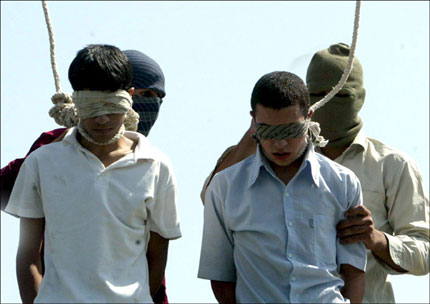
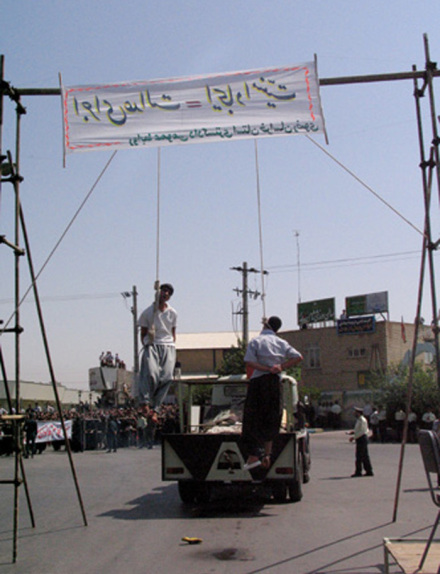
On this date in 2005, two teenagers were hanged in Mashhad, Iran.

Affecting photos of these two youths, their faces etched in fright and grief, their 16- and 18-year-old bodies pitifully boyish next to their executioners, became an immediate worldwide sensation.

These shocking images were quickly followed by a storm of controversy. The crime for which Asgari and Marhoni swung was the rape of a 13-year-old while both the offenders were themselves minors; gay organizations and human rights groups subsequently became mired in contentious dispute over whether (as a factual, legal, or tactical matter) they could be said to have succumbed to a “lethal reign of terror targeting Iranian gays”. For instance, was the conviction reliable, or a pretext? Would these boys actually have self-identified as “gay”?

To that were added charges and countercharges among western campaigners of racism, imperial lickspittle-ism, objective-pro-Islamic-fascism, and the like. Like, awfully convenient that Iran’s longtime dim view of homosexuality has everyone exercised at just the moment bombing Tehran was being openly mooted.

But whatever the text: those pictures. Still, those pictures.

It is certain that both Mahmoud Asgari and Ayaz Marhoni were juvenile offenders, whose execution is anathema almost everywhere in the world but Iran — just one of that country’s unique characteristics.

On this day..

2008: Tseng Fu-wen, drug dealer

June 26 is U.N. Anti-Drug Day, and if this year follows the recent trend, China will be marking the run-up with the salutary execution of consumers and/or vendors of chemical compounds disapproved by the state. (Update: Yes indeed it did.)

On June 24, 2008, for instance, Tseng Fu-wen, “a Taiwanese citizen who was convicted of producing or selling methamphetamine, heroin and other drugs,” was put to death in the eastern province of Fujian.

Two accomplices drew a prison sentence and a suspended death sentence (typically commuted to a prison sentence after two years).

Prosecutors said the Taiwanese trio started making drugs in October 2006.

Police arrested them one month later in Xiamen after they bought 50 kilograms of ephedrine to make methamphetamine, commonly known as “ice.”

The police also recovered 63.8 kilograms of ice, plus “varying quantities of other drugs such as heroin, and equipment and raw material in a workshop,” the agency said.

The method of execution does not appear to have been reported by the state media; China uses both lethal injection and gunshot, but I have not been able to document which method prevails in Fujian.

On this day..

2008: Anandrao Sainu Koram, Naxalite informer

Last year on this date, India’s Maoist “Naxalites” publicly beheaded a former comrade who had surrendered and collaborated with police.

Naxalites.

The incident that occurred in village Murgaon of Dhanora sub district has the entire Maoist-affected region in the grip of tension because of the manner in which the reprisal has been carried out.

A group of 40 to 50 Maoists went to the village Saturday night, called out Anandrao Sainu Koram from his house, tied him to a tree and beheaded him in full view of the villagers who had gathered at the spot, deputy superintendent of police Anant Rokde said Sunday.

“They also warned Anandrao’s colleague Shantaram Gawde, who too had surrendered to the police in April this year along with three others, that he would meet the same fate if he did not desist from acting as an informer,” Rokde told IANS on the basis of the complaint lodged by Anandrao’s wife.

The 23-year-old Koram was reportedly the fourth surrendered Naxalite slain by insurgents in as many months of the long-running and escalating conflict … which, needless to say, has been dire for civilians.

On this day..

2001: Zhang Jun and his gang

On this date in 2001, an infamous crime lord and 13 members of his gang were put to death in two Hunan Province cities.

Suave serial bank robber Zhang Jun had a reported 28 deaths on his conscience, including such underworld classics as forcing a lover to execute someone in order to prove her loyalty, in a years-long spree of robbery and mayhem. He was a major catch early in China’s execution-rich “strike hard” crime crackdown.

Despite-slash-because of the body trail, the cool Zhang — who appeared in court dressed modishly and flaunting such indifference to death that he disdained to defend himself — attracted a strain of fandom for his “gangland chic”.

He’s kind of like the gangsters in the movies, really likable.

The authorities, and his many victims, liked him less.


A still shot from the broadcast of Zhang Jun’s trial.

According to Courts and Criminal Justice in Contemporary China, the gang’s trial had the distinction of being the first ever broadcast live in China.

Zhang Jun’s trial was notable for its ripples in other media as well. The Committee to Protect Journalists reported that several writers and editors were demoted or fired after publishing a story in Nanfang Zhoumo (Southern Weekend) exploring the gang’s roots in poverty and inequality … a take deemed inimical to the dialectical historical march of the Peoples’ Republic. (See here for some of the more approved commentary angles.)

On this day..

2003: Three ferry hijackers

On this date in 2003, three men who commandeered a Havana harbor ferry and made a bid for American waters were shot as Cuba cracked down hard on a wave of hijackings.

Things moved extremely quickly for Lorenzo Enrique Copello Castillo, Barbaro Leodan Sevilla Garcia and Jorge Luis Martinez Isaac, described as “the three principal, most active and brutal leaders” of a gang of about 10.* It had been less than two weeks before that they seized the Baragua and ordered it to head for Florida.

The ship ran out of fuel, and the Cuban Coast Guard towed it back to Mariel. There were no injuries reported among the 50 passengers.

In the context of a then three-year-old moratorium on executions on the island, this probably would not have been enough to cost the ringleaders their lives, save that Fidel Castro perceived the need for a salutary example.

Despite the Yankee’s post-9/11 reprobation of “terrorism,” its definition of the phenomenon retained the familiar geopolitical biases — who is and is not a terrorist when it comes to Cuba is driven by anti-Castro Cuban exiles’ outsized political weight in Florida.

So Havana had some alarm to observe a spate of hijackings: two passenger planes had been redirected to Key West in the previous two weeks, and the passengers therefore offered American residency.

Accusing the U.S. of abetting terrorism — Washington blamed Cuba’s airport security — the government sent its own message when the Baragua desperadoes made it three hijackings in a fortnight.**

The Cuban Council of State, including Castro himself, reviewed the charges directly and gave the go-ahead to the shootings.

Hijackings did indeed stop.

Still, such a severe reprisal so swiftly enacted drew sharp rebukes from human rights advocates and even Cuban allies abroad.

Whether chastened by the reaction or just because it was indeed an exceptional circumstance, Cuba subsequently reverted to its de facto moratorium, and has not executed anybody else since this date six years ago. In 2008, Raul Castro commuted most of the extant death sentences in Cuba, leaving only three people — condemned on terrorism charges — still potentially in danger of execution.

* Others drew prison sentences ranging from a few years to life.

** The Cuban government claimed to have prevented yet another attempted skyjacking the night before the execution.

On this day..

2001: Mariette Bosch, love triangulator

On this date in 2001, Botswana secretly hanged creepy South African emigre Mariette Bosch for whacking her neighbor in order to steal the neighbor’s husband.

That the black widow was actually white only threw the lurid scenario into sharper relief. In the well-heeled enclaves of Gaborone, one Ria Wolmarans was found shot dead in 1996, and inside a month her former husband Tienie Wolmarans had moved in with Mariette Bosch.

The big break in the case came from Mariette’s sister Judith, to whom the murderess had unguardedly confided her love for Tienie prior to the shooting. (The lovebirds’ official story was that their loins only heated up as Ria Wolmarans’ body cooled.) Judith got ahold of the 9mm Mariette had borrowed and handed over to the police what proved to be the murder weapon.

Although the courts found Mariette’s erratic defense — something about hypnotism and her victim’s boss — absurdly implausible, her elite status helped make her the lightning rod for capital punishment in Botswana.

The international attention she attracted, however, simultaneously pressured the government to close the books with a very speedy hanging.

Bosch was hanged at 6 a.m. this date upon 24 hours’ notice to herself and none whatsoever to the outside world: Tienie — who always avowed disbelief that Bosch killed his wife — was turned away from the prison on what he figured was a routine visit the previous day, and found out about Bosch’s execution with the rest of the country when it hit the news two days later. Bosch had to go her last day on earth alone.

Although it remains an emblematic case, Bosch’s disposal hasn’t exactly changed Botswana’s hanging protocol: brief appeals process, executions in secrecy, scant prospect of clemency. The country’s politicians make no apologies about it, notwithstanding the high-profile work of its domestic human rights organization Ditshwanelo. (Here’s its statement on Bosch.)

On this day..

2006: Yuan Baojing, gangster capitalist

On this date in 2006, one of Beijing’s wealthiest plutocrats (along with two of his relatives) caught a lethal injection for the shady side of his business.

Yuan Baojing, “stock market whizzkid”, had risen from the nameless masses of China’s countryside to prosper in “Red” China’s authoritarian capitalism.

Though worth billions (or at least hundreds of millions), Yuan went down over the trivial sum of $9 million — the amount he reckoned a business associate had taken by fraud.

But then, it’s always impolite to count the corpses stuffed into the pillars of capital. The surprise here is that Yuan got caught: he’d hired a dirty cop to kill that business partner, but after the plot failed the cop started blackmailing the tycoon. Yuan responded by hiring his brother and cousin to pop the cop.

Yuan survived a scheduled execution the preceding October by transferring billions in assets to the Chinese government — understandably triggering some complaints about fair play.

Those billions bought him five months.*

On this date, he and his hirelings were given a public trial in Liaoyang, followed by an immediate lethal injection in one of China’s mobile execution vans.

* The mogul’s wife, Tibetan dancer Zhou Ma, was herself swindled during this period as she spread around cash trying to save her husband’s life.

On this day..