2005: Mohammed Bijeh, the desert vampire

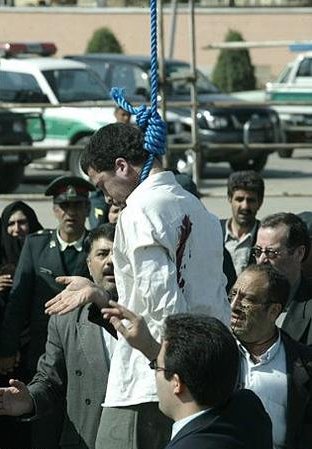
On this date in 2005, Iran “desert vampire” was flogged to the point of collapse and hanged before a bloodthirsty throng in Pakdasht.


Mohammed Bijeh collapses during his flogging (top); then, as he is hoisted by a crane — with what one would take to be the stab wound from a victim’s brother visible on his back. More frightful photos of this execution here.

Bijeh confessed to raping and murdering 16 boys age 8 to 15 over a yearlong spree.

His modus operandi? Lure them into the desert on the pretext of hunting animals.

Unsurprisingly a figure of intense public hatred, Bijeh stolidly endured his own death before a jeering mob.

Riot police held back the angry crowd, but at one point a brother of one of the victims managed to break through and stab Bijeh in the back.

After 100 lashes, the desert vampire was noosed to a crane arm by one of the victims’ mothers, and hoisted 10 meters into the air for public strangulation, to the cheers of onlookers who had to be restrained from savaging the body when it was finally brought down.

An accomplice, Ali Baghi, somehow avoided execution and got off with whipping and a prison term.

On this day..

2004: Ibtisam Hussein, child-murderer

Five years ago today, in Jordan’s Swaqa Prison, a 24-year-old woman named Ibtisam Hussein was hanged for drowning two young children in the Jordan Valley canal in 2002.

Ibtisam Hussein (or Ibtisam Hussain) was the only known execution in Jordan in 2004, after a manslaughter conviction was upgraded on appeal. The unfortunate five- and six-year-old victims belonged to members of her fiance’s family who opposed the engagement to Hussein … evidently with good reason.

The rope reportedly broke on the first attempt; she was executed successfully on a second try an hour later.

On this day..

2003: Richard Edwin Fox, bogus job interviewer

On this date in 2003, Richard Edwin Fox was put to death by lethal injection at the Southern Ohio Correctional Facility for murdering 18-year-old Bowling Green student Leslie Keckler in 1989.

Fox had plucked Keckler’s phone number from a job application she submitted to the Bob Evans restaurant where he worked as a short-order cook, then lured her to a phony job interview.

On the pretext of taking her on her prospective “sales route,” Fox drove Keckler to a rural area outside of Bowling Green where he stabbed and strangled her to death.

Creepily, the exact same modus operandi was linked to another woman whose meeting had been more fortunate than Keckler’s. Marla Ritchey met Fox — posing as “Jeff Bennett” — for a similar interview, and after she realized it was a hoax,

[Fox] asked her what she would do if someone pulled a knife on her and asked her for all of her money or asked her to do “other things” at which point Ritchey did jump out of the [parked] car. The man then attempted to grab Ritchie and told her to come back and as Ritchey ran for her car the man immediately pulled away. (Account from Death Penalty USA: 2003-2004)

Fox left an orphaned daughter (then aged 20) who had pled for her father’s life. Keckler’s brother spoke to the media for the victim’s family afterwards, remarking,

“The family feels justice has been served, that Leslie and my mother can now be at peace.”

On this day..

2006: A female spy by al Qaeda

On this date three years ago — or at least, so says the date in the camera’s viewfinder — a female spy was “tried” and “executed” in Iraq by al Qaeda affiliated terrorists for spying.

Warning: This is (by design) a graphic and chilling video. I have little information beyond the assertion of the video posters as to its veracity. Whether or not it may be relied upon factually or dated reliably, it’s a gut-twisting video of a woman being shot in the head.

[flv:http://www.nothingtoxic.com/mediar.php?552d90ab9f59a971705f6bf3300da297.flv 440 330]

A longer version is on a very not-safe-for-work site here.

On this day..

2001: Larry Keith Robison

(Thanks to Kristin Houlé of the Texas Coalition to Abolish the Death Penalty for the guest post, adapted from her Mental Illness and the Death Penalty Resource Guide (pdf link). Kristin blogs at Prevention Not Punishment. -ed.)

A mentally ill man who had been refused treatment because his condition had not yet turned him violent suffered lethal injection in Texas eight years ago today for finally turning violent.

Larry Robison was diagnosed with paranoid schizophrenia at the age of 21, three years before the murders for which he was sentenced to die. He began hearing voices and acting strangely as a teenager, claiming to have secret paranormal mental powers and the ability to read people’s minds and move objects from a distance. He joined the Army but was discharged after only a year.

Robison’s parents sought help and warned mental health authorities of their son’s erratic and increasingly aggressive behavior, but were told that the state could offer no resources unless he turned violent. He was shuffled in and out of mental hospitals, admitted after aggressive behavior and released after a period of medicated passivity. He received no regular, ongoing treatment. Robison was not covered by his parents’ insurance, nor did he have his own.

Robison claimed that voices in his head, which came through the clocks in his room, spewed out warnings about Old Testament prophecies of the Apocalypse and told him to murder, behead, and mutilate his roommate, Bruce Gardner. Robison then went next door and murdered four of his neighbors. When authorities arrested him, he told them that he had committed the murders in order to “find God.”

The four prosecutors developing the case against Larry Robison recognized his past history of mental illness and were willing to accept an insanity plea in exchange for life in a mental institution. The Tarrant County district attorney overruled them, however, and ordered them to seek a death sentence. In the courtroom, most evidence of Robison’s mental illness was ruled inadmissible, so the jury heard little of it. None of the three doctors who had diagnosed Robison before the crime as suffering from paranoid schizophrenia were called to testify at his trial. The jury rejected his plea of not guilty by reason of insanity.

Once in prison, evidence of Robison’s mental illness continued to accumulate. The Texas Court of Criminal Appeals stayed his execution at one point, doubtful as to whether or not he was competent to be executed. When asked what the execution would be like, Robison replied that he felt like “a little kid at Christmas time waiting for Santa Claus to come.” Eventually, he demanded that his lawyers cease filing appeals based on his mental illness, but only if the state agreed to execute him on the night of a full moon. Despite protests from mental health organizations and concerned citizens throughout the world, the state complied.

Larry Robison’s case drew attention largely as a result of the tireless efforts of his own family, taking a public profile unusual for the family of the condemned. CBS News’ 48 Hours profiled the Robisons shortly before Larry’s execution. They continue to maintain a website, larryrobison.org; mother Lois Robison remains a vocal critic of executing the mentally ill, and delivered this address to a Murder Victims’ Families for Human Rights conference last fall.

On this day..

2003: Nobody in Illinois

Six years ago today, a scandal-plagued governor of Illinois cleared out the state’s death row.

Republican George Ryan, in a speech two days before the end of his term, announced a mass commutation for anyone under sentence of death in Illinois — 157 people plus 10 others with pending legal challenges to vacated sentences, and four condemned men pardoned outright.

[flv:https://www.executedtoday.com/video/George_Ryan_clemency_announcement.flv 300 225]

Once a pro-death penalty legislator, Ryan grew increasingly discomfited with the state’s administration of the error-prone ultimate sanction.

That “demon of error” was dramatically unveiled for Ryan by Anthony Porter, a mentally retarded death row inmate who fortuitously avoided execution by two days on a legal technicality, and was subsequently exonerated by Northwestern University journalism students.

Seen as part of a pattern of wrongful convictions — like that of Rolando Cruz, who was cleared in the early 90’s despite the dogged efforts of then-Attorney General (and present-day quasi-Senator) Roland Burris to execute him in the face of exculpatory DNA evidence.

The governor imposed a moratorium on conducting executions for most of his term, culminating with this day’s controversial (though it did score him a Nobel Peace Prize nomination) announcement. Maybe there’s just something in the water at the Springfield governor’s mansion that attracts its residents to impolitic death penalty interventions.

Successor Rod Blagojevich called Ryan’s blanket clemency “a big mistake”, and his formal continuation of the Ryan moratorium on actual executions has been a dead letter since inheriting a vacant death row meant that no capital case reached the end of its appeals on his watch.

For the favor of sparing Blagojevich the burden of handling a death warrant — although one doesn’t get the sense that Blago is the type for a troubled conscience — George Ryan has been unkindly repaid.

Now residing in federal prison on corruption charges, the ex-governor’s own clemency petition has been complicated by sensational allegations of Blagojevich’s graft.

That petition is addressed to an outgoing executive oppositely inclined on the death row commutation question. Ryan authorized one actual execution early in his term, and spared this day’s host; George W. Bush, his virtual mirror image, has issued one commutation and carried out 155 executions during his time as chief executive of Texas and of the United States.

George Ryan is reportedly skeptical of his prospects for receiving a pardon.

On this day..

2006: Three old men and a taxi driver

Two years ago today, Japan resumed executions after a break of more than a year with four hangings.

Septuagenarians Yoshio Fujinami (wheelchair-bound) and Yoshimitsu Akiyama (partially blind) both needed the guards’ assistance to reach the trap at Tokyo Detention Center, a mere hour after they were informed of their imminent demise.

Two other prisoners, 64-year-old Michio Fukuoka and 44-year-old Hiroaki Hidaka, were simultaneously hanged in Osaka and Hiroshima, respectively.

Hidaka, a serial killer, had dropped his appeals and thus died a mere 12 years after his crimes. Fukouka died maintaining his innocence of three murders from 1978-81 he said police torture had forced him to confess. The oldest men were on the hook for killings dating to 1975 and 1981. (Much more from The Japan Times.)

Talk about justice delayed.

In Japan’s strange death penalty system, the condemned might await death for decades only to be hanged, as these were, with next to no warning. Their families and supporters did not hear about it until after the deed was done.

These hangings, though protested, were not altogether unexpected, for a break in the Japanese Diet around the end of the year often heralds an appearance on the public stage by the gallows. (Look for them in 2008 as the Diet goes out of session starting today.) And a turnover at the top of the Justice Ministry had replaced a pol disinclined to authorize any hangings, the source of the long break between executions during a decade when Japan’s use of the death penalty has generally been intensifying.

Although at least one particularly pressing motivation for this date’s hanging will not be present this year. After the long hiatus, an anonymous official told a newspaper,

We absolutely wanted to avoid ending the year with zero executions.

But in 2008, Japan has already carried out more hangings than in any year since 1975.


A panel from former prison guard Toshio Sakamato’s “How the death penalty is carried out”. More here.

On this day..

2003: Liu Yong, for corruption

On this date in 2003, Liu Yong’s situation took a very abrupt turn for the worse.

The wealthy Communist Party member and Shenyang city legislator had been sentenced to death 20 months before in a corruption case for ordering the murder of a tobacco vendor as part of a mafioso racket of graft, extortion, black marketeering, and kindred mayhem.

When that sentence was reduced on retrial on a showing that Liu’s confession was extracted by torture, public outcry at the appearance of a well-connected insider getting off scot-free led the Supreme Court to take the unprecedented step of yet again re-trying a criminal case itself.

“According to China’s legal system, a criminal case can usually be tried only twice,” as China Daily lightly put it.

Amnesty International is less measured, and alleges that the irregular Supreme Court hearing was ordered by political insiders to buttress the credibility of the country’s anti-corruption drive — and to avoid setting any precedent that evidence of torture should mitigate criminal sentencing. (China certainly found defenders for the trial (the link is to an ugly layout of raw HTML).)

The high court handed down its sentence this very day, after which Liu was immediately hailed to one of China’s mobile execution vans, given a lethal injection, and cremated.

On this day..

2005: Elias Syriani, a family affair

On this date in 2005, North Carolina executed 67-year-old immigrant Elias Syriani at Raleigh’s Central Prison for the murder of his wife — despite the emotional clemency intervention of the couple’s children.

Syriani, an ethnic Assyrian driven from his native Jerusalem by al nakba who moved to the U.S. from Jordan through marriage to a Jordanian immigrant, had a stormy marriage hit the rocks in 1990. Teresa filed for divorce after a few years facing Elias’s violent objections to her westernized behavior.

Syriani responded by jumping her when she drove home one night, and stabbed her to death with a screwdriver in front of their 10-year-old child.

This case meandered forgettably through the bowels of the criminal justice system; the traumatized children moved on (.pdf).

Until the year before Syriani met his fate, when the mysteries of the human heart flipped the script.

The four children visited Syriani and found themselves forgiving their mother’s murderer … and forging an unexpected bond with the father they hadn’t known for a decade. They called it a miracle, a gift from their late mother to go from “hate, absolute hate, to love in a split second.”

The children — by then grown — became Syriani’s advocates for executive clemency, posing an unusual challenge for Gov. Mike Easley: in an environment that (rhetorically, at least) often counts on survivors’ rage and grief as arbiters of punishment, would he spare a father for killing a mother when the children said execution would redouble the family’s injury?

But commutations rarely happen — there’s just no percentage in them for politicians.

“After careful review of the facts and circumstances of this crime and conviction, I find no convincing reason to grant clemency and overturn the unanimous jury verdict affirmed by the state and federal courts.” (Easley)

This startling story became the subject of a 2007 documentary, Love Lived on Death Row

[flv:https://www.executedtoday.com/video/Love_Lived_on_Death_Row_trailer.flv 440 330]

The following are excerpts from an interview with the film’s Producer/Director Linda Booker originally conducted by Sean O’Connell of The Charlotte Weekly.

When did you first hear about/become interested in this story?

Back in July 2005, I was checking the weather on a local news website and scanning the headlines when the article about the Syriani siblings forgiving their father caught my eye. I think at first it interested me because I have been involved with our local domestic violence agency as a volunteer and fundraiser, but as I read the article something about their reconciling with and forgiving their father really touched me. At this point they had begun to share their story with the public and had just appeared at a domestic violence conference in Charlotte called “Hope to Heal.”

At what point did you get the idea to film the story in documentary form? How long did it take to complete the film?

It was an immediate reaction for me upon reading the article that their story might make a compelling documentary film. I printed it out and carried it around with me. But I was still finishing up interviews and editing my first documentary project “Millworker: the Documentary” so I didn’t act on it right away. Then several months later I learned that they would be speaking in Chapel Hill, close to where I live, and I thought, “okay, if I feel this strongly about this, here’s my chance to meet them and film their discussion.” So there I was, a relatively new filmmaker and very nervous about that first step, but I received permission to film that night. That’s also when I first heard about and met Meg Eggleston, who had been writing letters and visiting Elias Syriani on death row for four years and the Syriani sibling’s attorney Russell Sizemore, who was helping them through their father’s clemency appeal pro-bono. I came to learn that Meg’s friendship with Elias was an essential part of their father’s transformation and was such an interesting story in itself.

I started filming in October 2005, edited in the fall of ’06 and started doing preview screenings in early ’07. Since then the film has screened at film festivals and many grassroots screenings with various non-profits and faith groups as sponsors in the U.S. especially in North Carolina.

The Syriani children are open and honest in the film. Did you have trouble accessing them? Were they open to the idea of participating in the film, even though at this point it could not help their father?

I started filming interviews with Meg Eggleston and Russell Sizemore first who trusted that I was not trying to do a sensationalized story, but that I recognized the Syriani’s story of forgiveness was inspirational, regardless of the outcome of the clemency appeal. The Syrianis knew that I was working with Meg & Russ, but out of respect for all they were going through, I did not push the issue of their participation. About six months after the appeal, I wrote them about participating and subsequently we went to California and Chicago in the summer of ’06 to film interviews with them. While they know that a part of the discussion around the film will be capital punishment, the Syriani siblings have expressed that they want their story to live on in hope that their experience of surviving a domestic violence tragedy and the healing that came from forgiveness will touch people’s hearts and help others.

I think it’s because this case is so unique, but I found the film’s stance on the death penalty unclear. Can you, as the filmmaker, clarify your thoughts on the death penalty?

Well, I’ll take that as a compliment, because the documentaries I admire aren’t pounding you over the head with the filmmaker’s opinion. I can tell you that making this film made me face how I felt about the death penalty and I spent a lot of time researching and doing some deep thinking about the issue.

Needless to say it’s very complex, and it is completely understandable that feelings of anger and retribution can occur when you have lost a loved one to violence. We need to do more for those dealing with the aftermath of murder with as much support, assistance and counseling services as possible, especially children. But as I went to restorative justice forums and have met many people who belong to organizations such as Murder Victims Families for Reconciliation, I kept hearing stories about how the death penalty was causing more grief, stress and division in families that had experienced murder. Between making the documentary and doing the research, I came to the conclusion that I couldn’t support a system of justice that can possibly create more pain and victims in its wake and that was also irreversible and arbitrary.

On this day..

2008: The Bali Bombers

On this date — mere hours ago as of this writing — three of the most infamous terrorists in two nation’s histories were shot in a jungle clearing on Indonesia’s Nusa Kambangan Island.

“At around 00:15 am (1715 GMT Saturday) the three convicted men on death row, Amrozi, Mukhlas and Imam Samudra, were executed by firing squad,” said attorney general’s office spokesman Jasman Panjaitan.

“The autopsy results show that all three are dead. The family members are now bathing the bodies.” (Source.)

The men were taken from prison and tied to wooden crosses in the Indonesian prison island’s forest, where they were shot simultaneously by three separate firing squads for the October 12, 2002 bomb attack on the island of Bali that claimed 202 lives.

Though taking place in Indonesia, the strike was aimed at westerners vacationing at a tourist hot spot. Eighty-eight Australians were slain, along with 76 other (predominantly European) foreigners. The only shred of regret the late executees ever betrayed was that the infidel body count wasn’t higher.


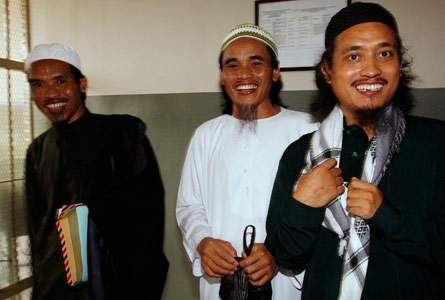
The mediagenic murderers display a range from insouciant to jocular in most of their photos. The ever-grinning Amrozi — in the middle — was known as the “smiling assassin.”

The three facing death today* have occupied most of the intervening six years endeavoring to transmute their criminal celebrity into the dearer coinage of martyrdom through the doubtful influence of the Philosopher’s Stone mass media.

Despite their body count, burial disturbances, and even the prospect of some follow-up strike by at-large members of Jemaah Islamiyah, a base metal the late bombers will remain. Picture the most fanatical devotee of any cause you care to conjure drawing any enduring inspiration from this juvenile twaddle.

Indonesia has appeared to sidle towards this execution, ginger at inflaming Islamic radicals; Australia, which has no death penalty itself, has been controversially mum and bombing victims and their families conflicted.

It remains to be seen whether the high-profile case has legs among militants. But its undertones of race, religion and national sovereignty are being very closely watched by one group of Australians in particular: the Bali Nine, Australian nationals in Indonesian custody for drug smuggling.

Three of the nine are currently on death row, reportedly “somber” at this day’s shootings — no doubt aware that they could be next.

Update: True to the publicity-savvy rep, Imam Samudra reportedly knocked out a nasheed or nasyid just before his execution that’s now a hot ringtone download.

[audio:Imam_Samudra.mp3]

* A fourth man was also death-sentenced, but that sentence was vacated on appeal.

On this day..