1879: Pocket, on the Hallettsville hanging tree

On this date in 1879, a half-blooded Native American named Pocket died in Hallettsville on an oak tree.

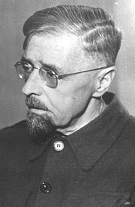
The son of a French Canadian father and a Blackfoot Sioux mother, Pocket had been befriended by a cattleman named Lou Allen. They met by chance in the early 1870s; Pocket was a half-caste child, maybe not even into adolescence, with broken English, doing odd jobs to scrape by.

Of Pocket we have only glimpses of the moments where he comes into the view of white men. His rancher-friend took him until “becoming tired of civilized life, and pining for the freedom of his native wilds,” Pocket vanished on a horse that Mr. Allen willingly gave him. (The quote comes from the Galveston Weekly News of September 18, 1879; it’s also the source for the other quotes in this post.)

That was in 1874. For the next several years Pocket’s activities are mostly unknown, save for the few times he popped back into Mr. Allen’s life — once to bum a suit of clothes; another time when they met by accident in Wichita, Pocket destitute after gambling everything away; and finally when Pocket reappeared in Lavaca County only to be refused aid by his benefactor in a possible gesture of tough love. Pocket found work on a nearby farm instead.

On Valentine’s Day 1878, Pocket was seen in the county seat of Hallettsville getting roaring drunk on whiskey. He left town for the countryside carrying another bottle and proceeded to stop at several farms to accost their residents.

At the Smith house, he barged in, stole a pistol, and forced his way into the family dinner. He stumbled into the home of a former slave named Frank Edwards, ripped up bed clothes, and started swinging an axe around until Edwards punched out the unwanted visitor.

Fuming, Pocket proceeded to yet another farm, the Petersons, where he contrived to get the family hunting rifle by representing the presence of a drove of turkeys nearby. A young Brit named Leonard Hyde worked for the Petersons, and he went along with Pocket “to see the fun.” As ominously as this reads, Hyde had no reason to suspect trouble; the Galveston Weekly News would note that Hyde and Pocket “were both under twenty-one years of age, friendly with one another up to the last moment, and both strangers in the land which has given to each of them a grave.” Two kids out on a turkey-shooting lark.

Hyde trotted along on foot after Pockett, and soon another of Hyde’s friends joined the supposed hunting foray. Suddenly, their intoxicated leader stopped and cursed Hyde for following him — then shot him dead through the forehead with his pistol. The killer’s mind was obviously disordered and impulsive, but it’s possible that Hyde died in place of Frank Edwards, or if not Edwards then whomever Pocket might have crossed paths with next that night.

Now with blood on his hands, Pocket did not pause to revenge any other slights but galloped off into the wilderness. He was eventually captured in Bosque County.


(Source, which also preserves a sad letter from Hyde’s father written in March 1878 upon learning of his son’s murder.)

Perhaps three thousand souls turned out to see a repentant Pocket die in Hallettsville on September 12, 1879 — “every road entering this town became alive with people of all ages, sexes and colors, without regard to previous condition, coming to witness the first legal execution in this county.” Pocket had spent his last weeks in religious devotion and struck those who saw him as a profoundly changed man.

The great hanging-tree can still be seen today, shading a picnic-table in City Park, next to the Hallettsville Golf Association clubhouse.

On this day..

1721: John Meff

John Meff hanged at Tyburn on this date in 1721 for returning from convict transportation.

If we are to credit the autobiographical account that Meff furnished the Ordinary of Newgate prior to his hanging, it was the last act in an adventuresome life. (Here’s the Ordinary’s account of the execution of Meff with three other men; here’s the Newgate Calendar entry based upon it, and which provides the quotes ensuing in this post.)

“I was born in London of French parents,” Meff begins — Huguenots who had fled Catholic harassment.

Huguenot refugees formed an important part of London’s Spitalfields weavers, and Meff apprenticed in this business until he could hang out his own shingle. But finding business too slow to support his family, he took to a bit of supplementary thieving.

Meff says that he had already once been condemned to death for housebreaking “but, as I was going to the place of execution, the hangman was arrested, and I was brought back to Newgate.”

Certainly the era’s executioners had frequent criminal escapades, but I have not found this remarkable Tyburn interruptus related in any press accounts in the 1710s. It’s possible that Meff is embellishing on the 1718 downfall and execution of hangman John Price — though Price was seized red-handed and not detained in the exercise of his office. This inconsistency has not prevented creation of a wonderful illustration, The Hangman Arrested When Attending John Meff to Tyburn, from this volume.

At any rate, Meff’s sentence was moderated to transportation to the New World, and he says that he “took up a solemn resolution to lead an honest and regular course of life … But this resolution continued but a short time after the fear of death vanished.”

Here Meff’s story really gets colorful — whether to the credit of the unsettled Atlantic economy or to the teller’s gift for embroidery we cannot say.

The ship which carried me and the other convicts was taken by the pirates. They would have persuaded me and some others to sign a paper, in order to become pirates; but we refusing, they put me and eight more ashore on a desert uninhabited land, where we must have perished with hunger, if by good fortune an Indian canoe had not arrived there. We waited till the Indians had gone up the island, and then, getting into the vessel, we sailed from one small island to another, till we reached the coast of America.

Not choosing to settle in any of the plantations there, but preferring the life of a sailor, I shipped myself on board a vessel that carried merchandise from Virginia and South Carolina to Barbadoes, Jamaica, and other of his majesty’s islands. And thus I lived a considerable time; but at last, being over-desirous to see how my wife and children fared inEngland, I was resolved to return at all adventures.

Once back, Meff says, he “quickly fell into my former wicked practices” — as if by gravity, no further explanation ventured. It’s hard not to suspect that he simply managed to escape his American indenture to continue a career in larceny, absent the whole marooned-by-pirates subplot. Men were known to tell tall tales to the Ordinary — who, after all, had their own story to sell the public through the deaths of their charges.

“The narrow escape he had experienced from the gallows ought to have taught him more wisdom than to have returned from transporation before the expiration of his time; but one would think there is a fatality attending the conduct of some men, who seem resolutely bent on their own destruction,” the Newgate Calendar’s entry concludes.

“One truth, however, is certain. It is easy, by a steady adherence to the rules of virtue, to shun that ignominious fate which is the consequence of a breach of the laws of God and our country.”

On this day..

1990: Charles Coleman, the first lethal injection in Oklahoma

Despite our occasional predilection for the odd “literally executed today” post, this macabre chronicle has never really aspired to focus on our subject matter’s breaking-news beat.

Nonetheless, the landscape of the death penalty has evolved noticeably in the years since we launched on Halloween 2007. Executions are down in China, but up in Saudi Arabia and Iran; India has ended a long death penalty hiatus; Pakistan began, sustained, and dramatically repudiated a death penalty moratorium.

And in the United States, the prevailing execution method, lethal injection, has fallen under a barrage of legal and political challenges.

Like the guillotine, the electric chair, the gas chamber, and weirder contraptions, the prick of the needle had once been sold as a Solomonic compromise between the executioner and his critics: you still get to kill a guy, but now he doesn’t feel a thing. This time we really mean it!

Lethal injection got some run in the Nazi T-4 euthanasia program but was first approved for regular judicial executions by Oklahoma in 1977, and first used by Texas in 1982. Where gas and electricity transferred industrial technology to the death chamber, with great metal chairs and huge switches like Dr. Frankenstein’s lab, injection analogized medicine: silent and light, and so sterile that the technicians would hygienically swab the skin before they pushed in the death-dealing needle.

Most of all it was sterile for the viewers, who had occasionally been subjected under the other processes to nauseating botches: men who were supposed to be dying instantly instead thrashing wildly away, catching fire, gushing blood, or requiring jolt after jolt to finish off. The electric chair surely owes its iconic cultural position in part to its reputation for spectacular failures.

When capital punishment got its 1970s reboot, it only seemed natural to think about cleaning up the how along with the why. Nearly everyone now had the experience of anaesthetic; it was natural to think that you could just put a man down like the family dog and not have any mess to clean up afterwards.

“Being a former farmer and horse raiser, I know what it’s like to try to eliminate an injured horse by shooting him,” future president Ronald Reagan had said in proposing the technology while he was still governor of California in 1973. “Now you call the veterinarian and the vet gives it a shot and the horse goes to sleep. That’s it.”

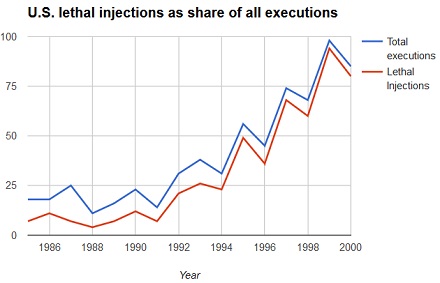
As executions surged in the 1990s, lethal injection was thoroughly displacing America’s previous humane technologies to become the overwhelmingly predominant method.


Data via the Death Penalty Information Center’s executions database.

And the state of Oklahoma, which had been first with a lethal injection law back in ’77, finally started rolling out gurneys — when it put murder Charles Troy Coleman to death with the needle on September 10, 1990. It was Oklahoma’s first execution in 24 years.*

It was Oklahoma’s medical examiner Jay Chapman who had formulated the three-drug cocktail that for a long time comprised the definitive lethal injection protocol: the short-acting barbiturate sodium thiopental, followed by the paralytic drug pancuronium bromide, capped with potassium chloride to stop the heart. Why three drugs, Human Rights Watch later asked him? “Why not?” Chapman was not a pharmacologist and had little expertise with the drugs in question.

Nevertheless, his process “could not be construed as cruel and unusual punishment since it is merely the extreme of procedures done daily around the world for surgical procedures,” Chapman insisted when he proposed it. “It’s simply an extreme form of anesthesia.”

Extreme anaesthesia. Was it really?

Even at Coleman’s death, observers saw it differently.

“I saw him choke and gasp and struggle for air,” said Joe Ward, an investigator in the public defender’s office. “It looked like he was choking to death. He looked over … and mouthed the words, ‘I love you.’ Then he looked straight back up and started choking.” Reporter Art Cox, by contrast, viewed it as “a very easy death … a very cold death, very antiseptic.”

Oklahoma has executed well over 100 people since Charles Coleman but if anything the uncertainty about that “easy” and “antiseptic” death has only grown — in the Sooner state and elsewhere.

And the question has become quite urgent during the lifetime of this blog as political pressure on manufacturers has dried up the supply of sodium thiopental, forcing the many states using lethal injection to scramble for a variety of new drug sequences that are basically being invented on the fly and sussed out with live experimentation on the next death row prisoner in the queue.

Oklahoma’s version was to switch from sodium thiopental to pentobarbital; in January 2014, a man being executed with pentobarbital exclaimed, “I feel my whole body burning.”. Months later, the manufacturer of that drug also cut off the supply, unwilling to be party to the executions it facilitated.

So Oklahoma switched to a third anaesthetic, midazolam, a drug whose execution debut took place in Florida in 2013. The state has also tried to shield its suppliers from anti-death penalty campaigners with a secrecy law.

Proceeding on a mad catch-as-can basis, Oklahoma proceeded to horribly botch its midazolam executions, throwing its new procedure right back to the courts. Just this past June, a divided U.S. Supreme Court narrowly approved the continued use of its midazolam cocktail, which a dissenting justice savaged as “the chemical equivalent of being burned alive.”

It’s a story still being written before our eyes — a long quarter-century after Charles Coleman premiered Oklahoma’s modern era of executions on this date in 1990.

* The last previous execution in Oklahoma was that of James French in 1966.

On this day..

1902: John C. Best

From the Boston Morning Journal, Sept. 9, 1902.

BEST COOL TO THE END

Bailey’s Murderer Executed Just After Midnight.


Assisted the Guards and Uttered Never a Word.


Dreadful Current Did Work Swiftly and Surely.

John C. Best was put to death by electricity this morning at Charlestown State Prison at 12.22 o’clock, paying the supreme penalty of the law for the murder of George E. Bailey of Saugus on Oct. 8, 1900. He maintained the air of coolness, and even indifference, which has marked his conduct since his arrest, to the the [sic] last. He walked to the chair unassisted and without even being held by the guards in attendance; sat down composedly, as one would waiting for a train at a station; assisted the guards even in the operations of confining his hands and legs, and awaited the shock of the current in perfect composure.

He had no word to say at the end, uttered no groan, and was pronounced dead by the attending physicians at 12.27. The witnesses were Dr. Joseph F. McLaughlin, prison physician; Dr. Robert A. Blood, Surgeon General of the State; Dr. George Stedman, Associate Medical Examiner of the District; Deputy Sheriff William Cronin, the presence of whom is prescribed by the Statutes; Rev. I. Murray Mellish of Salem, attending to the spiritual wants of the prisoner, and a representative of the press.

The Crime of Best.

The crime for which Best was executed was the murder of George E. Bailey, the caretaker of Breakheart Farm, Saugus. The murder took place in October, 1900, and Best was condemned by the Superior Court sitting at Salem June 14, 1901.

In the early part of October, 1900, Bailey was missed. Best was employed on the farm, and his replies as to the whereabouts of Bailey gave the impression that the missing man had gone to Maine. Inquiry failed to locate him, and until the morning of Oct. 17 nothing definite was known of his whereabouts.

On that morning the dismembered body of a man was found in Floating Bridge Pond, the mutilated torso encased in a sack. Later the arms, legs and head were found and the body was identified as that of George E. Bailey.

Suspicion pointed toward Best, and he was arrested Oct. 18, the day after the gruesome find at the pond. He appeared in the Lynn Police Court Oct. 20, and was remanded to Salem Jail, pending the hearing, which was held Nov. 8.

Judge Berry of the Lynn Police Court after a prolonged hearing, found “probable cause,” and Best was sent to jail to await the action of the Grand Jury which, on Jan. 25 following, indicted him for murder.

In Superior Court.

Best was arraigned in the Superior Court Jan. 30, and entered a plea of not guilty. The trial began March 18, and continued until March 29, when a verdict of murder in the first degree was rendered. The prosecution was conducted by Attorney General Knowlton, District Attorney Peters and his assistant, Roland H. Sherman. Best was represented by James H. Sisk and N. D. A. Clark of Lynn.

The day after the verdict was returned, counsel for Best filed exceptions and offered a motion for a new trial. Oct. 18 counsel conferred with Presiding Justices Sherman and Fox, and on Nov. 23 the exceptions were approved and allowed to go to the Supreme Court.

A hearing was given in the Supreme Court Jan. 6, 1902, and on Feb. 27, a rescript overruling the exceptions was filed. March 29 other exceptions were taken to a denial of amotion for a new trial, and the Supreme Court heard the arguments on May 19.

On June 3, in a rescript, the Court said:

After the exceptions in this case were disposed of a motion for a new trial was made upon the ground that one of the jurors was deaf. Evidence was put in on the subject before the Judges who had taken part in the trial, a portion of the evidence being an examination of the juror himself. The motion was denied, the Judges stating that they were satisfied that the juror heard substantially all the evidence. The argument addressed to us is a pure argument of fact as to what the proper finding would have been, a question with which we have nothing to do, and upon which the Judges considered not merely the testimony reported but what they saw at the time, as it was proper that they should. Assuming every proposition of law that could be urged in favor of the defendant, there is no ground for an exception.

After the first motion had been overruled another motion was made that the hearing be reopened and the defendant be allowed to introduce further evidence, cumulative in character, being the testimony of a doctor who had been consulted by the juror a little more than three months before the trial. The Judges refused this motion on the ground that the doctor’s statement did not change their opinion. The defendant’s counsel again attempted to save an exception. Apart from what else might be said, the same answer may be made to this as to the other exception. It is perfectly plain that the defendant had no ground for bringing his case here a second time. Exceptions overruled.

Counsel’s Great Fight.

All that could be done by devoted counsel to save Best from death sentence has been done, save an appeal to the Governor for a commutation of the final decree of the Court this forenoon, and it is understood that this will be made.

Of late Best has had frequent conferences with his spiritual adviser, Rev. Isaac M. Mellish of Salem. He steadfastly maintained his innocence of the crime.*

* In a last letter to his parents that later hit the presses, Best maintained his innocence: “One thing I would like to impress on the mind of you, my father and mother, is that it is not God’s will that I lose this life that he has given me, but through the vengeance and ignorance of men … I am not afraid to die, but I would like to live. I don’t compare myself to Christ, our Savior, but my condemnation is on the same line as His, and I will meet death as calmly as he did. If these lines, my dear father and mother, will give you any comfort, I am well paid for writing them.”

This excerpt is from The Evening Times (Pawtucket, R.I.), Sept. 20, 1902 — which also reported that Best felt out the prison physicians as to the prospect of their attempting a post-electric chair reanimation experiment. (The doctors turned him down.)

On this day..

1292: Johann de Wettre, medieval Europe’s first documented sodomy execution

On this date in 1292, Johann de Wettre, “a maker of small knives,” was condemned to die at Ghent for sodomy.

De Wettre was consequently (whether on September 8 or subsequently) “burned at the pillory next to St. Peter’s” in what appears to be the earliest documented execution of homosexuality in Christian Europe. Whether he was a habitual or a one-time offender, how he was detected and prosecuted, and the fate of his male partner — all of these are obscure.

One can safely suppose that de Wettre was not the first European executed for sodomy; perhaps the scanty lines we have of his death are only fortuitously preserved because he suffered his very public fate in one of Europe’s largest and most prosperous cities.

However accidental, de Wettre’s stake is a landmark for Christendom’s emerging conception of same-sex desire as not only a capital crime, but a downright existential threat.*

No matter what Leviticus might say on the subject, the late Middle Ages furnish no documented examples of official persecutions but a rich corpus of same-sex literary amour, often penned by monks — a class of men whose debauchery (real or alleged) would come to invite violent attacks in the coming centuries.

O would that I had been my own messenger
Or been that letter which your hand softly touched;
And tht I had had then the same power to feel I have now,
And that you could ot recognize me until I wanted you to.
Then I would have explored your face and spirit as you read,
That is, if I could have restrained myself long enough.
The rest we would have left to nature and the gracious gods.
For God is readier than man to grant indulgence.

Baudri of Bourgueil, the eventual bishop of Dol-en-Bretagne (via Rictor Norton)

Horace composed an ode about a certain boy
Whose face was so lovely he could easily have been a girl,
Whose hair fell in waves against his ivory neck,
Whose forehead was white as snow and his eyes black as pitch,
Whose soft cheeks were full of delicious sweetness
When they bloomed in the brightness of a blush of beauty,
His nose was perfect, his lips flame red, lovely his teeth —
An exterior formed in measure to match his mind.

Marbodius, bishop of Rennes (via Scott Bidstrup)

Now, the Church was still issuing plenty of edicts proscribing same-sex activity around this period, so whether or not the ability of these men and many others to produce overtly homoerotic verse while still prospering within the holy orders constitutes “toleration” is a lively scholarly debate. Suffice it to say that around the 12th and 13th centuries there was a social and legal shift underway from treating sodomy predominantly as a vice for personal penance, to treating it as, well …

If a sodomite had been executed, and subsequently several times back to life, each time he should be punished even more severely if this were possible: hence those who practice this vice are seen to be enemies of God and nature, because in the sight of God such a sin is deemed graver than murder, for the reason that the murderer is seen as destroying only one human being, but the sodomite as destroying the whole human race.

-Neapolitan jurist Lucas de Penna, Commentaria in Tres Libros Codicis (c. 1360) (via Johansson and Percy)

For this diabolical new construction of homosexuality Warren Johansson coined the term “the sodomy delusion”:** “a complex of paranoid beliefs … to the effect that non-procreative sexuality in general, and sexual acts between males in particular, are contrary to the law of Nature, to the exercise of right reason, and to the will of God and that sodomy is practiced by individuals whose wills have been enslaved by demonic powers.” It was a conception that would find its way into law and popular prejudice in the centuries following our Ghent knifemaker’s immolation — and would continue thereafter, evolving across revolutions† religious, political, and economic to shape public discourse about homosexuality down to the present day.

* And also a potent political weapon. Same-sex deviance featured prominently in the charges used to destroy the Knights Templar in 1307.

** Johansson explicitly sets “the sodomy delusion” alongside “the witchcraft delusion” and “the Judeophobic delusion” as analogous phenomena.

† A piquant coincidence: Thomas Cromwell, the great Henrician minister of state, when he fell shared the scaffold with the first man executed under England’s new (in the 16th century) Buggery Act.

On this day..

1732: Pompey, poisoner of James Madison’s grandfather

On this date in 1732, a Virginia slave entered American presidential lore at the end of a noose.

The Madisons were “planters, and among the respectable though not the most opulent class”* resident in Virginia from the 1650s or so — and would in time bequeath the new American Republic its fourth president, James Madison.

We are concerned for today’s post with President Madison’s paternal grandfather, Ambrose Madison. Alas, concern will not necessarily translate to elucidation, for most of the Madison family’s records and correspondence were destroyed in the 19th century: the first Madison generations are shadowy historical figures. Ann Miller has pieced together the fragments in the short book “The Short Life and Strange Death of Ambrose Madison”, published by the Orange County (Va.) Historical Society, and that is the primary source for this post.**

Ambrose Madison was a local grandee of King and Queen County, with landholdings elsewhere in Virginia; it was Ambrose Martin who in the 1720s acquired (via his father-in-law, a land surveyor) the Orange County grounds that would become the great Madison estate Montpelier.

In 1732, Madison moved his family to the Montpelier property. By that time, he controlled 10,000 acres in present-day Orange and Greene Counties, and was gobbling up land elsewhere — like the new frontier of westward settlement, the Piedmont.

And of course, Madison owned human beings, too. The inventory of his estate from 1732 lists 29 black slaves by their first (sole) names: ten adult men, five women, and 14 children.

In the summer of 1732, Ambrose Madison took ill and started wasting away towards death. The fact was apparent to Madison and those around him; the last weeks of his life were taken up in settling affairs. (He made out a will on July 31.)

Shortly before Madison’s death on August 27, two of his slaves — a man named Turk and a woman named Dido — along with another slave, Pompey, property of a neighboring plantation, were arrested on suspicion of having poisoned Madison. No record survives to indicate how or why they would have done so.

If grievances can only be guessed-at, they are not difficult to guess. At the same time, for aught we know the trio might have been falsely accused: there had never been a murder in the vicinity, but Madison’s death came just months after a gang of slaves committed a series of armed robberies and shot at three white people.† As we have seen from later and better-documented slave resistance, southern whites were prone to great paranoia where the prospect of servile rebellion was concerned. And as Madison was a healthy fellow in his mid-thirties, attributing his unexpected death to poison was a natural move.‡

As Miller notes,

It is likely that Ambrose Madison’s case sent ripples of fear — even panic — through the region … the court [appeared] eager to have a quick trial (and, perhaps, to make quick examples of those found guilty and hopefully deter any other slave rebellions).

All three slaves were convicted together on September 6 of “feloniously Conspiring the Death” of Ambrose Madison. Pompey hanged the next day — after he’d been appraised (at £30) to compensate his owner for the destruction of property. Turk and Dido were only found to be “concerned in the said felony but not in such a degree as to be punished by death but … by Whipping.” They suffered 29 lashes apiece “on their bare backs at the Common Whipping post, and thereafter to be discharged”.

We must deny the fact, that slaves are considered merely as property, and in no respect whatever as persons. The true state of the case is, that they partake of both these qualities: being considered by our laws, in some respects, as persons, and in other respects as property … Let the compromising expedient of the Constitution be mutually adopted, which regards them as inhabitants, but as debased by servitude below the equal level of free inhabitants, which regards the slave as divested of two fifths of the man.

-(Future President) James Madison awkwardly defending the three-fifths compromise in the Federalist #54

Madison’s principal heir was his only son, James — a nine-year-old boy at the time of the events in this post.

The family brush with slave revolt did not deter this future Col. Madison from resuming (once he came of age) the family trade in land acquisition. He had 108 slaves of his own by the time that he died in 1801.

Col. Madison’s more famous son, the U.S. “founding father” and eventual president also named James, had slaves in the White House but was deeply conflicted about the horrid institution.

“He talked more on the subject of slavery than on any other, acknowledging without limitation or hesitation all the evils with which it has ever been charged,” a slavery abolitionist who visited Madison (post-presidency) reported of the evening’s tete-a-tete. “Mr. Madison spoke strongly of the helplessness of all countries cursed with a servile population, in a conflict with a people wholly free.” Madison eventually came to support the fantastical solution of resettling U.S. slaves to an African colony; still, beset by debts, he never quite saw his way to manumitting his own slaves — not even in his will.

Whether the fate befalling his grandfather ever entered into President Madison’s considerations on the subject is left to posterity’s imagination; the documents surviving in his hand never mention anything about grandpa Ambrose.

* Per James Madison, Sr., Ambrose Madison’s son and the U.S. president’s father.

** Since the primary sources available are so scarce, there seems to be little that can be said with confidence of Ambrose Madison’s personality. Miller suspects him a skinflint, on the basis of a merchant’s exasperated correspondence: “I am sorry to find you complain of the cost of the Goods I sent you” … and the same man again two years later: “have Ship’d the Goods you ordered … I don’t expect that you’ll like the Cotton, you order the Cheapest.”

† A slave named Jack, owned by Mildred Howell, was hanged on May 2, 1732 for this affair. The fate of his seven compatriots history passes over in silence.

‡ Miller notes in an appendix several other trials of slaves for poisoning in 18th century Virginia, including some that resulted in acquittal — possibly militating against the railroading hypothesis.

On this day..

1943: Michal Kruk, Przemysl Pole who aided the Jews

In the German-occupied city of Przemysl, Poland on September 6, 1943, Michal Kruk and several other non-Jewish Poles were publicly executed for their roles sheltering Jews being rounded up for the local ghetto — bound, naurally, for worse fates thereafter.

Przemysl’s Jewish community was almost completely annihilated during the Holocaust.

On this day..

1789: Thomas Phipps the elder and Thomas Phipps the younger

From the Newgate Calendar (with thanks to frequent guest poster Meaghan Good of the Charley Project for the find):


These malefactors were father and son; and their final exit from this life was attended by circumstances of the most heart-rending and melancholy description.

The father was a man of good property, and lived on his own estate at Llwyney Mapsis, in Shropshire; and he and his son were indicted for uttering a note of hand for twenty pounds, purporting to be that of Mr. Richard Coleman of Oswestry, knowing the same to have been forged.

It was proved on their trial that Mr. Coleman never had had any transactions with Mr. Phipps that required the signing of any note whatever; that about the Christmas before, Mr. Coleman was served with a copy of a writ at the suit of Mr. Phipps the elder, which action Mr. Coleman defended, and for want of further proceedings on the part of the plaintiff, a non pros. was signed, with two pounds three shillings costs of suit against Phipps.

Upon this an affidavit was drawn up and sworn by Phipps the elder, Phipps the younger, and William Thomas, their clerk, for the purpose of moving the Court of Exchequer to set aside the judgment of non pros. and therein they swore that the cause of action was a note of the said Coleman’s for twenty pounds, which was given as satisfaction for a trespass by him committed in carrying some hay off the land of one of Mr. Phipps the elder’s tenants.

The Court thereupon granted a rule to show cause why the judgment should not be set aside; but Mr. Coleman insisting that the note was a forgery, the present prosecution was instituted against the father, son, and Thomas.

After a full hearing at the assizes at Shrewsbury, the father and son were pronounced “Guilty of uttering and publishing the note, knowing it to be forged;” and William Thomas was found “Not Guilty.”

Though convicted on the fullest evidence, the unhappy men, until the morning of their execution, persisted in their innocence; but when about to leave the jail, young Phipps made the following confession: “It was I alone who committed the forgery: my father is entirely innocent, and was ignorant of the note being forged when he published it.”

They were taken in a mourning-coach to the place of execution, accompanied by a clergyman and a friend who attended them daily after their condemnation.

On their way to the fatal tree the father said to the son, “Tommy, thou hast brought me to this shameful end, but I freely forgive thee;” to which the son made no reply. It being remarkably wet weather, their devotions were chiefly performed in the coach.

When the awful moment arrived, Mr. Phipps said to his son, “You have brought me hither; do you lead the way!” which the youth immediately did, and in the most composed manner ascended the ladder to a temporary scaffold erected for the purpose of their execution, followed by his father.

When their devotions were finished, and the halters tied to the gallows, this most wretched father and son embraced each other, and in a few moments the scaffold fell, and they were hand-in-hand launched into eternity, September the 5th 1789, amid a vast concourse of pitying spectators.

The father was forty-eight, and the son just twenty years of age.

On this day..

1946: Leon Rupnik, Erwin Rosener, and Lovro Hacin, for the occupation of Slovenia

On this date in 1946, the postwar state of Yugoslavia executed a trio of World War II occupation figures.


Left to right: Leon Rupnik, Erwin Rosener, and Lovro Hacin.

An Austro-Hungarian subject by birth, Leon Rupnik followed his native Slovenian soil into (proto-)Yugoslavia after the empire collapsed in World War I, and climbed the military ranks in the interwar era.

General Rupnik, as he could then be called, was the man tasked with engineering fortifications along the Italian and Austrian borders to ward off a fascist invasion. Modeled on the Maginot Line and every bit as effective, the Rupnik Line was little more than a speed bump when the Germans and Italians swept in during April of 1941.

But Gen. Rupnik was an open Nazi sympathizer, so sentimentality for his failed bunkers scarcely deterred him from joining the new occupation government as an enthusiastic collaborator, and he served or a time as the president of the German puppet province and the mayor of its capital, Ljubljana.

Erwin Rosener was a onetime brownshirt who became an SS General and was tasked by Heinrich Himmler with suppressing partisan resistance in Slovenia. He did the usual dirty things such a job entails, ordering torture and executions of hostages; Gen. Rosener also helped Gen. Rupnik organize the right-wing paramilitary Home Guard (Domobranci).

Lovro Hacin, the third member of the doomed party, was the police chief of Ljubljana.

Rupnik was shot. Rosener and Hacin were executed by hanging.


Rupnik (leftmost on the platform) reviews fascist Dombranci militia with Bishop Rozman and (rightmost) Gen. Rosener, January 30 1945.

Three others escaped execution at the same trials. Vilko Vizjak and Mha Krek both drew prison terms; Bishop Gregorij Rozman did as well, but his trial occurred in absentia and Rozman lived out his in exile.

On this day..

1430: La Pierronne, visionary

On this date in 1430, the Breton visionary La Pierronne was handed over to the secular authorities and burnt for blasphemy.

Not much is known of La Pierronne, save that she was a companion and follower of Joan of Arc — one of several women, who all shared Joan’s confessor, an itinerant monk known as Friar Richard. (Not much is known of him, either.)

La Pierronne was captured by the English at Corbeil in the spring of 1430, along with a younger companion whose name is not known. Rumor had it that she and Joan had both taken communion multiple times the previous Christmas, which was an irregular activity but not technically an outlawed one.

Still, cavalier behavior with the Host plus a surfeit of fealty to the Maid put our seer squarely in the sights of the Grand Inquisitor Jean Graverent. It was a preview of the sort of interrogation Joan herself would soon face.*

Like Joan of Arc, La Pierronne maintained that God spoke to her — and not only spiritually but in the shape of a physical apparition. This was clear heresy in the Church’s eyes — a direct ticket to the fire in the absence of speedy abjuration.

On the third of September, both women were presented with their options in the form of a sermon presented in the presence of the stakes that would otherwise receive them. Joan herself would face this test of faith, and would fail it on her first encounter. Here, the younger woman recanted — but La Pierronne held to her visions at the cost of her life.

Two women, who about half a year before had been captured at Corbeil and brought to Paris, had a sermon preached over them in the court before Notre Dame. The elder of these was Pierronne, and she was from Bretagne speaking Breton. She asserted and maintained that dame Joan (the Maid), who fought for the Armagnacs, was a good woman, and that what she did was well done and according to God.

Also she admitted having received the precious Body of our Lord twice in one day. Also she asserted and swore that God often appeared to her in human form, and spoke to her as one friend speaks to another, and that the last time she had seen Him, He was clad in a long white robe with a crimson doublet under it; which is nothing short of blasphemy. And she would never retract this statement that she often sees God clothed in this form, for the which, on this same day, she was sentenced to be burned, and so it was done and she died on the Sunday named persisting in this assertion, but the other woman was set at liberty at the same time.

* Joan had been captured by the Burgundians in May 1430. The Inquisitor Graverent was engaged by a different inquisition when Joan was prosecuted, so he didn’t take part in her trial.

On this day..