2015: Ahmed Ali and Ghulam Shabbir, Pakistan terrorists

Pakistan this morning has hanged at the central jail of Multan two members of the long-banned Sipah-e-Sahaba Sunni militant party.

Pakistan has been on an execution bender in recent weeks, following the terrorist massacre of 140-plus people at a Peshawar school on December 16.

Directly following that attack, Pakistan lifted a running moratorium on executions and began finalizing death sentences against various people with years-old terrorism death sentences having no particular connection to Peshawar; it carried out four cathartic hangings on December 20.

Ahmed Ali and Ghulam Shabbir both had death sentences from years-old murders (1998 and 2000) that Pakistan characterized as “terrorist” killings.

There have been a total of nine hangings since the Peshawar massacre, and at least eight more people have had mercy pleas officially rejected by Pakistan President Mamnoon Hussain, and could be executed soon.

While this is a fine clip for three weeks’ work, it might just be the tip of the iceberg: Pakistan has threatened to execute up to 500 prisoners over the coming months.

On this day..

1865: Henry Regley and Charles King, General Sheridan’s deserters

On this date in 1865, two Union soldiers were shot as spies at Winchester, Virginia.

Union General Philip Sheridan and his famed Napoleon complex* were wintering in Winchester, Va. where he had recently clinched northern control of the Shenandoah Valley, and put its fertile farmlands to the torch to cripple the rebel army.

Sheridan, who had in the course of that campaign made his lasting fame by rallying his troops after an initially devastating Confederate surprise attack, was highly concerned at the prospect of rebel spies and infiltrators.

Our two poor fellows, Henry Regley and Charles King, were actually nothing of the sort — just bounty jumpers who donned the blue uniform to collect a cash reward for joining up, and then deserted at the first opportunity. Given the state’s primitive tools in the 1860s for monitoring individual citizens or verifying identity, many bounty jumpers simply repeated the enlistment-desertion cycle several times.

Being shot as a deserter was one of the occupational hazards — a small one, but a real one. But being shot as a spy? Well, General Sheridan was on the lookout.

These deserters on their way out of camp happened to bump into a patrol of “Confederates”: actually a Union detail Sheridan had uniformed like the enemy for sneaky reconnaissance. What ensued next was your basic comedy of mistaken identity … with a double execution at the end.

The following is a newspaper dispatch filed a few day later by one of their fellow soldiers writing under the pen name “Manatom” for the Newark Daily Advertiser; it comes from New Jersey Butterfly Boys in the Civil War: The Hussars of the Union Army

Henry Recli [sic] of Co. L and Christian A. Gross, alias Charles King of the same Company, a German by birth, left the regiment while at the present camp. A party of scouts led by Major [Young] of Gen. Sheridan’s staff, at their head, dressed in rebel uniforms met these men up the valley, a number of miles outside the picket lines. As they conversed with them, the deserters supposing them to be genuine rebels, gave them the contraband information, and stated that they had been trying to desert for some time. They assented to a proposal to exchange clothing, and then were arrested.

I am informed by Chaplain John L. Frazee, whose trying duty it was to be with the condemned during their last hours, that both persisted in their innocence to the last. When told by the Provost Marshall Lee, that they were to die at noon, they said they knew that the night before, when they were in Winchester, at which place Gross, who had always signed his name as Charles King, wrote a letter to friends in Philadelphia, signed Christian A. Gross, in which he expressed his doubts of the carrying out of the sentence. The chaplain believes this idea deceived them until the last moment, although they yielded a sort of mechanical compliance with the solemn services held with them in private, and kneeled in prayer before being taken from prison.


Private Friederich Jaeckel’s drawing in his diary of the two deserters, again via New Jersey Butterfly Boys. Though that book’s caption places this on January 6, 1864, context suggests this must in fact be our 1865 incident; there is no indication I can find of an executed pair in the army dating to exactly one year before.

The details of the execution of this kind are terribly formal and impressive. Fully three thousand cavalrymen were drawn upon three sides of a square upon a gentle slope a little way from headquarters. Each regimental and brigade staff was with its organization and centrally stationed was Gen. Custer and his staff and body guard. When the Division was arranged, Provost Marshall Lee gave orders that the condemned should be brought forth, and thoroughly unused as I was to seeing death in that shape, the memories clustering about that slow moving group, seem as if burned in my brain.

The Provost Marshall, preceded by the band, with a small body guard, led — then the firing party, made up of twelve picked men from our own regiment. A large open wagon, drawn by four white horses, came next — in which there were two coffins, upon each of which sat a doomed man riding backwards, with feet ironed and hands tied behind. Each had a long white scarf about the head. Besides these rode the Chaplain and a proper guard dismounted closed the rear.

The fine brigade band, which had marched in silence until near the Division, when the first side of the square was reached, began playing a Dead March, and thus did this little group march slowly around inside the whole army, and at last halt at an open grave — dug in the center.

The men were now lifted from the wagon, the Coffins duly placed, and the men seated as before facing the whole Division. Marshall Lee then, from his horse, read the order and warrant … brief religious services were held, the Chaplain reading a portion of the burial service, and offering prayer for the condemned. Neither had anything to say, and the Chaplain retired a few paces. The faces of the men were then covered, and the firing party quickly drawn up in line with pieces previously carefully loaded and placed in their hands. One of the twelve had, by a merciful regulation in the Articles of War, a blank cartridge, and each comrade had the hope that he should send no fatal ball.

More rapidly than I can trace this account was the preparation done. Ten paces off stood the line — each man sternly appreciative of his fearful duty.

“Attention” Ready! Aim! Fire! The report was almost as if one carbine had responded. Two bodies fallen backwards and dead were all that remained of Recli and Gross. The surgeon in a few moments pronounced life extinct; and the scene closed by marching the whole body of troops past their Coffins, lying as they fell — this most solemn warning one can imagine to the soldier — to be faithful to himself, his oath and his Country. MANATOM

* Abraham Lincoln’s hilarious description of the 1.65-meter (5′ 5″) “Little Phil”: “A brown, chunky little chap, with a long body, short legs, not enough neck to hang him, and such long arms that if his ankles itch he can scratch them without stooping.”


General Sheridan

On this day..

1900: Geronimo Parra and Antonio Flores, the last hanged in El Paso

The last-ever hanging in El Paso, Texas, on this date in 1900* was distinguished by an astonishing attempted fight to the finish by the two doomed men.

Despite what Hollywood would have one believe, the dramatic bodily escape from the executioner is really never a thing. (Well, hardly ever.) Yet even if Geronimo Parra and Antonio Flores could not effect their escape that day, they would have been content, as Flores bellowed while brandishing his shank, if “You shall all go to hell with me!”

Parra, by far the more notable character in this drama, was long an infamous desperado in the borderlands. Though known for all manner of outlawry, he was specifically hunted by the Texas Rangers for slaying one of their number, John Fusselman, in a mountain ambush way back in 1890.

Parra was in jail in New Mexico for an unrelated robbery under an assumed name when he was recognized as the wanted murderer. Texas Ranger John R. Hughes cut a deal with the Sheriff of Dona Ana County, New Mexico — a lawman you might have heard of by the name of Pat Garrett.** Garrett wanted a fugitive hiding out in Texas, and arranged to extradite Parra in return if Hughes could find the man for him.

The second man doomed to die with Parra, Antonio Flores, was an altogether more everyday criminal: an avidity for a Smeltertown woman who would not have him led him to stab her to death, crying — as if he had not already done enough to poor Ramona Vizcaya without sending her to the next world with an eye-rolling banality — “If I cannot have you then no other man shall!”

Flores’s, shall we say, passion would prove an asset for the desperate duo on their final day.

The gallows had only a single trap, so the two men were to hang consecutively. When guards came to retrieve Antonio Flores, however, both he and Parra raced out of the open cell door wielding homemade blades — steel wire twisted and sharpened into makeshift daggers.


Dallas Morning News, January 6, 1900.

With the certainty of immediate death upon them, the prisoners made a desperate melee in the little hall.

Flores planted his cruel dirk into the stomach of a deputy named Ed Bryant, while Parra scored glancing blows on two men before he was shoved back into the cell. While the rustler looked on helplessly from behind bars, the available toughs piled onto Parra and subdued him.

Parra was trussed hand and foot and dragged straight to the scaffold for instant execution. On pain of prospective death by the constables’ revolvers, Parra too submitted when his turn came, and satisfied himself with declaring his innocence on the gallows — after which the noose nearly ripped the man’s head clean away.


San Antonio Express, January 6, 1900.

Spare a thought for these long-lost frontiersmen when next visiting the gorge where Ranger Fusselman caught that fatal bullet from Parra’s gang of cattle rustlers: Fusselman Canyon.

* Some sites give January 6 for the execution date. The primary sources here unambiguously show this is incorrect.

** Famous for shooting Billy the Kid. Pat Garrett served only a single term as sheriff of Lincoln County; his reputation for excessive violence and shady associations helped to give his career in New Mexico and Texas a somewhat vagabond quality.

On this day..

1568: Eighty-four Valenciennes iconoclasts

This date in 1568 saw the mass execution of 84 people in Valenciennes for participating in the Low Countries’ Calvinist movement against Catholicism’s longstanding use of images and icons to project its cosmology.

In his In Praise of Folly, the humanist Erasmus — a Dutchman, mark — jibed at those who

attribute strange virtues to the shrines and images of saints and martyrs, and so would make their credulous proselytes believe, that if they pay their devotion to St. Christopher in the morning, they shall be guarded and secured the day following from all dangers and misfortunes: if soldiers, when they first take arms, shall come and mumble over such a set prayer before the picture of St. Barbara, they shall return safe from all engagements: or if any pray to Erasmus on such particular holidays, with the ceremony of wax candles, and other fopperies, he shall in a short time be rewarded with a plentiful increase of wealth and riches.* The Christians have now their gigantic St. George, as well as the pagans had their Hercules; they paint the saint on horseback, and drawing the horse in splendid trappings, very gloriously accoutred, they scarce refrain in a literal sense from worshipping the very beast.

Those words were published just a few years before Martin Luther nailed his earthshaking theses to the church door in Wittenberg. Erasmus’s critique of the Catholic Church never extended so far as leaving its fold, but for observers who bent more towards revolution than reform, the adoration of these graven images could easily read as simple idolatry just this side of Golden Calf territory — and in this they harkened back to a venerable strain of iconoclasm within Christianity.

This was far from Luther’s own chief concern, but many other preachers and proselytizers thundered against the statues and paintings that stood in for the divine — and arguably, came to be venerated as if they were the divine. “[These] images are not to be endured, for all that God has forbidden, there can be no compromise,” said the Swiss theologian Huldrych Zwingli, under whose leadership icons were pulled down in Zurich churches as early as 1523.

Iconoclastic effusions followed elsewhere in Europe, tracking the spread of the various Protestant strains. John Calvin, himself driven to refuge in Switzerland, took a similar anti-icon line. It was Calvin’s theology that inspired the French Huguenots, and Huguenot iconoclastic demonstrations began occurring in the north and east of France from about 1560.

They soon spread to the neighboring Reformation-minded Habsburg possessions.

The so-called Beeldenstorm, or “Iconoclastic Fury”, broke in the town of Steenvorde near the southwestern fringe of the Low Countries. (In fact, it’s in France in the present day, as is Valenciennes, the site of our titular execution.) On St. Lawrence’s Day of 1566 — August 10 — a Calvinist mob invaded a church dedicated to that saint and stripped it of its idolatrous garnishes.

From Steenvorde, the storm raced north, gathering strength. Within days, it had deluged cities large and small throughout the Low Countries: formerly retiring heretics now bold and impious enough to assail Catholicism’s sacred emblems. They did not only pull down icons in churches — but in rectories, hospitals, universities. “We have had this night past a marvelous stir,” the Welsh cloth-merchant Richard Clough wrote on August 21 from Antwerp, the continent’s commercial capital. “All the churches, chapels and houses of religion utterly defaced, and no kind of thing left whole within them, but broken and utterly destroyed.”

In France, Catholic enragees mobilized in response, here repulsing an iconoclast raid and there sparking a street brawl. But in the Low Countries the iconoclasts faced much scantier resistance; even the authorities practically stood down — either enervated, or sympathetic.

This storm naturally shocked faithful Catholics. Rioters “defaced the painted images, not only of Our Lady but of all others in the town. They tore the curtains, dashed in pieces the carved work of brass and stone, brake the altars, spoilt the clothes and corporesses, wrested the irons, conveyed away or brake the chalices and vestiments, pulled up the brass of the gravestones … trod [the altar] under their feet and (horrible it is to say!) shed their stinking piss upon it,” an expatriate English theologian lamented from Louvian.


Frans Hogenberg‘s etching “The Calvinist Iconoclastic Riot of August 20, 1566” depicts iconoclasts attacking the Cathedral of Our Lady at Antwerp.

According to Carlos Eire there were some 400 iconoclast incidents in Flanders alone over the summer and fall of 1566.

Every prince in Europe was put to the test by the Reformation movements of the 16th century. Few answered with less finesse than Philip II, the fervently Catholic King of Spain who counted the Low Countries among his vast patrimony and viewed altar-pissing in Catholic churches as lese-majeste stacked upon sacrilege.

The iconoclastic disturbances led Philip to dispatch his best general, the Duke of Alba (or Alva) to suppress these rebellious subjects (and eventually, to lose his glasses). He replaced Philip’s half-sister Margaret of Parma in both position and approach: in vain did Margaret warn her successor against destroying the loyalty of these provinces with excess rigor. Alba’s mission was to handle the Low Countries roughly, and he did not fail to do it.


Simon Frisius‘s engraving of the Council of Troubles.

Setting up a drumhead tribunal known as the “Council of Troubles” — very soon popularly denoted the “Council of Blood” — the Iron Duke began wreaking havoc on enemies actual, perceived, potential, and in more than a few cases, not at all.

Through all these months the frightful cruelties of the blood-judges were continued. Every day the executions took a wider sweep. “I would have every man feel that any day his house may fall about his ears,” wrote Alva to the king. Of this benevolent wish he made a fact. Men of all creeds and of none felt equally insecure. The Romanists themselves, the most sturdy and devoted of them, shuddered and rubbed their necks, to be sure that their heads still rested upon their shoulders as they glanced towards Egmont‘s prison at Ghent. “The fury of the persecution spreads such horror throughout the nation,” said Orange at the time, “that thousands, and among them some of the principal papists, have fled the country where tyranny is direct against all.”

The blood-judges flooded the land with citations; but so certainly did conviction follow an appearance at their bar, that few responded, while such as did were not were condemned to exile and to suffer the confiscation of their estates for contumacy; or if caught, they were beheaded without trial. Those who, strong in innocence, ventured to brave an examination, were inevitably doomed.

Maybe the most outrageously illustrative case was a man named Peter De Witt** in Amsterdam. His crime was persuading a rioter not to shoot a magistrate — this being held to imply a level of esteem among the amok heretics incompatible with correct devotion to God and King.

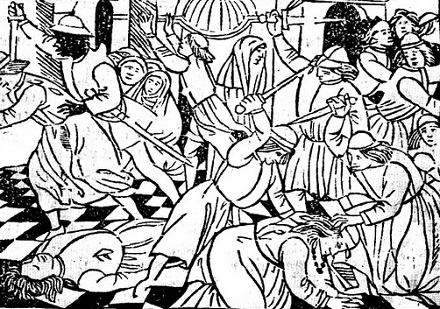
In batches of forty, fifty, and even a hundred, men, women and children were led out to indiscriminate death. On one occasion, ninety-five miscellaneous individuals, collected from various parts of Flanders, were butchered in company. At another time forty-six of the citizens of Malines were decapitated. On the 4th of January, 1568, eighty-four persons, charged with participating in the tumults, were executed together in the public square at Valenciennes.

The (helpfully dated) bloodletting we mark with this date’s post was itself no more representative of the Council of Troubles than any other, collectively amounting to uncounted thousands whose martyrdom — to creed, country, or both — would stir the Dutch Revolt and, eventually, the independence of the Netherlands from Spain.

* A wry reference to the writer’s namesake saint: Erasmus the humanist was perpetually short of cash, and at one point forced into monastic vows by his penury. (Erasmus the saint is not actually the patron of anything related to wealth.)

** No kinship that I’m aware of with the Dutch Republic’s leader a century later, Johan de Witt.

On this day..

1945: An unfortunate woman, name and nationality unknown


AP caption: “The expression on the face of this Hun posing for the camera standing by the gallows from which a woman is hanging, Jan. 3, 1945 shows a lack of concern. The name and nationality of the unfortunate woman is unknown. One of the many victims of Nazi terror. The German soldiers seem to be quite used to this kind of sights for them a picture like this is just a souvenir.” (Via)

On this day..

1477: Gerolamo Olgiati, ducal assassin


Dramatization of events in this post for the video game-derived film Assassin’s Creed: Lineage.

On this date in 1477, the assassins of the Duke of Milan suffered bitter death for fame eternal.

Famous for both his astute political machinations and for cruelty verging on the sadistic, Galeazzo Maria Sforza inherited leadership of Milan in at the age of 22 with the passing of his father, the great condottiero Francesco Sforza.

Francesco, the founder of the Sforza dynasty, had dynastically married himself to one Bianca Maria Visconti, a daughter of Milan’s previous ruling house.* But not all of the Visconti were at home with the Sforza.

A brash young man of that noble family, Carlo Visconti, as full of humanistic idealism as he was of bile for the licentious Duke’s alleged violation of his sister, joined a conspiracy also compassing two other gentlemen, Giovanni Andrea Lampugnani and Gerolamo Olgiati, to do Galeazzo Sforza to death.

At a St. Stephen’s Day service in a basilica christened to Stephen Lampugnani approached the prince feigning supplication for some audience, then produced a hidden blade and stabbed Galeazzo Sforza. Visconti and Olgiati then rushed on Sforza as well and before anyone realized what was happening the Duke, croaking some half-heard invocation of Mary, was falling dead on the church floor.


Illustration of Galeazzo Sforza’s murder on the title page of a 1476 Lament for the Duke decrying the assassination.

Pandemonium ensued, and in the ensuing helter-skelter, Sforza’s bodyguards fell on Lampugnani and killed him on the spot, while Olgiati managed to escape.**

“It now only remains for us to consider those dangers which follow after the execution of a plot,” Machiavelli mused in his “Of Conspiracies” typology of his Discourses. “These in fact resolve themselves into one, namely, that some should survive who will avenge the death of the murdered prince. The part of avenger is likely to be assumed by a son, a brother, or other kinsman of the deceased.”

Well, yeah.

The assassins of the Duke of Milan appear not to have burdened themselves overmuch with advance consideration of this danger, possibly indulging the dream of Brutus that by a dagger’s stroke alone they could restore the lost republic.

Needless to say, this beautiful hope vanished in the bloody revenge carnival that actually ensued the murder. Just a few days after the assassination, having taken refuge with a priest — his justly frightened family had closed its door on him and needed to make theatrical denunciations of his treason for their own safety — Olgiati was captured, put to a torturous interrogation, and publicly butchered. He had outlived the Duke by only a week, and his gashed carcass was hung up in sections around town by way of warning. The rotting heads of the conspirators remained impaled on lances on the city’s bell tower well into the 1490s.

According once again to Machiavelli, Olgiati “exhibited no less composure at his death than resolution in his previous conduct, for being stripped of his apparel, and in the hands of the executioner, who stood by with the sword unsheathed, ready to deprive him of life, he repeated the following words, in the Latin tongue, in which he was well versed

“‘Mors acerba, fama perpetua, stabit vetus memoria facti.'”

That is,

‘Death is bitter but fame is eternal, and the memory of the deed will endure.’

This attempt, quixotic and doomed, to depose an Italian tyrant by murdering him in church might well have formed the blueprint for a similar plot in Florence in 1478, the Pazzi conspiracy. That version was even less successful than its Milanese predecessor: at least Olgiati and company could say that they actually managed to kill their target before everything else hit the fan.

And republic or not, Sforza’s murder did shake up the polity. It put the Duchy of Milan in the hands of his wife, as the unsteady regent of a seven-year-old heir. A few years later, the late duke’s brother Ludovico displaced the regent and effectively bossed Milan until the French imprisoned him in 1500 during the Italian Wars.

While he had the run of the place, Ludovico Sforza commissioned of Leonardo da Vinci a monumental equestrian statue in memory of his brother that da Vinci never finished.† Quite strangely, the master’s notes were plumbed by a 20th century Pennsylvania airline pilot who dedicated the latter part of his life to actually casting “Leonardo’s Horse”.

* The names Visconti and Sforza are also associated with some of the earliest tarot decks and among the first to introduce to playing cards the use of trionfi, or “triumph” cards — that is, “trumps”. One can readily purchase present-day reprints of this historic pack.

** There is a positively maddening inconsistency, thus far irresolvable for this author, between accounts (here’s one example | and another) asserting that Carlo Visconti was slain by Sforza’s bodyguards directly after the assassination, and other accounts (like Gregory Lubkin’s 1994 history of Sforza’s Milan) that put Visconti on the scaffold beside Olgiati.

† Da Vinci’s ponderously slow progress on this high-profile project led Michelangelo to cattily impugn the rival artist’s bronze-casting aptitude.

On this day..

1926: Melton Carr

In contemporary America, it would be next to unthinkable to schedule an execution for New Year’s Day — and asking the associated team of wardens, guards, executioners, witnesses, lawyers, and journalists to ditch New Year’s Rockin’ Eve and do a ball drop to a lethal chemical injection would be a complete nonstarter.

But the First of January, especially prior to the age of widespread telecommunication, was not always so sentimentally held. The Espy File of historical American executions records none whatsoever for Christmas Day, but several have occurred on New Year’s. We’ve previously profiled some of them in these grim annals, like Sylvester Henry Bell and Archilla Smith.

January 1 of 1926, “just 15 minutes after the arrival of the New Year” in the words of the Associated Press report, was the occasion in Huntsville, Texas for electrocuting African-American Melton Carr for raping a white woman in Walker County.

I have found hardly any information pertaining to this case online, but the detail that Carr was reprieved from an earlier execution date “on a petition from officials and citizens of Walker county” — implicitly, white citizens — might be a suggestive indicator for a crime so incendiary under other circumstances. We have seen that detail before in the case of Tom Joyner’s ancestors, who had broad clemency support because the racial politics of the time made an open judicial exploration of their actual innocence impossible.

Hours later, the first-ever radio broadcast of the Rose Bowl introduced another New Year’s Day tradition to the national consciousness — and just by the by, changed the South forever.

After that game, there would be only more January 1 execution date in American history: the 1943 double gassing of Rosanna and Daniel Phillips.

On this day..

1460: Richard Neville, Earl of Salisbury

On the 31st of December in 1460, the Earl of Salisbury was beheaded the day after the Lancastrians routed the Yorkists at the Battle of Wakefield.

Salisbury — Richard Neville by name — was brother-in-law to the Yorkist claimant (and namesake) Richard Plantagenet, Duke of York, so you can guess which side Neville backed during these Wars of the Roses.

Actually, although your guess is spot on for the instance at hand, overlapping kin networks and cutthroat politicking made for an indistinct border between Lancastrians and Yorkists that some actors willingly crisscrossed. Richard Neville’s cousin Thomas Neville, for example, was a Lancastrian, who switched to the Yorkists, and then switched back to the Lancastrians. All this goes to show the treacherous environment for nobles who could go from the orbit of royal power themselves straight to the headsman’s block with each new battlefield reversal. And Salisbury, he was Team White Rose* right on down the line.

(The Neville family’s running feud with their fellow northern magnates, the Percys, helped to catalyze the York-Lancaster rivalry into open warfare.)

Salisbury led the Yorkist side to a notable early victory at the September 1459 Battle of Blore Heath, cunningly baiting the Lancastrians into a disadvantageous charge across a brook by feigning retreat. Then, runs Hall’s chronicle, “the Earl of Salisbury, which knew the sleights, strategies and policies of warlike affairs, suddenly returned, and shortly encountered with the Lord Audley and his chief captains, ere the residue of his army could pass the water … [and] so eagerly fought, that they slew the [Lancastrian commander] Lord Audley, and all his captains, and discomfited all the remnant of his people.”

The Yorkists didn’t do as well at the Battle of Ludford Bridge three weeks later and their leaders (Salisbury included) had to flee England to regroup.

This 1459-1461 period has especially rapid reversals of fortune for the contending parties in the Wars of the Roses, who seemed to alternate between them the results of the latest battle and with it the leadership of England.

As the most recent losers, Salisbury and his son, the Earl of Warwick — known as the “kingmaker”, this younger Richard Neville was one of the pivotal figures of the dynastic wars — had to flee England with many of the Yorkist leaders. But they mounted a re-invasion from Calais where Warwick was constable and the Nevilles pere and fils led separate columns that overran London, and captured the Lancastrian King Henry VI. Suddenly, the ex-fugitive York was the Lord Protector, England’s de facto ruler, and its de jure successor.

But as had been the case one year before, fickle Fortune abandoned the House of York almost immediately after raising it up. Two months later, their forces ventured battle with a much larger army of the regrouping Lancastrians; as night fell on December 30, 1460, York himself lay dead in his armor while his kinsman Salisbury was a prisoner with just hours left to live.

This was, of course, very far from the end for the Yorkist party, for both men left their causes to capable heirs. York’s 18-year-old son Edward inherited his father’s claims to the throne of England; together with Warwick, they counterattacked and crushed the Lancastrians at Towton on March 29, 1461** — finally deposing Henry VI and enthroning York’s eldest son as King Edward IV.

And they all lived happily ever after.

* The competing Rose devices used by the Yorkists, the Lancastrians, and the eventual Tudors, are one of the four suit markers we’ve used in our unique Executed Today playing card set. Pick up a pack or eight today why don’t you?

** The undercard fight to Towton was February’s Battle of Mortimer’s Cross, which also featured a crushing defeat of the Lancastrians — led on that occasion by a commander whom the Yorkists subsequently put to death, Owen Tudor.

Against any odds one could care to name, it was this Owen Tudor’s descendant who would eventually emerge from the Wars of the Roses as England’s legitimate-ish king, Henry VII — founder of the Tudor dynasty so very fruitful for this here execution blog.

On this day..

1757: Father Andreas Faulhaber, seal of the confessional martyr

On this date in 1757, Catholic priest Andreas Faulhaber was hanged at the order of Frederick the Great to defend the seal of the confessional.

Frederick had been appointed by the Heavenly Father, and a cruel earthly one, to a task far too monumental to tarry with theology: lifting the Kingdom of Prussia from the morass of German principalities and into the ranks of Europe’s great powers. Frederick was nominally a Protestant, as was the bulk of his domain, and der Alte Fritz once remarked that this profession pleasingly liberated his sovereignty from papal interference; his real doctrine was nothing but pragmatism.

Accordingly, the great enlightened absolutist sponsored Jesuit educators where schools were needed and Jewish merchants where trade was needed.

Disgusted at Frederick’s aggressive war on Austria, Voltaire scribbled to a friend,

I’ve seen his good intentions dropped
At the first trumpet blast.
They are nothing more than kings;
And live their lives with bloody things,
They take or rape a few provinces
To suit their ambitious ends
I give up, say goodbye princes
I want no one now but friends.

(Source)

But Voltaire did not in fact break with his royal admirer and correspondent over Silesia.

Frederick christened his new reign in 1740-42 by ripping the wealthy* province of Silesia away from the Habsburgs.

The Habsburgs were Prussia’s Catholic rivals for preeminence in central Europe and Silesia too was heavily Catholic, so Frederick extended over that province as liberal a grant of religious toleration as he might.

But the attachments of men for the kings of their forefathers are not always so easily displaced, and neither are those of kings for the most lucrative soil of their patrimony. Austria made two subsequent attempts to retrieve Silesia; together with Frederick’s initial invasion, these are the Silesian Wars.

The last of the three was itself just one theater of the gigantic Seven Years’ War. The conflict between Prussia and Austria over Silesia, and the complex continental diplomatic entanglements** each power effected in its pursuit, were among the root causes of that entire globe-spanning conflict.

Prussia won the first two Silesian Wars handily, but the third was a much more doubtful affair — indeed, Prussia was well on its way to defeat before the shock death of the Russian empress delivered that country into the hands of an unabashed Germanophile who pulled Russia out of the war.

But in view of Frederick the Great’s strained situation prior to this providential deliverance, some of his Silesian subjects made free to prefer their prospective Catholic/Austrian allegiance to that of their recent conqueror.

Desertions among Silesian conscripts, some of them even escaping to Austrian lines, called down the dark side of the religious toleration policy. Frederick let people pray as they liked so that he could rule as he liked; here, when he suspected the Silesian Catholic clergy of countenancing wartime disloyalty among their flock, those religious scruples had overstepped their proper sphere.

And so at last we come to our day’s execution.

One young man caught attempting to desert Frederick’s army was captured and interrogated by his commanders. He allowed that he had undertaken the sacrament of confession before escaping, and expressed to the priest his intention to abandon the army.

The priest, Father Andreas Faulhaber, was arrested on this basis, but between his calm defense of himself and the deserter’s shifting, unreliable story, the military court found little basis to proceed. The impression one gets is that the contemplated desertion was not the main thrust of the confession and that Father Faulhaber accordingly discouraged the sin in passing but didn’t bother to dwell on the point.

The impression is difficult to substantiate because the padre rigorously kept the seal of the confessional — another imposition demanded by faith that secular authorities who had armies to field preferred not to honor.

But evidently looking to serve notice that the monarch’s religious indifference could not be used to abrogate subjects’ responsibility to the state, Frederick himself ordered Faulhaber’s sudden execution for the morning of December 30.

The unfortunate priest only discovered his impending fate moments before it was enacted, but still refused under the makeshift gallows to give up anything incriminating about his parishioner. “Hang up the Jesuit Faulhaber, but let him not have a confessor,” read the order, according to this decidedly Catholic account, which adds that Faulhaber was not actually a Jesuit at all, and the word only added to invoke the going 18th century prejudice against that order.

Prussia won this war, too. It kept Silesia in Prussian hands, and then German hands, for two centuries. The bulk of Silesia was transferred to Poland after World War II.

* Silesia provided one-quarter of all the Habsburgs’ tax revenue, according to Frederick the Great: A Life in Deed and Letters.

** For the Seven Years’ War, Austria made common cause with its traditional foe, France: one consequence of this arrangement was the betrothal of the Austrian princess Marie Antoinette to the future French king Louis XVI.

On this day..

1868: Thomas Jones, bad uncle

(Thanks to Meaghan Good of the Charley Project for the guest post. -ed.)

Four days after Christmas in 1868, Thomas Jones was executed in London, Ontario for one of the most sensational murders perpetrated in the region at the time. He had brutally slaughtered his twelve-year-old niece in the town of Delaware.

Early that year, according to this article on the case, Jones had tried to rob his own brother’s house while wearing a false beard to disguise his identity. Unfortunately for him, young Mary Jones recognized her uncle and subsequently testified against him in the ensuing trial. Thomas Jones held this against her, as did Thomas’s daughter Elizabeth, who was thirteen.

On June 11, 1868, Mary’s mother sent her to Uncle Thomas’s house to fetch a cup of flour. (One wonders why she did so, given the history of bad blood between uncle and niece.) Mary never returned.

Suspicion inevitably fell on Thomas, who insisted she’d come and gotten the flour and left his home alive and well. Forty-eight hours after Mary’s disappearance, the search party got fed up, grabbed Thomas’s ten-year-old son and threatened to kill him if he didn’t tell what happened to his cousin.

The boy led them to her body, hidden in the woods under a fallen tree. Her skull had been fractured.

According to the child, both his father and his sister Elizabeth had participated in Mary’s murder. Public feeling ran high against the accused and the entire family had to be taken into custody and transported from Delaware to London to avoid a possible lynching. Only Thomas and Elizabeth faced murder charges, but according to this account, Thomas’s wife and younger son were kept in jail for four months and his two older sons, both in their teens, remained there until well after their father’s death.

The prosecution’s theory was that either Thomas had murdered his niece after Elizabeth lured her into the woods at his direction, or Thomas talked Elizabeth into committing the murder.

At trial, Elizabeth tried to take the rap for her father, claiming she’d beaten Mary to death entirely on her own and Thomas had only helped her hide the body. Thomas’s youngest son testified in support of this, saying he’d witnessed his sister striking Mary with a club.

Thomas used his underaged daughter’s statements like a shield — he would maintain his innocence to his dying breath — but in the end the jury convicted him of murder. What may have tipped the balance was the medical evidence, which indicated Mary had been dealt some powerful blows, stronger than a child could have inflicted.

Elizabeth was convicted of manslaughter and sentenced to ten years for her role in the crime, in spite of her youth. The older two of Thomas’s three sons, ages seventeen and fifteen, were finally released without charge in the spring of 1869. Elizabeth served seven years before she was freed.

In spite of the bitter cold many residents of Delaware came to watch Thomas hang at the Middlesex County Gaol. Around six thousand people were in the crowd — approximately half the population of London. This would be the last hanging in Middlesex county.

On this day..