1905: A.I. Volioshnikov, police spy

On this date in 1905,* the druzhinniki (militia) of Moscow’s insurrectionary Red Presnia district barged into the apartment of 37-year-old police detective A.I. Volioshnikov.

In front of his shrieking children, “they read the verdict of the Revolutionary Committee, according to which Volioshnikov had to be shot” — as a police spy surveilling rebels, according to Trotsky — then taken outside and executed directly at the Prokhorovka textile factory.**

The tsar’s artillery began barraging Red Presnia the very next day, and had overrun it — complete with summary executions of their own — before the calendar turned over to 1906.

* December 28 per the Gregorian calendar; it was December 15 per the Julian calendar still in use at the time in Russia.

** There’s a “Druzhinniki Street” in Moscow near the Krasnopresnenskaya metro station — and the Prokhorovka factory (dating to 1799) still stands nearby.

On this day..

1821: Ketaukah and Kewahiskin, the first hangings in the Michigan Territory

From the Salem (Mass.) Gazette, Jan. 18, 1822.

Executions — Two Indians,* Ketaukah and Kewahiskin [elsewhere given as Kewaubis -ed.] were hanged at Detroit on the 27th ult. the former for the murder of Dr. W.S. Madison, the latter for the murder of Charles Ulrick.

The criminals (says the account) often acknowledged the justice of their sentence,** and in their way they had prepared themselves to meet its execution.

For several weeks past they appeared very anxious to obtain presents of tobacco, pipes, &c. none of which they used, but carefully laid them aside as an offering to the Great Spirit on the day of their death.

They had contrived a sort of drum, by drawing a piece of leather over the vessel that contained their drink, and often engaged in their solemn death dance. On the night previous to their execution, they continued their death dance to a very late hour, and commenced it again early in the morning.

They had been presented, among other things, with some red paint — with this they painted on the wall of their cell numerous figures of men, quadrupeds, reptiles, &c. — on their blankets were also painted many figures — among the rest, an Indian, hanging by the neck, was observed.

From the jail they were taken to the Protestant Church, where an appropriate discourse was delivered to the assemblage by Mr. J.S. Hudson (one of the gentlemen belonging to the Mission family).

They appeared throughout the whole of the solemn preparatory steps to be perfectly collected — they walked firmly to the gallows, and previously to ascending to the drop, shook hands with the Rev. Mr. Juvier, Mr. Hudson, the Sheriff and Marshal, and several other gentlemen who stood near them.

They ascended the steps of the drop in a manner peculiarly firm — after which, they asked, through the interpreter, the pardon of the surrounding spectators, for the crime they had committed.

They then shook hands and gazed for a few minutes on the assemblage and on the heavens, when their caps were drawn over their faces, and they were launched into eternity.

* Ketaukah was of the Ojibwe (Chippewa) people, while Kewahiskin was a Menominee. (Source) The two men were not associates of each other prior to their shared condemnation, and their crimes were completely unrelated.

** Be that as it may, Ketaukah tested the jurisdiction of the Territorial Court (Michigan had not yet been admitted to statehood). He argued (like Tommy Jemmy in New York) that Anglo juries had no jurisdiction over his crime, which had been committed against a white doctor on Winnebago land. He also demanded the inclusion of Indians on the jury; complications of a potential language barrier within the jury pool, and the matter of whether an interpreter’s presence at jury deliberations would vitiate the verdict, defeated that motion. (For the jurisdictional question, see American Indians and State Law: Sovereignty, Race, and Citizenship, 1790-1880. For the jury composition, see the footnote on page 123 of this masters thesis.)

On this day..

1502: Ramiro d’Orco, discarded by Cesare Borgia

On this date in 1502, Ramiro d’Orco (Ramiro de Lorqua or de Lorca) was put to death in the main square of the city he had governed mere days before.

In 1498, Cesare Borgia, the bastard son of Pope Alexander VI, resigned his cardinalate* to pursue a conqueror’s laurels.

Dynastically allied with France and backed by il papa‘s ducats and decrees, Cesare seized control of Romagna after Alexander helpfully pronounced his vicars there deposed.

As Borgia extended his sword up and down the peninsula, he left his Spanish steward Ramiro d’Orco in Romagna’s capital of Cesena as his governor. D’Orco was a capable, cruel ruler. But his fall likely owed as much to his master’s gifts for the condotierro racket as to d’Orco’s overeager resort to torture and public executions .

Borgia’s conquests multiplied his rivals, fellow condotierri who feared that he could soon come to dominate Italy. The discovery of one plot by former allies against him might have inspired Borgia to consider the damage that the captain of Romagna could do, should he shift his loyalties.

Borgia, not present for events, had d’Orco arrested by surprise on December 22. He was on Christmas condemned to death for graft, and by the next day’s light his black-bearded head surmounted a bloody pike. Borgia also thereby reaped the benefits of d’Orco’s brutality while also dissociating his own person from the resentment those methods had engendered.

Niccolo Machiavelli, Florentine emissary to the Borgia court, watched Cesare’s career closely. In The Prince, Machiavelli is full of skepticism for rulers who come to power through the “fortune” of inheritance or another ruler’s patronage — but Cesare Borgia rates an exception. The conqueror “laid sufficiently good foundations to his power.”

When the duke occupied the Romagna he found it under the rule of weak masters, who rather plundered their subjects than ruled them, and gave them more cause for disunion than for union, so that the country was full of robbery, quarrels, and every kind of violence; and so, wishing to bring back peace and obedience to authority, he considered it necessary to give it a good governor. Thereupon he promoted Messer Ramiro d’Orco, a swift and cruel man, to whom he gave the fullest power. This man in a short time restored peace and unity with the greatest success. Afterwards the duke considered that it was not advisable to confer such excessive authority, for he had no doubt but that he would become odious, so he set up a court of judgment in the country, under a most excellent president, wherein all cities had their advocates. And because he knew that the past severity had caused some hatred against himself, so, to clear himself in the minds of the people, and gain them entirely to himself, he desired to show that, if any cruelty had been practised, it had not originated with him, but in the natural sternness of the minister. Under this pretense he took Ramiro, and one morning caused him to be executed and left on the piazza at Cesena with the block and a bloody knife at his side. The barbarity of this spectacle caused the people to be at once satisfied and dismayed.

* In fact, he was the first cardinal ever to resign the position.

On this day..

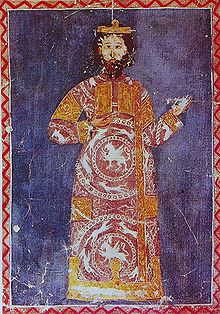
1204: Alexios V, precipitated Byzantine emperor

Around this time in the year 1205, the fleeting Byzantine emperor Alexios V Doukas was put to a dramatic death in Constantinople’s Forum of Theodosius by being hurled from the top of the ancient Column of Theodosius.

Nicknamed “Mourtzouphlos” for his prominent brow, Alexios obtained his Pyrrhic purple by being the only elite with wit and courage in Constantinople during the horror of the its sack by a Venetian Crusader army.

Vanity, vanity, all is vanity! Hands in mailed gauntlets and silk gloves grasping after glory and treasure were our Emperor Eyebrow’s rise and his fall.

The prime desideratum was the prime desideratum, Jerusalem. In a monument to bad management, a Crusader army of 12,000 was mustered to Venice in 1202 for a flotilla suitable to thrice its number. Venice had taken on an enormous contract to assemble this fleet and since the soldiers who showed up could in no way pay what the Serene Republic had been promised, Venice simply repossessed the army to make good its debt by means of pillage.

First, it sacked Venice’s Dalmatian rival Zadar. Then, having picked up the exiled nephew of the reigning Byzantine emperor — the uncle had overthrown the father to get the job — the Crusader-mercenaries made for Constantinople, become now shameless Praetorians by dint of young Alexios’s assurance of all the liberalities the East’s treasuries could bear.

Constantinople in 1202 was the jewel of Christendom. Its mighty walls had preserved the city inviolate since antiquity — a city of half a million souls reposing in the splendors of the Roman world, augmented by eight more centuries’ imperial surplus.

A morsel so ripe needs but one unguarded moment for some ruffian to pluck it. The Crusaders’ attack so happened to catch Constantinople, at long last, at such a moment. The city was lightly defended and unable to summon more aid — while under the direction of an emperor, Alexios III, who had been cruel and profligate in the enjoyment of his power but vacillated fatally when he was required to defend it.

In a matter of days in July of 1203, Alexios’s rule collapsed, and the emperor himself fled, when the Crusaders besieged Constantiople. These Crusaders of course installed their scheming moppet as Emperor Alexios IV, actually co-emperor with his father who despite having been brutally blinded by his brother was liberated and acclaimed by the populace.

The ensuing months make painful reading — and surely much worse than that to experience at first hand. The new emperors feuded with each other despite their kinship. They also had to squeeze every revenue they could for the Crusader army, which stubbornly refused to depart as its leader, the nonagenarian Doge of Venice, schemed to establish lasting Venetian authority in Byzantium. Irritated residents, enduring the continued presence of a Crusader army that thought it was supposed to be going to Jerusalem all along, rioted and fought with one another.

(For a ready summary of this situation and the entire buildup of the Fourth Crusade, grab episode 15 of Lars Brownworth’s outstanding 12 Byzantine Rulers podcast.)

The bottom line was that young Alexios was no more impressive in power than had been his predecessor and he had the added disability of having been installed by a foreign invader. He also discovered to his chagrin that the staggering sum of 200,000 he had so lightly promised the Venetians in exchange for his throne was double what he could actually find in the capital. When the situation unmanned him in January of 1204, he cowered in the imperial palace and sent his chamberlain to petition the Crusaders to back him in the latest exigency.

That chamberlain was our man, Alexios Mourtzouphlos.

Acting with an alacrity that might have spared Constantinople a horror had an earlier prince exercised it, Alexios instead arrested the co-emperors and spirited them off to a dungeon where they were quietly murdered.

The usurper then turned the city’s energies towards reinforcing its battered defenses and attempted to mount an attack against the Crusaders. This proved, however, much too late to spare the Second Rome its most awful tribulation.

In a matter of days in April 1204, the rude band of Latins who set out to win Jerusalem for Christ overran glorious Constantinople and put it to the sack. Tourists today who gawk at the bronze horses decorating Venice’s St. Mark’s Basilica are in fact enjoying the plunder of Byzantium. In time Constantinople would be retrieved from the Latins, but neither the city itself nor the Byzantine Empire ever fully recovered from the blow. This is also the event that made the schism between Eastern and Western confessions of Christianity permanently irretrievable.*

It was not given Alexios Mourtzouphlos to see what horrors ensued for Constantinople, never mind to get a start on finagling an imperial comeback of his own. Fleeing the sack of the city, he wound up in Thrace in the company of yet another deposed ex-emperor. But after first allowing Mourtzouphlos to marry his daughter, that old schemer had Alexios V blinded and in November 1204 abandoned him to an advancing Latin army — and its eventual death-by-precipitation — while his former in-laws fled to Corinth.

* One of Alexios IV’s promises to his Crusader buddies was to submit the Byzantine patriarchate to Papal authority — another pledge that could never have been realistically delivered.

On this day..

1774: William Ferguson, redcoat

On the morning of December 24, 1774, the British 10th Regiment encamped on Boston Common shot a 28-year-old soldier named William Ferguson for desertion.

We do know a bit about Ferguson, but the most self-evidently notable thing about him is that he was in Boston in 1774 — his regiment of redcoats a most unwelcome interloper lately brought from Quebec where it had alit after being shipped overseas years before to fight in the North American theater of the Seven Years’ War.

Back in December of 1773, a year before our action, American patriots had ratcheted up the colonies’ running tax dispute with the mother country by dumping 45 tons of East India Company tea into Boston Harbor.

Over the ensuing twelvemonth, London and the colonies escalated unpleasantries to the point where King George III remarked that “The die is now cast. The colonies must either submit or triumph.”

The immediate British response to the Boston Tea Party, and the reason that William Ferguson and His Majesty’s 10th Regiment of Foot made their obnoxious camp on Boston Common, was that Parliament responded to the Tea Party with a series of punitive enactments directed at the colonies in general and Boston in particular: the Coercive Acts. (Or “Intolerable Acts”, as called by the colonists.)

Among other things, these measures:

  1. Closed the port of Boston;
  2. Exempted British officials in the colony from trials before colonial juries for any excesses they might commit against American insurgents, instead removing administration of justice safely to Britain; and,
  3. Put Massachusetts under a military governor: General Thomas Gage

Gage’s first order of business was to garrison truculent Boston (already occupied since 1768) with enough soldiery to enforce Parliament’s will. Throughout the summer and autumn of 1774, British troops arriving from elsewhere in the colonies — or from Canada (as with the 10th) — or mustered in Great Britain — poured into Boston. By the end of 1774, eleven regiments made camp on the Common. “Boston,” Gage wrote to the Secretary of War, “will keep quiet as long as the troops are there.”

But to dominate Boston was not to bring the colonies to heel.

General Gage soon realized that he had a tricky assignment: even while implementing laws designed specifically to antagonize Massachusetts, he simultaneously had to try to pre-empt the gestating American Revolution. Egregiously underestimating the vigor of colonial resistance and the resources required to quell it, London brushed off Gage’s entreaties for thousands of additional troops while counterproductively pressuring him to take more confrontational action against disloyal colonists.

Gage’s attempt to reconcile all these contradictory demands was to use his regiments in Boston in a series of targeted sorties into the Massachusetts countryside, in an effort to deprive colonial militias (and, now, a rebel shadow government that held sway outside of Boston) of the arms they would need in the event of open rebellion. Gage hoped he could pick off tactical objectives one by one, and ideally do so without firing any shots that might further inflame a tense situation. Some of his own subalterns sneeringly nicknamed him the “Old Woman” for insufficient bellicosity.

Gage’s plan was probably always doomed to failure. Massachusetts militiamen had already demonstrated a considerable propensity to redcoat inflammation; some one of these expeditions was bound sooner or later to send musket balls flying.

In April of 1775, that’s exactly what happened: a column of British soldiers, some from the 10th Regiment, marched out to seize a militia arms depot in the town of Concord. About sunrise of April 19, 1775 that column entered the village of Lexington on the approach to Concord and there exchanged with a colonial militia the first shots of the American Revolution.

The only British casualty of the “shot heard round the world” was a minor leg wound suffered by a private of the 10th named Johnson. (The subsequent Battle of Concord was a different story.)

Present for Lexington and Concord and presumably also in attendance at William Ferguson’s execution by musketry was yet another brother Tenther: Ensign Jeremy Lister. Lister’s diary of events is one of our firsthand accounts of the Battles of Lexington and Concord.

On this day..

1679: “A number of poor people for the crime of witchcraft”

From the Domestic Annals of Scotland (see here or here):

A commission composed of country gentlemen and advocates sat in the Tolbooth of Borrowstounness to try a number of poor people for the crime of witchcraft. There was Annaple Thomson, who had had a meeting with the devil in the time of her widowhood, before she was married to her last husband, on her coming betwixt Linlithgow and Borrowstounness, when he, ‘in the likeness of ane black man, told you, that you was ane poor puddled body, and had an evil life, and difficulty to win through the world, and promised if you would follow him, and go alongst with him, you should never want, but have ane better life; and about five weeks thereafter the devil appeared to ye when you was going to the coal-hill about seven o’clock in the morning. Having renewed his former tentation, you did condescend thereto, and declared yourself content to follow him and become his servant.’ There were also women called Margaret Pringle, Margaret Hamilton (two of the name), and Bessie Vicker, besides a man called William Craw. ‘Ye and each person of you was at several meetings with the devil in the links of Borrowstounness, and in the house of you Bessie Vicker, and ye did eat and drink with the devil, and with one another, and with witches in her house in the night-time; and the devil and the said William Craw brought the ale which ye drank, extending to about seven gallons, from the house of Elizabeth Hamilton, and you, the said Annaple, had ane other meeting about five weeks ago, when you was going to the coal-hill of Grange, and he invited you to go along with him and drink with him in the Grange-pans.’ Two of the other accused women were said to have in like manner sworn themselves into the devil’s service and become his paramours, one eight years, the other thirty years ago. It was charged against Margaret Pringle, that ‘the devil took you by the right hand, whereby it was for eight years grievously pained, but [he] having touched it of new again, it immediately became hail;’ against Margaret Hamilton — ‘the devil gave you ane five-merk piece of gold, whilk a little after becam ane sklaitt stane.’ And finally, ‘you and ilk ane of you was at ane meeting with the devil and other witches at the cross of Muirstane, above Kinneil, upon the thretteen of October last, where you all danced, and the devil acted the piper.’

These poor people were solemnly tried by the commissioners before an assize of fifty persons, and, notwithstanding that the indictment charges scarcely any hurtful attempts against individuals, the whole were adjudged to be taken four days after to the west end of the town, and there worried at a stake and burnt.

On this day..

1960: Anthony Miller, the last hanged at Barlinnie

On this date in 1960, 19-year-old Anthony Miller became the 10th and last person executed at Scotland’s Barlinnie Prison.*

Miller worked in a team with a 16-year-old accomplice in a “queer-rolling” racket: the younger James Denovan would lure a mark with the promise of an assignation, then Miller would jump him and turn a 2-against-1 robbery. Artless, but effective.

With such a crude m.o., it’s no wonder Miller and Denovan beat a man all the way to death in the course of one of their shake-downs. Since he was a minor, Denovan drew a prison term. Miller … not so lucky. His plaintive last words, “Please, Mister …” form the title of a play about his life written by Patrick Harkins.

Tour Barlinnie’s capital punishment environs with one of its old death-watch officers in this David Graham Scott short film, “Hanging With Frank”:

David Graham Scott was good enough to share some firsthand recollections of the film’s title character Frank McKue, and the process of producing “Hanging With Frank”.

Frank McKue was an extremely likeable chap with a very dark sense of humour. Definitely my type of guy. Used to have a drink with him at his local pub in Edinburgh called ‘The Diggers Arms’ (called as such because local gravediggers would drink there) . The sound of the trapdoor swinging open that you hear in the film is actually the door to the beer cellar crashing open in the pub which I recorded as a foley. Frank said it was almost the exact sound! Since the trapdoor in the execution chamber at Barlinnie Prison was shored up and unable to open when we visited it seemed a logical idea to use this nice little soundbite.

Incidentally, the prison that we were filming was still (and still is) very much in operation. There are some shots where you can see prisoners moving about in the upper galleries. It’s Barlinnie Prison in Glasgow, Scotland and dates from the Victorian era. Frank worked there in the 50s as a prison officer who occasionally did deathwatch details. That involved sitting with the condemned man on his last nights and drinking tea, engaging him in conversation and playing draughts [checkers in the U.S.].

Frank showed how the prison officer’s escorting the condemned man would walk a few paces across the gallery and through the doors into the execution chamber.

They’d stand on planks placed over the trapdoors …

… and hold onto safety ropes dangling from the ceiling to stop them from falling down with the prisoner. There had been various instances in the past of prison guards and assistant executioners falling through the trapdoors with the condemned man.

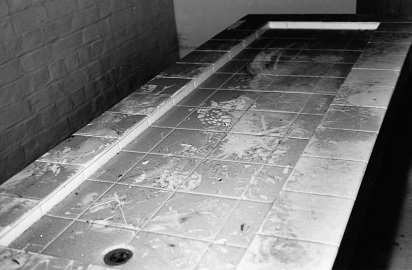
The deathwatch officers would sit with the condemned prisoner at all times after sentence was pronounced. Cups of tea, mingled with small-talk and endless games of draughts and they just chatted away about everything ‘except the obvious’! Their job on the morning of the execution was to escort the condemned man out of his cell (which was actually two normal sized cells knocked into one) and into the execution chamber just a few paces across the gallery in D-Hall of the prison. They steadied the man as the executioner led the way onto the scaffold and the assistant helped buckle his wrists and feet with leather straps when they reached the correct position on the trapdoors. A signal from the assistant to the executioner sent the man on his downward journey to the basement below where the mortuary slab awaited.

The positioning of the noose was crucial for a clean break between the 2nd and 3rd vertebrae The rope always did a quarter turn to throw back the head and cleanly sever the spinal column at those points and the hangman treated the affair with diligence and extreme reverence. Frank would then often sit with the executioner and assistants as they had their breakfast and left the executed man dangling for a full hour. The prisoner was then pulled back up, the noose removed and then he was lowered back down with other ropes to the basement room again where he was stripped and laid on the mortuary slab. The body ‘belonged to the state so it was buried within the prison grounds’ and no relative was allowed to visit the grave site or send flowers.

I storyboarded much of the film due to the restrictions of time, the nature of the equipment we were using and, of course, the mood I was trying to evoke. I also used black and white, grainy, light-sensitive film stock to try and get the feel of the execution facility in its heyday of the 1950s. If I had more money and time I would have made this film about 10 minutes longer but alas it was not to be. There was always the odd event that we shot spur-of-the-moment. Like when I noticed a butterfly trying to escape from the window of the execution chamber. In this space it took on quite a metaphorical aspect as it struggled desperately and futilely against the glass. Strangely, there was a large group of them roosting on the ceiling. I’ve never seen such a thing in my life and have no idea why they were acting like this. There were also mounds of pigeon droppings too which we tried to avoid as best we could (it can be quite toxic when breathed in). There’s a very brief shot in the film of two pigeon chicks which were nested snugly within a cavity of the execution beam … another bizarre metaphor about death and resurrection, I guess.

When we visited there were major renovations taking place within D-Hall and, as we see in the film, the condemned cell and execution chamber were torn apart. Even the grave sites were not spared. Drainage for the new toilets being built (this was the end of the notorious slop-out era) actually passed through the graves of the executed men. Indignity upon indignity heaped upon these pathetic corpses with each flush of the toilet. The graves had been marked with initials to denote where each of the murderers lay but these had been removed at some point as if to completely erase any trace of them. Frank knew exactly where each lay though and reeled them off one by one. He told me about the way the coffins were designed with a hinged flap over the face of the dead man. Once sealed in the coffin with quicklime scattered over him, Frank would open the flap and add water over the face of the executed prisoner to hasten the destruction of the body. The grave was then filled back in. One of the graves was forever sinking and had to be refilled with ashes from the boiler house on a regular basis. It was the grave of James Robertson, a former policeman who had run over and killed his lover in 1950. He was duly executed for the cold-blooded murder but it was as if his body was restless in the grave the way the tarmac kept on sinking down. In refilling the grave Frank told me that the body seemed to be miraculously well preserved and that somehow the quicklime designed to dissolve it had had the very opposite effect! The prisoners on that grave-filling detail were often terrified and were offered extra perks like cigarettes to make it a bit easier for them. To this very day that same grave is still sinking for some odd reason … the depression in the tarmac can be clearly seen in the film.

There were many stories that Frank related to me about his good friend Albert Pierrepoint, who he befriended during his time at Barlinnie Prison. Pierrepoint was the famous British state executioner at that time and conducted various executions throughout the entire United Kingdom. Frank kept up his friendship with Albert way after capital punishment was abolished and used to visit his pub in Manchester called ‘Help the Poor Struggler’. At his home in the west side of Edinburgh, Frank proudly showed me his various bits of execution related paraphernalia.

One of the prize exhibits was an engraved glass from the Albert’s pub. There was also an amazingly detailed scaled down model of the Delaware gallows which his retired carpenter friend and fellow execution enthusiast, Sudsy, had made for him. Frank showed me with great relish how this unique hanging apparatus would operate. It was obvious that he wanted more than mere models to play with and his real ambition was to be the British state executioner. He had contacted the British Home Office to put his name down as one of the persons willing to train as a state executioner should capital punishment come back. There was no way he’d be getting that job at the time I met him though as he’d already undergone a major operation and had a pig’s heart valve sewn into him. I felt guilty asking Frank to climb the rungs of the ladder into the beam room for a third take, I recall. He was happy to do it but breathless by the end! I thought how awful it would have been, and ironic, if he’d died within this space he loved so much.

But it seems that within the film Frank does fulfill the dual role of hangman and condemned man. The two aspects merged into one at the crowning moment as he puts the bag over his own head — a touch that I thought might be ridiculous at first but somehow does work quite well in the finished film.

Alas for Frank the calling to be a state executioner never came to happen and he died in 2008 from heart complications. Hanging with Frank will remain his legacy, however. A film as much a character study as it is a piece of history. [See more movie stills here -ed.]

I made this film with very little funding indeed and despite its receiving various accolades over the years the government funded film agency in Scotland at the time, The Scottish Film Council, refused to send it to film festivals as it was deemed distasteful. My work has frequently led me to being despised by the powers that be in the largely straight-laced documentary scene … I must be doing something right I suppose!

* Not to be confused with the last executed in Scotland full stop. Miller was the second-last in Scotland.

On this day..

1875: Henry Wainwright, Whitechapel murderer

On this date in 1875, Whitechapel’s most notorious murderer ere Jack the Ripper arrived on the scene paid for his double life on the gallows of Newgate.

Henry Wainwright, brushmaker and philanderer, came to his mortal ruin by way of a financial one.

The expansive Wainwright could not confine his adventures to actresses at the theater adjacent his Whitechapel Road shop* but in 1872 installed a mistress, one Harriet Lane, in a flat of her own with a liberal £5-a-week stipend. “Mrs. King”, as she styled herself with a better ear for the forgettable name than Wainwright would evidence (we’ll come to that part), bore her lover two children.

But by the next year, Wainwright’s prodigalities and a worldwide economic crisis had sunk him in debt. As his creditors circled, Wainwright pinched farthings where he could, putting predictable strain on his lover’s allowance — and with it, her affection, her sobriety, and her discretion.

As Wainwright succumbed to bankruptcy, Harriet Lane’s demands for money and occasional drunken forays into his very place of business had Wainwright scrambling for some way to fob the mistress off on some other man. His efforts thereto were frustrated, so he contrived the next best thing: prevailing on his brother Thomas** to write his mistress mash notes under the ungainly pseudonym of “Edward Frieake”, Wainwright spun a plausible scenario for her elopement.

Unfortunately for Mrs. King, the honeymoon would be a chloride of lime pit under the floorboards of Wainwright’s warehouse.

On September 11, 1874, the lady sallied out of her apartment, and was never heard from again.

Laborers working near Wainwright’s warehouse that night would report hearing three gunshots, but being unable to pinpoint their source they let the matter drop — just as did police with Harriett Lane’s disappearance. With the help of a chaser letter or two from his brother, Wainwright represented that she had run off to Paris with her correspondent. Why, she might never be heard from again!

According to Jonathan Goodman, the 1844 Thomas Hood poem “The Bridge of Sighs” was a Wainwright favorite, one he often recited to entertain his family(s):

One more Unfortunate,
Weary of breath,
Rashly importunate,
Gone to her death!

Take her up tenderly,
Lift her with care;
Fashion’d so slenderly
Young, and so fair!

Wainwright himself qualified for verse not long after poor Harriet Cole’s remains tumbled into plain view on that London street, like the “Awful Murder and Mutilation of a Female At the East-end of London”, whose composition mirrors its expository title:

Her head was severed from her body,
Her arms as well — how sad to tell

The above fragment (I have not located the entire original) is from this informative post about murder ballads

Another year on, Wainwright had good cause to believe he’d gotten away with the whole thing.† But his finances having finally collapsed, the warehouse that doubled has Harriet Lane’s tomb had been foreclosed upon in July of 1875, and it would soon be sold to new and potentially nosy owners. Wainwright had a body to move. And when the hole was opened up on September 10, 1875, it uncovered not a few scraps of a satisfyingly dissolved corpse — but the body entire, preserved rather than eroded by its chemical bath.

And the corpse stank disgustingly.

Showing the extraordinary judgment that had got him into this mess in the first place, Wainwright bought a spade and a cleaver to dismember the foul limbs he had once made love to, and then engaged a colleague to help him schlep the resulting packages out to the street. Arthur Stokes would later attribute his decision to peek to a divine command that struck him from the firmament, but nothing more remarkable than below-average curiosity will be required of a man encumbered by a heavy, fetid parcel to wonder what they might contain. A more impressive explanation will be required to justify Henry Wainwright’s decision to leave Stokes alone with the horrors while Wainwright jogged off to hail a cab.

Thinking fast for a man come face to face with a severed head, Stokes rewrapped the horrendous bundle and casually helped his homicidal friend pack it all onto the cab. When Wainwright drove off, Stokes trailed him, looking for constables to summon. And when he found them, and they approached the cab asking to inspect his cargo, all Henry Wainwright’s nauseating hypocrisy spilled out on the street in a lurid pile. He lamely tried to bribe the constables two hundred quid to ignore the putrid sackful of human remains.

A distinct scar and the dress Harriet Lane had worn on the day of her “elopement” identified the body to everyone’s satisfaction, and the circumstances of the body’s discovery did not admit much hope for Wainwright’s defense team.‡

So notorious was Wainwright’s crime that a vast concourse of gawkers mobbed the exterior of Newgate on the morning of his hanging, just like in the bad old days — even though, all executions by this late date being private affairs, these masses had no opportunity to glimpse anything save the black flag hoisted over Newgate to signal that the sentence of the law had been carried into effect.

Sources:

* Wainwright’s old shop apparently still stands, in relatively good condition. There are some 21st century photos of it and some interesting discussion of the case on casebook.org.

** Exactly when Thomas Wainwright became aware of what his brother had been up to with this “Edward Frieake” stuff is not certain. He did help his brother open Harriet Lane’s lime grave prior to its catastrophic attempted move.

Tried for his life alongside his brother, Thomas was acquitted of capital murder but caught a seven-year prison sentence as an accessory after the fact.

† The illegitimate children were in the care of a dressmaker, Ellen Wilmore, who still had them by the time of Wainwright’s trial. (Wilmore was called to testify.) It is not known what became of them thereafter.

‡ We are indebted to Foul Deeds and Suspicious Deaths in London’s East End for this outstanding detail: librettist W.S. Gilbert appears as a part of Wainwright’s defense. Gilbert, a barrister by training who had just made his big breakthrough by writing the 1875 musical theater hit Trial by Jury, was in the process of launching the collaborative career that puts Gilbert and Sullivan productions on community playhouse stages down to the present day.

Late in 1875, W.S. Gilbert received a jury summons highly inconvenient to his burgeoning artistic career. Consequently, he managed to finagle for himself a nominal assignment on the Wainwright defense team as a means of re-establishing “practicing attorney” bona fides that would exempt him from any jury boxes.

On this day..

1879: Swift Runner, wendigo

The first legal hanging in Alberta, Canada, took place on this date in 1879. Generations later, it’s still remembered as one of the province’s worst, and strangest, crimes.

The hanged man was a native Cree known as Swift Runner (Ka-Ki-Si-Kutchin) — a tall and muscular character with “as ugly and evil-looking a face as I have ever seen,” in the words of an Anglo Fort Saskatchewan officer. Whatever his comeliness, Swift Runner was on good terms with the frontier authorities, who trusted him as a guide for the North West Mounted Police. That is, until the Cree’s violent whiskey benders unbalanced him so much that the police sent him back to his tribe … and then his tribe kicked him out, too.

He took to the wilderness to shift as he could with his family in the winter of 1878-79: a wife, mother, brother, and six children.

But only Swift Runner himself would return from that camp.

When police were alerted to the suspicious absence of Swift Runner’s party, the former guide himself escorted investigators to the scene.

One child had died of natural causes, and was buried there.

The eight other humans had been reduced to bones, strewn around the camp like the set of a slasher film.*

They had all been gobbled up by a wendigo.

The wendigo (various alternate spellings, such as windigo and witiko, are also available) is a frightful supernatural half-beast of Algonquin mythology, so ravenous it is said to devour its own lips — and human flesh too. For some quick nightmare fuel,* try an image search.

The revolting wendigo was mythically associated with cannibalism, so closely that humans who resort to anthropophagy could also be called wendigos. According to Swift Runner, the ferocious spirit entered into him and bid him slaughter and eat all his relations.

Swift Runner is the poster child for the “Wendigo Psychosis”, a mental disorder particular to the Northern Algonquin peoples. In the psychosis, diagnosed by the early 1900s but hotly disputed in psychological literature, people are said to have experienced themselves possessed by the wendigo and wracked by violent dreams and a compulsion to cannibalism. It’s importantly distinguished from famine cannibalism: though it was the wilderness during winter, Swift Runner had access to other food when he turned wendigo. The author of a 1916 report on the phenomenon said he had “known a few instances of this deplorable turn of mind, and not one instance could plead hunger, much less famine as an excuse of it.”**

The disorder, whatever it was, was nevertheless surely bound to the precariousness of life in the bush; wendigo cases vanish in the 20th century as grows afflicted populations’ contact with the encroaching sedentary civilization.

For Canadian authorities in 1879, however, there was no X-File case or philosophical puzzle: there was a man who had shot, bludgeoned, and/or throttled his whole family and snapped open long bones to suckle on their marrow.

But if the verdict and sentence were clear, the logistics were less so: hangings were virgin territory for the Fort Saskatchewan bugler put in charge of orchestrating the event. Swift Runner, by this time repentant, had to wait in the cold on the frigid morning of his hanging while the old pensioner hired to hang him retrieved the straps he’d forgotten, to pinion his man, and fixed the gallows trap. “I could kill myself with a tomahawk, and save the hangman further trouble,” Swift Runner joked

* In the Stephen King novel Pet Sematary (but not in its cinematic adaptation) the master adversary behind the reanimation of murderous household pets is a wendigo. For a classical horror-lit interpretation, Algernon Blackwood’s 1910 The Wendigo is freely available in the public domain.

** Cited by Robert A. Brightman in “On Windigo Psychosis,” Current Anthropology, February 1983.

On this day..

1694: James Whitney, highwayman

Dapper highwayman James Whitney was hanged at Smithfield on this date in 1694.

A monument to the allures and the perils of a midlife career change, Whitney threw over a tiresome life as the proprietor of an inn in Cheshunt, Hertfordshire,* purchased with his liquidation the accoutrements of the gentleman thief, and took to the road.

“Captain” Whitney — he had no right to the rank he appropriated for himself — was one of those stickup men who greatly esteemed the pose of honor associated with his new calling. On one occasion, he relieved a gentleman traveler of a large sack of silver on Newmarket Heath, but when his victim pleaded the length of his journey Whitney opened the bag to its former owner with an invitation to take what he would need.

The man plunged his hands in and hauled out as much as they would carry, leading Whitney to remark with a smile, “I thought you would have had more conscience, sir.”

In another fine caper (there are more of them assembled here) Whitney told a man to stand and deliver, only to have the traveler reply that he was about to say the same back to him. The two robbers laughed at their encounter and went their separate ways, but Whitney later chanced to turn up at the same inn as his so-called brother plunderer and overhear him regaling his fellows with the tale of having outwitted a highwayman by pretending to be one of the same profession.

Whitney stalked the man and a companion out of the hostel the next morning and this time robbed them successfully: “You should have kept your secret a little longer, and not have boasted so soon of having outwitted a thief. There is now nothing for you but to deliver or die!” Nobody likes your stories anyway, you blowhard.

True, James Whitney ended his adventure at the gallows: death is the fate of us all. From his day to ours, folk toiling away the ceaseless lonesome days between ashes and ashes have understood the soul’s stirring to exalt their scant mortal hours with deeds of valor and romance and derring-do. And as Whitney himself is said to have remarked to a miser whose lucre he was seizing, “Is it not more generous to take a man’s money from him bravely, than to grind him to death by exacting eight or ten per cent, under cover of serving him?”**

Nobody knows any of James Whitney’s peers in the publican guild, but as Captain Whitney he joined England’s most legendary gentleman outlaw in verse.

When Claude du Val was in Newgate thrown,
He carved his name on the dungeon stone;
Quoth a dubsman, who gazed on the shattered wall,
“You have carved your epitaph, Claude du Val,

Du Val was hanged, and the next who came
On the selfsame stone inscribed his name;
“Aha!” quoth the dubsman, with devilish glee,
Tom Waters, your doom is the triple tree!”

Within that dungeon lay Captain Bew,
Rumbold and Whitney — a jolly crew!
All carved their names on the stone, and all
Share the fate of the brave Du Val!

Full twenty highwaymen blithe and bold,
Rattled their chains in that dungeon old:
Of all that number there ‘scaped not one
Who carved his name on the Newgate Stone.

* The George Inn. A map search does yield a The George in Cheshunt; whether this is actually the same facility where our famous highwayman once earned a lawful keep, I have not been able to establish.

** Parables from this golden age of highwaymen often place in the mouths of outlaws sharp critiques of their targets, who despite putative respectability turn out upon examination to be far more deeply corrupt than the dashing adventurer. See for example Old Mobb.

On this day..