1943: Yitskhok Rudahevski and family

(Thanks to Meaghan Good of the Charley Project for the guest post. -ed.)

Sometime in early October 1943, fifteen-year-old Yitskhok Rudashevski and his entire family were rousted out of their hiding place in the Vilna Ghetto, taken to nearby Ponary, shot to death and buried in a mass grave.

The Rudashevski family were among the last remnants of a once-vibrant Jewish community in the city once known as “the Jerusalem of the north” for its culture and scholarship. People came there from as far away as the United States to study in its highly regarded yeshivas.

After the start of World War II, Vilna was annexed by the Soviet Union. It became a sanctuary to Jews fleeing from the Nazis, who occupied western Poland.

All of that changed on June 22, 1941, when Operation Barbarossa began. On the day Germany invaded the USSR, there were approximately 80,000 Jews living in Vilna, many of them refugees from the Nazi terror. By the time the Red Army arrived and kicked the Nazis out three years later, Vilna’s Jewish population had been reduced –through starvation, disease, deportation and executions — to zero.

Yitskhok (also spelled Yitzhak, Yitzak, etc., or anglicized to Isaac), was thirteen years old at the time his city was occupied by the Germans.

An only child, he was the son of a typesetter and a seamstress. Talented in writing, history and languages, he was also a faithful Communist and a member of the Pioneers, the Communist youth organization.

From June 1941 to April 1943 he kept a diary in Yiddish. Yitskhok had a sense of the significance of his account; at one point he wrote, “I consider that everything must be recorded and noted down, even the most gory, because everything will be taken into account.”

He not only wrote about his own life and his family and friends, but about the wider community events and the devastation the Germans wrought on his people. The historian Allan Gerald Levine called him “an astute and passionate observer of the times,” and compared him to Anne Frank.

Nor was the diary Yitskhok’s only writing project.

When one of his teachers, a beloved figure in the ghetto, died, he wrote a eulogy for the man and read it out before a large audience. He was a member of a literary group and was also attached to the ghetto’s history project, for which he interviewed ghetto residents about their lives:

I got a taste of the historian’s task. I sit at the table and ask questions and record the greatest sufferings with cold objectivity. I write, I probe into details, and I do not realize at all that I am probing into wounds … And this horror, this tragedy is formulated by me … coldly and dryly. I become absorbed in thought, and the words stare out of the paper crimson with blood.

The Vilna Ghetto, whose population initially numbered 40,000, had a rich cultural life, just like prewar Jewish Vilna had. There were theaters, cabarets, the symphony, art exhibits, a library, public lectures, and underground schools for both children and adults.

Vilna Jews saw art, music, literature and the pursuit of knowledge as a form of resistance. As Jacob Gens, head of the “ghetto’s Judenrat, put it, cultural activity gave a person “the opportunity to free himself from the ghetto for a few hours … We are passing through dark and difficult days. Our bodies are in the ghetto, but our spirit has not been enslaved.”

Reality intruded, however, and in the final analysis the Vilna Jews were doomed to extinction.

Yitskhok’s final diary entry was dated April 7, 1943, two days after five thousand Vilna Jews had been rounded up and shot at Ponary. He was understandably in a very grim mood. His prophetic last line was, “We may be fated for the worst.”

On September 23, 1943, the Nazis began the final liquidation of the Vilna Ghetto, which had by then been reduced to about 10,000 people. After a selection, those who could work were sent off to labor camps in Estonia and Latvia, where almost all of them died due to the brutal conditions there.

Children, the elderly, and the sick were shot at Ponary or sent to the extermination camp Sobibor and gassed.

Yitskhok, his parents and his uncle’s family chose to go into hiding rather than take their chances at the selection. In hiding he sank into apathy and said very little. After about two weeks in the hideout, they were discovered and taken to their deaths.

The only surviving member of Yitskhok’s family was his teenage cousin, Sarah “Sore” Voloshin. Somewhere on the route to Ponary she was able to escape. She joined a partisan group in the forest and survived until the Red Army liberated the area in the summer of 1944. After the war was over, she returned to the family’s hiding place and found Yitskhok’s diary. As of 2010, Sore Voloshin was still alive in Israel.

And the diary she retrieved had become one of the major sources on day-to-day life in the Vilna Ghetto.
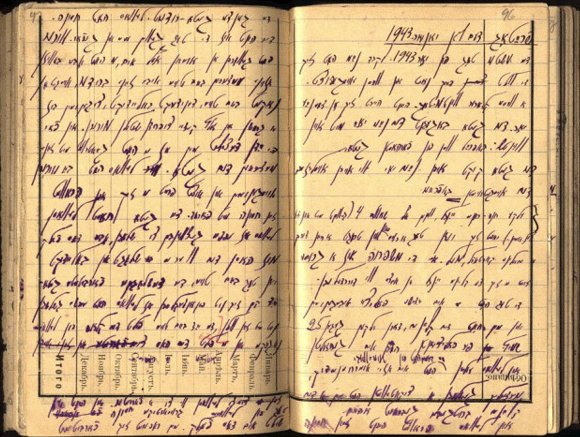
Yitskhok Rudashevski suffered and died in just the same way as hundreds of thousands of others, but unlike them he did not remain anonymous: he is one of the ghetto’s most famous inhabitants. His writings have been published in their original Yiddish and in Hebrew, German and English translations. Extracts of his diary can be found in several anthologies, and it’s available in its entirety under the title The Diary of the Vilna Ghetto.

On this day..

509 B.C.E.: The Sons of Brutus

August 21 is the harvest-time feast of Consualia, honoring the Roman god of grain storage, Consus.

We mark on this occasion the legendary capital punishment inflicted by Lucius Junius Brutus when he was consul of the ancient Roman Republic upon two rebels — his own sons, Titus and Tiberius.

The great Brutus had been one of the leaders of the revolt that expelled Rome’s last king, Lucius Tarquinius — reputedly after the king’s son raped Lucius’s kinswoman Lucretia. (Brutus was also Tarquin’s nephew.)

Upon completing his coup, Brutus immediately summoned the populace to swear an oath that no king would ever rule Rome again. So potent was the civic memory of this event that even centuries later when the Republic was well gone, Rome’s emperors dared not appropriate such an incendiary title as “King”.

But that was for a later time, after the winners wrote the history.

The exiled Etruscan king, subsequent Romans’ eternal watchword for tyranny, got the boot about 510 B.C.E., and in 509 was still hanging about looking for an opportunity to re-seat his dynasty. The plot he hatched is known as the Tarquinian conspiracy, and Brutus, to his grief, would discover that his own children had adhered to it. The statesman’s willingness to put his own flesh and blood to death for the security of Rome would long stand as a parable of manful patriotism.

Our account here is from Livy (line breaks have been added for readability), and the excuse to approximate this undated execution to summer’s harvest-time is bolded therein.

liberty was well nigh lost by treachery and fraud, a thing they had never apprehended. There were, among the Roman youth, several young men of no mean families, who, during the regal government, had pursued their pleasures without any restraint; being of the same age with, and companions of, the young Tarquins, and accustomed to live in princely style.

Longing for that licentiousness, now that the privileges of all were equalized, they complained that the liberty of others has been converted to their slavery: “that a king was a human being, from whom you can obtain, where right, or where wrong may be necessary; that there was room for favour and for kindness; that he could be angry, and could forgive; that he knew the difference between a friend and an enemy; that laws were a deaf, inexorable thing, more beneficial and advantageous for the poor than the rich; that they allowed of no relaxation or indulgence, if you transgress bounds; that it was a perilous state, amid so so many human errors, to live solely by one’s integrity.”

Whilst their minds were already thus discontented of their own accord, ambassadors from the royal family come unexpectedly, demanding restitution of their effects merely, without any mention of return. After their application was heard in the senate, the deliberation on it lasted for several days, (fearing) lest the non-restitution might be a pretext for war, and the restitution a fund and assistance for war. In the mean time the ambassadors were planning different schemes; openly demanding the property, they secretly concerted measures for recovering the throne, and soliciting them as if for the object which appeared to be under consideration, they sound their feelings; to those by whom their proposals were favourably received they give letters from the Tarquins, and confer with them about admitting the royal family into the city secretly by night.

The matter was first intrusted to brothers of the name of Vitellii and those of the name of Aquilii. A sister of the Vitellii had been married to Brutus the consul, and the issue of that marriage were young men, Titus and Tiberius; these also their uncles admit into a participation of the plot: several young noblemen also were taken in as associates, the memory of whose names has been lost from distance of time. In the mean time, when that opinion had prevailed in the senate, which recommended the giving back of the property, and the ambassadors made use of this as a pretext for delay in the city, because they had obtained from the consuls time to procure modes of conveyance, by which they might convey away the effects of the royal family; all this time they spend in consulting with the conspirators, and by pressing they succeed in having letters given to them for the Tarquins. For otherwise how were they to believe that the accounts brought by the ambassadors on matters of such importance were not idle?

The letters, given to be a pledge of their sincerity, discovered the plot; for when, the day before the ambassadors set out to the Tarquins, they had supped by chance at the house of the Vitellii, and the conspirators there in private discoursed much together concerning their new design, as is natural, one of the slaves, who had already perceived what was going on, overheard their conversation; but waited for the occasion when the letters should be given to the ambassadors, the detection of which would prove the transaction; when he perceived that they were given, he laid the whole affair before the consuls. The consuls, having left their home to seize the ambassadors and conspirators, crushed the whole affair without any tumult; particular care being taken of the letters, lest they should escape them.

The traitors being immediately thrown into chains, a little doubt was entertained respecting the ambassadors, and though they deserved to be considered as enemies, the law of nations however prevailed.

The question concerning the restitution of the tyrants’ effects, which the senate had formerly voted, came again under consideration. The fathers, fired with indignation, expressly forbad them either to be restored or confiscated. They were given to be rifled by the people, that after being made participators in the royal plunder, they might lose for ever all hopes of a reconciliation with the Tarquins. A field belonging to them, which lay between the city and the Tiber, having been consecrated to Mars, has been called the Campus Martius. It happened that there was a crop of corn* upon it ready to be cut down, which produce of the field, as they thought it unlawful to use, after it was reaped, a great number of men carried the corn and straw in baskets, and threw them into the Tiber, which then flowed with shallow water, as is usual in the heat of summer; that thus the heaps of corn as it stuck in the shallows became settled when covered over with mud: by these and the afflux of other things, which the river happened to bring thither, an island was formed by degrees. Afterwards I believe that mounds were added, and that aid was afforded by art, that a surface so well raised might be firm enough for sustaining temples and porticoes.

After plundering the tyrants’ effects, the traitors were condemned and capital punishment inflicted. Their punishment was the more remarkable, because the consulship imposed on the father the office of punishing his own children, and him who should have been removed as a spectator, fortune assigned as the person to exact the punishment.

Young men of the highest quality stood tied to a stake; but the consul’s sons attracted the eyes of all the spectators from the rest of the criminals, as from persons unknown; nor did the people pity them more on account of the severity of the punishment, than the horrid crime by which they had deserved it.

“That they, in that year particularly, should have brought themselves to betray into the hands of Tarquin, formerly a proud tyrant, and now an exasperated exile, their country just delivered, their father its deliverer, the consulate which took its rise from the family of the Junii, the fathers, the people, and whatever belonged either to the gods or the citizens of Rome.”

The consuls seated themselves in their tribunal, and the lictors, being despatched to inflict punishment, strip them naked, beat them with rods, and strike off their heads. Whilst during all this time, the father, his looks and his countenance, presented a touching spectacle, the feelings of the father bursting forth occasionally during the office of superintending the public execution.


Bummer: Jacques-Louis David‘s 1784 painting, Lictors Bring Home the Sons of Brutus.

This Brutus was an ancestor of the Brutus who helped assassinate Julius Caesar, and that later et tu, Brutus is commonly represented as having been convinced to turn against his friend and patron by, in part, the example of his legendary namesake.

O, you and I have heard our fathers say,
There was a Brutus once that would have brooked
The eternal devil to keep his state in Rome
As easily as a king.

-Cassius to Brutus in Shakespeare’s Julius Caesar (Act 1, Scene 2)

* “Corn” meaning not American maize, of course — which was not available before the Columbian exchange — but the word’s earlier meaning of whatever was the local grain: wheat, barley, and millet in Rome’s case. (The word corn derives from the Latin granum.)

On this day..

Feast Day of St. James the Greater

It’s a big day today in the Galician city of Santiago de Compostela, because the twenty-fifth of July is the feast of its patron and namesake* St. James the Great.

One of the original Apostles (literally, he and his brother John are the first two whom Jesus calls in the Gospels), James also had the distinction of apparently being the first Apostle to die for Christ.** His execution at the hands of Herod Agrippa† is reported in Acts 12:2;‡ it’s the only apostolic execution in the New Testament.

This, of course, occurred on the southeastern fringe of the Mediterranean, so it’s a wonder that James’s bones came to repose at a Spanish city literally situated on Finisterre, the far western edge of the world as far as Europeans saw it. The Lord works in mysterious ways.

It’s certainly plausible — though impossible to substantiate — that James evangelized in Spain prior to his execution. The whole Mediterranean was a Roman lake. More towards the outlandish is the patriotic story (pdf) that James’s relics were miraculously discovered there in 813 at the moment when Muslim expansion into Iberia gave the hard-pressed Christian kingdoms the greatest possible need for a morale boost.§

James became for those souls Saint James Matamoros, Moor-slayer, and started turning the tide of fictional battles and blessing his own very real chivalric order.


Saint James gets his Moor-slaying on.

“A knight of Christ’s squadrons,” Cervantes wrote. “St. James the moorslayer, one of the most valiant saints and knights the world ever had, and that now the heavens have … this great knight with the vermilion cross has been given by God to Spain for its patron and protection.”

James’s martial prowess is entirely posthumous: when the Son of God recruits him, he’s a humble piscator at labor mending his nets (there are some less-bellicose present-day churches going under the name “Saint James the Fisherman”). Gibbon could not but marvel at the “stupendous metamorphosis [that] was performed in the ninth century, when from a peaceful fisherman of the Lake of Gennesareth, the apostle James was transformed into a valorous knight, who charged at the head of Spanish chivalry in battles against the Moors. The gravest historians have celebrated his exploits; the miraculous shrine of Compostella displayed his power; and the sword of a military order, assisted by the terrors of the inquisition, was sufficient to remove every objection of profane criticism.”

But mythmaking exercises a historicity all its own, and the James legends offered a rallying-point for Spain’s Christians. He stands to this day the patron of Spain as well as a number of places colonized by Spain.

Pilgrims have ever since that stupendous metamorphosis of the 9th century made the journey to the apostle’s purported resting-place; this Way of St. James, actually comprising several different possible routes covering hundreds of kilometers on foot, has in recent years emerged as a major tourist draw. The Way terminates, of course, at Santiago de Compostela and the enormous cathedral there where repose James’s relics.

Saint James’s Day, 25 July, is its celebratory culmination.

James so overawes July 25 on the liturgical calendar that it’s a mere footnote to add that this same day also pays homage to Saint Christopher, a historically dubious Christian martyr from the third or early fourth century Roman Empire.

Christopher is rather nifty, because he’s sometimes depicted in iconography as cynocephalic — that is, having the head of a dog. At least the rest of him is human, unlike Saint Guinefort the Greyhound. (No lie. It’s a doggie saint, albeit of the distinctly unofficial variety. To stamp out folk veneration, an incensed preacherhad the dead dog disinterred, and the sacred wood [where it received offerings] cut down and burnt, along with the remains of the dog.”)

* The name “Santiago” derives from our saint’s name in Latin, Sanctu Iacobu. This is also the source, and James the intended honorary, for other places on the map named Santiago, such as Santiago, Chile.

** Assuming you don’t count Judas Iscariot, of course.

† Herod Agrippa is not to be confused with his grandfather Herod the Great — the Biblical Massacre of the Innocents guy — nor with his uncle Herod Antipas — the guy who punted Jesus’s prosecution back to Pontius Pilate. Three different Herods; three different New Testament heavies.

‡ James’s death in Acts 12 is followed immediately by Saint Peter staging a supernatural jailbreak out of the same prison. The latter goes on to evangelize for another 20-odd years.

§ The holy remains reached that resting point, goes the legend, only by perilously navigating a path of dragons, pagans, and wagons.

On this day..

356 BCE: Herostratus burns the Temple of Artemis

By the ancient world’s tradition, it was on July 21, 356 — the night of Alexander the Great‘s birth* — that a theretofore forgettable man set fire to the wooden rafters of the Temple of Artemis in Ephesus.

Situated on the Hellenized coast of Asia Minor, near present-day Selcuk, Turkey, Ephesus was one of the great cities of the Mediterranean. It counted Artemis (Diana) its patron deity, and gloried in a jaw-dropping marble temple, bankrolled two centuries before by the Lydian king Croesus, that would have nearly covered a modern football pitch. Ephesians took their Artemis seriously: 400-plus years later, St. Paul would barely escape lynching at the hands of enraged Artemis devotees when he proselytized there.

What a horror it must have been for 4th century BCE Ephesians to awake this day to the destruction of their city’s own sacred pride.

Even more shockingly, the temple’s destroyer made no effort to conceal himself. He openly boasted of his act, and of the horrifying reason for it: merely to exalt his obscure name with the luster of infamy.

Ephesus not only put this man to death, but passed a damnatio memoriae upon him, forbidding any mention of his name, in order to deny him his victory.

But the the historian Theopompus, who was not Ephesian, cheated the city of its sentence by recording it: Herostratus. It’s a word that has become a metonym in many languages and an allegory in many books for any villain impelled to his wickedness by the allure of celebrity.

We have no specific date for Herostratus’s execution. But we do have his last tortured victory. We do have his name.

The Ephesians in time rebuilt the magnificent temple, bigger and more awe-inspiring than before. It stood some 600 years more until the Goths sacked it in 268 AD, long enough to secure its place among the Seven Wonders of the Ancient World.

“I have set eyes on the wall of lofty Babylon on which is a road for chariots, and the statue of Zeus by the Alpheus, and the hanging gardens, and the colossus of the Sun, and the huge labour of the high pyramids, and the vast tomb of Mausolus,” wrote Antipater of Sidon of the reconstructed, post-Herostratus temple. “But when I saw the house of Artemis that mounted to the clouds, those other marvels lost their brilliancy, and I said, ‘Lo, apart from Olympus, the Sun never looked on aught so grand.'”


The Temple of Artemis today: a weedy rubble. (cc) image from LWY.

* Plutarch remarked that Artemis was too distracted delivering the conqueror into the world to protect her shrine.

On this day..

1991: Li Xinming, fecund

We seem to lack an exact date to attribute the evocative action so economically described in this May 30, 1991 Reuters wire story:

BEIJING — A man in northwest China has been executed for hacking to death the children of an official who punished him for violating China’s strict birth control rules, the Xinjiang Legal News said.

Farmer Li Xinming murdered his village chief’s two sons and seriously injured his wife after the chief informed him of his punishment for having a third child, the newspaper said in a recent edition reaching Beijing on Thursday.

The execution was carried out immediately after a public trial, the newspaper said.

The world’s most populous country punishes violators of its strict birth control policies, which restrict most couples to one child, with heavy fines and administrative penalties.

On this day..

399 BCE: Socrates

It might have been May 19, 399 BCE* — and if not, we’re in the neighborhood — that the original gadfly** philosopher Socrates obeyed a death sentence from his native Athens and quaffed a cup of deadly hemlock. It’s one of the most famous executions in history, and arguably one of the most consequential.

Socrates left no original writings that survive for us. Posterity sees him via the works of his students Xenophon and especially Plato, but he was a well-known figure to contemporaries in the polis.

For decades, the man with the method and the familiar daemon had been philosophizing around town. Socrates comes in for mockery in an Aristophanes play lampooning newfangled intellectual trends in the 420s BCE


“Like Ozzy Osbourne, [Socrates] was repeatedly accused of corruption of the young.”

The corrupting-the-young and impiety charges which putatively caused the man’s trial and death sentence have been much-debated in the centuries since. It seems clear that the real crime in the eyes of the hundreds of fellow-citizens who judged Socrates had to do with the students who weren’t reverential successor-eggheads, but toxic contemporary politicians. Socrates tutored the treacherous demagogue Alcibiades, who convinced Athenians to mount a catastrophic invasion of Sicily that cost Athens the Peloponnesian War; he rolled with Critias, one of the notorious tyrants of Athens during the 404-403 Spartan puppet dictatorship that resulted from losing that war.

All the while, Socrates had openly preached a dim view of the Athenian democratic system. Again, we don’t have the master’s direct words here, but something like the dialogue presented by the Socrates character in Plato’s allegory of the cave — in which non-philosophers are a lot of purblind morlocks — is difficult to square with anything but an elitist take of civilization. There’s a reason this could be a bit of a sore subject in a city that had just seen the glories of its late imperial apex possessed by Spartan hoplites, especially when espoused by a guy who rubbed chitons with the tyrants themselves.

Even so, Socrates was only narrowly convicted. Once convicted, the legal game had both the prosecution and the defendant propose a punishment, and the jury select one.

Were this system still practiced somewhere, game theorists would have a field day with it. But Socrates just opted out of the match by proposing that he be “punished” with a public pension for his services to the polis. There’s being a gadfly, and then there’s telling your jury to go take a long walk off a high rock: he was death-sentenced by a larger margin than had voted to convict. Plato makes this a much more martyr-like scene than Xenophon; the latter emphasizes that the septuagenarian chin-waggler didn’t much mind being excused from the frailties of advancing age.

Plato used Socrates repeatedly in various dialogues, and it goes without saying that these are cornerstones of the literary canon. The dialogues of most relevance† for his execution specifically are:

  • the Apology, Plato’s account of the defense Socrates mounted at trial: it’s in this text that Socrates is reported to utter the words, “the unexamined life is not worth living.”
  • Crito, a conversation between a wealthy guy of that name and the condemned Socrates in which the philosopher expounds his theory of citizenship and social contract in refusing Crito’s blandishments to escape before execution.
  • the Phaedo, in which Socrates argues for the immortality of the soul, and then gets down to the business of swallowing his fatal draught.

Soon the jailer, who was the servant of the Eleven, entered and stood by him, saying:—To you, Socrates, whom I know to be the noblest and gentlest and best of all who ever came to this place, I will not impute the angry feelings of other men, who rage and swear at me, when, in obedience to the authorities, I bid them drink the poison—indeed, I am sure that you will not be angry with me; for others, as you are aware, and not I, are to blame. And so fare you well, and try to bear lightly what must needs be—you know my errand. Then bursting into tears he turned away and went out.

Socrates looked at him and said: I return your good wishes, and will do as you bid. Then turning to us, he said, How charming the man is: since I have been in prison he has always been coming to see me, and at times he would talk to me, and was as good to me as could be, and now see how generously he sorrows on my account. We must do as he says, Crito; and therefore let the cup be brought, if the poison is prepared: if not, let the attendant prepare some.

Yet, said Crito, the sun is still upon the hill-tops, and I know that many a one has taken the draught late, and after the announcement has been made to him, he has eaten and drunk, and enjoyed the society of his beloved; do not hurry—there is time enough.

Socrates said: Yes, Crito, and they of whom you speak are right in so acting, for they think that they will be gainers by the delay; but I am right in not following their example, for I do not think that I should gain anything by drinking the poison a little later; I should only be ridiculous in my own eyes for sparing and saving a life which is already forfeit. Please then to do as I say, and not to refuse me.

Crito made a sign to the servant, who was standing by; and he went out, and having been absent for some time, returned with the jailer carrying the cup of poison. Socrates said: You, my good friend, who are experienced in these matters, shall give me directions how I am to proceed. The man answered: You have only to walk about until your legs are heavy, and then to lie down, and the poison will act. At the same time he handed the cup to Socrates, who in the easiest and gentlest manner, without the least fear or change of colour or feature, looking at the man with all his eyes, Echecrates, as his manner was, took the cup and said: What do you say about making a libation out of this cup to any god? May I, or not? The man answered: We only prepare, Socrates, just so much as we deem enough. I understand, he said: but I may and must ask the gods to prosper my journey from this to the other world—even so—and so be it according to my prayer. Then raising the cup to his lips, quite readily and cheerfully he drank off the poison. And hitherto most of us had been able to control our sorrow; but now when we saw him drinking, and saw too that he had finished the draught, we could no longer forbear, and in spite of myself my own tears were flowing fast; so that I covered my face and wept, not for him, but at the thought of my own calamity in having to part from such a friend. Nor was I the first; for Crito, when he found himself unable to restrain his tears, had got up, and I followed; and at that moment, Apollodorus, who had been weeping all the time, broke out in a loud and passionate cry which made cowards of us all. Socrates alone retained his calmness: What is this strange outcry? he said. I sent away the women mainly in order that they might not misbehave in this way, for I have been told that a man should die in peace. Be quiet then, and have patience. When we heard his words we were ashamed, and refrained our tears; and he walked about until, as he said, his legs began to fail, and then he lay on his back, according to the directions, and the man who gave him the poison now and then looked at his feet and legs; and after a while he pressed his foot hard, and asked him if he could feel; and he said, No; and then his leg, and so upwards and 118upwards, and showed us that he was cold and stiff. And he felt them himself, and said: When the poison reaches the heart, that will be the end. He was beginning to grow cold about the groin, when he uncovered his face, for he had covered himself up, and said—they were his last words—he said: Crito, I owe a cock to Asclepius; will you remember to pay the debt? The debt shall be paid, said Crito; is there anything else? There was no answer to this question; but in a minute or two a movement was heard, and the attendants uncovered him; his eyes were set, and Crito closed his eyes and mouth.

Such was the end, Echecrates, of our friend; concerning whom I may truly say, that of all the men of his time whom I have known, he was the wisest and justest and best.

A few books about the death of Socrates

* The Phaedo places Socrates’ trial on the day after Athens consecrated a ritual boat for its annual pilgrimage. (This was supposed to be the very boat that the hero Theseus had sailed back after defeating the minotaur in time immemorial, and the Athenians maintained it for centuries in a seaworthy state to make ceremonial voyages to the island of Delos, a sanctuary for Theseus’s patron Apollo. This is also the very conveyance in question in the “Ship of Theseus” paradox, a philosophical conundrum proceeding from the question of whether the thing was still “Theseus’s ship” if every single component of it had been replaced in the intervening years.) Anyway, Theseus aside, that mention of the consecration gives us Mounichion 7 on the confusing lunisolar Attic calendar for the trial of Socrates.

During the ship’s sacred voyage, Athens was to remain ritually “cleansed.” This condition included not conducting any executions. A date for the death of Socrates is established by Xenophon and Seneca reporting that the boat returned after 30 days — which was about twice as long as ordinarily required, but the archaic craft was very vulnerable to bad weather. 30 days is an eminently doubtable nice round number, but where ancient dates are concerned, we takes what we can gets.

“Counting inclusively, as was then the custom, Socrates died on Thargelion 6, which is the very day recorded for his birth,” notes Reason and Religion in Socratic Philosophy. It’s possible that Socrates’s birthday became associated with Thargelion 6 because Thargelion 6 was associated with Socrates via his execution … but Thargelion 6 became known as man’s execution date. It also happened to be the Athenian festival “Thargelia” (and the day before Plato’s Thargelia 7 birthday).

There are other dates out there. In particular, a number of easily accessible pages claim that the hemlock was downed on May 7, 399. I’m not positive, but it appears to me that this might have originally been arrived at by counting 30 days exclusively from Mounichion 7 to reach Thargelion 7, then noticing that Thargelion typically began sometime in May, and smushing together “May” and “7” from alien calendars … after which it’s been repeated on the basis of previous source’s authority. If there’s better support for this date than I infer, I welcome correction.

For my part, I’ve dated this entry based on the astounding Hellenic Month Established Per Athens calendar, specifically its dates for Thargelion of the 1st year of the 95th Olympiad. Thargelion 6 corresponded to May 18/19, says HMEPA — Greek days began at sundown — and since Socrates died at the end of daylight, just before sunset, that’s a Gregorian May 19th. Again, though, all this is built upon a chain of questionable inferences based on a few questionable passing remarks from just a couple of ancient sources. In the end, one just can’t know for sure.

** Plato reports in the Apology Socrates characterizing himself as such this way — “a sort of gadfly, given to the state by God; and the state is a great and noble steed who is tardy in his motions owing to his very size, and requires to be stirred into life” by his stings — bequeathing to us the evocative metaphor.

† Find these essential execution-related dialogues here, here, or here, or just the highlights here.

On this day..

1937: Camillo Berneri, anarchist intellectual

On this date in 1937, the Italian anarchist Camillo Berneri was kidnapped from his home by in Barcelona by armed paramilitaries. Berneri was shot that night.

Berneri (English Wikipedia entry | Spanish | timeline) had once been a University of Florence professor, but was forced into exile for opposing the fascist conquest of power in Italy.

When a coup threatened a similar right-wing conquest of power in Spain, Berneri organized the first column of Italian volunteers to oppose it.

International brigades poured into Spain to fight for the Republican government, but not everybody in the “popular front” was on the same side — a fact which became horrifyingly clear during Barcelona’s “May Days”, a week of internecine bloodletting in Republican Catalonia.

Anarcho-syndicalists of the CNT party and anti-Stalinist communists of POUM were the ones whose blood was mostly let; indeed, it might better be called a purge. The Moscow-backed Communist Party opposed the power of its putative comrades as much as or more than that of Franco. During the May Days, the Communists’ Catalan ally, a party called the PSUC, essentially took over Barcelona with the help of thousands of Assault Guards and killed, arrested, or dispersed the anarchists and Trotskyites.

Berneri clearly saw it coming, quoting Pravda in an April 1937 letter to the anarchist Health Minister criticizing his participation in the Popular Front government: “As for Catalonia, the purging of Trotskyist and anarcho-syndicalist elements has begun; this work will be carried out with the same energy with which it was done in the USSR.”

The British writer George Orwell served in a POUM unit, and the last third or so of his Spanish Civil War memoir Homage to Catalonia attempts to make sense of the chaotic scene.

Smitten when he arrived in Barcelona the previous December — “the first time that I had ever been in a town where the working class was in the saddle”* — the writer scoffed at the Communists’ official justification that anarchists and friends were a “counter-revolutionary” element, or even in actual league with their nationalist enemies.

It seemed queer, in the barber’s shop, to see the Anarchist notice still on the wall, explaining that tips were prohibited. ‘The Revolution has struck off our chains,’ the notice said. I felt like telling the barbers that their chains would soon be back again if they didn’t look out.

I wandered back to the centre of the town. Over the P.O.U.M. buildings the red flags had been torn down, Republican flags were floating in their place, and knots of armed Civil Guards were lounging in the doorways. At the Red Aid centre on the corner of the Plaza de Cataluña the police had amused themselves by smashing most of the windows. The P.O.U.M. book-stalls had been emptied of books and the notice-board farther down the Ramblas had been plastered with an anti-P.O.U.M. cartoon — the one representing the mask and the Fascist face beneath.

Down at the bottom of the Ramblas, near the quay, I came upon a queer sight; a row of militiamen, still ragged and muddy from the front, sprawling exhaustedly on the chairs placed there for the bootblacks. I knew who they were — indeed, I recognized one of them. They were P.O.U.M. militiamen who had come down the line on the previous day to find that the P.O.U.M. had been suppressed, and had had to spend the night in the streets because their homes had been raided. Any P.O.U.M. militiaman who returned to Barcelona at this time had the choice of going straight into hiding or into jail — not a pleasant reception after three or four months in the line.

Also a fighter of the liquidated POUM, Orwell too was proscribed: he had a job to make it out of Barcelona without winding up in someone’s dungeon or firing range. His disgust with what revolutionary Barcelona had come to would help to inform his subsequent anti-Soviet literary efforts.

Berneri, too, was an outspoken anti-Communist. Long a major intellectual in the anarchist camp, he was clearly targeted by name, and hauled from his house along with his brother-in-law Francesco Barbieri by a death squad. Their bodies turned up riddled with bullet holes the next morning.

There’s a collection of Berneri’s writings in English translation here, including one piece dated to the very day of his disappearance; also see this pdf of Berneri’s work. He was survived by his daughter, Marie-Louise Berneri, who herself became a noted anarchist activist of the 1940s.

* Orwell on Barcelona circa December 1936: “Practically every building of any size had been seized by the workers and was draped with red flags or with the red and black flag of the Anarchists; every wall was scrawled with the hammer and sickle and with the initials of the revolutionary parties; almost every church had been gutted and its images burnt … Waiters and shop-walkers looked you in the face and treated you as an equal. Servile and even ceremonial forms of speech had temporarily disappeared. Nobody said ‘Señor’ or ‘Don’ or even ‘Usted’ … Tipping was forbidden by law … revolutionary posters were everywhere, flaming from the walls in clean reds and blues that made the few remaining advertisements look like daubs of mud. Down the Ramblas, the wide central artery of the town where crowds of people streamed constantly to and fro, the loudspeakers were bellowing revolutionary songs all day and far into the night. And it was the aspect of the crowds that was the queerest thing of all. In outward appearance it was a town in which the wealthy classes had practically ceased to exist. Except for a small number of women and foreigners there were no ‘well-dressed’ people at all. Practically everyone wore rough working-class clothes, or blue overalls, or some variant of the militia uniform. All this was queer and moving. There was much in it that I did not understand, in some ways I did not even like it, but I recognized it immediately as a state of affairs worth fighting for.”

On this day..

1923: Konstanty Romuald Budkiewicz, Catholic priest in the USSR

Late the night of March 31-April 1, which was in 1923 the dark between Holy Saturday and Easter Sunday, the Catholic priest Konstanty Budkiewicz (Konstantin Budkevich) was shot in the cellars of Lubyanka.

Born to a Polish family in present-day Latvia, Budkiewicz (English Wikipedia link | Polish) went to seminary in St. Petersburg. He was in that same city, now a 50-year-old vicar-general, when the Bolshevik Revolution shook Petrograd.

Given the Bolsheviks’ anti-clericalism, this was bound to be a trying position: Catholic clergy, especially of relative prominence, faced intermittent harassment. The outlander Latin rite and any Pole’s hypothetical association with Russia’s ancient geopolitical foe only exacerbated the situation.

Matters came to a head with the March 13, 1923 arrest (Polish link) of a number of Catholic clergy. In the ensuing days, most would be convicted and sentenced to death at a show trial on the grounds of “inciting rebellion by superstition.” To be charged with “inciting rebellion by superstition” is pretty much to stand condemned for it, one would think.

New York Herald correspondent Francis McCullagh, who was present in the courtroom, would later publish his observations of the proceedings in The Bolshevik Persecution of Christianity. The proseutor, McCullagh wrote,

launched into an attack on religion in general and the Catholic Church in particular. “The Catholic Church,” he declared, “has always exploited the working classes.” When he demanded the Archbishop’s death, he said, “All the Jesuitical duplicity with which you have defended yourself will not save you from the death penalty. No Pope in the Vatican can save you now.” …As the long oration proceeded, the Red Procurator worked himself into a fury of anti-religious hatred. “Your religion”, he yelled, “I spit on it, as I do on all religions, — on Orthodox, Jewish, Mohammedan, and the rest.” “There is not law here but Soviet Law,” he yelled at another stage, “and by that law you must die.”

Although information about anti-Christian hostility in the USSR tended to reach the wider world in fragmentary form only, there was an outcry in the western world over this trial’s condemnation of Budkiewicz’s boss, Archbishop Jan Cieplak, as well as that of Monsgnor Budkiewicz. International pressure would ultimately save one of those men … but only one.

Cieplak’s death sentence was commuted, and in 1924 he was even released and allowed to leave for Poland. He died in the United States in 1926.

Budkiewicz made do with grace of the celestial kind. He was whisked from his cell late on the 31st, and shot sometime overnight in the notorious Lubyanka prison in Moscow. Soviet authorities were so tight-lipped and obfuscatory about his situation that the pope prayed publicly in St. Peter’s later that same day for Budkiewicz’s life to be spared. Only several days later was the accomplished fact of Budkiewicz’s execution openly confirmed.

The Polish poet Kazimiera lllakowiczówna dedicated a verse to Budkiewicz, titled The story of the Moscow martyrdom.

Budkiewicz is being investigated by the present-day Catholic church for possible beatification. (Archbishop Cieplak is, too.)

On this day..

Purim

February 24, 2013 is the Jewish festival of Purim. (Actually, it began at sundown last night.)

This holiday, corresponding to 14 Adar of the Hebrew calendar, falls on different dates of the Gregorian calendar (most often in March). It commemorates a bloody story from the Book of Esther. (The quotes in this post are from this translation of Esther.)

The factual historicity of Esther is pretty questionable, but that debate is a bit beside the point for purposes of the present post. As folklore or fact, the story of Esther and Mordecai, of their near-destruction and the consequent execution of their persecutor, is a staple of tradition and literature.


The thumbnail version of the Purim story has Esther (Hadassah), a Jew living in the Persian capital of Susa, plucked out of obscurity to become the (or a) queen of a “King Ahasverus”.

If Esther has a historical basis, this would be about the fourth or fifth century B.C.E., and “Ahasverus” could be Xerxes (the guy who invaded Greece and made Herodotus famous), or the much later Artaxerxes II.

Esther is an orphan being raised by her cousin Mordecai, and when Esther wins “Who Wants To Live In The Persian Harem?” Mordecai advises her to keep judiciously silent about her Hebrew lineage.

Mordecai doesn’t manage the same trick, however, and offends the king’s powerful minister Haman by refusing to bow to him. This gets the overweening Haman upset at not only Mordecai but at all Jews who share his anti-idolatry scruples, and Haman persuades King Ahasverus to authorize their indiscriminate slaughter:

“There is a certain people scattered abroad and dispersed among the peoples in all the provinces of your kingdom; their laws are different from those of every other people, and they do not keep the king’s laws, so that it is not for the king’s profit to tolerate them. If it please the king, let it be decreed that they be destroyed.”

13 Adar is the date fixed for the Jews’ destruction, by pur, a casting of lots — hence the festival’s eventual date and name. Haman, of course, does not realize that this policy makes Esther his enemy.

In order to save her cousin and her people, Esther must risk a death sentence of her own by approaching the king unbidden in his inner chambers. Mordecai charges her to her duty with a timeless moral force:

“Think not that in the king’s palace you will escape any more than all the other Jews. For if you keep silence at such a time as this, relief and deliverance will rise for the Jews from another quarter, but you and your father’s house will perish. And who knows whether you have not come to the kingdom for such a time as this?”

Esther pulls this dangerous maneuver off, and gains thereby a private audience with just the king and Haman. There, she springs her trap — revealing her Jewish identity.

The king again said to Esther, “What is your petition, Queen Esther? It shall be granted you. And what is your request? Even to the half of my kingdom, it shall be fulfilled.”

Then Queen Esther answered, “If I have found favor in your sight, O king, and if it please the king, let my life be given me at my petition, and my people at my request. For we are sold, I and my people, to be destroyed, to be slain, and to be annihilated. If we had been sold merely as slaves, men and women, I would have held my peace; for our affliction is not to be compared with the loss to the king.”

Then King Ahasverus said to Queen Esther, “Who is he, and where is he, that would presume to do this?”

And Esther said, “A foe and enemy! This wicked Haman!” Then Haman was in terror before the king and the queen.

Word arrives at this inopportune juncture that Haman, who has been gleefully preparing his vengeance, has just had completed a 50-cubit (~20-meter) gallows to execute Mordecai upon. The enraged king instead orders Haman hung on it.

“Hanging” Haman on the “gallows” was traditionally interpreted in the ancient and medieval world as crucifixion,* or some analogously excrutiating way to die.

By any method of execution, though, the dramatic power of the scene — sudden reversal of fortune, virtue elevated over wickedness, the oppressed turning the tables on their oppressors, divine deliverance — is obvious.

Haman and his gallows have consequently stood as a potent literary device ever since: for perfidious council; for violent anti-Semitism; for unusually spectacular punishment (to be hung “as high as Haman”); for the concept of getting one’s comeuppance or being hoisted by one’s own petard.

At least the guy was remembered. Hands up if you can name any other ancient Persian courtier.


“The Punishment of Haman” is a corner of Michelangelo’s Sistine Chapel.

However, this satisfying palace politics turnabout is not the end of the story, and punishment is not reserved only for the wicked minister.

Esther persuades the king not only to revoke Haman’s order, but to issue a new one — one that Esther and Mordecai will write tabula rasa over the king’s seal.

The writing was in the name of King Ahasverus and sealed with the king’s ring, and letters were sent by mounted couriers riding on swift horses that were used in the king’s service, bred from the royal stud. By these the king allowed the Jews who were in every city to gather and defend their lives, to destroy, to slay, and to annihilate any armed force of any people or province that might attack them, with their children and women, and to plunder their goods, upon one day throughout all the provinces of King Ahasverus, on the thirteenth day of the twelfth month, which is the month of Adar

So the Jews smote all their enemies with the sword, slaughtering, and destroying them, and did as they pleased to those who hated them. In Susa the capital itself the Jews slew and destroyed five hundred men, and also slew Parshandatha and Dalphon and Aspatha and Poratha and Adalia and Aridatha and Parmashta and Arisai and Aridai and Vaizatha, the ten sons of Haman the son of Hammedatha, the enemy of the Jews; but they laid no hand on the plunder. That very day the number of those slain in Susa the capital was reported to the king.

And the king said to Queen Esther, “In Susa the capital the Jews have slain five hundred men and also the ten sons of Haman. What then have they done in the rest of the king’s provinces! Now what is your petition? It shall be granted you. And what further is your request? It shall be fulfilled.”

And Esther said, “If it please the king, let the Jews who are in Susa be allowed tomorrow also to do according to this day’s edict. And let the ten sons of Haman be hanged on the gallows.”

So the king commanded this to be done; a decree was issued in Susa, and the ten sons of Haman were hanged. The Jews who were in Susa gathered also on the fourteenth day of the month of Adar and they slew three hundred men in Susa; but they laid no hands on the plunder.

Now the other Jews who were in the king’s provinces also gathered to defend their lives, and got relief from their enemies, and slew seventy-five thousand of those who hated them; but they laid no hands on the plunder.


This bloodbath is obviously a bit more ethically problematic than Haman’s individual fate.

Now, sure, this is an event of questionable authenticity situated in Iron Age tribal mores and exaggerated by the ubiquitous ancient inflation of head counts. The subtext (“defend their lives” … “relief from their enemies”) also implies something like civil strife, blows exchanged rather than merely blows delivered. The overt text says that the victims were people who intended to do exactly the same thing to the Jews.

Still, the plain words on the page says 75,000 humans were slaughtered by a mobilized ethno-nationalist group, “children and women” among them. Just imagine the same parable about a Serb in a Bosnian king’s court, and say a little thanksgiving that the Book of Esther doesn’t identify these 75,000 as constituents of any specific demographic group that remains a going concern today.

Purim is a beloved holiday among its celebrants, but most any explication of it on the Internet comes with a comment thread agonizing over (or rationalizing) the body count. (For example.)

That part of the narrative has unsurprisingly invited highly prejudicial interpretations, especially among hostile Christian interlocutors (pdf).

American pastor Washington Gladden called the first Purim “a fiendish outbreak of fanatical cruelty.”

The fact that the story was told, and that it gained great popularity among the Jews, and by some of those in later ages came to be regarded as one of the most sacred books of their canon is, however, a revelation to us of the extent to which the most baleful and horrible passions may be cherished in the name of religion … it is not merely true that these atrocities are here recited; they are clearly indorsed.

The Nazis promoted the Jews-as-mass-murderers version, too; there’s even an instance where the Zdunska Wola ghetto was required to provide ten Jews to hang for the ten hanged sons of Haman. The frothing anti-Semitic propagandist Julius Streicher, being positioned on the trap for execution after the Nuremberg trials, reportedly bellowed “Purim Fest 1946!” to the witnesses.

Blessedly Purim Fest is not ultimately defined by the likes of Streicher, nor by the bloodthirstiness that is this site’s regrettable stock in trade. For most observants it’s simply one of the most joyous holidays of the year, a time for gifts and feasting and dress-up and carnivals and celebration sometimes thought of as the “Jewish Mardi Gras” or “Jewish Halloween”. Adherents have even been encouraged in all religious solemnity to drink in celebration until they can no longer tell “blessed be Mordecai” from “cursed be Haman.”

Deliverance indeed. L’chaim.

* The concept of Haman crucified in turn encouraged Jews under Christendom to use the figure of Haman (who once upon a time, could be subject to Guy Fawkes-like effigy-burning on Purim) as a veiled stand-in for the current oppressor Christ, and/or encouraged Judeophobic Christians to impute this intention to Purim observances.

On this day..

1727: An Irish deserter at Gibraltar

This account of an incident during the 1727 Spanish siege of Gibraltar, where the British army garrisoned, comes from an unknown soldier who signed himself only

December 9th. Last night a deserter clambered up within a little of Willis’s battery and was assisted by a ladder of ropes by our men. When the officers came to examine his face, they found him to have deserted out of the Royal Irish two months ago. Asking the reason of his return, he said he chose rather to be hanged than continue in the Spanish service, so is to have his choice.

It is not positively stated that the hanging itself did take place on this date. Since we concern ourselves in these doleful pages with the circumstances under which life becomes dispensable, an assortment of other anecdotes from this same soldier’s journal helpfully illustrate the life of British soldiery at the Pillars of Hercules.

March 9th. Came a deserter who reports that while our guns were firing at them an officer pulled off his hat, huzzaed and called God to damn us all, when one of our balls with unerring justice took off the miserable man’s head and left him a wretched example of the Divine justice.

April 12th. A recruit refused to work, carry arms, eat or drink was whipped for the fifth time, after which being asked by the officer he said he was now ready to do his duty.May 7th. This morning Ensign Stubbs of Colonel Egerton’s regiment retired a little out of camp and shot himself.

June 17th. Today two corporals of the Guards boxed over a rail until both expired, nobody can tell for what reason.

October 11th. One of Pearce’s regiment went into the belfry of a very high steeple, threw himself into the street, and broke his skull to pieces.

October 16th. Will Garen, who broke his back, was hanged.

January 2 1728. Here is nothing to do nor any news, all things being dormant and in suspense, with the harmless diversions of drinking, dancing, revelling, whoring, gaming and other innocent debaucheries to pass the time — and really, to speak my own opinion I think and believe that Sodom and Gomorrah were not half so wicked and profane as this worthy city and garrison of Gibraltar.


Model of a soldier being flogged on present-day display in the remains of Gibraltar’s fortifications. The adjacent explanatory placard reads: “Under siege conditions, the mixture of tension, boredom, hunger and alcohol meant that discipline had to be strict if order was to be preserved. One of the most common forms of punishment was flogging with a nine tailed whip. A drummer in a regiment, which later became the Lancashire Fusiliers, achieved fame as the most flogged man in the British Army. In his first years here [in Gibraltar] he received 30,000 lashes, of which 4,000 were administered in a single year.”

On this day..