1663: Tempel Anneke, witch

Three hundred fifty years ago today Anna Roleffes — nicknamed “Tempel Anneke” — became one of the last* witches executed in Braunschweig, Germany.

Roleffes (English Wikipedia page | German) is particularly interesting due to the lengthy and detailed records of her case that remain preserved. Consequently she’s become the subject of one of the most compelling microhistories of the witch-hunt era, The Trial of Tempel Anneke: Records of a Witchcraft Trial in Brunswick, Germany, 1663.

The accused was a widow about 63 years of age, putting her right in the demographic sweet spot for a witchcraft accusation. She lived with her son, and kept up a side business in folk medicine and fortune telling, putting her right in the professional sweet spot for a witchcraft accusation.

But again, this was the decline phase of the burning time. The Thirty Years’ War was over,** and with it the time of panicky bloodbaths was receding (ever so gradually) relative to more measured legal procedures. In this meticulously documented instance, procedural rules are rigorously followed by rational, educated investigators looking to convict a duly accused citizen of being the bogeyman.† Some records of the investigation stretch from a full year before her June 1663 arrest.

It’s not completely clear exactly how she first entered the judicial process,‡ but her reputed felicity in the augury business stacked up the evidence against her. (Even though some of the witnesses providing it were themselves fined by the court for engaging it in the first place.) One of the first witnesses in the record was a fellow who came to Tempel Anneke for some palmistry. She told him that he’d soon retrieve some pewter silverware that had been stolen from him, and indeed he did. After such an event, you and I might be tempted to leave Tempel Anneke a favorable review on Yelp; Hans Tiehmann, by contrast, reported her for maleficium.

A person in such proximity to the many private woes of her neighbors could find such accusations quickly became self-confirming in the juridical eye. One shepherd came to her after losing several sheep. She prescribed a burnt curative and this proved effective in protecting the remainder of his flock. Then he returned complaining of an illness of his own, and this she could not cure. Both transactions inculpate her in the record. Just another satisfied customer!

The demonology theory of the day held that any magic at all flowed by definition from Hell. In the hands of judges steeped in such ideas, everyday hexes and cantrips — which, again, many of the witnesses themselves voluntarily sought out — could become, officially, infernal manifestations. From turning up lost cutlery, the proceeding segued all the way demonic contracts.

Tempel Anneke was literate and sharp, cannily refusing to confess anything voluntarily. But the terms of the Carolina — the 16th century Germanic criminal code governing proceedings — authorized torture to obtain such a confession upon a “credibly established legally sufficient and consequently suitable indication” of criminal behavior. (Source) The judges submitted their investigation records to legal experts at the University of Jena, who ruled that they had indeed met the legal threshold to enhance interrogation. This she could not withstand, and so eventually confessed that she had made a pact with Satan sealed with fornication

on her son’s farm in the granary … by the light of the moon, she had to step into a circle on the ground which was black, and on [the Devil’s] urging, she let three small drops of blood into a small piece of linen, from her smallest finger on her right hand, which she had pricked with a needle, and she had to give it to him. Thereupon he had started and said, “I now have your blood, now you are mine, with body and blood, now you shall do what I want from you.”

* She was for a time thought to be the last witch executed in Braunschweig. That distinction appears to belong instead to Katharina Sommermeyer (1698).

** Gone, but certainly not forgotten. Tempel Anneke was a widow because her husband died in the Thirty Years’ War.

† Modernity can’t cast too many stones here.

‡ The Carolina licensed investigation of someone who was simply “suspected of a crime through common repute.” Many accused witches of course were prior to their formal accusations suspected or reputed witches.

On this day..

1605: Niklaus von Gulchen, Nuremberg privy councillor

On this date in 1605, Nuremberg privy councillor Niklaus von Gulchen (or Gilgen) was beheaded for his scandalous corruption. The wheeler-dealer’s graft had problematically extended to playing false with and backstabbing any number of elite patrons, from Nuremberg burghers all the way up to the Prince of Sulzbach, and even gone so far as to provide advice to foreigners against the interest of his own city.

The great executioner Franz Schmidt, whose many diary entries record (often tersely) the hundreds of hangings, beheadings, drownings, burnings, and breakings on the wheel he performed for Nuremberg over his lifetime, made an unusually voluminous entry for this shocking treachery. And from the sound of it, the duplicitous Master Doctor earned every drop of his executioner’s opprobrium — even if, according to Schmidt’s biographer, the malefactor’s misused position still entitled him to the privilege of execution by the sword, exemption from torture, and a dignified black cloak to wear to his last performance.

December 23rd (a Monday).* Master Doctor Nicholas von Gilgen, who was by appointment a privy councillor in an honourable council and was bound to that council by oaths he did not observe; for the sake of money received wrote for and advised two (opposite) parties in many affairs; also gave evidence and sat in council for deliberations and decisions; also stole from my lords of this town the allowances for beer and wine, causing it to be stored by his servants.

Also he debauched before her marriage, forcing her to do his will, his servant whom he brought from Trier to this town, and whom he gave as a wife to his clerk Philip Tumbler, by a promise of 50 florins and large presents. According to her declaration she brought forth five children by him, three of which miscarried during delivery or by fright in the twelfth week, two remaining alive, a boy and girl, he being sponsor to the boy at baptism.

Similarly, by like promises, he forced his under-maid to consent to his will a year ago, and tried likewise to persuade his brother’s two daughters; one, the wife of Doctor Wurffbaum, he tried to compel, but she resisted, the other the wife of Doctor Calrot, who yielded to his will and consorted with him before and after her marriage, according to her account through fear and compulsion and the promise of many presents and a wedding portion (he did not admit he compelled her, and I do not believe he forced her).

Lastly he played false when serving the Prince of Sultzbach, whose advocate he was; he also mediated dishonestly between the families of Nuremberg, and between the noble families of Leschwitz and Redwitz, writing to, and advising both parties in one affair. Likewise he counselled the Italian Charles Albert Nello and other Italians against the rulers of our town; also stole the decrees from the office of an honourable councillor.

In Italy too, at Padua, he produced a false certificate, when he figured as a doctor there by means of a false certificate, for he became a doctor at Basel only long after. For his evil deeds he lay in prison for thirty-eight weeks in Lugins Land and in the jail. He was led out on Monday by favour in a long mourning cloak, his arms bound behind him with a black silk cord, and led by a cord, a black cloth being spread on the seat (on the scaffold).


Niklaus von Gulchen’s beheading, from the Nuremberg chronicle. Note that the illustration portrays the doomed pol kneeling, when in fact he was beheaded in a chair. In any stance, von Gulchen “was a mischievious, gold-grubbing man,” according to the chronicler.

When he had been beheaded his body was wrapped in the cloth and laid in a wooden coffin, nailed down and taken to St. Peter’s church by the assistant executioner, but removed at night in a cart to St. John’s by the little gate that leads to the Butts, and buried in the graveyard by the walls.

* Nuremberg, a Protestant city, was still on the Julian calendar.

On this day..

1941: The massacre at Skede in Liepaja

The World War II occupation of the Latvian town of Liepaja (Libau, to the Germans) produced mass executions throughout 1941.

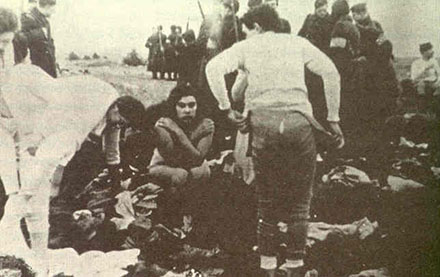
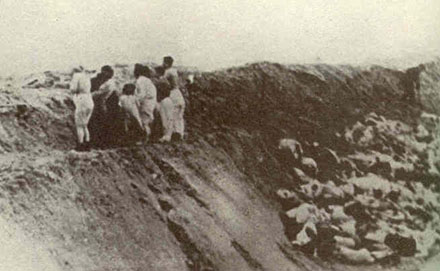
This date in 1941 commenced one of the largest such actions: over 2,700 Jews as well as 23 Communists forced over the course of two-plus days to strip on the freezing Skede dunes overlooking the Baltic and there shot by German and Latvian teams into a vast pit. It’s one of the most recognizable Holocaust atrocities because it was extensively photographed.*

As one can see from the pictures, the victims here were mostly women.


Some of the women in this photographs can be identified by name (pdf). Left to right: (1) Sorella Epstein; (2) presumably Rosa Epstein, her mother; (3) unknown; (4) Mia Epstein; (5) unknown. Alternate identification makes Mia Epstein (5) instead of (4), and (2) Pauline Goldman.

Almost all of Liepaja’s Jews perished during the war.

* Germany’s Bundesarchiv (search on Libau 1941) confirms the precise December 15 dating for these images; it also has some other photographs of atrocities in Liepaja/Libau on other occasions.

On this day..

1938: Martha Marek, Zeliopaster

On this date in 1938, Austrian Martha Marek was guillotined in Vienna for several murders by poison.

She first came to the attention of the discerning interwar crime audience in 1925 when she and her husband Emil were convicted of insurance fraud: Emil claimed to have “lost his leg while chopping wood” just after having taken out a policy, but examination showed that the lost leg had actually been chopped off methodically — and clumsily. They both served a short stint in prison but at least Martha still had four good limbs to go with her wits.

Martha before her marriage had been the lover of a department store magnate five decades her senior who lavished money on her and left her a tidy inheritance to the chagrin of his family. She made her way in the world hitting mother lodes and living comfortably on them, and the time would come that poison would suit her ends better than seduction.

In July 1932, Emil died of apparent tuberculosis. The next month, the couple’s infant daughter Ingeborg died too. Martha, who had lately been reduced to peddling vegetables in the street, pocketed insurance payments on both.

Shortly after, she moved in with an elderly aunt, and the aunt soon died too — leaving her home and assets to her “caregiver”.

As this nest egg dwindled, Martha opened the place to boarders, and one of these poor souls also died — not before mentioning to some people that he always seemed to get sick when he ate Martha’s food. Turned out, Martha had insured his life too.

Martha actually got away with all of this at first, despite the agitation of the dead boarder’s relative. But she pushed her luck a little bit too far when she tried to fraudulently report some insured paintings as stolen in 1937. Persnickety insurance adjusters investigated, and the whole murder spree came out in the process. She was convicted for killing husband, daughter, aunt, and lodger with the rat poison Zeliopaste (thallium).

Austria’s traditional execution method had been hanging, and its traditional executive behavior had been to commute women’s death sentences.

However, the March 1938 Anschluss annexing Austria to Hitler’s Germany brought an update to Germany’s capital punishment policies. Hitler rejected the mercy application (it didn’t help that Martha was half-Jewish) … and prolific Third Reich executioner Johann Reichhart overpowered a violently struggling Martha Marek to behead her on the fallbeil.

On this day..

1955: Elli Barczatis and Karl Laurenz, East Berlin spies

On this date in 1955, the East German Prime Minister’s own chief secretary was beheaded as a spy, along with her lover.

You’ll find this affair blurbed in the Historical Dictionary of Sexspionage, so you’d figure it’s got to be good — but it wasn’t quite James Bond. (They never really are.)


Elli Barczatis (top) and Karl Laurenz

Elli Barczatis hooked up in 1949 with Karl Laurenz when both worked in the DDR Ministry of Industry. (Both these links are in German, as are most that follow.)

Their careers went in opposite directions thereafter. Barczatis scored a plum appointment as Prime Minister Otto Grotewohl‘s administrative aide while Laurenz got booted out of the Communist party altogether for political unreliability: he’d been a mere social democrat before the communist takeover.

Laurenz started scratching out a living as a freelance journalist in both East and West Berlin, prior to Berlin Wall days, and was recruited by West Germany’s intelligence service to brief them on the goings-on in the East.

In December 1950, a former coworker saw Barczatis and Laurenz at a cafe rendezvous — and saw Barczatis pass the reporter a sheaf of papers. The coworker reported it to East Germany’s secret police, the Stasi.

Because of Barczatis’s proximity to the head of government, the Stasi had to investigate the tip with great delicacy. But no matter; the East German spooks could be patient as death when the occasion demanded. So over the course of four-plus years, they cautiously surveilled, and eventually entrapped, the lovers.

At last, on March 4, 1955, those grim security men arrested Barczatis at her apartment in the suburb of Kopenick. Laurenz, returning laster that day to the East from a West Berlin meeting with intelligence officers, was nabbed as well.

Laurenz confessed to espionage right away; it might have been a cathartic experience for him. “The accused became provocative, comparing the State Secretariat for State Security of the German Democratic Republic with the fascist Gestapo and the Nazi SD,” a Stasi officer reported after marathon interrogation sessions. “He remarked that the treatment of prisoners by the State Secretariat for State Security is worse than the treatment by the SD and the Gestapo.” But the doomed spy still stubbornly protected his contacts, sources — and Elli Barczatis. He insisted that she was more leaker than spy, and gave him information thinking only that it was background for his reporting.

According to John Koehler’s Stasi: The Untold Story of the German Secret Police, there might have been something to that.

What was the extent of Elli Barczatis’s espionage? What did she betray that justified her execution? Incredibly, the interrogation record reveals not a single instance in which she furnished Laurenz with material so sensitive that it could be interpreted as having endangered the security of the communist state. She betrayed no military or defense secrets. She merely told her friend about letters her office received from the populace complaining about food shortages; mismanagement that created problems in industry; government personnel changes; and Westerners who visited Prime Minister Grotewohl. The absurdity of all communist regimes was that such tidbits of information were considered state secrets.

Baczatis’s and Laurenz’s beheading on the fallbeil was the culmination of a mid-Fifties security crackdown by East Germany that also eliminated (although not by execution) at least two other highly-placed West German assets, Hermann Kastner and Walter Grosch. (Source.)

On this day..

1427: Johann Bantzkow, Mayor of Wismar

On this date in 1427, the merchant-mayor of Wismar was beheaded — the incidental casualty of a Baltic trade war.

The Hanseatic League, that vast trading cartel stretching from Europe’s Low Countries in the west to Novgorod in the east, was in its glory at the start of the 15th century. The Hanse dominated Baltic trade.

Its major rival was Denmark, which had brought most of Scandinavia together in the Kalmar Union.


Map of the Hanseatic League at its apex, circa 1400. (Via Wikipedia)

Come the 1420s, the Danish monarch was Eric of Pomerania, a handsome and headstrong king. He would come to blows with Hanse cities over the Duchy of Schleswig.

Schleswig is the “neck” of Denmark’s Jutland peninsula. In the present day, the German-Danish border splits Schleswig horizontally: north Schleswig is Danish soil; south Schleswig, German.

To summarize a complicated history, the historical Duchy of Schleswig was long a bone of contention between the pre-modern precursors of those current states. Since Germany was very far from a unitary entity where we lay our scene in the 15th century, Denmark’s immediate rival for Schleswig was that territory’s southern neighbor, Holstein. Eric had fought intermittently in the 1410s and 1420s against the counts of Holstein over who controlled what and upon what terms in south Jutland.

After securing a legal ruling favorable to his claims from the Holy Roman Emperor, Eric in 1426 began enforcing his rights by force.

Holstein in turn sought aid from Hanseatic towns many of whom — wary of Denmark as a rival to its Baltic trading stranglehold — did indeed enter the fray on the side of Holstein. Hanseatic ships began raiding southern Denmark in the spring of 1427.

Wismar, a Hanse wool-trading port just a few kilometers outside of Holstein, was one of these cities. Johann Bantzkow (German link), its merchant ruler, supplied some 200 sail for the Hanseatic flotilla.

Unfortunately for the Hanse, and for Bantzkow, the Danes proved to have naval superiority and dealt a crushing defeat to the Hanseatic fleet on July 11, 1427 — then once again on July 25. A number of Wismar ships were captured in the process.

Public anger in Wismar was intense. That city had seen its own social conflicts in the generations preceding between the town’s patricians and its guilds; now popular anger over the souls lost at sea caused Bantzkow’s fellow-mayor Hinrik van Haren to be slain by the mob. Bantzkow himself was condemned judicially, and his influential family could not manage any better succor than a death by the sword instead of the horrible prospect of the breaking-wheel. Claus Jesup (German link), a leader of guilds, made himself mayor of a rearranged political order.

The prospective realignment was itself reversed in 1430, and the re-established magnates put up a Bantzkowsche Sühnekapelle (German again), or Bantzkow Penance Chapel, to atone for the unjust beheading. Regrettably, the chapel was demolished in the 19th century.

Given setbacks at sea, Holstein and its remaining Hanseatic allies focused on actual conquest in Schleswig, and with much better success. Eric was eventually forced after great expense to sue for a costly stalemate,* an affair which helped to undermine Eric’s own hold on power until he was finally deposed in 1440.

However, Eric’s success on the seas — and his urgent need for funds — led to his establishing Denmark’s Sound Dues on 1429, collecting lucrative tolls from all foreign ships sailing between the Baltic Sea and the Kattegat.** This tax would remain a pillar of the Danish state well into the 19th century, at times providing up to two-thirds of the government’s operating income.

A new Hanse was re-founded in 1980 as a cultural exchange network among the historic cities of the federation.

* Control of Schleswig-Holstein never was definitively resolved, and it re-emerged as a famously devilish diplomatic problem in the 19th century — prompting Lord Palmerston to remark that “only three people … have ever really understood the Schleswig-Holstein business — the Prince Consort, who is dead — a German professor, who has gone mad — and I, who have forgotten all about it.”

** It’s thanks to Sound Dues that Elsinore, the main tolling point, got big and rich enough for Shakespeare to set Hamlet there.

On this day..

1941: Alfredo Castoldi, German spy in Vichy Algiers

Simon Kitson‘s engrossing The Hunt for Nazi Spies: Fighting Espionage in Vichy France makes the case that Vichy France — and in particular, 1940-42 Vichy, before Operation Torch triggered the outright German occupation of Vichy France — had an active counterespionage program working against German spies.

Once recruitment in the German secret services was suspected, evidence was needed to carry out an arrest. The general rule was to delay arresting suspects so as to be able to tail them to find out who their contacts were and the exact nature of their activities. This is what happened with Alfredo Castoldi, an Italian working for the Germans. Castoldi made the acquaintance of someone named Perez in a bar and tried to convince him to provide military information. Perez pretended to accept but the next day he went to tell all to the local police chief. The police did not arrest Castoldi right away but asked Perez to maintain contact with him and to earn his trust and find out the nature of his intentions and his network. The evidence acquired in this way was so convincing that on 3 November 1941, at 7:30 in the morning, Castoldi was executed by a French army firing squad in Algiers.

Castoldi was not an outlier. Several dozen German spies may have been shot by Vichy France in the 1940-42 period. Kitson notes that it is

difficult to ascertain the exact number of German spies sentenced by Vichy military courts who were actually executed by the firing squads of the French army. [Paul] Paillole claims there were forty-two of them. In research for the present study, I found formal proof of eight such executions, but Paillole’s figure seems credible for two reasons. Firstly, during the postwar trial of Marshal Philippe Petain, Ernest Lagarde, the former director of political affairs in the Foreign Affairs Ministry, claimed there were about thirty such executions in 1941, which does not exclude a total of forty-two for the years 1940-42. Secondly, there is a register of Petain’s decisions concerning appeals for clemency from individuals condemned to death for activities ranging from Communism to army mutinies to espionage. In espionage cases, the registry does not specify for which country a particular spy was working, but it would seem that, after cross-checking the names listed with other sources used for the present study, there were twenty-seven confirmed cases of Axis spies having their appeal for clemency refused. A further twenty-three cases in which clemency was refused also appear to involve Axis spies. Of course, in a handful of instances where the appeal for clemency was rejected, executions may still not have been carried out as a result of the invasion of the southern zone by the Germans, which brought a sudden end to official executions. This registry nevertheless adds credibility to Paillole’s estimate.

On this day..

1944: Six German POWs, for Stalingrad’s Dulag-205

On this date in 1944, Wehrmacht Oberst Rudolf Körpert, his deputy Hauptmann Carl Frister, and officers Fritz Müsenthin, Otto Mäder, Richard Seidlitz and Kurt Wohlfarth, were shot in the Soviet Union for their treatment of Russian prisoners of war at Stalingrad.

This was nearly two years on since the Germans had surrendered the eastern front’s horrific signature battle.

The six captured men were principals at the little-known Dulag-205, a transit camp the Wehrmacht erected at Stalingrad for Soviet prisoners of war pending westward deportation to less extemporaneous prisons. (And less extemporaneous mistreatment.)

A minuscule 10 acres, the camp was eventually crammed with up to 3,400 prisoners, triple its anticipated capacity. There was nowhere to send them once the Germans were fatally encircled, and as supplies failed in the last terrible weeks of the besieged Kessel (“cauldron”), the subsistence prisoner rations of putrefying-horseflesh soup were cut off entirely.

Several dozen dropped dead of starvation, overwork, and summary execution each day thence until the merciful end. When the Red Army finally took control of the camp on Jan. 22, 1943, it discovered corpses with obvious signs of cannibalism.

Frank Ellis has the definitive treatment of this affair in “Dulag-205: The German Army’s Death Camp for Soviet Prisoners at Stalingrad” (Journal of Slavic Military Studies, March 2006), and the facts in this posts are drawn from Ellis’s examination of the Dulag-205 interrogation and trial records.*

Our captured men enjoyed the company of NKVD and SMERSH interrogators for a number of months, under what duresses one shudders to imagine.

The rescued Soviet soldiers — who were themselves suspect in the eyes of Stalinist authorities merely for having been captured — provided ample firsthand corroboration of Dulag-205’s miserable conditions.

“The guards were allowed to shoot without any warning at prisoners who approached the barbed wire barrier, who tried to jump the queue for food and at prisoners who tried to have a piss in the wrong place,” one POW told his Soviet interrogators. “Hardly any water or bread was given to the prisoners. The prisoners slept in the dugouts without any bedding, jammed tight. The prisoners were never able to rest since they had to sleep standing and sitting. … There were no baths in the camp. During my whole time in the camp — about 5 months — I did not wash once.”

Moscow had by this time already begun rolling out war crimes trials relating to the German invasion. The guys who were captured with starving Red Army prisoners cannibalizing one another were going to be a prime target.

The subaltern officers, according to Ellis, generally tried to put the blame on Körpert and further up the chain of command, and understandably so. Mäder was a mere adjutant. Siedlitz was the director of camp construction. They weren’t the ones who got the Sixth Army encircled or cut prisoner rations or even made camp-specific decisions like when to set the dogs on a disobedient captive. They had no ability to transfer the prisoners back to the Soviets or to any less horrible detention on their side of the lines. Otto Mäder:

My service in the Dulag was a great spiritual torment for me. It was dreadful to see the terrible condition of Russian prisoners.

I stand before the court at that time when the main culprits responsible for the death of 3,000 Soviet prisoners — Field Marshall Paulus, the army’s chief-of-staff, General Schmidt, Lieutenant-Colonel Kunowski and the army quartermaster — do not stand before the court. They are not only guilty of the death of Soviet prisoners-of-war, but have put us on the accused’s bench!

You’d expect the guy to say that to a Soviet tribunal, certainly — especially a lawyer, which Mäder was also — but that doesn’t make it untrue. This case was actually evaluated in post-Soviet Russia for possible posthumous rehabilitation. (No dice.)

Intriguingly, the Wehrmacht officers were not tried for violations of the Geneva Conventions; indeed, the USSR had not ratified all of the Geneva Conventions, and this put Germany (which had ratified them) in an ambiguous position relative to its non-ratifying belligerent. (A less kind way to say it might be that the difference served to rationalize dreadfully inhumane treatment.)

Rather, Körpert et al were charged under Soviet laws promulgated only after the Battle of Stalingrad, a sketchy maneuver which Ellis thinks suggests that prosecutors hoped to avoid setting a precedent that could be cited by Germany relative to the USSR’s none-too-gentle treatment of its own prisoners of war.

* Ellis also has a topical recent book out, The Stalingrad Cauldron: Inside the Encirclement and Destruction of the 6th Army.

On this day..

1435: Agnes Bernauer

On this date in 1435, the Duke of Bavaria-Munich had his son’s commoner mistress drowned.

Agnes Bernauer (English Wikipedia link | German) was supposed to have been the daughter of an Augsburg barber, though hard details about her life are hard to come by owing to her social class.

By 1432, she’s demonstrably a part of the Munich court; it’s thought that the prince Albert (the future Duke Albert III) must have met her at an Augsburg tournament in 1428.

The nature of her relationship to the Bavarian heir, too, must largely be guessed at. It’s been widely hypothesized that they might have married secretly.

Such a marriage might explain the shocking end to the Agnes-Albert relationship by situating it as a threat to dynastic succession: Albert was Ernst’s only legitimate son, and the Bavarian patrimony had been subdivided and fought over among Wittelsbach kin over the preceding decades.

Whatever the reason, Ernst took the disapproving (maybe) in-law act quite a lot farther than most. While Albert was out on a hunt, Ernst had Agnes seized, condemned for witchcraft, and executed by drowning in the Danube River on Oct. 12, 1435.

Upon hearing of the death of his beloved, Albert bitterly deserted his father for Ernst’s cousin and rival Louis VII, Duke of Bavaria-Ingolstadt. The prospect of capping domestic homicide with civil war loomed for several months until father and son were reconciled — and one must guess, once again, at how that conversation went. Albert endowed a perpetual mass for Agnes which is still said annually. A Bernauer chapel containing a tomb relief of Agnes, erected as an apology by Duke Ernst, remains a tourist draw in Straubing.

The star-crossed love of Agnes and Albert has proven irresistible to the arts over the centuries, with a special boom in the Romantic era.

King Ludwig I of Bavaria composed a poem in her honor; several 19th century stage tragedies (most notably that of Friedrich Hebbel) explore the story; and Carl Orff made it into an opera, Die Bernauerin.

On this day..

1943: Yitskhok Rudahevski and family

(Thanks to Meaghan Good of the Charley Project for the guest post. -ed.)

Sometime in early October 1943, fifteen-year-old Yitskhok Rudashevski and his entire family were rousted out of their hiding place in the Vilna Ghetto, taken to nearby Ponary, shot to death and buried in a mass grave.

The Rudashevski family were among the last remnants of a once-vibrant Jewish community in the city once known as “the Jerusalem of the north” for its culture and scholarship. People came there from as far away as the United States to study in its highly regarded yeshivas.
After the start of World War II, Vilna was annexed by the Soviet Union. It became a sanctuary to Jews fleeing from the Nazis, who occupied western Poland.

All of that changed on June 22, 1941, when Operation Barbarossa began. On the day Germany invaded the USSR, there were approximately 80,000 Jews living in Vilna, many of them refugees from the Nazi terror. By the time the Red Army arrived and kicked the Nazis out three years later, Vilna’s Jewish population had been reduced –through starvation, disease, deportation and executions — to zero.

Yitskhok (also spelled Yitzhak, Yitzak, etc., or anglicized to Isaac), was thirteen years old at the time his city was occupied by the Germans.

An only child, he was the son of a typesetter and a seamstress. Talented in writing, history and languages, he was also a faithful Communist and a member of the Pioneers, the Communist youth organization.

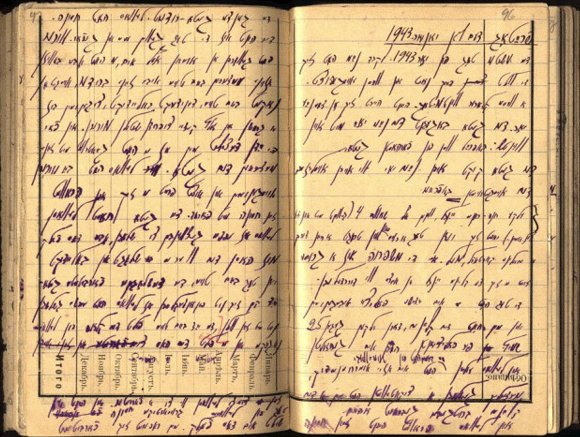
From June 1941 to April 1943 he kept a diary in Yiddish. Yitskhok had a sense of the significance of his account; at one point he wrote, “I consider that everything must be recorded and noted down, even the most gory, because everything will be taken into account.”

He not only wrote about his own life and his family and friends, but about the wider community events and the devastation the Germans wrought on his people. The historian Allan Gerald Levine called him “an astute and passionate observer of the times,” and compared him to Anne Frank.

Nor was the diary Yitskhok’s only writing project.

When one of his teachers, a beloved figure in the ghetto, died, he wrote a eulogy for the man and read it out before a large audience. He was a member of a literary group and was also attached to the ghetto’s history project, for which he interviewed ghetto residents about their lives:

I got a taste of the historian’s task. I sit at the table and ask questions and record the greatest sufferings with cold objectivity. I write, I probe into details, and I do not realize at all that I am probing into wounds … And this horror, this tragedy is formulated by me … coldly and dryly. I become absorbed in thought, and the words stare out of the paper crimson with blood.

The Vilna Ghetto, whose population initially numbered 40,000, had a rich cultural life, just like prewar Jewish Vilna had. There were theaters, cabarets, the symphony, art exhibits, a library, public lectures, and underground schools for both children and adults.

Vilna Jews saw art, music, literature and the pursuit of knowledge as a form of resistance. As Jacob Gens, head of the “ghetto’s Judenrat, put it, cultural activity gave a person “the opportunity to free himself from the ghetto for a few hours … We are passing through dark and difficult days. Our bodies are in the ghetto, but our spirit has not been enslaved.”

Reality intruded, however, and in the final analysis the Vilna Jews were doomed to extinction.

Yitskhok’s final diary entry was dated April 7, 1943, two days after five thousand Vilna Jews had been rounded up and shot at Ponary. He was understandably in a very grim mood. His prophetic last line was, “We may be fated for the worst.”

On September 23, 1943, the Nazis began the final liquidation of the Vilna Ghetto, which had by then been reduced to about 10,000 people. After a selection, those who could work were sent off to labor camps in Estonia and Latvia, where almost all of them died due to the brutal conditions there.

Children, the elderly, and the sick were shot at Ponary or sent to the extermination camp Sobibor and gassed.

Yitskhok, his parents and his uncle’s family chose to go into hiding rather than take their chances at the selection. In hiding he sank into apathy and said very little. After about two weeks in the hideout, they were discovered and taken to their deaths.

The only surviving member of Yitskhok’s family was his teenage cousin, Sarah “Sore” Voloshin. Somewhere on the route to Ponary she was able to escape. She joined a partisan group in the forest and survived until the Red Army liberated the area in the summer of 1944. After the war was over, she returned to the family’s hiding place and found Yitskhok’s diary. As of 2010, Sore Voloshin was still alive in Israel.

And the diary she retrieved had become one of the major sources on day-to-day life in the Vilna Ghetto.

Yitskhok Rudashevski suffered and died in just the same way as hundreds of thousands of others, but unlike them he did not remain anonymous: he is one of the ghetto’s most famous inhabitants. His writings have been published in their original Yiddish and in Hebrew, German and English translations. Extracts of his diary can be found in several anthologies, and it’s available in its entirety under the title The Diary of the Vilna Ghetto.

On this day..