1896: Carl Feigenbaum, the Ripper abroad?

On this date in 1896, New York City electrocuted Carl Feigenbaum.

He’d been convicted of slaying the widow from whom he rented a room at eight cents per day … but many at the time suspected his homicidal exploits might also have traced to Whitechapel, under the dread sobriquet Jack.

We can only really be sure of the one murder: on September 1, 1894, he attacked 56-year-old Julianna Hoffman in her room on East Sixth Street, for the possible reason of robbing her. One ferocious slash with his long bread knife nearly decapitated the landlady; the disturbance roused Hoffman’s 16-year-old son who burst in on the assailant — reportedly just as Feigenbaum had his blade poised to begin horribly gouging the corpse. Both killer and witness grappled briefly and then fled from each other; Feigenbaum was arrested before the day was out.

Today you’d call the part of town East Village but back in the 1890s it was Klein Deutschland, with one of the world’s largest concentrations of Germans abroad.

Probing his client for material to use for an insanity defense,* Feigenbaum’s attorney elicited his client’s self-diagnosis that “I have for years suffered from a singular disease, which induces an all-absorbing passion; this passion manifests itself in a desire to kill and mutilate the woman who falls in my way. At such times I am unable to control myself.” That seems interesting.

It emerged that Feigenbaum had left Germany as a merchant mariner, and that profession had possibly seen his boats tied up in the Thames during the pivotal months when the Whitechapel murders took place.

In the Big Apple, the idea of modern crime’s great bogeyman throwing his demonic shadow across their very own dungeons appealed irresistibly, to nobody moreso than Fiegenbaum’s own attorney William Lawton, who reveled in his hypothesis of proximity to evil and made a silly bid for celebrity on that basis. Lawton claimed to have hit upon the Ripper idea as he pondered the meaning of Feigenbaum’s professed impulse to mutilate women.


From the St. Albans (Vt.) Daily Messenger, April 28, 1896.

The very day after his client’s electrocution, Lawton explicated the suspected connection to the press, “stak[ing] my professional reputation that if the police will trace this man’s movements carefully for the last few years their investigations will lead them to Whitechapel.” (Lawton is also the sole source of Feigenbaum’s alleged self-incrimination, quoted above: to everybody else Feigenbaum insisted on his innocence far past any possible stretch of plausibility, and even carried that insistence to the electric chair.)

Regrettably, Feigenbaum’s pre-Hoffman movements are obscure to the point where Lawton’s theory is essentially immune to corroboration (or refutation). Even when Lawton dropped his intended bombshell did his hypothesis come in for some public ribbing; the New York Tribune scoffed on April 29 of that year that Feigenbaum now being indisposed to object, all the city’s most troublesome unresolved homicides ought to be attributed to this empty cipher.

Despite the surface similarities of his aborted disemboweling to the infamous London crime spree, Feigenbaum’s case for Ripper immortality doesn’t enjoy much of a constituency today. (Trevor Marriott’s 2005 Jack the Ripper: The 21st Century Investigation is a notable exception to the skepticism.)

* Feigenbaum, who had been literally caught red-handed, ultimately did not pursue the insanity defense that was probably his only hope of avoiding the chair because he did not have enough money to hire the expert alienists who would be required to present such a case to the jury. But for a guy supposedly resource-constrained, Lawton does seem to have gone to some trouble to research the possible Ripper connection.

On this day..

1947: Hisao Tani, for the rape of Nanking

Lieutenant General Hisao Tani was shot on this date in 1947 for his part in the Rape of Nanking.

Tani commanded a division that took part in the conquest and occupation of that Chinese city in 1937, and it was outside its gates — following a Chinese war crimes trial — that he took his leave of this world.

On this day..

1859: Oscar Jackson lynched, precipitating the Wright County War

(Thanks to Meaghan Good of the Charley Project for the guest post. -ed.)

The story of what would become known as the Wright County War began on September 21, 1858, when Henry A. Wallace was found lying dead in a clump of willows on his own farm, his head bashed in. He had last been seen alive on August 27, twenty-five days earlier.

Wallace’s employee, Oscar F. Jackson, was the prime suspect in his murder. Jackson had agreed to help Wallace reap his hay crop in exchange for a portion of the harvest, and on August 27 the two men had been seen working together in the fields near where Wallace’s body was later found.

Jackson showed a curious lack of concern about his boss’s disappearance. He never even bothered to tell the authorities he was missing, and when neighbors noted that Wallace hadn’t been seen in weeks and decided to launch a search, Jackson declined to join in. An impoverished sharecropper, Jackson also seemed to have become suddenly flush with cash — an oddity because like most of the residents of Wright County, Jackson was poor, still struggling to recover from the Panic of 1857. Wallace was comparatively well-off.

A grand jury indicted Jackson for his employer’s murder, but the case against him was incredibly feeble. At the trial, Jackson’s attorneys pointed out that no one had seen the murder or could even determine the day it took place, and suggested any number of people could have visited Wallace and killed him at any time during that three-and-a-half-week period that he was missing.

The jury quite rightly gave Jackson the benefit of doubt and acquitted him on April 3, 1859, after eighteen hours of deliberation.

That night, a lynch party of fifteen men chased him into the woods. Fearing for his life, Jackson fled to St. Paul.

The local citizenry — among them Henry Wallace’s brother, Hiram — were not prepared to let the matter rest. And, horrifyingly, neither was the Wright County Sheriff, George M. Bertram,* or the justice of the peace, Cyrus Chase Jenks.

Five days after Jackson’s acquittal, the three men went to find the presumed murderer in Hennepin County. There, Hiram Wallace swore out a complaint against Jackson accusing him of theft, and Jenks issued a warrant for his arrest. Never mind that Jenks did not have jurisdiction outside of Wright County: Sheriff Bertram delivered the warrant to Alfred Brackett, the deputy sheriff of Hennepin County, and asked him to serve it.

Walter N. Trenery wrote in his 1962 book, Murder in Minnesota,

Brackett found Jackson in St. Paul’s Apollo Saloon the next day. Handcuffing his prisoner, the deputy set out with him for St. Anthony by buggy. Jackson pleaded for time to call his attorney, but at first Brackett would not allow it. On the ride Jackson insisted that his arrest was based on a false charge, the purpose of which was to get him back to Rockford [in Wright County] where he would be murdered… Brackett reconsidered. When the two men reached St. Anthony, he sent word to Jackson’s counsel and persuaded the Wright County sheriff to spend the night in town before starting back to Rockford.

The implacable Sheriff Bertram

Jackson’s lawyer hastily drew up a writ of habeas corpus and before the day was out he’d served it to Sheriff Bertram. The Hon. Isaac Atwater, a Minnesota Supreme Court justice, ordered Jackson’s release on April 11. He was immediately re-arrested, however, as by then Jenks and Bertram had realized their error, gone back to Wright County and drawn up a second warrant. Jackson’s attorney responded with a second writ of habeas corpus, and on April 13, the man was ordered released again.

His friends had pooled their money and come up with enough for him to leave Minnesota forever, but for some reason Jackson returned to Rockford instead of skipping town. The residents of Wright County still wanted to lynch him, and to that end a neighbor swore out yet another phony complaint against him and yet another justice of the peace issued yet another warrant for his arrest.

A mob virtually tore Jackson’s cabin and its contents to pieces and set several fires. They surrounded the home of Jackson’s father-in-law, George Holdship, where the fugitive was reported to be hiding, and set more fires.

On April 24, Sheriff Bertram arrived at Holdship’s residence, and after he swore Jackson would not be harmed, arrested Jackson and took him away.

According to John D. Bessler’s book Legacy Of Violence: Lynch Mobs And Executions In Minnesota,

Less than half a mile from the house an armed mob overtook Sheriff Bertram’s procession. The sheriff relinquished power without resistance and rode off with the deputies, failing to even report the incident. After taunting Jackson throughout the night, the mob strung him up, even as his wife arrived to plead for mercy. Her pleas ignored, she was sent away distraught and empty-handed. The bloodthirsty mob hauled Jackson up and down times, failing to get Jackson to confess but successfully mangling his neck. Only when Jackson was hoisted up for a third time, at 2:00 P.M. on April 25, did his neck break. Jackson’s body was left dangling from a beam that protruded from Wallace’s cabin.

A coroner’s jury was called on the same day Jackson died and decided he had met with his death at the hands of some person or persons unknown. “The jury was not likely,” Trenery noted dryly, “to accuse its own members.”

But the story didn’t end there.

At the time of Oscar Jackson’s lynching, Minnesota had been a state for less than a year; it was admitted to the Union on May 11, 1858. Their first state governor, Henry Hastings Sibley, was anxious to maintain the rule of law, which had been besmirched by the Jackson outrage. One newspaper said, a tad melodramatically, “Wright County will be painted black upon the map of Minnesota — a patch of loathsome leprosy upon the fair surface of the land.”

Sibley offered a $500 reward for the arrest and conviction of anyone concerned with the lynching. It went unclaimed and the lynching started to slip away into obscurity, until July, when Oscar Jackson’s wife spotted Emery W. Moore (called “Emory” or “Aymer” in some accounts) at a gathering in Minnehaha Falls. Moore had been a member of the lynch mob, and it was his warrant that lead to Jackson’s arrest at his father-in-law’s house.

Mrs. Jackson alerted St. Paul’s chief of police, who arrested Moore for murder, and he was sent to Rockford to stand trial.

What followed, as Trenery describes it, was something of a solemn farce:

To prevent further collusion among local officials, the governor directed Charles H. Berry, the state’s attorney general, to conduct the prosecution in person. Berry opened the preliminary examination in Monticello on July 31, 1859, with an angry mob swarming about the building, shouting and threatening the agents of law enforcement. Mrs. Jackson, testifying for the prosecution, clearly and unequivocally named the leaders of the lynch mob and described the circumstances under which her husband had died. When the Wright County sheriff took the stand to explain how the mob had overwhelmed him and took Jackson from his custody, the attorney general found the sheriff’s explanation so unsatisfactory that he ordered Bertram arrested and held as an accomplice in the lynching. Berry then discovered that certain prosecution witnesses had mysteriously disappeared before they could testify, and he was forced to adjourn the hearing before it had been in session a full day.

To add insult to injury, that evening the vigilantes descended on the place where Emery Moore was confined, set him free, and melted into the darkness.

Berry returned to St. Paul and reported all this to the governor.

Fed up, Sibley declared Wright County to be “in a state of insurrection” and sent in the state militia to put a stop to mob justice and force the county officials to do their damn jobs. Three units — the Pioneer Guards, the St. Paul City Guards and the Stillwater Guards — marched in, aided by 35 special policemen.

The results were mixed. At first the militia was unable to find any members of the lynch mob, the locals just shrugged their shoulders when asked where they had gone, and the sheriff and other officials refused outright to cooperate. Only when they found out Governor Sibley was on his way over to personally take charge did the county officials “find” and arrest three suspected lynchers: Emery Moore, Hiram S. Angell, and J.E. Jenks.**

Satisfied, the governor sent the state militia home. The three-day occupation was later facetiously dubbed the Wright County War. It was a bloodless war.

The arrested men were almost immediately set free on a $500 bail, and in October, a grand jury refused to indict them. In the end, no one at all was punished for Oscar Jackson’s death, and Henry Wallace’s murder was never officially solved.

Charles Bryant groused in his History of the Upper Mississippi Valley,

And so the drama ended; the curtain fell; and the so-called “Wright county war” was a thing of the past. Its effects, however, long remained in the enormous expense incurred, which, with other criminal cases of less magnitude, created an indebtedness almost resulting in bankruptcy, and depreciating county orders to less than thirty-five cents on the dollar.

Of the principals involved in this story:

  • Sheriff Bertram left office in 1860 and was succeeded by W. Smith Brookins.
  • Cyrus Jenks died in Meeker City, Minnesota in 1897. He was almost 90 years old.
  • Governor Sibley stayed in office until 1860, and did not seek reelection. In 1862, he was appointed colonel of the Minnesota Militia and led them against the Native Americans in the Dakota War.
  • Charles Berry was later appointed as a judge in the Idaho Territory. He died in 1900.
  • Alfred Brackett fought in the Civil War, leading what would become Brackett’s Battallion, which served longer than any other Minnesota unit. The unit fought against the Confederates between 1861 and 1864, then became part of the Northwestern Indian Expedition in the Dakota Territory.
  • Hiram Angell also fought in the Civil War, with the Third Minnesota Volunteer Infantry Regiment. He died in St. Louis, Kentucky on April 5, 1862.
  • J.E. Jenks got elected to Minnesota’s House of Representatives in the 1870s and served for a year.

Nearly twenty years after Henry Wallace’s death, first his gold watch and then his rifle were found near the former site of Oscar Jackson’s cabin.

* Wright County boasts a Bertram Chain of Lakes, named for Sheriff Bertram.

** J.E. Jenks was probably Cyrus Jenks’s son; records note that Cyrus had a son named John Edwin Jenks who would have been about 22 years old in 1859, which matches J.E.’s first name and age.

On this day..

1852: Nathaniel Bowman, William Ide inspiration

This date’s anecdote, from a public domain local history, concerns the April 24, 1852 hanging of Nathaniel Bowman. Bowman has the minor distinction of being the first person executed in California’s Colusa County.

Bowman would not escape his execution but his attempt to do so summoned the offices of William B. Ide, a pioneer who had led a revolt in Mexico’s Alta California and thereafter headed the very short-lived California Republic — an affair sometimes remembered as the “Bear Flag Revolt” for the sigil still used today by the state.


The present-day California flag.

The service Ide would render his countrymen in this post was among the last of his life: he died of smallpox later in 1852.

The first legal execution in Colusa County occurred in the spring of 1852. Nathaniel Bowman was convicted of murder in the first degree for killing Levi Seigler by beating him over the head with a bottle.*

There was no jail then, and during the trial Bowman was placed under guard at Monroeville. After his conviction he nearly made good his escape. In some manner he eluded the vigilance of his guard and, still shackled, hobbled to the home of Jesse Sheppard, where he begged piteously to have his irons filed off. Sheppard, however, took him back and turned him over to the authorities at Monroeville, where he was executed soon afterwards.

This episode clearly showed the necessity of having some safe place of detention for prisoners.

With his characteristic resourcefulness in emergencies, William B. Ide met this situation also. He obtained some bar iron and bolts from San Francisco and fashioned a cage. This he placed in the shade of a great oak in front of the hotel in Monroeville, which did duty at that time as the county courthouse also. This simple expedient solved the problem until the seat of government was transferred to Colusa in 1854, whereupon Ide’s cage was removed also, to continue duty as a cell in the county jail in Colusa.

* The Sacramento News (April 27, 1852) advises that Bowman “addressed the assembled crowd, from the scaffold, and stated that it was not his intention to kill Seigler, but to beat him badly.”

On this day..

1943: The massacre of Janowa Dolina

On or very near this date in 1943, a Ukrainian militia massacred the Poles of the village of Janowa Dolina (Yanova Dolina).


Janowa Dolina in the 1930s. The village was a model settlement for workers at the nearby basalt quarry, jobs given at that time by official preferences to Poles. It was created in the 1920s, and featured an orderly plot with running water and electricity throughout.

In World War II, each theater of the war was unhappy in its own way. For the beautiful region of Volhynia long straddling the blood-soaked marches between Poland and Ukraine, it meant a ghastly local war under the umbrella of German occupation.

Mostly Polish in the interwar years, when Ukrainian residents chafed under “Polonization” policies, Volhynia had come fully under Soviet control when Berlin and Moscow carved up Poland in 1939, and then, of course, fully under German control in 1941. In these years of ash and bone, ethnic compositions in Volhynia were redrawn with every desperate ferocity nationalism could muster: pogroms visited neighbor upon neighbor, or ethnic cleansing visited state upon subject. It would be Ukrainian ultras positioned in the end to fantasize about ethnic purity by dint of their collaboration with the conquering Reich.

Come 1943, Poles comprised a shrinking minority in Volhynia. The prospect of purging this borderlands to cinch its place in a Ukrainian homeland made those Poles an inviting target for a campaign of ethnic slaughter that’s remembered now as the Volhynia or Volyn Massacres. And with the German defeat at Stalingrad and the Red Army’s advance on eastern Ukraine, Reich administration further west had become sufficiently distracted by more urgent priorities that genocidaires* perceived their moment to strike.

“We should undertake a great action of extermination of the Polish element,” thundered Dmytro Klyachkivsky, a commander of the Ukrainian Insurgent Army (UPA), military organ of the Organization of Ukrainian Nationalists (OUN-B).** “As the German armies withdraw, we should take advantage of this convenient moment for liquidating the entire male population from the age of 16 up to 60 years. We cannot lose this battle, and it is necessary to diminish Polish forces at all costs. Forest villages and those near forests, should disappear from the face of the earth.”

Many specific atrocities, beginning in February 1943 and continuing well into 1944, comprise this liquidation drive.

The one of interest for this post is the invasion on the night of April 22-23 — the eve and morning of Good Friday — of Janowa Dolina, a predominantly Polish village where 600 were massacred by the UPA and the village put to the torch.†

This horror is commemorated by a monument at the site …


The 1990 monument commemorating Poles murdered by UPA. Here’s a closer view of the stone marker, and here’s the inscription on the adjacent cross.

… but there seems to be a slight difference of opinion: the event is also memorialized by a rival stone erected by Ukrainian nationalists which “gives glory to the Ukrainian heroes” of the UPA for “destroying the fortifications of the Polish-German occupiers.”‡


(Thanks to Sonechka for translation help.)

As anyone holding even passing familiarity with events in present-day Ukraine will surely know this is no mere historiographical quibble; the legacy of the OUN from World War II and of its descendants on the modern far right remain deeply contentious in and out of Ukraine.

* Poland officially (and to the dismay of Ukraine) considers this campaign a genocide. There’s also a Polish film on the horrors of Wolyn.

** The OUN split factionally; the “-B” suffix in this case stands for Stepan Bandera, leader of the most militant faction; his surname is still today a byword and/or slur (“Banderists”) for Ukrainian fascism. Its rival faction was the more moderate OUN-M, led by Andriy Melnyk.

† The territory became Ukrainian — which at the time meant Soviet — after World War II and remains so today, so Janowa Dolina is now the Ukrainian town of Bazaltove. There’s a Flickr album tour of the muddy mining village, including photos of the Polish monument and a separate marker for Soviet POWs, but not the UPA monument, here.

‡ The UPA stone also cites April 21-22 as the date. It appears to me, a distant non-specialist, that the Ukrainian construction on what adherents prefer to more neutrally describe as the “tragedy” of Janowa Valley spreads action over two days and emphasizes alleged guerrilla actions by the UPA against German occupation targets prior to destroying the village.

On this day..

1947: Garlon Mickles, the last hanged in Hawaii


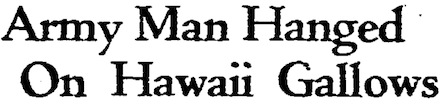
Seattle Times, April 22, 1947.

On this date in 1947, U.S. Army Private Garlon Mickles was hanged at a place called “execution gulch” in Honolulu’s Schofield Barracks.

Mickles had enlisted three years before, the 16-year-old son of a St. Louis laundress. (“Tell my mother I died like a man,” were his reported words to the chaplain.)

According to Associated Press reports, army engineers frustrated peeping eyes by “put[ting] up a smoke screen to shield the gallows from the view of the curious.”

He was convicted of raping and robbing a female War Department employee on Guam, where he was stationed with the Twentieth Air Force — from which staging-point the unit conducted bombing raids on mainland Japan. (The Enola Gay, which dropped the atomic bomb on Hiroshima, was part of the 20th.)

Mickles appears to be the last person ever executed on the Hawaiian islands, and also an unusual overlook by the Espy File of U.S. executions, from which he’s totally absent.

On this day..

1857: The mutineer Jemadar Issuree Pandy

From the Annals of the Indian Rebellion, 1857-58:

THE MUTINEER JEMADAR ISSUREE PANDY.

This Jemadar of the 34th Regiment N.I. was brought to trial on the following charges: —

1st. For having at Barrackpore on the 29th March 1857, he being then in command of the quarter-guard of his regiment, not used his utmost or any endeavours to suppress a mutiny begun by Mungul Pandy, the said sepoy having on the afternoon of the day above mentioned, gone out into the parade ground in front of and near to the quarter-guard of the regiment armed with a sword and musket; and then and there used words to excite the men of the reigment to come forth and join him in resistance to lawful authority; and having then and there on the parade ground, and near to the quarter-guard of the regiment, discharged his loaded musket at Serjeant Major James Thornton Hewson, and Lieutenant Bempole Henry Baugh, of the 34th Regiment N.I., and then and there with a sword struck, and severely wounded, the said Lieutenant Baugh and Serjeant Major Hewson, and the said Jemadar not having taken any measures to arrest and confine the said sepoy throughout the aforesaid occurrences, nor to assist the said Lieutenant Baugh and Serjenat Major Hewson, and he [sic] the said Jemadar having, moreover, then and there discouraged and interfered to prevent any sepoys of his guard from going to their assistance.

2nd. For disobedience to the lawful command of his superior officers in not having advanced with his guard to rescue the Serjeant and capture the aforesaid sepoy, Mungul Pandy, when shortly after the occurrences, set forth in the first charge, he was ordered to do so by Brevet Colonel S.G. Wheler, commanding the 34th Regiment N.I.

The Court found the prisoner, Jemadar Issurree Pandy, guilty of both charges preferred against him, and sentenced him to suffer death. On the 21st April 1857 Major General Hearsey reported as follows: —

Jemadar Issuree Pandy was duly hanged by the neck this afternoon at 6 o’clock in presence of all the troops at the station; the crimes, finding, and sentence of the General Court Martial before which he was arraigned, approved and confirmed by His Excellency the Commander-in-Chief, having been first carefully explained to all the native corps.

It may be perhaps satisfactory to the Government to know that when on the scaffold the Jemadar made a voluntary confession of his guilt, and admitted the justice of the sentence which had been passed on him, at the same time imploring all his fellow soldiers who were present to take warning by his untimely fate.

They didn’t.

On this day..

2017: Ledell Lee

Moments before his death warrant expired at midnight U.S. Central Time, after a last meal consisting only of communion, Ledell Lee was executed by the U.S. state of Arkansas.

Lee spent 24 years awaiting execution for the bludgeon murder of Debra Reese on February 9, 1993, but he was done to death in a rush that left unanswered some of the most fundamental questions in the case.

Trial is the forum designated for contesting this question, of course. At Lee’s, he was represented by an unwilling defense team that repeatedly sought its own removal from the case, citing an “intolerable conflict” with their client, a conflict that paled in comparison to that of the judge, who was having an affair with a prosecuting attorney. (Multiple separate rape cases were pending against Lee at the same time, and those same conflicting attorneys were removed from those cases.)

A quarter-century on death row suggests claims litigated to the point of exhaustion, but this is not how the death penalty game is played in America. The art of execution lies in expediting a conviction and then fighting hammer and tong to maintain that verdict as a fait accompli against any attempt on appeal to litigate issues that the jury never heard. Mostly, the clocks runs for years on useless waiting or epicycles of procedural do-overs that never reach the most salient topics. The Innocence Project reports that outright exonerees (not limited to condemned prisoners) serve an average of 14 years before winning release on their various evidentiary trump cards. (Arkansas’s most famous death row exoneree,* Damien Echols, waited 17 years.)

By the time one reaches the end of the glacial death penalty process, the very refusal of the law to probe the questions it never bothered asking will have become the fault of a prisoner’s own dilatory appeals, leading — in this instance — to victim’s kin at Lee’s clemency hearing “asking you and begging you to please let us have some closure.”

In the name of closure, end-state cases must also insist on renouncing one of the potential benefits of all that time-wasting, the perspective of passing years. DNA tests that were not available when Lee stood trial for his life — and the discredited “forensic evidence” of matching hair samples was invoked against him — could have been used to examine blood spots on Lee’s shoes.** Because the prisoner maintained his innocence in the case from the time he was arrested until the very end, one of his late appeals vainly implored Arkansas to test that DNA sample. There are many cases, death penalty and otherwise, meeting this description, and most U.S. jurisdictions compulsively resist any calls to revisit testable tissue in the light of emerging DNA science as so many affronts to the majesty of law.

So what has everyone been up to while not testing DNA all those years? The Fair Punishment Project report on Lee’s post-conviction road makes depressing reading.

Lee’s first state post-conviction attorney had substance abuse problems that left him “impaired to the point of unavailability on one or more days of the Rule 37 hearing.” The Arkansas Supreme Court noted several examples of his lawyer’s “troubling behavior,” including “being unable to locate the witness room;” “repeatedly being unable to understand questions posed by the trial court or objections raised by the prosecution;” “not being familiar with his own witnesses;” and “rambling incoherently, repeatedly interjecting ‘blah, blah, blah,’ into his statements.” Unsurprisingly, Ledell lost his state-post conviction petition. Eventually, the Arkansas Supreme Court recognized that Lee received grossly inadequate representation and withdrew its opinion, giving him new counsel.

Unfortunately, his new counsel were not much better. First, they missed the filing deadline for the appeal. Then, the Arkansas Supreme Court twice, sua sponte, ordered the attorneys to submit a new brief because their filings failed to comply with Court rules — the second time, the Court referred the attorneys to the Committee on Professional Conduct. The attorneys also appear to have refused to accept their client’s phone calls and ignored his letters.

At one point, Ledell received a glimmer of hope when the Arkansas court appointed the Arkansas Federal Defender to his case. They tried to litigate a claim that Ledell is intellectually disabled. In response, the state argued that Ledell — with all of his competent representation — had procedurally defaulted this claim by not raising it before.† But before the parties could complete litigation on the claim, the Federal Defender was removed due to a conflict.

In 2016, Ledell’s local habeas attorney moved to withdraw from the case because she was retiring. She made clear that in ten years, she had done little work on the case. “I have no file on [Ledell],” she stated, despite having argued at least one of Ledell’s appeals before the Eighth Circuit. “I have no working relationship with [Ledell]. I have not seen [him] for several years. I have no relationship with [his] present counsel and have not had any working relationship with them for some time.”

In June of 2016, one of Lee’s federal habeas lawyers, Gary Brotherton, voluntarily surrendered his legal license “to prevent possible harm to clients” because he was suffering from bipolar disorder with psychotic features and anxiety. One month later, the Missouri Supreme Court suspended him from the practice of law. So, just seven months ago, in the eleventh hour of his case, Ledell received yet another lawyer on his case.

All in all, a shambolic proceedings crowned by the indignity of Arkansas’s cramming Lee into a raft of eight proposed executions — many of them now stumbling on late appeals — slated together for the last days of April for the tawdry expedient of using up the state’s lethal injection drugs before their imminent expiry. It’s a very not normal situation, and yet, it is also all too normal.

Ledell Lee was the first person executed by Arkansas since 2005.

* As we’ve previously noted, Arkansas forced Echols to make an Alford plea as the price of his release, allowing it to claim on a technicality that it had not wrongfully imprisoned an innocent man for two decades.

** The crime scene was a bloodbath, so the supposition is that the murderer would certainly have imbrued his clothes with Reese’s blood.

† Reese’s alleged intellectual disability ought to have been raised by his unwilling defenders at the trial’s mitigation stage; it appears they barely investigated it.

On this day..

1374: Tile von Damm, Braunschweig mayor

On this date in 1374, mayor Tile von Damm was beheaded by rebel populares in his home city of Braunschweig (Brunswick).

One of northern Europe’s great Hanseatic merchant cities, Braunschweig enjoyed a rich history of civic unrest — the Braunschweiger Schichten. (Literally shift, but also carrying the sense of rebellion.)


The Great Rebellion in Braunschweig, by Alfred von Schüssler (mid-19th century).

One of its most outstanding installments — the one recalled as the Große Schicht — kicked off on April 17, 1374. (Most of the information about this incident is in German, as are most of the links in this post.) On that evening, a meeting of the ruling council of merchant magnates with its guild chiefs on how to deal with Braunschweig’s crippling debt turned tetchy and spilled into a popular protest. Within hours, as a chronicler would later put it, the devil was set loose in Braunschweig.

Guild protests carried to the “House of the Seven Towers” where Tile von Damm(e) resplended in the manner fitting the city’s mayor and its wealthiest patrician. That house still exists to this day, but the mayor’s thread was measured in mere hours: he was soon hauled out and beheaded on the Hagenmarkt.

Either eight or ten magnates (sources seem to be split on the figure) were slain during these April disturbances with others fleeing as guild rebels took full control of the city, not to be fully restored until 1386 — although in a show of transnational oligarch solidarity, Braunschweig was booted out of the Hanseatic League while the lower orders had the run of the place.


Allegory of the Great Rebellion (1514).

On this day..

1820: William Piper, drunken matricide

From the Boston Daily Advertiser and Repertory, April 26, 1820:


GEORGETOWN, (Del.) April 18 — This day, the awful sentence of the law was executed on William Piper, for matricide.

The following particulars were taken down by a person present at the time:

Early in the day a crowd was collected at the prison and another at the gallows. At 12 o’clock the tolling of the bell at the court-house announced the arrival of the time when the prisoner was about to bid adieu to earthly things. The anxiety of the people became very great, thousands crowding around the place where the gallows stood, and others pressing to see the criminal leave the prison.

The bell tolled ten minutes, when the sheriff entered the jail with the rope: 25 minutes past 12, the criminal appeared, and was assisted into the cart, and standing up with a horrible, frightened countenance he uttered the broken sentence, “Oh, all these people!”

The cart-horse was soon led off by the deputy sheriff, the guard forming around the cart and marching with charged bayonets; at 32 minutes past 12, the criminal was halted under the pole on which he was soon to be suspended.

The Rev. John Rogers addressed the people, and warned them against drunkenness; the crime, he said, that caused the criminal to do the act that had brought him to the gallows.

The Throne of Grace was then addressed in a very appropriate prayer by Mr. Hudson; after which the criminal spoke a few minutes to the congregation, declaring a knowledge of his sins &c.

The sheriff drew the cap over his face, and fastening [sic] the rope to the hook in the pole; at 13 minutes past one, the cart was moved off, and the criminal left hanging! A horrid consequence of drunkenness! Much might be said of the very trifling impression that was made on the minds of some rum drinkers that were present.

It might be proper to state, that the fatal deed was perpetrated in a state of intoxication, and after some quarrelling between him and his mother, and a blow on the head from her which drew blood, and after she had pushed him down over a chair, and a scuffle on the floor between Piper and his sister, who attempted to tie him, and after the sister had first seized upon the stick with which the fatal blows were given.

The only witness present at the beginning, stated that Piper when intoxicated, often threatened to kill his mother, but when sober he was as good to her as ever a child was.

Suffice to say, that he persisted to the last in solemnly declaring that he never had any malice against his mother, and that he was not sensible of having killed her.

He was 45 years of age.

On this day..