1942: Six aspiring escapees from Dulag-205

On about the 18th December 1942 a group of about 6 prisoners intended to escape but were betrayed by somebody. All six prisoners were led out ofthe camp beyond the wire, taken about 20 metres to a pit and shot without any hearing. Before the execution the interpreter told the prisoners that the 6 men had wanted to escape from the camp and for that they would be executed. This would happen to anyone who tried to escape from the camp. The surnames of those who died are not known to me.

This is the testimony of Konstantin Krupachenko, a Red Army prisoner-of-war retrieved from the Germans’ “Dulag-205” camp — a transit facility behind German lines at Stalingrad which was liberated as the Soviets overran the encircled German position.

Krupachenko’s testimony was part of the evidence prepared against six Wehrmacht officers taken prisoner at that camp and ultimately executed, men whose case we have previously detailed.

Though not well-known and hardly by scale a major contributor to the ghastly death toll among Soviet POWs, Dulag-205 was horror aplenty for those who survived it. Starvation rations gave way to no rations at all in the dead of winter, and the skeletal inmates cannibalized the dead. Harassment by guard-dogs, capricious beatings, and the usual regimen of dawn-to-dusk forced labor were the lot of the lucky ones.

The less fortunate, well …

On about the 25th November 1942 while working on a road which led to Gumrak three kilometres from the camp a group of prisoners of about 50-60 was levelling and clearing the road. One prisoner whose name I don’t know collapsed from tiredness and exhaustion and couldn’t work. The guard tried to force the exhausted man to stand and work but the prisoner couldn’t get up. Then the guard shot the prisoner dead with a sub-machine gun and ordered that he be buried in a ditch at the side ofthe road. (Krupachenko again)


There were public executions in the camp. In January 1943 on about the lOth-llth a former senior Lieutenant of the Red Army, his surname I don’t know, was executed for allegedly organising an escape attempt. (Anatoly Alexeev)


In all cases the Germans would shoot prisoners without any warnings at all. In the month of October 1942 I personally saw up to 30 prisoners shot. They shot people every day for falling behind to and from work, and sometimes for breaking ranks. I am unable to give the surnames of the prisoners shot by the Germans. Moreover, when we were herded from the Alekseevka camp to the area of Karpovka village, then several prisoners were shot dead by German officers for the fact that when we were working we were bombarded by Soviet troops and several prisoners took cover. After the firing had stopped the officers came out of their trench dug-outs and shot them on the spot. Three prisoners were shot dead for taking some tobacco while working on a dump. (Ivan Kosinov)


As one of the Germans on trial for these abuses agreed (Otto Mäder was trying to throw blame onto the camp commanders),

[t]here was no trial of any kind, they [prisoners] were shot without any trial on the order of [Dulag-205 commandant] Colonel Korpert. I am a lawyer by education and I understand perfectly that this these shootings were illegal, simply murder in fact.

All these quotations are via Frank Ellis’s “Dulag-205: The German Army’s Death Camp for Soviet Prisoners at Stalingrad” (Journal of Slavic Military Studies, March 2006),

On this day..

1707: Jack (Sam) Hall, chimney sweep and robber

Jack Hall, chimney sweep turned robber turned folk song antihero, hanged at Tyburn on this date in 1707, along with five other men.

Two of those others, Richard Low and Stephen Bunch, were Hall’s accomplices and co-defendants for burgling the home of a Captain John Guyon on a dark November night. They took “a blue Cloth Wastcoat, a pair of Cloth Breeches, 3 Suits of Lac’d Head-cloaths, four Yards of yellow Ribbon, four Yards of green Ribbon, two Silver Spoons, and a Dram Cup.”

It was only the latest in a string of raids that must have earned them some kind of reputation, for at their execution the Ordinary of Newgate, Paul Lorrain, pressed Hall “Whether (as ’twas reported by some) he had made a Contract with the Prince of Darkness, for a set time to act his Villanies in; he answer’d, He never did, nor said any such thing.”

The devil paid dividends into the afterlife by giving surprisingly long legs to a tributary folk ballad* which survives into the present as “Sam Hall”. Some (not all) of this song’s many latter-day versions reference Jack/Sam’s first legitimate occupation, chimney-sweeping: as a boy, Hall had been sold into a indenture as a “climbing boy”.**

* This song’s passage from its source of tunes dating to the 16th century English church into a delta of variant versions in the 19th and 20th century is traced by Bertrand H. Bronson in “Samuel Hall’s Family Tree” (California Folklore Quarterly, Jan. 1942).

** The horrifying use of small children to shimmy, near-naked, up asphyxiating chimneys a-soot scrubbing persisted deep into the 19th century. William Blake paid heartbreaking poetic tribute to chimney-climbing boys, and in Dickens’ Oliver Twist, young Oliver is nearly given as an apprentice to a vicious chimney sweep named Mr. Gamfield — the avoidance of which “was the critical moment of Oliver’s fate.”

On this day..

1946: Sulaiman Murshid, Alawite prophet

On this date in 1946, Alawite prophet Sulaiman Murshid (German Wikipedia) was hanged by the newly independent state of Syria as a traitor and a blasphemer.

In the mid-1920s, this shepherd turned demigod* on the coast of French Mandate Syria began reporting mystical visions, and soon gathered a following — and then, a larger and larger following.

Shia Alawites are a small minority in Syria, maybe 12% of the present-day population, so it might have been key to Murshid’s success that he so happened to begin his mission in a short-lived Alawite State created within the French Mandate. (Neither keen on his movement nor inspired to arrest it, the colonial French dismissed him as la Thaumaturge de Jobet Burghal.) It was a cradle in which a peasant obscurity grew into a political as well as a prophetic power — a tribal chief who could command armed men and rents.

Come 1936, the Alawite State folded into the Syrian Republic, and by that time Murshid’s adherents were so numerous that they promptly elected him to parliament.

Although this arrangement offered Murshid new vectors of ascent, the environment turned speedily hostile after France withdrew and Syria gained independence in 1946. Murshid’s entity was intrinsically inimical to a centralizing nation-state, and his lowly origins, suspect ethnicity, and half-heretical messianism all tended to set him at odds with Damascus. He was arrested for subversion by Syria’s nationalist first president Shukri al-Quwatli and hanged on Merdsche Square.

Murshid’s sons carried on the movement, whose followers, the al-Murshidun, were persecuted in the years after his death until fellow Alawite Hafez al-Assad ascended to the presidency in 1970. Today their sect numbers in the six figures.

* For more on Murshid’s background and the initial growth of his movement, see “Suleiman al-Murshid: Beginnings of an Alawi Leader” by Gitta Yaffe and Uriel Dann in Middle Eastern Studies, Vol. 29, No. 4 (Oct., 1993).

On this day..

1882: Myles Joyce, Maamtrasna murder miscarriage

Thanks to James Joyce for the guest post on “the ancient tribe of the Joyces”, originally published as “Ireland at the Bar” on September 16, 1907 during Joyce’s Italian exile for nationalist newspaper Il Piccolo della Sera of Austrian-dominated Trieste. As the reader will see, James Joyce is interested here in this case as symbolic,* but readers curious about the particulars of the murders and this still-notorious miscarriage of justice might want to tune into the Irish History Podcast’s three-part series on the case or follow the various links for more. -ed.

The definitive 1992 book on this trial, Maamtrasna: The Murders and the Mystery, is out of print but not difficult to find on the used book market. An earlier volume, The Maamtrasna Massacre: Impeachment of the Trials, is in the public domain.

Several years ago a sensational trial was held in Ireland. In a lonely place in a western province, called Maamtrasna, a murder was committed. Four or five townsmen, all belonging to the ancient tribe of the Joyces, were arrested. The oldest of them, the seventy year old Myles Joyce, was the prime suspect. Public opinion at the time thought him innocent and today considers him a martyr. Neither the old man nor the others accused knew English. The court had to resort to the services of an interpreter. The questioning, conducted through the interpreter, was at times comic and at times tragic. On one side was the excessively ceremonious interpreter, on the other the patriarch of a miserable tribe unused to civilized customs, who seemed stupefied by all the judicial ceremony. The magistrate said:

‘Ask the accused if he saw the lady that night.’

The question was referred to him in Irish, and the old man broke out into an involved explanation, gesticulating, appealing to the others accused and to heaven. Then he quieted down, worn out by his effort, and the interpreter turned to the magistrate and said:

‘He says no, your worship.’

‘Ask him if he was in that neighbourhood at that hour.’

The old man again began to talk, to protest, to shout, almost beside himself with the anguish of being unable to understand or to make himself understood, weeping in anger and terror. And the interpreter, again, dryly:

‘He says no, your worship.’

When the questioning was over, the guilt of the poor old man was declared proved, and he was remanded to a superior court which condemned him to the noose. On the day the sentence was executed, the square in front of the prison was jammed full of kneeling people shouting prayers in Irish for the repose of Myles Joyce’s soul. The story was told that the executioner, unable to make the victim understand him, kicked at the miserable man’s head in anger to shove it into the noose. [The hanging was botched -ed.]

The figure of this dumbfounded old man, a remnant of a civilization not ours, deaf and dumb before his judge, is a symbol of the Irish nation at the bar of public opinion. Like him, she is unable to appeal to the modern conscience of England and other countries. The English journalists act as interpreters between Ireland and the English electorate, which gives them ear from time to time and ends up being vexed by the endless complaints of the Nationalist representatives who have entered her House, as she believes, to disrupt its order and extort money.

Abroad there is no talk of Ireland except when uprisings break out, like those which made the telegraph office hop these last few days. Skimming over the dispatches from London (which, though they lack pungency, have something of the laconic quality of the interpreter mentioned above), the public conceives of the Irish as highwaymen with distorted faces, roaming the night with the object of taking the hide of every Unionist. And by the real sovereign of Ireland, the Pope, such news is received like so many dogs in church. Already weakened by their long journey, the cries are nearly spent when they arrive at the bronze door. The messengers of the people who never in the past have renounced the Holy See, the only Catholic people to whom faith also means the exercise of faith, are rejected in favour of messengers of a monarch, descended from apostates, who solemnly apostasized himself on the day of his coronation, declaring in the presence of his nobles and commons that the rites of the Roman Catholic Church are ‘superstition and idolatry’.


Myles Joyce (leftmost) along with Patrick Joyce (center) and Patrick Casey (right). All three hanged together.

There are twenty million Irishmen scattered all over the world. The Emerald Isle contains only a small part of them. But, reflecting that, while England makes the Irish question the centre of all her internal politics she proceeds with a wealth of good judgment in quickly disposing of the more complex questions of colonial politics, the observer can do no less than ask himself why St. George’s Channel makes an abyss deeper than the ocean between Ireland and her proud dominator. In fact, the Irish question is not solved even today, after six centuries of armed occupation and more than a hundred years of English legislation, which has reduced the population of the unhappy island from eight to four million, quadrupled the taxes, and twisted the agrarian problem into many more knots.

In truth there is no problem more snarled than this one. The Irish themselves understand little about it, the English even less. For other people it is a black plague. But on the other hand the Irish know that it is the cause of all their sufferings, and therefore they often adopt violent methods of solution. For example, twenty-eight years ago, seeing themselves reduced to misery by the brutalities of the large landholders, they refused to pay their land rents and obtained from Gladstone remedies and reforms. Today, seeing pastures full of well fed cattle while an eighth of the population lacks means of subsistence, they drive the cattle from the farms. In irritation, the Liberal government arranges to refurbish the coercive tactics of the Conservatives, and for several weeks the London press dedicates innumerable articles to the agrarian crisis, which, it says, is very serious. It publishes alarming news of agrarian revolts, which is then reproduced by journalists abroad.

I do not propose to make an exegesis of the Irish agrarian question nor to relate what goes on behind the scene in the two faced politics of the government. But I think it useful to make a modest correction of facts. Anyone who has read the telegrams launched from London is sure that Ireland is undergoing a period of unusual crime. An erroneous judgment, very erroneous. There is less crime in Ireland than in any other country in Europe. In Ireland there is no organized underworld. When one of those events which the Parisian journalists, with atrocious irony, call ‘red idylls’ occurs, the whole country is shaken by it. It is true that in recent months there were two violent deaths in Ireland, but at the hands of British troops in Belfast, where the soldiers fired without warning on an unarmed crowd and killed a man and woman. There were attacks on cattle; but not even these were in Ireland, where the crowd was content to open the stalls and chase the cattle through several miles of streets, but at Great Wyrley in England, where for six years bestial, maddened criminals have ravaged the cattle to such an extent that the English companies will no longer insure them. Five years ago an innocent man, now at liberty, was condemned to forced labour to appease public indignation. But even while he was in prison the crimes continued. And last week two horses were found dead with the usual slashes in their lower abdomen and their bowels scattered in the grass.

* Even, Christine O’Neill-Bernhard argues in “Symbol of the Irish Nation, or of a Foulfamed Potheen District: James Joyce on Myles Joyce” (James Joyce Quarterly, Spring-Summer 1995) to the point of indulging “highly tendentious” polemical misrepresentations, such as inflating the middle-aged Myles Joyce into a 70-year-old patriarch. In James Joyce’s defense, his expatriate apartments on the Adriatic did not comprise a strong fact-checking position with regard to Irish criminal annals, and he might have been working entirely from memory.

On this day..

1661: Murad Bakhsh, son of the Taj Mahal builder

Mughal prince Murad Bakhsh, the youngest son of Taj Mahal builder Shah Jahan, was executed on December 14, 1661.*


There’s blood in the stones … (cc) image from Vil Sandi.

Despite writing into stone a love to transcend time, Shah Jahan had the monarchy’s eternal managerial challenge: succession.

This ought not have surprised him. Jahan himself had been a third son, who took his own power by rebellion and clinched it by fratricide. And through the empress to whom Jahan would dedicate the Taj, Mumtaz Mahal, Shah Jahan had four sons who all thought they like their illustrious dad deserved the helm of the wealthy Mughal state.

In descending order of age, those rivalrous brothers were: Dara Shikoh,** Shuja, Aurangzeb, and our man Muhammad Murad Bakhsh. As we open the scene, each governs a portion of the father’s empire; by the end of this post, Aurangzeb will be emperor — his reign to span nearly a half-century — and his brothers will be all be dead.

The oldest boys had the first go, with Dara Shikoh’s power as the officially designated regent of the incapacitated Jahan challenged quickly by Shuja, who was governor of Bengal. Shuja decared himself emperor and marched on Dara Shikoh, who turned little brother aside.

The two were soon forced to come to terms with one another as the younger brothers, Aurangzeb and Murad, had combined their own forces — and the youth had their say in May 1658, smashing Dara Shikoh at the Battle of Samugarh. Murad is credited in this watershed battle with a decisive charge, personally slaying the enemy second-in-command using a composite bow. This fight made Aurangzeb emperor; Dara fled for Afghanistan but was caught and killed a few months later. (Shah Jahan, still living, was confined comfortably but sorrowfully by Aurangzeb.) In January of 1659, Aurangzeb put down Shuja’s challenge at the Batte of Khajwa.

Having wagered the Peacock Throne in battle twice for the honor of supplanting his elders, Aurangzeb had a more expedient solution to sweep away his last potential rival.

On arriving at Muttra (Mathura) Aurangzeb threw off the veil that he had worn with Murad. That brave but savage Prince was arrested while suffering from the effects of a carouse, and sent in all secrecy, a prisoner, to Dehli, where he was confined in the Salimgarh, a fort near the palace.

Murad would be put to death a couple of years later via the instrument of a murder charge supplied by the family of a courtier whom Murad had previously killed.

* The equivalent date on the Julian calendar, December 4, is also sometimes reported.

** The name means “as magnificent as Darius,” which is the sort of conceit destined to set a body up for disappointment.

On this day..

1943: The Massacre of Kalavryta

On this date in 1943, German troops occupying Greece massacred the entire male population of the town Kalavryta.


Memorial to the December 13, 1943 massacre.

Weeks earlier, resistance partisans had waylaid a German patrol in the vicinity, taking about 80 German soldiers prisoner and subsequently executing them.

A bestial Lidice-like mass reprisal, Unternehmen Kalavryta, commenced in December with German columns descending on the small Peloponnesian town — murdering civilians at nearby towns and firing the historic Agia Lavra monastery in the process.

Once they reached their target, the women and children of Kalavryta were locked in a school that was put to the torch, while men and older boys were marched to the outskirts and machine-gunned en masse, killing at least 500. (About thirteen are known to have survived this mitraillade and its ensuing finishing-off with axes.) The total death toll in Kalavryta was near 700, significantly mitigated by the women eventually forcing their way out of their burning tomb. Those survivors faced immediate winter privation to go with the horror of the massacre, for the Germans also destroyed homes and drove off the livestock.

A memorial at Kalavryta today* records some 1,300 names including villagers from the surrounding towns slain during the course of the operation — and the church clock is permanently fixed to 14.34, the moment on that awful December 13 that the massacre in Kalavryta began.

* The city also has a museum dedicated to the event.

On this day..

1924: A day in the death penalty around the U.S.

From the New Orleans Times-Picayune, Dec. 13, 1924:

Shreveport, La., Dec. 12 — Alfred Sharpe, about 25 years old, a negro, was hanged here today at 12:16 p.m. for the murder of Tom Askew, a white man, veteran of the World war and manager of a plantation near Keithville, which occurred last September 9.

Sharpe, in a statement just before going to the gallows blamed liquor for his trouble. He admitted since his captured two days after the killing that he was guilty.

The negro, who was unable to read or write, and did noot know his exact age, said as he mounted the scaffld: “I know I violated the law and that the law must be fulfilled.”

From the Cleveland Plain Dealer, Dec. 11, 1924:

COUMBUS, O., Dec. 11. — Alexander Kuszik, 20, of Akron, must die in the electric chair at the state penitentiary shortly after 1 a.m. tomorrow for the murder of his thirteen-year-old cousin, Elizabeth Nagy, who spurned his proffered love.

Gov. A.V. Donahey late today denied a last minute appeal by Kuszi’s counsel that the death sentence be commuted to life imprisonment. This plea, supplemented by the testimony of three alienists [psychologists — ed.] to the effect that Kuszik was not mentally responsible for his acts at the time of the crime’s commission, failed to convince the governor, however, that he should exercise his powers to extend clemency

Even Kuszik’s counsel, C.G. Roetzel, former prosecutor of Summit county, admitted the crime for which Kuszik was convicted was one of the most brutal on record, and made no claim the prisoner was insane. Roetzel based his plea for clemency on the theory, supported by alienists, that Kuszik was mentally irresponsible although he did know the difference between right and wrong.

Theory of Alienists.

The alienists advancing this theory were Dr. J.C. Hassall, superintendent of Fair aks sanitorium, Cuyahoga Falls; Dr. Arthur G. Hyde, superintendent of the Massillon State hospital, and Dr. D.H. Morgan of Akron.

Drs. Hassall and Hyde had made their observations of Kuszik within twenty-four hours after the crime had been committed. Dr. Morgan made his observations about a month later.

These specialists made their examinations at the request of Prosecutor Arthur W. Doyle, but their testimny was not used at the time of the trial, Dr. Doyle explained, because he reached his own conclusion that Kuszik was responsible for his acts.

Countering the views of this group of alienists was the testimony of three others who, after making an examination of Kuszik at the governor’s request, reported that the youth not only was not insane but that he was mentally responsible.

Mentality Subnormal.

These alienists were Dr. Charles F. Clark, superintendent of the Lima State hospital; Dr. H.H. Pritchard, superintendent of the Columbus State hospital, and Dr. Guy Williams, superintendent of the Cleveland State hospital. They all said Kuszik had no mental disorders. All the alienists had agreed that Kuszik’s mentality was sub-normal — that it represented the mentality of a child of about 11.

Prosecutor Doyle told the governor that, in his opinion, so long as the state recognizes capital punishment Kuszik’s case was one in which it should be used.

Kuszik exhibited no concern when told his appeal had been denied and that he was to die.

In complete control of his faculties, he walked even jauntily to the death cell to spend his few remaining hours.

“The youth has shown more spirit today than at any time since confined,” Warden P.E. Thomas said.

Two consecutive stories from the Portland (Ore.) Oregonian, Dec. 13, 1924:

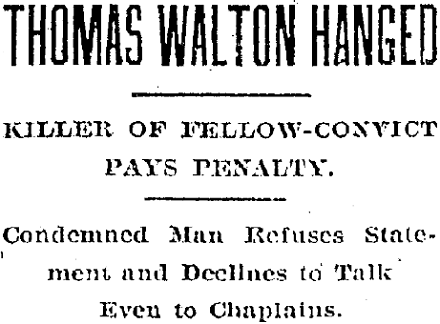
WALLA WALLA, Wash., Dec. 12. — Thomas Walton, convicted of the murder of S.P. Burt, a fellow convict, in the state penitentiary here October 7, 1923, was hanged at the penitentiary this morning. The trap was sprung at 5:06 A.M. and the prison physicians pronounced him dead 10 minutes later.

Walking to his death with the same fearlessness that he has displayed since the beginning of his prison career, Walton refused to make any final statement and even declined to talk with Rev. A.R. Liverett, prison chaplain, or Father Buckley, Catholic priest, in his cell prior to the execution.

His body will be sent to relatives in Montague, Cal.

Although Walton paid the penalty for killing Burt, he has of official record killed two other men. The first was in 1915 in California, for which he was sentenced to life imprisonment in San Quentin prison. The other was that of George McDonald, cellmate of Burt, whom he stabbed following his attack on Burt.

Walton and Burt were life termers in San Quentin and made their escape together in a prison automobile in January, 1923.

FOLSOM, Cal., Dec. 12 — Robert Matthews, negro, convicted of the murder of Coleman Stone, a grocer near Los Angeles, was hanged at the state prison here this morning. [Joe] Sinuel will be hanged next Friday.

On this day..

1981: El Mozote Massacre

On this date in 1981, the El Salvador military perpetrated the El Mozote massacre.

It was conducted by the U.S.-trained and -armed death squad, the Atlacatl Battalion, which on December 10 of that year entered the northern village of El Mozote in search of FMLN* guerrillas.

There weren’t any there — just townsfolk whose numbers were swollen by peasant refugees from the brutal civil war. After ransacking the town and interrogating and robbing the residents, the Atlacatl Battalion sent everyone home and bivouaced down for the night in the town square.

Dawn’s light the next morning would bring the unspeakable horror.

The battalion forced the entire population to the town square, divided men from women, and set about murdering men with gunshot, machetes, and worse — and raping and murdering the women — and then slaughtering all the children, too.

More than 800 civilians died. The next month, a Washington Post journalist described “dozens of decomposing bodies still seen beneath the rubble and lying in nearby fields, despite the month that has passed since the incident … countless bits of bones — skulls, rib cages, femurs, a spinal column — poked out of the rubble.”

A few survivors did manage to reach neighboring villages and the story of what had occurred at El Mozote worked its way out to the wider world over the days and weeks to come. It made little matter to the government in San Salvador where bloodbath was policy, openly espoused by the likes of the man who was about to be elected president of the Constituent Assembly.

In Washington, where the checks were written, destroying Latin American peasant guerrilla movements was a Cold War lodestar and so Orwellian denial of this atrocity soon became the virtual law of the land. After heroically risking his life venturing into the conflict zone to collect evidence, the New York Times reporter Raymond Bonner was tarred and feathered by America’s foreign policy apparatchiks and eventually driven off the Times foreign policy beat while the U.S. continued pumping money to the murderers. The Atlacatl Battalion in particular would author several more notorious atrocities in the course of the 1980s dirty war.

A U.N.-backed Truth Commission convened after the conflict finally ended in 1992, investigated the affair and agreed that

There is full proof that on December 11, 1981, in the village of El Mozote, units of the Atlacatl Battalion deliberately and systematically killed a group of more than 200 men, women and children, constituting the entire civilian population that they had found there the previous day and had since been holding prisoner… there is [also] sufficient evidence that in the days preceding and following the El Mozote massacre, troops participating in “Operation Rescue” massacred the non-combatant civilian population in La Joya canton, in the villages of La Rancheria, Jocote Amatillo y Los Toriles, and in Cerro Pando canton.

The El Salvador government officially apologized in 2011. Nobody has ever been prosecuted for the slaughter.


Memorial to the massacre. (cc) image by Amber.

* The Frente Farabundo Marti para la Liberacion Nacional, named for a famous executed Salvadoran peasant rebel.

On this day..

1916: Eric Poole, the first British officer shot at dawn during World War I

A century ago today in the Great War, Second Lieutenant Eric Poole laid down his life at the city hall of a Belgian border town.

As it was put by the sadly defunct Shot At Dawn site (still preserved at the Wayback Machine), “The cemetery register of Poperinghe New Military Cemetery states that Lt. Eric Skeffington Poole died of wounds on 10 December 1916. Tactfully, it omits to record also that his death was caused by a British Army firing squad.”

A Canadian-born engineer, Poole had enlisted in the very first weeks of the war and been commissioned an officer by May 1915.

In July of 1916, a falling artillery shell struck so close that its concussion knocked Poole down, spattering him with earth. He was hospitalized for shellshock but returned to duty in September — still complaining of rheumatism and feeling “damned bad.”

One night in October as his unit moved up to a forward trench, Poole disappeared from it — nobody knows how or when, but he wasn’t there when it mustered at its new position at midnight. He was detained two days later, wandering well west of the trenches, a leather jacket hiding his private’s tunic … “in a very dazed condition,” an officer who interviewed him would later remember. “From conversation which I had with him I came to the conclusion he was not responsible for his actions. He was very confused indeed.”

Evidence collected in Poole’s desertion trial pointed to a man taxed beyond his capacities by command responsibility and the strain of two years at war. His division commander recommended against the court martial, for Poole was “not really accountable for his actions. He is of nervous temperament, useless in action, and dangerous as an example to the men” — but still “could [be] usefully employed at home in instructional duties or in any minor administrative work, not involving severe strain of the nerves.” Another captain in his battalion described him as “somewhat eccentric, and markedly lacking in decision” and liable under pressure to “become so mentally confused that he would not be responsible for his actions.”

By the book the man’s irresolute midnight ramble was a clear instance of abdicating duty, but Poole’s weakness was apparent enough to trouble the court that tried him for desertion — not only to solicit this and other testimony from his comrades about the lieutenant’s state of mind but even to remark from its own observation that his “mental powers [were] less than average. He appears dull under cross examination, and his perception is slow.” Perhaps this was fellow-feeling by other officers that would not have been extended to a mere grunt; if so, what was a mitigating consideration for the court made Poole’s execution a in the eyes of Field Marshal Haig: “Such a case is more serious in the case of an officer than a man, and it is also highly important that all ranks should realise the law is the same for an officer as a private.” Two years in, and somehow not one officer had suffered such a punishment; Shot At Dawn speculated that military courts’ recent shocking verdict excusing Captain John Bowen-Colthurst on grounds of insanity for an atrocity in Ireland had also raised pressure on the armed forces to show that British officers stood not above the law.*

The British army executed 306 of its own soldiers during World War I. Among them, Poole was the first of only three officers.

* The War Office’s decision not to publicize his fate (and the euphemistic reference in the cemetery register) would seem sharply at odds with any intended demonstrative effect.

On this day..

2014: Robert Wayne Holsey, despite a drunk lawyer

On this date in 2014, Georgia executed a contrite Robert Wayne Holsey.

Out on probation for an armed robbery conviction, this avatar of the classic middle name robbed a convenience store at gunpoint, then shot and killed a deputy who pursued him.

Georgia somehow didn’t have a state public defender system until 2003, a system presenting to the counties who were supposed to appoint indigent defense counsel on a local and ad hoc basis a fine opportunity for callous graft dovetailing the interests of the prosecutor’s office in winning its cases with court’s interest in pinching its pennies.

Accordingly, Baldwin County stuck Holsey with a man to test appellate courts’ standards for minimal representation, an alcoholic attorney named Andy Prince* who was rock-bottoming during the trial to the gobsmacking reported tune of a quart of vodka every night. Prince was disbarred shortly after Holsey’s conviction for robbing another client of $100,000.

According to a tragic Mother Jones profile, Prince, who was white, also happened to get in a dispute around this same time with a black neighbor and hurled some racist invective, which doesn’t seem ideal when your day job consists of trying to keep a black defendant off death row.

The late Prince — he died in 2011 — told an appeals court in 2006 that he “shouldn’t have been representing anyone,” but appeals courts, which must generally find that such “shoulds” clearly “would” have changed the trial outcome, have much less scope to act on the determination.

It’s a massive systemic cheat still in widespread use, albeit not always in such egregious fashion: use some underhanded means to get a death sentence on the books, then argue to every higher court that the deficiency can’t be proven certainly decisive vis-a-vis what might have happened in a fair fight. Do you know Holsey wouldn’t have received a death sentence? He did shoot a cop in the course of committing a violent felony, after all.

There are many general reasons why a robust defense might mitigate a sentence, but the specific reason of interest in Holsey’s case — a reason not litigated by Prince, an omission that likewise foreclosed appeals avenues — was that Holsey was severely mentally disabled.

With a testing IQ around 70, just at the border of the conventional definition for so-called “mental retardation,” Holsey had at the minimum a very strong card for the mitigation phase of the trial — if not an outright bar to execution.** Prince failed to play that card … and as of this date in 2014, American jurisprudence and the state of Georgia determined themselves content to leave it permanently face-down.

There’s a WNYC podcast about this case here.

* The Guardian article cited in this post calls him Andy Price. As all other media citations I find call him Prince, I’m going with that — but as it’s likely that everyone is copying from the last story instead of doing original reportage, I’m not completely confident that it isn’t Price after all.

** Georgia was actually among the first states to bar the execution of mentally disabled prisoners — although paradoxically its early standard thereafter became one of the nation’s weakest as other states implemented their own over the years. The Supreme Court theoretically bars executing the mentally disabled, but as it has enforced no coherent standard the executing states themselves generally get to decide who qualifies.

On this day..