1698: Guido Franceschini, The Ring and the Book inspiration

Robert Browning‘s long narrative poem The Ring and the Book concerns the murder trial of the nobleman Guido Franceschini — a real-life case that saw the defendant in question executed in Rome on this date in 1698 for murdering his wife Pompilia as a suspected adultress. (And her parents just because.)

The 21,000-line work was Browning’s greatest success in life, though many particulars of Browning’s spin on events have been challenged by the 2001 study Roman Murder Mystery.

We’ll be content this day to take Browning’s audience’s-eye view of the jealous husband’s scaffold comeuppance on execution-day.

To mount the scaffold-steps, Guido was last
Here also, as atriciousest in crime.
We hardly noticed how the peasants died,
They dangled somehow soon to right and left,
And we remained all ears and eyes, could give
Ourselves to Guido undividedly,
As he harangued the multitude beneath.
He begged forgiveness on the part of God,
And fair construction of his act from men,
Whose suffrage he entreated for his soul,
Suggesting that we should forthwith repeat
A Pater and an Ave with the hymn
Salve Regina Coeli, for his sake.
Which said, he turned to the confessor, crossed
And reconciled himself, with decency,
Oft glancing at Saint Mary’s opposite,
Where they possess, and showed in shrine to-day,
The blessed Umbilicus of our Lord,
(A relic ’tis believed no other church
In Rome can boast of) — then rose up, as brisk
Knelt down again, bent head, adapted neck,
And, with the name of Jesus on his lips,
Received the fatal blow.

The headsman showed
The head to the populace. Must I avouch
We strangers own to disappointment here?
Report pronounced him fully six feet high,
Youngish, considering his fifty years,
And, if not handsome, dignified at least.
Indeed, it was no face to please a wife!

The “old yellow book” of original case notes that Browning found at a Florentine market and subsequently served as his reference source is available here. The poem itself is, of course, in the public domain; read it in its entirety here, or get hours of free audio reading here.

On this day..

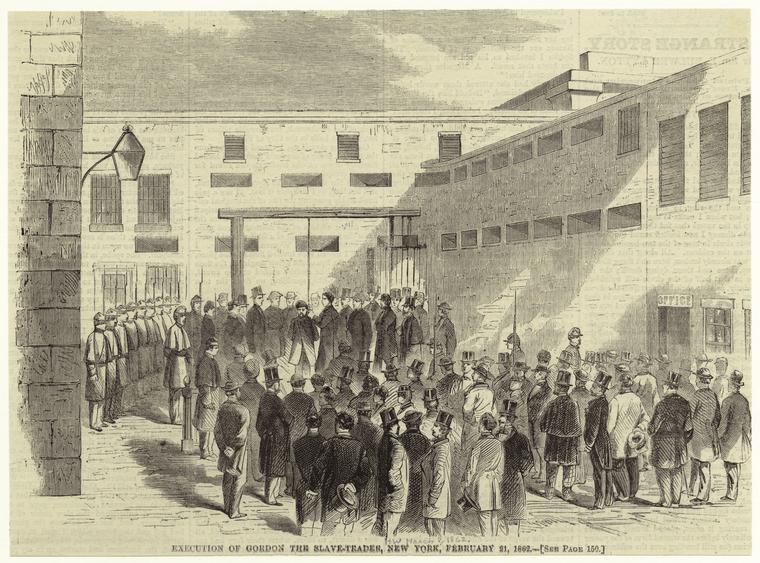
1862: Nathaniel Gordon, slave trader

On this date in 1862, the American commercial shipper Nathaniel Gordon was hanged at the Tombs for slave trading.

Importing slaves to the U.S. had been nominally illegal for over half a century, but had never been strongly enforced. In 1820, slaving (regardless of destination) had even been defined as piracy, a capital crime.

Importation of kidnapped Africans into the United States did significantly abate during this period, and that was just fine with U.S. slaveowners ever paranoid of servile rebellion.

But a voracious demand for conscript labor persisted elsewhere whatever the legal situation. About 3 million slaves arrived to Brazil and Cuba, the principal slave shipment destinations, between 1790 and 1860 — even though the traffic was formally illicit for most of this time.

Great Britain was endeavoring to strangle the Atlantic slave trade, but the diplomatic weight she had to throw around Europe didn’t play in the U.S. Washington’s adamant refusal to permit the Royal Navy to board and search U.S.-flagged ships made the stars and stripes the banner of choice for human traffickers profitably plying the African coast. “As late as 1859 there were seven slavers regularly fitted out in New York, and many more in all the larger ports,” one history avers.

Hanging crime? No slave-runner had ever gone to the gallows as a “pirate” — not until Nathaniel Gordon.

The U.S. Navy did mount its own anti-slaving patrols, but the odd seizure of human cargo was more in the line of costs of doing business than a legal terror for merchants.

So Gordon, son of triangle trade port Portland, Maine and a veteran of several known slaving runs, didn’t necessarily think much of it on August 8, 1860, when the Mohican brought Gordon’s ship to bear 50 miles from the Congo with 897 naked Africans stuffed in the hold, bound for Havana. Half of his slaves were children.

“The stench from the hold was fearful, and the filth and dirt upon their persons indescribably offensive,” Harpers reported.

Gordon chilled in very loose confinement in the Tombs, even enjoying family leave furloughs as he readied for the customary slap on the wrist.

But with Abraham Lincoln’s election in 1860, Gordon was promoted to demonstration case.

After a hung jury in June 1861, the feds won a conviction and death sentence on those long-unused piracy laws in November 1861.

Many New Yorkers were shocked at the prospect of such draconian punishment.

Abraham Lincoln found himself besieged by appeals public and private against the unprecedented judgment. “For more than forty years the statute under which he has been convicted has been a dead letter, because the moral sense of the community revolted at the penalty of death imposed on an act when done between Africa and Cuba which the law sanctioned between Maryland and Carolina,” Gordon’s counsel Judge Gilbert Dean wrote in an open letter to the President* — an argument that could hardly be more poorly calibrated to impress in 1862.

Despite Lincoln’s famous proclivity for the humanitarian pardon, he stood absolutely firm on the precedent Gordon’s hanging would set — especially in the midst of a bloody civil war driven by the very legal sanction Dean had cited so approvingly. As Lincoln wrote on February 4, 1862,

I think I would personally prefer to let this man live in confinement and let him meditate on his deeds, yet in the name of justice and the majesty of law, there ought to be one case, at least one specific instance, of a professional slave-trader, a Northern white man, given the exact penalty of death because of the incalculable number of deaths he and his kind inflicted upon black men amid the horror of the sea-voyage from Africa.

Gordon’s hanging was the one case — the only one ever.

* New York Times, Feb. 21, 1862.

On this day..

1961: About fifteen anti-Lumumbists, in Stanleyville

Although it occurred some weeks before, the execution/murder of Congolese Prime Minister Patrice Lumumba only became public on February 13, 1961.

A week later, on February 20, pro-Lumumba forces in Stanleyville (today, Kisangani) shot approximately 15 prisoners in retaliation. Stanleyville was the headquarters of Lumumba ally Antoine Gizenga, whose enclave the late Lumumba had been trying to reach when he was captured. In the confused post-Lumumba days, Gizenga elevated himself to head of state for the rebellious Lumumbist state; 21 Communist-backed states would recognize this as Congo’s legitimate government, in opposition to the official one of Joseph Kasavubu.

Those suffering the Lumumba-backers’ wrath this date included ten politicians — notably Alfonse Songolo, a former Lumumbist minister who had prominently broken with that faction after Lumumba was deposed the previous autumn — plus five soldiers in the anti-Lumumba force of the bright young officer and future definitive author of Congolese horrors, Joseph-Desire Mobutu.

The London Times had reported (Feb. 23-24) that “usually well-informed sources” alleged the execution, but that the U.N. was unable itself to confirm the fact independently.

On this day..

1878: J.W. Rover, sulfurous

Reno, Nevada had its only hanging on this date in 1878, and it’s never since been certain whether it was the right man they hung.

J.W. Rover, Frank McWorthy, and Isaac Sharp(e) had come from Oakland to work a sulfur claim in present-day Pershing County (then Humboldt County).

Sharp ended up dead, his body horribly mutilated and its dismembered parts scattered to different burial holes.

A mental health counselor I know is fond of saying of the family dysfunctions he has handled that who is crazy depends upon who gets to the phone first. It turns out that sometimes murder does, too.

McWorthy rode in to Winnemucca and swore out a complaint accusing Rover of the murder. Rover would spend the next three years vigorously but never quite successfully insisting that McWorthy was the one who killed Sharp.

Rover was convicted of murder in July 1875, but because the verdict didn’t mention degree of murder, the case had to be retried. In April 1876, Rover was convicted again, of first-degree murder, thank you very much. But the Nevada Supreme Court overturned that verdict, too, and granted Rover a change of venue to Reno’s Washoe County, where Rover was convicted for a third time in June 1877.

In all these proceedings, Rover never wavered from his claim of innocence, calling God to witness at trial after trial that it was his associate and accuser McWorthy who was the guilty party and wanted to frame up Rover to get his hands on that lucrative sulfur deposit.

Having failed three times over in court, Rover’s lawyers turned as the hanging approached to Section 458, a remote provision of the criminal code permitting a special jury to be impaneled “if after judgment of death there be good reason to suppose that the defendant has become insane.”

Three years and all those hearings on, Rover’s fate would finally rest in the hands of twelve new jurors impaneled on the very eve of his hanging. While Rover passed his final night in the Reno jail, his sanity jury met in a courtroom in an upper-story room.

Rover’s lawyers and the District Attorney made their arguments to the jury until midnight that night, then adjourned, and then re-assembled at 7:30 on the morning of the scheduled execution. Rover couldn’t sleep a wink, passing the night rambling emotionally with reporters — at one point breaking down as he read them a letter from his sister.

“As he lay there he formed an object at once of pity and interest,” one scribe wrote for the newspaper of nearby silver mining boomtown Virginia City.*

He was reclining upon a rude bed covered by a coarse blanket. His pillow had no case, and his hair was unkempt and rough-looking. His beard had the appearance of being about one month’s growth. The cell was narrow, and was lighted by the feeble rays of a tallow candle held by a Deputy Sheriff.

Once or twice, he would furtively ask the reporters’ estimation of his chances with the proceedings upstairs. The reporters didn’t know. The jury didn’t either.

That morning, as crowds besieged the courthouse seeking one of the 200 visitors’ permits for the “private” execution, the jury huddled inside it making its final deliberations over four long hours. At last, at noon, it came down seven votes for sane, five for insane.**

Seventy minutes after that vote, Rover was escorted to the gallows supported by two men and a stiff drink of whiskey. This was nearly a two-hour theater in its own right: after a 20-minute recitation of the death warrant, Rover spoke for 50-plus minutes, continuing to insist upon his innocence:

I am so prostrated by this long prosecution that I am unable to say what I want to say …

Gentlemen, McWorthy has got away, but if I had my liberty the face of the world would not be large enough to hide him. I would search him out and bring him to justice, and if the law could not reach him I would find a strong arm of justice that would reach him …

I must be hung; you will be sorry for it some day, but what good will that do me when I am dead and gone? Good-by. My heart is with you.

By the end, Rover could barely hold up. He took a drink of water. “Oh, gentlemen, I cannot realize that I am to be hung!” he cried as his limbs were pinioned at last, and had to be supported lest he swoon. The Catholic priest finally had to settle him down from his last babbling.

“Not guilty,” he insisted one last time. Then to the sheriff: “Go on and do your duty.”


Rumors of Rover’s innocence persisted for years after his hanging, not excluding claims that his ghost was on the haunt.†

In 1899, a newspaper reported that “It afterward developed that Rover was innocent of the crime for which he suffered. McWorthy died a few years ago in Arizona, and on his deathbed confessed that he was the murderer of Sharp.”

McWorthy might or might not have been the guilty party. But that story was not accurate — McWorthy was still alive at the time in Oakland, California.

* The newspaper in question was the Territorial Enterprise, notable for employing the young Mark Twain in the early 1860s. Indeed, it was here that the writer Samuel Clemens first employed that nom de plume. Ten years before Rover’s hanging, Clemens/Twain actually witnessed and wrote about a public hanging in Virginia City.

** Not as close as it sounds: Rover needed a unanimous verdict.

† The present-day Washoe County Courthouse, not built until many years after Rover’s hanging, allegedly has a haunted jail whose spook might be Rover.

On this day..

1478: The Duke of Clarence, in a butt of malmsey

(Thanks to Jonathan Shipley of A Writer’s Desk for the guest post. -ed.)

First Murderer

Take him over the costard with the hilts of thy
sword, and then we will chop him in the malmsey-butt
in the next room.

Second Murderer

O excellent devise! make a sop of him.

Shakespeare’s Richard III, Act I, Scene 4

On this day, in 1478, George Plantagenet was executed for treason against his brother King Edward IV — famously supposed (as in Shakespeare’s Richard III) to have been drowned in a butt of malmsey wine.

George Plantagenet, Duke of Clarence, played an important role in the long-waged War of the Roses, a series of dynastic wars, battles, and skirmishes between 1455 and 1487 between supporters of rival branches of the House of Plantagenet for the English crown: the House of Lancaster versus the House of York.

Plantagenet originally supported his brother’s claim to the throne. Through a series of battles with pro-Lancastrian armies, Edward, of the House of York, advanced towards London with his Yorkish army. Once there, he deposed the Lancastrian King Henry VI to rapturous celebration (London itself leaned Yorkist).

George naturally cashed in with his brother’s accession. He was made a duke. He was invested as a Knight of the Garter.

But one other perk proved butt-ugly for George’s future.

He was married, in 1469, to noblewoman Isabel Neville, daughter of the Earl of Warwick. Warwick was the famous kingmaker of the War of the Roses, whose support was instrumental for Edward IV.

But Edward ill rewarded that support by shockingly marrying a commoner and promoting her family to positions Warwick had intended to control. That drove a wedge between Warwick and Edward … and George Plantagenet went with the father-in-law during an abortive attempt to restore Henry VI.

Warwick died in battle. Edward benevolently restored his treacherous brother George back into royal favor.

But George’s mental state was deteriorating. He also became in inveterate alcoholic.

His wife died a few days before Christmas, 1476. George was convinced that his wife was murdered by her lady-in-waiting, Ankarette Twynyho. Though there was no evidence to support his claim (historians later believed Isabel died of consumption or fever) the court was bullied into hanging Twynyho on George’s accusation.

Soon after, his mental state waning still, the Duke of Clarence allegedly involved himself in another ill-conceived plot to overthrow his brother. He was soon summoned to Edward, was accused of treason and was imprisoned in the Tower of London.*

He was put on trial. The prosector was King Edward IV himself, at whose insistence Parliament attainted the royal brother of “unnatural, loathly treasons.”

Beheaded was the usual mode of execution for treasonous individuals. Not with George, however. No, at the age of 28, George Plantagenet died in his favorite beverage, malmsey wine. “The two of them roll a barrel of malmsey wine into George’s room,” Philappa Gregory writes in The White Queen, “and George the fool makes a joke of it and laughs with his mouth opened wide as if already gasping for air, as his face bleaches white with fear.”

His body was sent, still in the barrel, to Tewkesbury Abbey. He was entombed there beside his late wife, and they still reside there today.

According to the Italian chronicler Dominic Mancini, who was present in England in the 1480s and wrote an account of the fraught English political scene at that time, Edward’s and George’s youngest brother “was so overcome with grief for his brother, that he could not dissimulate so well, but that he was overheard to say that he would one day avenge his brother’s death.”

That grief-stricken sibling was the future Richard III. In a few years’ time would displace the (now-late) Edward IV’s young heirs and send them into history as the lost little Princes in the Tower.

* Clarence’s supposed rebellion is a sketchy bit of palace intrigue. Some have alleged that the whole thing was a pretext to eliminate a claimant who would be in position to argue that Edward’s supposed youthful precontracted marriage excluded the king’s children from succession. In time, Richard III did indeed make this argument.

On this day..

1815: Eight deserters by order of Andrew Jackson

(Thanks to Meaghan Good of the Charley Project for the guest post. -ed.)

On this day in 1815, eight young men condemned for desertion during the War of 1812 were executed by firing squad in Nashville, Tennessee.

They were brought out to be shot one by one, as there weren’t enough people available to form a firing squad large enough for the group of them.

Desertion was rife during this inglorious conflict, according to Wikipedia:

The desertion rate for American soldiers in the War of 1812 was 12.7%, according to available service records. Desertion was especially common in 1814, when enlistment bonuses were increased from $16 to $124, inducing many men to desert one unit and enlist in another to get two bonuses.

We’re not sure how well these eight got paid off in life … only that they collected their last check in lead.

  1. Nathaniel Chester, age unknown, a member of the Corp of Artillery.
  2. Benjamin Harris, 38, a private in the 44th Regiment. Born in Virginia and raised in New Orleans, Louisiana, he enlisted on March 26, 1814 and deserted on July 1.
  3. John Jones, 33, a private in the 2nd Rifle Regiment. He’d enlisted for a five-year stint on July 25, 1814 in Farquier, Virginia. The date he deserted has not been recorded.
  4. Jacob King, 20, a private in the 1st U.S. Artillery. He was born in Pennsylvania and enlisted on March 28, 1814 for five years. He deserted on July 12.
  5. James McBride, 21, a native of Virginia. Records about his military service are unclear: some reports are that he enlisted on April 20, 1813, and other accounts give the date as July 22, 1814. It’s possible he deserted twice; this was a common practice, as noted above.
  6. William Myers, 19, a private from Georgia. He enlisted on March 27, 1814; it’s unknown when he deserted.
  7. Drury Puckett, 36, a member of the 2nd Infantry. (Almost certainly the son and namesake of this Drury Puckett.) Like Harris and McBride, he was from Virginia and he had enlisted there for five years on September 24, 1814. The record says he deserted on December 31, but this is surely in error, because by then he had already been sentenced to die.
  8. John Young, age unknown, from Winchester, Virginia. He enlisted on October 3, 1814 and deserted after a mere five days.

General (and future President) Andrew Jackson affirmed their sentences on January 28, pardoning five others at the same time. This was twenty days after Jackson fought the Battle of New Orleans, the final major conflict in the war. This day’s event was the largest mass execution in Tennessee history.

On this day..

1318: Dukes Erik and Valdemar Magnusson

This is the generally attributed death date of Duke Erik and Duke Valdemar of Sweden — intentionally starved to death at the order of their royal brother, according to the 14th century Erikskrönikan.

This is pretty borderline as an execution, to be sure, but brutal games of thrones ran in these men’s family. Their grandfather Birger Jarl was a powerful duke who got his young child elected king when the throne came open in 1250, possibly circumventing family of the preceding monarch.

And no sooner did the old silverback shuffle off then said son was rudely usurped by his little brother Magnus.

We’re still in the family lore here, but past proved to be prologues for King Magnus’s kids. Magnus had his oldest child Birger set up to succeed, but Birger’s brothers Erik and Valdemar would struggle with the official heir for power after Magnus died.

The boys had a civil war in the 1300s that even resulted in Erik and Valdemar deposing Birger and clapping him in a dungeon — an outcome reversed by pressure from the Norwegians and Danes.

Come the 1310s, things were still tense. Situated on impressive domains of their own — Erik was Duke of Sodermanland, Valdemar, Duke of Finland — the kid brothers looked a potent threat to King Birger once again. Not fancying another stay in the family prison, Birger pre-emptively arrested his brothers at the family Christmas celebration in 1317.

Birger would learn that you can’t solve all family problems by starving them. Weeks after his fratricide, the brothers’ supporters ousted him for good.

Birger fled to exile. His own son, Magnus Birgersson, remained to answer at the executioner’s block for his father’s sins … while his three-year-old cousin, Erik’s son King Magnus, succeeded the throne and held it until 1364.

Cold comfort to the dead dukes, perhaps, but they at least had the consolation of being exalted as “holy dukes” thanks to the winner-written history.

On this day..

1947: Ernst Kundt, Sudeten German

On this date in 1947, Ernst Kundt was hanged in Prague’s Pankrac Prison.


Kundt (right) is honored at Prague Castle by Hans Frank. (Frank was hanged through the Nuremberg Trial.)

Kundt co-founded the Sudeten German Party, a nationalist-fascist party that would play a leading role as one of Nazi Germany’s stalking-horses as the latter maneuvered in the 1930s towards the takeover of Czechoslovakia.

The leaders of this movement were amply rewarded by Czechoslovakia’s new masters; for Kundt, this meant a transition from an MP in Prague to a seat in the Reichstag, a gig in the Luftwaffe, and various state posts around the Third Reich.

And of course, many of these Sudeten big wheels collected a different sort of reward after 1945. He was arrested in Czechoslovakia after the war and tried with a number of other Sudeten German leaders.

On this day..

2004: Yang Xinhai, Monster Killer

When I killed people I had a desire. This inspired me to kill more. I don’t care whether they deserve to live or not. It is none of my concern…I have no desire to be part of society. Society is not my concern.

-Yang Xinhai

On this date in 2004, China executed one of its most prolific serial killers ever.

Yang Xinhai was an impoverished migrant worker with previous theft and rape convictions already to his name when he commenced his infamous spree in 1999.

Over the ensuing four years the so-called “Monster Killer” amassed 67 murders and 23 rapes via terrifyingly bold home invasions: he would break into rural occupied rural dwellings under cover of darkness wielding a heavy iron hammer or similar slasher-villain melee weapon, and then just go to town.

“He didn’t leave survivors, and more than a few families were exterminated by his hand,” one newspaper report described. (In fact, about five people are known to have survived Yang’s various attacks.)

The last of his slayings — eight people in two different attacks in Hebei Province villages — occurred a bare six months before Yang himself caught a bullet to the back of his end. A routine police stop in November 2003 made him a little too shifty and prompted beat cops to detain him. Almost immediately the diabolical character of their new capture spilled out.

Yang himself didn’t see the point in resisting the inevitable. He provided a full confession, didn’t bother to defend himself in an hour-long trial on February 1, 2004, and declined to mount any sort of appeal to prevent his swift execution 13 days after that.

On this day..

1864: Bizoton Affair executions

On this date in 1864, a bustling market Saturday in Port-au-Prince, Haiti was enlivened with the public executions of eight Haitians for cannibalistic murder.

It was perhaps the signal event in a long-running campaign against vodou (voodoo, vaudoux) in whose service the murder was supposedly committed. The charge sheet had it that a man intent on an occult rite to propitiate the spirit world had slaughtered his own young niece and with several friends and family devoured her remains.

It made for some great copy.

“The eye of the law has penetrated into the midst of the bloody mysteries of this religious cannibalism, against which all the teachings of Catholicism have remained powerless,” breathed the world press in salacious revelry.


Sketch of the Bizoton Affair accused from Harper’s Weekly.

Within Haiti and without, vodou itself stood in the dock alongside its adherents. This was quite likely the very point of the trial.

The popular syncretic religion, heavily derived from Haitian slaves’ African roots, represented to Haitian elites and European observers alike all that was most barbarous about the one place that had run white slavers off. Just a few years ago as I write this, the U.S. televagelist Pat Robertson claimed that Haiti had come by its liberty due to a long-ago pact with the devil. That “pact” was a secret vodou ceremony launching the rebellion that became the Haitian Revolution.

Vodou persisted throughout the 19th century — it still persists today — among Haiti’s underclasses. Though frequently persecuted, vodou enjoyed the support and personal devotion of Emperor Faustin Soulouque, a former slave who ruled Haiti in the 1850s. When Soulouque was overthrown by Fabre Geffrard in a coup backed by Haiti’s elites, dissociating from vodou was one of his principal tasks.

As the history blogger Mike Dash explains in a detailed exploration of the case’s background, the deeply Catholic Geffrard had come to an arrangement with the Vatican that

committed the president to making Catholicism Haiti’s state religion — and the executions of February 1864, which so clearly demonstrated Christian “orthodoxy,” took place just weeks before the priests of the first mission to the country arrived from Rome. The trial was followed up, moreover, by a redrafting of Haiti’s Code Pénal, which increased the fines levied for “sorcery” sevenfold and added that “all dances and other practices that … maintain the spirit of fetishism and superstition in the population will be considered spells and punished with the same penalties.”

The original records of the trial are long lost, meaning the surviving accounts are typically the very partisan ones already convinced that pagan vodou cannibalism was rampant in Haiti. The British charge d’affaires Spenser St. John* has one of the best-known and most influential from his 1887 memoir of Haiti. (St. John attended the trial personally with other European dignitaries.)

St. John considered the case self-evident, and dwelt on its lurid revelations of the cannibalism scene — the flaying of little Claircine’s body, the palm of the hand savored by one cannibal as the choicest morsel. Cannibal testimony was St. John’s own choice morsel; in his view, Haitians extremely “sensitive to foreign public opinion” obstinately threw up a collective wall of silence on a practice that “every foreigner in Hayti” just knew was everywhere around him. But even when St. John published, after another 20-odd years past the Bizoton trial to gather evidence of anthropophagism, all that he managed to produce were two highly dubious second-hand accounts of white men allegedly sneaking into vodou ceremonies under cover of blackface and reporting the sacrifice of children. In the hands of Victorian writers prone to still further embroidery these few sketchy dispatches — and the notorious Bizoton case — would help to cement vodou’s sinister reputation.

St. John’s American counterpart was less impressed with the show trial, its moral panic scenario, and the thrashings administered to the accused to force their confessions.

It was not a fair trial; the evidence was extracted by torture. There was a report in circulation. It caused great excitement. Government took it up, and was determined to convict, because it was a seeming stain on their race. The verdict was forced.

Per St. John, the execution itself was badly botched. “The prisoners, tied in pairs” were “fired [at] with such inaccuracy” by their respective shooting teams “that only six fell wounded on the first discharge.” It took half an hour and much reloading to complete the executions, “and the incidents were so painful, that the horror at the prisoners’ crimes was almost turned into pity at witnessing their unnecessary sufferings.”

* As a consular official in a previous post on the opposite side of the globe, St. John accompanied two of the earliest ascents of Mount Kinabalu in Borneo; as a consequence, one of that mountain’s peaks bears his name.

On this day..