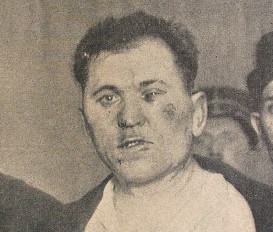
On this date in 2006, Catholics Fabianus Tibo, Marianus Riwu and Dominggus da Silva were shot in the Central Sulawesi capital of Palu for inciting murderous anti-Muslim riots six years before.
The riots in question occurred in Poso, a hotspot of Christian-Muslim conflict that over 1,000 lives from 1999-2001. According to the Jakarta Post (September 25, 2006),
Tibo, Marinus and Dominggus were convicted of leading a Christian militia that carried out a series of attacks in May 2000 in Sulawesi, including a machete and gun assault on an Islamic school where dozens of men were seeking shelter.
Though a 2001 treaty stabilized the situation, tension remained, occasionally flaring into violence.
The 2001 death sentences of Christian activists also remained, a legacy of the open conflict. Small wonder that their execution triggered further unrest, not only in Poso but in Silva’s hometown in predominantly-Christian West Timor. And aftershocks for months to come — the murder a month later of a prominent Christian cleric, for instance — quelled by security forces sweetened with a bit of goodwill rebuilding.
Jakarta ignored international as well as domestic clemency appeals in carrying out the executions, including from the European Union and the the Vatican. The latter’s argument may have been somewhat compromised under the circumstances by Pope Benedict XVI’s impoliticcitation just days before of a 14th-century Muslim-bashing text.
Apart from the humanitarian objections, others more specific to the case were raised in vain: that the trio executed had not been witnessed killing anyone personally, and that the sentences were disproportionate to that received by anyone else convicted in that era’s violence.
But such contentions were easily outweighed by the simultaneous progress of the Bali Bombers case, with the imminent likelihood of a triple-execution of Muslim militants … and the prospect of political fallout if only one faith’s martyrs were let off the hook.
On this date in 1950, an unfortunate military engineer was shot by the South Korean government for trying to obey his orders.
As North Korea overran South Korea in the opening months of the Korean War, it put the government in Seoul to flight. A predictably chaotic situation attended South Korea’s evacuation of its capital in the summer of 1950, with Korean and American agents frantically destroying anything of potential value to the invading army.
Among the things mooted for destruction were the bridges crossing the Han River south of Seoul, and in the confusion of the evacuation, some bridges were indeed blown early on June 28 — killing hundreds of civilians and soldiers who were trying to escape over them.
All hands on this unpleasant affair quickly scrubbed themselves clean; James Hausman, the (underappreciated*) American military advisor who was instrumental in creating the South Korean military, denied it but seems to have given the order by way of his Korean collaborator Chae Byong-deok.
Choi, the luckless military engineer who carried out the operation, was left holding the bag and drew a death sentence for gross misconduct on September 15, the same date the Americans counterattacked by landing at Inchon.
After the 1961 coup led by Park Chung-hee — a gentleman we’ve met in these pages — Choi’s conviction was reversed upon an appeal from his widow.
[I]n accordance with operational orders from a superior officer. Choi tried to stop people and cars approaching the bridge by firing over people’s heads and delaying the explosion for forty minutes. His behavior was according to military behavior.
* See “Captain James H. Hausman and the Formation of the Korean Army, 1945-1950,” Armed Forces & Society, Summer 1997, Vol. 23, Issue 4.
On this date in 1918, 26 Bolsheviks and Left SRs were shot in what is now Turkmenistan, their bid to establish Soviet power in Baku defeated — temporarily.
The Execution of the Twenty-Six Baku Commissars, by Isaak Brodsky (1925)
In a cauldron of ethnic violence and against the military interventions of Turkey and Britain, these worthies were tasked with extending Soviet writ to the stupendous Azerbaijani oil fields* — the predominant source of tsarist Russia’s oil, and destined to be the engine of Soviet industry as well.
Shahumyan and his fellow commissars, meanwhile, fled by ship across the Caspian Sea to Krasnovodsk (now Turkmenbashi, Turkmenistan), where they fell into the hands of a the anti-Soviet factions — backed, once again, by the British — of a brand new locale’s incarnation of civil war.
The commissars’ “presence in Krasnovodsk was a matter of great concern to the [anti-Bolshevik] Ashkhabad Committee, the members of which were seriously alarmed that opposition elements in Transcaspia might take advantage of the presence of the Commissars to stage a revolt against the government.” Said concern was relieved by the expedient of escorting the Baku Soviet to the desert and shooting them en masse.
The Red Army recaptured Baku in 1920, this time for good, and Shahumyan and friends were raised to the firmament of Communist martyrology, and not only in the Azerbaijan Soviet Socialist Republic. Streets and schools throughout the USSR bore their names.
As with many Soviet icons, the commissars had a rough come-down after the Iron Curtain fell. Their monument in Baku stood untended for many years, its eternal flame extinguished … until it was finally (and somewhat controversially) torn down earlier this year.
The Baku Commissars’ monument and its dead eternal flame, prior to its early 2009 demolition. Image (c) denn22 and used with permission.
Monday, September 19, 1692. About noon, at Salem, Giles Corey was press’d to death for standing mute; much pains was used with him two days, one after another, by the Court and Capt. Gardner of Nantucket, who had been of his acquaintance: but all in vain.
–Diary of Salem witch trials judge Samuel Sewall
Pressing to death — peine forte et dure — was a brutal procedure that wasn’t technically a method of execution: courts used it to extract a plea from a defendant, since the law of the time (altered in the 18th century) would not allow criminal proceedings to get underway without one.
Procedure: stake a fellow down and start piling crushing weight on his chest for hours or days until he agrees to enter a plea and start the trial.
For the sufficiently obstinate prisoner, it was a manner of exiting the world quite a bit more unpleasant than hanging. But it came with one significant advantage: since one died without a capital conviction, one could pass on one’s property rather than having it confiscated by the state. For Giles Corey, that was worth two days of agony.
ELIZABETH (quietly, factually): He were not hanged. He would not answer aye or nay to his indictment; for if he denied the charge they’d hang him surely, and auction out his property. So he stand mute, and died Christian under the law. And so his sons will have his farm. It is the law, for he could not be condemned a wizard without he answer the indictment, aye or nay.
PROCTOR: Then how does he die?
ELIZABETH (gently): They press him, John.
PROCTOR: Press?
ELIZABETH: Great stones they lay upon his chest until he please aye or nay. (With a tender smile for the old man.) They say he give them but two words. ‘More weight,’ he says. And died.
PROCTOR (numbed — a thread to weave into his agony): ‘More weight’.
ELIZABETH: Aye. It were a fearsome man, Giles Corey.
Giles Cory pleaded not guilty to his indictment, but would not put himself on Tryal by the Jury (they having cleared none upon tryal) and knowing there would be the same witnesses against him, rather chose to undergo what death they would put him to. In pressing his tongue being forced out of his mouth, the Sheriff with his Cane forced it in again, when he was dying. He was the first in New England that was ever prest to death. (Source)
* Arthur Miller availed himself some dramatic license in The Crucible; among the more trifling was that the historical John Proctor was actually hanged a month before Giles Corey’s death.
This evening in 1989, the number two and three men in Burkina Faso’s military government were seized and summarily executed for allegedly plotting a coup of their own.
Lengani and Zongo
Henri Zongo and Jean-Baptiste Boukary Lengani certainly had the pedigree for it; they’d conspired along with Blaise Compaore in the 1983 putsch that brought Thomas Sankara to power … and then Zongo, Lengani and Compaore had overthrown Sankara four years later.
On this date, a triumvirate increasingly strained by personal rivalries and economic disagreements was unilaterally dissolved.
According to the official announcement, Zongo and Lengani planned to seize the airport while President Compaore was out of the country, shooting down his returning plane if necessary.
Whether accurate or pretext, their elimination (along with two other conspirators) helped Compaore consolidate his hold on Burkina Faso — a country he still governs to this day.
On this date in 1961, the Turkish Prime Minister deposed in the previous year’s military coup was hanged at the island of Imrali.
Condemned at the same trial as his comrades in government,* Adnan Menderes delayed his execution with an unsuccessful suicide bid. Revived from a sleeping pill-induced coma, the gag about Istanbul was that he would soon be fit enough to hang.
Twenty-four hours and one involuntary stomach-pumping later, and he was.
The 62-year-old Smyrna/Izmir native had had a memorable run. He served in Ataturk’s army, then toppled Ataturk’s political party: Menderes won the first three free elections in Turkey in 1950, 1954, and 1957, a feat never since replicated. He was notorious for his temper and sensitivity to criticism, reportedly given to smashing things in his office and demonstrably given to firing ministers and aides for even trifling differences of opinion. Just months before his ouster, he’d survived a plane crash in England — “the former Premier,” observed the New York Times,** “might have gone down in Turkish history as a great patriot and champion of the people” if he had died in it.
His ignominious end didn’t blacken his name to posterity. Years later, he (and the officials who preceded him to the gallows) was posthumously pardoned and reburied in an Istanbul mausoleum. Today, he’s so far from public opprobrium that his name can be found on public accommodations like airports and ferries
There’s more information about Menderes available online in Turkish, including this biography and this film:
* Among the co-defendants also condemned but reprieved was Mahmut Celal Bayar, President of the Republic of Turkey. Bayar died in 1986 at age 103, supposedly the longest-lived head of state or head of government in all of history.
On this date in 1961, two former Turkish ministers of state were hanged together on the island of Imrali.*
A ten-month trial on the island of Yassiada had ended just the previous day, condemning 15 to death; 12 sentences were commuted, leaving only the biggest fish to fry.
Zorlu, the former Foreign Minister, and Polatkan, late the Finance Minister, were both implicated in the financial crimes often characteristic of high office. Zorlu was also condemned for helping instigate a notorious 1955 anti-Greek riot. The two were helicoptered to Imrali for a pre-dawn hanging.
Zorlu, at least, was reported to have died game. He helped slip the noose over his own neck, and at his hanging “asked that he be allowed to kick away the chair himself. Permission was granted.” (Los Angeles Times, September 18, 1961)
* Tangentially, the prison on Imrali is the one American drug-smuggler Billy Hayes subsequently escaped from. Hayes went on to write Midnight Express, later adapted for the silver screen by Oliver Stone.
With this post, we unveil a new metadata category, the Daily Double — related executions on actual consecutive dates in the same year. (We’re also retroactively defining an old Themed Set post into this category.)
The Turkish Republic, so violently born, has endured a tumultuous past half-century or so. In keeping with the Cold War Zeitgeist, it also enjoyed its share of coups.
The first such struck in May of 1960, toppling the elected (but by then deeply unpopular with young military officers) government of Adnan Menderes. Menderes had been Prime Minister for a decade, but he and two of his ministers would check out with the distinction of being the last politicians executed in Turkey.
On this date in 1932, deranged Russian emigre Paul Gorguloff was guillotined for murdering President Paul Doumer four months before.
The forgettable Paul Doumer — distinguished for reasons quite beyond his control as the penultimate President of the Third Republic — was a week short of his one-year anniversary in office when the nutbar gunned him down at a Parisian book fair.
Disturbed 37-year-old Gorguloff had some impenetrably incoherent justification for the murder having to do with some “Idea” formed in a trance-like state.
From the moment of my arrival in Paris, and even in the train, I had a sort of hypnotic obsession that I must kill the President. I went and prayed in Notre Dame; then I drank heavily, and gradually decided to kill myself, the idea almost supplanting that of assassination. After drinking I conceived the idea of getting arrested to prevent me from committing the crime, so I asked a policeman on the Boulevard Saint-Michel a lot of stupid questions, hoping that he would ask for my papers and, finding them not to be in order, arrest me. All the time the Devil was saying: “Kill yourself, if you like, but only after you have killed the President.” Until 2 o’clock in the afternoon on the day of the crime I drank in a bar, emptying a bottle of cognac in the hope that I would get too drunk to do anything. Nevertheless I finally went to the book exhibition in the Rue Berryer, where the President was expected. After I had spoken with M. Farrere [he was later shot in the arm by Gorguloff] and looked at a few books, the President arrived. I was in a kind of hypnotic sleep, and fired without really knowing what I was doing. (The Times of London, May 18, 1932)
Whatever this daemon may have amounted to in Gorguloff’s mind, he cherished it; the brief trial was punctuated by repeated invocation of the never-explicated “Idea”:
France, listen to me! I am the apostle of my Idea. My crime was a great protest in the name of the miserable ones who wait ‘over there’ [in Russia] … My Idea is more precious than my life. Take my life, but save my Idea. (The Times of London, July 26, 1932)
The “idea” may have been fame. Gorguloff’s defense counsel — understandably pinning its hopes on an insanity defense (French link) — entered into the record a request the assassin had forwarded Czech authorities to be launched in a rocket to the moon; a correspondent for Le Matindiscovered that the killer had nursed similarly half-baked plots to do in Hindenburg, Lenin, and Czech President Thomas Masaryk instead/as well.
Gorguloff was beheaded just before 6 a.m. outside La Sante Prison in Paris.
At 9:30 a.m. this day, as the American army raised the Stars & Stripes over Chapultepec Castle during the Mexican-American War, it simultaneously carried out a mass hanging of 30 Irish deserters who had gone over to Santa Anna — the Saint Patrick’s Battalion, or the San Patricios.
Irish had been migrating to the United States en masse even well before the Great Famine got rolling in 1845.
And for those of that great migration wave who wound up in the service fighting the Mexican-American War, there was a hint of deja vu — an Anglo and Protestant imperial power seizing land from a “black”* and Catholic neighbor?
Some of the Irish decided they were fighting for the bad guys, and switched sides.**
These were the plurality (though not necessarily the majority) of the couple hundred soldiers who comprised the Saint Patrick’s Battalion. German immigrants and other nationalities, along with American-born deserters (desertion during the Mexican-American War seems to have been rife), made up the balance.
Knowing full well the fate that would await them upon capture, the San Patricios were renowned for their ferocity in battle; at the hopeless Battle of Churubusco, they reputedly forced down a white flag that Mexican comrades were trying to hoist on three separate occasions.
Eventually, the ammunition ran out, and with it, the San Patricios’ luck.
Within days, courts-martial began handing out death sentences to almost the whole of the surviving unit. U.S. General Winfield Scott subsequently reduced a number of sentences, and those who had deserted before the war couldn’t legally be executed … but even the “lucky” ones suffered faint-inducing scourgings and branding on the cheeks with the letter “D”.
And 50 men more were still bound for the gallows.
Twenty hung in the days prior to this at two separate sites, but the Yanks’ piece de resistance was an orchestrated scene on the second day of the Battle of Chapultepec.
On September 13, 1847, at dawn, Harney ordered the thirty remaining prisoners to be brought forward. They stood on wagons with nooses placed around their necks. This included one man who had lost both legs and was unable to walk to his own execution. The site of these executions was within viewing distance of the site where the final battle — the outcome of which could not have been in doubt — was to be fought. There the sentenced soldiers watched until finally, at 9:30, the US victors raised the American flag atop Chapultepec Castle.† At that point the order was given, the wagons were pulled away and the men were all hanged.
It must be remembered that the San Patricios had been standing, bound hand and foot, each with his head in a noose, for nearly four hours in the burning Mexican sun. When Harney finally gave the order for the hangings to proceed, such was the relief that their sufferings were finally at an end that “some of the men actually cheered as the nooses tightened and the wagons pulled away.”
The cruelty of the punishments led a Mexican paper to spit,
these are the men that call us barbarians and tell us that they have come to civilize us … May they be damned by all Christians, as they are by God.
They brand with hot irons the faces of the Irish deserters and then hang them from the gallows. The Saint Patrick Irish Battalion arrived with the invaders, but fought alongside the invaded.
From the north to Molino del Rey, the Irish made theirs the fate, ill fate, of the Mexicans. Many died defending the Churubusco monastery without ammunition. The prisoners, their faces burned, rock to and fro on the gallows. -Eduardo Galeano, Masks and Faces
* The “blackness” of the Irish and the process of their “becoming white” later in the 19th and 20th centuries is one of the more illustrative and well-documented case studies of race and racism as social rather than biological constructs.
** They weren’t alone in this opinion. Many hundreds of miles from the fighting, Henry David Thoreau famously landed in jail for tax resistance in 1846 largely because of his disgust with the war. From Civil Disobedience:
The government itself, which is only the mode which the people have chosen to execute their will, is equally liable to be abused and perverted before the people can act through it. Witness the present Mexican war, the work of comparatively a few individuals using the standing government as their tool; for in the outset, the people would not have consented to this measure.
† The capture of Chapultepec Castle, forgotten north of the Rio Grande, is still commemorated in Mexico for the heroism of six teenage cadets who died in its defense. The last of their number, Juan Escutia, leapt from the castle walls wrapped in the Mexican standard to prevent its capture.


 Condemned at the same trial as his comrades in government,*
  A ten-month trial on the island of Yassiada had ended just the previous day, condemning 15 to death; 12 sentences were commuted, leaving only the biggest fish to fry.