1872: Patrick Morrissey, by a future U.S. president

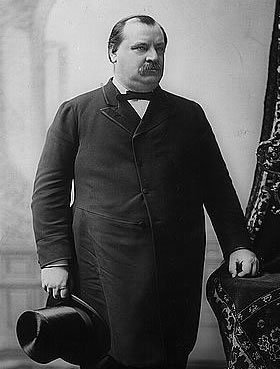
On this date in 1872, Buffalo sheriff — and future U.S. President — Grover Cleveland personally sprang the trap to hang matricide Patrick Morrissey.

Grover Cleveland hanged convicts on two non-consecutive occasions.

Morrissey’s drunken altercation with his widowed mother, that led to a stabbing, that led him to the gallows, would obviously be lost to remembrance but for his accidental association with the man who would become president 12 years later. Of course, it was precisely the other way around at the time of the hanging — so the New York Times article (pdf) on the execution has a pleasurable aspect of discovered curiosity: for the newsman, a dull just-the-facts slog in a forgettable day’s work; for posterity, an accidental glimpse at history’s backstage.*

Cleveland had taken office as Erie County sheriff the year before, his stepping stone from a legal practice into an illustrious electoral career in the Democratic Party that would see him rise to Mayor of Buffalo and Governor of New York (and, after his death, to the $20 bill).

One of Cleveland’s duties as sheriff was to carry out death sentences; he declined to delegate the responsibility to one of his assistants — the hagiography says that his ethical rectitude compelled him to assume the weighty responsibility personally — and handled Morrissey’s dispatch with his own hands.

With his subsequent ascent in the political realm, Cleveland’s activities this day made him the rare notable executioner to earn his fame in another walk of life.

Or infamy, as the case may be. In an era of competitive sloganeering and sobriquets,** Cleveland’s Republican opponents tried to hang him — so to speak — with the nickname “The Buffalo Hangman”.

* The other death row murderer referenced in the Times story was Cleveland’s second (and last) execution on February 14, 1873.

** Like most presidential pols of the time, Cleveland had many more nicknames, both friendly and not — “Uncle Jumbo” because of his girth; “Old Veto” for his liberal use of executive power; and others. (He was also elected a bachelor and married a 22-year-old beauty while in office. Eat your heart out, Bill Clinton.) The New Yorker avers that Buffalo voters during Cleveland’s early local incarnation actually knew him by the avuncular-yet-unwholesome handle of “Big Steve”.

On this day..

1930: Carl Panzram, rage personified

On this date in 1930, one of the most nihilistic criminals in American history was hanged for murder at Leavenworth Federal Penitentiary — in character to his last breath, a sneer at the hangman about to put him to death:

“Hurry it up, you Hoosier bastard! I could hang 10 men while you’re fooling around!”

Panzram — according, at least, to an autobiography which is largely unverifiable — had the chops to back up his taunt.

A Minnesota-born son of German immigrants, Panzram was into the juvenile detention system by adolescence, and at 14 hopped a freight train bound for a life of vagrancy. In Panzram’s recounting, his boyhood was a hellscape — even knowing what he became, it’s possible to feel compassion for the the killer’s remembrance, “Everybody thought it was all right to deceive me, lie to me and kick me around whenever they felt like it, and they felt like it pretty regular.”

Worse was to come for Carl — sexual molestation, a gang-rape by fellow hobos — and much worse by Carl.

The rape may have shattered the restraints on his conscience … or maybe they was already gone by then. “Might makes right” became his credo; to alcoholic and thief he added a portfolio of rape and enthusiastic homicide, crisscrossing the country (with a side trip to Africa), escaping or wheedling out of jails when he was picked up for something, and finding it amazingly easy to slay his fellow men.

A full narrative of Panzram’s grisly career is available at trutv.com. Much of this is, again, sourced only to Panzram himself, so the possibility of bloodthirsty braggadocio cannot be dismissed; even at a fraction of its alleged scope and brutality, his career was a triumph in horror.

While I was sitting there, a little kid about eleven or twelve years old came bumming around. He was looking for something. He found it, too. I took him out to a gravel pit about one-quarter mile away. I left him there, but first I committed sodomy on him and then killed him. His brains were coming out of his ears when I left him, and he will never be any deader.

It was the murder of a fellow inmate at the federal prison in Leavenworth, Ks., that sealed his fate. Panzram was in his late 30’s by this time, facing a long prison sentence. Something between the fury that fueled him and the desperate reality of not seeing the outside again until he was an old man may have impelled him to check out intentionally: he had warned that he would murder an inmate, and he responded to anti-death penalty campaigners’ attempts to save him by threatening to kill them, too.

In my lifetime I have murdered 21 human beings, I have committed thousands of burglaries, robberies, larcenies, arsons and last but not least I have committed sodomy on more than 1,000 male human beings. For all these things I am not in the least bit sorry.

It seems the fate of common criminals, even those as prolific and infernal as Panzram, to shuffle into obscurity in fairly short order. Among devotees of the dark underbelly, Panzram may be well-known; to the larger public, he’s long forgotten.

Panzram’s memoirs, released as Killer: A Journal of Murder, were turned into a 1996 James Woods vehicle of the same title:

Interestingly, Panzram is also name-checked in another more famous literary artifact: In the Belly of the Beast, the tour de force of Norman Mailer protege Jack Abbott, who had conned the litterateur into backing his bid for parole, was rather boldly dedicated to Carl Panzram.* It will not surprise the reader to learn that Abbott, upon his release, killed again.

But a new generation is waiting to rediscover its butchers … and a new documentary, Panzram, is in production to bring the story back to silver screens and Netflix queues of the 21st century.

* Abbott was writing to Mailer while the latter was banging out his book about notable executee Gary Gilmore.

On this day..

1638: Three (of four) English colonists for murdering a Native American

Four hundred years removed from the events surrounding the colonization of Massachusetts by English settlers through the 1620’s, it’s difficult to properly evaluate the mindsets of either colonist or colonizer in this time of violent encounters and expansive cultural shifts.

The 1638 case of Arthur Peach, Thomas Jackson, Richard Stinnings, and Daniel Cross serves as a potent reminder that the relationship between the interlopers and natives in the early years of these meetings was driven as much by tribal politics as by interpersonal attitudes.

Peach, by all accounts, was not on track to be elected Plymouth Man of the Year. A servant of Edward Winslow, one of the Mayflower originals responsible for political gaming with the native leaders, Peach was dispatched to serve in the Pequot War in 1637. The war pitted English colonists and some of their tribal neighbors against the Pequots and resulted in the slaughter of hundreds of Pequot in several attacks.

Peach went work-idle in the post-war years, enjoying his remaining youth: he frequently drank and spent evenings in merriment with his friends, accumulating a sizable debt in the process; said merriment also extended to impregnating Dorothy Temple, a servant of Stephen Hopkins (who was, in one of the less surprising twists, later charged with allowing drunken merriment of his servants in his house).

Plymouth Colony leader William Bradford: Can’t we all get along?

William Bradford speculates that it was to escape punishment for this latter social offense that Peach convinced three other indentured servants to break their bonds and follow him to the nearby Dutch plantations. No matter the motive, they were ill-advised to join him.

Along the way, the quartet came across a man of the Nipmuc tribe (allied with the English and Narragansett during the recent war) named Penowanyanquis. They convinced him to stay, smoked a pipe and talked trade, then stabbed and robbed him, leaving him for what they thought was dead; Penowanyanquis was found on the road and lived for several more days, plenty of time to describe his attackers to first his tribesmen, then the Englishman Roger Williams.

The Plymouth authorities accepted the case (in Plymouth, though the event occurred far from its apparent jurisdiction) in the interests of maintaining the tenuous peace with the New England natives — in Bradford’s words, “The Gov[ernment] in the Bay were aquented with it, but refferrd it hither, because it was done in this jurissdiction; but pressed by all means that justice might be done in it; or els the countrie must rise and see justice done, otherwise it would raise a warr.”

Peach, Jackson, and Stinnings were caught at Aquidneck Island, while Cross fled to Piscataqua (New Hampshire), where it was traditional for locals to refuse to help Plymouth colonials. The three detainees were tried, with much of the trial devoted to proving that Penowanyanquis was, in fact, dead. It took two Narragansett to affirm upon pain of their own heads that Penowanyanquis had succumbed to his injuries, but their testimony sent three whites to the gallows for killing an Indian; for the second time since the Plymouth colony was established 18 years prior, a murderer was hanged.*

The oddity of the affair is not that such a conviction occurred — it was a long-standing colonial tradition to uphold treaties with natives through civil law and break them in a variety of other ways — but the reaction of persons involved before and during the trial. To wit:

Ousamequin coming from Plymouth told me that the four men were all guilty. I answered but one; he replied true, one wounded him, but all lay in wait two days and assisted. Also that the principal must not die, for he was Mr. Winslow’s man; and also that the Indian was by birth a Nipmuck man, so not worthy that any other man should die for him.

Ousamequin, here making the case that Peach should be spared, was another name for Massasoit, the old chief of the Pokanoket whose special kinship with Peach’s indenturerer Winslow was cemented after the settler brought a severely ill Massasoit European remedies when the chief was struck with an unnamed ailment in 1623.

Nor, indeed, were the colonists uniformly positive about the event: Bradford reports that “[s]ome of the rude and ignorant sorte murmured that any English should be put to death for the Indean.”

Massasoit himself seems to have been the only thing holding the colonial relationship together: Metacomet (“King Philip”) took the title of Great Sachem shortly after Massasoit’s death, and his alliances with other tribes exacerbated the harsh feeling towards English attempts to Christianize their neighboring “heathens”. With the white population expanding swiftly beyond its early boundaries, a small event was bound to spell trouble, and when the Christian convert John Sassamon (an Indian) was found murdered and three Wampanoag were executed for the deed, Indian sovereignty was impugned.

King Philip’s War was on, and it did not end well for the native Americans.

No.

To his credit, Peach still produced a son, and Temple’s pregnancy ended the public life of Hopkins. Hopkins was charged with mistreating Temple, who was his indentured servant, and ordered to pay for both her and her child through the two years remaining on her contract.

Hopkins dissented and was jailed, bailed out four days later by John Holmes, who purchased Temple’s servitude for a whopping three pounds (somewhere between 1/4 and 1/2 the price of a cow). Her son remains unnamed in the record, but after giving birth, Temple was charged with producing a bastard child and whipped. Her fate thereafter is lost to the mists of history, as are the future exploits of Daniel Cross.

* The first was Mayflower original John Billington, who was executed in 1630 for shooting John Newcomen to resolve what was apparently a long-standing dispute.

On this day..

2003: Paul Hill, anti-abortion martyr

Five years ago today, minister Paul Hill was put to death by lethal injection for murdering an abortion provider and a clinic escort nine years before.

Hill rose to prominence in the early 1990’s as a fire-eating abortion foe, who openly preached the righteousness of defending unborn life by force — a divisive position among anti-abortion activists that got him excommunicated from the Presbyterian church.

On July 29, 1994, in the abortion conflict’s ground-zero of Pensacola, Fla., Hill put his theology into action by gunning down Dr. John Britton and his septuagenarian escort, along with Britton’s wife (who survived the shooting).

Creepy. It sure looks like the song and image pairings were done in earnest, not in irony.

He never betrayed the least scruple about his act, hoping only to use his trial to present a “justifiable homicide” defense; the judge’s suppression of this line was and remains a grievance of Hill’s fellow-travelers against the judiciary.

Nor did Hill betray the least concern to die for his beliefs; if anything, in dropping appeals that would at the least have prolonged his life, he cut a figure thirsty for the martyrdom he attained this day.

To what end?

Hill left a plentiful documentary record — like this manifesto, among the pro-Hill documents collected on the Army of God website:

I knew that [killing an abortion provider] would uphold the truths of the gospel at the precise point of Satan’s current attack (the abortionist’s knife). While most Christians firmly profess the duty to defend born children with force (which is not yet being disputed by the government) most of these professors have neglected the duty to similarly defend the unborn. They are steady all along the battleline except at the point where the enemy has broken through. I was certain that if I took my stand at this point, others would join with me, and the Lord would eventually bring about a great victory.

One can question whether this proved to be the case or not. The infamy (in most circles) of the killing arguably dampened enthusiasm for the cause, at least as measured by the sulfur level on clinic sidewalks. At the same time, Hill’s was only the most spectacular instance of a campaign to terrorize abortion providers that drove many out of business and made some areas of the country virtual abortion-free zones.

Whatever may have surprised him about the way the issue played out over the 1990’s, he was serene about his choices when interviewed the day before his execution.

To some in the movement, he’s a holy martyr, the John Brown of slavery’s modern-day parallel.

And even if Paul Hill’s name is taboo in the respectable public discourse of abortion today, with four relatively young rock-ribbed anti-Roe v. Wade votes now entrenched at the Supreme Court, it’s far from obvious that Hill won’t get what he was after all along … even if he didn’t live to see it.

Part of the Themed Set: Judging Abortion.

On this day..

1724: Half-Hangit Maggie Dickson

Allegedly on this date in 1724, a young woman was hanged at Edinburgh’s Grassmarket for concealing her pregnancy.

Any number of details in this horrible/wonderful story are shaky, including the date: some sources make it 1728, a few say 1723, and only a handful attest a specific calendar date. Nobody seems to doubt the tale in the main, however — and it’s certainly excellent enough lore to deserve even a heavily asterisked entry.

Deserted by her husband, young Maggie Dickson took lodgings at an inn in exchange for work, and became pregnant by either the innkeeper or his son. (Again — details in the various sources available read like a game of telephone.) Since single* pregnant working-class women had about as many employment options as birth control options, Maggie kept quiet about her condition in the interest of keeping her job.

And since male parliamentarians figured their job was to keep young lasses of loose character and modest means on the straight and narrow by criminalizing their options, Maggie’s sleight-of-womb put her in violation of a law against concealing a pregnancy. (The same situation was playing out elsewhere in the British sphere at this time.)

When the resulting infant turned up dead, the trail led straight to Dickson … but the concealment of the pregnancy and birth were capital crimes on their own, making it immaterial whether it had been a miscarried pregnancy, an act of infanticide, or simply one of the many early 18th century babies to die in the cradle. The law was an indiscriminate instrument to prevent women terminating their pregnancies.

Nothing noteworthy about the hanging itself is recorded; it seems to have been one of the routine public stranglings of the age, and even the scuffle over the body between family and medical students hunting dissection-ready cadavers was a normal occurrence.

The family won. And en route to Musselburgh for burial, Maggie started banging on the inside of the coffin, and was forthwith revived. Officials decided the sentence of hanging had already been carried out … and her awestruck neighbors suddenly started seeing Maggie sympathetically

And they all lived happily ever after. This day’s principal, at any rate, gained a foothold in adequate prosperity, bore more children, and answered to the nickname “Half-Hangit Maggie Dickson” all the many more years of her life.

The story passed into legend; the dates, as we’ve alluded, fuzzed. One entrepreneurial English broadside publisher of the 19th century even transported the affair to February 1, 1813 — four years after a Concealment of Pregnancy Act reduced the penalty for Maggie Dickson’s “crime” to penal servitude. And near the site of the not-quite-Passion, should you call sometime in Edinburgh, you can raise Half-Hangit Maggie a pint at Maggie Dickson’s Pub.

I’le crye as fu’ o’ tears an egg,
‘Death, I’ve ae favour for to begg,
That ye wad only ge a flegg,
And spare my life,
As I did to ill hanged Megg,
That graceless wife

-Broadside, ‘The last speech and dying words of John Dalgleish, Hangman of Edinburgh’

* Technically, she was still married but separated.

Part of the Themed Set: Judging Abortion.

On this day..

1538: Cratwell, a hangman

This yere, the first daye of September, beinge Sondaye, at Clerkenwell, where the wrestlinge is kept, after the wrestlinge was done, there was hanged on a payre of gallowes, newe made, in the same place, the hangman of London and two more for robbinge a bouth in Bartlemewe fayre, which sayd hangman had done execution in London since the Holy Mayde of Kent was hanged, and was a conninge butcher in quarteringe of men.

A Chronicle of England During the Reigns of the Tudors, from A.D. 1485 to 1559

On this day..

1593: Pierre Barrière, undeterringly

On this date in 1593, a would-be assassin of France’s King Henri IV was broken on the wheel.

An Orleans boatman turned Catholic League soldier in France’s internecine Catholic-Huguenot wars, he was among the numerous Catholics who looked askance at victorious Huguenot Henri IV‘s expeditious conversion to Catholicism.

In the months while Henri IV still held Paris under siege, the Jesuit father Jacques Commolet had called for his assassination from the pulpit. The Bourbon’s (nominal) switch to Catholicism with the words “Paris is worth a mass” had not persuaded hard-core Catholic partisans of the king’s sincerity.

Henri was a practical guy. And with civil slaughter afoot for most of the late 16th century, he took a dim view to loose talk about assassinations, especially his.

The safety of the king’s person was a paramount consideration of magistrates during this period. Thirty years of political assassinations during which the rule of law proved largely ineffective in bringing the guilty to justice had ultimately left a fundamental law of France, the inviolability of the king’s person, subverted. Magistrates … focused their attention on re-establishing the enforcement of this law …

Pierre Barriere was nabbed for planning to subvert that inviolability — arrested August 27, tried August 30, horribly broken on the wheel August 31.

Henri would keep the throne 17 more years, laying the basis for French absolutism. But continual assassination bids — nearly 20 documented — would pursue him throughout his reign … until one finally got him.

On this day..

1850: Prof. John Webster, for the timeless conflict between donors and academics

On this date in 1850, a 57-year-old Harvard professor expiated upon a gallows at Boston’s Leverett Square the murder of one of the university’s donors.

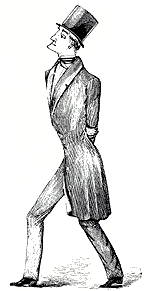
The buzz of Boston in 1849-50, the Parkman-Webster murder case began with the disappearance of one of the crimson’s great benefactors, George Parkman, a Boston Brahmin known for his Ministry of Silly Walks gait about town (see right). According to Oliver Wendell Holmes, Sr. (who appeared as a witness at the trial of Parkman’s accused murderer), “he abstained while others indulged, he walked while others rode, he worked while others slept.”

Also, he inherited a ridiculous sum of money, and was tight with the debtors to whom he lent it.

Back before collection agencies, Parkman disappeared in November 1849 while making the rounds to shake down his borrowers. Within days, suspicion settled on Harvard anatomy and geology professor John Webster, who had squandered his own pile of money buying rock collections and maintaining appearances and such, and sank into desperate hock to the jutting-chinned ambulator who had helped him land the Ivy League appointment in the first place.

A weighty circumstantial case soon formed against Webster, with the invaluable aid of a snoopy janitor who turned up human remains in the office and testified to incriminating-sounding conversations.

Elites-on-elite crime epidemics always churn the scandal mills. Henry Wadsworth Longfellow’s wife Fanny wrote a friend,

You will see by the papers what dark horror overshadows us like an eclipse. Of course we cannot believe Dr. Webster guilty, bad as the evidence looks. … Many suspect the janitor, who is known to be a bad man and to have wished for the reward offered for Dr. Parkman’s body. … I trust our minds will be soon relieved, but, meanwhile, they are soiled by new details continually.

“Harvard professors do not often commit murder,” or so they say. (This was still a century before Robert McNamara.)

Boston high society was about to see a whole different side of Harvard.

Although perhaps individually explicable — anatomists had plausible reasons to have human remains at work, and other anatomists than Webster could have had access to his office — the cumulative weight of Webster’s ham-handed attempts to declare that he had paid up his debts to Parkman just before the latter’s mysterious disappearance, of the discovery of what (disputed) dental forensics declared to be Parkman’s dentures, of the ghastly appearance of a torso (disputedly) declared to be Parkman’s stuffed in a tea chest at Webster’s offices started to really make the man look guilty.

In view of a mediocre defense, the jury convicted Webster of whacking his own professional benefactor, in the university building erected on said benefactor’s donated plot of land.

Talk about donor recognition.

While the prof’s seeming post-conviction acceptance of guilt — in a plain strategem to secure clemency — and generally shifty demeanor have cemented him as the definitive perpetrator in the standard historical reading,* Fanny’s snobbish take on the “bad man,” janitor (and moonlight body-snatcher) Ephraim Littlefield, has not been entirely lost to the tradition.

At the end of the day, everything about the case is circumstantial — indeed, besides being historically noteworthy for the first use of dental forensic evidence in a murder trial (forensics we might find rather speculative and unconvincing today), Webster’s case generated a landmark ruling from the judge’s jury instruction establishing “reasonable doubt” as the threshold for criminal conviction rather than the “absolute certainty” Webster’s prosecutors had no hope of attaining; that ruling influences American jurisprudence down to the present day.

And one cannot but notice how many of the circumstances — creepily playing Sherlock Holmes with a freelance dig into the professor’s furnace to discover charred bones, for instance — were provided by the fellow-suspect-turned-star-witness Littlefield, who niftily reaped the $3,000 reward for his offices in substituting Webster for himself under the pall of suspicion.

According to peripatetic crime blogger Laura James, a forthcoming (2009) book promises to revisit the sensational trial, “to examine all the intricacies for ourselves — not aided by the eager voice of the janitor.”

* Bemis, one of the prosecutors, wrote the go-to source on the Webster trial, available from Google Books; another contemporaneous account is here.

On this day..

1966: Sayyid Qutb

On this date in 1966, author and intellectual Sayyid Qutb was hanged for plotting to overthrow the Egyptian state.

Qutb — whose names can be transliterated many ways (Saïd, Syed, Seyyid, Sayid, or Sayed; Koteb, Kotb, Qutub or Kutb) — was one of the most influential Islamist thinkers of the 20th century, and helped shape the ideas of Osama bin Laden.

A traditionally-minded Muslim civil servant in a westernizing Egypt, Qutb’s journey to radicalism is traditionally dated to his late 1940’s study abroad in the U.S. at what is now the University of Northern Colorado, where the decadence, materialism, and lax morality of the global hegemon saw him seeing existential evil in the everyday all around him:

The American girl is well acquainted with her body’s seductive capacity. She knows it lies in the face, and in expressive eyes, and thirsty lips. She knows seductiveness lies in the round breasts, the full buttocks, and in the shapely thighs, sleek legs — and she shows all this and does not hide it.

Qutb left Greeley, Colo., in 1950 with a master’s degree and an intention to mount an Islamic revolution in his home country that would implement sharia and keep shapely thighs safely under wraps. (Qutb never married, bemoaning the scanty pickings of pure fish in the sea. He may have faced the gallows a virgin.)

He hooked up with the outlawed Muslim Brotherhood, landed in Egypt’s famously savage prisons (future president Anwar Sadat was one of his judges), and the experience of torture hardened his commitment to a vanguard-led revolution. He kept up his prolific writing output, penning perhaps his most notable work, Milestones (the text was later used against him at his capital trial).

Qutb’s release in 1964 was only for a few months, before Egyptian security got wind of a new Muslim Brotherhood plot to overthrow the government and rounded up Qutb as the supposed ringleader — or just railroaded him because it didn’t like where he was going with passages like

there are many practical obstacles in establishing God’s rule on earth, such as the power of the state, the social system and traditions and, in general, the whole human environment. Islam uses force only to remove these obstacles so that there may not remain any wall between Islam and individual human beings.

With the benefit of hindsight, one can readily imagine that his martyr’s death did not squelch his movement, but greatened his stature to admiring eyes.

But it was hardly a direct path into an un-critiqued hall of martyrs in an undifferentiated “radical Islam”. While Qutb had his own influence in Egypt, Cairo has managed to keep the lid on the Muslim Brotherhood. Qutbism, however, was exported to Saudi Arabia — which intentionally imported it for various practical and geopolitical reasons — where it flourished, often in a fractious relationship with official Saudi Wahhabism.

One of Qutb’s students was the uncle of Ayman al-Zawahiri, and the hanged intellectual greatly influenced Zawahiri’s own path into radicalism and to al-Qaeda. Since September 11, of course, the path Qutb himself followed has become of much more pressing interest to the West as well as within the Muslim world.

Some noteworthy works by Sayyid Qutb

On this day..

1807: James McLean, twice

On this date in 1807, James McLean survived one hanging but not a second at Batavia, N.Y.

Subject of the first public execution in Genesee County, the drunken Scottish immigrant had axed to death a fellow squatter in an argument … and then a second man who ran to his victim’s aid … and then almost a third who was saved by flight.

This minor execution is the subject of an extensive historical inquiry* by a descendant of one of the victims full of period color: the defendant claiming the (then-recognized) right to a jury consisting of half non-citizen aliens as a “jury of his peers”; the billing receipts for the manhunt and the gallows construction (including gallons of brandy for the guards); and the indeterminate legends about what happened when the rope broke the first time.

The story has been told and retold that during the hanging the rope broke and McLean fell to the ground, shaken and stunned but alive. While another rope was being secured, McLean was reputed to remark, “As I killed two men, I deserve two hangings.” Another version has McLean protesting a second hanging since he had been convicted of only the one murder and had already been hung for that.

However, a historian’s recounting of the era’s newspaper accounts claims

that when the weight fell, the rope broke and McClean fell to the ground. He soon recovered from the shock and rising to his feet, expressed a strong desire not to be “hung again.” Some insisted that one hanging was a fulfillment of the law. Others, however, thought differently and informed McClean that “as he had killed two men, he ought to be hung twice.”

* The writer’s use of “gibbet” to mean an apparatus for a “sudden suspension” hanging, where the prisoner is not dropped but jerked into the air by a countervailing weight, is non-standard; “gibbet” means a gallows (or certain types of gallows structures, if you’re persnickety about it), and became a verb signifying the salutary posthumous display upon such a structure of an executed prisoner’s remains.

On this day..