1979: Eleven by a Firing Squad in Iran

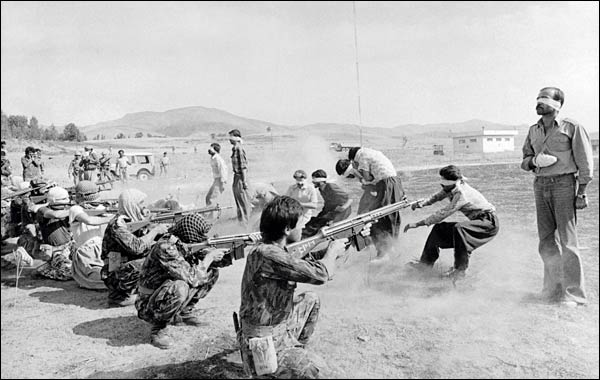
On this date in 1979, the only anonymous photograph to win a Pulitzer Prize captured nine Kurdish rebels and two of the Shah’s policemen executed by firing squad in revolutionary Iran.

This shot, one of a series taken of the event with the permission of the judge who condemned the men to immediate death in a half-hour trial at the Sanandaj airfield, ran the next day in the Iranian paper Ettela’at, whose editor prudently kept the photographer’s identity secret. Within two days, the stunning photo had rocketed around the world.

It won the Pulitzer Prize for Spot News Photography the following spring, still credited anonymously.

Two years ago, the Wall Street Journal revealed — with the photographer’s permission — the identity of the man who shot this indelible image: Jahangir Razmi, who had gone on to a career as one of Iran’s top photographic journalists. He came to New York to collect the prize 27 years late.

The article breaking the story is still available on the Journal‘s website, and on the personal site of reporter Joshua Prager. An NPR story discussing the search for Razmi’s identity is here.

On this day..

2004: Enzo Baldoni

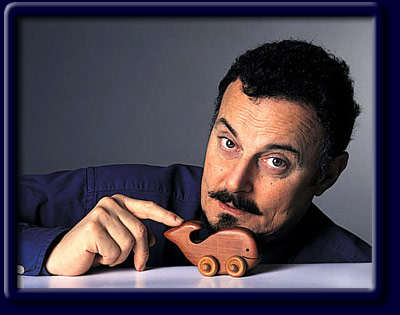
On this day four years ago, an Islamic militants in Iraq executed* hostage Enzo Baldoni, an Italian freelance journalist and Red Cross volunteer.


Baldoni had a variegated copyriting career, often working through his company Le Balene Colpiscono Ancora (“The Whales Strike Again”)

Baldoni (English Wikipedia page | Italian) made his writing chops with advertising copy, but also translated (notably the American comic strip Doonesbury, whose creator saluted him “Enzo the miraculous” in this FAQ) and segued into journalism. He was an early adopter of blogging and made a habit of traveling to the world’s hot spots; he had interviews with Subcomandante Marcos and Xanana Gusmao under his belt … but he was no scavenger of human misery.

Some people think I am some sort of a Rambo who loves strong emotions and seeing people die. I am miles away from that mentality. I am a convinced pacifist and for that reason I am curious to understand what make normal people brandish a gun.

Baldoni reported from Iraq for the Italian weekly Diario and kept a blog from the ground as well. On August 21, he was kidnapped after being caught in a firefight between Baghdad and Najaf.** Three days later, Al Jazeera aired his captors’ demand for Italian withdrawal within 48 hours; Baldoni was killed when that demand was ignored.

The day after Baldoni’s death, the black armband-clad Azzurri defeated the upstart Iraqi soccer team for the Olympic bronze medal.

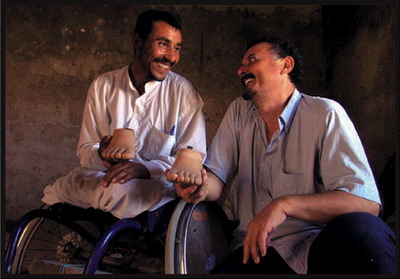
The final legacies of Baldoni’s work well reflected his generous principles. The last entry on his blog Bloghdad (now defunct; here’s how it looked four years ago) was this picture:

And his (translated, obviously) “last testament” as released by a fellow journalist described a man who would not want this blog post to linger on mawkishly.

[At my funeral] I want people to smile — did you notice? Funerals always end up with someone smiling: it’s natural, it’s Life taking over Death. And let people smoke freely anything they like; I’d also be pleased if new love stories would come out, and I’d even consider some casual sex an offer to Life rather than an offense to Death.

At about eight or nine o’clock, with little or no ceremony, bring my coffin quietly to the crematorium, while the party and the music should last until late night.

About my ashes … throw them into the sea. Or do as you want, who fucking cares? Just nothing phony like in The Big Lebowski.

Ciao, Enzo.

* Obviously, this is a case of a borderline execution, owing to the Islamic Army in Iraq’s non-state credentials — in a legal sense, Enzo Baldoni was murdered. But it was precisely the point of his killing to contest legitimate state authority, and according to a later interview with an alleged spokesman of the faction, there was even a juridical proceeding “convicting” Baldoni of espionage.

** According to Reporters Without Borders, a stupefying 142 journalists — Baldoni among them — were killed in Iraq from 2004 through 2007, nearly half the worldwide total of 299 reporters who died in their line of work during that span.

On this day..

1945: John Birch, Society man

On this date in 1945, according to a fringe faction of American conservatism, the first victim of the Cold War was shot by Chinese Communists at Suchow, China, near Xi’an.

John Birch, a military chaplain proselytizing in China and an agent of the CIA’s precursor entity Office of Strategic Services, had the kind of portfolio sure to rub Mao’s boys the wrong way.

Apparently it was his personality that got him into trouble.

On recon duty days after the end of World War II, he bumped into a patrol of Red Chinese. According to Time, he failed his diplomacy check.

As the scene has been reconstructed, Birch argued violently with the Communist officer who wanted to disarm him. Birch was seized and shot after his hands had been tied. The Communists then bayoneted him at least 15 times and tossed his body on a heap of junk and garbage.

“In the confusing situation,” said [Birch’s commanding officer Major Gustav] Krause last week, “my instructions were to act with diplomacy. Birch made the Communist lieutenant lose face before his own men. Militarily, John Birch brought about his own death.”

Days after World War II — how does that square with your international Communist conspiracy? The incident was not especially notable at the time, but some elements later conceived John Birch the first American casualty of Communism during the Cold War, and in this guise he became the namesake of the John Birch Society (Wikipedia entry | homepage — evidently forward-thinking enough to have grabbed their own three-letter acronym)

Here’s candy magnate and founder Robert Welch, Jr., explaining:

Despite the young lieutenant’s credentials as a martyr of evangelical anti-Communism, the oft-loopy Society’s relationship to the mainstream conservative movement and the Republican Party it took over was never completely comfortable and eventually came to a definite sundering.

The Society soldiers on, its “Get US out of the United Nations” billboards a minor fixture of Americana from Port Angeles, Washington to this one in Ypsilanti, Michigan.

On this day..

1993: Ruben Cantu, an innocent child?

On this date in 1993, Texas gave a lethal injection to a young man for murder — a crime many involved in the case no longer believe he committed, since the sole witness against him has recanted.

Ruben Cantu was only 17 years old at the time of the crime, and for that reason would not be eligible for execution today. But according to a Houston Chronicle investigation (the story is also mirrored here) 12 years after his death, he shouldn’t have been eligible then because he might not have done it. Cantu himself may have kept a street code of silence to his death.

Lise Olsen — interviewed by NPR here — blew up the case; Cantu’s jury forewoman and the district attorney who tried him for his life are among those who have publicly regretted their roles in what has emerged one of the most compelling cases of an executed innocent in the modern American death penalty era. Nobody could possibly have predicted that pitiable public defender resources and an extremely aggressive capital punishment regime could result in such a thing.

The subsequent (and still current) Bexar County District Attorney checked it out (threatening to prosecute the recanting witness) and declared everything proper. So don’t worry about it. What could she possibly have to gain from a whitewash?

On this day..

1305: William Wallace, Braveheart

On this date in 1305, Scottish knight Mel Gibson — er, William Wallace — was hanged, drawn and quartered at Smithfield for treason to a British crown he refused to recognize.

Just like so:

Well, close enough. Some wags have alleged one or two historical liberties in Braveheart.

Among the lesser (but more pertinent here): that they weren’t — you knew this already — offering the former Guardian of Scotland the opportunity to reduce his suffering with a public submission, or use the stage for theatrical defiance. Hanging, drawing and quartering was a brand new execution Edward I was experimenting with for emasculating, disemboweling, and (so the idea went) utterly cowing the rebellious hinterlands of the British Isles. Wallace may have been just the second person to suffer it.

But only a pointy-headed blogger could possibly care when the main point is that back before Christendom succumbed to nancy decadences like Vatican II, men wore woad, defenestrated queers, and tapped top-shelf babes.


Among the few things known for certain about William Wallace is that he did not score with Isabella of France. Or with Sophie Marceau.

Facts? This is show business!

Mel’s bloodbath only riffs the already-fantastic 15th century epic of “the Wallace” by Scottish minstrel Blind Harry, which in turn got a lyrical call-out in Robert Burns’ 18th century Scottish patriotic tune Scots Wha Hae.

National martyrs — and, sure, it helps to die at the right time, as Wallace did just before Robert the Bruce secured Scottish independence — feed a train of hungry authors and ready audiences in every time, place and medium.

However genuinely flesh-and-blood the limbs that wrought his feats and were torn apart on this day, Wallace returns to his generations of interlocutors half-shrouded in mythology. Seven centuries on, his contested (and sometimes absurd) use as precedent or metaphor stakes a claim to his Truth at least as compelling as battlefield tactics at Stirling Bridge. What does he “really” have to tell us? No matter how grisly his end, William Wallace doesn’t get to decide: it’s between you, me, Mel, and a few billion other folks.

Only a character really worth remembering is worth that kind of fictionalizing.

On this day..

408: Stilicho, whose execution let in the barbarians

Sixteen hundred years ago today, the general whose talents were the last bulwark against barbarian conquest of the Western Roman Empire submitted for the sake of civil peace to execution at the hands of a callow boy-emperor.

The half-Vandal patrician Stilicho comes to the notice of posterity late in the reign of Theodosius the Great, the last Roman to rule both Eastern and Western Empires. At Theodosius’s death in 395, his two sons ascended the separate thrones.

Honorius, a 10-year-old child, took the purple in the west and somehow held it for 28 lackluster years that saw Rome’s long erosion finally set the realm on the slide into collapse.*

An apt commander, Stilicho had held Visigoth king Alaric at bay in two invasions of Italy (the crucial Battle of Pollentia stanched the first).
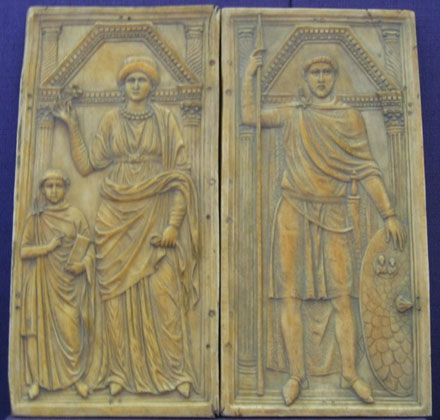

Stilicho and his wife Serena, with their child: two were executed, one was murdered.

Distrusted because of his part-barbarian parentage — and hated by the still-significant pagan community for burning the Sibylline Books — Stilicho’s service never made him popular. Because Alaric had escaped his battlefield defeats, it was whispered that Stilicho had connived with him … and Stilicho’s alliance of his legions with Alaric against other barbarians in Illyrium and Burgundy only heightened the suspicions.

We have little reliable basis to judge the possible truth of these accusations; the fundamental fact was that Rome no longer exercised its accustomed hegemony, and its principals needed to balance interests, cut deals and allocate scarce resources in ways that would have been unthinkable a century or two before.** The army itself was mostly barbarian; Alaric himself had once been a Roman officer.

In the story as related by Zosimus — a later Byzantine historian, a pagan famously abusive towards Christians and elsewhere critical of Stilicho, here softening his stance as he turns to savage his executioners — a wormtongued advisor got the ear of the still-youthful emperor and turned him against the general who was holding back the cataclysm.

Stilicho … was not conscious of any ill intention either against the emperor or the soldiers, [but] Olympius, a native of the vicinity of the Euxine sea, and an officer of rank in the court-guards, concealed under the disguise of the Christian religion the most atrocious designs in his heart. Being accustomed, because of his affected modesty and gentle demeanor, to converse frequently with the emperor, he used many bitter expressions against Stilicho, and stated that he was desirous to proceed into the east, from no other motive than to acquire an opportunity of … placing the empire in the hands of his own son, Eucherius. … Olympius, accustoming himself to visit the sick soldiers, which was the master-piece of his hypocrisy, dispersed among them, likewise, similar insinuations. … they were excited almost to madness … then dispersing themselves about the city, killed as many of the magistrates as they could lay hands on, tearing them out of the houses into which they had fled, and plundered all the town. … The tumult continued till late in the night, and the emperor fearing lest any violence should be committed against his own person also, for which reason he withdrew. … There likewise perished so great a number of promiscuous persons as is beyond all computation.

When intelligence of this reached Stilicho, who was then at Bononia, he was extremely disturbed by it. Summoning, therefore, all the commanders of his confederate Barbarians, who were with him, he proposed a consultation relative to what measures it would be most prudent to adopt. It was agreed with common consent, that if the emperor were killed, which was yet doubtful, all the confederated Barbarians should join together, and fall at once on the Roman soldiers, and by that means afford a warning to all others to use greater moderation and submissiveness. But if the emperor were safe, although the magistrates were cut off, the authors of the tumult were to be brought to condign punishment. Such was the result of the consultation held by Stilicho with his Barbarians. When they knew that no indignity had been offered to the person of the emperor, Stilicho resolved to proceed no further in punishing or correcting the soldiers, but to return to Ravenna. For he reflected both on the number of the soldiers, and that the emperor was not steadfastly his friend. Nor did he think it either honourable or safe to incite Barbarians against the Roman army.

It came to a bad end, Stilicho nobly refusing the prospect of his allies upholding his cause by arms:

Stilicho being therefore filled with anxiety concerning these circumstances, the Barbarians who were with him were very desirous of putting in force their former resolutions, and therefore endeavoured to dissuade him from the measures which he afterwards thought proper to be adopted. But being unable to prevail with him, they all determined to remain in some place until they should be better apprized of the emperor’s sentiments towards Stilicho, … In the meantime Olympius, who was now become master of the emperor’s inclination, sent the imperial mandate to the soldiers at Ravenna, ordering them immediately to apprehend Stilicho, and to detain him in prison without fetters. When Stilicho heard this, he took refuge in a Christian church that was near, while it was night. His Barbarians and his other familiars, who, with his servants, were all armed, upon seeing this expected what would ensue. When day appeared, the soldiers, entering the church, swore before the bishop that they were commanded by the emperor not to kill Stilicho, but to keep him in custody. Being brought out of the church, and in the custody of the soldiers, other letters were delivered by the person who brought the first, in which the punishment of death was denounced against Stilicho, for his crimes against the commonwealth. Thus, while Eucherius, his son, fled towards Rome, Stilicho was led to execution. The Barbarians who attended him, with his servants and other friends and relations, of whom there was a vast number, preparing and resolving to rescue him from the stroke, Stilicho deterred them from the attempt by all imaginable menaces, and calmly submitted his neck to the sword. He was the most moderate and just of all the men who possessed great authority in his time. … he never conferred military rank for money, or coverted the stipend of the soldiers to his own use. … In order that no studious person, or astrologers, may be ignorant of the time of his death, I shall relate that it happened in the consulship of Bassus and Philippus, during which the emperor Arcadius submitted to fate, on the twenty-second day of August.

This date is the end of the line for Stilicho, but hardly the end of the troubles that laid him low. A spasm of mob violence against barbarians on the peninsula ensued; the executed general’s son was among those murdered. Teutons, many of them Roman soldiers, in turn flocked to the banner of Alaric, who promptly swarmed into the enfeebled Italian lands and for the first time in 800 years sacked Rome.

Romans knew just who to blame: Stilicho’s widow, who was herself executed at the order of the Senate. In Gibbon’s relating:

The first emotions of the nobles, and of the people, were those of surprise and indignation, that a vile Barbarian should dare to insult the capital of the world: but their arrogance was soon humbled by misfortune; and their unmanly rage, instead of being directed against an enemy in arms, was meanly exercised on a defenceless and innocent victim. Perhaps in the person of Serena, the Romans might have respected the niece of Theodosius, the aunt, nay, even the adoptive mother, of the reigning emperor: but they abhorred the widow of Stilicho; and they listened with credulous passion to the tale of calumny, which accused her of maintaining a secret and criminal correspondence with the Gothic invader. Actuated, or overawed, by the same popular frenzy, the senate, without requiring any evidence of his guilt, pronounced the sentence of her death. Serena was ignominiously strangled; and the infatuated multitude were astonished to find, that this cruel act of injustice did not immediately produce the retreat of the Barbarians, and the deliverance of the city. That unfortunate city gradually experienced the distress of scarcity, and at length the horrid calamities of famine.

Alaric made out quite a lot better.

* Such, at least, is the conventional assessment of Honorius. For a take friendlier to the emperor (and less so to Stilicho), see here.

** Stilicho, incidentally, called home the second-last legion of Roman troops from Britain for use closer to home, and the island’s remaining Roman presence was cut off by barbarian incursions into Gaul during his lifetime … setting that island on its independent way (into, if you like, the Arthurian age); Honorius would later answer a plea for help from those lands with a note to the effect of, “good luck on your own.”

On this day..

2007: Frank Duane Welch, a cold case CSI caught

One year ago today, justice was served better late than never, courtesy of the crime lab.

The 1987 rape and murder of Jo Talley Cooper, a pregnant 28-year-old Norman woman killed while her infant son lay unharmed in the next room, had stood unsolved for a decade.

Coincidentally — unluckily for Frank Duane Welch — forensic DNA testing was just coming online during that decade. A match in another case led the database to its culprit, in the Cooper murder and a similar crime around the same time.

Apart from the manner of his capture — and the incidental minor distinction of being the last person killed in Oklahoma’s busy death chamber before the 2007-2008 execution moratorium due to court challenges to lethal injection — Welch is an almost wholly unremarkable character, central casting for the modern American death row, a paragon of the banality undergirding appalling, life-shattering crimes.

The penpal site of the Canadian Coalition to Abolish the Death Penalty still preserves Welch’s c. 1999 appeal for correspondence:

My name is Frank Duane Welch, I am a 38 yr. old white male who is confined on Death Row within the Oklahoma Department of Corrections. I enjoy watching numerous sporting events, such as football, baseball, tennis and rodeo. Here on Death Row we have only two options of exercise, basketball or handball. I try and take advantage of both in order to stay in shape. Besides sports, I enjoy a good book, novels mostly. My tastes in music are first country and then some light rock, no heavy metal. My educational background consists of a bachelors degree in Animal Science. Now as for what I am looking for in a pen pal. I am looking for a friend, age not important. One who is willing to be straight forward with me, no games. For I will be straightforward with them. I need someone who is willing to help me both emotionally and financially. Someone who, when I am having a bad day, is willing to listen and give support. I am a proud man, but it is hard being alone in this place, no one to share your thoughts and feelings with. For this is the reason I have written this letter. If you are willing to accept me as I am and not hold my faults against me, I would love to hear from you.

According to the macabre* blog Dead Man Eating, Welch checked out with a belly full of pizza and a two-liter Coke, tritely last-wording:

There is nothing that can change the horrible thing I done. There is nothing that can change that. I take full responsibility for what I done. I am truly, truly sorry for all the hurt and pain I have caused you. I take full responsibility for what I’ve done. There’s no excuse for it. There never was. It was just me.

I love y’all. God bless y’all. I’m ready.

Maybe that’s as much closure as one can have in this world. That infant child who survived the horror had grown into a 20-year-old man who had never known his mother. Travis Cooper’s testimony at the clemency board hearing helped seal Welch’s fate.

It would be different if my mother would have died of natural causes. It would be different if it was God’s will, but the truth is that an evil man named Frank Welch took her life … And the unspeakable things he did to her, my mother, is what fills me with anger, the pain, and the loneliness that I feel to this day.

“None of this will ever bring my mom back,” Cooper told reporters after the execution. “I miss my mom.”

* Pot. Kettle. Black.

On this day..

1191: Muslim prisoners at Acre

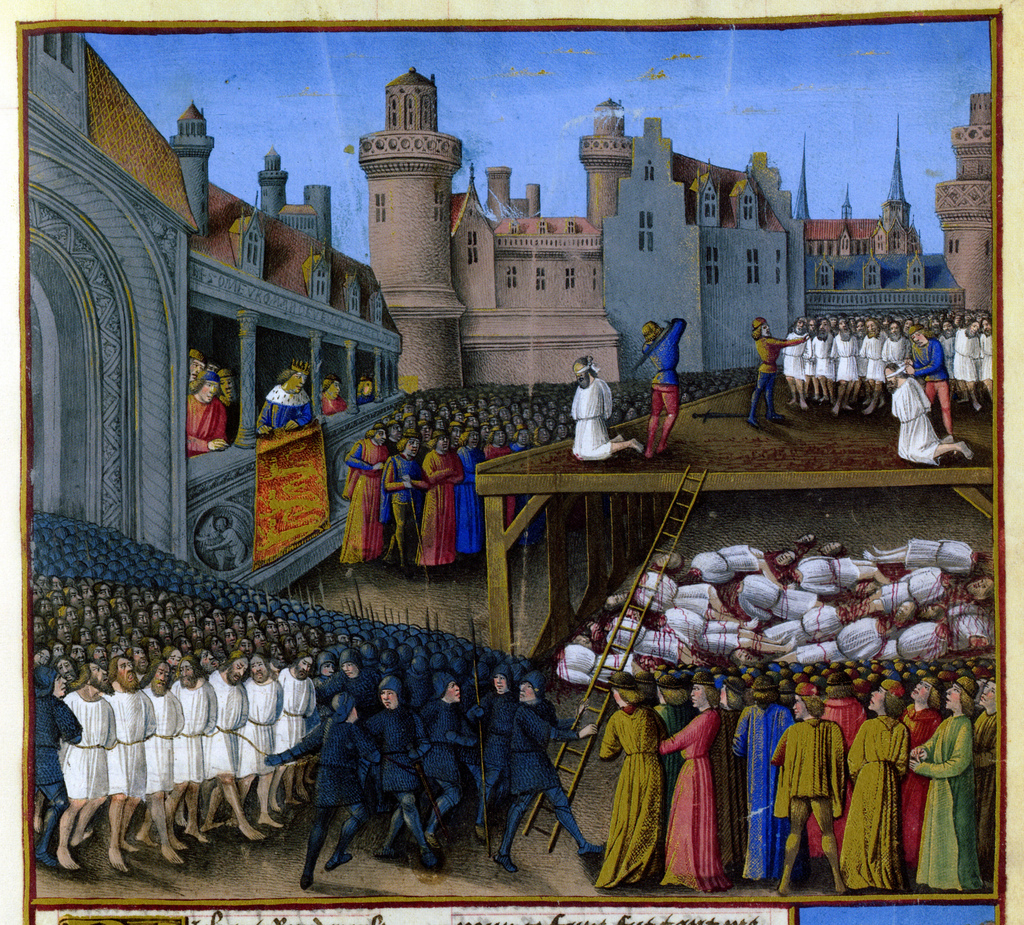
On this date in 1191, Richard the Lionheart had 2,700 Muslim prisoners of Acre demonstratively executed before his opposite number Saladin, when ransom arrangements dilated.

Courtesy of Project Gutenberg, here is Guizot on this ugly prod to action from the Third Crusade

From the 1st of August, 1191, to the 9th of October, 1192, King Richard remained alone in the East as chief of the crusade and defender of Christendom. He pertains, during that period, to the history of England, and no longer to that of France. We will, however, recall a few facts to show how fruitless, for the cause of Christendom in the East, was the prolongation of his stay and what strange deeds—at one time of savage barbarism, and at another of mad pride or fantastic knight-errantry—were united in him with noble instincts and the most heroic courage. On the 20th of August, 1191, five weeks after the surrender of St. Jean d’Acre, he found that Saladin was not fulfilling with sufficient promptitude the conditions of capitulation, and, to bring him up to time, he ordered the decapitation, before the walls of the place, of, according to some, twenty-five hundred, and, according to others, five thousand, Mussulman prisoners remaining in his hands.

The only effect of this massacre was, that during Richard’s first campaign after Philip’s departure for France, Saladin put to the sword all the Christians taken in battle or caught straggling, and ordered their bodies to be left without burial, as those of the garrison of St. Jean d’Acre had been. Some months afterwards Richard conceived the idea of putting an end to the struggle between Christendom and Islamry, which he was not succeeding in terminating by war, by a marriage. He had a sister, Joan of England, widow of William II., king of Sicily; and Saladin had a brother, Malek-Adhel, a valiant warrior, respected by the Christians. Richard had proposals made to Saladin to unite them in marriage and set them to reign together over the Christians and Mussulmans in the kingdom of Jerusalem. The only result of the negotiation was to give Saladin time for repairing the fortifications of Jerusalem, and to bring down upon King Richard and his sister, on the part of the Christian bishops, the fiercest threats of the fulminations of the Church. With the exception of this ridiculous incident, Richard’s life, during the whole course of this year, was nothing but a series of great or small battles, desperately contested, against Saladin. When Richard had obtained a success, he pursued it in a haughty, passionate spirit; when he suffered a check, he offered Saladin peace, but always on condition of surrendering Jerusalem to the Christians, and Saladin always answered, “Jerusalem never was yours, and we may not without sin give it up to you; for it is the place where the mysteries of our religion were accomplished, and the last one of my soldiers will perish before the Mussulmans renounce conquests made in the name of Mahomet.”

Good thing that Jerusalem issue has since been cleared up.

The BBC treated the scenario — complete with the resultant loss of the last chunk of the supposed True Cross — in a chunk of its 90-minute documentary on the Third Crusade:

On this day..

1937: Ikki Kita

On this date in 1937, intellectual Kita Ikki (Kita is the family name) was executed by the Japanese military government for inspiring a failed coup d’etat the previous year.

A onetime socialist turned radical nationalist, Kita — born Kita Terujiro — preached a doctrine of authoritarian national restoration around some socialist-sounding communitarian purpose, coupled with an unapologetic imperialism.

His Outline Plan for the Reorganization of Japan (the translation is from a reader, Sources of Japanese Tradition, partially excerpted here) argues that in the wake of Europe’s self-immolation in World War I, initiative lay with the Land of the Rising Sun — and that the country must adopt a muscular unity of purpose to grasp it.

The entire Japanese people, thinking calmly from this perspective which is the result of Heaven’s rewards and punishments, should, in planning how the great Japanese empire should be reorganized, petition for a manifestation of the imperial prerogative establishing “a national opinion in which no dissenting voice is heard, by the organization of a great union of the Japanese people.” Thus, by homage to the emperor, a basis for national reorganization can be set up.

Truly, our 700 million brothers in China and India have no path to independence other than that offered by our guidance and protection. And for our Japan, whose population has doubled in the past fifty years, great areas adequate to support a population of at least 240 million or 250 million will be absolutely necessary a hundred years from now. For a nation, one hundred years are like a hundred days for an individual. How can those who are anxious about the inevitable developments or who grieve over the desperate conditions of neighboring countries find their solace in the effeminate pacifism of doctrinal socialism? … At a time when the authorities in the European and American revolutionary creeds have found it completely impossible to arrive at an understanding of the “gospel of the sword” because of their superficial philosophy, the noble Greece of Asian culture [meaning Japan, of course] must complete its national reorganization on the basis of its own national polity. At the same time, let it lift the virtuous banner of an Asian league and take the leadership in the world federation that must come. In so doing let it proclaim to the world the Way of Heaven in which all are children of Buddha, and let it set an example that the world must follow.

One could quibble about particulars, but it’s essentially fascism — paralleling Mussolini in doctrine as well as ideological evolution. (According to W.G. Beasley Kita also co-founded a Gen. Jack Ripper-esque Society for the Preservation of the National Essence.)

A military coup was supposed to get the ball rolling, which made him a guru to an aggressive cadre of young officers who tried to seize the government in the February 26 Incident, named for the date in 1936 it took place.

Kita wasn’t himself involved in the coup, but his intellectual sponsorship was enough of a connection for the Kempeitai.* Modern Japanese Thought tartly observes that Kita’s vision for an imperial dictatorship didn’t turn on any misty-eyed allegiance to the emperor’s person.

When he was executed for his role in the mutiny of 1936, he was ordered to recant by saying “long live the emperor” as a final act of reverence and submission. He is reported to have refused by replying that he had vowed long ago never to joke about his own death.

In Fighting Elegy (or Elegy to Violence or Elegy to Fighting), Seijun Suzuki’s 1960’s skewering of militarist 1930’s Japan (review), Kita makes cameos to inspire the main male character to greater feats of violent sublimation of his repressed sexuality. (The following clip is merely the trailer.)

There’s also a 1973 biopic — the last film of Yoshishige Yoshida.

* I don’t have definite documentation on the method of execution; I’m supposing it was hanging, the standard method in Japan since the Meiji period.

On this day..

1848: Camila O’Gorman and Father Ladislao Gutierrez, for traditional family values

On this date in 1848, a pregnant 20-year-old socialite and her forbidden lover were shot at the order of an Argentine dictator.

Virtually a lens for the contradictory currents of gender, class and power in her time, Camila O’Gorman was the daughter of an elite family of (as her name suggests) Irish extraction, and a bosom friend of the daughter of her future executioner, dictator Juan Manuel de Rosas.

She fell into a torrid affair with Gutierrez, the family priest, and in 1847 eloped with him, a grand gesture of romanticism that brought a government warrant for their capture to “satisfy religion and the law and to prevent further cases of immorality and disorder.”

A scandal, as one might suppose — there was much chatter over who seduced whom, and whether it was a kidnapping — but a manhunt (and womanhunt)? Rosas appears psychotically enraged by two young people crazy in love, and still more so for summarily decreeing their death when he had them in his clutches. Another priest, it turned out, handed them over — more in sadness than in anger, in the manner of such folk, but understanding deep down that the arbitrary law is the law and immorality and disorder don’t go about preventing themselves.

O’Gorman was the first woman executed in independent Argentina, and she was eight months pregnant: the better to “satisfy religion” (though not the law, which forbade the execution of a pregnant woman), O’Gorman’s unborn child was baptized … by making her mother drink holy water.

The lovers were then shot together at the town of General San MartĂ­n, then known as Santos Lugares de Rosas.

The pregnant O’Gorman, borne to her firing squad. The image comes from this Argentinian page (in Spanish) about the heroine.

According to this effusively pro-elopers essay,

Camila and Uladislao’s brave sense of freedom upset the structured norms of a society used to obeying through fear. Their only way of facing the tyrannical power was escaping from a society which would never understand. They did not give up on their love to please the Restorer [Rosas], as was expected in those days. They never showed signs of repentment, [sic] on the contrary their peaceful minds reflected their clean consciences.

And among the many questions this tragic true story might raise, there’s one that particularly appals [sic] us: why did Rosas shoot Camila knowing the law stated a pregnant woman could not be murdered? Was that baby guilty of his parents’ “crime”?

He evidently was, since by being born he would symbolise the testimony not only of the criminal act, but also the evidence of “disobedience” of a moral code imposed by a fearful dictator.

Such Shakespearean drama ripped from recent history has not failed to inspire literary treatment — such as Enrique Molina’s Una Sombra Donde Suena Camila O’Gorman, (“A Shadow Where Camila O’Gorman Dreams”) and this 19th century Spanish text.

On the screen, O’Gorman and Gutierrez’s doomed love was the topic of one of the first Argentine feature films (a century-old silent film now thought lost), and an Academy Award-nominated 1984 film with plenty of talking:

On this day..