1571: Marco Antonio Bragadin, flayed Venetian

On this date in 1571, the commander of a Venetian garrison was flayed by the Turks.

Marco Antonio Bragadin (English Wikipedia entry | Italian) — or Marcantonio Bragadin — was the captain of Famagusta as an Ottoman Empire near the peak of its power began to wrest Cyprus from eight decades of Venetian control.

The Turks sacked the wealthy Cypriot capital Nicosia in September 1570, slaughtering or enslaving the inhabitants. Bragadin thereupon received an inducement from the invaders to surrender the last Venetian outpost still remaining in Cyprus: the severed head of Nicosia’s general.

Bragadin was having none of it.

Milord pasha of Carmania,

I have seen your letter. I have also received the head of the lord lieutenant of Nicosia, and I tell you herewith that even if you have so easily taken the city of Nicosia, with your own blood you will have to purchase this city, which with God’s help will give you so much to do that you will always regret having encamped here.

The Famagustans didn’t get quite that much help from God, but they forced a dear purchase in blood. For nearly a year, they repelled the siege; starving and exhausted, they at last accepted a merciful surrender only to have the entire garrison slain (the link is in Italian) at the beginning of this month.

The entire garrison, save Bragadin.

Special torments were reserved for the general who had given them such trouble. Executed Today friend Melisende’s Historic Biography post on Bragadin recounts the nauseating Calvary of the Venetian: mutilated, dragged around his fallen fortress, then exposed on the docks for flaying alive. The skin was stuffed with straw and sailed back to Istanbul as a war trophy for the Sultan Selim II.

One can see here, of course, the narrative of East vs. West in a war for civilization itself, although one should observe that the overthrow of Catholic hegemony on Cyprus restored the privileges of the Orthodox church. But the fall of Cyprus was itself the backstory for one of the pivotal naval battles of the age two months later, the Battle of Lepanto, at which a league of Mediterranean powers including Venice decisively checked Ottoman influence at sea, pre-empting a likely invasion of Italy.

Bragadin, for his part, became a potent symbol blending civic and religious martyrdom in what turns out to be (post-Lepanto) a victorious cause. One might say that he fulfilled a need.

Cultures which have drawn nourishment from their legendary martyrs feel a need to prolong the spectacle of their suffering. They hark back to the desire to keep the dying man with them; and the memory of this desire strengthens their tales of holy victimhood, dramatizes them, keeps them alive. Bragadin’s torture was long-drawn-out, and it must be constantly remembered as such.

… Christians’ preoccupation with relics has been complex, enduring and, at times, feverishly obsessive. It has reached high points in moments when Catholic doctrines and practices have felt most dramatically threatened. During Marcantonio Bragadin’s lifetime, and during the period immediately following, Christendom trembled before the encroaching Muslims. In this context, the story of Bragadin’s martyrdom acquired particular potency: not because the Church proclaimed him a saint, but because by analogy, he seemed to bring the ancient Christian matrydoms up to the present. He seemed to make those sufferings real and explicit, lifting them out of their legendary fogginess. Step-by-step, piece-by-piece, he “demonstrates” the martyr’s ordeal, almost as in a manual of suffering.

Nor was the fulfillment merely conceptual. According to this page on Rome tourist destinations, the painting of St. Bartholomew‘s flaying executed for the ancient basilica of Santi Nereo e Achilleo in the 1600 Jubilee alludes directly to the more contemporary event — notice the dark, turban-clad figure on the left.

In 1596, one of the few survivors of Cyprus nicked Bragadin’s hide from Istanbul and returned it to Venice, where it remains today entombed as a relic at the Basilica di San Zanipolo.

On this day..

1894: Sante Geronimo Caserio, anarchist assassin

On this date in 1894, Sante Geronimo Caserio was guillotined in Lyon, where he had assassinated the president of France two months before.

In the day when the terror stalking European order brandished the black flag of anarchy, the Italian immigrant Caserio (his first name can be rendered either Sante or Santo, and his middle name alternately as Jeronimo, Ironimo or Heironymus) escalated the “propaganda of the deed” into the nightmares of Europe’s executives.

Retaliating for the executions of two previous anarchists, August Vaillant and Emile Henry, Caserio (English Wikipedia entry | Italian | French) stepped up to the carriage of Marie Francois Sadi Carnot on the night of June 24-25 and efficiently planted a dagger in his heart.

Before the decade was out, the Prime Minister of Spain, the King of Italy and the Empress of Austria-Hungary would all likewise be murdered by Italian anarchists.

As one might imagine, Caserio played the role of cocksure martyr to the hilt: asked whether he repented, he vowed to kill another president if given a few minutes; he refused to pursue a mental illness defense or inform on comrades; and at the guillotine, he exhorted the onlookers, “Forza, compagni! Viva l’anarchia!” (The New York Times account of the beheading recounts Caserio’s background, from an obviously hostile class position.)

By the time Caserio lost his head, the propaganda of his deed had already provoked mass arrests of Italians, and a tightening of the lois scelerates (“villainous laws”) cracking down on dissidents.

But as always, one person’s evildoer is another’s hero, and Caserio has his online monuments — like this Italian page, or this blog entry, or this rendition of one of the several songs in his honor:

In an artsier vein, one can also follow the thread of the story to Les Bal des Innocents, a downloadable French production billing itself as “The first feature film under Creative Commons Licence.”

On this day..

1963: Henry John Burnett, Scotland’s last hanging

On this date in 1963, the executioner paid his last call to Scotland with the hanging of Henry John Burnett for the murder of a rival-in-love seaman.

The type whom parents hope their daughter never dates, Burnett liked to keep his squeeze Margaret May Guyan under lock and key to keep her stepping out on him.

It’s an old, old tale. Boy meets girl, boy makes girl his prisoner, girl gets creeped out and returns to estranged hubby Thomas Guyan at 14 Jackson Terrace in Aberdeen, boy blasts Guyan in the face with a shotgun. How many times have we heard it told?

Even though the noose was on its way out — this is not only the last execution in Scotland, but the only hanging in Aberdeen in the past century and a half — there wasn’t much pussyfooting around when they’d made up their mind to use it: Burnett outlived his victim by only eleven weeks — notwithstanding an insanity plea and clemency petitions from both his own and the victim’s families — before hanging at Craiginches Prison, a facility that surely ought to be somebody’s porn name.

It’s got pride of place in a book about Aberdeen crime history, Blood and Granite. Because you can find anything on YouTube, there’s also this fine teaser for a forthcoming animation project of some kind:

Part of the Themed Set: At the End of the Rope.

On this day..

1936: Rainey Bethea, America’s last public hanging

On this date in 1936, thousands thronged Owensboro, Kentucky, for a glimpse of what would prove to be the last public hanging in the United States.

The U.S. followed the trend of its onetime mother country, England, in moving the formerly iconic public hanging increasingly behind closed doors, but its federalist structure made that change uneven. In Kentucky itself at this time, the law displayed sedimentary layers of death penalty history.

Caught up for killing a 70-year-old woman — done in the midst of a drunken burglary, he had left a telltale ring at the scene; fingerprint analysis also helped establish his guilt — Rainey Bethea was on the hook for murder, robbery and rape. The former two indictments would have subjected him to (private) electrocution at the state penitentiary. The latter charge still carried the punishment of public hanging in the local county seat.

Bethea was charged only with rape.

While the explicit sentencing disparity between the crimes bears the clear marks of racism and patriarchy that made purported black-on-white sexual crimes such live fodder for lynch law, and the four-and-a-half-minute jury deliberation doesn’t have the look of solemnity, Bethea’s actual guilt seems fairly well-established.

But the case attracted a nationwide media swarm not for any exceptional quality of the crime or the anachronistic nature of the punishment, but for the involvement of a female sheriff. The “matronly” (virtually all descriptions of her gravitate to this adjective) Florence Thompson had inherited the top law enforcement post upon the death of her husband … and that meant she had inherited the responsibility of hanging Rainey Bethea, which would make her the first American woman to supervise an execution.

Would she or wouldn’t she? The press descended on Owensboro to cover the edifying spectacle of a plump mother stringing up a rapist, or else maneuvering her way out of the job. Thompson played cagey until the very last moment, when the ringers she had secretly hired appeared on the scaffold while she watched from a nearby vehicle.
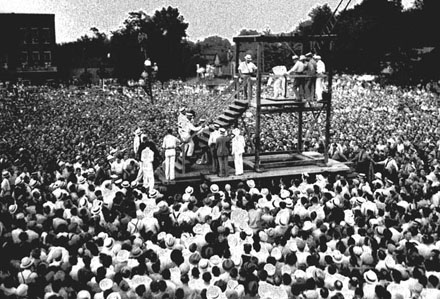
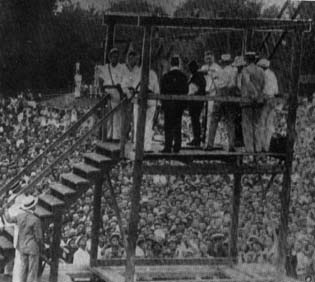
In this photo, Bethea — almost totally obscured between his escorts — has just begun ascending the gallows.

The man who threw the trap showed up drunk and performed appallingly, but press reports subsequently focused on the beastly behavior of the “jeering” crowd rushing the gallows to tear souvenirs from the corpse. (For instance, Time and the New York Times.)

But according to Perry T. Ryan’s 1992 review of the case — including interviews with surviving witnesses — little to nothing of the kind occurred. Ryan claims Bethea faced about the most dignified hanging mob imaginable.

Maybe hyped-up atrocities in the hinterlands were part of what distant editors demanded after H.L. Mencken at the Scopes trial. Certainly, the local Messenger-Inquirer painted a sharply different picture from more prominent outlets in this August 16 editorial (titled “Panderers Galore”) whose themes could have stepped fresh from a modern cable TV gabfest:

Ambitious and irresponsible reporters and photographers who swarmed into Owensboro for the Bethea hanging dipped their ready hands into the cloaca of evil designs and plastered over the name of this fair city the dirty results of their pandering.

Those who saw the dawn kindling in the east and ushering in the last sunrise of the despicable creature about to die, did not expect all of the watchers to be in reverent mood, but a calm, quiet demeanor characterized their behavior, as a group, throughout their long wait, surprisingly moderate for an occasion on which the law was exacting the supreme penalty.

Considering the size of the throng that witnessed the hanging Friday morning and that it was composed largely of people, who journeyed to Owensboro from distant places, the wonder is that there was no demonstration, no emotional outburst. There was not the semblance of ‘mob impulse’ or ‘eagerness for the kill.’ For the sensation seeking star scribes of quacks of American journalism, it was entirely too tame an affair. This is the reason that some of them reported it as they wanted it to be — not as it was.

They heard a very few people on the outskirts of the crowd call out at different times: ‘Hurry up,’ ‘Get it over’ or ‘hang him.’ To give screaming bulletins to the yellow press and to ruthless radio commentators, they magnified and colored it into a scene of ‘great disorder’ though there was never a general outcry of any kind.

When a priest held up his hand from the scaffold for silence, as Bethea was about to go to his death, there was no ‘blood thirst’ mob ‘shouting and yelling.’ Present were several thousand, who came from near and far to see a man legally hanged for the most heinous crime ever committed in Daviess county, and several thousand more, who turned out to see how the rest would act. When that hand went up in a gesture for silence, the buzz of the multitude’s conversations died down till the fall of the proverbial pin could have been heard.

The smart scribes and sob sisters looked on. All they saw was a black man standing on a scaffold with a rope around his neck and a mass of people peering up at him. That was too tame, they would call it a ‘jeering’ throng. All they heard was the click of the trap door. That would not do. There would have to be ‘cheering.’ So they said there was. Then they heard cameramen from cities where nothing is cared about the horrible crime Bethea committed. They were bawling at officials to ‘move out of the way,’ to ‘give us a break.’ They had to have their souvenirs to show the half civilized readers of their yellow sheets. The boys and girls who had to tell the story needed more color to regale them with atrocious accounts of how the people behaved. They found a few individuals who had gone in the bizarre which inspired thundering headlines about ‘gayety’ and ‘carnival’ spirit.

In administering the last sacrament, the Rev. H. J. Lammers, of Louisville, made an opening in the hood. When the doctors pronounced Bethea dead, one of the attendants at the scaffold took a tag off the hood. Another then took a fragment and others, who were at arms length from the dead man, followed suit. The blunder of tearing off that tag gave the high powered thrill-writers their big opening. They pictured the crowd as tearing Bethea’s clothes from his body. The crowd was never in disorder and Bethea’s clothes were never torn.

The ‘souvenir hunting mob’ did not even pick up the sox [sic] and shoes the doomed man left at the foot of the gallows. It did not so much as touch the basket in which Agnew and Wheatley, colored undertakers, placed the body, clothes and all, or molest it or them in the slightest as they bore it away.

The scavenger writers who came to depict a ‘jolly holiday’ and ‘gala occasion’ had both, but they never saw a more orderly throng at a baseball game.

The public hanging of Bethea was not a disgrace to Kentucky. But, a disgrace to Illinois, Missouri, Tennessee, and some other states, was the spectacle made of it in their scandal monger press. Owensboro should not be surprised at the scurrilous attack upon it by lurid writers and glib tongued talkers in northern and eastern states for they delight to distort any news from Kentucky into weird barbaric tales. We have learned how best to protect our women from rapists-murderers, white or colored. The only way, it seems, that we will ever be able to protect them from the cruelties of a sordid section of the press, will be by softening the state’s anti-rape law, which makes public hanging mandatory. So many as favor that will please tell the legislature.

Vendors of news occupy an important place in the nation, and their purpose should always be to maintain unquestioned exactness of facts. Where the subject matter is susceptible to coloring there should be no sacrifice of truth. To pervert the high honor of the profession for the paltry reward of more readers is a dangerous venture and one that should be curbed.

Owensboro’s citizenry, than which no finer representatives of high-bred Americans can be found anywhere, regrets that it was necessary to invoke the Mosaic law, but a sobered regret and a more solemn memory is that the hanging was eagerly seized upon and transformed into a picturization of the exhibition of low passions loosed.

We are proud of our city, and justly so, for no people are of finer fiber. The putrid pens of those who wore the garb of the news profession painted in lurid colors purported happenings, and it is sad but true that such distorted reports are accepted while the plain statement of facts is discarded as an attempted apology.

Thousands of those who witnessed the Bethea hanging came from outside the county. They belonged to good families in their communities, temporarily bereft of their better judgment and bent on viewing a scene which ordinarily would be extremely repugnant to them. And the out-of-town reporters found in the visitors elements to embody in their sordid stories.

A thoughtless word here and there, expressed without cognizance of its probability of misuse, and the staid citizen away from home becomes to the wild-eyed correspondent a Kentuckian gunning for human game. There should be available means of calling to account the writer who for a few filthy shekels diverts his sense of justice into the recording of things that never were.

As the editorial intimates, regardless of what actually happened in Owensboro, the circus atmosphere quickly brought the matter of public hangings into question. In 1938, the Kentucky legislature moved all executions behind prison walls … and Bethea secured an indefinite claim to the status of last person publicly executed in the United States.

Part of the Themed Set: At the End of the Rope.

On this day..

1964: Gwynne Owen Evans and Peter Anthony Allen, England’s last hangings

At 8 o’clock in the morning this date in 1964, two gallows traps 50 kilometers apart opened simultaneously — dropping the last two men England ever hanged.

Gwynne Owen Evans and Peter Anthony Allen couldn’t have been much smaller fare for a milestone as momentous as the last entry in England’s copious annals of execution.


Evans (left) and Allen.

The two twentysomethings had dropped by Evans’s former coworker’s place in the aptly-named port Workington to borrow money. Since the call was at 3 a.m. and the petitioners were armed, it might appear that they had in mind an offer that John Alan West couldn’t refuse. The reader is invited to fill in the rest: a quarrel, a murder, a stolen watch, a medallion dropped at the crime scene with one of the perps’ own names on it …

Three months later, they were on trial for their lives; a month after that, hanged by the neck until dead. If there is tragedy in these hapless thugs, it may be that either could possibly have saved the other by claiming sole responsibility for the murder; since each blamed the other, the jury ended up finding them equally culpable.

While the last hangings in Canada featured two unconnected men hanged together, the last in England had partners in crime hanged separately. Allen died at Liverpool’s Walton Prison; Evans was dropped at Manchester’s Strangeways Prison.*

And unlike the Canadian case, Evans and Allen didn’t die knowing they were likely the last.

Although hangings had slowed to a crawl in Britain — there were just two in 1963, and none in 1964 before this day — death sentences continued to be handed down. But the trend was toward abolition: the British Parliament suspended the death penalty for ordinary crimes late in 1965, and made the suspension permanent in 1969. The handful of exceptional crimes for which the gallows remained nominally available — treason, piracy, espionage — were never enforced as such before those statutes too were removed from the hangman’s jurisdiction by 1998.

* Evans’ executioner, Harry Allen — no relation to Peter Anthony Allen — also conducted the last hanging in Scotland.

Part of the Themed Set: At the End of the Rope.

On this day..

1833: Captain Henry Nicholas Nicholls, sodomite

On this date in 1833, Captain Henry Nicholas Nicholls was hanged in London for sodomy.

Sodomy — “buggery,” in the more evocative British phrase, often bowdlerized in court records as b-gg–y or the like — was a capital offense in England until 1861, when the penalty was reduced to “merely” life imprisonment.

The London Courier reported the event:

Captain Henry Nicholas Nicholls, who was one of the unnatural gang to which the late Captain Beauclerk belonged, (and which latter gentleman put an end to his existence), was convicted on the clearest evidence at Croydon, on Saturday last, of the capital offence of Sodomy; the prisoner was perfectly calm and unmoved throughout the trial, and even when sentence of death was passed upon him. In performing the duty of passing sentence of death upon the prisoner, Mr. Justice Park told him that it would be inconsistent with that duty if he held out the slightest hope that the law would not be allowed to take its severest course. At 9 o’clock in the morning the sentence was carried into effect. The culprit, who was fifty years of age, was a fine looking man, and had served in the Peninsular war. He was connected with a highly respectable family; but, since his apprehension not a single member of it visited him.

The popular broadside on the case was scarcely more sympathetic. [Here’s another version of the gallow lit]

Even though once or twice a year someone would hang for it and the scandal would send family fleeing his name, Old Blighty still had a vigorous underground gay scene in the 19th century. While Lord Byron was enjoying the easier same-sex access of the Ottoman lands, a friend wrote to him, “that what you get for £5 we must risque our necks for; and are content to risque them.” (Cited here)

Quite accidentally, the senseless destruction this day of a respectable veteran helped set the put-upon gay underground upon its long march towards mainstream acceptance.

A first-person narrative written* in 1833 under the name of Lord Byron (who was in fact nine years dead, but whose queer identity clearly informs the work), Don Leon was a signal piece of literature: the first overt literary defense of homosexuality in English.**

It opens with a scene said to be inspired by Captain Nicholls:

Thou ermined judge, pull off that sable cap!
What! Cans’t thou lie, and take thy morning nap?
Peep thro’ the casement; see the gallows there:
Thy work hangs on it; could not mercy spare?
What had he done? Ask crippled Talleyrand,
Ask Beckford, Courtenay, all the motley band
Of priest and laymen, who have shared his guilt
(If guilt it be) then slumber if thou wilt;
What bonds had he of social safety broke?
Found’st thou the dagger hid beneath his cloak?
He stopped no lonely traveller on the road;
He burst no lock, he plundered no abode;
He never wrong’d the orphan of his own;
He stifled not the ravish’d maiden’s groan.
His secret haunts were hid from every soul,
Till thou did’st send thy myrmidons to prowl,
And watch the prickings of his morbid lust,
To wring his neck and call thy doings just.

The author — whose identity is still debated† — continues writing more or less autobiographically of Byron’s life, and using his illicit desires and lifestyle (with digressions into historical precedent) to defend homosexuality as ultimately natural and harmless.

The tree we plant will, when its boughs are grown,
Produce no other blossoms than its own;
And thus in man some inborn passions reign
Which, spite of careful pruning, sprout again.
Then, say, was I or nature in the wrong,
If, yet a boy, one inclination, strong
In wayward fancies, domineered my soul,
And bade complete defiance to control?

Though law cries “hold!” yet passion onward draws;
But nature gave us passions, man gave laws,
Whence spring these inclinations, rank and strong?
And harming no one, wherefore call them wrong?
What’s virtue’s touchstone? Unto others do,
As you would wish that others did to you.
Then tell me not of sex, if to one key
The chords, when struck, vibrate in harmony.
No virgin I deflower, nor, lurking, creep,
With steps adult’rous, on a husband’s sleep.
I plough no field in other men’s domain;
And where I delve no seed shall spring again.

Look, how infected with rank disease
Were those, who held St. Peter’s holy keys,
And pious men to whom the people bowed,
And kings, who churches to the saints endowed;
All these were Christians of the highest stamp-
How many scholars, wasting over their lamp,
How many jurists, versed in legal rules,
How many poets, honoured in the schools,
How many captains, famed for deeds of arms,
Have found their solace in a minion’s arms!
Nay, e’en our bard, Dame Nature’s darling child,
Felt the strange impulse, and his hours beguiled
In penning sonnets to a stripling’s praise,
Such as would damn a poet now-a-days.
To this conclusion we must come at last:
Wise men have lived in generations past,
Whose deeds and sayings history records,
To whom the palm of virtue she awards,
Who, tempted, ate of that forbidden tree,
Which prejudice denies to you and me.
Then be consistent; and, at once confess,
If man’s pursuit through life is happiness,
The great, the wise, the pious, and the good,
Have what they sought not rightly understood;
Or deem not else that aberration crime,
Which reigns in every caste and every clime.

To this conclusion we must come at last:
Wise men have lived in generations past,
Whose deeds and sayings history records,
To whom the palm of virtue she awards,
Who, tempted, ate of that forbidden tree,
Which prejudice denies to you and me.
Then be consistent, and, at once confess;
If man’s pursuit through life is happiness,
The great, the wise, the pious, and the good,
Have what they sought not rightly understood;
Or deem not else that aberration crime,
Which reigns in every caste and every clime.

Statesmen, in your exalted station know
Sins of omission for commission go;
Since ships as often founder on the main
From leaks unstopped as from the hurricane.
Shore up your house; it totters to the base;
A mouldering rot corrodes it; and the trace
Of every crime you punish I descry:
The least of all perhaps is sodomy.

I stand a monument, whereby to learn
That reason’s light can never strongly burn
Where blear-eyed prejudice erects her throne,
And has no scale for virtue but her own.

* Don Leon circulated initially in manuscript form, and was not published in England until years later — a known printing in 1866, and possibly another lost edition from before 1853.

** Here lagging well behind France, which had burned only a bare handful of homosexuals under monarchist anti-sodomy laws in the 18th century, and decriminalized homosexuality full stop in 1791. In Philosophy in the Boudoir the Marquis de Sade preened casually triumphant over the bad old days while Lord Byron was still a boy.

We wonder that savagery could ever reach the point where you condemn to death an unhappy person all of whose crime amounts to not sharing your tastes … Nature, who places such slight importance upon the essence that flows in our loins, can scarcely be vexed by our choice when we are pleased to vent it into this or that avenue.

† Candidates include parliamentarian William Bankes, who was arrested for sodomy in 1833 but acquitted later in the year; fellow MP John Cam Hobhouse; and playwright and Byron-idolizer George Coleman.

On this day..

1978: Antonina Makarova, Nazi executioner

On this date in 1978, a young Soviet girl’s desperate collaboration with the Wehrmacht caught up with a 55-year-old mother.

A village girl and the first in her family to go to school, young Antonina Parfenova was dubbed “Makarova” (after her father, Makar) by a teacher when the girl forgot or was too shy to say her surname. This childhood switcheroo would follow her into adulthood and ultimately buy her half a lifetime and a family to mourn her.

At 19, she had moved to Moscow when the German onslaught against the Soviet Union erupted, and like many young people in similar straits, she volunteered to help fight the Nazis. But as the front swept past her, she found herself in enemy territory, and was nabbed by the SS and persuaded to become the Germans’ executioner of Russians at Lokot, a village near the Ukrainian and Belarussian borders for which a short-lived Nazi-controlled “republic” was named.

A 2005 Pravda article (with a somewhat prurient concern over the young woman’s sexual incontinence) delves into her activities:

Usually Antonina Makarova was ordered to execute a group of 27 people, the number of partisans which a local prison could house. Death sentences were carried out on the edge of a pit half a kilometer from the prison. She never knew people whom she executed and they had no notion who the executioner was either. Antonina executed the first group of partisans being absolutely drunk and the girl could hardly realize what she was doing. She often kept clothes of those whom she killed if the things were good; she carefully washed them and heaped them in her room.

In the evenings after work Antonina loved to dress up and enjoy her time dancing with German officers together with other girls who came there as prostitutes. Antonina boasted she used to live in Moscow that is why other girls kept aloof from her.

At dawn, Antonina often came to the prison and peered into the faces of people whom she was to execute in the morning. The woman just did her job when executing people and believed that the war would write her crimes off.*

“Antonina Makarova” was implicated in some 1,500 executions, and formally charged in around 200 cases with identifiable victims. The KGB turned up scores of women of the right age with the right name, but none of them fit the bill: the real Makarova’s passport said “Parfenova.”

Not until 1976 did the case break, when a relative applying for a travel visa named her in a routine list of relatives. Now named Antonina Ginsburg — she had married a veteran and taken his name — she was living quietly in Belarus, but hardly in hiding: the pair attended parades and town functions in the honor accorded World War II survivors.

Viktor Ginsburg would be in for a bit of a shock.

Even 35 years after her spell with the Germans ended, the wounds of the Great Patriotic War were raw enough to spell her death in very quick order in Briansk, the capital of Lokot’s district. She was the last World War II traitor of any note executed in the Soviet Union, and according to this page, the only Soviet woman ever judicially executed by shooting. (I’d take that claim cautiously without more corroboration.)

The Pravda article cited above is about the only original English source readily available online; Russian speakers (or people prepared to grapple with an online translator’s inelegance) can read much more at her Russian Wikipedia page as well as here, here and here.

Update: Courtesy of Executed Today’s own Sonechka, a translation from this Russian story of Makarova’s daughter’s heartbreaking remembrance of a woman she only knew as a mother:

Pain, pain, pain … She spoiled the life of four generations … You would like to know whether I would take her back if she returned? I would. She is my mother after all… I really don’t know how to remember her — as if she’s alive or dead. According to the tacit law, women were not shot. Maybe she’s alive somewhere? And if not, tell me — I’ll finally light a candle for her soul.

(Candles in Orthodox churches are lit for “zdravie” — literally “good health, well being” — or “upokoi” — “peace of a soul.” The former is intended for living beings, the latter for dead ones.)

* This, at least, is what she told her interrogators.

On this day..

1862: Nueces Massacre

On this date in 1862, German immigrants fleeing Confederate conscription were caught near Texas’ Nueces River and slain to a man.

The nomenclature of the “Nueces Massacre” is controversial since this party of Union loyalists making a leisurely pace* for Mexico got its shots off as it was gunned down in a gully by Texas Partisan Rangers in the predawn hours.

But the incident becomes a clear candidate for these pages with the summary execution of the surviving captured and wounded men later this day. Here’s the account of an obviously upset member of the Confederate party:

[S]ome of the more humane of us did what we could to ease the sufferings of the wounded Germans. They had fought a good fight, and bore themselves so pluckily I felt sorry I had taken my part against them. We bound up their wounds, and gave them water, and laid them as comfortably as we could in the shade. Poor creatures, how grateful they were!

He then pauses for breakfast and helps gather up the scattered German horses; we rejoin the narration after 4 o’clock in the afternoon.

I hurried over to where we had left the German wounded to see how they were getting on, and was surprised to find them gone. Asking what had become of them, I was told they had been moved to a better shade a short distance away. With this answer I was quite satisfied, and never dreamed the brutes with whom I served would be guilty of foul play, especially after the gallant fight the enemy had made.

Just then one of our wounded called for water, and I brought him some from the cool spring. As I was giving it to him, the sound of firing was heard a little way off. I thought at first they were burying some of the dead with the honors of war; but it didn’t sound like that either. Then, possibly it might be an attack on the camp; so I seized my rifle and ran in the direction of the firing. Presently I met a man coming from it who, when he saw me running, said, “You needn’t be in a hurry, it’s all done; they shot the poor devils, and finished them off.”

“It can’t possibly be they have murdered the prisoners in cold blood!” I said, not believing that even Luck [a villainous — to the diarist’s mind — lieutenant] would be guilty of such an atrocious crime. “Oh, yes; they’re all dead, sure enough — and a good job too!” Feeling sick at heart, though I hardly even then credited his report, I ran on, and found it only too true.

It seems they were asked if they wouldn’t like to be moved a little way off into better shade. The poor creatures willingly agreed, thanking their murderers for their kindness. They were carried away, but it was to the shade and shadow of death, for a party of cowardly wretches went over and shot them in cold blood.

More summary justice followed in the weeks ahead against members of the party who had escaped** and others, and Confederate Haengerbande would plague Texas Germans of insufficient southern enthusiasm for the remainder of the war.

Fred Shon Powers offers this detailed account of the affair; there’s another here.

This day’s victims are honored by the Treue der Union obelisk, the only Union monument in Confederate territory, a prominent distinction that (as with all things in the Civil War) invites political football. This conservative article throws cold water on the “Germans-as-antislavery-Unionists” trope, and academic papers from a 1990’s conference gathered in this volume treat Nueces among other topics of “disloyalty” in the Confederacy.


The photo is taken by Steve & Marion Daughtry In Comfort, Texas. Image used with permission.

* An escapee recounted decades later by way of explanation for the party’s fatal inattention to either haste or defense, “Having read a proclamation from the Confederate government announcing that all persons not friendly to it might leave the country, we believed we had a right to do so in large or small bodies, as best suited our convenience, to the border and there cross over into Mexico.”

** About half the group had separated from the main body just before the Confederates engaged them. From this number come the “escapees,” many of them later killed in the hills or while crossing into Mexico. Those who stayed put all died this day.

On this day..

1993: Mohamed Mustafa Tabet, serial rapist with a badge

On this date in 1993, the police chief of Casablanca was shot in Kenitra Central Prison for abuse of power.

Mohamed Mustafa Tabet (or Tabit) wasn’t exactly Captain Renault.

While Morocco still has prisoners on death row, Tabet’s was the first execution actually carried out in 11 years, and it’s the last execution in Morocco to date. He went on the rocket docket, just five months from his arrest to standing up against a wall.

To earn that rare distinction, Tabet exploited his official power to rape or sexually exploit hundreds of women. Tabet confessed to some 1,500 victims over 13 years; the minimum figure matches the 518 personal identity cards found in his apartment. (Also found: 118 video cassettes — many of them violent — and a computer list of his crimes.)

The “Tabet Affair” — actually called “Tabetgate,” proving that the United States retains the power of exporting ideas — opened a discomfiting window on gender and power in Morocco.

Webster University Prof. Don Conway-Long was in Morocco at the time researching gender and masculinity for his dissertation. His paper “Sexism and Rape Culture in Moroccan Social Discourse” (pdf) is probably the most illuminating readily-available English* document on the affair — and the many contradictory reactions it drew from contemporaries, and the pressure it put on the government to contain the fallout as “a morals case, instead of looking further into overall police corruption.”

Prof. Conway-Long was good enough to spare Executed Today a few minutes to explore power and gender in Morocco, then and now.

ET: The scale of the crime spree seems just unimaginable, that he could get away with victimizing hundreds upon hundreds of women.

DCL: And not that many came forward! It was just a couple of women. If it’s difficult to talk to rape and sexual assault survivors here [in the U.S.], it’s exponentially harder in Morocco.

You were in Morocco in the years leading up to this trial. What was the country like in terms of its gender outlook?

It’s more like our 1950’s in terms of the attitudes towards women. Some educated professors at one point were laughing at the idea that a man could be charged with raping his wife in the West. In some ways, attitudes in Morocco are maybe 20 years behind what we see in the West. We had that same conception in the 1950’s — Missouri actually finally changed that law in 1993. [See here and here -ed.]

Morocco was also probably one of the most liberal countries of the Muslim world in the sense of being more closely connected to the West. Morocco has had more openness, more tourism.

How did the Tabet case impact women’s position?

[In 1995,] about a year after I left, a battered women’s shelter was set up in Casablanca, the first one in Morocco. By comparison, our first shelters in the U.S. and U.K. were set up in 1971, 1972.

In 2004, they passed a new family law that changed a lot of the freedoms that women have — e.g., women can ask for divorce, and don’t have to obey their husbands.

But I have no idea if you can claim there’s any causal relationship between the discovery of Tabet’s crimes and these later events. At the time, some men thought he was this great sexual hero, very virile.

So what lies ahead?

The old king died in 1999; his son Mohammed VI is in there now and he’s young and more aware and one of the rising stars of the monarchs of the middle east, like the king of Jordan. His [Mohammed’s] head is on the right way, but running a country like this with so much variation — there’s 50% illiteracy, the Western Sahara conflict, a certain level of Islamist opposition, and around twenty political parties all the way out to the Communists.

So there’s no certain future, absolutely not.

As far as cases like Tabet’s — let’s hope it’s not happening still, but Morocco when I was there was a place where you pass six different kinds of uniforms walking down the street with Uzis that would be pointed at your body as you passed.

* There’s more in French and Arabic.

On this day..

1944: Eight July 20 plotters

On this date in 1944, Nazi Germany’s juridical vengeance against Hitler’s near-assassins commenced.

Barely two weeks after Col. Stauffenberg‘s bomb had barely missed slaying the Fuhrer, eight of his principal co-conspirators stood show trials at the Volksgerichtshof (People’s Court) before hectoring prig Roland Freisler.

The outcome, of course, was foreordained.

Apparently orders had come down from on high to make the deaths as degrading as possible; this batch, convicted August 7-8, was hanged naked this day at Berlin’s Plotzensee Prison on thin cord (piano wire, say some sources, although it’s not clear to me whether this is literally true) suspended from meathooks while cameras rolled. Video and stills from the ghastly scene were shipped back to Hitler’s bomb-damaged Polish outpost for the edification of the powers that be.

The eight fitted for those nooses were:

Many hundreds more would follow, both at Plotzensee and throughout the Reich where persons distantly connected to the plotters and various miscellaneous resistance figures were swept up in the purge.

On this day..