1909: Francisco Ferrer, martyred teacher

(Thanks to Emma Goldman for the guest post on her anarchist contemporary; it originally appeared in her Anarchism and Other Essays -ed.)

Experience has come to be considered the best school of life. The man or woman who does not learn some vital lesson in that school is looked upon as a dunce indeed. Yet strange to say, that though organized institutions continue perpetuating errors, though they learn nothing from experience, we acquiesce, as a matter of course.
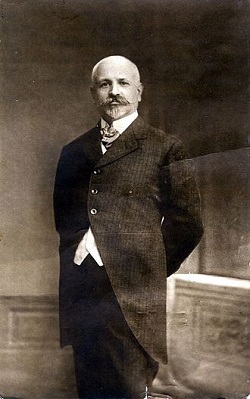
There lived and worked in Barcelona a man by the name of Francisco Ferrer. A teacher of children he was, known and loved by his people. Outside of Spain only the cultured few knew of Francisco Ferrer’s work. To the world at large this teacher was non-existent.

On the first of September, 1909, the Spanish government — at the behest of the Catholic Church — arrested Francisco Ferrer. On the thirteenth of October, after a mock trial, he was placed in the ditch at Montjuich prison, against the hideous wall of many sighs, and shot dead. Instantly Ferrer, the obscure teacher, became a universal figure, blazing forth the indignation and wrath of the whole civilized world against the wanton murder.

The killing of Francisco Ferrer was not the first crime committed by the Spanish government and the Catholic Church. The history of these institutions is one long stream of fire and blood. Still they have not learned through experience, nor yet come to realize that every frail being slain by Church and State grows and grows into a mighty giant, who will some day free humanity from their perilous hold.

Francisco Ferrer was born in 1859, of humble parents. They were Catholics, and therefore hoped to raise their son in the same faith. They did not know that the boy was to become the harbinger of a great truth, that his mind would refuse to travel in the old path. At an early age Ferrer began to question the faith of his fathers. He demanded to know how it is that the God who spoke to him of goodness and love would mar the sleep of the innocent child with dread and awe of tortures, of suffering, of hell. Alert and of a vivid and investigating mind, it did not take him long to discover the hideousness of that black monster, the Catholic Church. He would have none of it.

Francisco Ferrer was not only a doubter, a searcher for truth; he was also a rebel. His spirit would rise in just indignation against the iron régime of his country, and when a band of rebels, led by the brave patriot General Villacampa, under the banner of the Republican ideal, made an onslaught on that regime, none was more ardent a fighter than young Francisco Ferrer. The Republican ideal, — I hope no one will confound it with the Republicanism of this country. Whatever objection I, as an Anarchist, have to the Republicans of Latin countries, I know they tower high above that corrupt and reactionary party which, in America, is destroying every vestige of liberty and justice. One has but to think of the Mazzinis, the Garibaldis, the scores of others, to realize that their efforts were directed, not merely against the overthrow of despotism, but particularly against the Catholic Church, which from its very inception has been the enemy of all progress and liberalism.

In America it is just the reverse. Republicanism stands for vested rights, for imperialism, for graft, for the annihilation of every semblance of liberty. Its ideal is the oily, creepy respectability of a McKinley, and the brutal arrogance of a Roosevelt.

The Spanish republican rebels were subdued. It takes more than one brave effort to split the rock of ages, to cut off the head of that hydra monster, the Catholic Church and the Spanish throne. Arrest, persecution, and punishment followed the heroic attempt of the little band. Those who could escape the bloodhounds had to flee for safety to foreign shores. Francisco Ferrer was among the latter. He went to France.

How his soul must have expanded in the new land! France, the cradle of liberty, of ideas, of action. Paris, the ever young, intense Paris, with her pulsating life, after the gloom of his own belated country, — how she must have inspired him. What opportunities, what a glorious chance for a young idealist.

Francisco Ferrer lost no time. Like one famished he threw himself into the various liberal movements, met all kinds of people, learned, absorbed, and grew. While there, he also saw in operation the Modern School, which was to play such an important and fatal part in his life.

The Modern School in France was founded long before Ferrer’s time. Its originator, though on a small scale, was that sweet spirit Louise Michel. Whether consciously or unconsciously, our own great Louise felt long ago that the future belongs to the young generation; that unless the young be rescued from that mind and soul-destroying institution, the bourgeois school, social evils will continue to exist. Perhaps she thought, with Ibsen, that the atmosphere is saturated with ghosts, that the adult man and woman have so many superstitions to overcome. No sooner do they outgrow the deathlike grip of one spook, lo! they find themselves in the thraldom of ninety-nine other spooks. Thus but a few reach the mountain peak of complete regeneration.

The child, however, has no traditions to overcome. Its mind is not burdened with set ideas, its heart has not grown cold with class and caste distinctions. The child is to the teacher what clay is to the sculptor. Whether the world will receive a work of art or a wretched imitation, depends to a large extent on the creative power of the teacher.

Francisco Ferrer could not escape this great wave of Modern School attempts. He saw its possibilities, not merely in theoretic form, but in their practical application to every-day needs. He must have realized that Spain, more than any other country, stands in need of just such schools, if it is ever to throw off the double yoke of priest and soldier.

When we consider that the entire system of education in Spain is in the hands of the Catholic Church, and when we further remember the Catholic formula, “To inculcate Catholicism in the mind of the child until it is nine years of age is to ruin it forever for any other idea,” we will understand the tremendous task of Ferrer in bringing the new light to his people. Fate soon assisted him in realizing his great dream.

Mlle. Meunier, a pupil of Francisco Ferrer, and a lady of wealth, became interested in the Modern School project. When she died, she left Ferrer some valuable property and twelve thousand francs yearly income for the School.

It is said that mean souls can conceive of naught but mean ideas. If so, the contemptible methods of the Catholic Church to blackguard Ferrer’s character, in order to justify her own black crime, can readily be explained. Thus the lie was spread in American Catholic papers that Ferrer used his intimacy with Mlle. Meunier to get passession of her money.

Personally, I hold that the intimacy, of whatever nature, between a man and a woman, is their own affair, their sacred own. I would therefore not lose a word in referring to the matter, if it were not one of the many dastardly lies circulated about Ferrer. Of course, those who know the purity of the Catholic clergy will understand the insinuation. Have the Catholic priests ever looked upon woman as anything but a sex commodity? The historical data regarding the discoveries in the cloisters and monasteries will bear me out in that. How, then, are they to understand the co-operation of a man and a woman, except on a sex basis?

As a matter of fact, Mlle. Meunier was considerably Ferrer’s senior. Having spent her childhood and girlhood with a miserly father and a submissive mother, she could easily appreciate the necessity of love and joy in child life. She must have seen that Francisco Ferrer was a teacher, not college, machine, or diploma-made, but one endowed with genius for that calling.

Equipped with knowledge, with experience, and with the necessary means; above all, imbued with the divine fire of his mission, our Comrade came back to Spain, and there began his life’s work. On the ninth of September, 1901, the first Modern School was opened. It was enthusiastically received by the people of Barcelona, who pledged their support. In a short address at the opening of the School, Ferrer submitted his program to his friends. He said: “I am not a speaker, not a propagandist, not a fighter. I am a teacher; I love children above everything. I think I understand them. I want my contribution to the cause of liberty to be a young generation ready to meet a new era.” He was cautioned by his friends to be careful in his opposition to the Catholic Church. They knew to what lengths she would go to dispose of an enemy. Ferrer, too, knew. But, like Brand, he believed in all or nothing. He would not erect the Modern School on the same old lie. He would be frank and honest and open with the children.

Francisco Ferrer became a marked man. From the very first day of the opening of the School, he was shadowed. The school building was watched his little home in Mangat was watched. He was followed every step, even when he went to France or England to confer with his colleagues. He was a marked man, and it was only a question of time when the lurking enemy would tighten the noose.

It succeeded, almost, in 1906, when Ferrer was implicated in the attempt on the life of Alfonso. The evidence exonerating him was too strong even for the black crows; they had to let him go — not for good, however. They waited. Oh, they can wait, when they have set themselves to trap a victim.

The moment came at last, during the anti-military uprising in Spain, in July, 1909. One will have to search in vain the annals of revolutionary history to find a more remarkable protest against militarism. Having been soldier-ridden for centuries, the people of Spain could stand the yoke no longer. They would refuse to participate in useless slaughter. They saw no reason for aiding a despotic government in subduing and oppressing a small people fighting for their independence, as did the brave Riffs. No, they would not bear arms against them.

For eighteen hundred years the Catholic Church has preached the gospel of peace. Yet, when the people actually wanted to make this gospel a living reality, she urged the authorities to force them to bear arms. Thus the dynasty of Spain followed the murderous methods of the Russian dynasty, — the people were forced to the battlefield.

Then, and not until then, was their power of endurance at an end. Then, and not until then, did the workers of Spain turn against their masters, against those who, like leeches, had drained their strength, their very life — blood. Yes, they attacked the churches and the priests, but if the latter had a thousand lives, they could not possibly pay for the terrible outrages and crimes perpetrated upon the Spanish people.

Francisco Ferrer was arrested on the first of September, 1909. Until October first his friends and comrades did not even know what had become of him. On that day a letter was received by L’Humanité from which can be learned the whole mockery of the trial. And the next day his companion, Soledad Villafranca, received the following letter:

No reason to worry; you know I am absolutely innocent. Today I am particularly hopeful and joyous. It is the first time I can write to you, and the first time since my arrest that I can bathe in the rays of the sun, streaming generously through my cell window. You, too, must be joyous.

How pathetic that Ferrer should have believed, as late as October fourth, that he would not be condemned to death. Even more pathetic that his friends and comrades should once more have made the blunder in crediting the enemy with a sense of justice. Time and again they had placed faith in the judicial powers, only to see their brothers killed before their very eyes. They made no preparation to rescue Ferrer, not even a protest of any extent; nothing. “Why, it is impossible to condemn Ferrer; he is innocent.” But everything is possible with the Catholic Church. Is she not a practiced henchman, whose trials of her enemies are the worst mockery of justice?

On October fourth Ferrer sent the following letter to L’Humanite:

The Prison Cell, Oct. 4, 1909.

My dear Friends — Notwithstanding most absolute innocence, the prosecutor demands the death penalty, based on denunciations of the police, representing me as the chief of the world’s Anarchists, directing the labor syndicates of France, and guilty of conspiracies and insurrections everywhere, and declaring that my voyages to London and Paris were undertaken with no other object.

With such infamous lies they are trying to kill me.

The messenger is about to depart and I have not time for more. All the evidence presented to the investigating judge by the police is nothing but a tissue of lies and calumnious insinuations. But no proofs against me, having done nothing at all.

FERRER.

October thirteenth, 1909, Ferrer’s heart, so brave, so staunch, so loyal, was stilled. Poor fools! The last agonized throb of that heart had barely died away when it began to beat a hundredfold in the hearts of the civilized world, until it grew into terrific thunder, hurling forth its malediction upon the instigators of the black crime. Murderers of black garb and pious mien, to the bar of justice!

Did Francisco Ferrer participate in the anti-military uprising? According to the first indictment, which appeared in a Catholic paper in Madrid, signed by the Bishop and all the prelates of Barcelona, he was not even accused of participation. The indictment was to the effect that Francisco Ferrer was guilty of having organized godless schools, and having circulated godless literature. But in the twentieth century men can not be burned merely for their godless beliefs. Something else had to be devised; hence the charge of instigating the uprising.

In no authentic source so far investigated could a single proof be found to connect Ferrer with the uprising. But then, no proofs were wanted, or accepted, by the authorities. There were seventy-two witnesses, to be sure, but their testimony was taken on paper. They never were confronted with Ferrer, or he with them.

Is it psychologically possible that Ferrer should have participated? I do not believe it is, and here are my reasons. Francisco Ferrer was not only a great teacher, but he was also undoubtedly a marvelous organizer. In eight years, between 1901–1909, he had organized in Spain one hundred and nine schools, besides inducing the liberal element of his country to organize three hundred and eight other schools. In connection with his own school work, Ferrer had equipped a modern printing plant, organized a staff of translators, and spread broadcast one hundred and fifty thousand copies of modern scientific and sociologic works, not to forget the large quantity of rationalist text books. Surely none but the most methodical and efficient organizer could have accomplished such a feat.

On the other hand, it was absolutely proven that the anti-military uprising was not at all organized; that it came as a surprise to the people themselves, like a great many revolutionary waves on previous occasions. The people of Barcelona, for instance, had the city in their control for four days, and, according to the statement of tourists, greater order and peace never prevailed. Of course, the people were so little prepared that when the time came, they did not know what to do. In this regard they were like the people of Paris during the Commune of 1871. They, too, were unprepared. While they were starving, they protected the warehouses filled to the brim with provisions. They placed sentinels to guard the Bank of France, where the bourgeoisie kept the stolen money. The workers of Barcelona, too, watched over the spoils of their masters.

How pathetic is the stupidity of the underdog; how terribly tragic! But, then, have not his fetters been forged so deeply into his flesh, that he would not, even if he could, break them? The awe of authority, of law, of private property, hundredfold burned into his soul, — how is he to throw it off unprepared, unexpectedly?

Can anyone assume for a moment that a man like Ferrer would affiliate himself with such a spontaneous, unorganized effort? Would he not have known that it would result in a defeat, a disastrous defeat for the people? And is it not more likely that if he would have taken part, he, the experienced entrepreneur, would have thoroughly organized the attempt? If all other proofs were lacking, that one factor would be sufficient to exonerate Francisco Ferrer. But there are others equally convincing.

For the very date of the outbreak, July twenty-fifth, Ferrer had called a conference of his teachers and members of the League of Rational Education. It was to consider the autumn work, and particularly the publication of Elisée Reclus‘ great book, L’Homme et la Terre, and Peter Kropotkin‘s Great French Revolution. Is it at all likely, is it at all plausible that Ferrer, knowing of the uprising, being a party to it, would in cold blood invite his friends and colleagues to Barcelona for the day on which he realized their lives would be endangered? Surely, only the criminal, vicious mind of a Jesuit could credit such deliberate murder.

Francisco Ferrer had his life-work mapped out; he had everything to lose and nothing to gain, except ruin and disaster, were he to lend assistance to the outbreak. Not that he doubted the justice of the people’s wrath; but his work, his hope, his very nature was directed toward another goal.

In vain are the frantic efforts of the Catholic Church, her lies, falsehoods, calumnies. She stands condemned by the awakened human conscience of having once more repeated the foul crimes of the past.

Francisco Ferrer is accused of teaching the children the most blood-curdling ideas, — to hate God, for instance. Horrors! Francisco Ferrer did not believe in the existence of a God. Why teach the child to hate something which does not exist? Is it not more likely that he took the children out into the open, that he showed them the splendor of the sunset, the brilliancy of the starry heavens, the awe-inspiring wonder of the mountains and seas; that he explained to them in his simple, direct way the law of growth, of development, of the interrelation of all life? In so doing he made it forever impossible for the poisonous weeds of the Catholic Church to take root in the child’s mind.

It has been stated that Ferrer prepared the children to destroy the rich. Ghost stories of old maids. Is it not more likely that he prepared them to succor the poor? That he taught them the humiliation, the degradation, the awfulness of poverty, which is a vice and not a virtue; that he taught the dignity and importance of all creative efforts, which alone sustain life and build character. Is it not the best and most effective way of bringing into the proper light the absolute uselessness and injury of parasitism?

Last, but not least, Ferrer is charged with undermining the army by inculcating anti-military ideas. Indeed? He must have believed with Tolstoy that war is legalized slaughter, that it perpetuates hatred and arrogance, that it eats away the heart of nations, and turns them into raving maniacs.

However, we have Ferrer’s own word regarding his ideas of modern education:

I would like to call the attention of my readers to this idea: All the value of education rests in the respect for the physical, intellectual, and moral will of the child. Just as in science no demonstration is possible save by facts, just so there is no real education save that which is exempt from all dogmatism, which leaves to the child itself the direction of its effort, and confines itself to the seconding of its effort. Now, there is nothing easier than to alter this purpose, and nothing harder than to respect it. Education is always imposing, violating, constraining; the real educator is he who can best protect the child against his (the teacher’s) own ideas, his peculiar whims; he who can best appeal to the child’s own energies.

We are convinced that the education of the future will be of an entirely spontaneous nature; certainly we can not as yet realize it, but the evolution of methods in the direction of a wider comprehension of the phenomena of life, and the fact that all advances toward perfection mean the overcoming of restraint, — all this indicates that we are in the right when we hope for the deliverance of the child through science.

Let us not fear to say that we want men capable of evolving without stopping, capable of destroying and renewing their environments without cessation, of renewing themselves also; men, whose intellectual independence will be their greatest force, who will attach themselves to nothing, always ready to accept what is best, happy in the triumph of new ideas, aspiring to live multiple lives in one life. Society fears such men; we therefore must not hope that it will ever want an education able to give them to us.

We shall follow the labors of the scientists who study the child with the greatest attention, and we shall eagerly seek for means of applying their experience to the education which we want to build up, in the direction of an ever fuller liberation of the individual. But how can we attain our end? Shall it not be by putting ourselves directly to the work favoring the foundation of new schools, which shall be ruled as much as possible by this spirit of liberty, which we forefeel will dominate the entire work of education in the future?

A trial has been made, which, for the present, has already given excellent results. We can destroy all which in the present school answers to the organization of constraint, the artificial surroundings by which children are separated from nature and life, the intellectual and moral discipline made use of to impose ready-made ideas upon them, beliefs which deprave and annihilate natural bent. Without fear of deceiving ourselves, we can restore the child to the environment which entices it, the environment of nature in which he will be in contact with all that he loves, and in which impressions of life will replace fastidious book-learning. If we did no more than that, we should already have prepared in great part the deliverance of the child.

In such conditions we might already freely apply the data of science and labor most fruitfully.

I know very well we could not thus realize all our hopes, that we should often be forced, for lack of knowledge, to employ undesirable methods; but a certitude would sustain us in our efforts — namely, that even without reaching our aim completely we should do more and better in our still imperfect work than the present school accomplishes. I like the free spontaneity of a child who knows nothing, better than the world-knowledge and intellectual deformity of a child who has been subjected to our present education.

Had Ferrer actually organized the riots, had he fought on the barricades, had he hurled a hundred bombs, he could not have been so dangerous to the Catholic Church and to despotism, as with his opposition to discipline and restraint. Discipline and restraint — are they not back of all the evils in the world? Slavery, submission, poverty, all misery, all social iniquities result from discipline and restraint. Indeed, Ferrer was dangerous. Therefore he had to die, October thirteenth, 1909, in the ditch of Montjuich. Yet who dare say his death was in vain? In view of the tempestuous rise of universal indignation: Italy naming streets in memory of Francisco Ferrer, Belgium inaugurating a movement to erect a memorial; France calling to the front her most illustrious men to resume the heritage of the martyr; England being the first to issue a biography; all countries uniting in perpetuating the great work of Francisco Ferrer; America, even, tardy always in progressive ideas, giving birth to a Francisco Ferrer Association, its aim being to publish a complete life of Ferrer and to organize Modern Schools all over the country, — in the face of this international revolutionary wave, who is there to say Ferrer died in vain?

That death at Montjuich, — how wonderful, how dramatic it was, how it stirs the human soul. Proud and erect, the inner eye turned toward the light, Francisco Ferrer needed no lying priests to give him courage, nor did he upbraid a phantom for forsaking him. The consciousness that his executioners represented a dying age, and that his was the living truth, sustained him in the last heroic moments.

A dying age and a living truth,

The living burying the dead.

On this day..

1923: Jesus Saleta and Pascal Aguirre, Terrassa anarchists

On this date in 1923, two anarchists were garroted in the Catalan city of Terrassa.

Terrassa was unwillingly under new management, having been occupied by the Captain-General of Catalonia Miguel Primo de Rivera* upon the latter’s coup just days prior to the events in this post.

In historical periodization, Primo de Rivera’s six-year dictatorship marks a last stage of the Restoration, a decades-long social struggle bridging the span between Spain’s twilight years in the imperial-powers club and the onset of the Spanish Civil War.

Spain and especially the notoriously insurrectionary Catalonia had been riven by conflict in the first years of the 1920s. One of our principals for this day’s execution, Jesus Saleta, had been a leader of the intermittently outlawed anarchist trade union CNT,* whose gunmen fought ferocious street battles with police and company enforcers.

He was not averse to dirtying his own hands. In 1922, Saleta had stood trial (he was acquitted both times) for running a bomb factory and for orchestrating an attack on businessman Joan Bayes. After the murder of CNT executive Salvador Segui early in 1923, Saleta helped organize the reprisals. Tension and bloodshed rose throughout the year.

On September 18, he committed the crime for which he would die less than a week later: together with Pascual Aguirre and several other anarchists, he robbed a bank to finance his underground operations; a man was shot dead in the process. Saleta, Aguirre, and a third collaborator, Joaquin Marco, were arrested in the ensuing chase.

Marco was acquitted — he had not been identified clearly enough — but both Saleta and Aguirre were condemned to the firing squad, a sentence the military unilaterally amended to the garrote on the grounds that shooting was too honorable a death for these terrorists.

Both went boldly to the scaffold on this date. (There’s a full narration of proceedings in a Spanish newspaper (pdf) here, and a plain-text equivalent here) “This is the way anarchists die!” a proud Saleta exclaimed to the executioner as he was seated.**

The cry “Viva anarchy!” was the last thing each man uttered as the metal ring wrung the life from his throat.

* We’ve already met Primo de Rivera’s Falangist son in these pages.

** The two were garroted by longtime executioner Gregorio Mayoral Sendino, assisted by Rogelio Perez Vicario [or Cicario]. The latter was assassinated in revenge by Barcelona anarchists on May 7, 1924.

On this day..

1538: Anna Jansz, Anabaptist

Dutch Anabaptist Anneke Esaiasdochter (better known as Anna Jansz; this was the surname of her husband*) was executed in Rotterdam on this date in 1538.

Anna (English Wikipedia entry | German) is a key martyr of the fragmented Anabaptist movement following the destruction of Anabaptis’s “New Jerusalem” in Münster.

This catastrophe hurled Anabaptism into the desert, where rival leaders pointed the way to different horizons. Would it double down on revolutionary political aspirations, along the lines of Münster? Would it become a pacificist, spiritual movement without secular aspirations?

Anna Jansz, at least as she appears in the readings others have given her, somewhat personifies these conflicting directions — and not incidentally, the also-open question of women’s role in the Anabaptist movement.

Though she appears in the Martyrs’ Mirror as a model feminine sufferer, the “Trumpet Song” she composed has in at least some versions a distinctly apocalyptic tone. One historian called it the Marseillaise of Anabaptist hymns:

Wash your feet in the godless blood

This is shocking imagery, but it’s also far from clear that it’s actually what Anna herself wrote — or if its surface interpretation is what the author intended to convey. Anabaptism’s fast-evolving strains published different versions of the “Trumpet Song” in the 16th century, whose slight alterations dramatically shade its meaning — especially so in view of the possible scriptural allusions. Here’s a version of the same line in which the verb wash (wascht) is replaced with watch, or mind (wacht), and it now advises the true Christian to leave punishment of the persecutors to God:

You true Christians be of good cheer
Mind dipping your feet in blood
Because this is the reward which those who
robbed us will receive

As Timothy Nyhof details in this paper (pdf), her image is ultimately quite elusive to us,** and filtered through the texts of interlocutors like the great Anabaptist fugitive David Joris, rumored to have been Anna’s onetime lover. Joris published the version of the “Trumpet Song” excerpted just above — the cautious one.†

In the end, a fixed conclusion as to whether Anna was a firebrand later softened for public consumption, or the reverse, or a more nuanced character entirely, is beyond the reach of posterity. In any guise, she was an exponent of the call to spiritual purity and anticipation of the Lord that fortified a proscribed faith in its wilderness sojourn.


Detail view (click for the full image) of Anna Jansz en route to her January 24, 1538 execution from the Martyrs’ Mirror.

* Anna’s husband Arendt Jansz fled to England to escape the persecution of Anabaptists, which is why he doesn’t figure in this story.

** Nyhof ultimately situates Anna Jansz among the Melchiorites. Although that philosophy’s namesake had gone down backing the Anabaptist commune, his post-Münster followers turned Melchior Hoffman’s eschatology towards personal redemption instead of political violence. (Source)

† I’m certain it must exist out there, but I have not been able to find online a complete version of any of the “original” versions of Anna’s famous song, either in Dutch or in translation. Profiles of Anabaptist Women: Sixteenth-Century Reforming Pioneers gives the last three of its 13 stanzas thus:

At Borsa and Edom, so the author has read
The Lord is preparing a feast
From the flesh of kings and princes.
Come all you birds,
Gather quickly
I will feed you the flesh of princes.
As they have done, so shall be done to them.
You servants of the Lord, be of good cheer.
Wash your feet in the blood of the godless.
This shall be the reward for those who robbed us.

Be pleased therefore, rejoice and be glad.
Play a new song on your harps;
Delight in our God
All you who foresee vengeance.
The Lord comes to pay
And to revenge all our blood.
His wrath is beginning to descend.
We are awaiting the last bowl.

Oh bride, go to meet your Lord and King.
Arise, Jerusalem, prepare yourself.
Receive all your children alike.
You shall spread out your tents.
Receive your corwn, receive your kingdom.
Your King comes to deliver.
He brings his reward before him.
You shall rejoice in it.
We shall see his glory in these times.
Rejoice, Zion, with pure Jerusalem.

On this day..

1809: Seven Valladolid ruffians, by Napoleon

Upon this a question arises: whether it be better to be loved than feared or feared than loved? It may be answered that one should wish to be both, but, because it is difficult to unite them in one person, is much safer to be feared than loved, when, of the two, either must be dispensed with. Because this is to be asserted in general of men, that they are ungrateful, fickle, false, cowardly, covetous, and as long as you succeed they are yours entirely; they will offer you their blood, property, life and children, as is said above, when the need is far distant; but when it approaches they turn against you. And that prince who, relying entirely on their promises, has neglected other precautions, is ruined; because friendships that are obtained by payments, and not by greatness or nobility of mind, may indeed be earned, but they are not secured, and in time of need cannot be relied upon; and men have less scruple in offending one who is beloved than one who is feared, for love is preserved by the link of obligation which, owing to the baseness of men, is broken at every opportunity for their advantage; but fear preserves you by a dread of punishment which never fails.

Machiavelli, The Prince

This date in 1809, Napoleon gave that dread of punishment to the Spanish with the execution of seven insurgents at Valladolid, where he had come to collect grudging oaths of loyalty from that conquered nation’s grandees to his brother and puppet king Joseph.

We get this entry from Adolphe ThiersHistory of the consulate and the empire of France under Napoleon. We’ve added some paragraph breaks for readability.

Napoleon very distinctly discerned in the alleged devotion of the Spanish people for the house of Bourbon the demagogue passions that stirred them, and which took that strange way to manifest themselves; for it was the most violent democracy under the appearance of the purest royalism.

This people, extreme in all things, had in fact begun again the work of assassination in revenge for the disasters of the Spanish armies. Since the murders of the unfortunate marquis de Parales in Madrid, and of Don Juan Benito at Talavera, they had massacred in Ciudad Real Don Juan Duro, canon of Toledo, and a friend of the prince of the Peace; and at Malagon, the ex-minister of finance, Don Soler. Wherever there were no French armies, honest men trembled for their property and their lives.

Napoleon, resolving to make a severe example of the assassins, ordered the arrest in Valladolid of a dozen of ruffians known to have been concerned in all the massacres, particularly in that of the unfortunate governor of Segovia, Don Miguel Cevallos; and he had them executed, notwithstanding the apparent entreaties of the principal inhabitants of Valladolid.

“You must make yourself feared first, and loved afterwards,” was his frequent remark in his letters to his brother. “They have been soliciting me here for the pardon of some bandits who have committed murder and robbery, but they have been delighted not to obtain it, and subsequently everything has returned to its proper course.”

Our historian encloses as a footnote the text of a Napoleonic correspondence, documenting not only this date’s particular entry into the annals of execution but the Corsican’s methods generally.

The historian Thiers, it transpired, would soon be called upon to implement the sanguinary lessons of his study.

To the king of Spain

Valladolid, January 12, 1809 — noon.

The operation effected by Belliard is excellent. You must have a score of rascals hanged. To-morrow I hang seven here, notorious for having committed all sorts of atrocities, and whose presence was an affliction for the honest folks who secretly denounced them, and who are recovering courage since they are quit of them. You must do the same in Madrid. If a hundred incendiaries and brigands are not got rid of there, nothing is done. Of these hundred have a dozen or fifteen shot or hanged, and send the rest to France to the galleys. I have had quiet in France only in consequence of arresting 200 incendiaries, September murderers, and brigands, whom I sent off to the colonies. Since that time the tone of the capital changed as if at a whistle.

On this day..

1568: Eighty-four Valenciennes iconoclasts

This date in 1568 saw the mass execution of 84 people in Valenciennes for participating in the Low Countries’ Calvinist movement against Catholicism’s longstanding use of images and icons to project its cosmology.

In his In Praise of Folly, the humanist Erasmus — a Dutchman, mark — jibed at those who

attribute strange virtues to the shrines and images of saints and martyrs, and so would make their credulous proselytes believe, that if they pay their devotion to St. Christopher in the morning, they shall be guarded and secured the day following from all dangers and misfortunes: if soldiers, when they first take arms, shall come and mumble over such a set prayer before the picture of St. Barbara, they shall return safe from all engagements: or if any pray to Erasmus on such particular holidays, with the ceremony of wax candles, and other fopperies, he shall in a short time be rewarded with a plentiful increase of wealth and riches.* The Christians have now their gigantic St. George, as well as the pagans had their Hercules; they paint the saint on horseback, and drawing the horse in splendid trappings, very gloriously accoutred, they scarce refrain in a literal sense from worshipping the very beast.

Those words were published just a few years before Martin Luther nailed his earthshaking theses to the church door in Wittenberg. Erasmus’s critique of the Catholic Church never extended so far as leaving its fold, but for observers who bent more towards revolution than reform, the adoration of these graven images could easily read as simple idolatry just this side of Golden Calf territory — and in this they harkened back to a venerable strain of iconoclasm within Christianity.

This was far from Luther’s own chief concern, but many other preachers and proselytizers thundered against the statues and paintings that stood in for the divine — and arguably, came to be venerated as if they were the divine. “[These] images are not to be endured, for all that God has forbidden, there can be no compromise,” said the Swiss theologian Huldrych Zwingli, under whose leadership icons were pulled down in Zurich churches as early as 1523.

Iconoclastic effusions followed elsewhere in Europe, tracking the spread of the various Protestant strains. John Calvin, himself driven to refuge in Switzerland, took a similar anti-icon line. It was Calvin’s theology that inspired the French Huguenots, and Huguenot iconoclastic demonstrations began occurring in the north and east of France from about 1560.

They soon spread to the neighboring Reformation-minded Habsburg possessions.

The so-called Beeldenstorm, or “Iconoclastic Fury”, broke in the town of Steenvorde near the southwestern fringe of the Low Countries. (In fact, it’s in France in the present day, as is Valenciennes, the site of our titular execution.) On St. Lawrence’s Day of 1566 — August 10 — a Calvinist mob invaded a church dedicated to that saint and stripped it of its idolatrous garnishes.

From Steenvorde, the storm raced north, gathering strength. Within days, it had deluged cities large and small throughout the Low Countries: formerly retiring heretics now bold and impious enough to assail Catholicism’s sacred emblems. They did not only pull down icons in churches — but in rectories, hospitals, universities. “We have had this night past a marvelous stir,” the Welsh cloth-merchant Richard Clough wrote on August 21 from Antwerp, the continent’s commercial capital. “All the churches, chapels and houses of religion utterly defaced, and no kind of thing left whole within them, but broken and utterly destroyed.”

In France, Catholic enragees mobilized in response, here repulsing an iconoclast raid and there sparking a street brawl. But in the Low Countries the iconoclasts faced much scantier resistance; even the authorities practically stood down — either enervated, or sympathetic.

This storm naturally shocked faithful Catholics. Rioters “defaced the painted images, not only of Our Lady but of all others in the town. They tore the curtains, dashed in pieces the carved work of brass and stone, brake the altars, spoilt the clothes and corporesses, wrested the irons, conveyed away or brake the chalices and vestiments, pulled up the brass of the gravestones … trod [the altar] under their feet and (horrible it is to say!) shed their stinking piss upon it,” an expatriate English theologian lamented from Louvian.


Frans Hogenberg‘s etching “The Calvinist Iconoclastic Riot of August 20, 1566” depicts iconoclasts attacking the Cathedral of Our Lady at Antwerp.

According to Carlos Eire there were some 400 iconoclast incidents in Flanders alone over the summer and fall of 1566.

Every prince in Europe was put to the test by the Reformation movements of the 16th century. Few answered with less finesse than Philip II, the fervently Catholic King of Spain who counted the Low Countries among his vast patrimony and viewed altar-pissing in Catholic churches as lese-majeste stacked upon sacrilege.

The iconoclastic disturbances led Philip to dispatch his best general, the Duke of Alba (or Alva) to suppress these rebellious subjects (and eventually, to lose his glasses). He replaced Philip’s half-sister Margaret of Parma in both position and approach: in vain did Margaret warn her successor against destroying the loyalty of these provinces with excess rigor. Alba’s mission was to handle the Low Countries roughly, and he did not fail to do it.


Simon Frisius‘s engraving of the Council of Troubles.

Setting up a drumhead tribunal known as the “Council of Troubles” — very soon popularly denoted the “Council of Blood” — the Iron Duke began wreaking havoc on enemies actual, perceived, potential, and in more than a few cases, not at all.

Through all these months the frightful cruelties of the blood-judges were continued. Every day the executions took a wider sweep. “I would have every man feel that any day his house may fall about his ears,” wrote Alva to the king. Of this benevolent wish he made a fact. Men of all creeds and of none felt equally insecure. The Romanists themselves, the most sturdy and devoted of them, shuddered and rubbed their necks, to be sure that their heads still rested upon their shoulders as they glanced towards Egmont‘s prison at Ghent. “The fury of the persecution spreads such horror throughout the nation,” said Orange at the time, “that thousands, and among them some of the principal papists, have fled the country where tyranny is direct against all.”

The blood-judges flooded the land with citations; but so certainly did conviction follow an appearance at their bar, that few responded, while such as did were not were condemned to exile and to suffer the confiscation of their estates for contumacy; or if caught, they were beheaded without trial. Those who, strong in innocence, ventured to brave an examination, were inevitably doomed.

Maybe the most outrageously illustrative case was a man named Peter De Witt** in Amsterdam. His crime was persuading a rioter not to shoot a magistrate — this being held to imply a level of esteem among the amok heretics incompatible with correct devotion to God and King.

In batches of forty, fifty, and even a hundred, men, women and children were led out to indiscriminate death. On one occasion, ninety-five miscellaneous individuals, collected from various parts of Flanders, were butchered in company. At another time forty-six of the citizens of Malines were decapitated. On the 4th of January, 1568, eighty-four persons, charged with participating in the tumults, were executed together in the public square at Valenciennes.

The (helpfully dated) bloodletting we mark with this date’s post was itself no more representative of the Council of Troubles than any other, collectively amounting to uncounted thousands whose martyrdom — to creed, country, or both — would stir the Dutch Revolt and, eventually, the independence of the Netherlands from Spain.

* A wry reference to the writer’s namesake saint: Erasmus the humanist was perpetually short of cash, and at one point forced into monastic vows by his penury. (Erasmus the saint is not actually the patron of anything related to wealth.)

** No kinship that I’m aware of with the Dutch Republic’s leader a century later, Johan de Witt.

On this day..

1936: Jose Antonio Primo de Rivera, Falange founder

On this date in 1936, the Spanish Republicans shot Don José Antonio Primo de Rivera y Sáenz de Heredia, 1st Duke of Primo de Rivera, 3rd Marquis of Estella, Grandee of Spain.

The son of Spain’s 1920s dictator, Primo de Rivera founded in 1933 the Falange, Spain’s native fascist movement.

At the October 29 founding convention that year at Madrid’s Theatre of Comedy, Primo de Rivera scathingly pilloried the wan democratic rituals that coming years’ conflict would sweep aside. “The most ruinous system of wasted energy,” he jeered at liberal democracy, where men with leadership waste their talents in hollow electoral hustling and parliamentary rigmarole while the nonsensical ephemeral whims of a formless plurality pass for the vision he attributed to the time before Rousseau ruined everything. “What alone mattered to the liberal state was that a certain number of gentlemen be sitting at the polling station, that the voting start at eight o’clock and end at four, that the ballot boxes not get smashed — when being smashed is the noblest aspiration of all ballot boxes.” (The full speech is available in Spanish here.)

Primo de Rivera espoused for Falangismo the same impulses — of unity, of destiny, of national rebirth, of the triumphant collective — that animated Europe’s similar extreme right stirrings in those years. Only 35 years before, Spain had lost her empire, near enough in memory to inform an acute ache of loss.

In a poetic sweep we will raise this fervent devotion to Spain; we will make sacrifices, we will renounce the easy life and we will triumph, a triumph that — you know this well — we shall not obtain in the upcoming elections. In these elections vote the lesser evil. But your Spain will not be born out of them, nor does our frame for action reside there. That is a murky atmosphere, spent, like a tavern’s after a night of dissipation. Our station is not there. I am a candidate, yes, but I take part in these elections without faith or respect. And I say this now, when so doing may cost me every vote. I couldn’t care less. We are not going to squabble with the establishment over the unsavory left-overs of a soiled banquet. Our station is outside though we may provisionally pass by the other one. Our place is out in the clear air, beneath a moonlit sky, cradling a rifle, and the stars overhead. Let the others party on. We stand outside vigilant; earnest and self-confident we divine the sunrise in the joy of our hearts.

Unlike the Naziism in Germany or Fascism in Italy, Falangism never grew into a force capable of conquering state power itself. Just thirty-three months after Primo de Rivera’s founding address, the Spanish Civil War erupted. The Falangists’ alliance with Francisco Franco — after the war, they would be combined with the Carlists into the only legal political association* in Francoist Spain — spelled great gains for their membership rolls but it was still the General who called the shots.**

Primo de Rivera’s share in this alliance was a voluptuous cult of personality as Spain’s preeminent right-wing martyr, fine posthumous work if you can get it mitigated only by the necessity of undergoing the martyrdom. The fascist prophet was already in prison at the time Franco struck the first blow of the war: he’d been arrested in Madrid on weapons charges. From his cell he carried on a brazen correspondence with Nationalists conniving to subvert the hated Spanish Republic, and when his activities were discovered and prosecuted that autumn in light of Franco’s July revolt they could scarcely have been better framed to incur the utmost measure of judicial wrath.

In consequence of his martyrdom, November 20 remains down to the present a hallowed day for the far right in Spain.


“Cara al Sol” (“Facing the Sun”) is the Falangist anthem; the lyrics are generally credited to Primo de Rivera.

* The Falange Española Tradicionalista y de las Juntas de Ofensiva Nacional-Sindicalista, or “Spanish Traditionalist Phalanx of the Assemblies of National-Syndicalist Offensive” (FET y de las JONS) — or less exhaustingly, the Movimiento Nacional (National Movement).

** Primo de Rivera and Franco didn’t like each other much personally, either.

On this day..

1816: Francisco Jose de Caldas, wise person

Colombia polymath Francisco Jose de Caldas was shot on this date in 1816 during the Spanish commander Pablo Morillo‘s decimation of rebellious intelligentsia in separatist New Granada.

While Europe was mired in the Napoleonic Wars, those United Provinces of New Granada — roughly modern Colombia, which remembers its short-lived New Granada predecessor as la Patria Boba, the Foolish Fatherland — had asserted their independence. As we have detailed previously, it was Morillo who arrived from the mother country to disabuse them of this dream. Morillo did it with such a flair for the merciless that he earned the nickname El Pacificador.

Morillo conquered Bogota by May 1816 and for the rest of the year put large numbers of the pro-breakaway intelligentsia to political trials in an apparent attempt to cripple any future independence movements. (It didn’t work; during this very period, future liberator Simon Bolivar was making his first landings in Venezuela.)

A history by Jose Manuel Restrepo, a political figure of New Granada who was fortunate enough to escape the crackdown, lamented the fate of the men with whom he had once dreamed the dream.

for the space of six months, scarcely a week passed without the execution, in Santa Fe or the provinces, of three, four, or more individuals, shot as traitors. Thus perished the persons of the greatest wisdom, the most virtuous and wealthy, in New-Granada. The object which Morillo had in view, was to extinguish intelligence, remove men of influence, and destroy property, so that, in future, there should be none capable of originating or directing another revolution. New-Granada has deplored, and will for a long time deplore, among other illustrious victims, the loss of Doctors Camilo Torres, Joaquin Camacho, Jose Gregorio and Frutos Gutierrez, Crisanto Valenzuela, Miguel Pombo, Jorge Lozano, Francisco Antonio Ulloa, and Manuel Torices; and of military men, general Custodio Rovira, Libario Mejia, and the engineer Francisco Jose de Caldas. The murder of this celebrated mathematician and philosopher, was a piece of wanton cruelty on the part of Morillo. The exact sciences lost much by his premature death; and the geography of New-Granda especially, retrograded beyond measure, by the loss of the precious works which he had nearly perfected.

The spirit of these dark days is summarized by a reply Morillo supposedly made to petitions for him to spare the wise Caldas: “Spain does not need wise people.”

Present-day Colombia memorializes Francisco Jose de Caldas in the name of a department and numerous public monuments. (He also used to be on the 20-peso note when such a thing existed. Colombia’s smallest paper bill today is 1,000 pesos.)


Statue of Caldas on Bogota’s Plaza de Caldas. (cc) image from Mauromed.

On this day..

1781: Twelve Aymara rebels

[M]ore than 14,000 will have perished in this unhappy city, the great majority through starvation; others were shot, and still others were beheaded by the rebels in the fields that many attempted to cross even though they knew that the rebels would not show them any mercy if they looked Spanish in any way. And I, in the middle of all this misfortune and despite having as many bullets pass over me as passed over Carlos Federico of Prussia, I am still alive up to this date and after having satisfactorily carried out all the enterprises entrusted to me by my friend Commander Segurola, and having shown myself on all occasion to be very competent, and with a selfless love of service towards both Majesties, risking my life and everything I own to defend this hapless city. And everybody has celebrated, but especially said Commander, my activity and boldness at night as well as during the day, as I could always be found in the most dangerous areas of this wretched city, supervising and reprimanding those officers who were slack in their duties. Whatever happens from now on, God was served.

There is no Indian who is not a rebel; all die willingly for their Inca King, without coming to terms with God or his sacred law. On October 26th twelve rebels were beheaded and none of them were convinced to accept Jesus; and the same has happened with another 600 that have died in executions during both sieges.

The head of the infamous Tupac Catari still hangs from one of the gallows of this square, and on the 20th of last month they began to form the cases against twenty-four of the principal rebel officers who served under his perverse and iniquitous command. Equal diligence is being practiced against five women who are being held in the command post of this square. Among them is Catari’s sister and one of his women with the same inclinations as that iniquitous Indian, who must have come from the depths of hell.

More troops are needed from both Viceroyalties or from Spain, some 8,0000 to 10,000 men to make Our Sovereign’s name respected throughout the entire Sierra and to finally, once and for all, cut off some heads and be finished with all these cursed relics.

-Dec. 3, 1781 letter from Juan Bautisa Zavala “summarizing the calamities” of La Paz under Aymara siege over the foregoing months (As quoted in this anthology)

On this day..

1621: Rodrigo Calderon, ambitious

On this date in 1621, Spain’s once-powerful Marquis of the Seven Churches fell as far as tragedy can drop a man.

Still to this day a Spanish emblem of the perils of ambition, Rodrigo Calderon hailed from the minor nobility in the rebellious Low Countries breaking away from Hapsburg rule.

Displaced to Spain, Calderon had a meteoric rise as the trusted henchman of the Duke of Lerma — who was himself the trusted (some say over-trusted) favorite of the Spanish King Philip III from the moment the latter came to the throne at age 20 in 1598. It’s not what you know, it’s who you know.

Calderon’s who became perhaps Spain’s most powerful figure, and surely its most resented. By Philip’s own decree, nothing came to the royal quill but through his valido Lerma. Lerma dominated access to Philip and to a great extent, Calderon dominated access to Lerma. Both men prospered accordingly.

Calderon cut an operatic character — he’s one of those characters awaiting a suitably coruscating literary treatment, although Bulwer-Lytton gave it a shot — of zealotry mixed with greed. His family was the aristocratic equivalent of “new money”; his father had not been born to the nobility at all, and Calderon hustled to climb so high as he did. He did not mean to forego the emoluments of office, like the flattering Rubens portrait that illustrates this post.*

Inevitably, such a figure attracted the resentment of other courtiers, and not only courtiers.

Calderon almost fell in 1607 for extracting bribes far in excess of what acceptable corruption permitted. But he had by then the open enmity of the queen herself. It’s testimony to Lerma’s power that his patronage sufficed for Calderon to maintain his station in the face of such a powerful foe.

Queen Margaret died in 1611. The cause was complications from childbirth, but rumors, like this anonymous pamphlet, hinted at other hands in her death.

moved by the outcries of the people and the advice of wise and virtuous persons … felt obliged to confront the ill intentions of those who without doubt have caused her death. Her goal was to serve our Lord by promoting justice in the distribution of favors, appointments of good ministers, and the elimination of bribes, simonies, the sale of offices, and the promotion of unworthy and inept persons.

While not daring such an accusation, a friar preaching Margaret’s funeral sermon directly to Philip made bold that

a king has two wives, the queen and the community … the offspring of the first marrriage should be children. The offspring of the second marriage should be prudent laws, the appointment of good ministers, mercies to those who deserve them, the punishment of criminals, audiences to all your subjects, dedication to affairs of state, and the consolation of the afflicted. To repay God for the abundant offspring from the first marriage Your Majesty has to comply with your duties towards your second wife. (Both quotes via Kingship and Favoritism in the Spain of Philip III.)

Nothing troubled, Calderon had become a marquis by 1614.

But the rumor mill played the long game. Calderon’s patron Lerma was displaced by his son in 1618, leaving his longtime crony vulnerable to the next turn of fortune. That turn was the 1621 death of Philip III himself and the succession of a 16-year-old son, Philip IV.

It is said that when Calderon heard the bells tolling the elder Philip’s passing he remarked, “the king is dead, and I am dead.”

Determined to rein in the perceived decadences of the last era — this period was the peak, and the very start of the decline, of Spain’s wealth and global power — the younger Philip’s Lerma figure the Duke of Olivares had Calderon arrested. Regicide and witchcraft were right there on the charge sheet, but it was the murder of a different man in 1614 allegedly killed to keep him silent about Calderon’s misdeeds that sustained the sentence. A bit more exotic than regular beheading, Calderon had his throat slashed, then was left to bleed out on the scaffold.

As Calderon had come to personify courtly corruption, the new regime anticipated a salutary effect from making an example of him. To their surprise, the pitiless and obviously politically-motivated handling of the fellow — who bore his fate with lauded stoicism — made the late grasping aristocrat the subject of no small sympathy.

Calderon’s mummy, the executioner’s gash through its neck still gruesomely visible, is still preserved in Valladolid. (Link in Spanish, but more importantly, with pictures.)

* Calderon was himself a great collector of art.

On this day..

1603: Marco Tulio Catizone, the false Dom Sebastian

On this date in 1603, a man claiming to be the long-lost Portuguese king was publicly hanged on a square in the Andalusian city of Sanlucar.

Not Marco Tulio Catizone, but pretty close: the real Dom Sebastian

Dom Sebastian — so named because he was born on the Feast of St. Sebastian in 1554 — would be remembered longingly after his untimely death at age 24 as o Desejado, the Desired. What was truly desired was a return to Portugal’s golden age.

In its day, little Portugal had flourished as a great maritime empire of the Age of Discovery

One could say that trade was the calling-card of this realm of venturesome explorers, but there is no empire but that bears a sword, too. Sebastian, his young head probably bursting dreams of Alexander, undertook in 1577-78 to intervene under the glorious banner of Crusade in a disputed succession of the Moorish kingdom of Morocco.

This sort of personal valor makes for great press in the woodblocks when things go to script, and the allure must be correlated to the disproportionate odds engaged in gratuitously chancing one’s royal person to war. Sebastian was unmarried and had no children; his own father had succumbed to consumption at age 17 so he had no siblings, either. When this sole pillar of royal authority suicidally crashed himself headlong into a superior Moroccan force at the so-called Battle of Three Kings, his chivalrous self-immolation exacted a crippling toll on his kingdom.

An uncle in the cardinalate, Henry, was surprised to find himself suddenly elevated to the now-precarious Portuguese throne; Henry was 66 years old at the time and had taken vows of chastity that he could not maneuver to shed before he too died in 1580 with no heir at all.* In the ensuing succession crisis, the Spanish king soon swallowed up Portugal in a personal union.

It was only natural that the many Portuguese distressed by this staggering sequence of events would indulge the dream of their late king. Besides having the advantage of being frozen in time at the height of his youthful potential, Sebastian had never actually been found after that bloody Battle of Three Kings — or, at least, the identity of the body that the Spanish produced in the way of ending discussion was deeply doubted. Without convincing royal remains, such a dream began to spawn here and there pretenders who would emerge from unhappily unified Iberia to claim the name and the patrimony of the lost desired king.


The Recovering of the Desired King’s Body at Alcácer Quibir by Caetano Moreira da Costa Lima (1888)

The wild cast of longshot characters, according to Bryan Givens in Braudel Revisited, featured the likes of “the anonymous ‘King of Pernamacor’ in 1584; Mateus Alvares, the ‘King of Ericeira’ in 1585; and Gabriel Espinosa, the ‘Pastry-Maker of Madrigal’ in 1595.” These guys are claimants to a sleeping-king tradition aptly named “Sebastianism” which also fronted the prophecy of a visionary Azores blacksmith named Balthasar Goncalves who insisted to the Inquisition that the fallen King would return like a Messiah to liberate Portugal from Spain — and conquer Africa and the Holy Land — and defeat the Antichrist.** These beliefs in turn eddied out of currents of already-existing mystical eschatology, like the Trovas of Antonio Goncalves de Bandarra from earlier in the 16th century, mystically prophesying the return of a Hidden King.

Our man Marco Tulio Catizone (Italian link), a native of the south Italian town of Taverna, was one of these. In Venice he had made the chance acquaintance of an Italian mercenary who had joined Dom Sebastian’s catastrophic crusade, and this soldier was amazed by Catizone’s resemblance to the late king.

Thus handed a compelling calling in life, Catizone announced himself the very man himself, who had wandered the world in penance after the battle but now would like Portugal back if you please. The Venetians jailed and then expelled him (in the vein of the “King of Ericeira” and the “Pastry-Maker of Madrigal”, this one is the “Prisoner of Venice”); the Florentines re-arrested him and eventually deported him to Spain; and in Spain under the gentle suasions of hostile interrogators he coughed up his real name and purpose and was condemned a galley slave for life in 1602.

But no such sentence could squelch the desiring of a return to king and country, and for such a purpose the least plausible pretender could serve a sufficient rallying-point. João de Castro, the illegitimate son of a Portuguese nobleman who would become “the St. Paul of the sebastianista religion”† met the imprisoned “Sebastian” in Italy and became the convinced herald of his return as Bandarra’s Hidden King, the restorer of Portuguese glory and the scourge of Spain and Islam alike.

De Castro was nothing daunted by Catizone’s confession and confinement and from exile in Paris wrote a tome “with the license of the King” entitled Discurso da Vida do Sempre Bem Vindo et Apparecido Rey Dom Sebiao nosso Senhor o Encuberto, advancing the Prisoner of Venice’s claims. An attempt by De Castro and others like-minded to stir a Sebastianist rebellion in Lisbon in 1603 on Catizone’s behalf led to the latter’s trial for treason, with the outcome we have already noted.

Yet even this did not abate de Castro’s prophetic vigor.

“The man executed by the Spanish had, in fact, been Catizone, de Castro admitted, but Catizone had been switched with Sebastian by the Spanish so that they could quell the growing support for Sebastian without having the guilt of royal blood on their hands,” writes Givens. Our St. Paul would spend the remaining quarter-century of his life churning out treatises in exile “to prove Sebastian’s providential destiny, citing predictions from the full range of the Western prophetic corpus to prove that Sebastian was destined to rule the world.”

* The best who could be advanced as the Cardinal-King’s homegrown successor candidate was an illegitimate cousin of the late Dom Sebastian.

** Instead of burning this fellow as a heretic, the Inquisition instead mercifully judged him a lunatic and released him to some intensive personal indoctrination.

† J.L. de Azevedo in A evolucao do sebastianismo (1918), cited in Portuguese Studies Review, vol. 17, no. 1 (2009).

On this day..