1876: Jesse Pomeroy’s sentence commuted

(Thanks to Meaghan Good of the Charley Project for the guest post. -ed.)

On this date in 1876, serial killer Jesse Pomeroy was reprieved by a 5-3 vote of the Governor’s Council of Massachusetts. Rather than hanging him, they elected to bury him alive instead.

With a “mere” two deaths to his name, at first glance Jesse Pomeroy may not seem like much of a serial killer. In fact, according to some definitions that require a higher body count, he wasn’t a serial killer at all. But give the kid some credit: he was only fourteen years old when he was caught. What’s more, his two murders were committed in a most brutal, sadistic manner.

Jesse was born in Massachusetts in 1860, the son of a violent and abusive father and a doting mother. He’d always been considered a “difficult” child and had tortured the family pets, but his known criminal career didn’t begin until he was twelve years old.

Over the course of nine months, he lured eight young boys between five and eight years old to remote areas and attacked them, beating them badly with a stick, a belt or his hands. In his later attacks he took to biting, and started using a knife as well. He tried to stick a needle into one child’s eyes, another boy, age six, was stabbed between the shoulders and had his penis nearly half cut off. Eventually Jesse would let his victims go, leaving them physically and mentally scarred for life.

Each attack was worse than the last, and each time the intervals between them got shorter. There were three months between the first assault and the second, and only five days between the seventh incident and the eighth (which was the last).

In his biography of Pomeroy, Fiend: The Shocking True Story of America’s Youngest Serial Killer, Harold Schechter described the assaults vividly:

The seventh attack occurred … on Wednesday, September 11. This time the “boy torturer” lured a seven-year-old named Joseph Kennedy to a vacant boathouse near the salt marshes of South Boston bay. Once inside the building, he slammed his victim’s head against the wall, stripped him naked, and administered a ferocious beating, breaking the little boy’s nose and knocking out several of his teeth. Then, pulling out his pocketknife, he forced the seven-year-old to kneel and ordered him to recite a profane travesty of the Lord’s Prayer, in which obscenities were substituted for Scripture.

When young Joseph refused to commit this blasphemy, his tormentor slashed him on his face, his back, his thighs. Then he dragged the bleeding child down to the marsh and — laughing delightedly at the little boy’s suffering — doused his wounds with salt water.

Most serial killers have a basically normal appearance, and some are downright handsome.

Jesse, however, actually did look pretty creepy. His head was too large for his body, he was blind in his right eye and the eyeball was covered by a whitish film that was deeply unsettling to look at. One of the boys he attacked said the eye looked like a “milkie,” a white marble. After that, the press often referred to the unknown assailant as “The Boy with the Marble Eye.”

On the day of his arrest on September 20, 1872, the police brought Joseph Kennedy, one of Pomeroy’s victims, around to various local schools to see if the child could find his attacker in the classrooms.

When little Joseph entered Jesse’s classroom, Jesse lifted his head when the teacher told him to but kept his gaze directed down at his desk. Joseph couldn’t see his deformed eye and didn’t recognize him. That afternoon, however, for some reason Jesse decided to pop in to the local police station on the way home from school. The boy was there and this time he recognized him.

Arrested and subjected to several hours of grilling, Jesse quickly confessed to his crimes, saying he “could not help himself” and wasn’t sure why he’d done such terrible things.

His victims identified him as the boy who had hurt them, and five of them testified against him in juvenile court. Jesse was sent off to the Lyman School for Boys, a juvenile reformatory.

The authorities were supposed to keep him locked up until he turned 18, but Pomeroy, who was no fool, read the fine print in his sentencing and discovered that if he “reformed,” he would be released early.

He immediately set about becoming an absolutely angelic inmate. He obeyed all the rules, did all the work assigned to him and didn’t talk back to the staff. When the other boys tried to bully him, he ignored them.

Before long, he was awarded the coveted position of dormitory monitor, with some responsibility over the other boys. On the outside, his devoted mom, who never believed in his guilt, kept up a letter-writing campaign, asking anyone with influence to help get her son released.

Jesse’s good behavior was rewarded and he was paroled to his mother’s custody in February 1874. He had been in custody for less than a year and a half. By then, his mother had left his father and was running a small store in South Boston.

On March 18 that year, six weeks after Jesse was released from the reformatory, ten-year-old Katie Curran disappeared. She was last seen when she went into the Pomeroy family’s store to buy a notebook for school. A neighbor boy saw her go into the store, where Jesse was manning the counter, but no one ever saw her come out.

Shockingly, in spite of his antecedents, the police at the time didn’t consider him a suspect in Katie’s disappearance, didn’t thoroughly search the store, and accepted his story that he hadn’t seen Katie at all that day.

This may have been because Jesse had never been known to attack little girls. In any case, over the ensuing six weeks the search instead concentrated on the Boston Wharf, on the theory that she’d accidentally fallen off a dock and drowned. Another theory was that she had been kidnapped.

The investigation went nowhere.

On April 22, Jesse accosted four-year-old Horace Millen while the child was on the way to the bakery with a few pennies to buy a sweet. Numerous witnesses saw them together, hand in hand, walking to the harbor; most of them assumed they were brothers out for an adventure.

What happened next is unprintable.

Suffice it to say that at 4:00 p.m., Horace’s body was found beyond a hill in a remote area near the shore. He’d been stabbed eighteen times in the chest, his throat was cut, and his face and genitals were mutilated. His fists were still clenched, the nails biting into his palms, indicating he’d been conscious during the attack and died in considerable pain.

As the police began their murder investigation, someone remarked that Horace’s injuries were remarkably similar to the attacks Jesse Pomeroy had committed before he was locked up two years ago.

As soon as the cops discovered Jesse was in fact on parole, they rushed to his house and took him into custody. His boots were caked with mud and grass was stuck to the soles, his face was scratched and his pocketknife was bloodstained.

At first, Jesse denied having done anything wrong. But when he was confronted with Horace Millen’s corpse, he cracked and started sobbing. “Please don’t tell my mother,” he pleaded. “Put me somewhere, so I can’t do such things.”

Unaccountably, more than a month passed from the time Jesse was arrested until Katie Curran’s body was found, and it was located by accident. Jesse’s mother and brother had to move out of their store in the wake of the murders. A new tenant moved in to the building and decided to refurbish the basement. Workers found Katie’s body. Her throat had been cut and her genitals mutilated.

When confronted with the news about Katie, Jesse denied any knowledge of her death and seemed indignant. “After all,” Harold Schechter noted, “aside from the fact that he was already in custody for child-murder and the little girl’s decomposed corpse had been found in the cellar of his family’s store, there was no reason in the world suspect him.”

Jesse ultimately confessed to killing the girl as well. He said he’d lured Katie down into the basement by saying there were some notebooks down there for her to look at. As soon as they reached the bottom of the steps, he took hold of her and cut her throat. He hadn’t even concealed her body very well, just tossing it in the ash heap.

The police search of the Pomeroys’ store must have been perfunctory indeed to have missed it.

(Jesse would later retract both confessions and claimed, to the end of his days, that he had never harmed a child in his life and was the victim of circumstances, coercive tactics by the police and a deliberate frame up.)

At his trial, his defense was one of insanity.

Three psychiatrists, or “alienists” as they were known in those days, examined him, one for the defense and two for the prosecution. Jesse told them he would get “a sudden feeling” that prompted his violence to small children and “I could not help doing it.”
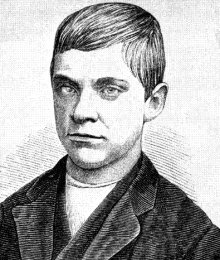

Jesse Pomeroy, young and old.

The doctors noted his lack of remorse or any sympathy for his victims. They believed Jesse would always be dangerous to society. His attorney argued that he should be found not guilty by reason of insanity and then locked away in a mental institution for good.

In the end, the jury convicted him of first-degree murder, for which the mandatory penalty was hanging. However, they issued a recommendation of mercy on account of his youth.

Although juveniles had been executed in the United States before and would be again, the state of Massachusetts had never hanged a boy of fourteen. On the other hand, Jesse had committed no ordinary crimes. By any standard he was a monster. His case was extremely controversial and the governor, William Gaston, was besieged with petitions both for and against clemency.

Gaston didn’t want to hang Jesse Pomeroy and stalled on the issue for as long as he could. It may well have cost him re-election. But his successor, Alexander Rice, didn’t want to hang Jesse either, campaign promises to the contrary.

So in August 1876, two years after Jesse’s murder conviction, by which time the furor in the press had died down, Rice commuted the now-sixteen-year-old’s sentence to life in prison. But there was a catch: the sentence had to be served in solitary confinement.

He would spend 41 years in a tiny cell, isolated from the world. His mother visited him once a month until her death. The only other people he saw were the guards. He was allowed to exercise alone in the prison yard and was allowed to read books. He wrote some bad poetry. Most of his efforts, however, were concentrated on escape. Schechter records:

Nothing — no amount of time locked in a dungeon, no beatings administered with a brass-tipped cane, no efforts at reinforcing his cell — discouraged Jesse for long. When plates of boiler-iron were bolted to his walls to keep him from digging at the stones, he set to work prying loose the bolts. When the walls were painted with a white preparation that would make even a pin-scratch conspicuous, he turned his attention to the floor, cutting loose one of the heavy boards, then digging at the ground underneath … Over the course of fifty years, virtually everything that fell into his hands became a potential implement of escape … He managed, over the decades, to fashion an amazing assortment of tools: awls, chisels, saws, drills, files, pry bars.

He never even came close to breaching the prison walls and his escape attempts mainly just made him a pain in the prison’s collective ass. Then again, a man needs a hobby.

In 1887, his ninth year in the solitary cell, he caused an explosion that blasted a hole in the ceiling and temporarily blinded him but didn’t get him anywhere. Only in 1912 was he ever able to actually make it out of the cell, something that took three years of work to accomplish — and he was caught within minutes. By then he was fifty-two.

His sentence was relaxed in 1917 and he was allowed into the general population. By then, Jesse’s health was failing, and his crimes were passing out of local memory. New inmates to the prison no longer recognized his name, something that deeply upset him. In 1929, he was transferred to the prison farm at Bridgewater. He took a car to get there, his very first automobile ride, but didn’t he didn’t seem interested in his surroundings. One reporter described him as “a deadened creature gazing with lusterless eyes upon a world that means nothing to him.”

He died at the Bridgewater Prison Farm on September 29, 1932, having spent sixty of his seventy-two years behind bars.

On this day..

1835: Captain Pedro Gilbert and the Spanish Pirates

On this date in 1835, four Spanish pirates — it was supposed to be more — were put to death at Boston.

Their captain, the Catalan Pedro Gilbert, was chief among them in death as he was in life. Three years previous, he had commanded the buccaneer schooner with the deceptively cuddly name Panda out of Havana. It’s for Gilbert that “Gilbert’s Bar” is named, a historic sandbar off Stuart, Florida where the man reputedly liked to lure ships aground.*

Gilbert and his crew of forty or so souls — Spaniards, Portuguese, South Americans, half-castes, and at least one west African — waylaid the Salem, Mass. brig Mexican.

After hours ransacking the ship, relieving it of $20,000 in silver, the raiders locked the crew of their prize below decks and put the Mexican to the torch. After the Panda departed, those imprisoned unfortunates managed to break out of the death trap in time to control the blaze and return to port.

The incident thereby reported, the Panda would in due time be cornered off the African coast and sunk by a British ship. A dozen of the salty brigands fished out of the sea were eventually extradited to the U.S. for an eventful fourteen-day trial.


One of the crew of the Mexican, called upon to identify a member of the pirate crew who tried to drown him in a burning ship, strikes the accused corsair.

A defense lawyer laboring mightily in a half-lost cause managed to procure not-guilty verdicts for five of the crew on grounds of superior orders. The cabin boy (15 at the time of the raid) and the aforementioned west African were among these men spared.

The four who hanged today — Pedro Gilbert, Juan Montenegro, Manuel Castillo, and Angel Garcia — were meant to have been seven. Two of the seven received stays of execution; we’ll return to them in a moment.

The other man in the condemned party, Manuel Boyga, cheated his executioner, kind of, by exploiting a guard’s momentary inattentiveness to slash open his own carotid artery with a sharp bit of tin. He bled out too quickly for his executioners to “help” him, but because this efficient (near-?)suicide occurred immediately before the hanging, Boyga’s unconscious form was still borne in a chair to the scaffold and hung along with his four quick mates, just to make sure. Boyga might well have been dead already; if not, the hanging only hastened his demise by moments.

As to the other two: the ship’s carpenter Francisco Ruiz, it was thought, might have been crazy. But the Spanish-speaking physicians who eventually examined him would pronounce his ravings a simulation; he was accordingly hanged in a follow-up execution on September 12, 1835.

The last man was Bernardo de Soto, the first mate and the owner of the Panda.

De Soto’s pretty black-eyed wife back home caught wind of her man’s fate and made the Atlantic crossing to comfort her husband in prison … and to prostrate herself before the U.S. president Andrew Jackson who had the final say for clemency in this federal case. Duly smitten by this pleasing romantic flourish, Jackson did better than merely sparing de Soto’s life: he gave the condemned pirate a free pardon on July 6, 1835.

* Gilbert’s Bar today has the last remaining “House of Refuge”, once one of several standing 19th century encampments built to shelter any wayfarer who shipwrecked in the vicinity.

On this day..

1721: Joseph Hanno, “miserable African”

(Thanks to Meaghan Good of the Charley Project for the guest post. -ed.)

On this date in 1721, Joseph Hanno was hanged in Boston, Massachusetts for the murder of his wife, Nanny.

He’d killed her “in a very barbarous manner” on November 10 the previous year: while she was getting ready for bed, he struck her twice in the head with the blunt end of an ax and then slit her throat. He made a feeble attempt to pass the murder off as a suicide, but the coroner’s jury was not fooled.

“Could Hanno expect a fair trial in a Massachusetts court?” asks Mark S. Weiner in his book Black Trials: Citizenship from the Beginnings of Slavery to the End of Caste.

Perhaps surprisingly, Weiner believes the answer is yes:

In general, free black men received rather even treatment in the New England judicial system, at least at this period … They were entitled to the full range of legal rights, with the important exception of the ability to serve on juries. There also was no marked inequality between the punishments they received and those of white convicts. And though Hanno, in particular, certainly faced hostility and anger in the courtroom, in [Judge Samuel] Sewall, he was facing no irredeemably biased magistrate; in fact, years earlier, Sewall had written the first antislavery pamphlet published in the American Northeast.

Weiner notes that Hanno “had no defense counsel, for at the time the institution was almost unknown.” He may have hoped to beat the rap because there were no witnesses to the murder. But the jury convicted him and the judge pronounced the sentence of death.

Ultimately, Hanno himself admitted his guilt.

Other than her name, nothing is known about the victim in this case. But we know something about the perpetrator because of a sermon preached at the time of his execution and distributed in pamphlet form under the bombastic title of “TREMENDA: The DREADFUL SOUND with which the WICKED are to be THUNDERSTRUCK, Delivered upon the Execution of a MISERABLE AFRICAN for a most inhumane and uncommon MURDER.”

The sermon was promulgated by none other than Cotton Mather, the Puritan minister noted for his role in the Salem witchcraft trials. (Old Cotton really got around the gallows back in his day.)

Hanno had been brought over from Africa on a slave ship as a child and grew up in slavery. He was freed in 1707, when he was about forty years old, and then settled down in Boston with his wife.

He was literate and his masters brought him up as a Christian, and he enjoyed “vain gloriously Quoting of Sentences” from the Bible. Indeed, when Cotton Mather offered spiritual counsel to the condemned, Hanno boasted, “I have a great deal of knowledge. Nobody of my color, in old England or new, has so much.”

Replied the minister (without apparent irony), “I wish you were less puffed up with it.”

Hanno himself seems to have subscribed to the “slippery slope” theory of criminality. A newspaper account of his execution says he

hoped that all Mankind would take warning by him to keep themselves from committing such Sin & Wickedness as he was guilty of, particularly, Sabbath-breaking and willful Murder, the one being the Ringleader to the other, for which last he was justly Condemned, which had he not been guilty of the first he might probably have never committed the second.

An aside: although he may have been the only person executed that day, Joseph Hanno didn’t stand alone on the gallows.

At the same time a white woman did public penance on the same gallows. Her crime: giving birth to a child of mixed race. This being considered the lowest depth of self-degradation (especially if the father was a Negro), the woman was made to sit on the gallows with a noose around her neck — a sign of extreme disgrace. Then she was whipped through the streets until her back was raw. (Source)

On this day..

1898: Alfred C. Williams

(Thanks for the guest post to Robert Wilhelm, author of the Murder By Gaslight historic crime blog, and author of the book Murder And Mayhem in Essex County. Executed Today readers are sure to enjoy Wilhelm’s detailed investigations into long-lost historic crime. -ed.)

When Alfred C. Williams was arrested for the murder of John Gallo, his conviction seemed highly unlikely. There appeared to be no direct link between Williams and Gallo. There was no absolute proof that Gallo had been murdered, or even that he was dead. But in this case, circumstantial evidence, rather than increasing doubt, actually succeeded in dispelling doubt, bringing investigators closer to the truth and drawing the noose ever tighter around Alfred Williams’s neck.

John Gallo was a young Italian immigrant who worked on a farm in Lynnfield, Massachusetts. He was industrious and popular with the other workers, but kept to himself and very seldom left the farm. Gallo lived alone in a small shack in the rear of the farm. In the early hours of July 28, 1897, the shack caught fire and burned with flames so high they could be seen in neighboring towns. The shack was leveled, leaving nothing but ashes and the charred remains of a body, so badly burned that it could not be identified.

The body was so charred that it took two examinations to verify that it was, in fact, the body of a human. The head and neck were gone, both arms and both legs had been completely consumed, bone and all, by the fire. The spinal column remained with some back muscle attached; the heart, liver, kidneys, and bladders remained, but were badly burned. Everything else was completely gone. The medical examiner could state that the body was that of an adult human being, but nothing more.

With the destruction so complete, it appeared to investigators that nothing could be learned to explain what had happened that night. But as the investigation progressed, details began to emerge, like an image developing on a photographic plate. The fact that there was too little information became a clue in itself, and soon investigators were able to compile a list of facts that pointed to foul play:

  1. The body had been destroyed to a greater extent than would be expected from a fire in such a small building.
  2. The deceased had not been burned in bed. The bedsprings had survived the blaze but the body was found several feet away.
  3. The victim had not been dressed. Some buckles, metal buttons, a few coins and the clasp of a pocketbook were found by the side of the bedsprings, none were found near the body.
  4. The body lay in the doorway between rooms with the head back in the room toward the bed, not falling forward as a person naturally would if trying to escape from a burning room.
  5. A kerosene-oil can, which was usually kept near the stove, was found in the middle of the floor
    next to the body.

It was believed that the victim had been murdered before the fire started. His body was doused with kerosene and ignited, which would account for the severe damage to the body. The flame then quickly spread to the rest of the house.

John Gallo had earned $1.50 a day at Phillips’s farm and was paid monthly, always in five dollar bills. He spent very little and at the time of his death, it was suspected that he had around one hundred dollars earned on the farm. It was also well known that Gallo always carried three twenty dollar gold pieces that he had earned on a construction job prior to coming to the farm. No trace of the gold pieces or any melted gold were found.

Another crime had allegedly been committed near Lynnfield in the early morning of July 28. That afternoon, Alfred C. Williams reported that he had been held up near his rooming house in Wakefield. He had been unable to sleep and went outside to smoke a cigar. As he stood with one foot on the rail fence by the road, someone struck him on the head from behind. He turned to fight back, striking his assailant on the nose causing it to bleed. He was knocked unconscious, robbed of his watch and a small amount of money, and then thrown down the banks of Wakefield Pond.

He told his story to the police, showing them bruises on his neck and face from the fight, and bloodstains on his clothing from the assailant’s nose. The officers were skeptical of his story and held Williams for questioning. Unlike most holdups, Williams apparently had more money in his possession after the crime than he did before. On July 27, Williams had not had enough money to buy a meal or even pay a five-cent streetcar fare. The morning of July 28, he paid his back board bill and made some purchases. The police found seventy-five dollars, in five dollar bills, on his person.

The police learned that Williams had previously worked as a laborer on Phillips farm and knew the habits of the deceased. They searched Williams’s room and under the carpet, they found two twenty dollar gold pieces. When Williams was told where they found the coins he responded, “I know, I put them there.” They also found a bloodstained coat and vest in his room. Alfred C. Williams was arrested for the murder of John Gallo.

At the trial, the prosecution presented a case against Williams that was based entirely on circumstantial evidence. While there was nothing to directly link Williams to the fire, his familiarity with Gallo’s habits, his possession of money — including gold pieces — the day after the fire, the bloody clothing, and Williams’s inconsistent stories, taken all together were incriminating.

The defense challenged the very core of the evidence. There was no proof that the body found in the ashes was John Gallo’s; it could not be proven that a murder was committed or that the fire was not started accidentally; there was no proof that Alfred Williams was anywhere near the fire that night. But Williams was sticking to the story that he was held up on the night of July 28, so his alibi was also a matter of circumstantial evidence, and no one seemed willing to believe it. The jury deliberated for six hours before returning a verdict of guilty, first degree murder.

Alfred C. Williams was hanged in the yard of Salem jail on October 7, 1898. It was not a public hanging; the sheriff issued a few invitations, but only for the purpose of providing legal witnesses. Williams’s arms and legs were bound and his head was covered as he stood on the gallows. At 10:01 a.m. the trap was sprung and Williams dropped six feet, one inch. His neck was broken and he died within seconds. Williams professed innocence to the end.

Get Murder and Mayhem in Essex County here.

On this day..

1637: William Schooler and John Williams

(Thanks for the guest post to Robert Wilhelm, author of the Murder By Gaslight historic crime blog, and of the book Murder And Mayhem in Essex County. Executed Today readers are sure to enjoy Wilhelm’s detailed investigations into long-lost historic crime. -ed.)

On September 28, 1637, two men convicted on separate counts of murder in the Puritan colony north of Boston — in what is now Essex County — were executed on the same gallows. The first was William Schooler, convicted a year earlier of killing Mary Scholy on the path to Pascataquack; the second was John Williams convicted of killing John Hoddy near Great Pond in Wenham.


Original (c) image from Murder And Mayhem in Essex County, used with permission.

In the autumn of 1636, an Agawam Indian walking through the Winnacunnet woods, north of the town of Newbury, found the body of a young white woman, lying in a thick swamp about three miles north of the Merrimack river. From the condition of the body, he could tell that the woman had been dead for several months. She lay naked, with her clothing still in a pile not far from the body. The Indian took the news to Newbury, and led the Englishmen to the spot so they could see for themselves.

The woman’s name was Mary Sholy. She was identified more by the circumstance than by appearance, since the flesh had begun to rot. Mary had left Newbury several months earlier, traveling north to her home at the English settlement at Pascataquack. The people of Newbury were also fairly certain who had killed her; they believed she had been ravished and murdered by the man she had hired to guide her journey home, an outsider named William Schooler.

In London, England, William Schooler had been a vintner with intemperate habits. Schooler was, by his own admission, a common adulterer. After wounding a man in a duel he fled to Holland to escape the law; then, leaving his wife behind, he traveled to New England. In 1636 he was living in a shack by the Merrimack River within the limits of Newbury but outside the boundaries of sanctioned Christian behavior.

Mary Sholy, a servant girl, was looking for someone to guide her to Pascataquack, to return to her master. Pascataquack — now Portsmouth, New Hampshire — was a small settlement, about twenty-three miles north of Newbury. It is not known why Mary Sholy had come to Newbury; it is unlikely that her master would have sent her there without providing a guide back. The journey from Newbury to Pascataquack would have been too perilous for a young woman to take alone, first crossing the Merrimack River in a canoe, then following the route to Pascataquack, which was described as little more than a path through the woods. In 1636, even the well-traveled path between Ipswich and Newbury was too narrow for a horse cart. In addition to the possibility of losing her way and becoming hopelessly lost in the woods between the two settlements, there was a very real danger of being attacked by wild animals or hostile Indians.

Seeing an opportunity to make a little money, William Schooler sought out Mary and offered to guide her home for fifteen shillings. He did not tell her that he himself had never made the trip to Pascataquack before. Two days after their departure, William Schooler was back in Newbury alone. When asked why he had returned so soon Schooler replied that he had guided Mary to within two or three miles of Pascataquack, where she stopped, saying she would go no further. Schooler left her there and returned to Newbury.

The people of Newbury remained suspicious and Schooler was questioned by the magistrates in Ipswich. When he returned from the trip he had blood on his hat and a scratch on his nose the “breadth of a small nail.” He explained that the blood was from a pigeon he had killed and the scratch on his nose was from walking into some brambles. He was released, as there was no evidence then that a crime had been committed.

The following year the Pequod tribe took up arms against the English colonists and Schooler was drafted to serve in the militia. He deemed this service to be an oppression and publicly spoke out against it. His outspoken opposition was considered “mutinous and disorderly,” and the governor issued a warrant against him. When he was arrested, Schooler assumed it was about Mary Sholy and began to vehemently defend himself against the charge of her murder. Schooler;s behavior made the magistrates suspicious and, since they now knew Mary Sholy had been murdered, they decided to reopen the case.

Newbury residents who knew him came forward to volunteer information on Schooler’s character. In a Puritan court the character of the accused was as important as the physical evidence against him.

Schooler denied that he murdered Mary Sholy but the jury found him guilty and he was sentenced to hang. The court and the clergy tried desperately to persuade Schooler to confess but he would not. Schooler was contrite, saying he had told many lies to excuse himself, but vehemently denied that he had killed or ravished Mary Sholy. Some ministers argued that the evidence against him was not sufficient to take away his life, but Governor Winthrop denied Scholler a reprieve, saying: “but the court held him worthy of death, in undertaking the charge of a shiftless maid, and leaving her (when he might have done otherwise) in such a place, as he knew she must needs parish, if not preserved by means unknown.”


John Williams was a ship carpenter who had recently come to America from England. In 1637, he was in prison in Boston for theft. Williams and another prisoner, John Hoddy, escaped from the jail and traveled north. They had gone beyond Salem and were on the road to Ipswich, on the east end of the Wenham Great Pond when they had a falling out. The two men had a fight that ended with the death of John Hoddy.

There are two versions of what happened next. In one story John Hoddy’s dog held Williams at bay until the noise drew the attention of enough residents of Wenham to apprehend Williams and take him to jail in Ipswich. The more likely story says that Williams took everything belonging to Hoddy, including his clothes, and buried his body under a pile of stones. Williams proceeded to Ipswich where he was apprehended, after having been recognized as a criminal. Though his clothes were bloody when arrested, he would confess to nothing until a week later, when the body of John Hoddy was found. Cows at a farm near Great Pond smelled the blood and made such a “roaring” that they got the attention of the cow keeper, who on investigation found Hoddy’s naked body under a heap of stones.

Around the same time the justice of the peace in Ipswich learned that both Williams and Hoddy were escaped prisoners. Williams was indicted for the murder of John Hoddy and tried by the Court of Assistants in Boston. Though he confessed to the murder, the court insisted on enforcing Williams’s right to due process, and tried the case before a jury. Williams was, of course, found guilty and sentenced to death.

The double hanging, on September 28, 1637, took place on Boston Common, where all executions in the Massachusetts Bay Colony were held.

Get Murder and Mayhem in Essex County here.

On this day..

1735: Patience Boston, converted

On this date in 1735, a truculent indentured servant with a name like a primetime drama was hanged in York, Maine (at that time part of the Massachusetts colony), for killing her master’s grandson.

Patience Boston had cut a hard-partying, hard-drinking swath from her teen years to her execution at age 23, leading a succession of masters to dump her contract on whomever would take it. Early American Crime tracks her rowdy career, “mad and furious in my Drink, speaking dreadful Words, and wishing bad Wishes to my self and others” through a succession of fights, adulteries, dead infants (which she didn’t kill), a nonexistent infant (which she claimed to have killed).

All this draws upon a lengthy “Faithful Narrative of the Wicked Life and Remarkable Conversion of Patience Boston alias Samson” published three years after the woman’s death by her ministers Samuel and Joseph Moody (more on them in a bit). In it, “Patience” relates in a first-person voice* the real murder she finally did commit.

From some groundless Prejudice which I had taken against my Master, to whom I was sold by Mr. Bailey, I did last Fall bind my self by a wicked Oath that I would kill that Child, though I seem’d to love him, and he me; which is an Aggravation of my bloody Cruelty to him. Having solemnly sworn that I would be the Death of the Child, I was so far from repenting of it, that I thought I was obliged to fulfil it. And I often renewed my Resolution when I had been in Drink, and made my Master angry, that to be revenged on him, I might Murder his Grand-Child, of which I thought he was very fond, having bro’t him up from his Infancy. I would have killed my Master himself, if I could have done it; and had Thoughts of putting Poison into his Victuals, if I could have got any. But when the Time came for me to be left under the prevailing Power of Satan’s Temptations; I took the Opportunity of my Master and Mistress being from Home, and both his Sons also abroad; that the Child and I were left alone. The Evening before I had been contriving to burn the Barn, but was prevented: I had also once before drawn the Child into the Woods with me, designing to knock him on the Head, and got a great Stick for the same Purpose; but as I was going to lift it up, I fell a trembling, from a sense of God’s Eye upon me; so that I had not Power to strike. — But now, as I was going to say, when the Time was come to fill up the Measure of my Iniquity; I went to the Well and threw the Pole in, that I might have an Excuse to draw the Boy to the Well, which having done, I asked his Help to get up the Pole, that I might push him in, which having done, I took a longer Pole, and thrust him down under the Water, till he was drowned. When I saw he was dead, I lifted up my Hands with my Eyes towards Heaven, speaking after this Manner, Now am I guilty of Murder indeed; though formerly I accused my self falsly, yet now has God left me &c. And it seemed as if the Ground where I went was cursed for my sake, and I thought God would not suffer me to escape his righteous Vengeance. I went forthwith, and informed the Authority, and when the jury sat on the Body, I was ordered to touch it: This terrified me, lest the Blood should come forth, to be a Witness against me; and I then resolved in my Heart, that I would be a Witness against my self, and never deny my Guilt; so I tho’t God would not suffer the Child to bleed; then I laid my Hand on it’s Face, but no Blood appeared. Yet after this, I would fain have covered my Sin in Part, as if the Child had of himself fallen into the Well, and I was tempted to thrust him down under the Water. After the Jury had bro’t in wilful Murder, I was sent to Prison, but got Drunk by the Way, having little Sense of my dreadful Case; yet my Temptation in Part was to drink that I might forget my Sorrow.

Patience would need her namesake virtue, since she had the best part of a year to wait before the Supreme Court could gavel in a session to hear her case — a case where she would plead guilty and embrace the certain sentence.

In the meantime, we get to the real meat of the Moody pamphlet: our murderess’ conversion.

Allowing even for the interlocution of her reverend ministers, it presents a moving portrait of a genuine spiritual experience during the “Great Awakening” of religious revival. The narrative’s latter half tracks the doomed woman’s refinements of conscience, of fear, of religious comfort and joy in God — all as she grapples with her conduct and her fate.** “How are we condemned by the Covenant of Works,” Patience remarks, “and relieved by the Covenant of Grace.”


Now … as for this clan Moody that supplies our day’s post.

Samuel Moody, the father, had nudged young Joseph into the ministry business in York. Both men appear to have ministered to Patience Boston.

In 1738, the same time they were readying all this text about “rejoyc[ing], though with trembling” the younger Moody began a bizarre practice: he took to shrouding his face with a handkerchief.

In boring reality, this seems to have been occasioned by a breakdown caused by the sudden death of his wife in childbirth, a breakdown from which Moody recovered over the succeeding months.

In the much spicier legendary embellishment that developed, however, Moody was thought to have kept this veil for the balance of his life: he would present himself in this state, it is said, to his own congregation, turning his back on the multitude so that he could lift the veil to read a sermon, and likewise sitting face to corner when he should eat in public.

In this version, Moody is supposed to have confessed on his deathbed to having shrunk from men in his own spiritual torment over having accidentally killed a childhood friend while hunting, a killing that had been popularly ascribed to Indians and therefore unpunished save by the scourge of conscience. Nathaniel Hawthorne mined this irresistible New England folklore for his short story “The Minister’s Veil”.

“Tremble also at each other! Have men avoided me, and women shown no pity, and children screamed and fled, only for my black veil? What, but the mystery which it obscurely typifies, has made this piece of crape so awful? When the friend shows his inmost heart to his friend; the lover to his best beloved; when man does not vainly shrink from the eye of his Creator, loathsomely treasuring up the secret of his sin; then deem me a monster, for the symbol beneath which I have lived, and die! I look around me, and, lo! on every visage a Black Veil!”

-Hawthorne’s “Reverend Hooper”

* “It must be confessed,” the Moodies gamely preface their text, “that it could not be exactly taken in her own Way of expressing her self” so long after her death. But they gave it their best shot, and “here is nothing false or feigned.”

** The Faithful Narrative takes special note of the impression made on our subject by “the Case of the Prisoners at Boston, especially when the Day came for their Execution”. Although the text here refers to “three Malefactors”, there’s no 1734-1735 triple execution recorded in the Espy files; I believe the event intended here is the October 1734 double hanging of Matthew Cushing and John Ormsby.

On this day..

1693: Elizabeth Emerson

(Thanks for the guest post to Robert Wilhelm of the Murder By Gaslight historic crime blog, and author of the book Murder And Mayhem in Essex County. Executed Today readers are sure to enjoy Wilhelm’s detailed investigations into long-lost historic crime. -ed.)

The Emersons of Haverhill, Massachusetts, were the kind of family that just could not stay out of trouble. Death was a common feature in the Emerson household; only nine of their fifteen children survived infancy. Michael Emerson’s first child, Hannah, would marry Thomas Duston and, become famous for escaping Indian captivity by murdering and scalping ten of her captors.

The sixth child was a daughter named Elizabeth, born in 1664. Twelve years later, Michael was brought to court “for cruel and excessive beating of his daughter with a flail swingle and for kicking her, and was fined and bound to good behavior.” Corporal punishment was not considered wrong in and of itself, but Michael’s beating of Elizabeth was criminally excessive. There is no way to know why Elizabeth was being punished, but the impression is, that she was a rambunctious, strong-willed child living in a violent household.

Another of Elizabeth’s sisters, Mary Emerson, was married in 1683 to Hugh Mathews of Newbury. Though there is no record of premature offspring, Hugh and Mary were both brought to court and found guilty of fornication before marriage. They were sentenced to be “fined or severely whipped.”

Perhaps with her sister as an example, Elizabeth also engaged in premarital sex. In 1686, Elizabeth Emerson gave birth to an illegitimate daughter she named Dorothy. It is not clear whether Elizabeth was ever punished for this, but court records indicate that Michael Emerson accused a neighbor, Timothy Swan, of being the father. Timothy’s father, Robert Swan, vehemently denied that Timothy was the father because he “… had charged him not to go into that wicked house and his son had obeyed and furthermore his son could not abide the jade.” He further threatened to “carry the case to Boston” if Timothy was formally accused. Michael did not pursue the charges and little Dorothy remained fatherless.

Five years later, with Elizabeth and her daughter still living at her parents’ house, Elizabeth became pregnant again. She somehow managed to keep this a secret from her parents, but the neighbors were suspicious. Sometime during the night of May 7, 1691, Elizabeth, who slept at the foot of the bed where her mother and father slept, gave birth to twins without waking her parents. The twins were either stillborn or murdered by their mother. She hid the bodies in a trunk for three days then sewed them into a sack and buried them in the backyard.

The following Sunday, while her parents were at church, the neighbors who had suspected Elizabeth’s pregnancy, came to the house with a warrant from the magistrates of Haverhill. While the women examined Elizabeth, the men went to the backyard and found the bodies buried in a shallow grave. Elizabeth was arrested for murdering her bastard infants.

Elizabeth maintained that she had kept the pregnancy and birth a secret out of fear. Her mother had been suspicious, but whenever asked about it, Elizabeth denied she was pregnant. Michael claimed he had no idea that Elizabeth was pregnant but this time put the blame on Samuel Ladd, age 42, a married man, nine years older than Elizabeth. Elizabeth also named Samuel Ladd as the father, saying that the “begetting” had taken place at an inn house. She also stated that Ladd was the only man with whom she had ever slept, implying that Dorothy was Ladd’s daughter as well.

Although Samuel Ladd had been previously found guilty of a misdemeanor and fined for an earlier episode involving sexual advances on a younger woman, Ladd was never questioned in Elizabeth Emerson’s case. Elizabeth was already the mother of a bastard child, and Samuel Ladd was the son of an early settler — her story was not believed.

Elizabeth Emerson was sentenced to hang and remanded to the custody of the Boston prison on May 13, 1691. An accompanying letter explained the facts and said that she had been examined for “whore-dom.” By English law, concealment of the death of a bastard child had been punishable by execution. Though this law had been repealed in England, it was still on the books in Massachusetts. It did not matter whether Elizabeth Emerson had murdered her babies or merely concealed their death — she would be hanged.

The hanging was scheduled for 1693. Elizabeth was imprisoned during the height of the Salem witch trials, and though he played an active role in the trials, Reverend Cotton Mather found time to take an interest in her case. Mather worked on her soul and before her execution Elizabeth confessed that “when they were born, I was not unsensible, that at least one of them was alive; but such a Wretch was I, as to use a Murderous Carriage towards them, in the place where I lay, on purpose to dispatch them out of the World.” But Mather believed she had more to confess and held little hope for her salvation.

Elizabeth Emerson was hanged in Boston on June 8, 1693, along with a black indentured servant named Grace. Before the execution Cotton Mather preached a sermon during which he read the following declaration written by Elizabeth:

I am a Miserable Sinner; and I have Justly Provoked the Holy God to leave me unto that Folly of my own Heart, for which I am now Condemned to Dy … I believe, the chief thing that hath, brought me, into my present Condition, is my Disobedience to my Parents: I despised all their Godly Counsils and Reproofs; and I was always an Haughty and Stubborn Spirit. So that now I am become a dreadful Instance of the Curs of God belonging to Disobedient Children.

Get Murder and Mayhem in Essex County here.

On this day..

1788: Archibald Taylor, but not Joseph Taylor

On this date in 1788, two highwaymen were hanged at Boston Neck: Archibald Taylor, and Joseph Taylor.*

According to a letter later published purporting to be from that Joseph Taylor, however, he and a sympathetic doctor actually engineered one of the most amazing scaffold escapes on record. It all got started when Joseph Taylor found his fellow-condemned Archibald in high spirits one day on death row.

I never, even after my condemnation, realized that I was suddenly to die in so awful a manner, until a gentleman, who I afterwards found was a doctor, came and talked privately with the late unhappy sufferer, and my fellow convict, Archibald Taylor, who, when the gentleman was gone, came to me with money in his hand, and so smiling a countenance, that I thought he had received it in charity. But he soon undeceived me, telling me with an air of gaiety, that it was the price of his body.

This doctor dropped was doing the workaday ghoulishness of procuring imminent corpses for medical cadavers.

Such practices were still highly taboo, viscerally shocking in this case to Joseph Taylor:

This was the first time since my condemnation that I thought what it was to die. The shock was terrible, and Taylor increased it, saying that the doctor had desired him to bargain with me for my body also. The thoughts of my bones not being permitted to remain in the grave in peace, and my body, which my poor mother had so oten caressed and dandled on her knee, and wich had been so pampered by my friends in my better days, being slashed and mangled by the doctors, was too much for me. I had been deaf to the pious exhortations of the priests; but now my conscience was awakened, and hell seemed indeed to yawn for me.

What a night of horror was the next night! — When the doctor came in the morning to bargain for my body, I was in a cold sweat; my knees smote together, and my tongue seemed to cleave to the roof of my mouth.

According to the letter, the doctor “perceived the agony of my soul” and in the conversation as it unfolded agreed to try to help Joseph Taylor survive the hanging — advising him, in order to “not dislocate the Vertebrae of the Neck,” to “Work the Knot behind your Neck and Press your Throat upon the Halter which will prevent the Necks breaking and likewise the Compression of the Jugular and preserve the circulations in some degree.” (This is actually sound advice in case you ever find yourself about to be hanged in the 18th century.)

And the doctor — remember, he was only there in the first place to get his hands on some raw materials that he could autopsy the day after the hanging — even agreed to receive the “body” in secret from Taylor’s confederates and try to restore it to life.

This bit is essential to the narrative, but the skeptical reader can’t help but doubt. What an enormous and unprofitable risk for the unnamed physician to take on behalf of a slab of meat!

I want to propose (and this is too delicious to be anything better than baseless speculation) a false-flag operation on behalf of the medical profession, which just days before the Taylors’ hanging had suffered an astounding public relations debacle. Obnoxious Manhattan medical students had wantonly displayed severed limbs from one of their subjects to schoolboys, whose frightened reports of it ultimately set off the “Doctors Mob”.

Ordinary people hated and feared anatomization, and resented “resurrection men” who stole corpses (sometimes made corpses) for the industry. The mob smashed up the hospital, thrashed the med students, and made off with the human remains.

This is the idiom for Joseph Taylor’s revulsion at being propositioned with the body trade. Although it nevertheless turned out to be his path to salvation, it is evident in his remarks that even then, something in Taylor himself rebels at the coldly utilitarian use to which he himself must put his flesh and bones, and his consequent “reliance on the doctor”, as inimical to the interests of his soul.

The state of my mind after my conversation with the doctor, until the day of execution, it is impossible for me to describe. This glimpse of hope, this mere chance of escaping the jaws of death, and of avoiding the eyes of an offended Judge, at whose bar I was no ways prepared to appear, semed to render my mind but more distracted. I sometimes indulged myself with the thoughts of being recovered t life; and as I had fortunately concealed my real name, that I might return, like the Prodigal, to my parents, and live a life devoted to God and their comfort. But I oftener feared the means might fail to bring me to life: and then I wished that this scheme had never been mentioned, as the hopes of life seemed to prevent my conversion; and then, to be surprised into another world, totally unprepared, how terrible!

According to the writer, the arrival of execution day wonderfully concentrated the mind on its big plan and put those pesky qualms of conscience to rest.

Walking out to the gallows with a case of stagefright — he was worried that his demeanor as he thought about worldly subterfuge rather than spiritual salvation would give away the game — Taylor nonetheless

preserved my presence of mind; and when the halter was fastened, remembered the doctor’s directions, and while the prayer was making I kept gently turning my head so as to bring the knot on the back of my neck … When the trap fell I had all my senses about me; and though I have no remembrance of hearing any sounds among the people, yet I believe I did not lose my sense until some minutes after. My first feelings after the shock of falling was a violent strangling and oppression for want of breath: this soon gave way to a pain in my eyes, which seemed to be burned by two balls of fire which appeared before them, which seemed to dart on and off like lightning; settling ever and anon upon my shoulders as if they weighed ten hundred tons; and after one terrible flash, in which the two balls seemed to join in one, I sunk away without pain, like one falling to sleep. [compare to this account from a survived hanging. -ed.]

As promised, his buddies got hold of the body and spirited it away to the doctor. After the application of a conveniently unreported treatment, Joseph Taylor quickened back to life two hours and forty-three minutes after he had been “turned off” with the knot at the back of his neck. The reawakening — “I cannot describe the intolerable agony of that moment. Ten thousand stranglings are trifling to it!” — was no more pleasant than the passing had been.


Now … is this account true? In the completely unverifiable and also completely sensational version that circulated (quite widely) in periodicals on both sides of the Atlantic, Taylor completed his escape by sailing for the Old World, disappearing thence into obscurity.

However, according to another, killjoy newspaper (Western Star, Feb. 2, 1790) some early-American Mythbusters team got wind of this popular fable and went to dig up Joe Taylor’s alleged grave — finding the highwayman securely taking his dirt nap after all.

That may be so, but the reader will kindly observe that two-plus centuries on, nobody’s posting anything about Archibald Taylor.

* No relation between the two Taylors, to judge by the indifferent way Joseph writes about Archibald.

On this day..

1674: Benjamin Gourd, the last bestiality execution

On this date in 1674, Benjamin Gourd (or Goad) was hanged for bestiality in Puritan Massachusetts.

Six New England colonists (pdf) had died for bestiality up through 1662, but the sentence was falling out of fashion.

Gourd, caught having his way with a mare “at noon day in an open yard” and within sight of the gallows, has the distinction of being the last colonist of the future United States put to death for fauna-philia. And even the jury that sentenced him was noticeably reluctant about dooming the 17-year-old.

Well, preacher Samuel Danforth wasn’t going to have any of this ungodly backsliding on Gourd’s ungodly backsliding.

Danforth’s The Cry of Sodom Enquired Into; Upon Occasion of the Arraignment and Condemnation of Benjamin Goad, for His Prodigious Villany (that’s a pdf of the full spiel; here’s a Cliff Notes version) is regarded as the first published “execution sermon” in American history.

the Earth groans under the burthen of such Wickedness. You pity his Youth and tender years, but I pray pity the holy Law of God, which is shamefully violated; pity the glorious Name of God, which is horribly profaned; pity the Land, which is fearfully polluted and defiled.

We think Corey Robin will recognize Danforth’s indictment of the youth’s “licentious liberty” obtained in defiance of an unnamed Master as the root of all his ruin, and any American with an AM radio dial will recognize the rest.

Being at length, by the good hand of God, brought under the Yoke of Government and Service, (which might have bridled and restrained him from such wickedness) he violently brake away from his Master, and with an high hand boldly and impudently, like a childe of Belial, shook off that Yoke of God, casting reproach and disgrace upon his Master. Having now obtained a licentious liberty, he grew so impudent in his wickedness, as to commit this horrid Villany in the sight of the Sun, and in the open field, even at Noon-day; proclaiming his sin like Sodom. Though he be a Youth in respect of years, yet he is grown old in wickedness, and ripe for Vengeance.

On this day..

1644: Mary Latham and James Britton, adulterous lovers

One James Britton, a man ill affected both to our church discipline and civil government, and one Mary Latham, a proper young woman about 18 years of age, whose father was a godly man and had brought her up well, were condemned to die for adultery, upon a law formerly made and published in print.

It was thus occasioned and discovered. This woman, being rejected by a young man whom she had an affection unto, vowed she would marry the next that came to her, and accordingly, against her friends’ minds, she matched with an ancient man who had neither honesty nor ability, and one whom she had no affection unto.

Whereupon, soon after she was married, divers young men solicited her chastity, and drawing her into bad company, and giving her wine and other gifts, easily prevailed with her, and among others this Britton. But God smiting him with a deadly palsy and fearful horror of conscience withal, he could not keep secret, but discovered this, and other the like with other women, and was forced to acknowledge the justice of God in that having often called others fools, etc., for confessing against themselves, he was now forced to do the like. The woman dwelt now in Plymouth patent, and one of the magistrates there, hearing she was detected, etc., sent her to us.

Upon her examination, she confessed he did attempt the fact but did not commit it, and witness was produced that testified (which they both confessed) that in the evening of a day of humiliation through the country for England, etc., a company met at Britton’s and there continued drinking sack, etc., till late in the night, and then Britton and the woman were seen upon the ground together, a little from the house. It was reported also that she did frequently abuse her husband, setting a knife to his breast and threatening to kill him, calling him old rogue and cuckold, and said she would make him wear horns as big as a bull. And yet some of the magistrates thought the evidence not sufficient against her, because there were not two direct witnesses; but the jury cast her, and then she confessed the fact, and accused twelve others, whereof two were married men. Five of these were apprehended and committed, (the rest were gone,) but denying it, and there being no other witness against them than the testimony of a condemned person, there could be no proceeding against them.

The woman proved very penitent, and had deep apprehension of the foulness of her sin, and at length attained to hope of pardon by the blood of Christ, and was willing to die in satisfaction to justice. The man also was very much cast down for his sins, but was loth to die, and petitioned the general court for his life, but they would not grant it, though some of the magistrates spake much for it; and questioned the letter whether adultery was death by God’s law now.* This Britton had been a professor in England, but coming hither he opposed our church government, etc., and grew dissolute, losing both power and profession of godliness.

March 21 [1643/44*]. They were both executed, they both died very penitently, especially the woman, who had some comfortable hope of pardon of her sin, and gave good exhortation to all young maids to be obedient to their parents, and to take heed of evil company, etc.

John Winthrop‘s journals, specifically this volume

While Puritan courts were certainly known to execute for sexual transgressions, Mary and James appear to be the only documented case in the history of [what is now] the United States of an outright execution for adultery.**

The crime and the setting inevitably call to mind Nathaniel Hawthorne’s The Scarlet Letter, and indeed he would likely have known about this case from Winthrop’s journals.

There are, however, even more compelling parallel cases — which, if they do not end on the scaffold, are at least as dramatic from the standpoint of posterity.

The case of the woman branded for adultery first appeared in the records of York, in what is now Maine. Dated 15 October 1651, the entry reads:

We do present George Rogers for, & Mary Batchellor the wife of Mr. Steven Batcheller minister for adultery. It is ordered by ye Court yt George Rogers for his adultery with mis Batcheller shall forthwith have fourty stripes save one upon the bare skine given him: It is ordered yt mis Batcheller for her adultery shall receive 40 stroakes save one at ye First Towne meeting held at Kittery, 6 weekes after her delivery & be branded with the letter A.”

Beside that entry, written in the same hand, is the notation, “Execution Done.” It appears that Charles Edward Banks, in his History of York, Maine (1935), recognized the connection between Hawthorne’s novel and this case, for he refers to Mary Batchellor’s branding in a section titled “The Scarlet Letter.”

… the similarities between Hester Prynne and Mary Batchellor are so outstanding that is is tempting to argue for a direct source. For example, Mary Batchellor’s adultery is the only known case involving a child that can be linked to Hester’s plight. By postponing execution of the sentence until six weeks after Mrs. Batchellor’s delivery, the officials of York obviously considered the health of the unborn child. Hawthorne suggests a similar delay in the novel, for when Hester and Pearl appear in the opening scaffold scene, Pearl is “some three months old”.

It’s rather interesting to notice that in Latham and Britton’s case, even the judges who ultimately sentenced the lovers to die were overtly reluctant about doing so: the subtext of Winthrop’s narrative suggests to this reader that, had the pair not confessed, everyone would have been more than happy to use the “two witnesses” loophole to avoid noosing a concupiscent teenager stuck in a barren marriage. Whatever our caricature of them, Puritan elites too had some sense of proportionality about these things.

Even in Hawthorne, where the protagonist is punished only with public shaming, one of the crowd complains,

“This woman has brought shame upon us all, and ought to die. Is there not law for it? Truly, there is, both in the Scripture and the statute-book. Then let the magistrates, who have made it of no effect, thank themselves if their won wives and daughters go astray.”

And they have, ever since.

Thanks to Laura James of the (alas) dormant true-crime blog CLEWS for bringing this case to our attention.

* 1643/44: England was observing the legal new year on March 25 at this point.

** See the Espy file.

On this day..