1817: James Lane

I was born near Goshen, in the state of Connecticut, about the year 1793. My father was a show-man, and his business leading him much from home, I was neglected, and suffered to follow my own inclinations … I chose for my companions the most vicious boys, and spent most of my time in quarrelling, fighting, sabbath-breaking, and other vices. I was indeed sent to school a short time; but, disliking restraint and study, made but little progress in learning. Thus by parental neglect on the one hand, and bad example on the other, were sown those seeds of vice, which, as will be seen in my narrative, produced such a dreadful harvest of crimes.

-From the Narrative of the life of James Lane: who was executed at Gallipolis (Ohio), September 9, 1817, for the murder of William Dowell, with some observations on his behaviour under condemnation : to which is added the address of the court, on pronouncing sentence of death upon the prisoner.

The gallows narrative commenced thereby will arrive on this date in 1817 at a hangman’s tree in Ohio. But it begins, as is customary, delving into the miscreant’s youthful forays into theft, through which he soon “stifled the voice of conscience, which cried against it.” He suffered 10 lashes at the public whipping-post of Litchfield for robbing a schoolhouse of books, and had a couple of close brushes for his habit of walking into unattended farm houses and making off with clothes.

The War of 1812 gave Lane the opportunity to mend his ways, or at least collect enlistment bonuses, which he did on at least three occasions. Being caught in desertion attempts one time, Lane was “sentenced to be cobbed two mornings, fifteen strokes each time. This mode of punishment is very severe. It is performed by laying the offender across a barrel, and whipping him with rods. Five or six others suffered the same punishment with me, some of them much worse than I.”

At last, following more successful desertions, he found his way up the Hudson to

Catskill, [where] I fell in with one Church, as hardened as desperate as myself. We formed an acquaintance with each other, and travelled together to a place near the city of New York. Here we went into a store to buy some small article; and the store keeper suspecting our money to be bad, I flew into a violent passion, snatched the watch from his pocket, and stamped it under my feet. Church then seized a scythe and drove him out of the door. We then locked ourselves in and in spite of the danger which threatened us, ate and drank our fill of the good things we found. By this time, a number of people had assembled in the chamber over our heads, and were making their way down the trap door to take us. Hardened, insensible, and enraged with liquor and passion as we then were, it would have been no wonder if we had put fire to some barrels of powder there. This we might easily have done; but either did not think of it at the time, or were prevented by some other circumstance. I thank God for preventing this dreadful crime; for preserving my life and the lives of so many people as would have been thus destroyed, and giving me a space for repentance.


But it seems so idyllic in Thomas Cole’s 1833 “Catskill Scenery”.

They got a three-year sentence in the penitentiary for this brazen raid, and Lane piously averred that “the time spent there was the happiest of my life.”

“But such deep rooted habits as ours are not to be cured by a few years of confinement,” the narrator continues, rubbishing the penitentiary movement without which he might have been hanged already. “No sooner were we at liberty, than we betook ourselves to our old course of life.”

The old confederates burgled in Albany, then wandered to New York, and Philadelphia, and Pittsburgh, separating along the way. Lane lived hand to mouth, moving town to town, working a day or two here and there, stealing when the opportunity arose, and wasting whatever money he laid hands upon “in drinking, carousing, and every other species of vice.”

Following the Ohio River, he made his last call at the river hamlet of Gallipolis, Ohio where he “first met with Dowell, removing from Virginia, for whose murder I am so justly condemned to suffer death.”

The next morning I went to his house, or shed, about six miles from Gallipolis, on my way to Chillicothe, entered, sat down, and talked in a friendly manner with him and a female slave, his house keeper. I then walked on to Mr. Ryan’s, about a quarter of a mile from Dowell’s, where the latter soon came in to buy some meat. We were both asked to breakfast, and accepted the invitation. When Dowell had paid for the meat, I perceived that he had about forty dollars left. To possess myself of this, I resolved to commit the horrid crime of murder! and this on a man who had never done me any injury, whose house I had entered an hour or two before as a friend, and been treated as such, and with whom I had just partaken at the table of the bounties of Providence; and not only on him, but on the woman also, and her four children, and then set fire to the home. Astonishing and incredible wickedness!!! Six human beings were to be sent to their final account, in a sudden and awful manner, and perhaps unprepared — and for what? That I might have a few dollars to throw away, or worse than throw away, as I had done with all my former ill gotten money!!? I can plead no excuse. I was able to work, and not ashamed to beg, till I could find employment. — Shall I say I was urged on by the devil? No doubt I was; but his temptation could have been of no avail, if I had not lent a willing ear to him. I had never resisted him. I was completely his slave! Just, I repeat it, is the sentence of death pronounced against me!!

Lane executed his exclamation-mark plan that night, stealing a cudgel from yet another farm and slipping back to ol’ Moneybags Dowell’s. When the house was asleep, he crept into the house and to Dowell’s very bedside, and slew him unawares with a mighty two-handed smash.

The blow woke Dowell’s slave — who is never referred to by name in this narrative — and after a struggle she managed to escape out the door and elude her murderous pursuer, and we presume her four children did likewise since they were also not murdered. When Lane returned to the emptied Dowell house, he could find no money — “for it since appears he had left it with Mr. Ryan.” He fled over the river into Virginia (today West Virginia), but was captured a few miles away, and as will be readily perceived, was thoroughly worked over before his execution by the local divine.

Since a small town like Gallipolis (population as of the 1850 census: 1,686) didn’t exactly have regular traffic to the gallows, this was a big occasion for the ministers as well. To Lane’s confession, the Rev. Gould appends a two-page summary modestly reviewing his soul-saving offices. Lane’s own biography traces the classic gallows narrative, from sabbath-breaking to the noose; the like formula for Gould’s review ought to be taking Lane from his initial condition, “destitute of all religious knowledge, insensible of his sinfulness, and unconcerned about futurity” to the hope of eternal salvation.

Gould, however, remained skeptical of Lane’s histrionics of religiosity. After the prisoner was sentenced, he “broke off profane swearing, acknowledged his guilt, and became sober,” but as Gallipolis’s pious citizens held prayer meetings in the jail or read the Bible to him, Gould thinks it was his narcissism as much as his conscience that was excited and “the increasing attention which he received from every kind of character, elated him, and did much to divert his mind from the thoughts of death.” Although sometimes “under lively representations of his situation and of the mercy of God in Christ Jesus, his feelings were softened into tears,” these interludes “lasted but a few moments” and “he showed no pleasing signs of repentance, no attachment to the Saviour.”

The evening before execution, like careless sinners, he was unwilling to be disturbed with the thoughts of his unpreparedness and danger. He said he had left off swearing, and had prayed a good deal; and therefore believed that God would pardon him. This appeared to be the foundation of his hope to the last. On the day of execution, his sensibility nearly or quite left him. He appeared not to realize his situation. When he was first placed upon his coffin, at divine service, however, he was affected … [but] on the gallows, he expressed his willingness to die, saying he had made his peace with God; but manifested little sense of the importance of death and of eternity.

On this day..

1782: The Gnadenhutten Massacre

You recall the time when the Jesus Indians of the Delawares lived near the Americans, and had confidence in their promises of friendship, and thought they were secure, yet the Americans murdered all the men, women, and children, even as they prayed to Jesus?

Tecumseh, to William Henry Harrison in 1810

This date in 1782 marks one of the more appalling single atrocities in the United States’s long destruction of indigenous Native Americans — the Gnadenhutten Massacre.

This incident during the American Revolution took place in the Ohio River basin, a vast and fertile flashpoint whose part in not only the revolution but the antecedent French and Indian War perhaps entitles it to claim the midwifery of the coming American empire.

After victory in the French and Indian War, the British closed the area west of the Appalachian mountains to European settlement. This proclamation:

  • Made good a wartime pact Britain had made to secure the support of the Iroquois, Lenape (Delaware) and Shawnee tribes; and
  • Trailed facts on the ground the moment it was issued.

European settlements and land claims already existed in the supposed Indian Reserve, and land-hungry settlers did not let the supposed frontier deter them from advancing new ones. Confrontations between these arriving claimants and the native inhabitants not infrequently came to atrocious resolutions.

By 1768, a new treaty pushed the line further west, effectively ceding to the colonists everything south of the Ohio River — present-day Kentucky and West Virginia.*


Map of the disputed area: the frontier moved from the yellow line along the Applachians to the orange line along the Ohio.

Ohio Country, the remaining territory in dark green shading north of the Ohio River, lay at the time of the American Revolution between the British garrison at Fort Detroit and colonial outposts along the nascent United States’s western marches, such as Fort Pitt (Pittsburgh).

The Lenape Indians in Ohio Country had a difficult calculation to make as to which side (if any) and how to support during the British-American fighting. The question split the Lenape internally.

In this cauldron, a strange morsel: Lenape who were Moravian** Christian converts had established a little missionary village. “Gnadenhutten” literally means “huts of grace”.

As one might imagine, Gnadenhutten and its sister settlements of pacifistic, Christian Lenape stood in a terribly ambiguous position in the brutal irregular war going on around them. Their fellow Lenape distrusted them because they were Christians; their fellow Christians, because they were Lenape.

Suspected by the British of being friendly enough with the American colonists to pass intelligence to their eventual murderers, these converts were in 1781 forced out of Gnadenhutten by British-allied Lenape to a new settlement aptly named “Captive Town”.

Starving there in the ensuing winter, the Moravians dispatched nearly 100 of their number back to Gnadenhutten to retrieve food abandoned at that settlement.

The Moravians were still at their village when a raiding party of Pennsylvanians descended on the town. Under no authority but the militiamen’s own festering grievances from the ongoing dirty war, the Pennsylvanians rounded up the Delaware and heartlessly declared their deaths.

Here were Indians who would pay for the violence Indians had done. And they were the best kind: the kind who didn’t fight back.

After spending a night praying and preparing for the end, the Moravian Lenape were systematically butchered on the morning of March 8† with mallet blows and scalpings.

Depending on your source, there were either 90 or 96 scalps to take that morning – women, men, and children in nearly equal proportions. At least one young boy survived the death squad and reported the massacre. Nor were all the militia themselves at peace with their deed.

one Nathan Rollins & brother had had a father & uncle killed took the lead in murdering the Indians, & Williamson was opposed to it; & Nathan Rollins had tomahawked nineteen of the poor Moravians, & after it was over he sat down & cried, & said it was no satisfaction for the loss of his father & uncle after all. — So related Holmes Jr. who was there — who was out on both Moravian campaigns, & Crawford’s. (Source)

Ah, Crawford’s campaign.

Later in 1782, another expedition of frontiersmen under Col. William Crawford set out “to destroy with fire and sword” a different Lenape settlement in Ohio. Instead, the Lenape met and routed the expedition, taking Crawford prisoner. He and the other captives from that misadventure would be burned to death, in part to avenge Gnadenhutten.

This, and whatever like tit for tat could be exacted in the field, was all the justice the Lenape could ever hope to have for the hecatomb of Gnadenhutten. American authorities declined to prosecute or sanction any members of the militia.


“Here triumphed in death ninety Christian Indians March 8, 1782”: inscription at the base of a memorial obelisk in Gnadenhutten. (cc) image from Mike Drabik.

* This might have been a nice solution, except that said treaty was made by the Iroquois — and only the Iroquois. For the Shawnee who actually lived and hunted in this cessation, this was two outside powers bartering their land. They didn’t mean to give it up on the say-so of the Iroquois. Another nasty frontier war followed, and even when that was won by Virginian militia, dissatisfied Shawnee continued targeting settlements in Kentucky; it’s partly for this reason that the Declaration of Independence slates King George III with having “endeavoured to bring on the inhabitants of our frontiers, the merciless Indian Savages whose known rule of warfare, is an undistinguished destruction of all ages, sexes and conditions.”

For more on the long and tragic Shawnee struggle in this period, see “‘We Have Always Been the Frontier’: The American Revolution in Shawnee Country” by Colin G. Calloway in American Indian Quarterly, Vol. 16, No. 1 (Winter 1992).

** The Moravian Church‘s name harkens to its Czech origins. It’s a successor to the reform tradition of Jan Hus.

† There are a few cites out there for the day before or the day after March 8.

On this day..

1844: Hester Foster and William Young Graham

(Thanks to Meaghan Good of the Charley Project for the guest post. -ed.)

At 1:30 p.m. on this date in 1844 at the Columbus Penitentiary in Ohio, William Young Graham, aka William Clark, and Hester Foster, aka Helen or Esther, were hanged together for their respective crimes.

It was an integrated execution: Graham was a white man, and Foster was black.

Foster was the first woman to be executed in Ohio. (There have been just three more … so far.) The previous spring, while incarcerated for some offense lost to history, she beat a white female prisoner to death with a fire shovel. As this history of Franklin County notes, Foster admitted to her actions, but claimed the murder wasn’t premeditated and therefore not a death penalty crime.

Graham’s crime was somewhat similar; within a few months of the murder Foster committed, he killed a prison guard with an ax. He claimed insanity by way of defense.

The pair’s public execution was attended by thousands. In the atmosphere of “noise, confusion, drunkenness and disorder,” one attendee, a Mr. Sullivan Sweet, was accidentally trampled to death. Many more Ohio men would face the death penalty in coming years, but Ohio’s next execution of a woman would not be until almost a century later, with the electrocution of serial poisoner Anna Marie Hahn in 1938.

On this day..

2011: Reginald Brooks, flipping the bird

(Thanks to Meaghan Good of the Charley Project for the guest post. -ed.)

On this day in 2011, multi-filicide Reginald Brooks was executed in the Southern Ohio Correctional Facility in Lucasville, Ohio.* He was the fifth man executed that year and, at 66, the oldest since 1999.


Brooks (top) and the children he murdered.

Although his guilt was never in question, he had spent close to thirty years on death row while his appeals wound their way through the system.

On March 6, 1982, just days after his wife filed for divorce, Brooks shot their three sleeping sons: Reginald Jr., 17, Vaughn, 15, and Niarchos, 11. He then bought a bus ticket to Las Vegas, taking the gun with him in his suitcase, as well as his birth certificate and high school diploma. The police caught up with him in Utah.

Brooks had some history of domestic violence, but his only prior arrest had been for grand theft. His aunt, when asking the appeals board for clemency, said he had a normal, loving relationship with his children. Before shooting them all in their sleep, that is.

His attorneys argued that his crimes were motivated by mental illness, namely paranoid schizophrenia. Brooks had a normal childhood and young adulthood, but started to fall apart in the years prior to the murders. He quit his job in the 1970s because he thought his coworkers were trying to poison him. (He never worked again and his wife had to support their family.)

Beginning around 1980, he began isolating himself from friends and family, and accused his wife of committing incest with Reginald Jr. The family tried to get psychiatric help for him, to no avail.

In spite of overwhelming evidence, Brooks never admitted to his crime and suggested various bizarre theories as to what had really happened. A psychiatrist who evaluated him in 2010 and 2011 believed Brooks genuinely could not remember shooting his sons.

There was, however, clear evidence of premeditation: Brooks had purchased the murder weapon nine days before the murders, lying on his application form where it asked if he’d ever been convicted of a felony. He also turned on the stereo in his apartment and left the music blaring loudly, presumably to drown out the sound of the gunshots. Then, after the murders, Brooks immediately left town, taking documents he would need to start a new life — clearly suggesting cognizance of guilt.

The prosecution conceded Brooks did have schizophrenia, but argued that his illness was not so severe as to make him incompetent or legally insane, and that he was lying when he said he couldn’t remember committing the murders. Attorneys for the state suggested he murdered his children to spite his wife, “through a twisted sense of jealousy, hatred, or despair.”

Brooks’s ex-wife, Beverly, witnessed his execution. He had no last words, but he did give a message: glaring at the glass behind which the witnesses were standing, he stuck out the middle fingers of both hands. And as he slowly lost consciousness and breathed his last, his middle fingers still stood erect.

* The Texas of the North when it comes to capital punishment.

On this day..

1887: Josiah Terrill, “I ain’t guilty of this here charge”

From the out-of-print The palace of death, or, the Ohio Penitentiary Annex: A human-interest story of incarceration and execution of Ohio’s murderers, with a detailed review of the incidents connected with each case by H.M. Fogle (1908):


Chapter 4

Josiah Terrill
September 2, 1887

Hanged Sept. 2, 1887, for the murder of a Meigs County, Ohio, citizen. It is believed that he was innocent but lacked friends and finances to clear himself.

Died Brave, Proclaiming His Innocence


Josiah Terrill, serial number 18,872, a Meigs County murderer, was hanged September 2, 1887. He met his fate bravely and, as is said of college graduates, “acquitted himself with great honor.” Like nine-tenths of the men who die upon the gallows, Terrill denied all knowledge of the crime with which he was charged, and with a last breath declared that he suffered death as an innocent man.

A few hours before the time appointed for his execution, the condemned man awoke from a refreshing sleep and asked for something to eat. The request, of course, was granted. Someone unguardedly expressed surprise at the desire to eat, and Terrill said, “You ain’t going to choke me off that way are you, without anything to eat?”

While Terrill was eating, a Missouri Colonel conversed with him, urging him to unburden his mind if he had any guilty knowledge. The murderer reiterated his oft repeated declaration of innocence, and requested the Warden to give him a drink of whiskey. But the man’s nerve was so great that the Warden declined to give him a stimulant to raise his courage for the trying ordeal.

After the final administration of spiritual comfort, the Warden read the death warrant, and the condemned man was lead [sic] to the scaffold.

Terrill was perfectly cool and collected, and his features shone in their natural color. As he stepped to the trap, Warden Coffin asked him if he had anything to say, to which he replied, “I say I ain’t guilty of this here charge.” “You say you are guilty?” queried the Warden who, with others, misunderstood him. “I say I ain’t guilty of this here charge,” reiterated Terrill. “God in heaven knows I ain’t guilty. There are some people and lawyers in Pomeroy who think they have got satisfaction on me now. That’s all I’ve got to say.”

Warden Coffin then stepped over and shook hands with the condemned man, bidding him good-bye. The minister gravely followed his example, saying in a solemn tone: “Josiah, put your confidence and trust in the Lord.” “I have,” replied Terrill.

He was placed over the trap and, standing as if being measured for a suit of clothes, permitted Deputy Cherrington to adjust the ropes. There was some difficulty in fastening a strap, and he considerately moved his feet to facilitate operations. The black-cap–a rude bag–was placed over his head and the noose adjusted. At 12:34 A.M., before the audience realized that it had happened, Warden Coffin shot the lever from north to south. Rattle went the trap against the sides of the scaffold, and with a boom the body of the condemned man shot down seven feet, oscillated once or twice and then became quiet. There was not a twitch of the muscles or a movement of the body.

Instantly there was a plank placed across two chairs on the platform directly under the body of the hanging man, and two doctors sprang upon the plank to take note of the pulse and respiration. The heart beats were very rapid at first, but after six minutes began to lessen. In twelve minutes he was dead. The rope was lowered so the body could be placed on the plank, the knot was cut and the noose loosened, and then the black-cap removed, exposing the swollen and blackened face. His neck had been broken by the fall, but the rope had not cut the flesh. The body was placed in a coffin and shipped to Pomeroy, where it was buried by the dead man’s mother.

Strange to say, he expressed no desire to meet the aged woman before his death; on the contrary, he remarked at supper that the only person he cared to see was his child (illegitimate).

There has always existed grave doubts in the minds of some of Meigs County’s best citizens as to Terrill’s guilt. The evidence against him was purely circumstantial, but the jury evidently thought it strong enough to warrant a verdict of guilty.

He was accused of murdering an old man for whom he had previously worked. The opinion of the writer is that Josiah Terrill died an innocent man. This opinion is based upon evidence, and what could be learned from some of Meigs County’s best citizens. Certain it is that he was a poor illiterate man, without money and without influential friends.

Charles Phillips, the murdered man, was aged and decrepit. By frugality and hard toil he had accumulated quite a sum of money. Robbery was the motive of the crime, and a bludgeon and knife were the instruments of destruction.

Innocent or guilty, Terrill is in the hands of a just God, where he will remain until that great “Day of Judgment,” when all wrongs will be righted, and the innocent shown and the guilty punished according to the unerring judgement of an ETERNAL GOD.

On this day..

1810: Leatherlips, tomahawked

On this date in 1810, Ohio’s Wyandot (aka Huron) tribe executed Leatherlips by tomahawk.

This evocative name,* and his proper Wyandot name of Chief Shateyaronyah, appears among the signatories of the Treaty of Greenville — a pact secured after military action ceding Ohio to white settlers. It’s just an early installment of the rolling continental conquest with its familiar Hobson’s choice for natives: resist or accommodate?

Leatherlips was a leader of the accommodationist strand, advocating peacable relations with neighboring whites.

And in a few years, this would become a very big problem for the leader of the resistance camp — Tecumseh. This soon-to-be-renowned Shawnee would shortly raise a broad confederation up in arms against whites.

To do this, Tecumseh felt it necessary to eliminate the go-along, get-along types.

On June 1, 1810, six Wyandot warriors showed up at the historic Black Horse Tavern, a regular Leatherlips haunt at the Sells Settlement. This germ of present-day Dublin, Ohio, was the Scioto River property of the settler John Sells,** a friend of Leatherlips.

Sells heard about this unsettling visit the next morning, and immediately set out on horseback to find the party. He came upon them in a lodge, with Leatherlips bound, being tried for witchcraft — a charge that was all the vogue after the recent death of a Lenape chief who was thought to have been enspelled. Leatherlips was pushing 80 years of age.

Sells’s attempts to save the elderly Wyandot’s life were in vain. That afternoon, Leatherlips painted his face, sang a war chant, and knelt by his own grave, where one of the braves slew him by tomahawking his head. The Wyandot warriors allegedly drew the Sells party’s attention to Leatherlips’s sweating face as he died, viewing this phenomenon as an indicium of guilt.


Monument to Leatherlips in Dublin, Ohio. (cc) image from future15pic. The monument marks the spot of Leatherlips’s execution, but its plaque attributing the execution date of June 1 appears to me to be mistaken.

* As much as it sounds like the poor guy needed some lip balm, “Leatherlips” was actually a nickname conferred (by whites) for his trustworthiness … as in, any promise that passes his lips is strong as leather, just like RUN-DMC.

** Today, there’s a John Sells Middle School in Dublin in this pioneer’s honor. Leatherlips, for his part, has his name on a street.

On this day..

1863: William Francis Corbin and Thomas Jefferson McGraw

On this date in 1863, two men were shot* on the beach at Johnson’s Island in Lake Erie, site of a Civil War prison. Their crime: recruiting for the Confederate army behind Union lines.

After a short-lived attempt to maintain a posture of “armed neutrality” vis-a-vis the Civil War combatants, Kentucky became the uncertain and bloodily contested frontier march between the rival governments.

With the 1862 invasions of Kentucky by armies North and South, sides had to be chosen. Corbin enlisted with some local militia mates in the Confederate army; after wintering in Virginia, he was dispatched back to his native Campbell County, Ky. — now under Union control — to beat the bushes for more Confederate enlistees. With him was another Campbell County native son now serving in the Southern army, Jefferson McGraw.

In April 1863, a Union patrol out hunting Confederate guerrillas accidentally caught wind of the recruiters’ activities and followed McGraw to the Rouse’s Mill safe house where he was to rendezvous with the waiting Corbin.

Several days after the recruiters’ capture, Union Gen. Ambrose Burnside issued General Order 38, threatening the death penalty for “all persons found within our lines who commit acts for the benefit of the enemies of our country.” This order explicitly compassed “Secret recruiting officers within our lines.”


Not to be confused with Order 66.

This book has a chapter about the Corbin-McGraw case.

General Order 38 was viewed as targeting “Copperheads” and other anti-war northern agitators — and it almost immediately resulted in the arrest of Ohio Democrat Clement Vallandigham** — but it was the less august Corbin and McGraw who paid the heavier penalty.†

Again, General Order 38 postdated Corbin and McGraw’s arrest. They had expected, and perhaps were even directly assured by their captors, to be treated as regular prisoners of war. On the other hand, Order 38 aside, these men were undoubtedly working covertly behind Union lines, and risked harsher treatment on that basis alone.

At any rate, the two were condemned to die by a military commission in Cincinnati for violating Order 38 by recruiting behind Union lines. Neither Gen. Burnside nor Abraham Lincoln himself — who were both besieged by petitions for clemency — would consent to spare them.

Corbin, who was a church elder in his home environs, led a prayer service for guards and inmates alike at the prison chapel on the morning of his execution. Writing 34 years later, a witness recalled the moment:

That scene, and the words which fell from his lips on that occasion, are indelibly stamped on my memory …

After reading and prayer by Captain Corbin, he said, in part, speaking of himself, that “life was just as sweet to him as any man, but if necessary for him to die in order to vindicate the law of the country, he was ready to die, he did not fear death; he had done nothing he was ashamed of; he had acted on his own convictions and was not sorry for what he had done; he was fighting for a principle, which in the sight of God and man, and in the view of death which awaited him, he believed was right, and feeling this he had nothing to fear in the future.” He closed his talk by expressing his faith in the promises of Christ and his religion.

To see this man, standing in the presence of an audience composed of officers, privates, and prisoners of all grades, chained to and bearing his ball, and bearing it alone, presenting the religion of Christ to others while exemplifying it himself, was a scene which would melt the strongest heart, and when he took his seat every heart in that audience was softened and every eye bathed in tears.

After Corbin and McGraw were shot, two Union prisoners of war in Confederate custody were selected by lot for a retaliatory execution. With some diplomatic maneuvering (and a Union threat to retaliate for the retaliation by executing Robert E. Lee’s captured son), they managed to avoid that fate. (One of these men almost executed in retaliation, Henry Washington Sawyer, went on after the war to build the still-extant Chalfonte Hotel in his hometown of Cape May, N.J.)

There is a weathered but still-visible monument to Thomas J. McGraw erected in 1914 by the Daughters of the Confederacy at the Flagg Springs Baptist Church cemetery where his remains were interred. (Corbin’s remains are at a family cemetery in Carthage.)

* Corbin and McGraw were set up for execution seated on the edges of their own coffins, so that the force of the firing detail’s barrage would knock them conveniently back in. That’s efficiency.

** General Order 38 also resulted in the arrest of an Indiana legislator named Alexander Douglas. Douglas beat these charges thanks to the energetic defense mounted at the tribunal by his neighbor, attorney Lambdin P. Milligan … and the fame thereby falling to the latter man would eventually help to fix his own name into the jurisprudential firmament as the subject of the landmark Supreme Court ruling Ex parte Milligan. For more background, see this pdf.

Nobody else was ever executed under General Order 38.

On this day..

1934: Harry Pierpont, Dillinger mentor

At 12:09 a.m. this date in 1934, Harry Pierpont — a partner of notorious gangster John Dillinger — was electrocuted at the Columbus, Ohio penitentiary.

This Indiana-born criminal helped Dillinger transition from local malcontent to FBI’s Most Wanted* in prison in Michigan City, Indiana. Pierpont was a professional armed robber and the leader of a gang that knocked over several Indiana banks in the mid-1920s before his capture.

That was right about the time that fellow Hoosier Dillinger was catching an absurdly harsh 10-to-20-year sentence for robbing a local grocer in Mooresville — a sentence Dillinger helped bring on himself when he took his father’s advice to plead guilty and take responsibility and blah blah blah.

The court threw the book at him.

“I will be the meanest bastard you ever saw when I get out of here,” 21-year-old Dillinger is supposed to have said. He’d prove infamously true to his word … with the help of Harry Pierpont.

The two crossed paths in the penitentiary system in 1925. Pierpont was only eight months older, but was a much more seasoned criminal and mentored the young Dillinger in the arts of bank robbery. Both also cribbed from two former associates of the German robber Hermann Lamm, who broke new ground in the larceny game with his disciplined, systematic approach to the job: casing the bank, organizing the crime, plotting and practicing the getaway route.

Dillinger finally made parole after nine long years in the stir on May 22, 1933. The years-long show of rehabilitation that won him his liberty immediately proved to have been a facade: in a pre-arranged plan, Dillinger committed several bank robberies that summer to raise funds to orchestrate a prison break for Pierpont et al.

Pierpont and seven others, who would form the first Dillinger gang (Pierpont reportedly encouraged the branding fronting his charismatic former apprentice), and their escape conveniently occurred just after Dillinger himself had been arrested. His once-and-future associates returned the favor by liberating Dillinger from the Lima, Ohio jail — gunning down Sheriff Jess Sarber in the process.

That was Oct. 12, 1933. (Here’s a Dillinger gang timeline.)

Dillinger would be dead within the year and Pierpont not much outlive him. But in those months pillaging banks (wildly unpopular at this moment, the very pits of the Great Depression) from the open-road freedom of zooming Terraplanes that could outrace police cars, wielding spectacular Tommy guns that could outgun police, the Dillinger gang staked its social bandit bona fides.**

They robbed several more banks with the discipline and precision that would make them famous; notably, Dillinger and company rarely drank and never when planning heists, evaluating targets with all the businesslike sobriety of corporate raiders.

They weren’t caught in the act, but while trying to lay low in Arizona.

Dillinger and had one more escape in his bag, and that a spectacular one: brandishing a fake wooden “gun”,† Dillinger busted out of the allegedly “escape-proof” Lake County Jail in Crown Point, Ind. and joined up with another gangster.

Dillinger had four months and change yet to go, a cavalcade of Midwestern robberies, an alleged appearance-altering plastic surgery, and a running battle with the young HerbertJ. Edgar Hoover and his star agent Melvin Purvis. Dillinger was finally shot dead in Chicago that summer of 1934. His robbery spree had lasted only 15 months, but it made him a worldwide celebrity.

Three others arrested with Dillinger in Arizona, however, were not with Dillinger when he escaped Crown Point.

Instead, they were destined for Ohio to answer for that sheriff they’d murdered freeing Dillinger the year before. Harry Pierpont and a fellow gang member, Charles Makley, caught capital sentences.

It’s more than likely that they were anticipating another rescue from their famous confederate, but Dillinger’s end in Chicago sealed Pierpont’s and Makley’s fate, too.

On September 22, with death dates looming, those two attempted to replicate Dillinger’s “fake gun” escape gambit with bars of soap carved like pistols and painted with bootblack. (Woody Allen paid it homage.) It was a desperate try, and it ended in a fusillade from an un-bluffed squad of prison guards as Pierpont and Makley tried to spring the gate to their prison block.

Makley, perhaps the luckier of the two, died of his injuries. The hobbled Pierpont lived long enough to make it to the electric chair.

A few books about John Dillinger

* Dillinger was the first person designated as the fledgling Federal Bureau of Investigation’s Most Wanted.

** Anecdote: the Dillinger gang wouldn’t steal from bank customers, telling them “we only want the bank’s money.”

† Or maybe a real gun subsequently replaced with a fake gun, maybe with the connivance of bribed guards or the like … there’s a good deal of unresolved speculation about this escape.

On this day..

1945: Henry William Hagert

(Thanks to Meaghan Good of the Charley Project for the guest post. -ed.)

On this day in 1945, twenty-year-old Henry William Hagert died in Ohio’s electric chair for the murders of thirteen-year-old twins James and Charles Collins two years earlier.

Hagert, who was only seventeen at the time of the crime, had shot the boys in cold blood and for no reason at all.
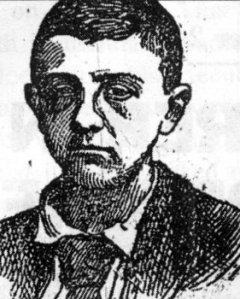
The young murderer was from Lakewood, a suburb of Cleveland. He was a bit of a bad seed; those who knew him said he started to go bad when he was about seven years old, after a bout with double pneumonia and “brain fever.” After his recovery from the illness, he became unstable and aggressive. In 1942, after a high-speed police chase, he was arrested on multiple charges of auto theft and sent to the Boys’ Industrial School for a year.

Typically, this experience in reform school failed to reform him, and he returned home worse than ever.

John Stark Bellamy II, writing about him in the book The Killer in the Attic: and More True Tales of Crime and Disaster from Cleveland’s Past, noted that Hagert’s formal education stopped after his 1942 arrest, but he earned “a graduate degree in sexual perversion” from his stint in juvy.

Hagert’s mother, unable to handle him, had him committed to the psychiatric ward in Cleveland City Hospital in early July 1943. There he was diagnosed as having a “psychopathic personality” and released on August 9. (Just why is unclear; Hagert’s mother claims she begged the chief staff physician not to release him, and the doctor denied this and said, on the contrary, she had begged for him to let her son go.)

Just two days later, Hagert was driving his blue Chevy around when he picked up a nine-year-old boy, the son of a city aide. His plan had to been to sexually assault and murder the child, but he later claimed he was moved by the boy’s crying and pleas and decided to spare his life. This didn’t stop him from keeping his victim in the car overnight, torturing and sexually abusing him. The next day, Hagert drove the boy to a wooded area, tied him to a tree, and placed a series of anonymous calls to the child’s parents with clues as to his whereabouts. The police found the little boy where his abductor had left him.

The following afternoon, for reasons best known to himself, Hagert returned to the spot where he’d left the abduction victim and encountered a Cleveland Plain Dealer reporter and a photographer.

As Hagert made small talk with the photographer, the reporter became suspicious of his behavior and remembered the old cliché about the killer returning to the scene of his crime. He scribbled down a physical description of Hagert and took note of the license plate number on his Chevy. Later, he turned his notes over to the police.

A compliant Hagert was taken in for questioning. Unaccountably, two hours passed before anyone realized he had a loaded gun under his shirt. When an officer removed Hagert’s shirt, the gun fell to the floor. As the officer picked it up, the young man said casually, “The gun you have in your hand is the one I shot the other two with.”

James and Charles Collins had been missing since noon the previous day and law enforcement agents were frantically searching for them. They were last seen hitchhiking to their jobs as caddies at a local golf course. Hagert calmly confessed to killing the Collins twins and lead authorities to their bodies. The dead boys were about 300 feet apart and each had been shot at the base of the skull — that is, “execution style.”

If anyone doubted by now that Hagert was a monster, they would have been convinced by what he had to say about the double murder:

It’s pretty serious, you know. I kidnapped one kid and killed two others … I just felt like killing them, so I killed them. Now it all seems like a bad dream … I had the urge to kill before but I always managed to suppress it by running. I’d run down the street because I felt I had too much energy. The Collins boys were just victims of circumstance. I would have killed anyone at that time. It just happened to be them … I’m not especially sorry for any of those folks I have hurt … The whole thing is just like a smashed fender … When it’s done, it’s done — that’s all.

While in custody he also confessed to a third murder, but this statement turned out to be a fabrication.

An initial panel of three psychiatrists unanimously agreed that Hagert was insane. This would not do: the state could not risk the possibility that this incredibly dangerous psychopath would be committed to a hospital, only to escape later on, or be released like before, to walk the streets again.

Five more psychiatrists were appointed to examine the defendant and this group said he was sane. In spite of this, the defense went with an insanity plea anyway. There wasn’t much of an alternative, given the evidence against their client.

Testifying before the jury, one of the doctors described Hagert as “a petulant, cruel, ruthless, determined, egotistical young man with no respect for God, man or the Devil.” Another said Hagert had told him that, if he were set free, the first thing he would do was track down and kill the newspaper reporter whose tip had led to his arrest.

The tearful testimony of his mother, who said Hagert had often complained of seeing “little midgets” who mocked him, carried little weight.

The jury took only two hours to find Henry Hagert guilty without a recommendation of mercy. In his book, Bellamy opines, “Most of the jurors, one suspects, thought Henry was insane by any imaginable standard of common sense, but they knew not what else to do with such an incorrigible monster.”

Hagert’s conviction was overturned on a technicality in December 1944, but his second trial, held before a three-judge panel in March 1945, resulted in the same inevitable guilty verdict. Hagert himself didn’t seem to care much. His last words were, “Do a good job of it now. Give me a good dose — it’s good for what ails for me.” He did donate his corneas, possibly the only contribution he ever made to society.

On this day..

1890: Otto Leuth

(Thanks to Meaghan Good of the Charley Project for the guest post. -ed.)

On this date in 1890 at the Columbus Penitentiary in Ohio, a sullen German-American teenager named Otto Leuth (sometimes spelled “Lueth”) paid with his life for the brutal murder of his seven-year-old neighbor, Maggie Thompson.

John Stark Bellamy II, writing of the murder in his book The Corpse in the Cellar: And Further Tales of Cleveland Woe, noted how familiar the case sounds to modern ears:

[T]he sickening murder of an innocent child; yet another child accused for the dreadful deed; a sensational trial, replete with dubiously “expert” testimony, suspicious “confessions,” allegations of police “third-degree” methods, and charges of biased press; not to mention “latchkey” children, systematic child abuse, saccharine sympathy for the guilty, and charges of ethnic favoritism.

Yet it happened over a century ago.

Otto, sixteen at the time he killed little Maggie Thompson, had had a hard life, as Bellamy explains in his book. His mother, Lena, testified at his trial that she

went into veritably demonic fits of rage, during which she was in the habit of physically abusing her children, especially Otto. From an early age, she blandly admitted, she had pulled his hair, kicked him, beaten him, walked on him, and often hit him with any object that came to hand. Once, when Otto was eight, she had beaten him with a chair leg and, when [Otto’s father] Henry tried to intervene, stabbed Henry twice with a convenient butcher knife. Just a few months before Maggie Thompson’s murder, Lena had repeatedly slammed Otto’s head into a wooden door.

It speaks volumes of the difference between that century and this one that nobody who heard Lena’s testimony seemed to think this was in any way excessive, never mind cruel; on the contrary, one person praised her methods as being “good German discipline.”

On May 9, 1889, sixteen-year-old Otto was alone at his family’s home at 47 Merchant Avenue in Tremont, a suburb of Cleveland. He was used to being alone: his mother had been committed to a mental hospital some months before, his father was wrapped up in his cabinet-making business, and his older brother had moved out of the house.


Otto (top) and his victim.

That morning, down the street at 24 Merchant Avenue, Maggie Thompson set off for school. Her mother, Clara, dropped her off at the front gate; it was the last time she would see her daughter alive.

Maggie attended the morning classes and, when school was dismissed for lunch at 11:15 a.m., started on the four-block walk home. En route, she vanished without a trace, as if “the sidewalk might have opened and swallowed the girl.”

Naturally there was a frantic search, lead by her devastated parents and the Cleveland Police Department, who tore the city apart looking for her.

But, although there were numerous false sightings and a few wild stories about Maggie’s disappearance, in spite of everyone’s efforts they couldn’t find her.

Otto participated in the search, along with most of the neighborhood. Nearly every day he would approach Clara Thompson and solicitously ask if she’d heard any news of her child.

In early June, Clarissa Shevel, the woman who lived with her husband in the back of the Lueths’ two-family house, asked Otto to do something about the terrible stench that pervaded the entire building. Otto suggested the odor was caused by a dead animal. He bought some chloride of lime and put it in the ventilation hole, then burned some sulfur, but it didn’t help.

Around that time he was witnessed carrying some badly stained bedding to the smokehouse at the back of the property.

On June 9, Otto’s mother Lena, who had by now been discharged from the mental hospital, became fed up with the smell and sent her husband Henry down to the cellar to investigate. He came back up a few minutes later, deeply shaken, and ran out to find a policeman.

In the Lueths’ cellar was the nude corpse of Maggie Thompson.

She was wrapped in one of Lena’s dresses and her own clothes lay underneath her. She had been beaten to death and her body was so badly decomposed that her parents had to identify her by scars on her hips.

The police promptly arrested everyone who lived at the house: Henry and Lena Lueth, Clarissa Shevel and her husband, and Otto, who was picked up on his way home from the ice cream parlor. All five suspects were separated and subjected to a serious “sweating,” but Otto was the prime suspect. He had a reputation as a bully, and he’d been at home alone for much of the previous month.

Bellamy records:

The climax came at 3:30 a.m., when an agonized female shriek resounded from the floor below the sweating room. “Who is that?” cried Otto to Detective Francis Douglass. “Your mother, I believe,” replied Douglass. “She had nothing to do with it!” blurted out Otto. “Who did?” queried Douglass. Otto: “I did it! I did it!” Douglass: “Did what, Otto?” “I killed her! I killed her! Please give me your revolver so I can kill myself!”

Resisting the temptation, the police instead took his verbal confession, wrote it down, had him sign it and escorted him to a cell.

Otto said he had been standing outside his parents’ home at about 11:30 a.m. on May 9 when he encountered Maggie. She asked him if he could donate any buttons to the “button-string” she was making, and he said he had four and would give them to her if she came inside.

Maggie obediently followed him in, and he led her upstairs to his bedroom, where he attempted to rape her. When she screamed, he hit her with a nearby hammer.

Otto said he thought he’d probably killed her with the first blow, but he kept striking her until her head was a pulp and the bed was covered in blood. After an unsuccessful attempt to have sex with her body, he fled the scene. He did go back to the house that night, but spent the next several days at his brother’s home.

Six days later, just before his mother was supposed to come home, Otto returned home to clean up. He carried Maggie’s corpse to the family cellar and left it lying there; he didn’t even bother to bury it or cover it up.

Given Otto’s confession, the circumstantial evidence and the revulsion his crime invoked in the city of Cleveland, his lawyer didn’t have much to work with. Not even trying for an acquittal, his defense instead claimed Otto was mentally impaired and/or insane.

Otto had a strange depression in his skull and his attorney suggested he was brain-damaged — which might very well have been true, given the abuse he had suffered at Lena’s hands. Several members of his family, including his mother and brother, had epilepsy, and his attorney suggested he might have had a seizure and committed his crime without even knowing what he was doing.

Such a scenario was possible. The problem was, though, that none of the medical experts who testified for the defense could diagnose Otto with epilepsy.

The claims of subnormal intelligence were contradicted by the testimony of Otto’s former teachers. Although his pathetic attempts to conceal Maggie’s body might indicate otherwise, his intellect seems to have been about average. Before he quit school at age 13, he had been an unexceptional student with some talent as a violinist.

Otto’s lawyer also said his client had not, in fact, attempted to sexually assault Maggie Thompson either before or after death, and Otto had invented that part of his confession because the police were pressing him to cough up an explanation for his motiveless crime. But given the fact that Maggie’s body was found naked, this claim didn’t carry much weight either.

It was no surprise that, when the trial concluded on December 27, 1889, the jury came back with a verdict of guilty without a recommendation of mercy. Perhaps the only surprising thing was that they actually bothered to deliberate for a whole four and a half hours.

Otto rapidly exhausted his appeals and was hanged eight months after his trial, alongside another killer, one John “Brocky” Smith of Cincinnati. Two other men had also been scheduled to die that night, but one got reprieved and the other’s execution was postponed.

Otto left behind a statement where he admitted he’d killed Maggie Thompson, but denied his previous claims that he’d tried to rape her. He died calmly and without a fuss, standing on the trap and saying simply “All right, let her go.”

On this day..