Francesco Baldovino was a gentleman in affluent circumstances, of a handsome person, and of engaging manners. His domestic establishment was princely. He had a large sum in the Funds. In short, every adventitious advantage, which fortune brings, was within his reach, excepting one; Baldovino was not a noble.
It is said that, at the period of the War of Chioggia, he desired to become, among the rest, a candidate for the honours of the peerage. But, his paternal ancestor having been implicated in some manner in the Bocconio conspiracy of 1300, the family laboured under a certain obloquy, and Baldovino was a disappointed man.
Among his numerous acquaintance was one Bartolomeo D’Anselmo, also a cittadino of great wealth, and also an unsatisfied expectant of nobility. It happened on Friday, the 4th March, 1413, that Baldovino and D’Anselmo met at the Minorites, and began to discuss their common grievance. “We,” cried Baldovino, at once launching into diatribe, “pay taxes enough forsooth; yet those of the Council enjoy the emoluments of office.”
“True,” returned his companion, “and indeed we ought to make it our business to see if we cannot get for ourselves a share in the administration. Devise some plan in which I may co-operate.”
“The way would be,” whispered Baldovino, “to collect a company of our following, and to massacre them as they are leaving the Council, particularly the College, the Decemvirs, and the Avogadors.”
D’Anselmo said, “That is an excellent plan. How then do you purpose to find your men?”
“I intend,” the other continued, “to seek a good many trusty fellows, who will be at my elbow to compass this matter for us on Sunday that is coming.”
“I, too,” rejoined D’Anselmo, “will bring some.”
So they parted.
Bartolomeo D’Anselmo was not a bad man; but he was a man of no steady principle, and of an exceedingly nervous temperament. He had hardly bidden farewell to Baldovino, when the treasonable dialogue which had passed between them began to haunt his imagination. He found himself a prey to a variety of unwholesome and chimerical fancies. The echoes of his own words grated on his ears. The sound of his own voice threw him into a cold sweat.
He conceived it more than possible that they might have been overheard, and that they were betrayed. He pictured himself arrested, dragged before the Ten and into the chamber of torture, put to the question, condemned to an infamous and horrid punishment. If there had been eavesdroppers, he was pretty sure that this would be his destiny; and he knew that there was only one method of escaping from the danger.
He was base enough to pursue that method; D’Anselmo turned evidence, on the same day, against his friend.
The informer was pardoned and ennobled.
The man, whom with such vile and pitiful cowardice he had denounced, was taken into custody, examined under the cord, and on Saturday morning the 5th, at eight o’clock, was executed between the Red Columns, where he was left hanging three days, as a warning to traitors.
On this date in 1828, Quaker forger Joseph Hunton was hanged at Newgate Prison.
The very model of petit bourgeois hustle, Hunton was a versatile businessman who variously engaged in slop-selling, linen-draping, sugar-baking, and warehousing, before turning his craft to that most lucrative of all trades, money-minting.
Hunton circulated bills of exchange fraudulently drawn on dead people, and easily traced back to his hand. Ever the assiduous merchant, Hunton was arrested trying to flee England — with a letter in his pocket to post for the Times correcting that paper’s inflated account of his graft to a more modest figure.
Since the reputation that preceded him was otherwise a good one, and since executions for white-collar crime suffered declining popularity, Hunton had “every reason to expect that the mercy of the Crown will be extended to the unhappy object of public commiseration.” (The London Times, Nov. 21, 1828, evidently an error-prone source on the subject of J. Hunton.) Even Nathan Mayer Rothschild, one of the founders of that family’s banking empire, signed a petition for Hunton along with other eminences of the London financial district. This sentiment, the Times observed (Dec. 6, 1828)
proves sufficiently that in the opinion of the commercial public, fraud is not an appropriate subject for capital punishment … The human heart, we say, in the 19th century, revolts at such a retribution for such a transgression … [which] flies in the face of those feelings which attest, because they go far to constitute, the advancement of mankind in civilization and humanity. The penalty of death was enacted for the sake of the monied interest,–the monied interest, by this petition, loudly proclaim that they deem the penalty unnecessary!
Little wonder the Newgate Calendar noticed “a very general belief … that a respite would most certainly arrive for him even so late as on the morning fixed for his death. His safety was considered almost certain, and many were scarcely persuaded that he would really suffer even at the moment when the fatal cord encompassed his neck.”
But it was not so.
Some things never change.
Though 1828 is many decades before England developed its exacting “drop tables” calculating the precise length of rope meant to hang a fellow of a given stature, the accounts of Hunton’s hanging are at pains to note that, because Hunton himself was so short, his rope was made longer than that of the three unconnected fellow-convicts who hanged with him. Table or no, the executioner knew his craft: Hunton died instantly, or appeared to.
(Another Quaker once an intimate of Hunton later became notable gallows fodder himself, John Tawell. Tawell was the first criminal captured with use of the telegraph.)
On the night of November 26-27, 1940, the Romanian Iron Guard massacred sixty-plus political prisoners of the pre-fascist regime at Jilava — the Jilava Massacre.
An authoritarian right-wing dictatorship by any standard, but like any polity it had its own internal conflicts. Of moment for this date: the detention of people whom the Legions considered implicated in the execution of fascist martyr Corneliu Zelea Codreanu two years before, as well as miscellaneous other undesirables who had prospered under the abdicated King Carol II.
Antonescu, who had a thing about rectitude, proposed to ornament these men’s inevitable deaths with the formalities of investigation and trial. Long story short, Sima and the Legionaries didn’t trust Antonescu; when Antonescu ordered some of the prisoners transfered to a different prison, the Guard refused — and when replacement jailers were consequently slated for the Guard, the Guard took matters into its own hands by slaughtering its charges this night.
Antonescu was furious.
the handful of reprobates who have committed this crime will be punished in an exemplary manner. I will not allow that the country and the future of the nation be compromised by the action of a band of terrorists … I was reserving the punishment of those held at Jilava for the justice system of the country. But the street decreed otherwise, proceeding to implement justice itself
By the following January, the conflict between the National Legionary State factions came to a head. With the support of the Third Reich, Antonescu mastered the Iron Guard, took control of the state, and sent Sima into exile.
And he did indeed punish — up to and including execution — several of the Guard members involved in this date’s massacre.
On the other hand, as a prize for serving as wartime Prime Minister of an Axis-aligned state, Antonescu himself was shot for war crimes not far from Jilava Prison in 1946. Sima, on the other hand, had a few in absentia death sentences, but checked out comfortably in Madrid at the age of 85.
On this day in 2009, Chinese citizens Zhang Yujun and Geng Jinping were shot to death in connection with China’s tainted milk scandal.
The affair caused some 300,000 infants to became sick, six of them fatally. They were killed by powdered milk tainted with melamine, an industrial chemical used in plastics and fertilizer. Zhang, a dairy farmer from the province of Hebei, sold hundreds of tons of tainted milk powder in 2007 and 2008; he was the largest supplier. Geng supplied toxic milk to dairy companies.
The scandal was stupendous and made headlines all over the world. According to Time magazine, the tainted milk found its way to Taiwan, Singapore and Japan. China’s $232 million dairy export industry cratered as the European Union and a dozen nations in Asia and Africa banned Chinese milk and milk products. The farmers who depended on milk sales for their livelihood were reduced to simply pouring their surplus stock down the drain, and since nobody wanted to buy dairy cows under these conditions, some farmers just slaughtered their animals.
Top: Chinese farmers destroy tainted milk. Bottom: Zhang Yujun (left) and a supplicating Geng Jinping (right).
Nor was milk wasn’t the only export product with this problem; Wikipedia’s timeline of the scandal states melamine was subsequently discovered in Chinese eggs, egg powder, baking ammonia, chicken, crackers and animal food.
Melamine was added to the milk to fool government protein tests, which would show whether the milk had been diluted or not. (Watered-down milk had been a problem in the past; in 2004 thirteen Chinese babies died of malnutrition after being fed milk that was so watery it had almost zero nutritional value.) Melamine, like protein, is high in nitrogen, so the presence of melamine in food would cause the protein content to appear higher than it really was.
It isn’t clear whether the people who altered the milk knew — or cared — that it was poisonous. Very poisonous. Melamine is never supposed to be used in food; it causes kidney stones and in some cases complete renal failure, especially in young children. A child can take over six months to recover from exposure.
Some blame must be attached to the (suspect) Chinese food safety administration, which in May 2008 reported that over 99% of baby milk powders had been deemed safe. (In fact, one major dairy company had begun hearing complaints about its baby milk as far back as the previous December.) The Ministry of Health was informed about the sick infants in July. There are strong suspicions that the government tried to suppress the reports to avoid embarrassment; the Olympics were in Beijing that summer and the world’s eye was on China. The scandal was only made public in September, after the Games.
Twenty-one people involved in the scandal were brought to trial on various charges in December 2008, and convicted in January.
Tian Wenhua, the general manager of the Chinese dairy giant Sanlu, pleaded guilty to producing substandard goods and was sentenced to life in prison. She admitted she’d known the milk was bad for four months before she reported this fact to the authorities. Sanlu tried to keep complaining parents quiet by giving them free milk, which was also tainted. Tien was widely perceived as being the person most responsible for the scandal, and many were disappointed that she didn’t get the death sentence.
Other defendants received various prison terms. One of them was given a suspended death sentence, but only Zhang (guilty of endangering public safety) and Geng (guilty of producing and selling toxic food) were actually executed.
On this date in 1761, John Perrott was hanged at Smithfield for fraudulent bankruptcy.
Perrott was one of the bare handful of British subjects executed during the last century that bankruptcy legislation officially came with hemp teeth; he’s sometimes noted as the last bankrupt put to death, although in reality, he was simply the most famous of the last few.
John Perrott hanged at Smithfield (detail view; click for full image). From here.
He got famous in the usual way.
A once-reputable merchant who blew his fortune in the late 1750s? That backstory does not get you into the Newgate Calendar.
Fortune blown by siphoning creditors’ money to shady mistress, then refusing to divulge the particulars? Now you’re talking. It’s a wonderful vignette in the annals of moralism to find Perrott on the eve of his execution keeping mum on the subject because he had already received his last Sacrament — the inference being that in speaking, he would only sully his soul with a lie.
It was an aggravating position for his creditors, who had reason to believe that there remained recoverable cash, in the hands of his “Mrs. Ferne” or elsewhere.
Creditors always get stuck in a bind when debt goes bad.
The death penalty for bankruptcy has a long and illustrious history, back to the Roman Twelve Tables with its Shylock-like right for the aggrieved lenders to cut the debtor apart into parts proportional to their lost investments, de debitore in partes secando.*
Still, that stern corporal stricture has tended to run up against the simple fact that creditors are financially interested parties whose benefit is almost always better served by keeping their debtor among the living where he might be capable of repairing some part of his bond. Slavery, therefore, was often preferred by the ancients and retains a symbiotic relationship to debt to this day: to force the service of a debt, make a man your slave; likewise, to force someone into slavery, make him your debtor. Human traffickers love this tactic.
At any rate, English bankruptcy law as it evolved was a strange hybrid of public (criminal prosecutions) and private (creditors initiated and paid for the prosecutions). Bluffing a charge at the Old Bailey was just one potential strategem in the contentious relationship between borrower and lender, and not the most effective one, as this Duke law journal article (pdf) by Emily Kadens notes:
“[I]f this Bill Pass,” [critics of a 1706 bankruptcy measure] warned, “it will never be executed.” The latter prognostication turned out to be virtually correct. Creditors prosecuted infrequently because of the severity of the punishment and the cost and difficulty involved. Even when creditors did bring lawsuits, juries may have been reluctant to convict not only because of the penalty but also because they understood the potential for fraud in the bankruptcy system itself … A man was made a bankrupt by the ex parte declaration of a person claiming to be a creditor … The alleged bankrupt had no right to object … In the meantime, his alleged creditors had taken possession of his assets, leaving him nothing with which he could fight his case, unless he committed a felony by concealing his assets or had friends or family support him.
That fraud aspect was essential to making it, as Perrott did, so far as the gallows; plain-vanilla bankruptcy was not in itself a capital offense, but a debtor hiding his assets in the process changed matters. The law distinguished the accidental bankruptcy (e.g., the ship with your imports sunk) from the larcenous: “To the misfortunes … of debtors, the law has given a compassionate remedy,” Blackstone notes. “But denied it to their faults.” Which is not to say that many, many debtors did not indulge these “faults.”
It was nearly two full years from the time Perrott sat his lenders down in a tavern in — naturally — Cheapside to give them the bad news that he was a little bit short, until the time he met the hangman. In that span, auditors picking through the wreck of his estate gradually became aware that the numbers didn’t add up, and his bum business practices (selling 20% below cost to obtain ready cash) still left up to 17,000 missing pounds unexplained.
By the by, the emergence into the investigation of a paramour, who then turned out to be hiding Perrott-issued banknotes, transformed an ordinary bankruptcy into one of those felonious asset-concealment situations. (And, into fine tabloid fodder for the broadsheets.) When Perrott wouldn’t come clean with the whereabouts of his purloined boodle, his creditors had him up on hanging charges. And when Perrott still wouldn’t come clean — Sacrament and all — he stiffed his lenders at the last by leaving them no way to recover their swag.
Hopefully, Mrs. Ferne was worth the trouble.
* More discussion of the Roman jurisprudence here.
On this date in 1769, five French Creoles were shot in New Orleans for a revolt the previous year against a Spanish takeover.
This date’s story begins with the French King Louis XV getting his French clock cleaned in the French and Indian War. This conflict blew an ill wind all over Francophone North America, much of which was taken by the British. Result: a quarter-millennium later, this blog is in English.
Even what France kept, she did not keep. In a secret pact, France ceded to wartime ally Spain “the country known as Louisiana, as well as New Orleans and the island in which the city is situated.”
This projection onto New World colonists of Old World diplomatic horse-trading was rife with potential hostility among the traded horses. In this instance, Louisianans were widely dismayed when they were finally informed that they’d become Spaniards.
These weren’t mere rabble who showed Ulloa “insubordination … a sense of liberty and independence,” but elites of French New Orleans. Nicolas de Lafreniere was the attorney general.
“The name of Lafreniere deserves rank with those of foremost American patriots,” Americans later reckoned. O’Reilly’s reputation did not fare as well in the patriotic literature, but he perhaps had the best of the law.
Between a rock and a hard place, the leftover French adjutant Charles-Philippe Aubry refused to support the rebels, but also refused to fire on fellow Frenchmen. Meanwhile, Ulloa refused to provide his credentials to the uppity colonists. Louis XV refused to receive the delegations sent to implore him to keep Louisiana.
All these refuseniks found the matter adjudicated by immigrant Irish officer Alejandro O’Reilly, plucked out of Cuba to replace Ulloa and lay down the law. He spoke softly when he landed, but the amnesty he offered was followed a few months later by the surprise arrest of the chief rebels.
Lafreniere, Joseph Milhet, Jean-Baptiste Noyan, Pierre Caresse, and Pierre Marquis were ordered hanged on this date. Noyan, nephew of the city’s founder and a young man just married, was offered his pardon, but melodramatically refused.
It was found that there was no hangman in the colony, so the condemned prisoners were ordered to be shot. When the day of execution came, hundreds of people left the city. Those who could not leave went into their houses, closed the doors and windows and waited in an agony of sickening dread to hear the fatal shots. Only the tramping of soldiers broke the deathlike stillness which brooded over the crushed and helpless city. At three o’clock on a perfect October afternoon in 1769, the condemned men were led to the Spanish barracks. Lafreniere, it is said, gave the order to fire. A volley of muskets broke out on the still air, and five patriots went to their death, — the first Louisianians to give their blood for the cause of freedom.
Whether or not all that stuff about Louisiana planters as freedom-loving patriots trod down by the barbarous Spanish has any real merit to it, that’s the way they’ve been memorialized.
When next visiting the Louisiana State House, keep an eye out for this day’s victims on the frieze to the right of the main entrance. And when next visiting New Orleans, keep an ear out for the ghost of the priest that buried them.
* Ulloa was also a scientist and gave his name to the Ulloa Halo, a “physical illusion consisting of a white luminous ring or arch that can sometimes be seen in mountainous regions, typically in foggy weather, while facing an area opposite the Sun.”
The two timeless pursuits of man — a bigger boodle, and a better boner — brought Wang Zhendong to execution in Liaoning province this date in 2008 for a nine-figure ant-farming scam. True story.
With the sort of screw-thy-neighbor entrepreneurial spirit of the times, the aptly-named Wang engorged himself to the tune of 3 billion yuan — around $400 million, give or take — running a pyramid scheme based on the reputed herbal aphrodisiacpolyrhachis vicina roger. (Seriously, “roger”.)
From 2002 to 2005,* ten thousand Chinese investors fantasizing of 40 and 60% returns ponied up $1,300 a pop for ant-breeding kits with a street value of twenty-five bucks.
Sex: it makes men stupid.
The buyers were supposed to return the formicids after a few months so the company could process them into aphrodisiacs and miscellaneousotherremedies … then watch the money gush. Some early investors were paid off by those who got sloppy seconds, but eventually the ponzi scheme collapsed and the pigeons realized that the ants they’d sprung for were really a pig in a poke.
By the time investigators cockblocked the company in 2005, less than 1% of the proceeds could be recovered. At least one sucker committed suicide realizing he had shot his life’s wad.
“He should just die,” one non-suicidal investor told the western press. “He hurt so many people. Some people even sold their house, their cars. People don’t have money, and they don’t have work. What can they do?” What, no bailout?
A “beware of ant scam artists” poster put up in Shanghai. Image (c) MFinChina and used with permission.
Besides Wang’s petite morte this day, fifteen of his company’s former managers drew prison sentences ranging from five to ten years.
Fifty-nine minutes after midnight on this date in 1950, five Soviet cadres were condemned to death in a secret trial on trumped-up charges of treason in one of Stalin’s party purges. An hour later, they were shot.
The “Leningrad Affair” saw Uncle Joe — with the urging of other henchmen jockeying for the imminent post-Stalin succession — liquidate the excessively independent leaders of Russia’s other capital.
During the late World War, the “hero city” Leningrad withstood a withering 28-month Nazi siege stretching from the very first weeks of war into 1944.
In those days there was something in a man’s face which told you that he would die within the next twenty-four hours …
I shall always remember how I’d walk every day from my house near the Tauris Garden to my work in the centre of the city, a matter of two or three kilometres. I’d walk for a-while, and then sit down for a rest. Many a time I saw a man suddenly collapse on the snow. There was nothing I could do. One just walked on. And, on the way back, I would see a vague human form covered with snow on the spot where, in the morning, I had seen a man fall down.
One didn’t worry; what was the good? People didn’t wash for weeks; there were no bath houses and no fuel. But at least people were urged to shave. And during that winter I don’t think I ever saw a person smile. It was frightful. And yet there was a kind of inner discipline that made people carry on.
-A survivor of the siege
This horror cost the lives of a million Leningraders, and tour guides will be sure to point out the physical scars still to be seen.
But the city never fell, and its resistance wrote one of the 20th century’s awe-inspiring monuments to human perseverance. Dmitri Shostakovich, caught in the city himself, composed one of the Great Patriotic War’s most famous musical anthems, defiantly performed by the Leningrad symphony itself during the actual siege, and broadcast on Soviet radio and around the world.
One result of a city’s being carved away from its country — and of consequence to this date’s victims — was that it put Leningrad on increasingly autonomous footing.
Voznesensky, who literally wrote the (incautiously heterodox) book on The Economy of the USSR during World War II
And as the war receded, the men who administered Leningrad were left with an unusual scope of action … bolstered by their recent reputation for anti-fascist heroism. The so-called “Leningraders” had become an embryonic rival power center.
[t]he executions of October 1, 1950, were only the tip of the iceberg … The Leningrad Affair probably claimed more than 1,300 victims, including over 100 who were shot, nearly 2,000 people who were dismissed, and many arrseted.
This day’s victims (though not all those persecuted) were officially rehabilitated during the Khrushchev era; responsibility for the Leningrad Affair even served to condemn one of its authors, NKVD torturer Viktor Abakumov, to death in the 1950s.
But compared to the corpse motel of 1930s USSR, this purge was distinctly small potatoes. One of its survivors — a man who could easily have been condemned on the same evidence that doomed the likes of Kuznetsov — was politician Alexei Kosygin, later to emerge as one of the USSR’s leading liberalizers in the 1960s and (in the words of Canadian Prime Minister Pierre Trudeau) “the forerunner of Mikhail Gorbachev.”
This date is the sesquicentennial of former Costa Rican president Juan Rafael Mora Porras’s death by firing squad, for attempting to retake that office from his brother-in-law after being ousted in a coup.
Little wonder he held the presidency for most of the 1850s.
(Signal achievement: allied with American tycoon Cornelius Vanderbilt to help drive filibuster William Walker out of neighboring Nicaragua. Unfortunately, Mora’s army returned home bearing something besides the enemy standards: a cholera epidemic that decimated — literally, killed 10% of — the Costa Rican populace.)
In 1859, while making unwelcome sounds about a national bank not controlled by the coffee barons, Mora was overthrown by another coffee baron — Jose Maria Montealegre.
Rather than leave well enough alone, Mora regrouped in exile and launched an 1860 bid to regain power.
While Juan Rafael Mora was introduced to a firing squad for his trouble, one of his party who was spared that indignity was Mora’s nephew Manuel Arguello Mora, a future novelist and Costa Rican Supreme Court justice.
On the 20th of August, 1672, the city of the Hague, always so lively, so neat, and so trim that one might believe every day to be Sunday, with its shady park, with its tall trees, spreading over its Gothic houses, with its canals like large mirrors, in which its steeples and its almost Eastern cupolas are reflected,–the city of the Hague, the capital of the Seven United Provinces, was swelling in all its arteries with a black and red stream of hurried, panting, and restless citizens, who, with their knives in their girdles, muskets on their shoulders, or sticks in their hands, were pushing on to the Buytenhof, a terrible prison, the grated windows of which are still shown, where, on the charge of attempted murder preferred against him by the surgeon Tyckelaer, Cornelius de Witt, the brother of the Grand Pensionary of Holland was confined.
…
the whole town was crowding towards the Buytenhof, to witness the departure of Cornelius de Witt from prison, as he was going to exile; and to see what traces the torture of the rack had left on the noble frame of the man who knew his Horace so well.
Yet all this multitude was not crowding to the Buytenhof with the innocent view of merely feasting their eyes with the spectacle; there were many who went there to play an active part in it, and to take upon themselves an office which they conceived had been badly filled,–that of the executioner.
There were, indeed, others with less hostile intentions. All that they cared for was the spectacle, always so attractive to the mob, whose instinctive pride is flattered by it,–the sight of greatness hurled down into the dust.
That ominous mob got its spectacle this date in 1672, lynching the Dutch Republic’s longtime de facto head of state, Johan de Witt along with his brother Cornelis/Cornelius.
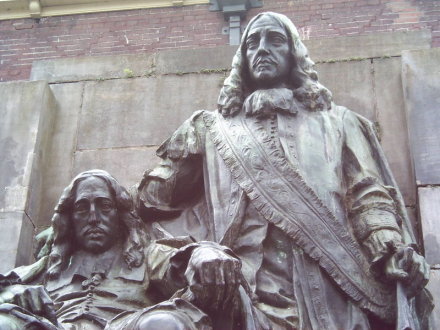
A statue of Johan (standing) and Cornelis de Witt in their native Dordrecht.
The mercantile powerhouse that was the 17th century Dutch Republic was the stage for a long-running conflict between the Orange monarchists (hence the soccer uniforms) and the Republican merchant class.
With the sudden death of the young William II, Prince of Orange in 1650, leaving the (non-hereditary) executive office of stadtholder vacant, the Republicans became ascendant.
And the outstanding figure of the First Stadtholderless Period was Johan de Witt, scion of a Dordrecht merchant family powerful enough that William II had imprisoned de Witt’s own father during a power struggle.
While all these guys were landing themselves in their respective canons, Johan de Witt was trying to keep the age Golden.
Having only relatively recently broken free of Spain, the small country was an up-and-comer on the horns of a serious security dilemma: its leading commercial position put it into maritime competition with England, while its continental location made it vulnerable to the enormous army of the neighboring continental hegemon, France. Ultimately, even with its trade wealth, it did not have the resources to keep up with both of western Europe’s leading powers.
For a generation, de Witt’s statecraft kept the men of the Low Countries out of that predicament, while his brother Cornelis chipped in with a couple of timely naval victories. (Actually authored by Michiel de Ruyter, but Cornelis rode shotgun.)
In 1654, Johan brought the First Anglo-Dutch War to a close, making with Oliver Cromwell a secret pact he was only too happy to enforce never to allow William II’s son, the eventual William III, to be named stadtholder. Reason being: William III was the grandson of the Stuart king Cromwell beheaded, Charles I, and thus a potential claimant to the English throne. Both Protestant Republics had a distinct interest in keeping this monarchist well away from power. (Both would be sorely disappointed.)
A decade and a Stuart Restoration later, de Witt maintained (mostly) Dutch dominance of the seas in the Second Anglo-Dutch War, then held off France (with the help of a timely alliance with the recent adversary, England) in the War of Devolution.
In each case, he kept at least one of England or France on the sideline, or in his own camp.
But the Third Anglo-Dutch War was the charm — as it was also the Franco-Dutch War, and therefore 1672 was Rampjaar: disaster year. While the Dutch were aces on the waves, a massive French invasion easily overwhelmed them on terra firma.
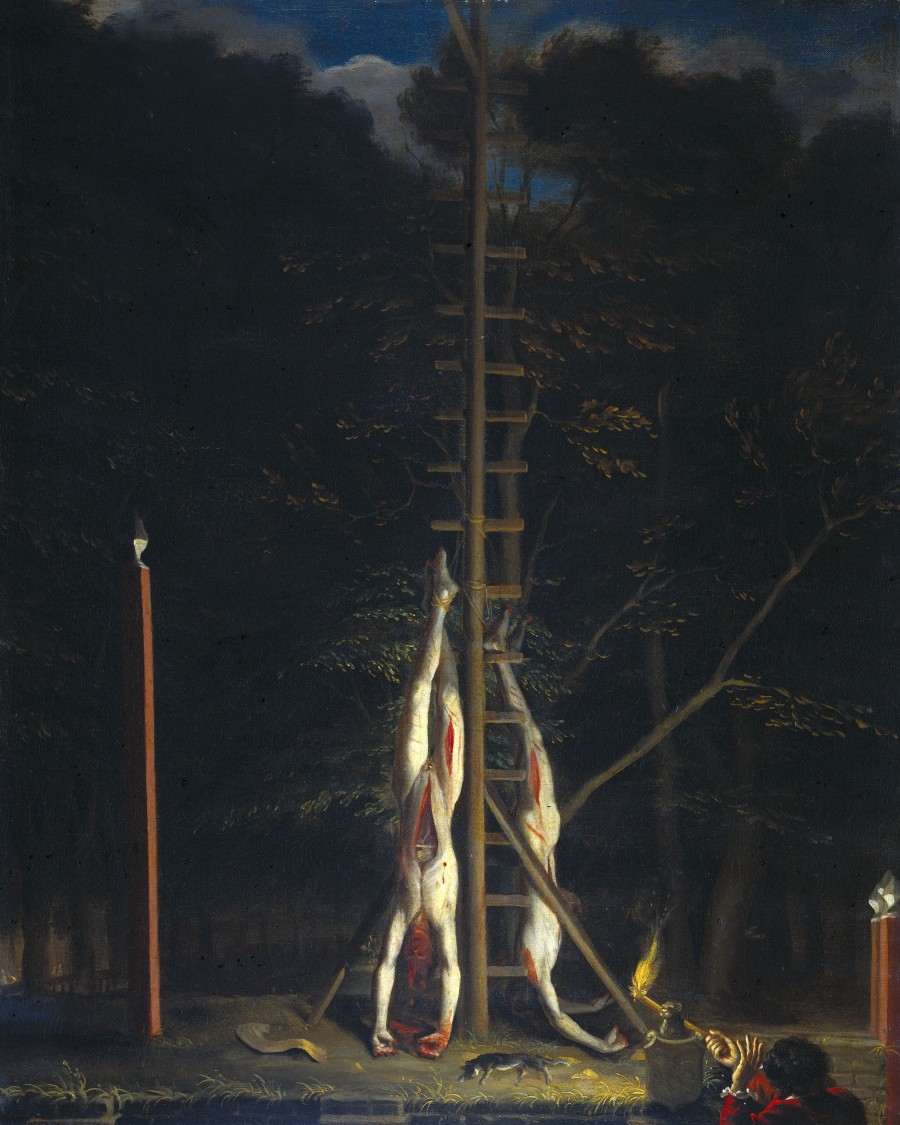
Detail view (click for the full image) of a grisly painting of the mutilated de Witt brothers strung up at The Hague. It’s attributed to Jan de Baen, who in better times took Johan de Witt’s portrait.
De Witt’s never-beloved mercantile oligarchy speedily collapsed with the military reverses, and the now all-grown-up William III was there to pick up the pieces to popular acclaim. Arrested for treason, Cornelis sustained torture without confessing, but when Johan visited him in prison — and William III incriminatingly withdrew the cavalry protecting the brothers — the mob quenched its fury with the de Witts’ blood.
every one of the miscreants, emboldened by his [Johan’s] fall, wanted to fire his gun at him, or strike him with blows of the sledge-hammer, or stab him with a knife or swords, every one wanted to draw a drop of blood from the fallen hero, and tear off a shred from his garments.
And after having mangled, and torn, and completely stripped the two brothers, the mob dragged their naked and bloody bodies to an extemporised gibbet, where amateur executioners hung them up by the feet.
Then came the most dastardly scoundrels of all, who not having dared to strike the living flesh, cut the dead in pieces, and then went about the town selling small slices of the bodies of John and Cornelius at ten sous a piece.
-Dumas
The word “ungrateful” comes to mind.
De Witt stood altogether on a lower plane than Cromwell. We regard him rather as a man of rare and singular talent, than as one of the chosen great ones of the earth, which Cromwell was. He stands far above the common run of men; and he was head and shoulders above nearly all the notable men of his time. He would have been greater if the movement of his limbs had been less burdened with the Dutch governing apparatus … He is not one whom the world can ever greatly admire or love.
(Here’s another, and here’s a 17th century volume de Witt himself coauthored.)
The rise of William III came with the decline of that Dutch Golden Age: the country fended off the immediate military threat, but it increasingly slipped behind its larger neighbors. Costly as was the Franco-Dutch War, it is a step on the path towards the present-day Europe, and this gives us enough excuse to notice that the Eurovision lead-in tune is actually from a Te Deum composed to mark its end.
But William’s own ascent to this wealthy sovereignty was just the beginning for him. Sixteen years later, the House of Orange’s champion vindicated Cromwell’s trepidation about him and gained a far more satisfactory position from which to do battle with his Gallic rival Louis XIV by stunningly overthrowing the Stuart dynasty and becoming King of England in the Glorious Revolution.**
* The Dutch remained the sole western contact of closed Japan until 1854, which is why Japan’s eventual period of scientific advancement became known as ‘Dutch Learning’.
** Albion did not forget the de Witts, either: according to this 1785 cant dictionary, the term “dewitted” had a 17th-18th century run in English to denote — well, exactly what happened to Cornelis and Johan.


 In the mid-19th century,