The last execution in Dundee, Scotland occurred on this date in 1889 — and some folk suspect that the fellow that fell through the gallows-trap might have been the great bogeyman of a different place: Whitechapel.
Orphaned son to a fishmonger who was broken when he fell under the wheels of his own laden cart and a mother who expired in a lunatic asylum, William Henry Bury just so happened to be resident of Whitechapel’s adjacent East End neighborhood of Bow when the former experienced a notorious spate of murders in 1888. Bury marked his time as an unsuccessful sawdust merchant vending to Whitechapel taverns, and as a downright atrocious husband drinking and whoring away the modest inheritance of his wife Ellen, then returning home to thrash her for it.
Proximity and misogyny begin the case for William Bury as a possible Jack the Ripper candidate, but it was a host of more specific circumstances that really interested posterity and contemporaries alike.
The Ripper killings abated in the autumn of 1888; nobody really knows why, though in making the case for Bury as the murderer, William Beadle has suggested that heavy fog that season complicated Bury’s post-slaughter escape routes back to Bow. By January, Bury had moved away to Dundee dragging along his reluctant, and now penniless, wife. Other Whitechapel homicides extending up to 1891 might be copycat crimes or coincidences, but all of the so-called “canonical five” consensus victims of Jack the Ripper were in their graves by the time Bury left town. Ripper or no, Bury is known to have committed knife attacks on at least two women (and threatened his wife with same); he’s also a likely suspect for the December 1888 strangulation murder (sans mutilation) of Rose Mylett, one of the several possible Ripper crimes outside the canonical five.
Days after moving to Dundee, Bury strangled his wife with a rope … and gashed open her abdomen, eerily mirroring the Whitechapel killer’s horrific attacks. (Although Bury’s slashes of Ellen were not as deep or ferocious as those associated with the Whitechapel killer.)
Finding he could not get the body out of the apartment, and recollecting that people were bound to notice that his wife had vanished, Bury eventually went to police with a preposterous story that he had awoken to find his wife a suicide several days before and then — strange topic to bring up — hid the body for fear that this Whitechapel emigre would be taken for Jack. Someone clearly did so, for when police investigated they found strange chalk graffiti: “Jack Ripper is at the back of this door”, “Jack Ripper is in this seller”. The operative assumption is that Bury himself scratched them but these creepy notices at a crime scene have a whiff of street vigilantes tagging the murderer as in Fritz Lang’s M. Then again, the Burys were strangers who had just arrived from the epicenter of a notorious crime spree, and Dundee probably had prankster schoolboys in abundance.
London police and Scotland Yard sniffed around Bury and didn’t find enough whiff of the Ripper to charge him up as the Whitechapel murderer, but not all were persuaded. Executioner James Berry was reportedly convinced that in Bury he had noosed England’s legendary monster, and a Scotland Yard detective — despite failing to get anything but denials out of his interrogations — allegedly agreed, telling the hangman, “We are quite satisfied that you have hanged Jack the Ripper. There will be no more Whitechapel crimes.” We have suggestive — nothing is dispositive with Jack, much to the profit of amateur sleuths down the years — hints that Ellen too believed this, as she is said to have remarked to Dundee acquaintances who quizzed her about the killings in her former neighborhood things like “Jack the Ripper is taking a rest.” Meaningless conversational nicety, or clue from the bedmate of the monster?
There are of course dozens of Jack the Ripper suspects from then and now; Bury isn’t even the only one who ultimately got executed. And there are reasons to doubt Bury beginning most obviously with his clumsy performance for the Dundee police: seemingly very far from the cool and shrewd sociopath we commonly suppose for the Whitechapel Ripper.
But there’s a lot that fits, too, and even though Bury always denied the charge, some part of him — be it a confessional mode, or a starfucking one — couldn’t resist hinting. When that hangman Berry implied in the last moments that Bury should unburden himself of the Whitechapel crimes, his mark repelled the attempt with tantalizing non-denials, e.g. “I suppose you think you are clever to hang me … but because you are going to hang me you are not going to get anything out of me.”
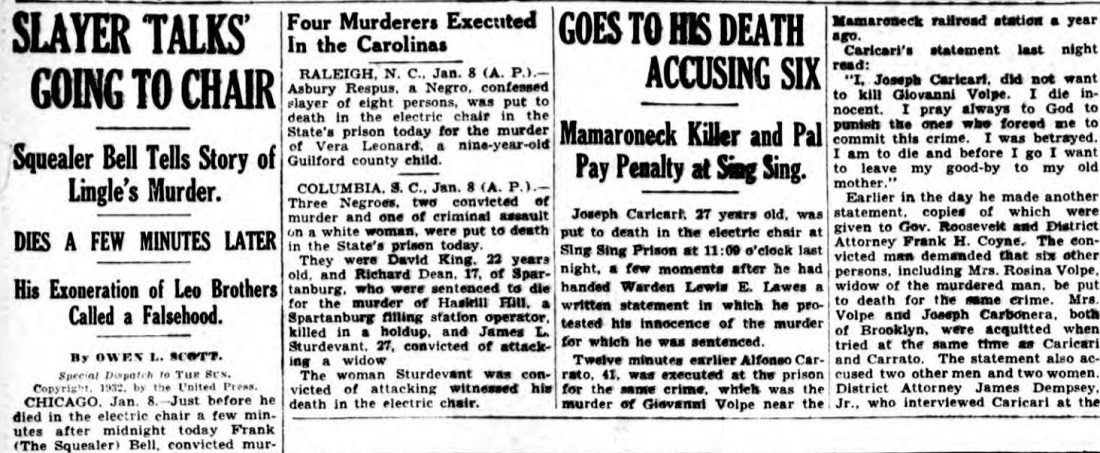
On this date in North Carolina, a middle-aged man named Asbury Respus was executed for the murder of nine-year-old Vera DeWitt Leonard.
And that wasn’t all: though virtually forgotten today, Respus was a serial killer with eight confessed murders to his name.
He claimed that he fell from a barn rafter as a youth and was never quite the same after that, being prone to “spells” of homicidal rage. This story may well have been true; he had a noticeable indentation in his skull.
According to Respus’s confession, he killed his first and second victims in Northampton County in the early 1900s. Their names were Lizzie Banks, whom he shot, and Zenie Britt, whom he beat to death with a stick. The third victim was Becky Storr, killed in Boydton, Virginia around 1910; she too had been bludgeoned with a stick.
These early murders are attested only by Respus’s own confession; the first verifiable homicide by his hand took place in 1912. Sentenced to 15 years for manslaughter in the shooting death of a Northampton County man named Ed D. Wynne, Respus escaped from a road gang in 1916 and began life as a drifter.
They can’t have hunted this fugitive very hard. He never went far, always staying in the vicinity of Greensboro, North Carolina.
All four victims prior to his incarceration had been African Americans, as was Respus himself. On January 14, 1918, Respus crossed the color line to axe to death a 56-year-old white woman named Jennie Brown in her home, which he then burned to the ground. So thoroughly did his arson consume the premises that no evidence of a crime remained … leaving Respus free to continue his murder spree. From here on out, by whatever happenstance, all victims were white.
On July 22, 1920, he came across a little boy named Robert Neal Osborne and drowned him in a stream, just for kicks. Again he got lucky: little Robert’s death was recorded as accidental. On July 17, 1925, he murdered 80-year-old widow Eunice Stephenson by striking her on the head and hanging her body from a ceiling beam. This homicide was recognized as such but went unsolved for years.
Vera Leonard was Respus’s youngest female victim and his undoing. Respus may have killed her with rape on his mind. As it was, he went with his old standby, a blunt instrument to the head; afterwards, he burned her body “to a char.” He did not blame his “homicidal spells” for Vera’s murder but instead said he’d been out of his mind on drugs.
Respus expressed gratitude that he was going to his death. “I’d rather he dead and in heaven,” he said, “than here on earth being tormented to death.”
It was a busy day for U.S. executioners. Headlines from the Jan. 8, 1932 edition of the New York Sun.
East Germany executed sociopath Hilmar Swinka* on this date in 1970 for three murders in Berlin.
Swinka’s trial and execution were conducted in great secrecy — the Communist bloc being oft lothe to acknowledge such bourgeois monsters as serial sex-killers. Hans Girod describes him in his German-language study of DDR criminals, Blutspuren (Bloodstains), using the pseudonym Henry Stutzbach.
Swinka/Stutzbach wasn’t the type where you say nobody could have seen it coming.
A disaffected loner abandoned by his violent father, he dropped out of his apprenticeship and rotated unskilled jobs through his twenties while passing his time with pugilism of both the sweet science and the barroom brawl varieties.
His last job, as an assistant at a pathology institute, creepily set up his crimes — where he made a nauseating mockery of dissection by strangling and then carving open two ex-lovers on February 13, 1969. The next day, Swinka honored St. Valentine by doing the same thing to his lawfully wedded wife.
Swinka was shot at a secret execution facility in Leipzig, by Hermann Lorenz — East Germany’s last executioner.
There’s a truncated version of this documentary about the Leipzig death chambers here.
Pawel Tuchlin, whose eight-year serial murder spree earned him the nickname “the Scorpion”, was hanged on this date in 1987 — the second-last execution in Poland’s history.
The classic quiet-neighbor-we-never-saw-it-coming type, farmer Tuchlin authored 20 sex attacks on young women in the vicinity of Gdansk from 1975 to 1983. Eleven of the victims survived their ordeals, but a bloodied hammer recovered from Tuchlin’s farm testified to the horror of the nine deaths to his name.
After confessing the crimes, Tuchlin attempted to retract the admission — and upon sentencing in 1985 he anticipated O.J. Simpson by a decade with his vow, “If I am released, I will search for the murderer to the end of my life.”
Two inconsistent versions of a mass-murderer’s moniker in this American colonial news dispatch* can hardly detract from the horror of Jamaica’s first serial killer. The Scots emigre Lewis Hutchinson owned an isolated estate along the only byway connecting the north and south sides of Jamaica.
“The Mad Master of Edinburgh Castle” sought the most dangerous game in this creepy defile, and as many as 40 or 50 passing travelers might have become his prey when they came calling in need of a bed for the night at his sinister donjon.
Extract of a letter from Kingston, in Jamaica, April 1.
The 16th of last month was hanged at Spanish Town, one James [sic] Hutchinson, the most detestable and abandoned villain, that ever disgraced the human species.
He was a naive of North-Britain, and had a pen in Pedro Valley, in St. Ann’s parish: when any of his neighbours cattle strayed on his lands, he always secured them as his own, and by that means had acquired a little fortune, and it is imagined that many people had been murdered by him for demanding their property, and this conjectue seems but too well founded as you’ll observe in the sequel.
A Mr. Callender (whose land joined Hutchinson’s) had lost a Jack-ass, and seeing him in this wretch’s pasture, went to him and requested that the Ass might be turned in the highway, when he would take care he should trespass upon him no more.
Hutchinson told him this command should be immediately complied with, and when Callender had turned his back and was going away, the villain took a gun, and killed him on the spot. A man then lying sick at Hutchinson’s hearing the report of a gun, crept out of his bed, asked what firing that was, and said, I believe you have shot the man that I heard enquiring about the Ass.
The villain replied, go instantly to your bed, or I’ll serve you the same sauce.
The sick man however in the evening, found means to get privately out of the house, and immediately lodged a complaint, upon which Hutchinson, was apprehended, and by the information of one of his negroes, the place was discovered where he had conveyed the head of Callender, and where near 20 other human skulls were found, the body was thrown into a cockpit (as is here called) a place deemed inaccessible, being down a perpendicular rock, that had been split by an earthquake, or so formed by nature, the bottom of which could not be discerned, hanging however upon a point of the rock which jetted out, the unfortunate man’s body was seen, and well known by his cloaths; by some daring contrivance, a person went down a considerable length, and discovered a great number of human bones, but no skulls, so that it is to be supposed, this merciless villain had always taken off the heads of those he had murdered, in the same manner he did with poor Callender.
At his trial, he had several of our most eminent council to plead for him, and during the whole time for his commitment to his execution, he behaved with the greatest insolence, he employed the whole day before he died, in writing, and told the people he had made his own epitaph, and left a 100l. to have it engraved on his tomb stone. It is long and ill wrote, but he concludes it in these words, speaking of the Courts and Jury,
Their sentence, pride, and malice I defy,
Despise their power and like a Roman die.
Lewis Hutchinson, hanged at Spanish Town the 16th of March, 1773, aged forty years. — Thus was the world rid of this detestable and most execrable monster.
* It was printed many places; the Salem, Mass. Essex Gazette of May 25, 1773 is the specific one I’ve transcribed from.
On this date in 1985, serial killer Carroll Edward “Eddie” Cole was executed in Nevada.
A smart and troubled Iowa boy, Cole‘s earliest memories were of his mother’s thrashings to scare him into keeping quiet about the affairs she had while dad was away fighting World War II.
One never knows how trauma will work its way with this or that child. In Cole’s case, it twisted him early on: he nursed a deepening hatred for women and a callousness to his fellows that would one day be diagnosed as psychopathy. Cole’s final body count is not known for sure, but while in prison he would claim that the first of them was a bullying schoolmate named Duane whom he drowned. Duane’s death had been ruled by examiners as an accident.
Carroll tested with a genius-level I.Q., but his criminal career was not one of devious brilliance. Alcoholism and petty crime — soon not so petty at all — consumed him in his adolescence and put him on his way to a rootless, lonely life alternating dead end jobs, catastrophic relationships, jail terms, and mental institutions.
The latter two did not acquit themselves well for their frequent contact with the budding butcher. Over and over, Cole was discharged without the benefit of either treatment or restraint even though Cole himself sought help on several occasions. In 1963, a psychiatrist at Stockton State Hospital in California observed that Cole “seems to be afraid of the female figure and cannot have intercourse with her first but must kill her before he can do it.” Then, that doctor approved Cole’s release. It happened again in 1970 when he checked into a Reno facility begging doctors to help him control his fantasies of misogynist violence. The doctors didn’t buy his act and sent him on his way.
Self-medicating from the bottle, Cole drifted to Texas; he married an alcoholic stripper* there, then ended it by torching in a jealous rage the hotel where she resided. Then on to Missouri and a five-year sentence for trying to strangle a little girl there — then Nevada — then back to California. In San Diego in 1971 he finally embarked on his career in homicide, Duane notwithstanding. He picked up a woman in a bar and strangled her to death. Later he would explain that Essie Buck had proven herself faithless to her real partner: vicarious revenge against his adulterous mother.
Again, an institutional failure: Cole was questioned in this murder, but released uncharged.
And thanks to that police misstep, Eddie Cole drifted through the 1970s in a drunken fog, detained several times for the minor crimes he had been committing since his teens, but murdering often without repercussion. Soon enough he experimented with necrophilia and cannibalism, too. “In the case of a woman he murdered in Oklahoma City,” according to Charlotte Greig, “he claims he came out of an alcoholic blackout to find slices of his victim’s buttocks cooking on a skillet.”
Crime Library has a detailed biography of Cole and his murders. “Spree”, with its undertones of passion and energy, doesn’t feel like quite the right word to use for this man’s self-loathing crimes. Few serial killers better exemplify the ease with which one preys on people on the fringe, the police lethargy in investigating a suspicious death that nobody cares about.
In San Diego in 1979, he strangled one woman at his own workplace, then murdered his latest alcoholic wife Diana a few weeks later. Cole was arrested digging his wife’s grave: they still ruled the death accidental. How much simpler just to close the file on the “drunken tramp”?
Cole left California after that and returned to Dallas (pausing long enough in Las Vegas for one of the two murders that would supply him his death sentence). There he slaughtered three women in the span of 11 days and was once again on the verge of being cleared as a suspect when he simply confessed to the police. His existential scream was lost in America’s trackless underbelly; in the end, he had to beg for someone, anyone, to catch and kill him. He would claim to have killed about 35 women but even then investigators, ever skeptical, would chalk more than half that tally up to bravado.
Despite what one might think about Texas’s suitability for culminating a career in self-destruction, Cole caught only a life sentence there. Fortunately for him, his wandering ways made possible a bit of venue-shopping for the death sentence he sought.
In 1984, after his own mother died, he waived extradition and voluntarily went to face two murder charges in Nevada. There he simply pleaded guilty to capital murder.
The careworn killer rocketed from conviction in October 1984 to execution in a today-unthinkable 14 months, steadfastly repelling the attempts of outside advocates to intervene on his behalf or convince him to pick up his appeals. “I just messed up my life so bad that I just don’t care to go on,” he said.
At 1:43 a.m. this date, Cole entered Nevada’s brand-new lethal injection theater. He was not the first executed in Nevada’s (post-Gary Gilmore) “modern” era: Jesse Bishop had earned that distinction in 1979. But he was the first to die in Nevada by that modernized killing technology, lethal injection. Nevada had cribbed the idea from Texas after the Silver State’s lastcutting-edge killing apparatus, the gas chamber, started leaking.
It took Cole about five minutes to finally achieve his death wish … 47 years, six months, 27 days, and those five minutes.
Emerging from the spectacle, Cole’s Nevada prosecutor enthused, “It is enjoyable to see the system work.”
On this date in 1999, Gary Heidnik was executed in Pennsylvania for a horrific spree that saw him kidnap five African-American women to a makeshift torture dungeon in his Philadelphia basement.
Intelligent but socially maladroit and diagnosed from his youthful U.S. Army service as mentally ill, Heidnik gave a preview of his later notoriety by signing his girlfriend’s sister out of a mental hospital in 1978 and locking her up in his basement to rape. He spent most of his resulting sentence in a mental institution of his own, refusing even to speak for two-plus years after claiming in 1980 that Satan had stopped up his throat.
Afflictions of the infernal and the criminal justice variety somehow failed to impede the growth of Heidnik’s personal sham church and tax dodge, the “United Church of the Ministers of God” from piling up a half-million in assets operating from the mid-1970s until Heidnik’s last arrest in 1987.
Heidnik got out of detention for the 1978 kidnap-rape in 1983. After a short mail-order marriage to a Filipina woman who ditched him in 1986 for beating and raping her, he finally went full Gary Heidnik.
On November 25, 1986, Heidnik authored the first of the abductions that would etch his name in serial killer lore, snatching Josefina Rivera and imprisoning her in the cellar of his house at 3520 North Marshall Street. (Rivera recently published an autobiographical account of her captivity.)
For the next five months, Heidnik’s underdark played host to its owner’s unspeakable depravities. Five women he kept there for various periods, shackled to pipes and subject to the gratifications of his violent sexual predilections. One woman, Sandra Lindsay, died of the maltreatment, leading to Heidnik’s closest accidental brush with the law: the stench of incinerating pieces of her dismembered corpse in his oven attracted the complaints of neighbors. Heidnik coolly shooed away the responding police officers with a story about burning the roast.
His prison’s most distinctive chilling feature was a tomblike hole handy for punishing resistance; a second woman, Deborah Dudley, died when Heidnik flooded and electrocuted this crevasse with her in it.
Considering the diabolically systematic nature of the torture dungeon, it’s actually a lucky job that it didn’t go on much, much longer. Remarkably, Heidnik’s last kidnap victim Agnes Adams was able to talk her way into a spot of temporary leave which she naturally used to summon disbelieving police and arrest Heidnik on March 23, 1987.
Once exposed to public view the Marshall Street monster could scarcely fail to leave a cultural impression. Among other things, Heidnik is one of several serial killers on whom Thomas Harris based the fictional murderer “Buffalo Bill” in his 1988 novel Silence of the Lambs.
On this day in 1962, 30-year-old Henry Adolph Busch went to the gas chamber at San Quentin State Prison in California.
Condemned for the murder of his aunt, he had in fact slaughtered three Hollywood women and nearly killed a fourth.
Busch’s childhood was about what you would expect for a multiple murderer. Born Charles C. Hutchinson, he spent the first six years of his life being passed around to various foster homes before he was adopted by his much older half-sister, Mae E. Busch, and her husband Henry.
He emerged from those first six years emotionally scarred, and physically too: emaciated and with a deformed jaw. (En route to his adult “rat-like” face, enormous ears, and scrawny physique “like a string bean.”)
Years six through adulthood were no treat, either. Schoolmates teased young Henry about his appearance, and he had serious problems with his adoptive mother: one evaluation noted that Mae was a cold parent and “usual maternal feeling between mother and son seemed totally lacking.”
The youth also had difficulty maintaining concentration and suffered from terrible headaches, so it’s no wonder he did badly at school. He joined the Army but was dishonorably discharged; after that he became an optical technician and was viewed as “an excellent lens polisher” and a good employee.
Busch blurs the line between “spree killer” and “serial killer” (the former being itself a poorly defined medium between serial killer and mass murderer). He knew all of his victims, which isn’t typical for a serial murderer. Four months passed between his first and his second murders, but he went on to kill two women and attack a third within the space of three days.
That first victim was 72-year-old woman named Elmira Myrtle Miller, whom Henry had known since he was a child. On May 2, 1960, he dropped by her house and they watched The Ed Sullivan Show together. According to Busch, during the TV program he began to have irresistible thoughts of killing the old woman.
So he did. When Miller turned around to cover up her birdcages for the night, Busch seized her and strangled her to death. He pulled her housecoat up over her waist and tore her underclothes in an attempt to make the murder look like a sex crime, but made no attempt to molest her body.
Elmira’s murder baffled the police; months passed, without any solid leads.
On September 4, the 29-year-old Busch was in his adopted mother’s apartment building when he encountered 65-year-old Shirley Payne, who also lived there. He asked her out on a date to see the hot new film Psycho.
They watched the movie, went to his apartment and had sex. As Payne was getting ready to leave, Busch, again, jumped her from behind and strangled her. He wrapped the body in a sheet and stowed it under the sink temporarily. Fluid was oozing from Shirley’s eyes and nose, so the next day he bought a waterproof sleeping bag and put the body inside it.
Now getting the hang of this murder thing, Busch drank the draught deeply. The very next evening, he went to visit his favorite aunt, Margaret Briggs … and brought along a knife and a pair of handcuffs. They watched television until the early morning hours. He wanted to tell Margaret about Shirley’s murder and ask for advice, but when he started to confide in her she told him that, whatever his problem was, she was too tired to talk about it tonight.
So he strangled her too. After her death, he cut the clothing off her body. The police would subsequently discover numerous bruises and some cigarette burns on the corpse, something Busch never explained.
Henry went to sleep in Aunt Margaret’s bed. The next day he drove her car to work, where he asked a co-worker, 49-year-old Magdalena A. Parra, if she’d like to grab a coffee with him before their shift started. She agreed and got in his car, and immediately he tried to throttle her.
Magdalena was able to fight him off, however, and her screams caught the attention of two truck drivers. Busch bolted from the car; the truckers gave chase. He only went around the corner before he gave up and allowed them to catch him. The police initially thought Busch had just been trying to steal Mrs. Parra’s purse, but, he immediately confessed to the attempted homicide as well as the murders he’d committed during the previous 48 hours. He would eventually cop to Elmira’s slaying too.
In the aftermath of his arrest, predictably, the newspapers suggested Psycho might have given Busch the idea to attack Mrs. Payne. But it’s hard to reconcile the blame-the-movie idea with the inconvenient fact that he had killed before the movie was even released. When asked for comment, Psycho‘s director Alfred Hitchcock said violence was ubiquitous in cinema and his movie wasn’t any more likely to cause someone to commit murder than any other film.
When a doctor, William J. Bryan, examined him prior to his trial, Henry Busch said he’d been wanting to kill someone for years, but had always kept the urges in check, except for one time in the Army when he killed a POW. He said he probably would have kept killing people if he hadn’t been caught in the act with Mrs. Parra, and that he’d had his eye on his landlady for his next victim.
Dr. Bryan (who, it should be noted, was an expert hypnotist but not a psychiatrist) diagnosed the defendant with a schizoid personality and said he didn’t think Busch was capable of forming the intent to commit murder. Bryan suggested Busch’s murders, all of women significantly older than he, were inspired by Henry’s mommy issues: “The killings themselves seem to represent an attempt to possess the desired maternal object, at the same time destroying the power of the object to hurt.”
The state argued that Busch knew exactly what he was doing and was motivated not by mental illness but by pure and simple sadism. The prosecution suggested Shirley Payne had been raped before her death, a contention unsupported by the medical evidence.
In the end he was convicted of attempted murder of Mrs. Parra, second-degree murder in the Miller and Payne cases, and first-degree murder in the case of his aunt. The sentence was death.
Dispute about Henry Busch’s mental state continued as he waited to die. His mother, who testified that he had never been normal, appealed on his behalf. Even his fellow denizens of death row sent a petition to Governor Edmund “Pat” Brown, saying they thought Henry’s life should be spared because it was obvious to them he was mentally ill. But the governor decided to let the law take its course.
Mary Ann Cotton
She’s dead and she’s rotten
She lies in her bed
With her eyes wide open
Sing, sing!
Oh what can I sing?
Mary Ann Cotton is tied up with string
Where, where?
Up in the air
Selling black pudding a penny a pair.
-Children’s nursery rhyme
On this date in 1873, prolific poisoner Mary Ann Cotton — whom some have tabbed Britain’s first serial killer for an arsenic murder spree claiming 21 or so souls — hanged at Durham County Gaol.
Her exact death toll remains somewhat conjectural since her method of choice — arsenic poisoning — so closely mirrored gastroenteritis. Vomiting, diarrhea, and dehydration were hallmark symptoms of both afflictions, and as Mary Ann’s many children succumbed in such conditions over the years, they were easily chalked up to just another childhood mortality among the vast ranks of working poor.
At age 20, she wed a coal miner (her father had been one too, but fell to his death in a mine shaft years before). In the twelve-plus years of their marriage, she bore William Mowbray at least four children. Three died in childhood of — so the death certificates read — gastric ailments. William himself died of one too in January 1865, and Mary banked 35 quid in life insurance on the occasion.
Mary’s own testimony would eventually indicate at least four other children by Mowbray from when they lived in Plymouth. These were the circumstances for a repeat killer to thrive: when a mother can be eight or nine bodies into her career, every one of them close family members, and nobody has bothered to notice. She was said to be a consummate actress in her grief.
With Mowbray and her ample brood — of whatever size — off her hands, Mary Ann now made a career of disposable short-term marriages to men who could support her for a while, and then would mysteriously drop dead of a gastric problem with life insurance policies naming Mary Ann.
An engineer named George Ward, married in 1865 and died in 1866.
A widower named James Robinson had the good fortune to throw Mary Ann out of the house in 1869 for stealing. But that was only after five children in the household mysteriously died (three by Robinson’s previous marriage, one of Mary Ann’s and Robinson’s, and the last surviving child of Mary Ann and William Mowbray). Mary Ann also dipped out of that household for a bit to care for her ailing mother, who also then died within days. Robinson would say after his former wife’s arrest that he had been suspicious of all the dead kids and her eagerness to insure him, but nothing so strong it would lead him to, say, call the police.
In 1870, she found a Northumberland miner name of Frederick Cotton, who gave her the name by which history knows her. Only after Cotton dropped dead — and her lover Joseph Nattrass dropped dead — and a stepson and her own son by Cotton both dropped dead — did the black widow finally come to official attention. That happened when the mother, desperate to fob off her inconvenient last child, incautiously implied to a village overseer in Walbottle, Northumberland where she had moved to wed Frederick Cotton that young Charles Edward Cotton was likely to die soon.*
When he did so, that official had the death certificate held up to examine the boy’s body. Though arsenic’s symptoms were difficult to distinguish from less sinister medical conditions, the mid-19th century had seen the advent of an effective scientific test for toxin: the Marsh test. The end of the arsenic era would be the ensuing decades’ march towards ever more powerful forensic tests that could put the lie to the “gastroenteritis” diagnosis.
The Marsh test easily did so when applied to Charles Edward Cotton. All it had taken these twenty years was for someone at last to suspect something. Her trial of the “West Auckland poisoner” over a few days in early March — delayed because she was pregnant with one last child when arrested — saw intense public interest, and an easy conviction.
She only dropped her pretense of innocence, partially, on the morning of the hanging itself, under the persistent questioning of her Wesleyan minister “when, after some hesitancy, she said, ‘I believe that I poisoned the boy.’ She was also minutely questioned about the other cases of poisoning, and when it was urged that they could not have been accidental, she made no reply, but turned aside, leaving it to be inferred that she had been the cause of the other deaths.” (Huddersfield Daily Chronicle, March 25, 1873)
* She was remarking on the difficulty that care of Cotton’s son posed for her intended next marriage/victim. “T’won’t matter, I won’t be troubled long,” she said … which looks foolishly self-incriminating in print, but she had probably said such knowing-wink nothings to others before without trouble, seeing as even the wholesale deaths of several men’s entire progenies had not formerly sufficed to attract an inquiry.


 Proximity and misogyny begin the
 A smart and troubled Iowa boy,
 Intelligent but socially maladroit and diagnosed from his youthful U.S. Army service as mentally ill, Heidnik gave a preview of his later notoriety by signing his girlfriend’s sister out of a mental hospital in 1978 and locking her up in his basement to rape. He spent most of his resulting sentence in a mental institution of his own, refusing even to speak for two-plus years after claiming in 1980 that Satan had stopped up his throat.
 Her exact death toll remains somewhat conjectural since her method of choice — arsenic poisoning — so closely mirrored gastroenteritis. Vomiting, diarrhea, and dehydration were hallmark symptoms of both afflictions, and as Mary Ann’s many children succumbed in such conditions over the years, they were easily chalked up to just another childhood mortality among the vast ranks of working poor.